

Introduction
Soybean [Glycine max (L.) Merrill] is a significant agricultural crop on a global scale [1, 2]. It is regarded as one of the most significant oilseed crops globally due to its extensive cultivation area [3], substantial production volume, and significant involvement in international trade. Soybean covers > 50% of global oilseeds’ cultivation area and has a significant contribution as a feed source for livestock such as poultry, meat, and dairy farming [4].
Soybean seeds contain significant amounts of oil, protein, carbohydrates, and minerals, ranging from 18– 24%, 35–42%, 30%, and 5%, respectively [5]. Additionally, seeds are rich in vitamins and amino acids. Soybeans provide organic matter and nitrogen (N) to the soil [6]. Crude protein content in the pulp renders soybean as an essential source of nutrition for livestock, while its fat and protein content make it a crucial component in human dietary intake [7, 8]. Approximately 85% of the global soybean production is utilized for manufacturing soybean oil and meals [2].
Soybean is cultivated as a main and second crop in Türkiye [7] and is mostly used in poultry nutrition [9]. Soybean produced in Türkiye cannot fulfill the domestic demands; therefore, significant amount is imported every year [10]. Soybean was produced on an area of 38.009 ha during 2022 in Türkiye, which produced 155.000 tons of grains with an average yield of 4080 kg ha-1 [11]. The adoption of monoculture in numerous regions of the country has decreased crop productivity [12]. Excessive fertilization to improve yield increases input costs, reduces farmers’ profit, and exerts adverse effects on soil biological productivity [13]. Furthermore, nutrient accumulation in plants and contamination of drinking water have significant implications for human and animal health.
Soybean can fix atmospheric N to the soil due to the presence of Bradyrhizobium japonicum bacteria in its root system [14]. Soybean fulfills its N requirements while enriching the soil with N for subsequent plant cultivation. Furthermore, easy decomposition of soybean stalks increases soil organic matter content. For these reasons, soybeans are an ideal candidate for crop rotation [15]. Legumes are unable to utilize atmospheric N on their own. Rhizobium bacteria residing in the roots of legume crops facilitate N-incorporation. Therefore, the presence of Rhizobium bacteria in the soil is necessary to fix atmospheric N. Bradyrhizobium japonicum is not naturally present in Turkish soils; therefore, it is necessary to inoculate seeds with bacteria culture prior to planting soybean in the country.
Kuntyastuti [16] applied 30, 60, 90, 120, 150, 180, and 210 kg ha-1 N to soybean in Malang, Indonesia, and the highest (3210 kg ha-1) yield was recorded under 120 kg ha-1 N. It has been reported that N application increases plant height and positively affects protein content. Kılınç and Arıoğlu [17] reported that the highest yield (3745.7 kg ha-1) of second crop soybean was obtained with the application of 180 kg ha-1 N in Çukurova region, Türkiye. Conversely, the lowest grain yield (3059.3 kg ha-1) was recorded with no N application. Arıoğlu et al. [18] investigated the effects of B. japonicum inoculation with different methods on the yield and quality of soybean cultivated as a second crop in the Çukurova region. Three different inoculation methods (i.e., pre-packaging inoculation and pre-sowing powder and liquid bacteria) were used to inoculate soybean seeds. Grain yield, 1000-grain weight, number of pods per plant, plant height, and protein content of bacteria inoculated seeds were higher compared to non-inoculated ones. Seed inoculation with liquid and powder bacterial before sowing proved better than pre-packaging seed inoculation.
Soybean cultivation areas have been increasing in Şanlıurfa province nowadays. It is vital to sow the bacteria-inoculated soybean seeds in the moist soil with the appropriate N dose for obtaining a high yield in the hot season. Although some studies have inferred the role of B. japonicum in improving soybean yield and optimized N doses for some regions in Türkiye, no studies have been conducted to optimize N dose for soybean grown as a second crop in southeastern Anatolia. Furthermore, the role of B. japonicum bacteria in lowering N requirements for the crop has never been tested in the region.
The present study was aimed at investigating the impact of seed inoculation with liquid bacteria culture commonly used in soybean and different N doses on yield and some quality traits of soybean grown as a second crop in Şanlıurfa, Türkiye. It was hypothesized that seed inoculation with B. japonicum would improve the yield and quality attributes of soybean. It was further hypothesized that seed inoculation with B. japonicum will lower the N requirements of the crop. The results will help to optimize the N dose for second crop soybeans in the region to get better economic returns.
Materials and Methods
Experimental Site
The experiments were conducted at Talat Demirören Research Station affiliated with the GAP Agricultural Research Institute, Şanlıurfa Province, Türkiye, during 2021 and 2022. Şanlıurfa has a continental climate of the Southeastern Anatolia region, with a minor influence of Mediterranean climate. Summers are arid and hot, while winters are relatively mild. The region is predominantly affected by a dry and hot tropical air mass that settles over the Basra low-pressure center during the summer season. Weather data of the experimental site for the study years are given in Table 1.
Soil samples were collected from 0–30 cm and 30–60 cm depth from the experimental site during both years of the study to determine the soil properties (pH, EC, calcium carbonate, phosphorus, potassium, and organic matter) and fertility status. The collected soil samples were analyzed at the Soil Science Laboratory of the GAP Agricultural Research Institute. Organic matter was determined by the Walkley and Black method. Soil pH and electrical conductivity (EC) were measured in a saturated paste. The CaCO3 was determined by the calcimeter method. Potassium was determined by extraction with neutral 1M ammonium acetate, whereas phosphorus was determined by the Olsen method. The soil properties and nutrient availability are given in Table 2.
Table 1.
Weather data of the experimental site during the growing season of 2021 and 2022.
Table 2.
Physicho-chemical properties of experimental site during study years.
Treatments
Seeds of the ‘Gapsoy 16’ soybean variety were procured from the GAP Agricultural Research Institute, Şanlıurfa, Türkiye, and used in the experiment. Liquid bacterial culture (1×10⁸ CFU B. japonicum) and N fertilizer were procured from the local market. The experiment consisted of two factors, i.e., bacteria inoculation and N doses. Two bacteria inoculation treatments (bacteria-inoculated and non-inoculated seeds) and 8 N doses (0, 40, 80, 120, 160, 200, 240, 280 kg ha-1 N) were included in the study (Table 3).
Seeds were inoculated prior to sowing by homogenously mixing the seeds and bacteria culture. Seeds were sown with an experimental drill at a depth of 4–5 cm, 70 cm row spacing, and 3–4 cm plant spacing on June 15th every year. Phosphorus fertilizer (60 kg ha-1) was uniformly applied to all plots, whereas N was applied according to the treatments. Potassium was not applied as it was not required according to soil analysis. The experiments were laid out according to a randomized complete block design with split-plot arrangements and four replications. Bacteria inoculation treatments were kept in main plots, whereas N doses were randomized in sub plots. An area of 2.8 m between experimental plots and 3 m between replications was left blank to prevent N movement. Insecticides were applied when necessary to protect crops from pest infestation. Experimental fields were irrigated with the basin irrigation method, and a total of 900 and 850 mm of water were applied to the crop during 2021 and 2022, respectively.
Data Collection
Ten plants were randomly selected from each experimental plot in each replication to record data on morphological attributes. Plant height of ten randomly selected plants in each replication was measured and averaged. The number of pods present on randomly selected ten plants was counted and averaged. The crop was manually harvested on October 28, 2021, and October 17, 2022. A 0.5 m area was left as a border effect from all sides of the plots, and the remaining area was harvested. A harvester machine was utilized to separate the grains from the husk. Three random samples of 1000 grains were taken from each seed lot, weighed, and averaged to record 1000 grain weight. The harvested grains from each experimental unit were weighed and converted to kg per hectare by the unitary method. Standard official protocols were used to determine seed protein content and oil concentration.
Statistical Analysis
The collected data on morphological, yield-related, and quality traits were analyzed by Analysis of Variance (ANOVA). The differences among years were tested by a paired t test, which denoted no differences. Hence, the data of both years were pooled for analysis. A two-way ANOVA was used to infer the significance of the data. The normality in the dataset was tested prior to ANOVA by the Shapiro-Wilk normality test, which indicated a normal distribution. Therefore, original data were used in the analysis. A least significant difference (LSD) post-hoc test at 95% probability was used to compare the means, where ANOVA denoted significant differences. All statistical computations were done on SPSS statistical software version 21.0. Linear regression analysis was conducted between N doses and grain yield to determine the optimum N doses. The linear regression was performed on the Microsoft Excel application of Office 365.
Table 3.
Bacteria inoculation and nitrogen doses used in the study.
Results and Discussion
Number of Pods per Plant
Individual and interactive effects of bacteria inoculation and N doses significantly (p ≤ 0.01) affected the number of pods per plant. The highest (87.1) and the lowest (82.6) number of pods per plant were recorded for bacteria-inoculated and non-inoculated seeds, respectively. Similarly, the highest (86.4) and the lowest (83.1) number of pods per plant were noted from the plants receiving N5 and N1 doses, respectively. Regarding bacteria inoculation by N doses interaction, bacteria-inoculated seeds×N7 dose resulted in the highest (89.3), while non-inoculated seeds×N0 dose resulted in the lowest (80.7) number of pods per plant (Table 5). The results revealed that seed inoculation with liquid bacteria culture and nitrogen fertilization positively affected the number of pods per plant.
The quantity of pods per plant is substantially influenced by growth seasons. Soybean requires shorter day length to flower and reach maturity. Consequently, the duration of vegetative and reproductive stages is shortened under these circumstances. The number of pods per plant is a crucial agronomic characteristic and positively related to soybean yield [19]. Liquid bacterial application resulted in the largest number of pods per plant (75.6 pods plant-1), whereas non-inoculated treatment resulted in the lowest pod count (67.9 pods plant-1) in the Çukurova region [18]. Özkul [20] reported that bacterial inoculation and N fertilization had a beneficial impact on pod count in second-crop soybean cultivation in the Çukurova region. These findings align with our results.
Plant Height (cm)
Plant height was significantly (p ≤ 0.01) influenced by individual effects of bacteria inoculation and N doses. However, the interactive effect of bacteria inoculation and N doses remained non-significant in this regard. Non-inoculated and inoculated seeds produced the longest (99.1 cm) and shortest (97.4 cm) plants, respectively. Similarly, N3 (99.4 cm) and N0 (96.9 cm) doses produced the longest and the shortest plants, respectively (Table 5). Being a leguminous plant, soybean depletes a significant quantity of N from the soil throughout its growth stages. The N application increased plant height in the current study. Bakal et al. [21] reported that the height of soybean plants ranged from 89.9 to 131.5 cm. Ilker [22] reported that plant heights of soybean ranged from 81.5 to 105.4 and 63.1 to 94.9 cm in a two-year study. Boydak et al. [23] studied yield-related traits of 12 different soybean varieties, and plant height values ranged from 79.37 to 126.07 cm in the first year and 67.90 to 102.80 cm during the second year. Sevilmiş [24] reported that soybean varieties planted on June 15 attained plant heights ranging from 75.2 to 111.5 cm. Ekinci [25] reported that plant height ranged from 37.27 to 98.67 cm in second-crop soybean. These studies are consistent with our findings.
Thousand Grain Weight (g)
Individual and interactive effects of bacteria inoculation and N doses significantly altered 1000-grain weight. Bacteria-inoculated and non-inoculated seeds resulted in the highest (218.1 g) and the lowest (211.3 g) 1000-grain weight, respectively. Similarly, the highest (217.1 g) and the lowest (207.4 g) 1000-grain weight was recorded for N4 and N0 doses, respectively. Regarding interaction, bacteria inoculation×N3 doses resulted in the highest (220.3 g), whereas non-inoculated seeds×N0 doses resulted in the lowest (198.4 g) 1000-grain weight (Table 6).
Seed size and composition are crucial characteristics of food crops and influenced by the availability of nutrients in the soil. Ohyama et al. [26] reported that seed weight directly influences yield along with seed count. The 1000- seed weight is a crucial and intricate characteristic in soybeans that has a significant role on crop productivity. Arıoğlu et al. [18] reported that 1000-grain weight ranged from 196.0 to 217.3 g under various bacteria inoculation methods in soybean. Seed inoculation with liquid bacteria before sowing resulted in the highest 1000-grain weight (217.3 g), whereas the control treatment had the lowest (196.0 g) 1000-grain weight. Özkul [20] reported that bacteria inoculation and N fertilization at various doses positively impacted 1000-seed weight in second-crop soybean cultivated in the Çukurova region. Application of N-fertilizer and seed inoculation with N-fixing bacteria such as Bradyrhizobium are essential for higher soybean yields. Several studies have demonstrated that seed inoculation with B. japonicum positively impacted soybean yield [27, 28].
Grain Yield (kg ha-1)
Grain yield was significantly (p ≤ 0.01) influenced by individual effects of bacteria inoculation and N doses, whereas their interactive effect remained non-significant in this regard. The highest (3645 kg ha-1) and the lowest (3072 kg ha-1) grain yield was recorded for bacteria-inoculated and non-inoculated seeds, respectively. Similarly, N7 (3628 kg ha-1) and N0 (2791 kg ha-1) doses produced the highest and the lowest grain yield, respectively. Likewise, bacteria-inoculated seeds×N7 dose resulted in the highest (3932 kg ha-1) grain yield, whereas non-inoculated seeds×N0 dose produced the lowest (2598 kg ha-1) grain yield (Table 6). The present investigation revealed that application of N and seed inoculation with bacteria exhibited a favorable impact on the grain yield, leading to a significant increase in the yield. Liu et al. [29] discovered that seed yield is a multifaceted characteristic that is greatly affected by the interplay between genotype and environment. Bakal et al. [21] reported that the seed yield of 14 soybean varieties grown as a second crop in the Çukurova region ranged from 4667 to 3194 kg ha-1. Gai et al. [30] found that application of 25, 50, and 75 kg N per hectare increased root activity, leaf photosynthesis, and yield of soybean. Arıoğlu et al. [18] found that liquid bacterial application resulted in the highest seed production (5056 kg ha-1) in Çukurova, whereas non-inoculated treatment produced the lowest yield (3562 kg ha-1). Stajković-Srbinović et al. [31] reported that seed inoculation with Bradyrhizobium japonicum and two Pseudomonas sp. affected soybean seed production and macronutrient absorption. They found that B. japonicum and Pseudomonas sp. improved soybean seed production from 65% to 134%. The results of the current study are consistent with earlier investigations.
Regression Analysis
Different N doses and seed inoccualtion with bacteria significantly altered soybean yield grown as a second crop. The correlation between N application and crop yield was established for fertilizer recommendations. The relationship between N doses and yield was determined using the average yield values (Table 4). The regression analysis resulted in a quadratic Equation expressed as y = -0.1976x2 + 8.9314x + 294.79 for the relationship between N fertilizer and yield. According to this equation, the relationship between applied N and yield is depicted in Fig. 1.
The kilogram price of soybean and ammonium sulfate fertilizer used in the economic analysis was 11 and 7.50 TL, respectively. Furthermore, it was observed that effects of N doses on yield can be expressed by the Equation Y = a + bx + cx2. Therefore, the parameters a, b, and c were calculated for the experimental site, and the relationship between N doses and yield was determined [20]. It is necessary to calculate the cost of 1 kg of pure N fertilizer. Ammonium sulfate fertilizer contains 21% pure N; therefore, the price of 1 kg of pure N was computed as:
Table 5.
The impact of individual and interactive effects of bacteria inoculation and nitrogen doses on number of pods per plant and plant height of soybean.
[i] ** = Significant at 0.01, * = significant at 0.05, ns = non-significant, The means sharing the similar letters are statistically non-significant, N0 = Control, N1= 40 kg ha-1 pure N, N2 = 80 kg ha-1 pure N, N3 = 120 kg ha-1 pure N, N4 = 160 kg ha-1 pure N, N5 = 200 kg ha-1 pure N, N6 = 240 kg ha-1 pure N, N7 = 280 kg ha-1 pure N.
Table 6.
The influence of individual and interactive effects of bacteria inoculation and nitrogen doses on thousand grain weight and grain yield of soybean.
[i] ** = Significant at 0.01, * = significant at 0.05, ns = non-significant, The means sharing the similar letters are statistically non-significant, N0 = Control, N1 = 40 kg ha-1 pure N, N2 = 80 kg ha-1 pure N, N3 = 120 kg ha-1 pure N, N4 = 160 kg ha-1 pure N, N5 = 200 kg ha-1 pure N, N6 = 240 kg ha-1 pure N, N7 = 280 kg ha-1 pure N.
Fig. 1.
The relationship between nitrogen doses and grain yield of bacteria-inoculated soybean sown as second crop.
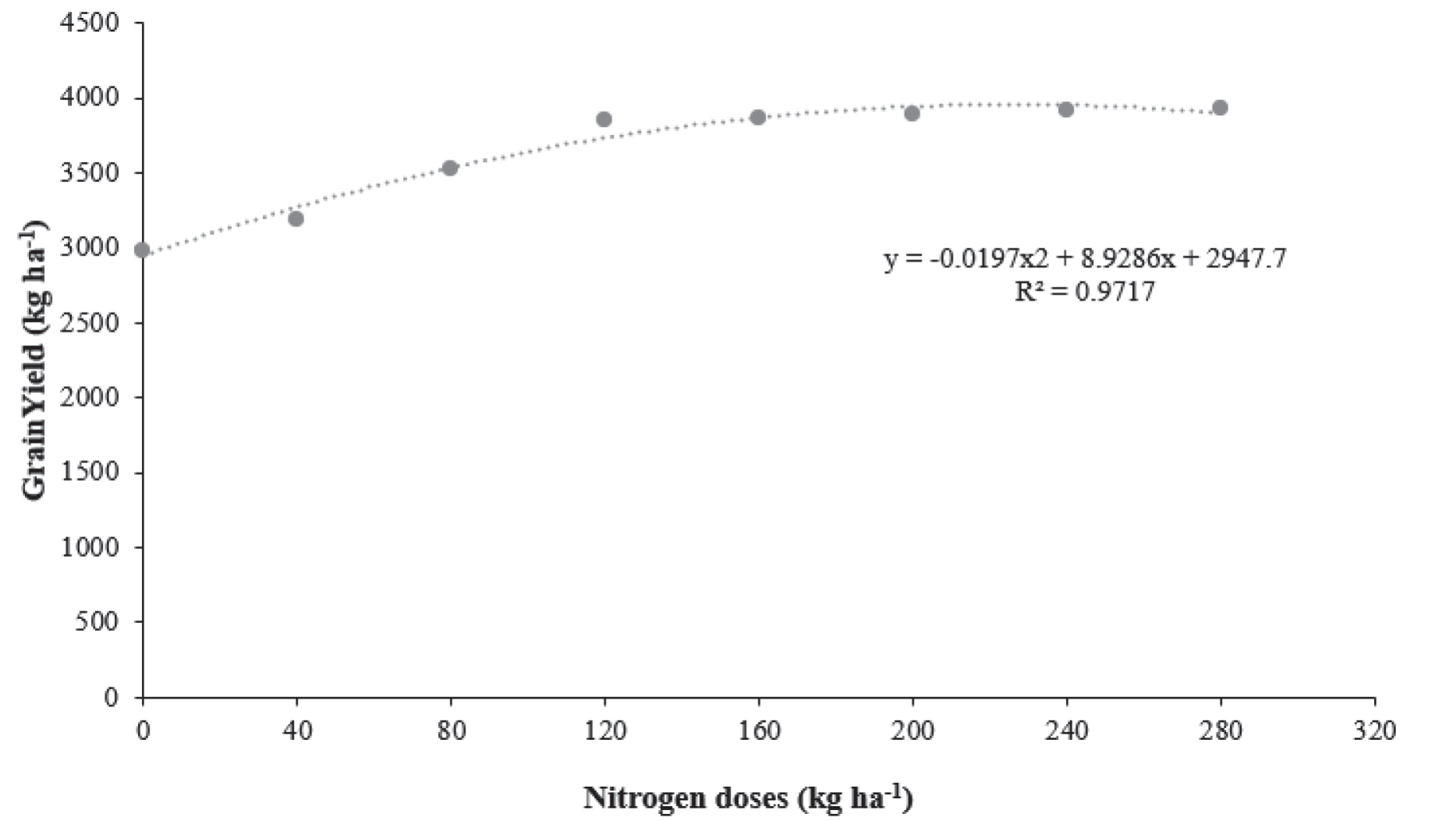
The economic fertilizer dose was calculated by using the Equation given below:
Here, Fg = unit price of fertilizer, Fm = unit price of produce, b = linear effect of fertilizer (bx), and c = quadratic effect of fertilizer (cx2).
Eg = (35.71- (11 × 8.9314)) / (2 × 11.0 ×-0.1976)
Eg = 144 kg ha-1 pure N
According to this, the optimum economic pure N required for soybean cultivation under the climatic conditions of Şanlıurfa was 144 kg ha-1.
Protein Ratio (%)
Individual and interactive effects of bacteria inoculation and N doses significantly altered protein ratio. The highest (39.6%) and the lowest (38.9%) protein ratio was noted from bacteria-inoculated and non-inoculated seeds, respectively. Similarly, N7 (39.8%) and N0 (%38.7) doses resulted in the highest and the lowest protein ratio. Regarding the interactive effect, bacteria-inoculated seeds×N7 resulted in the highest (40.1%), while non-inoculated seeds×N0 resulted in the lowest (37.9%) protein ratio (Table 7). The current study found that bacteria inoculation and nitrogen application improved protein ratio. Bakal et al. [21] reported that the protein content ranged from 36.52% to 38.46% in the Çukurova region.
Oil Ratio (%)
The combined two-year data analysis indicated that oil ratio was significantly (p ≤ 0.01) influenced by individual effects of bacteria inoculation and N doses. However, the interactive effect of bacteria inoculation and N doses remained non-significant in this regard. The highest (18.4%) and the lowest (17.6%) oil ratio was recorded for non-inoculated and bacteria-inoculated seeds, respectively. Similarly, N1 and N6 and N7 resulted in the highest (18.4%) and the lowest (17.6%) oil ratio (Table 7). Fabre and Planchon [32] reported a strong correlation between oil and protein ratio and nitrogen fertilization in soybean. Specifically, the efficacy of root nodules formed during the growth phase and the availability of usable nitrogen in the soil are significant factors impacting the oil and protein ratio. It has been observed that an increase in available nitrogen decreases the oil ratio and increases the protein ratio.
Conclusions
Soybeans require a high amount of N; however, fulfilling this demand through fertilization is not economically feasible. Soybean plants obtain a portion of their required N from the soil in a readily available form, while a significant portion is met through the aid of Rhizobium bacteria residing in their roots, which fix atmospheric N. This study investigated the effects of bacteria inoculation and different N doses on yield and certain quality parameters of soybean grown as a second crop in Şanlıurfa Province, Türkiye. The results revealed that bacteria inoculation and different N doses significantly altered the yield and quality traits of soybean. The grain yield of the plants receiving no N and no bacteria inoculation was significantly lower than the plants fertilized with N and seeds inoculated with bacteria. The results revealed that bacteria inoculation and N application exerted positive impacts on yield and quality of soybean. The N7 dose along with bacteria inoculation improved grain yield by 51.35% compared to non-inoculated seeds receiving no N. The highest grain yield (3932 kg ha-1) was noted for bacteria-inoculated seeds × N7 interaction, whereas non-inoculated seeds × N0 interaction produced the lowest grain yield (2598 kg ha- 1). The results further revealed that grain yield linearly increased till the application of 144 kg ha-1 pure N; however, the yield increase beyond this N amount was minimal. Therefore, it is not recommended to apply N fertilizers > 144 kg ha-1 due to the cost outweighing the resulting seed yield. In conclusion, the optimal economic pure N amount for the cultivation of the ‘Gapsoy 16’ soybean variety in Şanlıurfa is 144 kg ha-1.
Table 7.
The influence of individual and interactive effects of bacteria inoculation and nitrogen doses on protein and oil ratio of soybean.
[i] ** = Significant at 0.01, * = significant at 0.05, ns = non-significant, The means sharing the similar letters are statistically non-significant, N0 = Control, N1 = 40 kg ha-1 pure N, N2 = 80 kg ha-1 pure N, N3 = 120 kg ha-1 pure N, N4 = 160 kg ha-1 pure N, N5 = 200 kg ha-1 pure N, N6 = 240 kg ha-1 pure N, N7 = 280 kg ha-1 pure N.

