

Introduction
Arsenic (As) is a highly toxic element that is widely present in natural and man-made environments in the form of arsenate, arsenic compound salts, arsenic sulfides, and oxides [1]. In the smelting process of non-ferrous metals (such as Zn, Cu, and Pb) and precious metals (such as Au and Ag), the extraction and separation of target elements from arsenic-bearing minerals will generate a large number of solid wastes and wastewater, which contain arsenic with varying levels of mobility and toxicity [2]. Considering the toxicity and limited marketability of arsenic, most of the arsenic in arsenic-containing wastewater must be converted to a stabilized solid form by precipitation and disposed of safely to limit the release of arsenic into the environment [3]. To date, common methods used to immobilize arsenic from arsenic-containing wastewater include lime neutralization-precipitation [4, 5], sulfide precipitation [6, 7], iron-arsenic co-precipitation [8, 9], and crystallization of relatively insoluble minerals (e.g., scorodite [10, 11], basic sulfate iron arsenate [12], arsenical natroalunite [13], and magnesium ammonium arsenate [14, 15]). The first two methods produce voluminous calcium arsenate and arsenic sulfide sludges, both of which are unstable under aerobic and acidic to neutral conditions and release large amounts of arsenic into the surrounding environment [16-18]. Therefore, calcium arsenate and arsenic sulfide sludge require secondary treatment, such as stabilization/solidification, for further conversion to more stable arsenic-bearing phases to reduce their environmental risks [19-21]. In contrast, iron-arsenic co-precipitation usually requires a high Fe/As molar ratio (usually greater than 3 or 4) to obtain environmentally safe precipitates, with high iron consumption and low arsenic content (0.5-7 wt%) in slag samples also resulting in a large amount of solid waste [2, 22].
Arsenic-bearing solid wastes are usually disposed of safely in landfills. Considering the landfill capacity and long-term storage, a large number of researchers focus on converting arsenic into minerals with a high arsenic capacity and long-term stability [23, 24]. Among the many arsenic-fixing minerals, FeAsO4∙2H2O has attracted much attention in recent decades due to its low arsenic solubility, high arsenic content (25-30 wt%), and excellent filtration and settling properties, as well as relatively high stability and density under acidic to neutral conditions [25, 26]. Currently, scorodite is considered to be the most environmentally safe arsenic fixation material for stable storage, and the scorodite precipitation method is widely used for the removal and fixation of arsenic in arsenic-containing wastewater [16, 27, 28]. In the harmless treatment of arsenic-bearing solid wastes, such as arsenic-rich lead/zinc anode slime, arsenic sulfide sludge, and high-arsenic flue dust, the scorodite precipitation method is also the preferred treatment method [29-31]. Obviously, the scorodite precipitation method has become an important treatment method and means to control arsenic pollution in the non-ferrous metal industry.
After several decades of research and development, a number of mature synthesis methods have been established. In addition to conventional synthesis methods being widely studied, some researchers have also explored derived methods for synthesizing scorodite in recent years. Most studies related to scorodite focus on its synthesis and leaching stability. The former primarily optimizes synthesis conditions and explores the synthesis mechanism, while the latter evaluates the stability of the synthesized scorodite. Meanwhile, many researchers are committed to treating arsenic-bearing wastes using the scorodite precipitation method, but many synthesis methods can only be used in the laboratory. Despite the significant advantages of the scorodite process compared to other arsenic fixation techniques, the application of this process is still limited and rarely reported.
As a promising arsenic fixation technique, the formation of scorodite has been discussed in several review papers related to arsenic disposal, but they are not comprehensive or timely and lack systematic comparison. While these review papers provide a useful background to help understand the significance of scorodite in arsenic disposal, none of them specifically reviewed the synthesis methods and process applications of scorodite. Therefore, in order to improve the understanding of scorodite and achieve arsenic fixation by a green process, it is necessary to summarize the synthesis methods of scorodite and current process applications in the non-ferrous metallurgy industry.
The current critical review provides a comprehensive overview of the research status of synthesis methods and process applications of scorodite that have been proposed and developed in recent decades. We have focused for the first time on the three types of scorodite synthesis and explained how each method works. These conventional methods are classified as hydrothermal synthesis methods, atmospheric synthesis methods, and biological synthesis methods. The review provides a framework for understanding how different synthesis methods can change the synthesis conditions and how these changes can influence the formation of scorodite. Tables 1 and 2 provide a significant comparison of the four synthesis methods in terms of synthesis method characteristics and synthetic product properties. The following section includes an overview of some derived synthesis methods, such as synthesis using ultrasound irradiation, synthesis using solid iron sources, and other methods. These methods are an important supplement and update to the current research on the synthesis of scorodite. Then we provide examples of process applications for the four synthesis methods. Conclusions section focuses on the current challenges in scorodite synthesis and application, the future research prospects, and the conclusions of the review.
Results and Discussion
Synthesis Methods of Scorodite
Hydrothermal Synthesis Method
The hydrothermal synthesis method is a technology that synthesizes scorodite through hydrothermal precipitation at high temperatures (150-200℃) and high pressure (above 1MPa) [32-35]. Iron sources (such as ferric sulfate, ferrous sulfate, etc.) are added to the autoclave-containing arsenic solution to generate scorodite precipitates. Arsenic and iron can be pre-oxidized before entering the precipitation stage, or they can be oxidized simultaneously during the precipitation stage. The main factors affecting the synthesis of scorodite are reaction temperature, Fe/As molar ratio, arsenic concentration, initial pH, reaction time, etc.
In early studies of scorodite synthesis, the iron arsenate products synthesized by researchers at about 100℃ were completely amorphous or contained only partially crystalline iron arsenate. The crystallinity of precipitates in the Fe(Ⅲ)-As(Ⅴ) system increases with an increase in temperature, and the crystalline compounds dominate at temperatures above 100℃. Dutrizac and Jambor [35] prepared highly crystalline scorodite through a hydrothermal synthesis method in 1988 using Fe(NO3)3 and As(Ⅴ) solutions as raw materials. The article pointed out that temperatures higher than 125℃ (ideally 160℃) are required to ensure the good crystallinity of scorodite. Swash and Monhemius et al. [36] studied hydrothermal precipitation products in the Fe(Ⅲ)-As(Ⅴ)-SO42- system at high temperatures (150-225℃) and a low pH (<1) and found that crystalline scorodite would be formed when the Fe/ As ratio was 1.5 or higher at 150-175℃. Vanweert and Droppert [32] also introduced that in the temperature range of 140-160℃, Fe(NO3)3 and As2O3 were mixed and reacted to obtain crystalline scorodite, in which nitric acid was used as the oxidant to oxidize As(Ⅲ). Yu et al. [37] prepared large-grained crystalline scorodite by arsenic-iron hydrothermal precipitation and explored the influencing factors and rules for the synthesis of large-grained scorodite in the Fe(Ⅱ)-As(Ⅴ)-SO42- system. The results revealed that appropriately reducing the initial pH, reaction temperature, and Fe/As molar ratio favored the formation of purified and large-sized scorodite, with an arsenic removal efficiency higher than 97%. Since As(Ⅲ) is usually the main component in arsenic-containing wastewater, pre-oxidation treatment is often required before synthesizing scorodite. Based on the mechanism of synergistic oxidation of As(Ⅲ) and Fe(Ⅱ) at high concentrations in an acidic solution, Jiang et al. [33] added ferrous sulfate as an iron source at high temperature (170℃) and pressurized oxygen (1 MPa) to achieve the process of simultaneous oxidation and precipitation of As(Ⅲ) and Fe(Ⅱ) into scorodite. The process does not require pre-oxidation of As(Ⅲ) to As(V) and uses cheap Fe(Ⅱ) as an iron source, which is economically efficient and environmentally friendly.
The above studies show that scorodite synthesized by the hydrothermal synthesis method has the advantages of high crystallinity, uniform distribution, and light particle agglomeration. At the same time, this method has the lowest requirements for the initial reaction valence state of arsenic and iron and can directly treat many different arsenic-containing materials while making it easy to produce high-grade and low-solubility arsenic residue. However, the hydrothermal synthesis method requires the use of an autoclave that is resistant to high temperature, pressure, acid, and abrasion, as well as ancillary facilities such as mechanical seals, heat exchangers, and flash tanks [10, 38]. In addition, steam heat loss also increases its energy consumption. These factors lead to its high capital and operating costs and greatly restrict its application. Therefore, this method is generally not used alone for the industrial synthesis of scorodite. However, if this method is combined with the processing of some valuable concentrates, such as pyrite and copper concentrates containing gold and silver, it is considered economically viable [39, 40]. For example, Demopoulos and Papangelakis introduced the formation of scorodite after pressure oxidation treatment of refractory arsenic-containing gold ore at >150℃ [41].
Atmospheric Synthesis Method
Due to the high investment and high energy consumption of the hydrothermal synthesis method, the synthesis of scorodite at atmospheric pressure and lower temperature has always been an issue of great concern to the entire industry. The atmospheric synthesis method is a technique that synthesizes scorodite from arsenic-rich solutions below 100℃ under atmospheric conditions [10, 11, 39, 42].
Demopoulos and his co-workers at McGill University in Canada have been working in this area since 1995 [11, 40, 43]. They found that by combining supersaturation control and the addition of crystal seeds, well-crystallized scorodite could be precipitated from chloride and sulfate media at ambient pressure and below 100℃. The atmospheric supersaturation control method developed by Demopoulos et al. involves two key technologies: (1) the addition of scorodite seeds to maintain a low supersaturation level of ferric arsenate and (2) the use of neutralizing agents (magnesium hydroxide or calcium hydroxide) to achieve strict pH control [11]. The method is based on controlled crystallization, that is, proper pH control through 3-4 gradual neutralization to control supersaturation, which can induce crystal growth and prevent excessive homogeneous nucleation. Therefore, pH control is crucial during the controlled crystallization of scorodite. A fast increase in pH induces high supersaturation in the system, which leads to excessive nucleation and the formation of poor crystalline phases [39]. In the atmospheric supersaturation control method, seed quality, seed concentration, and seed types will also affect the synthesis of scorodite [40]. For example, the effect of a hydrothermal seed is significantly better than that of atmospheric seeds, and the precipitation rate of scorodite can be accelerated by increasing seed concentration. In addition to scorodite seed, hematite and gypsum can also be used as seed material to promote scorodite precipitation.
Singhania et al. [43] pointed out that strict pH control was not absolutely necessary during the precipitation of scorodite. Even if the pH is slowly lowered, crystalline scorodite will continue to precipitate. This means that the crystallization process of scorodite is inherently tolerant to pH fluctuations common in industrial operations. To improve the application feasibility of the atmospheric synthesis method, it is necessary to solve the problems of low crystallinity and insufficient stability of scorodite synthesized by the atmospheric supersaturation control method. In 2008, Fujita et al. [10, 42] developed a new atmospheric process based on the atmospheric supersaturation control method for the synthesis of large-sized and well-crystallized scorodite particles that are easy to re-pulp and filter. Under atmospheric and 70-95℃ conditions, the ferrous iron in the Fe(Ⅱ)-As(Ⅴ)-H2O system is gradually oxidized by introducing air or oxygen, thereby inducing the precipitation of scorodite. In order to distinguish it from the atmospheric supersaturation control method, it is usually called the “improved atmospheric synthesis method”. The key to this new process is attributed to the presence of ferrous iron in solution and the oxidation of Fe(Ⅱ) during scorodite precipitation. In the precipitation reaction involving Fe(Ⅱ), the acid generated by the reaction can be controlled, and the pH of the solution will not drop significantly [10]. The slow oxidation of Fe(Ⅱ) enables the reaction system to maintain low supersaturation, which is conducive to homogeneous nucleation, inhibition of nucleation rate, and promotion of crystal growth. This method utilizes a cost-effective divalent iron source and enables the synthesis of highly stable crystalline scorodite particles of 15 μm in 1-7 h without the addition of seed crystals and neutralizing agents [10].
Biological Synthesis Method
It has been found that naturally occurring acidophilic thermophilic microorganisms (e.g., Acidianus Sulfidivorans) can oxidize Fe(Ⅱ) to Fe(Ⅲ) using O2 in the air as an electron acceptor under pH and temperature conditions favorable for scorodite crystallization [44]. Thus, crystallization of scorodite is expected to occur when these microorganisms grow in the presence of ferrous and arsenate. As early as 2005, Schouten et al. [45] proposed a new concept, the “Bioscorodite Process”, which utilizes microorganisms to control the degree of supersaturation during crystallization. The biological synthesis method is the technique of generating scorodite from arsenic-rich solutions induced by specific microorganisms under aerobic conditions [46-49].
Gonzalez-Contreras and her team have done a lot of work at the Awakening University in the Netherlands. In 2009, Gonzalez-Contreras et al. [46] reported for the first time the use of iron-oxidizing bacteria, Acidulous Sulfonamides, to induce the oxidation of Fe(Ⅱ) and the synthesis of biodiversity at 80℃ and 1 g·L-1 As(Ⅴ) without seeding. This process is similar to the improved atmospheric synthesis method, both of which oxidize Fe(Ⅱ) in the presence of As(Ⅴ), but the oxidation mechanism involved in both is unique [50]. The oxidation rate of Fe(Ⅱ) is dependent on the type of microorganism, oxygen concentration, the retention of biomass, and operating conditions (pH, temperature, salinity) [51]. Gonzalez-Contreras et al. [47] studied the synthesis of biodiversity in continuous stirred tank reactors (CST), where the initial concentrations of As(Ⅴ) and Fe(Ⅱ) were 2.8 g·L-1 and 2.4 g·L-1, respectively, with arsenic removal efficiency up to 99%. Batch-crystallized biodiversity was present as agglomerated and cellar precipitates, leading to the formation of glass-wall scaling in CST. Therefore, Gonzalez-Contreras et al. [52] chose a more advanced airlift reactor for continuous biodiversity production in a further study. In the airlift reactor, the size distribution frequency indicated that the average size of the biodiversity crystals grew from 30 am in the batch operation phase to 160 am at the end of the continuous operation phase. The high rate of airflow mixing and the large size of the crystals avoid scaling of the precipitates.
Given that As(Ⅲ) is the predominant As species in metallurgical industrial wastewater or acid mine wastewater, oxidative maltreatment is often required to achieve arsenic removal in the form of cordite. Therefore, some researchers began to try a one-step process to achieve the simultaneous oxidation and fixation of As(Ⅲ). Bookie and colleagues from Kyushu University, Japan, investigated the biological oxidation and fixation of As(Ⅲ) by the archaeon, Acidianus brierleyi, using a copper refinery process solution containing As(Ⅲ) and Fe(Ⅱ) [49, 53, 54]. When the initial Fe(Ⅱ)-As(Ⅲ) ratio was adjusted to 1.4-2.0, both ions were easily bio-oxidized, and 94-99% of As was successfully fixed into biodiversity from 0.25-1.5 g·L-1 As(Ⅲ) solution [53]. As an alternative, Vega-Hernandez ET AL. [48, 55, 56] similarly achieved a one-step preparation of biodiversity by employing granular activated carbon as a catalyst for oxidation of As(Ⅲ) combined with the bio-oxidation of Fe(Ⅱ) by a thermoplastic mixed culture (including Lactobacillus and Sulfonamides).
Different synthesis methods have their own characteristics, as summarized in Table 1. The initial reaction valence state, reaction conditions, application range, reaction time, arsenic removal efficiency, and advantages and disadvantages of the four synthesis methods are introduced. In addition, the differences in crystal size and As-leaching toxicity of cordite synthesized by different methods are compared in Table 2. As shown in Tables 1 and 2, the improved atmospheric synthesis method has outstanding advantages such as low temperature, atmospheric pressure, high arsenic removal efficiency, and large-sized cordite particles. At present, this method has become a mainstream selection for the synthesis of cordite, which is widely used in the treatment of arsenic-containing wastewater and arsenic-bearing solid wastes [16, 28, 57, 58]. A large number of researchers have modified this method to a certain extent, such as changing the oxidizing agent, oxidizing Fe(Ⅱ) by dropping H2O2 solution [59] or reacting by dropping Fe(Ⅲ) solution into As(V) solution [57]. The essence is to control the low supersaturation level near the precipitation boundary. This method is generally used to treat high arsenic solutions (>10 g·L-1) because higher arsenic concentrations favor the production of cordite with higher crystalline formation in a larger size [60, 61]. The advantages of large cordite particles are efficient solid-liquid separation, easy cleaning, and convenient storage.
Table 1.
Comparison of the four synthesis methods of cordite.
Derived Synthesis Method
Synthesis Using Ultrasound Irradiation
High-power ultrasound irradiation not only facilitates particle agglomeration but also generates free radicals (OH∙, H2O2, O2-∙, etc.) in solution [67-69]. Therefore, the application of ultrasound irradiation to achieve the agglomeration and oxidation of scorodite precursor particles is expected to synthesize large-sized scorodite particles at lower temperatures and shorter reaction times. Based on such knowledge, Kitamura et al. [70] made the first attempt to synthesize large-sized scorodite particles by ultrasound irradiation (200 kHz) at 50-70℃ for 3 h in 2014. The results showed that large scorodite particles (>10 µm) could be obtained after 3 h of reaction by only a short time (<30 min) of ultrasound irradiation to promote precursor agglomeration and oxidation under stirring with O2 flow. In further studies, Kitamura et al. [71, 72] thoroughly investigated the effects of ultrasound intensity and reaction temperature on the size and morphology of synthesized scorodite particles. The increase in ultrasound intensity will facilitate the oxidation of Fe(Ⅱ), which results in a higher redox potential value in the solution and, consequently, a higher yield of precipitates. The morphology of the particles is affected by ultrasound intensity, with the surface of the particles synthesized at low intensity being rough and the surface of the particles synthesized at high intensity being faceted. In the study of reaction temperature, Kitamura et al. [71] even synthesized crystalline scorodite by reacting at a low temperature of 30℃ for 3 h.
Table 2.
Comparison of crystal size and arsenic-leaching toxicity reported for chemically synthesized scorodite and bioscorodite.
Although ultrasound irradiation can promote the production of large particles through the effect of particle agglomeration, it also causes the generation and collapse of small bubbles, which directly leads to the formation of small scorodite particles (<1 μm). Therefore, the shortcoming is that the size of the scorodite particles obtained is inhomogeneous. Arsenic dissolution tests showed that scorodite synthesized at the highest ultrasound intensity of 11.6 W exhibited minimal arsenic leaching of 15.4 mg·L-1 in HCl solution at pH 5.1 [72]. Apparently, this is significantly higher than the leaching toxicity of scorodite synthesized by the improved atmospheric synthesis method. It is undeniable that ultrasound irradiation, as an important auxiliary means, plays a key role in the synthesis of scorodite. From the point of view of lowering reaction temperature and shortening reaction time, ultrasound irradiation-assisted synthesis of scorodite not only reduces the cost but also improves the synthesis efficiency.
Synthesis Using Solid Iron Sources
In the synthesis methods described above, scorodite is basically synthesized using liquid ionic iron sources (Fe2+/Fe3+). Of course, pyrite, magnetite, and other solid iron sources are also often used in industrial applications to reduce operating costs [34, 73]. However, most of them are converted into liquid iron sources and are not directly applied in the form of solid iron sources for the synthesis of scorodite. The use of liquid iron sources greatly improves arsenic removal efficiency, but the pH must be adjusted between 1 and 3 throughout the reaction. In particular, the crystallization process of scorodite using a trivalent liquid iron source leads to the accumulation of H+, which often requires neutralization of the acid during the reaction to maintain a relatively stable pH. In addition, due to the high degree of supersaturation of the Fe(Ⅲ)-As(V) system, this process tends to produce poorly crystalline and amorphous phases. It requires low supersaturation control through the use of additional seed, controlled oxidation, or an asynchronous feed mode [39, 40, 74].
Waste acid is a common arsenic-containing wastewater in non-ferrous smelting, often containing high concentrations of sulfuric acid (10-200 g·L -1) and arsenic (0.5-30 g·L-1) [16]. Before removing arsenic using the scorodite precipitation method, it is usually necessary to neutralize the high concentration of sulfuric acid in the waste acid using a calcium-containing neutralizer to adjust the proper pH. This process inevitably produces a large number of arsenic-containing gypsum sludge. To improve the synthesis of scorodite and offer a more flexible reaction pathway for arsenic fixation, Zhu Xing and his team at the Kunming University of Science and Technology tried to remove arsenic from arsenic-containing waste acid using a solid iron source. In 2019, Cai et al. [75] used magnetite as an in-situ iron source donor to synthesize scorodite. This process occurred through the dissolution of magnetite and the co-precipitation of iron and arsenate ions on the magnetite surface. The degree of supersaturation of Fe(Ⅲ) is controlled by the dissolution of magnetite, ensuring the formation of well-crystallized and stable scorodite. H+ generated during the crystallization of scorodite can be neutralized by reacting with magnetite, thus providing a stable pH range during the process. Although the removal efficiency of arsenic using magnetite has reached 99.9%, the process requires a high Fe/As molar ratio of 4 and a long reaction time of 18 hours. On the basis of magnetite research, researchers have successively tried to use ferrihydrite [76], siderite [77], limonite [78], pyrite [79], and other natural iron-bearing minerals as in situ iron source donors to synthesize scorodite. Moreover, industrial iron-containing waste slags, such as copper smelting slag [38], lead-zinc smelting slag [59], and Waelz slag [80], have also been studied. The use of such solid iron sources provides two significant advantages for the synthesis of scorodite: 1) The neutralization treatment is avoided, eliminating the need to add neutralizing agents to adjust pH; 2) Solid iron sources are readily available and cost-effective compared to liquid iron sources.
Other Methods
The synthesis of scorodite is usually carried out in conventional inorganic acidic media such as hydrochloric, sulfuric, and nitric acids. Ahn et al. [81] used methanesulfonic acid (MSA, CH3SO3H) as a lixiviant to leach As2O3 and studied the leaching of arsenic and the crystallization of scorodite in MSA media. The results showed that more than 95% of the arsenic was precipitated as scorodite within 6 hours at pH 0.5 and 80℃. This work demonstrated the feasibility of applying MSA to arsenic leaching and stabilization.
Guillermo et al. [82] explored a gas-diffusion electrocrystallization (GDEx) method for the synthesis of scorodite, which achieves simultaneous oxidation of Fe(Ⅱ) and As(Ⅲ) through the in-situ generation of oxidized substances (i.e., H2O2) via an oxygen reduction reaction on a gas-diffusion cathode. At 70℃, As(Ⅲ) was used as a precursor to obtain polydisperse micrometric scorodite particles (from <1 μm fine particles to about 5 μm large particles). Without the addition of any primary minerals or seed crystals, GDEx has an arsenic fixation efficiency of 70%. This work provides a new route for the one-step oxidation and fixation of arsenic from solution to scorodite. However, compared with other synthesis methods, this method still has a lot of room for improvement, and an important consideration is to improve the precipitation rate of scorodite in a low supersaturation environment.
Application of the Scorodite Process
Hydrothermal Synthesis Method
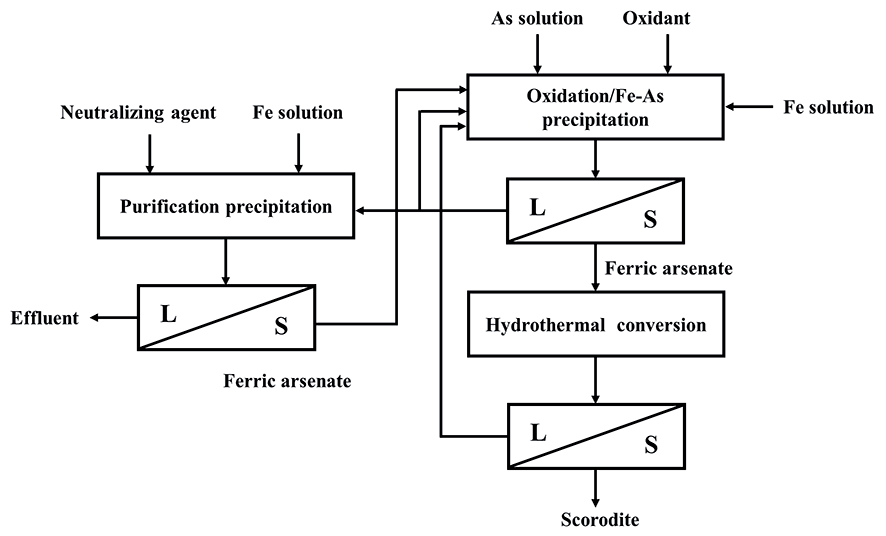
Outotec Oyj [83] patented a process for fixing arsenic as scorodite in 2014: (i) in the first stage, iron and arsenic are precipitated to amorphous ferric arsenate by simultaneous oxidation under atmospheric pressure; and (ii) in the second stage, the precipitates after solid/liquid separation are hydrothermally converted to scorodite in an autoclave (160-180℃). The pH of the solution is controlled in the region of 1.5-4 (Fig. 1). When the iron-arsenic molar ratio is set between 1-1.5:1, the formed ferric arsenate residue is highly filterable. The essential benefit of the process is that the hydrothermal conversion stage treats only the precipitates, not the entire solution. As a result, the required autoclave size is now only 1/2 to 1/10 the size of that required for conventional pressure oxidation processes. The process operates in a smaller autoclave than conventional pressure oxidation processes, which will provide an economic advantage and greatly improve the applicability of the hydrothermal synthesis process.
Atmospheric Supersaturation Control Method
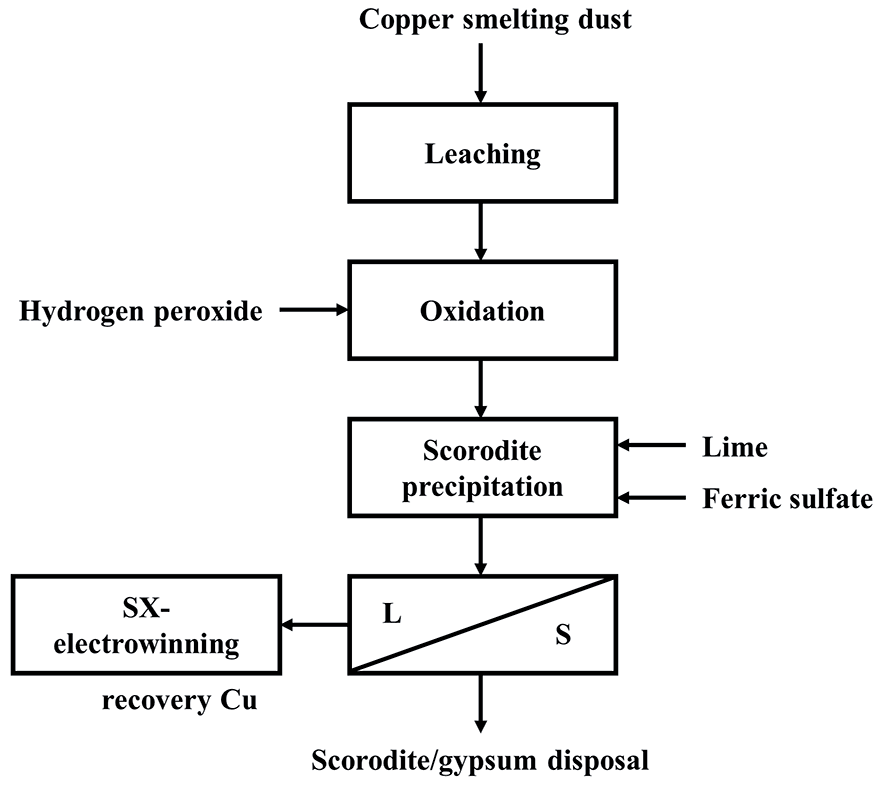
In 2012, EcoMetales Limited of Chile initiated the commercial operation of a scorodite plant using a synthesis process developed by McGill University based on an atmospheric supersaturation control method. The plant, which deals with copper smelting dust, stabilized 10,000 tons of arsenic per year while recovering 25,000 tons of copper [73, 84]. The whole process begins with sulfuric acid leaching of copper smelting dust to produce a leaching solution rich in copper and arsenic. After the oxidation treatment of As(Ⅲ), calcium carbonate and iron sulfate are added (the iron and arsenic molar ratio is close to 1) to form scorodite at atmospheric pressure and high temperature (85-95℃). Finally, the arsenic-free leaching solution is sent to the solvent extraction-electrowinning operation for copper recovery. The entire process is depicted in Fig. 2.
Improved Atmospheric Synthesis Method
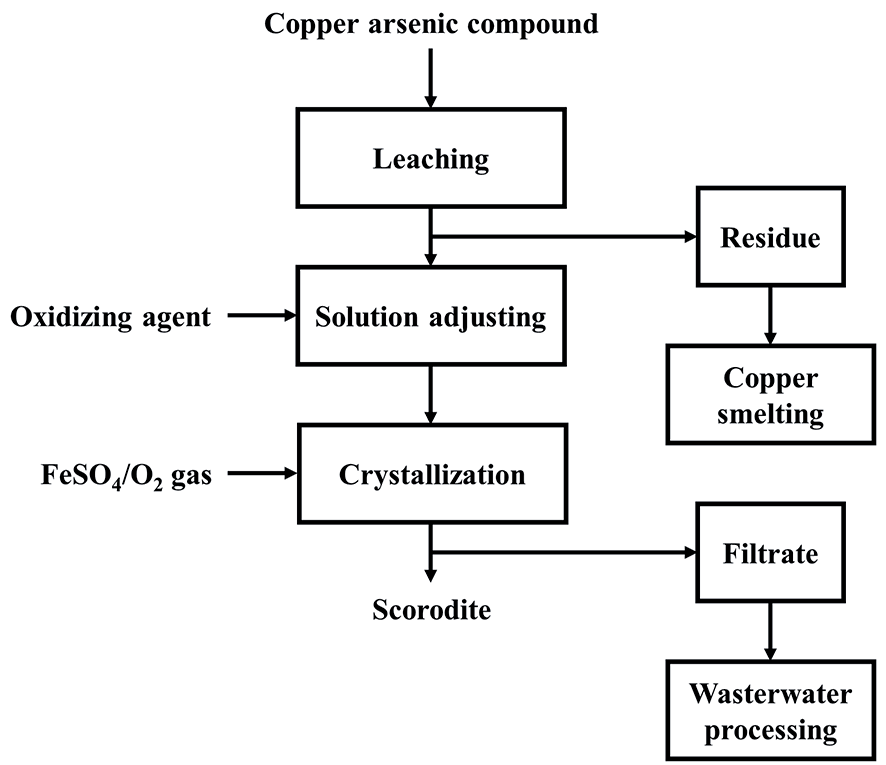
The Dowa scorodite plant (Dowa Metals & Mining Co., Ltd.) in the copper smelter site located in Kosaka, Japan, achieved 30 tons of arsenic fixation per month based on an improved atmospheric synthesis method [85, 86]. The process can be separated into three main steps: (i) a leaching step of leaching arsenic from non-ferrous smelting copper arsenic compound; (ii) a solution-adjusting step of oxidizing As(Ⅲ) to As(Ⅴ) by adding the oxidizing agent to the leaching solution; and (iii) a crystallization step of converting the arsenic in the adjusted solution to scorodite. The process diagram is illustrated in Fig. 3.
Biological Synthesis Method
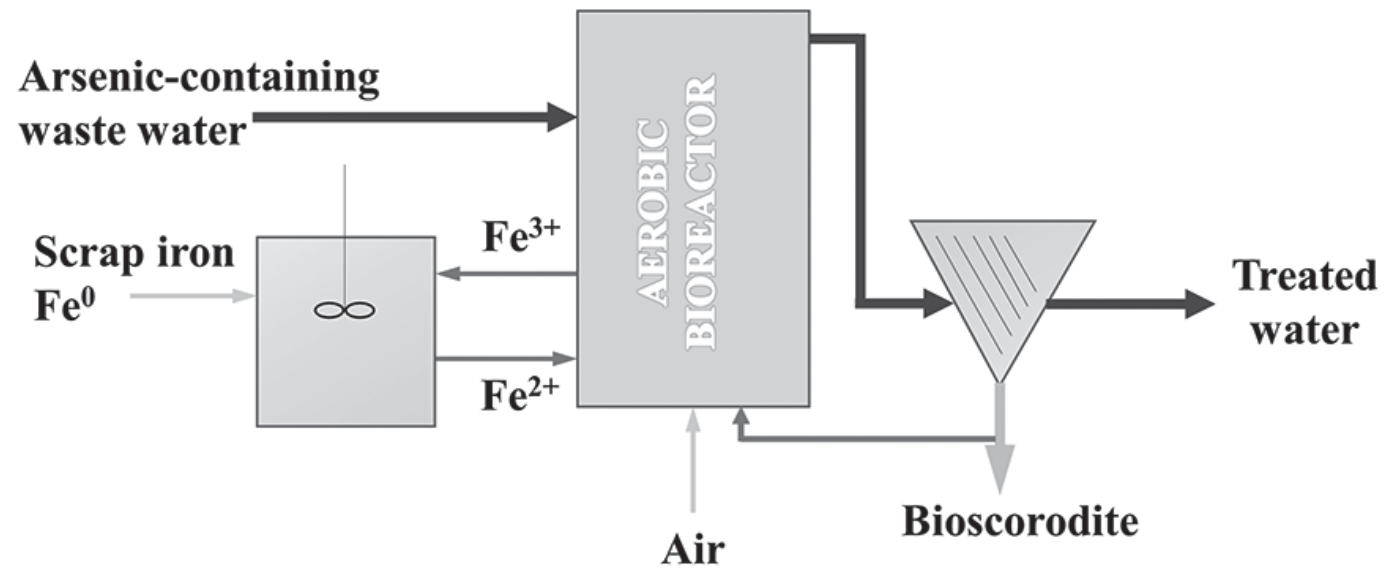
Paques B.V. (The Netherlands) has been granted a patent for a scorodite process called THIOTEQTM Scorodite [87]. THIOTEQTM Scorodite is a process that uses a CIRCOX® airlift bioreactor to fix arsenic through the biological formation of highly stable bioscorodite. The process is suitable for solutions containing more than 1 g·L-1 of arsenate, reducing the arsenic levels of several grams per liter to milligrams per liter in one step, and is currently in pilot trials. As shown in Fig. 4, the THIOTEQTM Scorodite process operates at pH 1-2 and 60 to 90℃. The As(Ⅲ) solution is oxidized to As(Ⅴ) by H2O2 before entering the reactor.
It is worth noting that all scorodite processes are designed to fix most of the arsenic in arsenic-containing wastewater as a solid that can be safely stored. The primary goal is not to remove arsenic from the solution to safe discharge levels. Therefore, a secondary arsenic removal step is required to remove the arsenic to such levels, such as lime neutralization or sulfide precipitation.
Conclusions
In this paper, the progress of research in the synthesis and process application of scorodite in recent decades is reviewed, and three types of synthesis methods (hydrothermal synthesis, atmospheric synthesis, and biological synthesis) are highlighted. Furthermore, some derived synthesis methods based on the atmospheric synthesis method, such as synthesis using ultrasound irradiation and synthesis using solid iron sources, are also described. These methods have significantly expanded the range of scorodite synthesis and are a valuable addition to its synthesis and application. The scorodite processes associated with the three types of scorodite synthesis methods have corresponding industrial applications. Compared with other types of synthesis, the improved atmospheric synthesis method has become a common method for the synthesis of scorodite due to its simple operation, high arsenic removal efficiency, large particle size, and high leaching stability. This method is expected to be widely adopted in the future. The hydrothermal synthesis method is commonly used in experimental studies for the preparation of crystal seeds required for other synthesis methods and is often used in industry for the fixation of arsenic in refractory gold ore or concentrates. The biological synthesis method is limited by microbial tolerance to arsenic and is only suitable for the treatment of wastewater with low arsenic concentration, but the environmental and economic advantages of the bioscorodite process make it expected to become a suitable process for safe arsenic fixation.
The research on the synthesis methods of scorodite should eventually be implemented into specific industrial applications, and there is still room for further research in the current study. To obtain a higher arsenic removal efficiency and a more stable product, the reaction time employed in most of the scorodite synthesis experiments is notably longer than the typical residence time in industrial reactors, e.g., up to even 24 h for chemical synthesis and more than 40 h for biological synthesis. A fast and effective process design is more favorable for practical industrial applications, so one of the future research focuses will be how to shorten the reaction time under the premise of ensuring the arsenic removal efficiency and the stability of scorodite. In addition, the simultaneous oxidation and crystallization of As(Ⅲ) in arsenic-containing wastewater to form scorodite in one step without any As(Ⅲ) oxidation pretreatment or chemical oxidant is also the focus of subsequent research. The mining and smelting industries of nonferrous metals have produced and continue to produce large quantities of arsenic-containing wastewater and solid wastes, which must be treated for recycling and harmless disposal. At present, based on some developed laboratory techniques, the industrial practice of the scorodite process has been applied worldwide, while the lime neutralization and arsenic sulfide precipitation methods are still dominant in China. With increasingly strict environmental regulations, the scorodite process will be widely used as a terminal arsenic fixation process in the future.