

Introduction
The economically developed big cities have an urgent need for subway transportation. However, some cities that could afford to build subways are located in coastal areas, such as New York [1], Shanghai [2], Copenhagen [3], Sydney [4], etc. The development of underground space is unprecedented, especially in recent years when rail transit develops rapidly, and shield tunnel takes up a large proportion. Due to the influence of geological conditions, surrounding environment, and complex construction procedures, there are many safety factors in shield tunnel construction. Although there have been many research achievements [5] in engineering risk theory and practice, there has been little study on tunnel shield construction.
The safety assessment of shield tunnel construction needs to analyze many factors, especially the uncertainty problem. In the 1970s, HH Einstein first proposed the tunnel Risk management models, such as Geological Model for Tunnel Cost Model, Decision Aids in Tunneling [6], Risk and Risk Analysis in Rock Engineering [7]. After the shield tunnel project used the risk management concept, the related research developed rapidly. For example, after the shield tunnel project used the risk management concept, the related research developed rapidly. For example, Huang et al. [8] performanced risk uncertainty analysis in shield tunnel projects. Wu et al.[9] recognized risk factor of shield tunnel crossing underneath the existing subway tunnel. Huang et al. [10] study on on the construction risk control technology of shield tunnel underneath an operational railway in sand pebble formation. Among most of the studies, the fuzzy mathematics theory has been widely applied to the risk assessment of shield tunnel construction [11-16]. In addition, Huang et al. [17] focused on the safety risks of shield tunnel construction and built a risk database based on the accumulation of shield subway construction in the Shanghai coastal area and computer technology [18-19]. Moreover, we carried out risk assessments from each of the key parts of shield construction, such as the stability analysis of the shield tunnel segment lining structure and its safety risk of assembly [20]. Through the above analysis, the research on risk management of subway shield tunnel construction has plenty of achievements, but there are still many problems. At present, most of the research focuses on a defined construction technology in the construction process. The fuzzy mathematical evaluation method is not objective enough, especially when determining the weight, and the risk identification process lacks reliability.
The entropy method is a commonly used weighting method that measures value dispersion in decision-making [21]. The entropy method is used to determine the index weight according to the variation degree of the index value, which is an objective weighting method and avoids the deviation caused by human factors [21- 22]. Therefore, this method was adopted for decision-making and indicator scoring, such as evaluation of soil erosion vulnerability [23], tunnel gushing water disaster assessment [24], measuring water security assessment [25]. Compared with those subjective assignment methods, it is more accurate and objective and can better explain the obtained results. Wei Cai. [26] devised the matter-element method with mathematics and experimental disciplines, which can consider the independence and contradiction of technical indicators, and the advantages and disadvantages of various indicators in various schemes. So, this method is used for truss structure performance [27], health assessment [28] traffic service evaluation [29], etc. As for these advantages, we proposed a new evaluation model by integrating the two methods, which can be better applied to the engineering field.
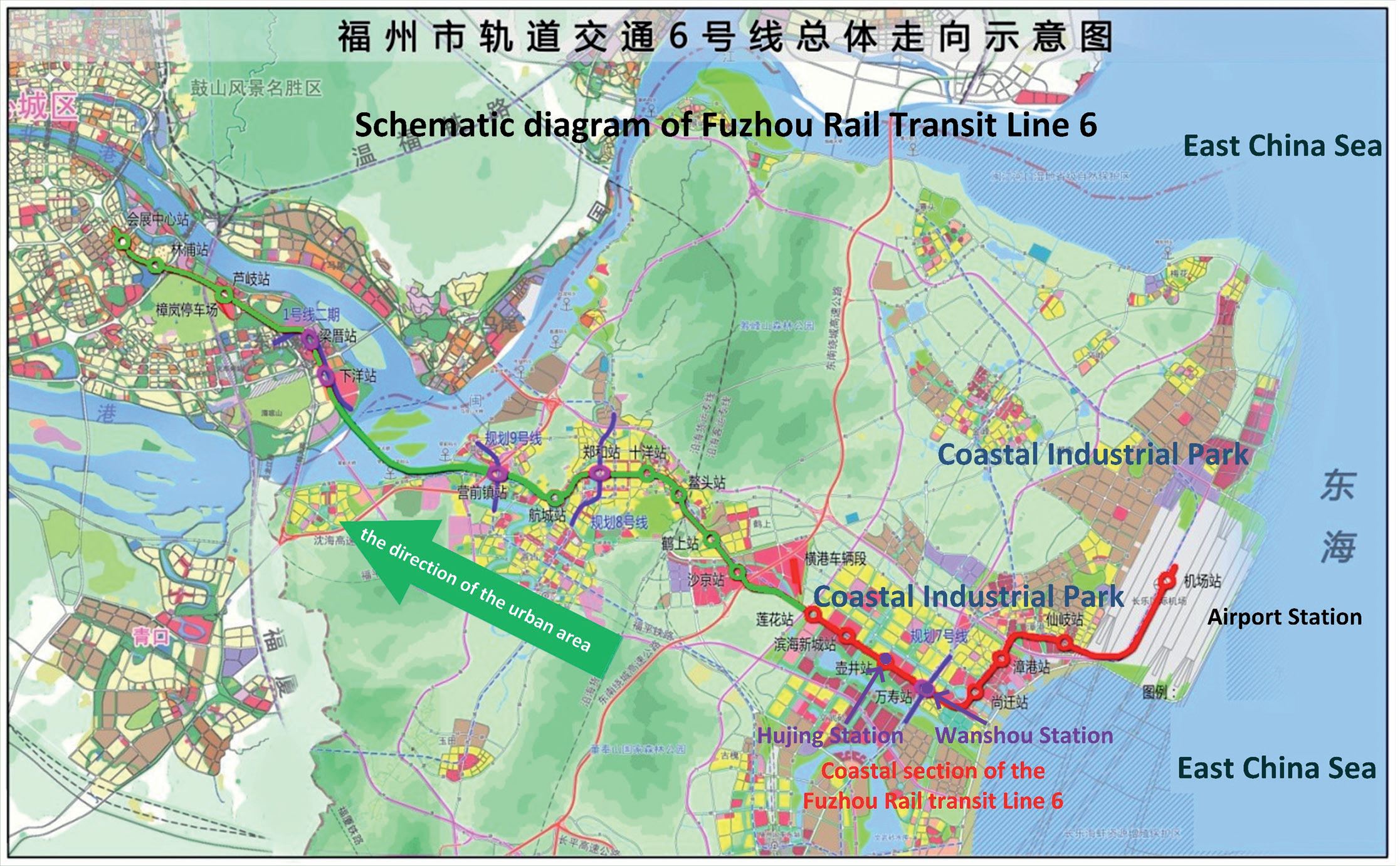
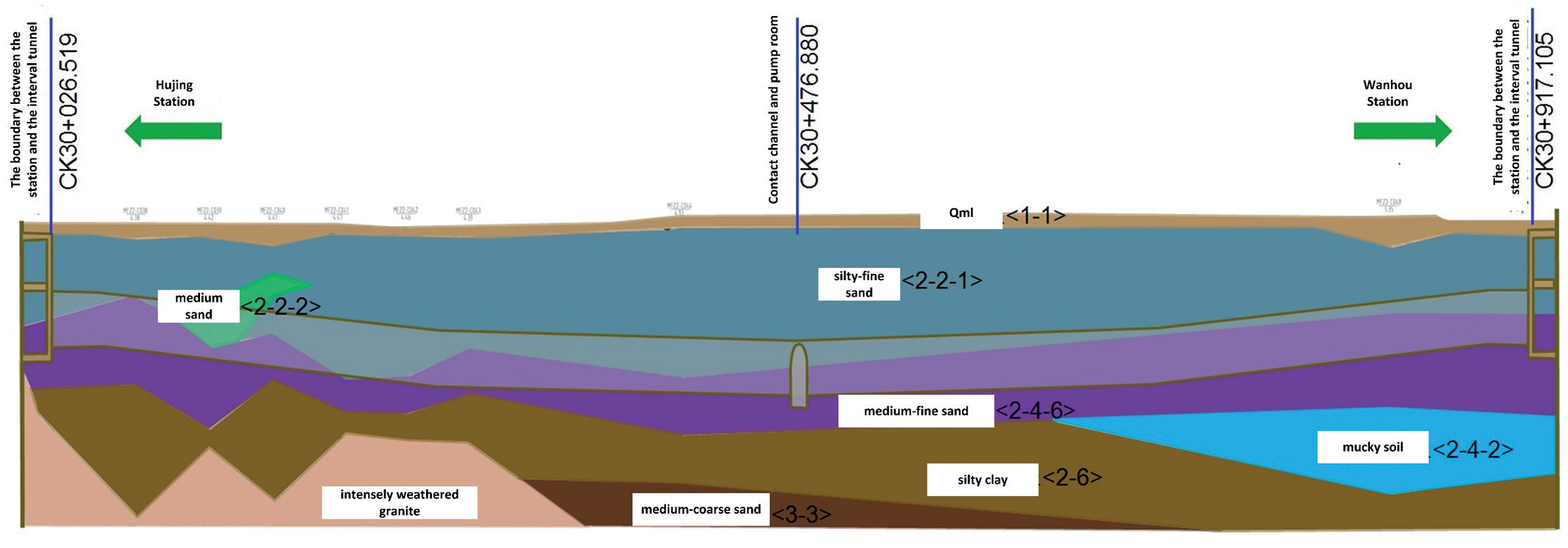
The Fuzhou Metro Line 6 is located along the coast of the Fujian province, connecting Fuzhou city and Changle Airport. The section from Hujing Station to Wanshou Station of Fuzhou Metro Line 6 passes through the coastal industrial park, as shown in Fig. 1. The interval length is 920.928 m, and the interval overburden depth is 6.5 m~14.1 m. Fig. 2 shows the geological conditions of the coastal area in the shield tunneling area, and Table 1 shows the main physical and mechanical parameters of the soil layer. The strata in the Hujing-Wanshou interval are mainly filled soil, fine sand, medium-fine sand (including mud), completely weathered granite, and strongly weathered granite. The Hujing-Wanshou interval is located on the coastal plain on the south of the Min River. One of the biggest characteristics of this project is that the depth of surface water, with a large number of fish ponds and small streams. Surface water and groundwater have a unified underground water level, and the buried depth is extremely shallow (0.11 m~1.89 m). Therefore, it is a typical shield tunnel construction in coastal areas, and the construction safety risk is high. If an accident occurs in the process of construction, it is very easy to cause mud outbursts and gushing accidents, resulting in great losses.
Fig. 1.
Schematic diagram of Fuzhou Rail Transit Line 6, and it shows the direction of a subway tunnel near the coast and their general orientation.
In view of the existing problems in the risk assessment of shield construction, we established a safety assessment index system based on the entropy method and matter-element theory. In which, we used the entropy method to calculate the weighted value of each index and used the matter-element theory to construct the classical domain, the joint domain, and the matter element; and we calculated the correlation degree of the risk level. In this paper, we successfully established the safety assessment model to evaluate the safety level of the interval tunnel construction.
Methods
It is complicated systematic work to evaluate the safety risk of shield tunnel construction in the coastal area. Therefore, it is necessary to establish an evaluation index system and a new evaluation model. In this process, we should consider the particularity and complexity of the project.
Basic Principle
From the perspective of feasibility and optimization, we used the matter-element method to evaluate the research objects [26]. With the matter-element theory, we selected important parameter indexes according to the actual situation. The matter-element method is a new evaluation method, which can transform each evaluation index into a compatible problem. With the establishment of the principal factor model, a practical conclusion can be drawn and thus provide a valid reference and suggestions for decision-makers.
The risk level domain of objects Z is
We selected the risk feature set of objects according to the comprehensive consideration of various factors in the actual situation C, which can be written as
If the N is used for risk assessment of an object, and there are n characteristic factors affecting the risk level of the object; the risk of the object can be described by n-dimensional matter element and is represented as
Table 1.
The main physical and mechanical parameters of soil layer.
where N is the matter name, C is the risk factor characteristic of matter elements, and V is the risk factor values of matter elements.
Identify the Classical Domains
The classic domain element of matters to be evaluated can be obtained by the following equation
where Not are the objects to be evaluated that is divided into t levels and xoti is the range of value determined by characteristic factor c.
Identify the Joint Domains
The joint domain can be expressed as
where Np are Risk-level individuals, and Np is the value range of characteristic factor c in the corresponding risk level.
Identify the Matter-Element to be Evaluated
According to the collected data and information, the actual value of each characteristic factor corresponding to the object to be evaluated can be obtained by the following equation
where xn is the value corresponding to the characteristic factors.
Determine Correlation Degree
Since the factors have been evaluated, the correlation degree of the risk level z is obtained by Equation (7)
(7)
Where
where ρ(xi, xoti) represents the distance from the actual value of the characteristic factor c of the risk assessment object to the classical domain, and ρ(xi, xpi) represents the actual value of the characteristic factor c of the risk assessment object to the distance of the joint domain, |xoti| represents the modulus of the classical domain interval xoti = (a0ti, boti).
Determine the Weighted Coefficient by Entropy Theory
In entropy theory, entropy is a measure of uncertainty. The smaller the uncertainty, the smaller the entropy, and the smaller the corresponding calculated weighted value; the greater the uncertainty, the greater the entropy, and the smaller the corresponding calculated weighted value. Therefore, according to the characteristics of entropy, the weighted value of each evaluation index can be calculated, which provides a basis for a multi-index comprehensive evaluation. The main steps are as follows:
Identify an Evaluation Matrix
First, identify a set of evaluation data matrices based on the index data of the evaluation objects, P is a matrix of 1×n, denoted as P = [x01, x02, ..., x0n], where the data of the rating index are the average value of the evaluation results of the indicators by l experts, as Equation (11)
Second, construct a benchmark evaluation matrix Q according to m–1 safety level nodes, and Q is a matrix of (m–1)×n
where m and n represent the evaluation level and the number of evaluation indicators, respectively.
Then, the constructed participating data matrix P and the safety level node construction benchmark evaluation matrix Q are constructed together into a decision matrix X, where X is a m×n matrix, namely
Standardize the Processing of the Decision Matrix
The decision matrix X = (xij)m×n uses the linear proportional transformation method to obtain the standardized matrix Y = (yij)m×n
Calculate the entropy value of the indicator
where λ = 1/1nm.
Calculate the coefficient of variance of the index
Assign the weighted value to the index with the entropy method, and the weight vector of the index W = (w1, w2, ..., wk) is
Determine Risk Level and Evaluation Gradation
According to the correlation equation, the correlation degree kt(xi) of a certain risk factor of the object to be evaluated for the level z can be obtained. Combined with the weighted coefficient wj obtained by the entropy method, the correlation degree Kt(N) of the thing concerning the level Z can be obtained
Risk Assessment Index System
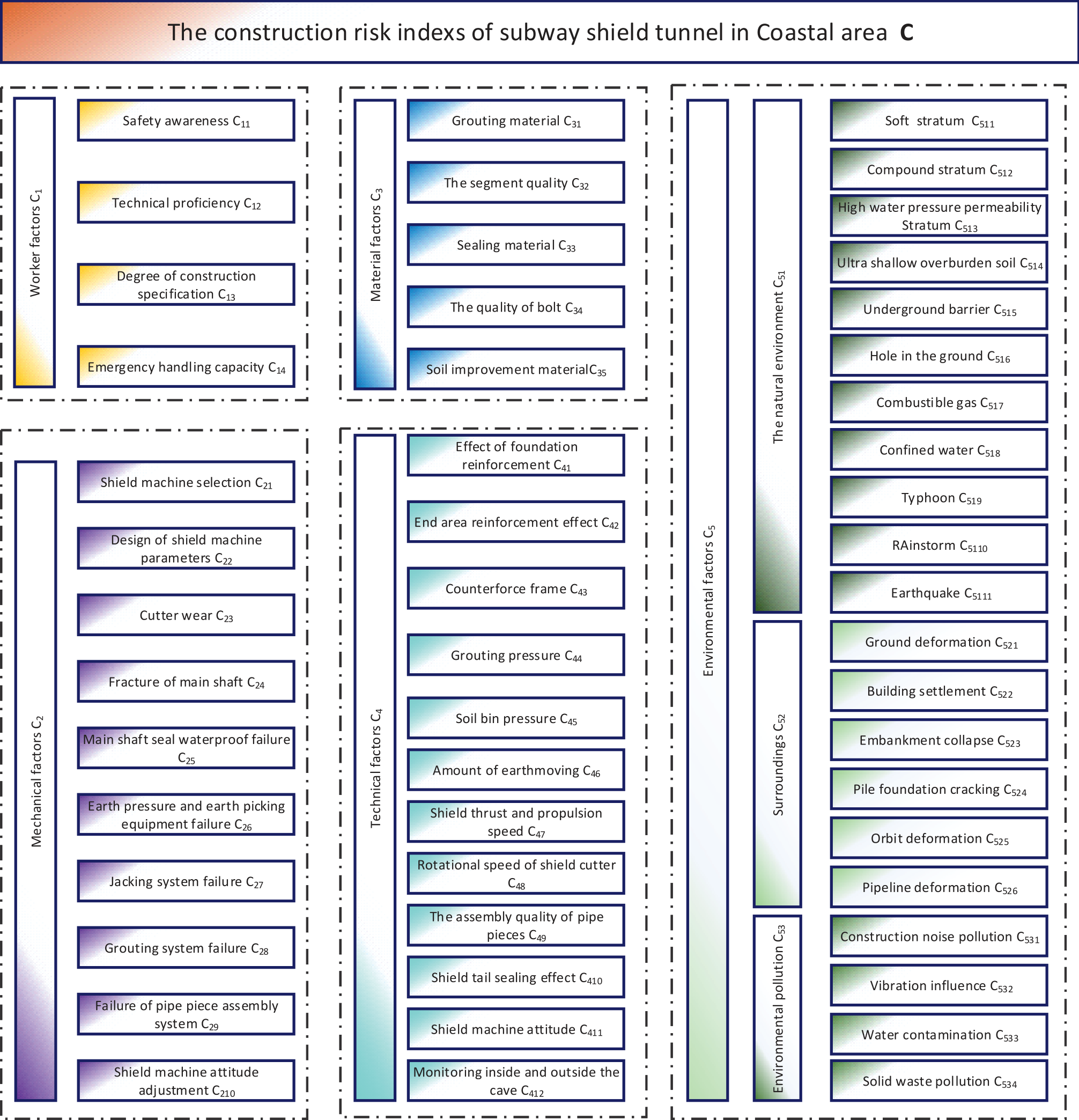
Based on the investigation and analysis of the safety risk management of shield tunnel construction [30-33], we carried the valid risk identification and established a complete risk assessment index system of shield tunnel construction. In addition, we adopted some views of senior engineers to build the index system through interviews, and Fig. 3 shows the indicator system.
According to the probability and consequence level of accidents, a risk grading evaluation matrix is established, and the risk is divided into four levels [34], as shown in Table 2.
Refer to the risk assessment matrix and use the single factor method to classify shield construction risk into four categories: Very high risk (t = 1), High risk (t = 2), Medium risk (t = 3), and Low risk (t = 4)
Z = ( ,z z1 2 , z z3, 4 ) = (Very High Risk H,
High Risk Midium Risk Low Risk, , )
Based on the above theory, we established the entropy weight-matter-element model to evaluate the safety risk level during shield tunnel excavation.
Determine the Risk Level Domain
According to the design specifications and the construction experience, we can obtain the quantification range of each risk assessment index of the shield tunnel construction under a single factor, as shown in Table 3. For example, the Worker Factors (C1) depend on the safety awareness (C11) of the workers. Those with high safety awareness are rated as “Very Good” in the range [90~100]. If workers’ safety awareness is poor, then the value range is [60-70], which is rated as “Worse”. Because all qualified workers have been trained, the range does not start at zero. However, in the process of operation, different workers will have distinct safety awareness. Similarly, the remaining indices are assigned one by one.
Results
It is complex to accurately describe the risks of building shield tunnels in coastal areas. Therefore, we must discuss the weight allocation of the evaluation index. Moreover, we adopted the evaluation model based on matter-element theory and calculated the level of safety risk.
Table 3.
Quantitative scope of each index of shield tunnel construction risk assessment.
Determine the Weight Coefficient with the Entropy Method
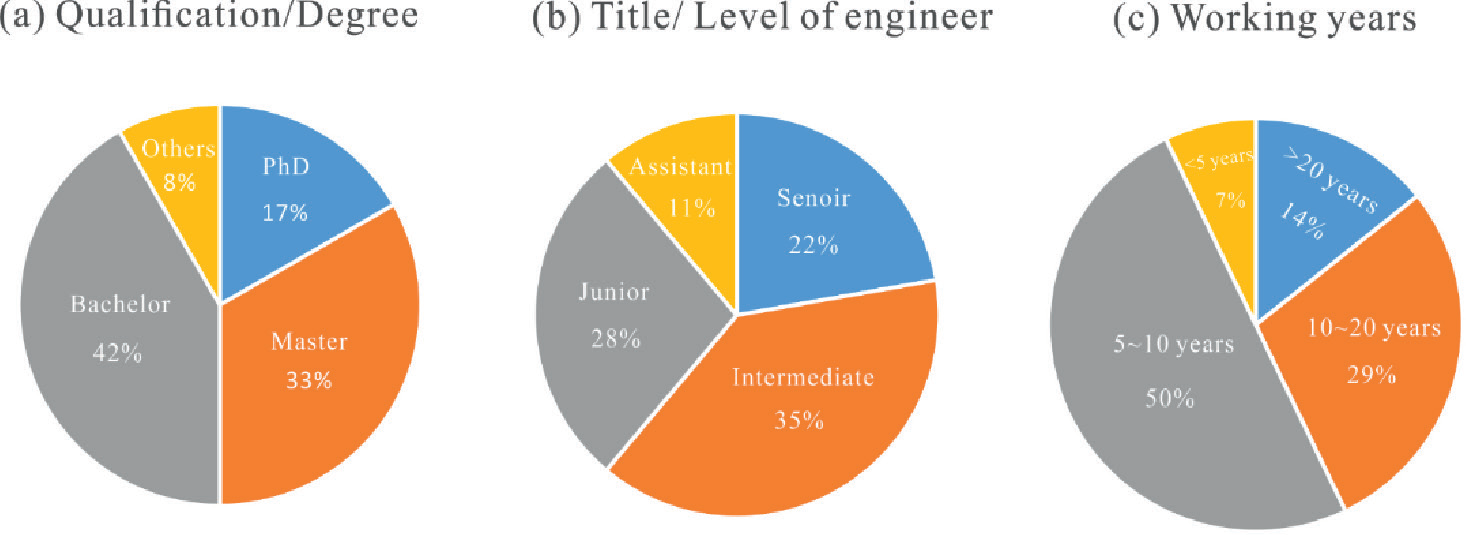
According to the established evaluation index system, we invited many experts to score 52 indicators that affect the safety status of shield tunnel construction in terms of the on-site construction status and Table 3, obtaining a scoring matrix S. Fig. 4 shows that a high proportion of experienced experts can ensure the mutual accuracy of assessments.
Normalize the result to make the assignment data range (0,1) and get the standardized matrix S'.
First, we should sum the median of the four quantification ranges of each index under a single factor together. Then, we obtained the normalized result of each indicator by dividing the expert scores by the sum above.
Then we established the model of entropy method as follows:
1. Taking the average value of each index assigned by experts, we established a set of evaluation matrix;
2. The evaluation matrix and the node value of the safety level of foundation pit construction form a decision matrix X;
3. The decision matrix X is subjected to the elementary transformation of the matrix by the linear proportional transformation method to obtain the standardized matrix Y; Since the Y matrix is very large, its contents are expressed in a table, as shown in Table 4.
4. We calculated the entropy value and difference coefficient of each index in turn and finally obtained the weight value of each underlying index. According to Equation (14), we transformed the above-mentioned matrix into a standardized matrix Y by the linear proportional transformation method. Then, the weight value of each index is obtained according to the Equation (15)-(17) and is shown in Table 5.
Risk Assessment
Since the excavation process involves different risk accidents, according to the expert’s scoring matrix S and the Equation (6), the object to be evaluated can be obtained as
According to Equations (7)-(10) of the correlation degree, we calculated the correlation degree of the safety risk level of foundation pit excavation construction under various working conditions. Table 6 shows the results of kt(xi).
According to Equation (18), the correlation degree of each risk level is calculated as
In the matter-element theory, the closer the absolute value of deviation is to 0, i.e., the smaller is, the higher the probability of belonging to the risk level. Therefore, according to the above calculation, the risk assessment level of the tunnel entrance section is high, i.e., it belongs to low risk and is consistent with the on-site construction situation.
Discussion
Many factors affect the construction safety of shield tunnels in the coastal area, the main factors can be obtained by analyzing the main element of the Matter-element model. Fig. 5 shows the influences of five kinds of risk sources on the construction of the coastal shield tunnel. Among the workers’ factors, the correlation degree of construction specification as the C13 has the greatest impact on construction safety. Therefore, to reduce the construction risk, it is necessary to improve the level of construction safety standards and workers’ safety awareness. Through the analysis of mechanical and material factors, the influence of each index is similar, and the score is high. Therefore, during the construction period, we cannot ignore these factors. As for the technical factors, on the one hand, it is directly related to the quality of the shield tunnel, on the other hand, it is also related to construction safety. Among the 12 indicators, 6 technical indicators have a great impact on construction safety. Compared with the other four types of influencing factors, the environmental factors are the most complex. Table 5 shows the top four indicators with the highest scores the soft stratum C511, the embankment collapse C523, the pile foundation cracking C524, and the pipeline deformation C526. These results are sorted according to the weight scores in Table 5 and verified by the entropy weight model. It can indicate that necessary measures must be taken to reduce the environmental risks of construction. The highest of these is the embankment collapse C523 and its proportion is 8.14%.
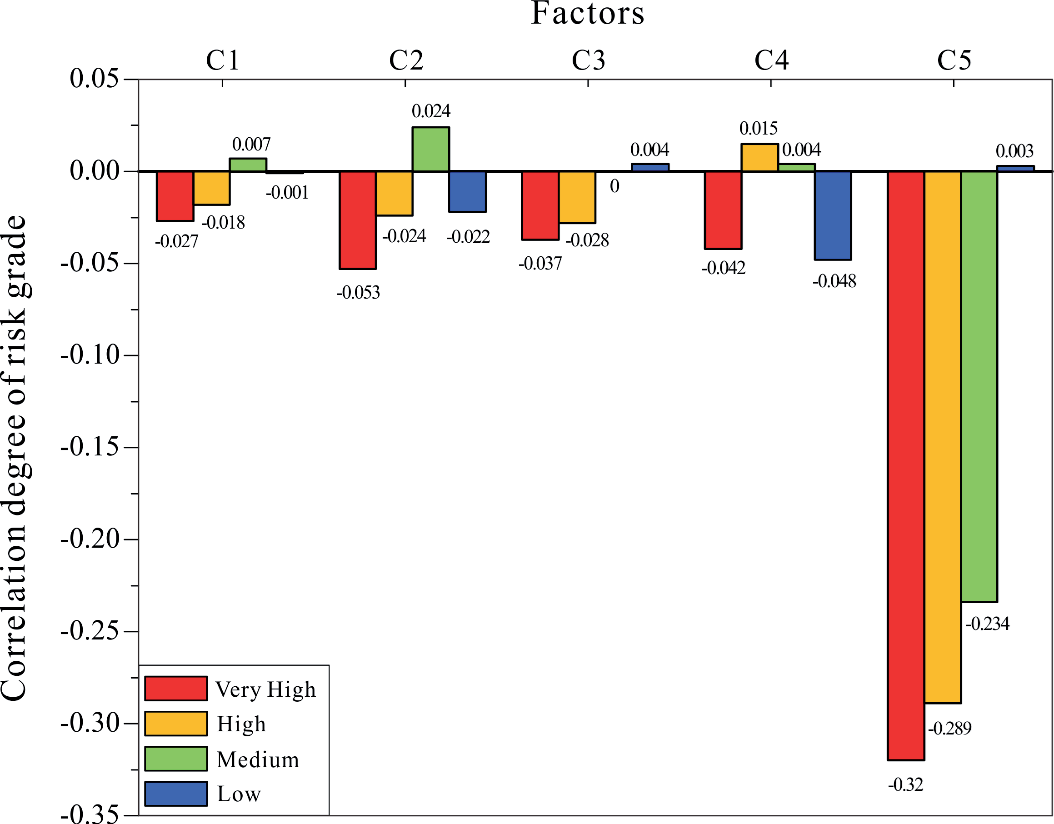
According to the calculation, the total construction safety risk level is low. However, due to the requirements of safety risk control, we should analyze the correlation degree of each influencing factor and give some valid suggestions. Fig. 6 shows the calculated correlation degree of each influencing factor. In addition to the environmental factors, the correlation degree of the other four factors is similar to that of Fig. 6. The environmental factors have a great influence on the shield tunnel construction in this coastal area. It is consistent with the analysis of major influencing factors.
Table 4.
The contents of Y matrix.
Table 5.
Index weight.
Fig. 5.
The influence of different risk factors: a) Worker factors of construction risk b) Mechanical factors of construction risk c) Material factors of construction risk d) Material factors of construction risk e) Environmental factors of construction risk. By comparing the parameters of each indexs, the degree of influence of each factor can be obtained.
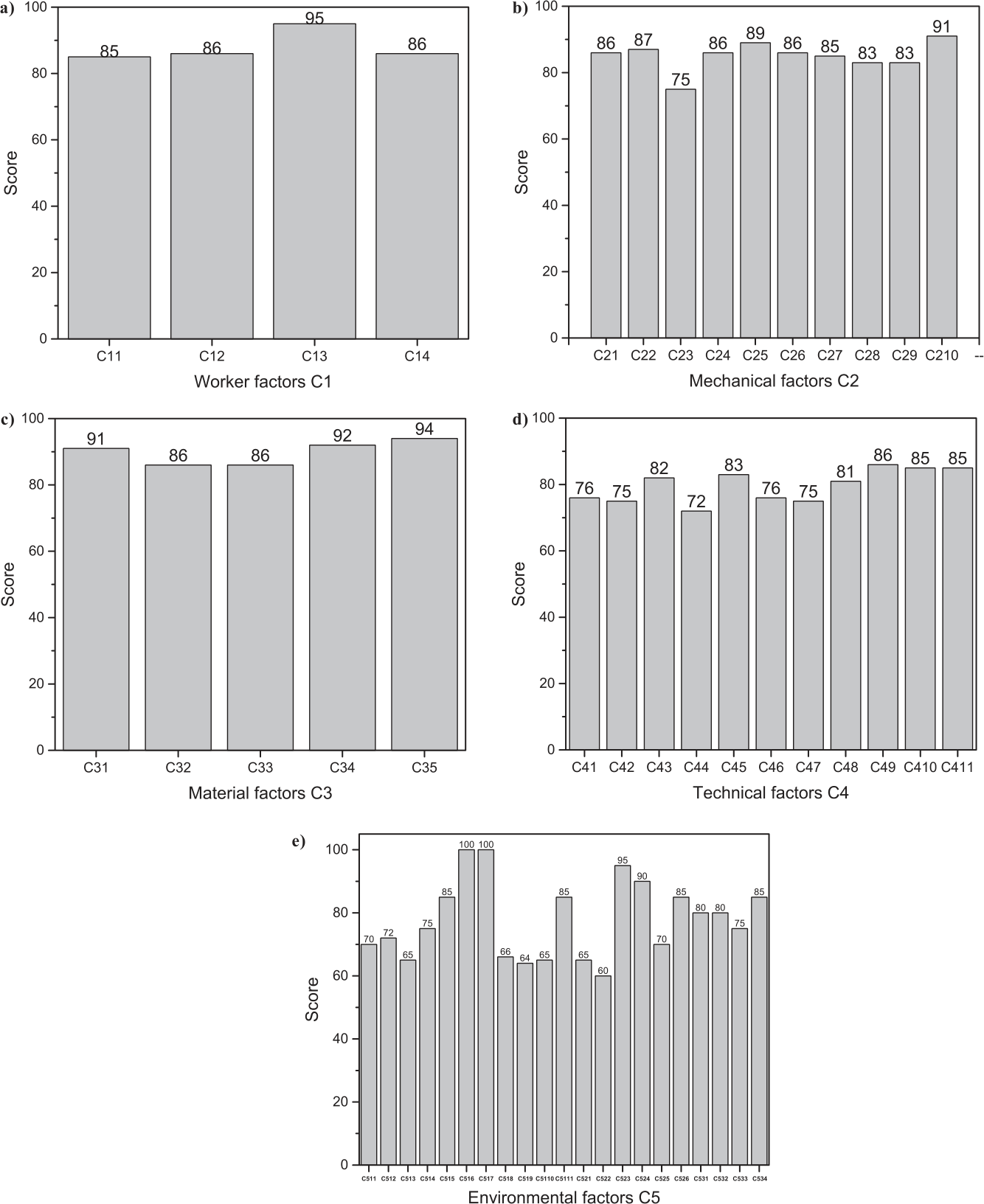
Table 6.
Calculation results of correlation degree of risk.
Conclusions
The construction of subway tunnels in the urban underground space is a high-risk project with considerable uncertainty and ambiguity. The ability to take reasonable and effective methods to evaluate and control the safety risks of tunnels during construction is directly related to the development of the entire project, reducing safety risks during construction, improving tunnel construction efficiency, and reducing risk losses. The entropy method combined with matter-element theory evaluates the construction risk of shield tunnels. The main conclusions are as follows:
1) Through the investigation and analysis of the safety risk management of shield tunnel construction at home and abroad, we carried out effective risk identification and built a complete risk assessment index system for shield tunnel construction. According to the design specifications and existing literature, we obtained the quantification range of each risk assessment index of shield tunnel construction under a single factor.
2) Based on the matter-element theory, we built a safety risk assessment model for shield tunnel construction and a quantitative evaluation system according to the uncertainty, system complexity, and ambiguity of tunnel construction to ensure that the evaluation results are scientific and reliable, and it has guiding significance for the follow-up construction.
3) We used the entropy matter-element method to evaluate the safety risk of typical shield tunnel construction. The results show that environmental factors are vital and must strengthen the monitoring of the surrounding environment. The results are reliable and consistent with the on-site construction situation.
Fig. 6.
Correlation degree of risk grade. Through the comparison of 5 main factors, environmental factors are prominent.
The entropy-matter-element theory method can be used to evaluate the risks of complex engineering systems [35-36] and further applied to the planning, design, construction, and operation stages of underground engineering.

