

Introduction
By the end of 2022, China’s total road length exceeded 5.35 million kilometers, including 177,000 kilometers of highways. The country’s road traffic is transitioning from construction to maintenance, but factors such as construction quality and traffic volume have led to a concentration of road diseases. Interlayer voids, located between the base and subbase or roadbed, are particularly harmful. Repairing only the surface layer will not improve the condition of the road; internal voids must be fixed to improve the base’s bearing capacity and roadbed parts [1-3].
The non-excavation grouting reinforcement method is a commonly used technique to strengthen road surfaces. Injecting grouting materials into cracks and pores in the roadbed and base layer reinforces and increases the bearing capacity of the base layer [4, 5]. Compared to other repair methods, grouting has a minimal impact on traffic, lower material and construction costs, and significant social and economic benefits. The success of grouting projects heavily relies on the performance of grouting materials throughout the construction process [6, 7].
The grouting materials commonly used include cement, geopolymer, and asphalt. The novel geopolymer grouting material has high temperature resistance, acid resistance, excellent durability, and recyclability [8-15]. Due to the unique structure of geopolymers, they have many excellent properties that are difficult to achieve with Portland cement-based materials, particularly outstanding in terms of mechanical properties, chemical resistance, heat resistance, and fixation of heavy metals [14, 15]. Slag itself is a potentially active vitreous structure substance. Some studies have shown that the glass slag does not have the ability of hydration hardening alone; the hydration reaction in pure water is very slow or does not even carry out hydration, but under the action of alkaline substances such as NaOH and sodium silicate, its activity is stimulated, which can promote the hydration reaction. Fly ash is a solid waste discharged from the combustion of pulverized coal by power plants, and with the rapid development of the power industry, the amount of fly ash emitted by coal-fired thermal power plants has also increased rapidly, becoming one of the largest industrial waste residues in China [16-18]. Moreover, the fluidity of fly ash material is good, and the price of slag and fly ash is low, which greatly reduces the cost of grouting in road engineering. Moreover, because the use of cement is reduced, the amount of non-renewable resources consumed in the production of cement is reduced, which is more suitable for large-scale applications in engineering [19-21].
There is a lack of research and development in road grouting materials that address the characteristics of road diseases. The form of road interlayer voids is flat and prone to fracture [22], while ordinary geopolymer materials have poor toughness and are prone to brittle fracture. For the hollowing disease, the volume of the grouting consolidation body is large, and the geopolymer material is prone to shrinkage, which can easily lead to secondary detachment [23].
In order to solve the above problems, this study focuses on the disease characteristics of road voids, selecting active components of industrial solid waste as the main raw materials, adding VAE to improve the brittleness and flexural strength of geopolymer materials, and adding ultrafine fly ash microspheres to improve the material’s shrinkage resistance in order to develop a novel geopolymer grouting material with good flowability, high early strength, high flexural strength, strong toughness, microexpansion, and strong shrinkage resistance.
Experimental
Materials
The experiment selected slag powder and fly ash as the main raw materials, and the main chemical composition is shown in Table 1. The main reason for selecting slag powder is that after alkali excitation, it can quickly react to generate early high-strength hydration products, making it the main active material to provide strength. Slag has an extremely obvious early strength advantage compared to traditional cement materials. In engineering applications, it can shorten road maintenance time and avoid obstructing traffic, and because its production process does not cause significant environmental pollution, it has good environmental characteristics. The experiment selected S95 grade slag powder with a density of 2.8 g/cm3 and a specific surface area of 400m2/kg; The main reason for choosing fly ash is that the particle surface of fly ash has a certain degree of smoothness, which can improve the flow performance of grouting materials. Secondly, as an industrial waste, it has a wide range of material sources, high economic benefits, low cost investment, reduced environmental pollution, is greener and more environmentally friendly, and has good social benefits. The recycling and utilization of fly ash can achieve the reuse of energy resources, avoid waste, and be very energy-saving and emission-reducing. The experiment selected Class II fly ash with a density of 2.0 g/cm3 and a specific surface area of 400 m2/kg.
The experiment selected SP50 water glass liquid sodium silicate as the alkaline activator. The mass fraction of silica (SiO2) was 29.9%, the mass fraction of sodium oxide (Na2O) was 13.75%, the density (20 ℃) was 1.526 g/cm3, and the modulus was 2.25. Sodium hydroxide produced by Century Star Chemical Reagent Co., Ltd. was selected for the experiment to adjust the modulus of water glass to an analytical grade purity.
Table 1.
Main chemical composition of raw materials
| Material | Mass fraction/% | ||||
|---|---|---|---|---|---|
| SiO2 | Al2O3 | Fe2O3 | CaO | MgO | |
| Slag | 33.50 | 4.60 | - | 49.20 | 3.70 |
| Fly ash | 59.31 | 29.46 | 3.21 | 2.72 | 2.51 |
| Ultrafine fly ash microspheres | 63.95 | 33.58 | 0.84 | 0.37 | 1.26 |
The configuration of the activator: By adding sodium hydroxide to the high modulus water glass solution, the required low modulus water glass solution is obtained. The water glass modulus for every 100 g of water glass solution is adjusted from 2.25 to 1.2-2.0, and the required sodium hydroxide mass is shown in Table 2.
The additives used in the experiment include an air entraining agent and an expansion agent, among which the air entraining agent is a high-purity concrete air entraining agent used to improve the workability of grouting materials and reduce the bleeding rate of grouting materials. The expansion agent is the United Expansion Agent (UEA), used to provide microexpansion of materials.
The glue powder selected for the test is VAE, which is called vinyl acetate ethylene cogeopolymer redispersible emulsion powder in full. It is a powder adhesive made of vinyl acetate and ethylene cogeopolymer after spray drying. This kind of powder can be redispersed into lotion soon after it contacts water. VAE has high strength, good adhesion, and required flexibility, which can enhance the adhesion strength of all substrates, reduce elastic modulus, increase water retention, and reduce water penetration. It has compliant flexibility, high adhesion, and suitable bending and tensile strength. Therefore, VAE was selected for the experiment, which can improve the flexural strength and flexibility of the grouting material in a targeted manner. Its physical and chemical indicators are shown in Table 3.
The experiment selected ultrafine fly ash microspheres. Its specific surface area is 400m2/kg. The purpose of selecting this material is that using ultrafine microspheres as a microskeleton is beneficial for limiting the shrinkage of the slurry and reducing the shrinkage rate of the material.
Method
In this test, it was determined through pre-test that the strength, fluidity, and economy of the ground geopolymer grouting material were better when the dosage of slag in alkali-excited cementitious material was 40%, the dosage of fly ash was 60%, the dosage of alkali exciter water glass was 25%, and the water-cement ratio was 0.35 of alkali-excited cementitious material (the dosage mentioned in the text is all mass fractions).
On this basis, to develop the novel geopolymer grouting material with high early strength, good fluidity, improved flexural strength, improved toughness, and micro-expansion, the controlled variable method was used for different water-glass moduli (1.2, 1.4, 1.6, 1.8, 2.0), and different dosages of VAE (0%, 1%, 2%, 3%, 4%), different ultrafine fly ash microspheres (0%, 2.5%, 5%, 7.5%, 10%), different air entraining agent dosage (0%, 0.1%, 0.2%, 0.3%, 0.4%), and different expansion agent dosage (0%, 1%, 2%, 3%, 4%) were designed for six times, each time five groups of test ratios.
Conduct tests on the flowing time, setting time, bleeding rate, expansion rate, flexural strength, and compressive strength of the slurry, and analyze and compare the results to explore the impact of various factors on the performance of the novel geopolymer grouting materials and select the best ratio that is most suitable for repairing road void diseases.
According to the designed mix proportion, add evenly mixed raw materials in the cement mixer, then add water according to the designed water binder ratio and stir evenly, then add the water glass solution with good modulus prepared with sodium hydroxide in advance, and mix in the planetary mixer for 5 minutes to make the geopolymer slurry. Test the performance of the geopolymer grouting material according to DGTJ08-2240-2017 technical specifications for road grouting reinforcement [24]. The performance shall meet the requirements in Table 4.
Table 2.
Mass of NaOH that needs to be added when adjusting the modulus of water glass
| Modulus | 1.2 | 1.4 | 1.6 | 1.8 | 2.0 |
|---|---|---|---|---|---|
| Addition amount of NaOH/g | 15.48 | 10.74 | 7.19 | 4.42 | 2.21 |
Table 3.
Physical and chemical indicators of VAE
Table 4.
Performance indicators of geopolymer grouting materials [24]
| Flowing time/s | Setting time/min | Bleeding rate/% | Expansion rate/% | Compressive strength/MPa | ||
|---|---|---|---|---|---|---|
| Initial setting | Final setting | 7d | 28d | |||
| ≤20 | ≥10 | ≤400 | ≤0.4 | ≥0.01 | ≥20 | ≥30 |
Results and Discussion
Effect of Water Glass Modulus on the Performance of the Novel Geopolymer Grouting Material
When the water cement ratio is 0.35, the water glass content is 25% of the external cementitious material, the slag content is 40%, and the II grade fly ash content is 60%, the influence of the water glass modulus on the novel geopolymer grouting material is shown in Table 5. Among them, setting time, bleeding rate, expansion rate, flexural strength, and compressive strength are significantly affected by the water glass modulus.
The setting time of geopolymer grouting materials with different water glass moduli was tested, and the results are shown in Fig. 1(a). As shown in Fig 1(a), as the modulus of water glass increases, the setting time of the geopolymer grouting material in the area also gradually increases. The reason for this phenomenon may be that when the modulus of water glass is low, the alkalinity is high, the reaction rate of the geopolymer is fast, and the initial setting time is short. However, when the modulus of water glass is high, the alkalinity is low, the reaction rate of the geopolymer is slow, and the setting time is long. Therefore, when the modulus of water glass is between 1.2 and 2.0, the setting time of the geopolymer grouting material in the area also significantly increases with the increase in water glass content.
Table 5.
Effect of water glass modulus on the properties of geopolymer slurry
Fig. 1.
Effect of water glass modulus: a) on setting time, b) on bleeding rate and Expansion rate, c) on flexural and compressive strength, d) on Compressive-flexural ratio
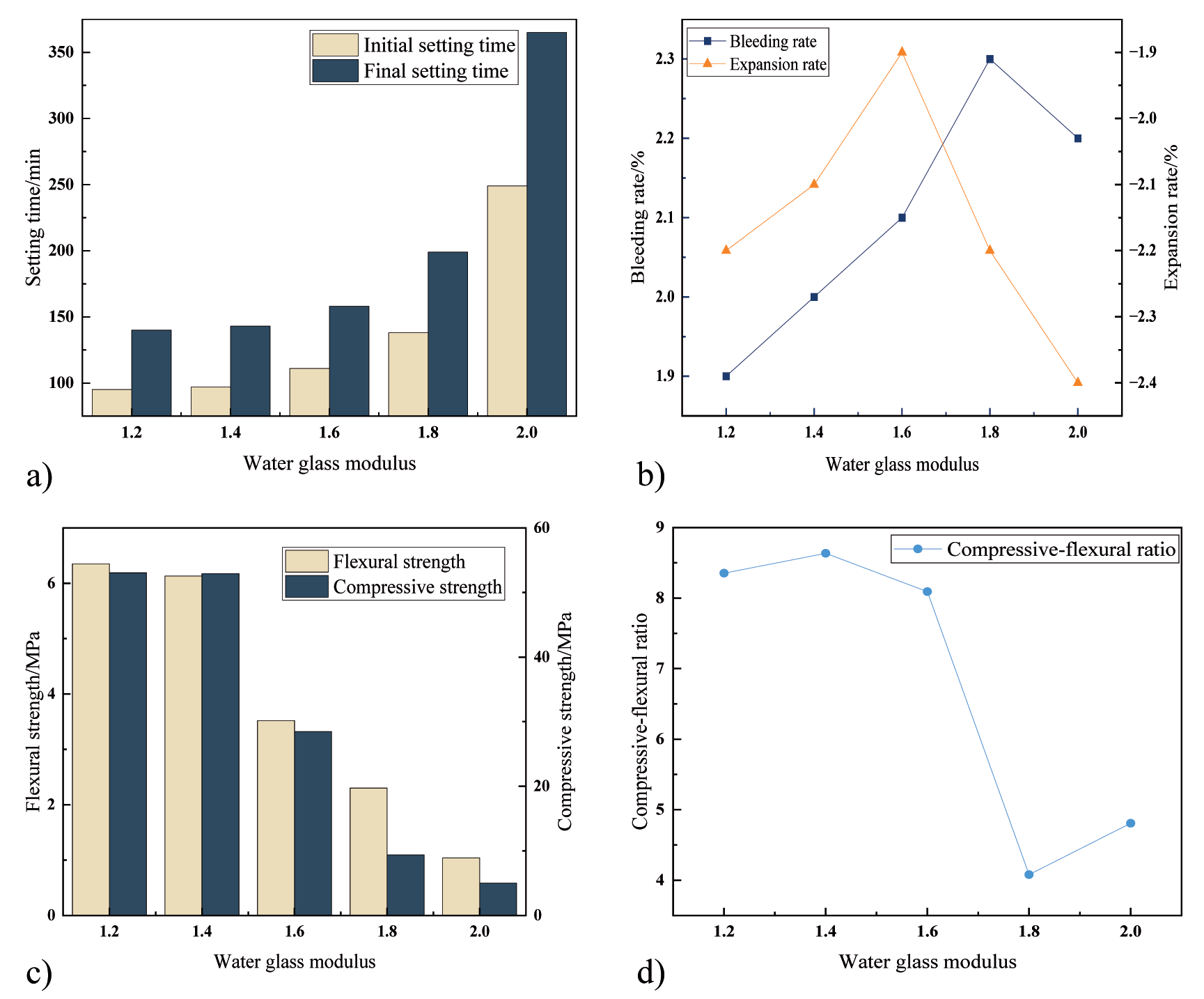
The bleeding rate and expansion rate of geopolymer grouting materials with different water glass moduli were tested, and the results are shown in Fig. 1(b). From Fig. 1(b), it can be seen that as the modulus of water glass increases, the bleeding rate and expansion rate both show a trend of first increasing and then decreasing. Among them, the expansion rate reaches its highest at a modulus of 1.6, and the bleeding rate is the lowest at a modulus of 1.2. Therefore, considering the influence of the above two factors comprehensively, the optimal modulus of water glass should be between 1.4 and 1.6.
The flexural strength and compressive strength of geopolymer grouting materials with different water glass moduli were tested, and the results are shown in Fig. 1(c). From Fig. 1(c), it can be observed that the flexural and compressive strengths of geopolymer materials decrease with an increase in the water glass modulus. When the water glass modulus decreases to 1.4, the flexural and compressive strengths almost reach their maximum values. This is because an increase in the modulus of water glass enhances the alkaline environment of the activator, accelerates the geopolymerization reaction rate, and ultimately leads to an upward trend in material strength.
The compressive-flexual ratio of geopolymer grouting materials with different water glass moduli was calculated, and the results are shown in Fig. 1(d). From Fig. 1(d), it can be seen that when the modulus of water glass is less than 1.8, as the modulus of water glass increases, the compressive-flexual ratio of the geopolymer material generally decreases, indicating that appropriately increasing the modulus of water glass can improve the brittleness of the material and increase its toughness.
Therefore, taking into account various factors, when the modulus of water glass is selected as 1.6, the performance of the novel geopolymer material reaches its best.
Effect of VAE Content on the Properties of Geopolymer Grouting Material
When the water cement ratio is 0.35, the water glass content is 25% of the external cementitious material, the slag content is 40%, and the II grade fly ash content is 60%. When the water glass modulus is 1.6, the effect of VAE adhesive powder content on the performance of the novel geopolymer slurry is shown in Table 6. Among them, flowing time, bleeding rate, expansion rate, flexural strength, and compressive strength are significantly affected by VAE content.
Fig. 2.
Effect of VAE glue powder content: a) on flowing time, b) on bleeding rate and Expansion rate, c) on flexural and compressive strength, d) on Compressive-flexural ratio
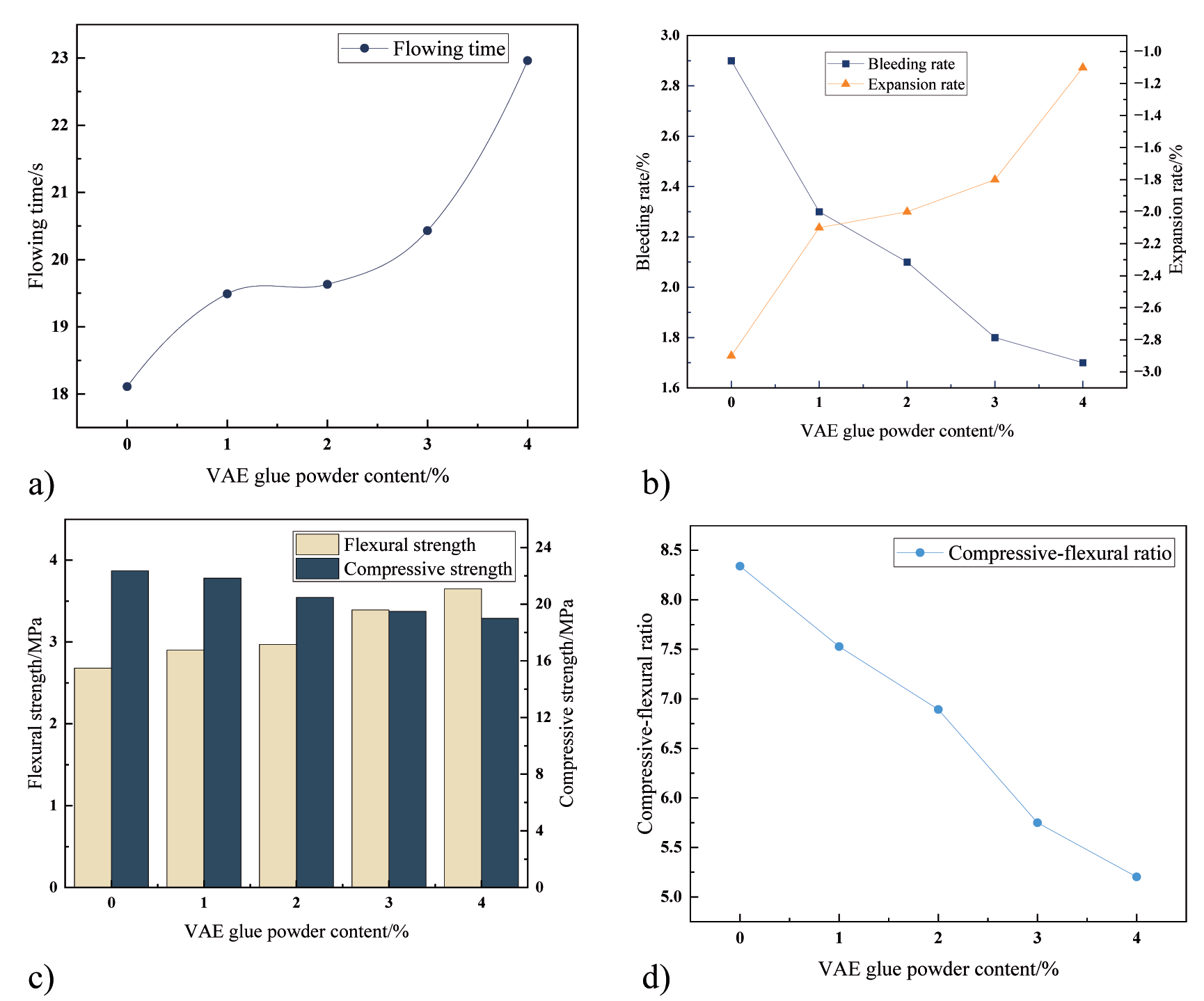
The flowing time of geopolymer grouting materials with different VAE dosages was tested, and the results are shown in Fig. 2(a). As shown in Fig. 2(a), with the increase in VAE content, the flowing time will decrease. This is mainly because the adhesive powder dissolved in water has a certain viscosity. When the dosage of adhesive powder continues to increase, it leads to an increase in the viscosity of the slurry, ultimately resulting in a downward trend in flowing time.
The bleeding rate and expansion rate of geopolymer grouting materials with different VAE dosages were tested, and the results are shown in Fig. 2(b). As shown in Fig. 2(b), with the increase in VAE content, the material bleeding rate gradually decreases and the expansion rate gradually increases. Therefore, under the premise of meeting the flow time index of grouting materials, the VAE content can be appropriately increased.
The flexural strength and compressive strength of geopolymer grouting materials with different VAE dosages were tested, and the results are shown in Fig. 2(c). As shown in Fig. 2(c), with the increase in VAE content, the flexural strength of the material gradually improves. Mainly due to the excellent bonding strength of the adhesive powder, as the dosage of the adhesive powder continues to increase, the bonding force of the slurry material is enhanced, ultimately improving the flexural strength of the material. In addition, as the amount of rubber powder increases, the compressive strength of the material gradually decreases. This is because the addition of rubber powder reduces the content of slag, which mainly provides compressive strength, and the addition makes the material structure loose, ultimately leading to a decrease in compressive strength.
The compressive-flexual ratio of geopolymer grouting materials with different VAE dosages was calculated, and the results are shown in Fig. 2(d). As shown in Fig. 2(d), with the increase in VAE content, the material’s compressive-flexual ratio gradually decreases, indicating that the addition of VAE can effectively improve the toughness of the material.
Therefore, taking into account various factors, the optimal dosage of VAE is selected as 2%. Compared to the material without VAE adhesive powder, its flexural strength is increased by 10.8% and its brittleness (compressive-flexual ratio) is reduced by 17.4%.
Effect of Ultrafine Fly Ash Microsphere Content Content on the Properties of Geopolymer Grouting Material
When the water cement ratio is 0.35, the water glass content is 25% of the external cementitious material, the slag content is 40%, and the II grade fly ash content is 60%. When the water glass modulus is 1.6, ultra-fine fly ash microspheres are used to replace the II grade fly ash. The effect of the ultra-fine fly ash microsphere content on the properties of the novel geopolymer slurry is shown in Table 7. Among them, flowing time, bleeding rate, expansion rate, flexural strength, and compressive strength are significantly affected by the content of ultrafine microspheres.
Table 6.
Effect of VAE glue powder content on the properties of geopolymer slurry
Table 7.
Effect of ultrafine microsphere content on the properties of geopolymer slurry
Fig. 3(a) shows that the flowing time of the grouting material increases with the dosage of ultrafine fly ash microspheres. This is due to the low density of the microspheres and the increase in powder volume after replacing the fly ash with the same mass, resulting in decreased water per unit volume of the slurry and decreased fluidity.
As shown in Fig. 3(b), with the increase in the dosage of ultrafine fly ash microspheres, the bleeding rate of the grouting material decreases and the expansion rate increases.
As shown in Fig. 3(c), the flexural and compressive strengths of the grouting material increased with the increase in the dosage of ultrafine fly ash microspheres. Because the microspheres, as a microskeleton, are conducive to improving the strength of the slurry.
As shown in Fig. 3(d), with the increase of the dosage of ultrafine fly ash microspheres, the folding pressure ratio of the grouting material roughly shows a trend of decreasing-increasing-decreasing, and it reaches the lowest when the dosage is 5%.
Fig. 3.
Effect of ultrafine microspheres content: a) on flowing time, b) on bleeding rate and Expansion rate, c) on flexural and compressive strength, d) on Compressive-flexural ratio e) on shrinkage
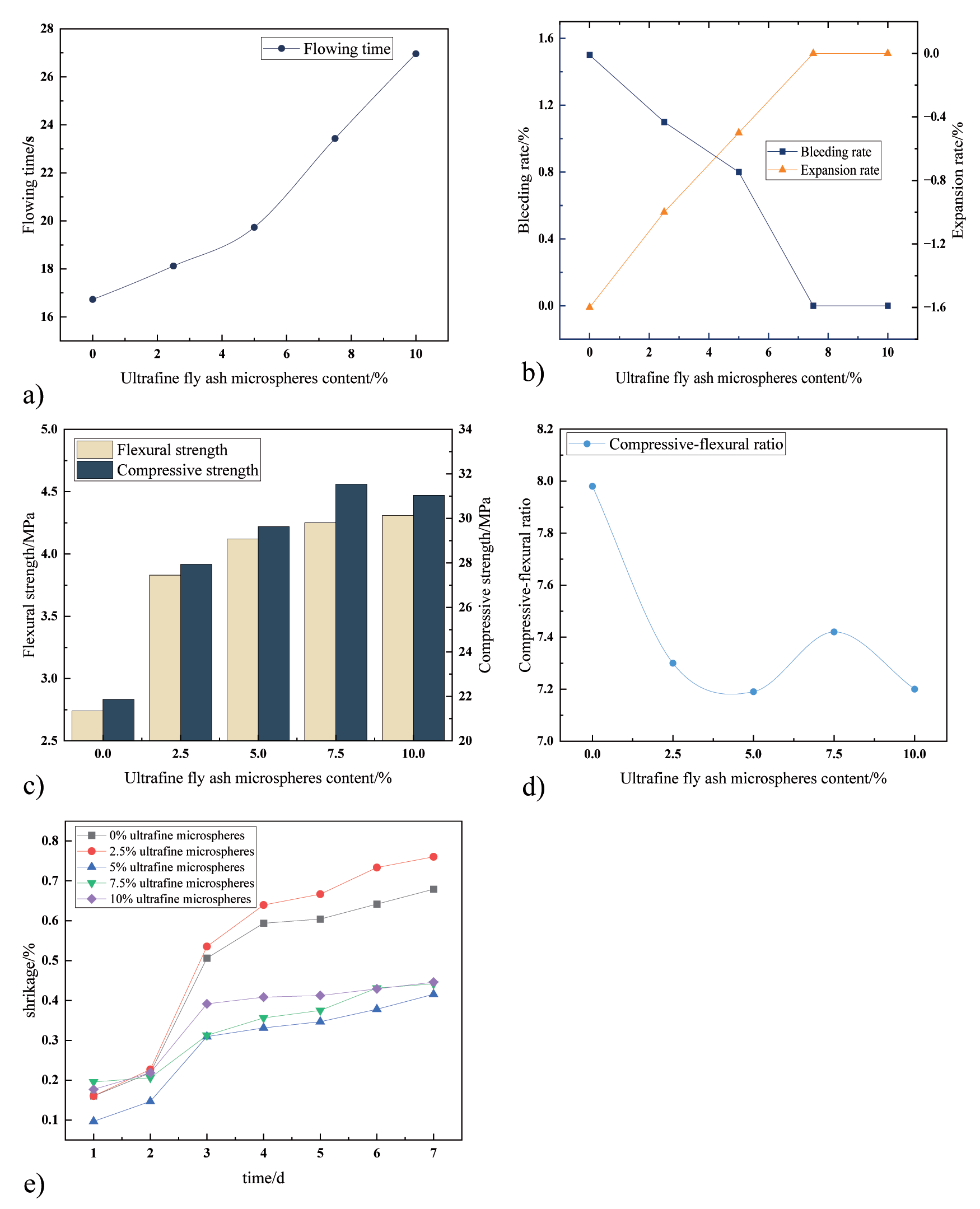
Fig. 3(e) shows that the shrinkage of the grouting material grows with time at different dosages of ultrafine fly ash microspheres, where the slowest growth of shrinkage of the material is observed at a dosage of 5%. Compared with the material not mixed with ultrafine fly ash microspheres, its 7d shrinkage rate decreased by 38.2%. Because the microspheres act as a micro-skeleton to help limit pulp shrinkage.
Therefore, taking into account various factors, the optimal dosage of ultrafine microspheres is selected at 5%.
Effect of Air Entrainer Content on the Properties of Geopolymer Grouting Material
When the water cement ratio is 0.35, the content of water glass is 25% of the external cementitious material, the content of slag is 40%, and the content of Class II fly ash is 60%. When the modulus of water glass is 1.6, the effect of the amount of air entraining agent on the performance of the novel geopolymer slurry is shown in Table 8. Among them, only bleeding rate and expansion rate are significantly affected by air entrainer content.
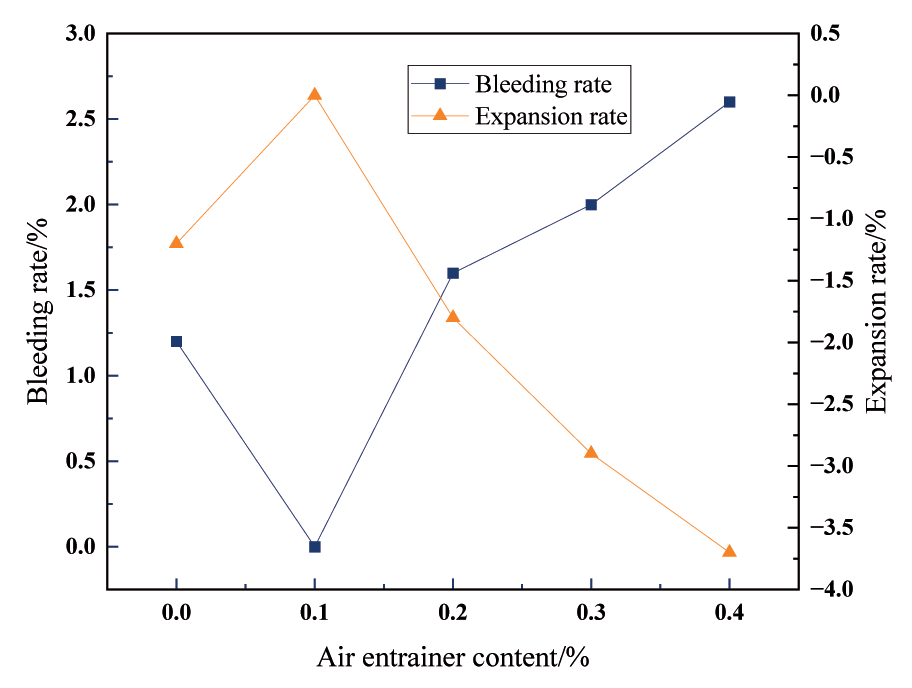
The bleeding rate and expansion rate of geopolymer grouting materials with different air entraining agent dosages were tested, and the results are shown in Fig. 4. From Fig. 4, it can be seen that as the amount of air entraining agent increases, the bleeding of the geopolymer grouting material first decreases and then increases, while the expansion first increases and then decreases. Adding a small amount of air entraining agent can improve the material’s water bleeding effect and increase the expansion rate. However, excessive mixing can lead to the opposite effect, reducing the stability of the slurry, increasing bleeding, and reducing the expansion rate. Due to the addition of air entraining agents, a large number of small, enclosed spherical bubbles are formed in the concrete mixture. Due to the uniform distribution of water on the surface of a large number of bubbles, the amount of water that can move freely is reduced, resulting in a decrease in the amount of bleeding in the concrete mixture. In summary, the optimal dosage of air entraining agent is selected as 0.1%.
Effect of UEA Content on the Properties of Geopolymer Grouting Material
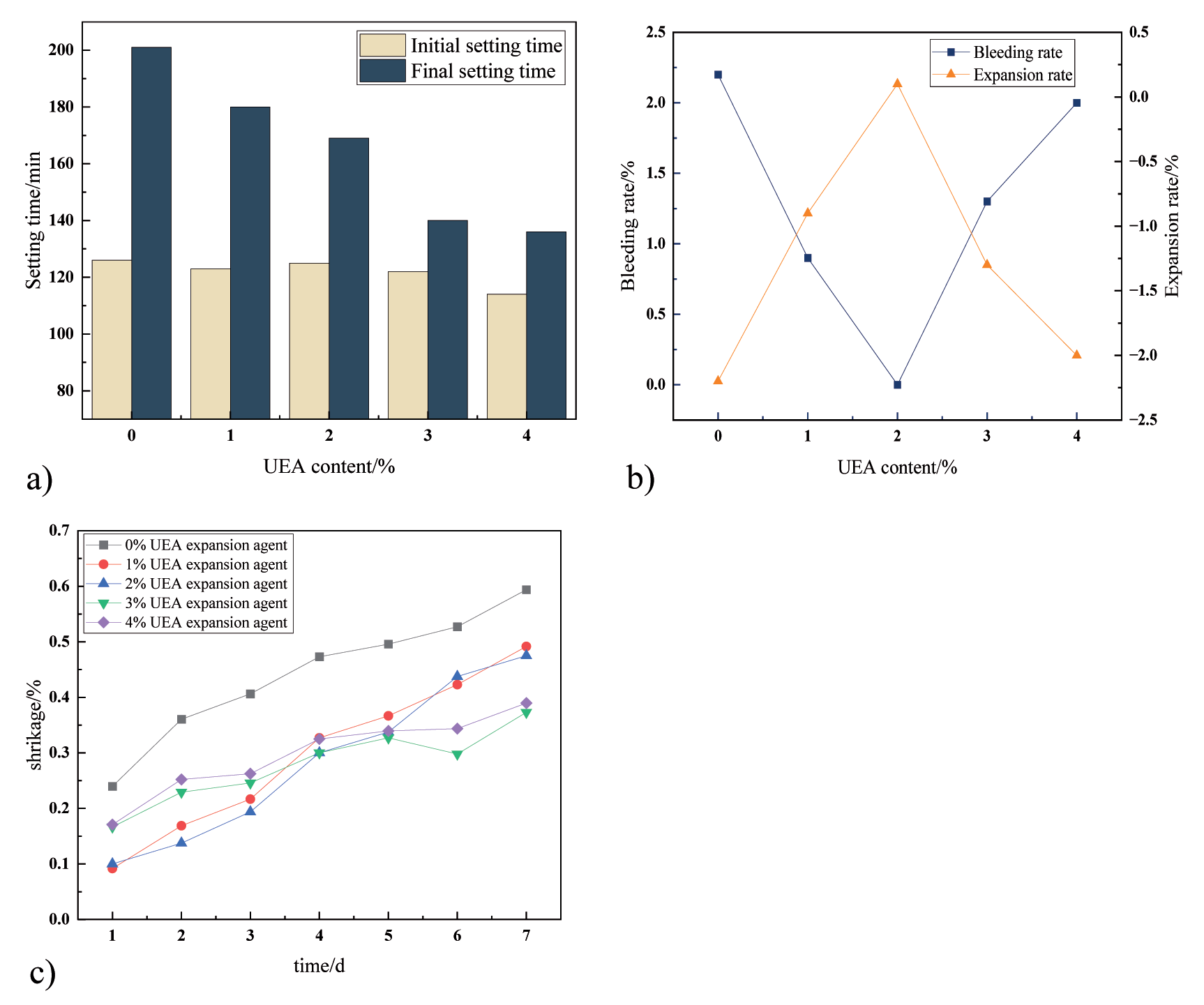
When the water cement ratio is 0.35, the water glass content is 25% of the external cementitious material, the slag content is 40%, and the II grade fly ash content is 60%. When the water glass modulus is 1.6, the effect of UEA content on the performance of geopolymer slurry is shown in Table 9. Among them, setting time, bleeding rate, and expansion rate are affected by UEA content.
The setting time of geopolymer grouting materials with different UEA expansion agents was tested, and the results are shown in Fig. 5(a). From Fig. 5(a), it can be seen that with the increase in UEA expansion agent dosage, the initial setting time of the polymer grouting material in the area decreases, but the change is not significant, while its final setting time significantly decreases, indicating that UEA expansion agent can significantly reduce the final setting time of the material.
As shown in Fig. 5(b), with the increase in UEA dosage, the bleeding of geopolymer grouting material first decreases and then increases, while the swelling first increases and then decreases. This indicates that a small amount of expansion agent can improve the bleeding effect of the material and increase the expansion rate, while excessive addition will lead to the opposite effect, reducing the stability of the slurry, increasing the bleeding, and decreasing the expansion rate. When the content of UEA is 2%, the material produces a microexpansion effect of 0.1%.
Table 8.
Effect of air-entrained content on the properties of geopolymer slurry
The shrinkage of the novel geopolymer grouting material with different UEA dosages was tested, and the results are shown in Fig. 5(c). It can be seen that the 7d shrinkage of the geopolymer grouting material increases with time, where it reaches its lowest in the first four days with a UEA doping of 2% and in the last three days with a UEA doping of 3%. Therefore, considering all the factors, the optimum dosage of UEA was selected as 2%.
Performance Optimization Test Results of the Novel Geopolymer Grouting Material
Based on the above research, on the basis of meeting the requirements of DGTJ08-2240-2017, the optimal mix ratio for the comprehensive performance of the novel geopolymer grouting material is 40% slag powder, 55% fly ash, 5% ultrafine fly ash microspheres, 2% VAE adhesive powder, 0.1% air entraining agent, 2% UEA, 25% water glass, 1.6 water glass modulus, and 0.35 water cement ratio. The performance test results of the geopolymer grouting material prepared according to this mixture ratio are shown in Table 10.
Table 9.
Effect of UEA content on properties of geopolymer slurry
Conclusions
Used for road interlayer hollowing disease repair grouting materials for the best overall performance of the ratio of slag powder dosage of 40%, fly ash dosage of 55%, ultrafine fly ash microspheres dosage of 5%, VAE doped with 2%, air entraining agent dosage of 0.1%, UEA dosage of 2%, water glass dosage of 25%, the modulus of 1.6 water glass, and water-cementitious ratio of 0.35.
The modulus of water glass is 1.4 ~ 1.6, which is the best, its flexural strength and compressive strength are higher; a small amount of air entraining agent can improve the control of the water secretion effect, and the optimal amount of air entraining agent doping is 0.1%. The increase in the amount of UEA can significantly shorten the final setting time, the novel grouting material expansion is the first to increase and then decrease, and the best dosage of UEA is 2%.
With the increase in VAE adhesive powder doping, the flexural strength is gradually improved and the compressive strength is gradually reduced. The optimal dosage of VAE is 2%; compared with the material not mixed with VAE, its flexural strength increased by 10.8% and its brittleness (compressive-flexual ratio) decreased by 17.4%.
As the dosage of ultrafine fly ash microspheres increases, the shrinkage of the grouting material increases first and then decreases, and the shrinkage is the lowest when the dosage is 5%, and the shrinkage grows at the slowest rate with time. Compared with the material not mixed with ultrafine fly ash microspheres, its 7d shrinkage rate decreased by 38.2%.

