

Introduction
New urbanization is an urbanization mode of urban and rural integration, ecological environmental protection, mutual promotion and coordinated development of large, medium and small cities and new rural communities [1]. The level of new urbanization is an important factor to measure the economic and social status of a country or region, and it is also a key pillar of national economic development [2]. The construction of new urbanization absorbs the collection of scientific and technological industries and high-end technical talents, thus driving the cityʼs scientific and technological innovation output [3]. Technological innovation promotes the progress of industrial intelligence and promotes the level of urban public facilities [4]. Innovation drives the release of economic vitality and promotes the construction of new urbanization [5]. The construction of new urbanization also breeds the development of scientific and technological innovation, forms the sustainable development linkage between scientific and technological innovation and new urbanization, and jointly promotes the process of national (regional) economic and social development [6, 7].
The promotion of scientific and technological innovation and new urbanization construction to the sustainable development of society is mainly manifested in the following points: Firstly, the development of scientific and technological innovation promotes the renewal of industrial facilities and equipment and the improvement of intelligent level [8], which promotes the improvement of production efficiency to a certain extent, thus reducing the waste of non-renewable resources and carbon emissions caused by the production and operation process [9-11]. Secondly, the new urbanization construction promotes the improvement of residentsʼ living standards [12], attracts highly educated and high-tech talents, provides human resources supply for regional industrial development, and promotes the improvement of regional economic level to a certain extent [13, 14]. Thirdly, the development of scientific and technological innovation helps to promote the development of regional high-tech industries and has a certain role in promoting the improvement of regional economic structure, thus driving economic growth and residentsʼ employment [15].
Located in the upper reaches of the Yangtze River, the Chengdu-Chongqing Economic Circle is the region with the highest population density, the most open market and the highest level of development in western China. It has great economic development potential and room for improvement. The development of Chengdu-Chongqing economic circle is centered on Chengdu and Chongqing, which plays a radiation and driving role in Sichuan, Chongqing and even the whole western region. The sustainable development of scientific and technological innovation and new urbanization in the Chengdu-Chongqing Economic Circle and the “Belt and Road“ initiative promote each other, which has a constructive role in improving the international competitiveness of Chinaʼs Chengdu-Chongqing region, and has a strong role in promoting the economic upgrading of Chinaʼs western region and the smooth development of Chinaʼs “internal circulation“ strategy. Therefore, the research on scientific and technological innovation and new urbanization in Chengdu-Chongqing economic circle has certain practical significance.
Although the research on urbanization and technological innovation has been relatively rich, the research on the synergy between the two is still lacking. Compared with previous studies, the innovation of this paper is mainly reflected in the following aspects:
(1) Analyze the interaction mechanism between technological innovation and new urbanization. Through the previous investigation and related data collection, this paper analyzes the mechanism of the interaction between scientific and technological innovation and new urbanization. (2) This paper constructs the coupling coordination model of technological innovation and new urbanization. By measuring the coordinated development degree of the two, this paper analyzes the coordinated development status and trend of scientific and technological innovation and new urbanization in the economic circle of Chengdu and Chongqing.
(3) The PVAR model is used to test the interaction between scientific and technological innovation and new urbanization in Chengdu-Chongqing economic circle, summarizes the conclusions, and puts forward specific feasible development suggestions.
The research contributions of this paper can be summarized as follows: (1) It further enriches the research in the field of new urbanization and technological innovation. In the research literature on scientific and technological innovation and new urbanization, the research area is taken as the entry point, and the research object is concentrated in the eastern provinces and economic zones of China. This paper takes the Chengdu-Chongqing twin-city economic circle as the research object, which has certain reference value for the western region of China and the overall development of China. (2) Further enriched the research on the direction of sustainable development. This paper not only explores the mutual promotion relationship between scientific and technological innovation and urbanization development, but also links them with the sustainable development standards of regional economy, which provides some reference for the direction of national sustainable development. (3) While discussing the development level and development relationship between scientific and technological innovation and new urbanization, this paper puts forward specific suggestions to promote the sustainable development of new urbanization and scientific and technological innovation, which is helpful to provide some reference value for the sustainable development of related fields.
The second section after this section reviews the previous research on urbanization and technological innovation. The third section expounds the index system of this research, and constructs the coupling coordination model of technological innovation and new urbanization. The fourth section introduces the Chengdu-Chongqing economic circle, calculates the weight of each index of the two subsystems of technological innovation and new urbanization through the entropy weight method, and systematically analyzes the empirical results of the study. The unit root test, cointegration test, Granger causality test and impulse response research methods are used to further verify the relationship between scientific and technological innovation and new urbanization in the Chengdu-Chongqing twin-city economic circle.
Literature Review
At present, the development of scientific and technological innovation and new urbanization has attracted the attention of many scholars, and the relevant literature has been more comprehensive. This paper sorts out the existing literature according to three parts: scientific and technological innovation, new urbanization, and the relationship between scientific and technological innovation and new urbanization development.
Scientific and technological innovation plays an important role in social and economic development [16]. Wang et al. [17] believe that scientific and technological innovation plays a very important role in national economic growth. WU et al. [18] also emphasized the contribution of scientific and technological innovation to national economic growth. Verganti et al. [19] introduced the popularization of artificial intelligence and the importance of scientific and technological innovation, and found that artificial intelligence can affect the innovation environment. Litvinenko and Sergeev [20] explored the role of scientific and technological innovation in the development of resource economy is discussed, and the role of scientific and technological innovation enterprises in the development of natural resources sector is emphasized. Scientific and technological innovation is conducive to the improvement of resource economy. Based on the sample data from 2011 to 2019, Ding et al. [21] explored the digital economy, high-quality economic development and scientific and technological innovation in 30 provinces of China by using empirical research methods such as intermediary effect model, and verified that scientific and technological innovation has a certain role in promoting the high-quality development of the digital economy. Ouyang et al. [22] used the two-way fixed effect model to study the relationship between Chinaʼs environmental regulations and scientific and technological innovation in the industrial sector, and concluded that environmental supervision has a negative impact on the scientific and technological innovation of state-owned enterprises. Ahmad et al. [23] believes that from a long-term perspective, economic growth and natural re-sources have a positive effect on the expansion of ecological footprint, and scientific and technological innovation can effectively alleviate this situation.
The construction of new urbanization is conducive to low-carbon environmental protection and urban sustainable development [24]. Cai [2] emphasized the importance of new urbanization construction. Yu [25] used the provincial panel data from 2003 to 2017 to empirically analyze the ecological effects of new urbanization from four different aspects, such as population and environment, and found that within the research time range, Chinaʼs new urbanization process has a certain role in promoting pollutant emission control, which verifies the role of new urbanization in promoting regional sustainable development. Cheng and Wang [26] used the DID model to study the relationship between new urbanization and urban total factor energy efficiency, and confirmed that the construction of new urbanization is conducive to the improvement of urban energy efficiency. Wu et al. [27] believe that in the process of rapid urbanization in China, the problem of air pollution is becoming more and more serious. The construction of new urbanization is helpful to improve air quality, especially for the improvement of low air quality quantile. The impact of new urbanization on environmental pollution will have different effects due to the change of new urbanization level [28]. Therefore, the country should pay attention to the construction of new urbanization, promote the promotion effect of new urbanization on ecological protection and energy efficiency, and promote the healthy development of regional economy.
The interactive development of scientific and technological innovation and new urbanization has a certain role in promoting the sustainable construction of cities [9]. Feng et al. [29] think that under the background of economic development, the scientific and technological innovation and new urbanization in various provinces are showing a trend of development, and the degree of coupling and coordinated development of the two is also on the rise. The development of new urbanization is not only closely related to urban infrastructure, but also highly related to scientific and technological innovation industries such as intelligent communication [1]. Ning et al. [30] used the data of Changsha-Zhuzhou-Xiangtan urban agglomeration from 2000 to 2020 as a sample to verify the role of scientific and technological innovation in promoting new urbanization by empirical analysis. Fu et al. [31] found that scientific and technological innovation has a significant role in promoting new urbanization, and there is a spatial spillover effect. Li [32] believes that new urbanization and scientific and technological innovation are intertwined, and scientific and technological innovation is an indispensable element in the process of new urbanization. Tu et al. [33] selected the data of the Yangtze River Delta urban agglomeration from 2005 to 2019 as the research sample, and used the PVAR model to empirically analyze the relationship between scientific and technological innovation and new urbanization. The study found that the impact of scientific and technological innovation on new urbanization is weak, while in areas with high-level new urbanization, the impact of scientific and technological innovation on it is more significant.
In summary, scientific and technological innovation and new urbanization development are conducive to the improvement of regional economic level and sustainable construction. Scientific and technological innovation promotes the improvement of urban public facilities and industrial equipment, which is conducive to the improvement of intelligent production level and the improvement of peopleʼs quality of life [34], and plays a certain role in promoting the new urbanization process. The development of new urbanization has an agglomeration effect on financial resources, industries and talents, thus promoting the sound development of urban scientific and technological innovation. The two complement each other, promote each other, and make positive contributions to urban prosperity.
Material and Methods
At the end of 2014, Chinaʼs first batch of new urbanization pilot projects were released, and some cities in the Chengdu-Chongqing economic circle were shortlisted. Coordinating the radiation and driving role of the central cities in the Chengdu-Chongqing Economic Circle, combined with the implementation time of the new urbanization policy, taking 2015 as the research starting point, selecting 2015-2022 as the research time range, selecting 16 cities such as Chongqing and Chengdu as the regional scope, exploring the sustainable development of scientific and technological innovation and new urbanization, providing direction for the construction of new urbanization in China, and providing certain reference value for the sustainable development of the country (region). The research data come from the Sichuan Provincial Bureau of Statistics, “Chongqing Statistical Yearbook”, “Sichuan Statistical Yearbook” and “National Statistical Yearbook”. A very small number of original data are missing, and linear prediction methods are used to estimate and fill them.
Selection of Indicators
According to the focus of the “National New Urbanization Plan (2014-2020)”, this paper determines the first-level indicators of the new urbanization subsystem as economic development, population urbanization, public services, green environmental protection and residentsʼ life. Based on the “Japanese science and technology indicators” and the systematic analysis of scientific and technological innovation, the scientific and technological innovation indicators are summarized into two categories: scientific and technological R&D investment and scientific and technological R&D output. This paper selects 15 secondary indicators of per capita GDP, per capita retail sales of social consumer goods, per capita general public budget income, urbanization rate of household registration population, proportion of employees in the second and third industries, number of beds in health institutions per 10,000 people, number of health institutions per 10,000 people, water supply penetration rate, gas penetration rate, green coverage rate of built-up areas, sewage treatment rate, harmless treatment rate of urban domestic waste, per capita urban road area, per capita disposable income of urban residents, and per capita consumption expenditure of urban residents. The second-level indicators of scientific and technological innovation include internal expenditure of R&D funds, full-time personnel of R&D personnel, number of patents applied per 10,000 people and number of patent grants.
Model Construction
The weighting method is divided into subjective weighting method and objective weighting method. In order to avoid the influence of individual subjective consciousness on the empirical results [35], the objective weighting method (entropy weight method) is selected to determine the index weight. The entropy weight method starts from the thermodynamic concept and uses the entropy value to measure the degree of dispersion between the indicators. The mathematical statistics process increases the scientific nature of the empirical results. This paper uses this method to determine the weight of each index of the scientific and technological innovation subsystem and the new urbanization subsystem. In order to eliminate the influence of different measurement units and dimensional differences of each index data [36], dimensionless processing of each index data is needed. Use Stata software to standardize the data. According to the normalized results, the weight of each city index in each research time is determined as follows:
The technological innovation and new urbanization of Chengdu-Chongqing dual-city economic circle are divided into two different systems, where i represents the city, i = 1,2...n, n is the number of cities in each system, j represents the index, j = 1,2...m, m are the number of indicators of each system. Aij represents the value of j index of i city after standardization, and Pij represents the proportion of j index of i city.
Determine the entropy ej of indicator j for each system:
Where
Calculate the difference coefficient dj:
Determining weights of indicators wj:
The comprehensive evaluation scores of each index system were calculated according to the above formula results:
Among them, t represents the year, Mit and Nit represent the comprehensive evaluation scores of science and technology innovation and new urbanization in Chengdu-Chongqing dual-city economic circle.
The coupling coordination degree model is used to measure the coordinated development level between two or more different systems, which can reflect the dynamic correlation degree between different systems. The degree of coupling reflects the degree of interaction between different systems. The higher the degree of coupling, the stronger the degree of action, otherwise the weaker. The coupling coordination degree reaction reflects the benign relationship under the interaction. The higher the coupling coordination degree, the stronger the benign interaction relationship, and vice versa. Referring to Liaoʼs research [37], this paper constructs the coupling coordination degree model of scientific and technological innovation and new urbanization, and further explores the coordination degree of scientific and technological innovation and new urbanization in Chengdu-Chongqing economic circle, providing reference for the sustainable development of Chengdu-Chongqing economic circle. The coupling level is expressed as follows:
Among them, Mit and Nit represent the comprehensive scores of i city t year under the science and technology innovation system of Chengdu-Chongqing dual-city economic circle and the new urbanization system, t = 1, 2, ..., u , a and b are the specific weights of the two systems, respectively. This paper believes that the two systems are equally important. Both a and b are valued at 0.5, and r is generally greater than or equal to 2 and less than or equal to 5. In this paper, r = 2. Cit represents the coupling level of urban science and technology innovation and new urbanization in t year. 0<Cit≤1, the higher the Cit value is, the higher the coupling level is. On the contrary, the smaller the Cit value is, the lower the coupling level is.
Comprehensive evaluation index:
Coupling coordination:
According to (7) (8) (9) three formulas, the coupling coordination degree formula of scientific and technological innovation and new urbanization in Chengdu-Chongqing dual-city economic circle is as follows:
Dit indicates the degree of coupling coordination between scientific and technological innovation and the development of new urbanization in the city i in the t year. The greater the Dit value is, the higher the coupling coordination degree is, and vice versa. Referring to the classification criteria of Liao [37] and Yang [38], the coupling coordination degree between Chengdu-Chongqing economic circle and new urbanization development is shown in Table 1.
Table 1.
Degree of Coupling Coordination and Classification.
Table 2.
Index Weights of Science and Technology Innovation and New Urbanization in Cheng-du-Chongqing Economic Circle.
Results and Discussion
According to the formula 1-4, combined with the results of data standardization to calculate the weight of each index is shown in Table 1. The weight results of each index are shown in Table 2. In the science and technology innovation system of each level index weight: science and technology research and development (R&D) investment weight is 0.52574, science and technology R&D output weight is 0.474246, in the new urbanization system of each level index weight: economic development weight is 0.189494, population urbanization weight is 0.200163, public service weight is 0.213992, green environmental protection weight is 0.179153, residents living weight is 0.217198.
Comprehensive Score Analysis
Comprehensive Scoring of Scientific and Technological Innovation
Based on the index panel data from 2015 to 2022, combined with Formula 5-6, the comprehensive score and corresponding growth rate of scientific and technological innovation in Chengdu-Chongqing economic circle are calculated as shown in Table 3 and Table 4. Within the scope of the study time region, the growth rate of the comprehensive score of scientific and technological innovation in the double-city economic circle of Chengdu-Chongqing region is mostly positive. From the overall perspective, the score shows an upward trend. The development level of scientific and technological innovation in Chongqing and Chengdu is at a leading level and steadily rising in the Chengdu-Chongqing dual-city economic circle, while other urban areas show a significant downturn, and the development levels in different regions are quite different. The relatively perfect transportation system and logistics development level of Chongqing and Chengdu also provide help for the development of scientific and technological innovation in the two cities. In 2022, the comprehensive scores of scientific and technological innovation in Chongqing and Chengdu reached 0.9014 and 0.6275.
Compared with Chongqing and Chengdu, the scientific and technological innovation of 14 cities such as Zigong, Luzhou and Deyang shows a low level of development and a slow upward trend. In addition to Mianyang City, the comprehensive score of scientific and technological innovation in other urban areas is even lower than 0.1000. For the development imbalance within the economic circle of Chengdu and Chongqing, the comprehensive score of scientific and technological innovation in Mianyang City in 2022 is 0.2284, that in Deyang City is 0.0890, and the comprehensive score of scientific and technological innovation in the other 12 cities is lower. In addition to Chongqing and Chengdu, the development level of scientific and technological innovation in other urban areas is lagging behind, which may be due to the siphon effect of Chongqing and Chengdu, and other urban areas in the Chengdu-Chongqing economic circle are at a disadvantage in competition, thus showing a downturn in development.
Table 3.
Comprehensive Scores of Science and Technology Innovation in Chengdu - Chongqing Double City Economic Circle.
Table 4.
The Growth Rate of Comprehensive Score of Scientific and Technological Innovation.
Table 5.
Comprehensive Scores of New Urbanization in Chengdu - Chongqing Economic Circle.
Table 6.
The Growth Rate of New Urbanization Comprehensive Score.
Table 7.
Coupling coordination degree of scientific and technological innovation and new urbanization in Chengdu-Chongqing dual-city economic circle.
Comprehensive Scoring of New Urbanization
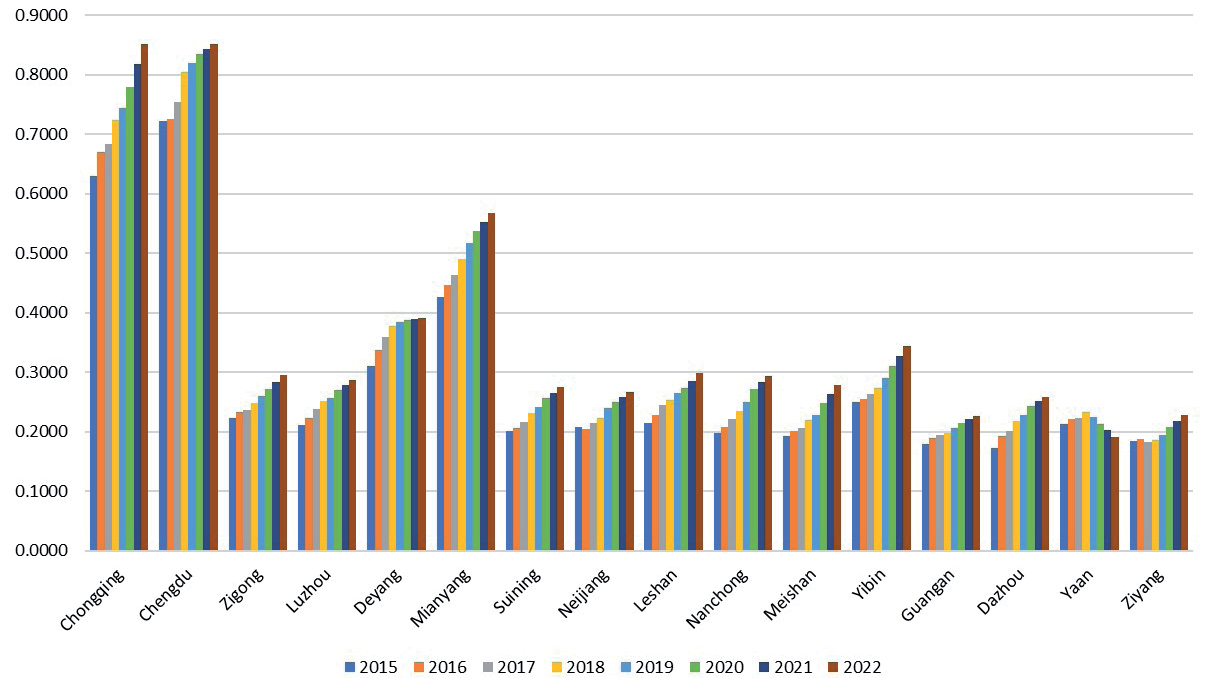
According to the calculation of panel data, the comprehensive score and corresponding growth rate of new urbanization in Chengdu-Chongqing Economic Circle are shown in Table 5 and Table 6. It can be seen that the overall comprehensive score of new urbanization in each city has significantly increased from 2015 to 2022. The calculation in Table 6 shows that the average growth rate of the comprehensive score of new urbanization in the Cheng-du-Chongqing dual-city economic circle from 2015 to 2016 is 23.21%, while the average growth rate from 2016 to 2017 is reduced to 8.29%. From the perspective of national policy, it is closely related to the transformation of the development path of the “Chengdu-Chongqing urban agglomeration development plan” implemented in April 2016, and the plan emphasizes the leading role of the core city to the surrounding small and medium-sized cities, and promote the improvement of the new urbanization system and the coordinated development between cities. The past “Chengdu-Chongqing Economic Zone” focuses on the radiation of Chongqing and Chengdu to the western region and the attraction of industrial population. The planning of “urban agglomeration” is based on the “economic zone”, which also leads to the decrease of the average growth rate in the transition period.
Related to the development plan of Chengdu-Chongqing urban agglomeration, Chengdu’s new-type urbanization development in 2015 has been significantly higher than that of other urban areas, and combined with the policy bias towards the radiation and driving effect on other small and medium-sized cities, Chengdu’s new-type urbanization development in 2016 has stopped due to the development plan. Therefore, while the comprehensive score of new-type urbanization in each city of Cheng-du-Chongqing economic circle has basically increased steadily, Chengdu has slightly decreased in 2016, but the development plan has laid a good foundation for further development. The comprehensive score of new-type urbanization in Chengdu ranked first, reaching 0.8566 in 2022, surpassing other urban areas in Chengdu-Chongqing economic circle. The comprehensive score of new-type urbanization in Chongqing ranked second in 2022, with an overall upward trend. However, compared with Chengdu, there is still a certain gap, which is related to the complex terrain and large rural area of Chongqing. The mountainous hills in Chongqing account for 98% of the total area of Chongqing, the rural areas account for 95%, and the rural population ac-counts for about 30%. Compared with Chongqing, Chengdu has more advantages in regional and topographic environment.
From the overall perspective, the comprehensive scores of the new urbanization of the 16 cities in the panel data are in an upward state, and the regional planning of the Chengdu-Chongqing Economic Zone and the development planning of the Chengdu-Chongqing urban agglomeration have achieved remarkable results. However, the comprehensive score of new urbanization in individual cities in 2022 is still low. For example, in 2022, the comprehensive score of Dazhou was 0.4234, and the comprehensive score of Ziyang was 0.3794. On the basis of “the construction plan of Chengdu-Chongqing double city economic circle,” the overall development level of new urbanization needs to be further strengthened.
Analysis of Coupling Coordination Degree
Based on the analysis of the comprehensive score of scientific and technological innovation and new urbanization in the Chengdu-Chongqing dual-city economic circle, through the measurement of the coupling level and the comprehensive evaluation index, the coupling coordination degree of scientific and technological innovation and new urbanization in the Chengdu-Chongqing dual-city economic circle is obtained by calculation and collation, as shown in Table 7 and Fig. 1. The relevant coordination degree and classification are referred to Table 2.
The level of coupling and coordination between scientific and technological innovation and new urbanization in each city of Chengdu-Chongqing dual-city economic circle has been improved in the panel data. Among them, Chengdu has developed from intermediate coordination in 2015 to good coordinated development, and Chongqing has improved from primary coordination in 2015 to good coordinated development. The main reason is that Chongqing and Chengdu, as municipalities and provincial capitals, are more competitive in industry [39], talent and resources. Before 2016, the regional planning of Chengdu-Chongqing Economic Zone and the Belt and Road Initiative promote each other. Further promote the coordinated development of science and technology innovation and new urbanization in Chengdu. From the average coupling coordination degree of science and technology innovation and new urbanization in Chengdu-Chongqing dual-city economic circle, the overall coordination degree is not obviously attributed to the large gap between other cities and Chongqing and Chengdu.
Combined with the dimensions in Table 1, it can be known that the coupling coordination degree of scientific and technological innovation and new urbanization in Chengdu-Chongqing twin-city economic circle is in an overall growth state. Although the level of coupling coordination between scientific and technological innovation and new urbanization in most cities in the Chengdu-Chongqing economic circle has im-proved over time, 13 cities including Zigong, Luzhou, Suining, Ya‘an and Ziyang, are still in a state of imbalance until 2022, and Mianyang is in a state of reluctant coordination, The coordination degree is not higher than 0.6. Based on the advantages of provincial capitals, municipalities and geographical locations, the gathering of external resources to Chengdu and Chongqing leads to the lack of other urban resources in the Chengdu-Chongqing dual-city economic circle. In addition, due to the policy planning that takes Chongqing and Chengdu as the strategic basis to promote the role of urban radiation, the development of the other 14 cities in the Chengdu-Chongqing dual-city economic circle shows a lag effect, and the coupling coordination degree of scientific and technological innovation and new urbanization is also at a low level.
PVAR Model Test
Based on the above research on the coordinated development status and trend of scientific and technological innovation and new urbanization in Chengdu-Chongqing economic circle, in order to further verify the relationship between scientific and technological innovation and new urbanization, the PVAR model is used to test the interaction between the two. The comprehensive evaluation score of scientific and technological innovation (STI) is selected as the proxy variable of scientific and technological innovation in Chengdu-Chongqing economic circle, and the comprehensive evaluation score of new urbanization (URB) is selected as the proxy variable of new urbanization development in Chengdu-Chongqing economic circle. The proxy variables and names of the two subsystems are arranged as shown in Table 8.
Unit Root Test
Before estimating the PVAR model, in order to avoid the phenomenon of pseudo-regression, it is necessary to test the stability of the data. This paper combines LLC test, IPS test and Fisher test for stationarity test, and the test results are shown in Table 9. According to the results, the P values under the three test methods are all less than 0.05, which verifies that the two variables of the comprehensive score of scientific and technological innovation and the comprehensive score of new urbanization in Chengdu-Chongqing economic circle are stable sequences.
Cointegration Test
Based on the cointegration test method of panel data, combined with Kao test and Westerlund test, the cointegration relationship between technological innovation and new urbanization is verified. The test results are shown in Table 10 and Table 11 respectively. Table 8 shows five different test statistics. The P values of the five elements are all less than 0.05, so the null hypothesis of “no cointegration relationship” is rejected at the level of 5%. Similarly, in Table 11, the P value is 0.0219, less than 0.05, rejecting the null hypothesis at the 5% level. Therefore, the two cointegration test methods verify the cointegration relationship between technological innovation and new urbanization.
Table 8.
Proxy variable name.
| Variable | Original Sequences |
|---|---|
| Comprehensive score of scientific and technological innovation | STI |
| Comprehensive score of new urbanization | URB |
Table 10.
Kao test results.
Granger Causality Test
In order to further analyze the dynamic causal relationship between technological innovation and new urbanization in Chengdu-Chongqing economic circle, the Granger causality test is carried out on the variables by using stata15 software. The test results are shown in Table 12. The P value in the first row is 0.006, less than 0.05, rejecting the null hypothesis that URB is the Granger cause of STI. The P value in the second line is 0.000, less than 0.05, rejecting the null hypothesis, so STI is the Granger cause of URB. That is, there is a two-way Granger causality between STI and URB. The scientific and technological innovation of Chengdu-Chongqing economic circle has a significant role in promoting the development of new urbanization, and the new urbanization can effectively promote the improvement of scientific and technological innovation.
Impulse Interference Wave Response Analysis
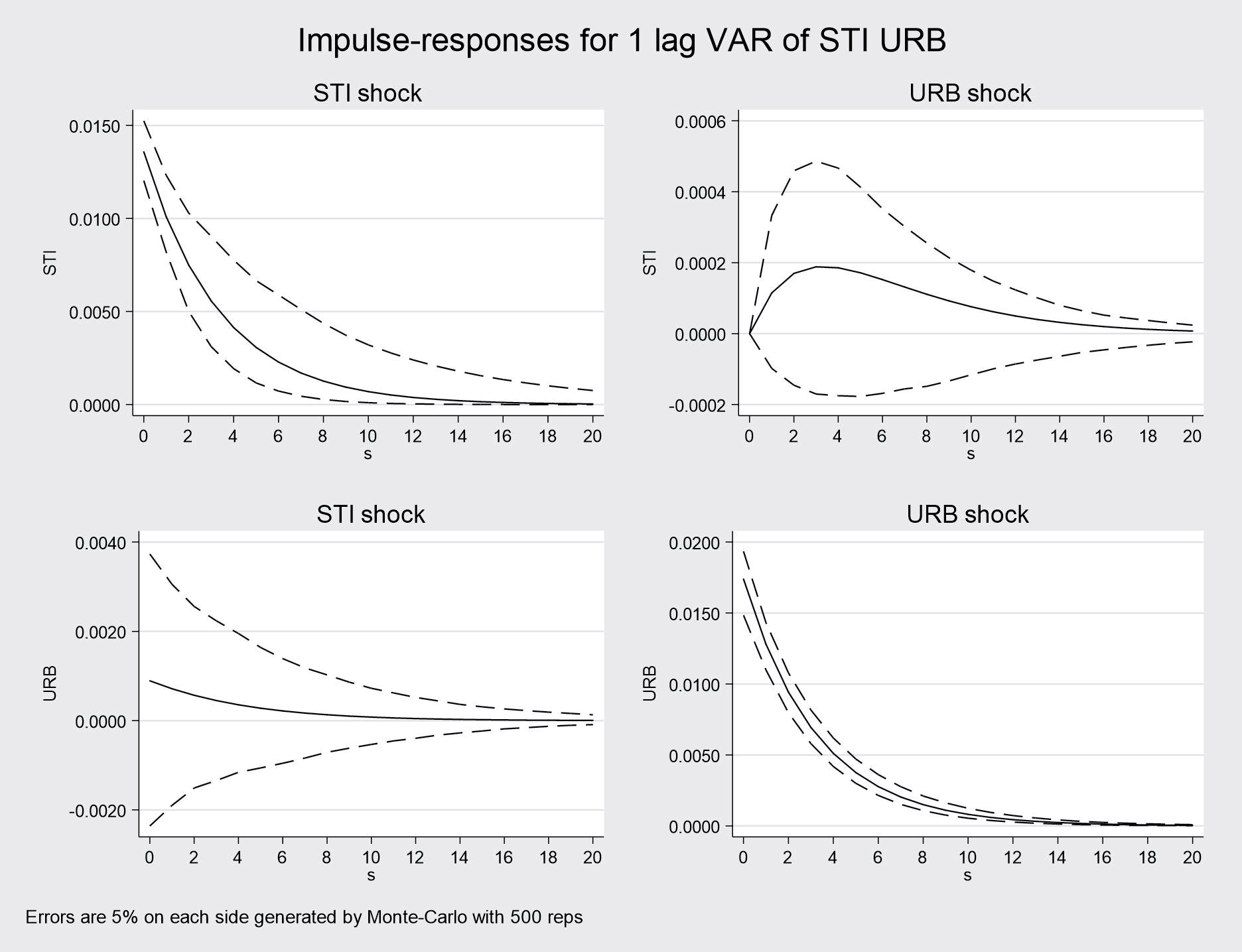
On the premise of obtaining the cointegration relationship between scientific and technological innovation and new urbanization in the Chengdu-Chongqing Economic Circle, the dynamic correlation between the two in the long run is further analyzed. The impulse response diagram of the variable is obtained by 500 Monte Carlo simulations, as shown in Fig. 2.
The first Fig. in Fig. 2 shows that when scientific and technological innovation is impacted by itself, the response value peaks at the beginning and gradually decreases with the advancement of time, so scientific and technological innovation has a strong dependence on itself. According to the third diagram, when the scientific and technological innovation is impacted by the new urbanization, it reaches the maximum response in the early stage, and then the impact gradually decreases. It shows that the development of new urbanization is conducive to the improvement of scientific and technological innovation level, and strengthening the construction of new urbanization will effectively promote the progress of urban scientific and technological innovation.
The second Fig. in Fig. 2 reflects the response of the new urbanization when it is impacted by itself. According to the trend on the way, the new urbanization does not respond in the current period when it is impacted by itself, and then responds and begins to decline after reaching the peak in the third period. It can be seen from the fourth Fig. that the response value of the impact of new urbanization on a standard deviation of scientific and technological innovation is positive, and reaches the maximum in the current period, and then gradually declines and tends to be gentle. It shows that scientific and technological creation has driven the construction of new urbanization and encouraged the output of scientific and technological innovation of enterprises, which plays an important role in promoting the construction of new urbanization.
Conclusions
In this study, the entropy weight method is used to calculate the weight of each index of the scientific and technological innovation subsystem and the new urbanization subsystem, and the comprehensive evaluation score of the scientific and techno-logical innovation and new urbanization of the Chengdu-Chongqing Economic Circle is calculated by the formula 5-6. The coupling coordination model is further constructed, and the coupling coordination degree of the two subsystems is calculated by the formula 7-10, and combined with the PVAR model test. According to the empirical results and the corresponding data analysis, the following conclusions are summarized:
First, from a holistic perspective, the level of scientific and technological innovation and the level of new urbanization in Chengdu-Chongqing dual-city economic circle are on the rise, but there are significant differences among cities. The development level of large cities is far higher than that of other small and medium-sized cities.
Second, the coordination degree of scientific and technological innovation and new urbanization in Chengdu-Chongqing dual-city economic circle shows an upward trend year by year, but some small and medium-sized cities are still in a state of imbalance.
Third, there is an equilibrium relationship between the scientific and technological innovation and the comprehensive evaluation score of the new urbanization in the Chengdu-Chongqing Economic Circle, and it is a two-way Granger causality. Technological innovation and new urbanization influence each other.
According to the empirical data and research conclusions, the practical implications for scientific and technological innovation and sustainable development of new urbanization in Chengdu-Chongqing dual-city economic circle are as follows:
First, increase investment in scientific and technological innovation, and guide enterprises to carry out scientific and technological innovation to nurture new urbanization. According to the “Seventh National Census Bulletin of Sichuan Province”, the number of people with a university degree in Chengdu is 25582 per 100,000 people, which is much higher than other cities in Sichuan Province. The higher education level has a certain effect on the development of urban science and technology innovation [40]. Therefore, we should strengthen the “inflow” and “retention” of high-tech talents in small and medium-sized cities of Chengdu-Chongqing economic circle to narrow the gap of scientific and technological innovation ability between cities. Increasing subsidies and tax incentives for enterprisesʼ innovative industries will promote enterprisesʼ emphasis on innovative projects and investment in innovative technologies, and enhance the level of scientific and technological innovation from the perspective of capital and talent introduction, thus nurturing the development of new urbanization.
Second, accelerate the construction of new urbanization, and actively integrate with urban development. Basic public service efficiency and new urbanization construction promote and restrict each other [39]. In terms of public service facilities, the popularization of water supply and gas in some cities in the Chengdu-Chongqing economic circle has not been effectively improved in recent years. Based on the existing level of social services, we should further strengthen the level of social security and public services, enhance the construction of new-type urbanization, and make mutual connection and progress with the development of scientific and technological innovation.

