

Introduction
The current improvement and success in terms of technology, society, and the provision of multiple services after the Industrial Revolution was accompanied by a massive toll of air pollutants that were introduced and emitted into the air, causing global public health issues [1]. Air pollutants are among the factors that play a role in the interaction between humans and their physical surroundings [2]. They are labeled as one of the critical determinants of life expectancy today [3]. The toll on public health is becoming more central to policy discussions, making quantification even more essential [4, 5]. According to World Health Organization (WHO) statistics, in 2019, almost all of the world’s population (99%) breathed air containing high levels of pollution, surpassing the WHO guideline limits [6, 7]. 2016, the World Health Organization (WHO) reported that ambient air was associated with 4.2 million premature deaths. An estimate is projected to increase due to the increasing number of people living in places with hazardous air quality [6].
The new WHO guidelines specify six pollutants: particulate matter (PM), ozone (O₃), nitrogen dioxide (NO₂), sulfur dioxide (SO₂), and carbon monoxide (CO), as they are primarily linked to the worst health outcomes and environmental health impacts [6]. The risk associated with particulate matter equal to or smaller than 10 and 2.5 microns (µm) in diameter (PM₁₀ and PM₂.₅) is of particular public health relevance either in the short-term (acute) or long-term (chronic) exposure [8]. The smaller the size, the higher the penetration ability of the particles, invading the deepest parts of the lungs and more easily reaching the bloodstream, resulting in respiratory and cardiovascular effects and affecting other organs [9].
Furthermore, empirical data demonstrates a positive correlation between elevated ambient levels of PM₂.₅ and the incidence of depression [10]. Several studies [11] have reported a correlation between the daily ranges of PM concentrations and mortality [12-14]. Furthermore, in 2013, the WHO International Agency for Research on Cancer (IARC) classified outdoor air pollution and particulate matter as carcinogenic [6].
Researchers [15] studied the ecological footprint of E7 countries from 1990 to 2017 and how it affects health outcomes. They analyzed this relationship using two models: Panel Fully Modified Ordinary Least Square (FMOLS) and Dynamic Ordinary Least Square (DOLS). The study found that a higher ecological footprint positively correlates with increased life expectancy. This suggests that a favorable environmental footprint is essential for human life. However, monitoring ecological footprints in the long run is crucial to maintain this benefit to human life. Therefore, it is necessary to implement targeted strategies to keep ecological footprints at a favorable level.
Carbon Monoxide (CO) is another pollutant associated with human health; its toxicity is primarily attributable to the more competitive affinity of CO for hemoglobin than for oxygen, which is nearly 200-fold higher [16]. It causes poisoning, hypoxia, ischemia, and cardiovascular [17]. However, continued public health education has reduced global mortality by 40% [18]. Another air pollutant is nitrogen dioxide (NO₂), a highly reactive gaseous air pollutant that causes increased airway inflammation and worsens respiratory symptoms [19, 20].
Life expectancy at birth is a human development index and one of the most widely used health indicators associated with air pollution [6, 21, 22]. Improvements in life expectancy are associated with improved life achievements. This is desirable for both intrinsic value and personal life accomplishments. Several medical studies have focused on life expectancy as an important indicator of human health. Excellent longevity and health are associated with higher production, an essential stimulus for long-term economic growth, consequently boosting GDP growth [23].
A study in 46 Asian countries [24] examines the impact of various factors on health outcomes from 1997 to 2019. Health expenditure and energy consumption positively affect health outcomes, while CO2 emissions have a negative impact. Population size has a mixed effect across different estimation methods. Healthcare spending significantly influences life expectancy, indicating the need for increased spending to improve health outcomes.
Public Health expenditure measures the final consumption of health goods and services plus capital investment in the healthcare infrastructure [25]. Vigorous economic development is accompanied by improvements in people’s quality of life. However, air pollution exacerbates human health problems and increases health expenditures owing to increased medical and health costs [26-28]. According to previous studies, healthcare expenditure significantly impacts and improves life expectancy [24, 29-36].
Saudi Arabia faces some of the most significant air pollution burdens [37-39]. Over the years, there has been a gradual increase in chemical production and petroleum refining, accompanied by rapid economic growth (Fig. 1), causing increased air pollutant emissions and negatively affecting health outcomes [40, 41]. As a result, the country experiences more deaths attributable to pollutants than other countries with comparable incomes [42]. According to a global burden of disease report, outdoor air pollution is associated with 18,600 mortalities and 2.04 years of loss of life expectancy [43]. Furthermore, ambient PM₂.₅, the fifth health risk factor, represents 9% of the total mortality [44]. Although the associated mortality and DALY have decreased gradually since 2011, air pollution concentrations have continued to increase, exceeding the WHO air quality guidelines [41]. However, health expenditures in the country are positively correlated with the efficiency of health outcomes [45]. This indicates the ability of the healthcare system to provide high-quality care while effectively managing finances. [46-48]. This is a crucial factor to consider in the healthcare industry because rising costs can restrict patient’s access to vital care and burden the economic resources of healthcare organizations. Preventative care and early intervention can reduce costly treatments and boost economic efficiency [49]. This may include health education, screening, and lifestyle modification.
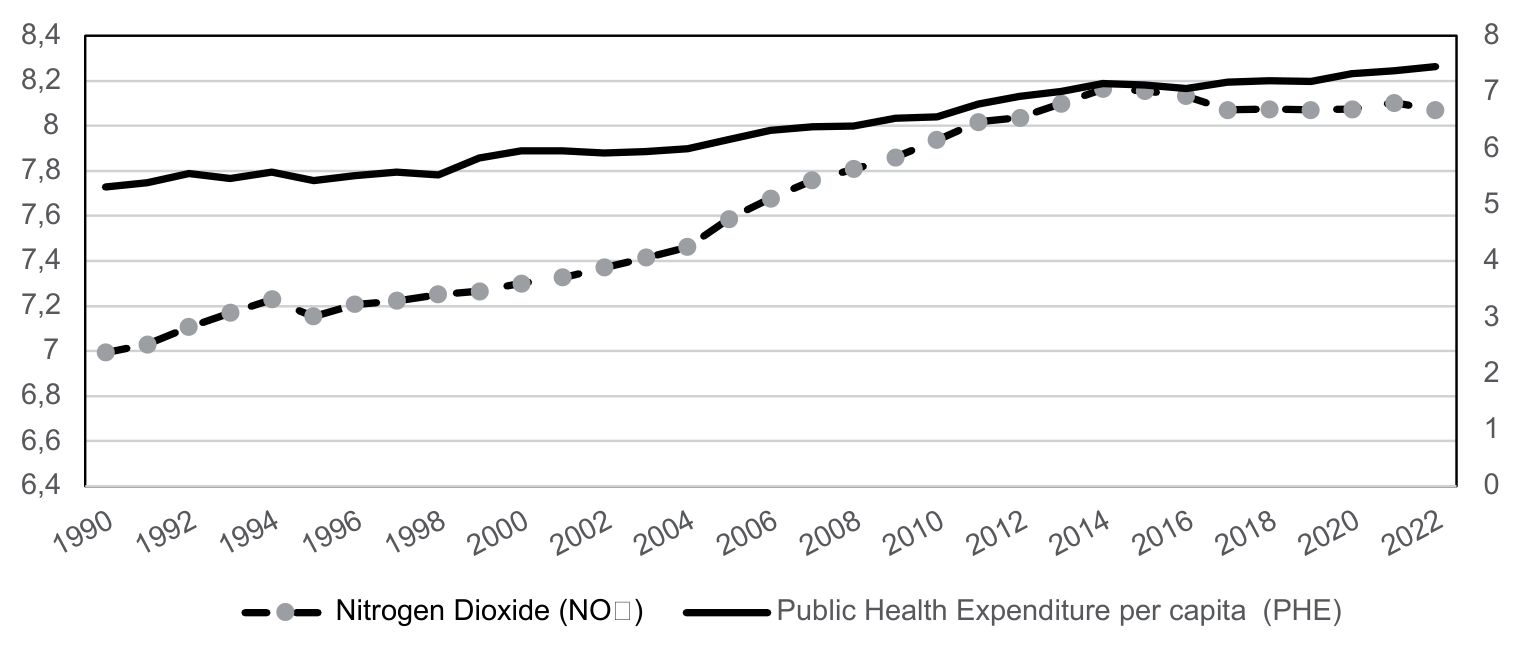
In this study, life expectancy was used as a public health outcome. The main variables of interest are air pollutants proxied by delicate particulate matter PM₂.₅, nitrogen dioxide (NO₂), public health expenditure per capita (PHE), and CO carbon monoxide, and impact on Life expectancy (LE). The study’s primary hypothesis is that the positive correlation between economic growth and life expectancy will persist and that air pollutants will negatively impact life expectancy.
The contributions of this paper are as follows: first, to our knowledge, this is the first paper that has addressed this topic using time series data for more than 33 years in Saudi Arabia; secondly, fine particulate matter PM₂.₅ is often used as an essential indicator of air pollution in the existing literature, in this paper we used NO2 also. This study aimed to investigate the effect of the PM₂.₅, NO₂, PHE, and CO carbon monoxide on LE in Saudi Arabia from 1990 to 2022 using the empirical test of the novel Bootstrap Autoregressive Distributed Lags model developed by [50].
Material and Methods
Data and Model Specification
This study discusses the association between Environmental Health assessed by CO Carbon Monoxide per capita (CO), Public Health Expenditures per capita (PHE), Toxic Air Pollution (PM₂.₅ and NO₂), and Life Expectancy (LE) [6], of Saudi Arabia for the period 1990-2022 (Table1), all variables are transformed into logarithmic form. This model is expressed by Equation (1):
Methodology
Unit Root Tests
Augmented Dickey-Fuller (ADF) and Phillips-Perron (PP) models were used [51, 52]. Furthermore, we used the unit root test with structural breaks (Zivot & Andrews, 2002) in the intercept and trend terms of the time-series data of PM₂.₅, NO₂, PHE, CO Carbon Monoxide and LE.
ARDL Bounds Test
To investigate the long-run causal relationship between PM₂.₅, NO₂, PHE, CO₂, and LE, using the variables I(0) or I(1), the autoregressive distributed lag (ARDL) bound test is used (1) [53]. Equation (2) illustrates the ARDL Approach:
(2)
Table 1.
Data description.
Where:
The Bootstrap ARDL Bounds Test
The Bootstrap ARDL method proposed by McNown [50], is a powerful tool for analyzing and forecasting time-series data. This method combines the classical ARDL model with a bootstrap technique to obtain more accurate results. The Bootstrap BARDL method is based on the traditional ARDL model, an econometric model used to study the relationship between a dependent variable and one or more independent variables. It was also used to provide more accurate estimates of the parameters of the ARDL model [54].
In a long-term relationship, not all series must be integrated in the same order: I(0) or I(1). McNown also used a lagged independent variable to support the present (F-test and t-test) and enhance the ARDL bound test [50, 53]. There are two degenerate cases that McNown [50] investigated: (1) if the lagged independent variable shows significant results in both the F-test and t-test, then the t-test on the lagged dependent variable is not significant; and (2) if the lags in the dependent variables are statistically significant using the F-test and t-test, then the lags in the independent variables are not.
Cointegration and Granger Causality Test
The next step in this analysis is that the cointegration test does not show the direction of causation between variables; it only shows the existence of Granger causality in at least one direction. A long-term cointegrating vector-derived error correction model (ECM) [55] was used to determine the cause of this situation. The t-statistics of the error-correction term that only applies to the ECM are used to examine long-term causal effects. In contrast, F-statistics and t-statistics can be used to interpret short-term causal effects. The F-statistics and t-statistics of the independent variables and the t-statistics of the error correction terms demonstrate a causal effect.
The co-integration results suggest long- and short-term relationships between the variables, and an error correction model (ECM) was used to determine the directions of the causal relationship (ECM). According to [37, 38], suppose a long-term relationship is discovered. The ECM framework model (Equation 3) is as follows:
(3)
Where:
(1 − L) = first difference
ln = the natural logarithm
[(ECM]_(t − 1)) the lagged error correction terms
ε1, ε2, ε3, ε4, ε5 = error terms
Results and Discussion
Empirical Results
The results of the descriptive statistics indicate that, according to the Jarque-Bera statistical data and standard deviations, all variables are normally distributed at the 5% significance level. The skewness values are within the normal distribution range; skewness, kurtosis, Jarque-Bera, and probability statistics data are also shown (Table 2).
The results in Table 3 indicate that PM₂.₅, NO₂, PHE, CO carbon monoxide, and LE, are stationary at the first difference I(1), which means that all the variables are integrated in order I(1). These empirical data indicate that the time series is nonstationary at the level, even if all variables are stationary at the first difference. Consequently, given the associated breakpoints, the unit root tests pass [56].
The unit root test findings show that all variables are integrated in the order I(1); hence, we employed the ARDL limits test method in our empirical model. Criteria such as the Akaike Information Criterion (AIC), Schwarz Bayesian Criterion (SC), and Hannan-Quinn Criterion (HQ) were used to determine lag order. Table 4 shows that lag order (4) is the best length for evaluating cointegration in the long-run ARDL bounds model. In addition, lag order four is suitable for our model data, and its distribution is normal.
In this step, we employ Bootstrap ARDL based on the cointegration test approach to examine cointegration because all the variables have already been integrated. Table 5 illustrates the results of the bootstrap ARDL test based on the cointegration test, showing sufficient evidence to reject the null hypothesis of no cointegrating relationship between PM₂.₅, NO₂, PHE, CO carbon monoxide, and LE.
Table 6 illustrates the Granger causality analysis based on the Bootstrap ARDL Model to determine the causal relationship between the PM₂.₅, NO₂, CO carbon monoxide, and LE in Saudi Arabia. The results indicate a negative one-way causal relationship between CO₂ emissions, NO2, PM2.5, and LE – an increase in PM₂.₅, NO₂ and CO carbon monoxide were associated with decreased LE. Another one-way causal relationship between PM₂.₅, NO2, and CO carbon monoxide and PHE was also detected; the increase in PM₂.₅, NO2 and CO carbon monoxide were associated with increased PHE. Finally, a positive two-way causal relationship was detected; an increase in PHE caused an increase in LE.
Table 2.
Descriptive Statistic.
Table 3.
ADF, PP, and ZA unit root test results.
Table 4.
Lag-order selection criteria.
| Lag | LogL | LR | FPE | AIC | SCI | HQ |
|---|---|---|---|---|---|---|
| 0 | 121.356 | NA | 9.746 | 6.025 | 8.317 | 7.170 |
| 1 | 217.421 | 371.384 | 0.0007 | 5.148 | 6.105 | 5.313 |
| 2 | 285.193 | 98.607 | 0.0002 | 4.074 | 5.974 | 5.722 |
| 3 | 381.295 | 443.522 | 0.0006 | 6.261 | 7.381 | 5.873 |
| 4 | 412.697 | 568.880* | 0.0009* | 6.661* | 7.936* | 6.607* |
Table 5.
Results of the bootstrap-ARDL cointegration test.
Table 6.
Granger-Causality Analysis based on Bootstrap ARDL Model.
Discussion
This study aimed to investigate potential toxic air pollutants (PM₂.₅, NO₂), environmental health (CO carbon monoxide), public health expenditure per capita (PHE), and public health (life expectancy, LE) nexus in Saudi Arabia using the novelty bootstrap ARDL approach to examine the potential of cointegration and causality relationships between variables from 1990 to 2022. Empirically, the results validate the stationarity results for all the variables. Indicating that PM₂.₅, NO₂, PHE, CO carbon monoxide, and LE are stationary at the first difference I (1); all the variables are integrated in the order I (1).
Subsequently, we used the Bootstrap ARDL cointegration test approach to examine cointegration because all variables had already been integrated. The results of the bootstrap ARDL test based on the cointegration test show sufficient evidence to reject the null hypothesis of no cointegrating relationship between PM₂.₅, NO₂, PHE, CO carbon monoxide, and LE. Subsequently, we applied a Granger causality analysis based on the Bootstrap ARDL Model to determine the causal relationship between PM₂.₅, NO₂, CO carbon monoxide, and LE in Saudi Arabia from 1990 to 2022. The results indicate a negative one-way causal relationship between CO₂ emissions, NO2, PM2.5, and LE, an increase in PM₂.₅, NO₂, and CO carbon monoxide were associated with decreased LE, in line with [58- 65]. Another one-way causal relationship between PM2, NO2, and CO carbon monoxide and PHE was detected; an increase in PM2, NO2, and CO carbon monoxide was associated with an increase in PHE. An observation that is in the same direction as [66-88].
Finally, a positive two-way causal relationship was detected; an increase in PHE caused an increase in LE. It is well documented that countries with higher public health expenditures have a higher life expectancy than those with lower public health expenditures [29, 31, 32, 35, 36, 89-92].
Air quality in the surrounding area is one of the primary factors determining environmental pollution [93, 94]. A prerequisite for a healthy lifestyle is a high level of air quality in the surrounding environment. However, rapid industrialization has been linked to increased emissions of various gases and particulate matter (PM) [95]. Particulate matter and carbon monoxide contribute to air pollution, which is associated with overall environmental health and has detrimental effects on human health. Consequently, there will likely be an increase in the demand for medical treatment [94, 96, 97].
Furthermore, environmental health is part of public health and directly affects development through its influence on productivity. A healthy environment allows an individual to be more productive during the same unit of time, work for a longer time during the same day, and live a longer productive life [98]. Hence, it helps increase production and productivity. An efficient healthcare system can sustain public health measures, including disease prevention, health education, and community outreach. Economic efficiency and public health synergistically improve health outcomes, reduce healthcare expenditure, and boost social and economic growth.
Reducing carbon monoxide (CO) is crucial for human health and mitigating climate change [99, 100]. Saudi Arabia is one of the world’s largest oil producers, and its energy sector, including oil and gas extraction and refining, has been a significant contributor to CO carbon monoxide. However, the country aims to reduce carbon emissions and transition towards renewable energy sources. The national transformation agenda and national industrial development strategic areas for the Saudi government’s vision of 2030 aim to reduce environmental pollution for air, soil, and water to promote healthy living [101, 102]. Targeting generating 50% of its electricity from renewables and the other half from gas by 2030. In addition to implementing effective policies to encourage innovative technologies, such as smart carbon-free cities and green space [103-105]. Moreover, the Saudi Green Initiative aims to reduce greenhouse gas emissions to reach a net-zero zone by 2060. A significant aim and step toward achieving the Saudi Goal and improving air quality for a healthy living [106].
Conclusions
Environmental health can sustain public health measures, including disease prevention, health education, and community outreach. Results showed no cointegrating relationship and a negative one-way causal relationship between CO, NO₂, PM₂.₅, and LE. Moreover, a positive two-way causal relationship was found between PHE and LE. Economic efficiency and public health synergistically improve health outcomes, reduce healthcare expenditure, and boost social and economic growth. To achieve environmental protection and sustainability, the government of Saudi Arabia has initiated several projects to develop clean energy technologies, reduce waste, promote environmentally friendly industry practices, and generate electricity from renewable energy and gas by 2030. However, more regulations on industrial emissions and pollution are needed to reduce air pollution levels in the country. The effects of air pollutants are also associated with social, demographic, and economic factors. Therefore, a more holistic assessment and interventions are necessary to optimize the multi-sectoral approach involving collaboration between governments.
Policy Implications
The issues of air pollution, environmental health, and health economics are interconnected and significantly impact public health and policymaking. It is crucial to understand how harmful air pollutants affect ecological health and the economic consequences of such effects. It is important to consider implementing more robust and effective environmental regulations, such as stricter emissions standards for industries and vehicles, improved monitoring and enforcement, and harsher penalties for violations. Since Saudi Arabia heavily relies on the oil and gas industry, diversifying the country’s energy sources and transitioning to cleaner, renewable sources is crucial. Investing in solar and wind energy might have significant potential for regional growth due to their climate-friendly nature.
Further, increased training for healthcare professionals and public health campaigns to raise awareness about the risks of air pollution also have a significant potential impact on reducing medical expenses and lost productivity due to illness. Policymakers should consider these costs when deciding on environmental regulations and healthcare expenditures.
Limitations
This study had some limitations; first, this study was limited to Saudi Arabia; hence, the results cannot be generalized to other countries. Furthermore, this study is determined by the association between life expectancy and environmental factors. Additionally, PM₂.₅ is a heterogeneous mixture; we did not address its chemical composition or effect due to limited data. Finally, we used life expectancy as a health-related variable, although other measures of health outcomes may have been associated with the investigated factors.
Future Research
Environmental health and its associated hazards burden the economy and health, directly and indirectly, affect health quality and well-being. However, with the advancement of machine learning, several models were proposed to predict, manage, and mitigate disease progression. However, a collaborative, multisectoral, and transdisciplinary approach is needed to improve the shared environment, a step toward One Health.

