

Introduction
Against the backdrop of slowing global economic growth and unstable international economic and trade patterns, the trend of steady progress in the domestic economy has not changed. However, in the international market, the labels “high investment, high pollution” and “low price, low value” have always been accompanied by “Made in China”. The Fifth Plenary Session of the 19th Central Committee of the Communist Party of China proposed that in the process of comprehensively winning a moderately prosperous society in the past, efforts to control pollution have been continuously increased, the ecological environment has significantly improved, opening up to the outside world has continued to expand, and institutional advantages are significant. However, there is still a long way to go for ecological and environmental protection issues. During the 14th Five Year Plan period, the goal of continuously reducing total pollutant emissions and improving the ecological environment should be achieved. From an economic perspective, environmental governance has a positive impact on technological innovation, which can promote the process of green development [1, 2], and can also promote green economic progress by improving pollution emission efficiency and reducing pollution emissions. From a humanistic perspective, industrial waste is the main type of pollutant, and exhaust gas is mainly nitrogen oxides, which have the characteristics of a wide pollution range, fast diffusion speed, and a high degree of harm. These pollutants are not properly treated and discharged below emission standards, not only threatening human health but also causing damage to the homes that humans rely on for generations to survive. The problem of pollution control has always been one of the focuses of attention in China’s economic development. How to innovate systems to save energy and reduce emissions and thus widely form a green production and lifestyle is an important issue currently facing China.
At present, global trade is constantly turbulent, with unilateralism and protectionism continuing to rise. Faced with the severe international situation, China has proposed to build a new development pattern with domestic circulation as the main body and domestic and international dual circulation advancing each other. As a major measure to comprehensively deepen reform and expand opening up under the new situation, FTZ is an important driving force for stabilizing trade development and accelerating the formation of a new development pattern. Since the first FTZ was established in 2013, China has established 22 FTZ, and the establishment of FTZ has gradually entered deep waters, ushering in a new pattern of opening up to the outside world. Due to differences in geographical location and resource endowments, FTZ in different regions has different functional positioning, implementing distinctive policy measures in investment, trade, financial services, and other fields. The establishment of multiple institutional mechanisms fully reflects the outstanding achievements made in the establishment of FTZ. Previous studies have shown that the establishment of FTZ has, to some extent, driven the development of the local economy [3, 4]. However, while enjoying the benefits of the system, we should also be vigilant about its negative impact, especially the environmental impact brought about by industrial transfer and manufacturing agglomeration.
Most studies have examined the impact of the establishment of FTZ on economic growth. Scholars have studied whether China’s FTZ policies affect income inequality and found that the implementation of FTZ policies significantly reduces the income gap between provinces in China, with a more significant impact on the income gap in the eastern region [5]. Scholars have also evaluated the performance of the FTZ from the perspective of intensive land use, believing that factors such as land use degree, dominant industry function positioning, and structural diversification are important influencing factors on the level of intensive land use in the Shanghai FTZ. In the evaluation process of the FTZ, indicators such as its influence, social benefits, and ecological benefits should be included in the evaluation system [6]. Muhammad et al. (2017) used the SWOT analysis method to analyze the advantages and disadvantages of the China-Pakistan Free Trade Area. The results showed that Pakistan’s import and export trade had significantly increased before and after the signing of the China-Pakistan Free Trade Agreement, but with it, the trade deficit gradually increased [7]. In addition, some scholars believe that the establishment of FTZ has promoted regional economic growth [8-10].
Therefore, it is not difficult to find that the establishment of FTZ has reached a consensus on promoting regional economic growth, and few studies have examined the impact of FTZ establishment on urban environmental pollution, which has inspired our research. Based on this, we collected data on the establishment of FTZ in China from 2010 to 2021 and matched it with a dataset on environmental pollution to examine the impact of FTZ establishment on environmental pollution. The establishment of FTZ, as an exogenous policy shock, has brought exogenous changes to the environmental pollution of cities where policies are implemented, which can be approximated as a natural experiment. This helps us to use the differences-in-differences (DID) to identify the changes in local environmental pollution after the establishment of FTZ. Our research has found that, after the establishment of FTZ, the local environmental pollution level will decrease. In addition, we further found that the establishment of FTZ can effectively promote the upgrading of regional industrial structures and technological innovation, which are the main reasons for reducing environmental pollution. Our conclusion provides an important reference for developing countries to implement environmental protection.
Our study contributes to three strands of literature. Firstly, we use a DID model to reduce endogeneity interference in the empirical part, which is conducive to accurately identifying the causal effect between the establishment of FTZ and environmental pollution. Secondly, we construct a mediation effect model to analyze the path of improving urban environmental pollution through the establishment of FTZ from two aspects: upgrading industrial structure and improving technological innovation level. Thirdly, our conclusion clearly indicates that the establishment of FTZ has reduced urban environmental pollution, providing a reference for other developing countries to implement environmental protection policies. The research conclusion of this article is of great significance for the FTZ to formulate reasonable industrial planning and promote the green development of the urban economy.
The rest of the paper is structured as follows: Section 2 provides background information and theoretical analysis. Section 3 describes the data, variables, and empirical specifications. Section 4 presents the baseline results and robustness results. Section 5 presents the mechanism analysis, and Section 6 concludes.
Background and Theoretical Analysis
Background
After the 2008 financial crisis, trade protectionism emerged in various countries, and regional bilateral and multilateral free trade agreements continued to emerge, such as the TPP, TTIP, and TISA. The signing and development of these regional trade agreements have had a significant impact on global trade rules and standards, directly or indirectly affecting China’s comparative advantage, market access, and international discourse power, making China face more severe challenges in integrating into globalization strategies. At the same time, China is also facing urgent practical problems such as the gradual decline of traditional factor dividends, difficulties in industrial structure adjustment and upgrading, and slow progress in economic system reform. This makes it difficult for the country’s administrative management system, economic freedom, and business environment to adapt to the current high-standard economic and trade rules in the world.
Given the aforementioned domestic and international background, the State Council issued the Overall Plan for China Pilot FTZ in September 2013, establishing the first domestic FTZ in Shanghai, actively connecting with new rules and standards for international trade and investment, and using this to force domestic market economy system reform. In order to promote pilot experience and amplify the institutional dividend effect of FTZ, the State Council has successively approved the establishment of FTZ in Guangdong, Tianjin, Fujian, Liaoning, Zhejiang, Henan, Hubei, Chongqing, Sichuan, Shaanxi, Hainan, Shandong, Jiangsu, Guangxi, Hebei, Yunnan, Heilongjiang, Beijing, Hunan, and Anhui. At this point, China has a total of 22 FTZ, covering two-thirds of the country’s provinces and cities, forming a new pattern of “1+3+7+1+6+3” reform and opening up.
As of July 2021, a total of 278 institutional innovation achievements at the national level and approximately 1400 replicable and promotable institutional innovation achievements at the local level have been summarized in 22 FTZ, involving government function transformation, investment and trade liberalization and facilitation, financial openness and innovation, the rule of law environment, and regulatory systems. Since the establishment of FTZ, China has achieved remarkable results in economic system reform and innovation and has made great achievements in optimizing the business environment. According to the Global Business Environment Report released by the World Bank over the years, China’s business environment index has jumped from 96th place in 2013 to 31st place in 2022.
Theoretical Analysis
The establishment of FTZ is an important policy for the country to adapt to various changes and contradictions, deepen reform, and expand its opening up in the new situation. With the support of the local government, many FTZs have innovated their institutional mechanisms from multiple dimensions in order to build them into internationally competitive parks. Firstly, the establishment of FTZ can fully leverage reform autonomy, carry out institutional innovation in areas such as trade, finance, and the legal system, attract high-quality enterprises through relevant policies, and promote the optimization and upgrading of urban industrial structures. Industrial structure upgrading is a key path to curbing environmental pollution. On the one hand, the establishment of FTZ generates a competitive effect through efficient resource allocation and increased entry barriers, promoting the survival of the fittest among enterprises, eliminating backward enterprises that cause serious environmental pollution, and suppressing the aggravation of environmental pollution. On the other hand, the establishment of FTZ attracts a large number of high-tech enterprises to settle in the park by absorbing foreign investment. At the same time, it guides the transformation of park enterprises from resource intensive to technology intensive, promotes the upgrading of enterprise production methods through innovative green technologies, and further reduces environmental pollution. In terms of the impact of industrial structure upgrading on environmental pollution, Cole et al. (2003) argue that capital intensive production is highly correlated with environmental pollution [11]. Lin (2017) found that the reduction of trade barriers significantly reduced the carbon dioxide emissions of enterprises, which was mainly due to the reduction of coal use intensity and cleaner production processes [12]. In addition, some scholars have found that the larger the proportion of the secondary industry, the higher the degree of environmental pollution, while the tertiary industry can alleviate the deepening of environmental pollution. The industrial structure is closely related to the degree of environmental pollution [13, 14]. In summary, it can be considered that upgrading the industrial structure is beneficial for improving the environmental pollution situation.
Secondly, in the process of constructing FTZ, the degree of openness to the outside world gradually increases, the degree of marketization also increases, and the allocation of resource elements is further improved, among which the allocation of environmental resource elements is also optimized. In the process of continuously optimizing resource allocation and guided by market mechanisms, enterprises change their production methods, promote technological innovation, and provide the impetus for the green development of FTZ and regional sustainable development. According to Porter’s hypothesis, incentivizing environmental regulatory policies will encourage enterprises to engage in technological innovation, which will increase their productivity, compensate for the cost losses caused by environmental governance, and enhance their competitiveness. The coordination role between government policies and environmental protection can be fully utilized. The government has formulated multiple preferential policies, and the institutional mechanism innovation of FTZ has attracted enterprises to increase their technological innovation efforts, driving local enterprises to improve emission reduction technologies and reduce environmental pollution [15, 16]. In summary, it can be considered that technological innovation can suppress urban environmental pollution. Based on this, this article proposes the following hypothesis:
Hypothesis 1: The establishment of FTZ reduces urban environmental pollution through two paths: upgrading industrial structures and technological innovation.
The establishment of FTZ has reduced trade barriers between regions, effectively promoted the free flow of factors between regions, and made trade activities in different regions no longer limited to their own regions. It has strengthened trade and economic connections between regions and, to some extent, changed the regional development pattern. At the same time, the development of FTZ not only promotes the cities they are located in, but also serves as a demonstration and driving force for other regions, thus their policy effects have a certain regional radiation power [17, 18]. Chen and Hall (2011) believe that the convenience of factor flow between regions is an important factor affecting industrial upgrading, thereby promoting technology spillovers [19]. Wang et al. (2019) measured the international competitiveness of China’s manufacturing industry and found that the expansion of the FTZ network can promote the growth of the country’s manufacturing output value, and the increase in foreign trade dependence can enhance the competitiveness of the country’s manufacturing industry [20]. However, based on different association rules, the establishment of FTZ will have different spatial effects on the manufacturing industries of different neighboring countries or regions. Jiang et al. (2021) studied the policy effects of FTZ establishment on air pollution and found that pilot cities can not only improve air pollution through industrial structure upgrading and technological innovation, but also generate spatial spillover effects to improve the atmospheric environment of neighboring cities [21]. According to existing research, the establishment of FTZ has spatial spillover effects on the economic development, industrial development, and other aspects of surrounding cities. Therefore, the inhibitory effect of FTZ establishment on environmental pollution should not be limited to this region, and the environmental pollution of surrounding cities may also be improved by the establishment of FTZ. Therefore, this article proposes the following hypothesis:
Hypothesis 2: There is a spatial spillover effect of the establishment of FTZ on urban environmental pollution.
Data and Research Design
Data Source
Our dataset comprises multiple sources, mainly including the urban environmental pollution index, the establishment of FTZ, and other data at the city level.
Urban environmental pollution index: To scientifically reflect the environmental pollution situation in various cities, we calculate the comprehensive environmental pollution index of each city from three dimensions: industrial wastewater, sulfur dioxide, and smoke dust emissions, using the entropy method, and correct outliers to more accurately reflect the regional environmental pollution situation. Considering the availability of data and to ensure the consistency of the data sample, this article has determined the data sample period to be from 2010 to 2021.
Establishment of FTZ: The independent variable is a dummy variable of whether a city has established an FTZ. If the city has established an FTZ, the value of did is assigned to 1, otherwise it is 0. Post is a policy time dummy variable. If the city established an FTZ in 2015, the value of Post is 1 in 2015 and beyond; otherwise, it is 0. Meanwhile, considering that the FTZ established from 2018 to 2019 has not yet produced significant economic and environmental effects during the sample period, the selected sample for the treatment group is 22 cities that established FTZ from 2013 to 2017, with other cities as the control group.
Mechanism variable: Industrial structure upgrading, using the ratio of the added value of the tertiary industry in each city to the sum of the added values of the primary and secondary industries to represent the overall upgrading status of the city’s industrial structure. The level of technological innovation is characterized by the number of patent applications in each city in the current year.
Other city-level data mainly include the economic development level, the proportion of the secondary industry to GDP, FDI, city size, and urbanization rate. These data mainly come from the website of the National Bureau of Statistics and the China City Statistical Yearbook.
Table 1 reports the summary statistics of the above dependent variable, independent variable, control variables, and mechanism analysis variables.
Empirical Strategy
The most commonly used method for evaluating policy effects is the DID method. Due to the differences in the timing of the establishment of each trade zone, in order to better examine the impact of the establishment of FTZ on the environment, this article chooses a staggered DID.
Table 1.
Summary statistics.
In Eq. (1), pollutionit is the outcome variable, which is represented by the urban environmental pollution index; didit denotes the independent variable, which is a dummy variable used to describe FTZ. It will be coded 1 in the current and subsequent years if city i is piloted in year t and 0 otherwise. Xit denotes a series of control variables that may affect environmental pollution, including economic development level, the proportion of the secondary industry to GDP, FDI, city size, and urbanization rate. yeart and cityt are year fixed effects and city fixed effects, respectively, and εit is the error term. The coefficient β1 on the post-visit dummy captures the treatment effect of the FTZ on urban environmental pollution.
Main Results
Baseline Results
Starting with the staggered DID of the baseline, we estimate Eq. (1) using the urban environmental pollution index from 2010 to 2021 as the dependent variable. To ensure the accuracy of the empirical results, Table 2 presents our baseline results obtained by not adding control variables and adding control variables. Estimates are separately reported in Columns (1) and (2). The estimated coefficients of interest are highly significant. The results in Table 2 show that the establishment of FTZ has reduced urban environmental pollution as measured by the urban environmental pollution index. Specifically, in the results of Column (2), the estimated coefficient is -0.400, which means that after controlling the relevant control variables and fixed effects, the cities piloted by the FTZ have significantly lower pollution emissions than those cities not piloted.
Parallel Trend Test
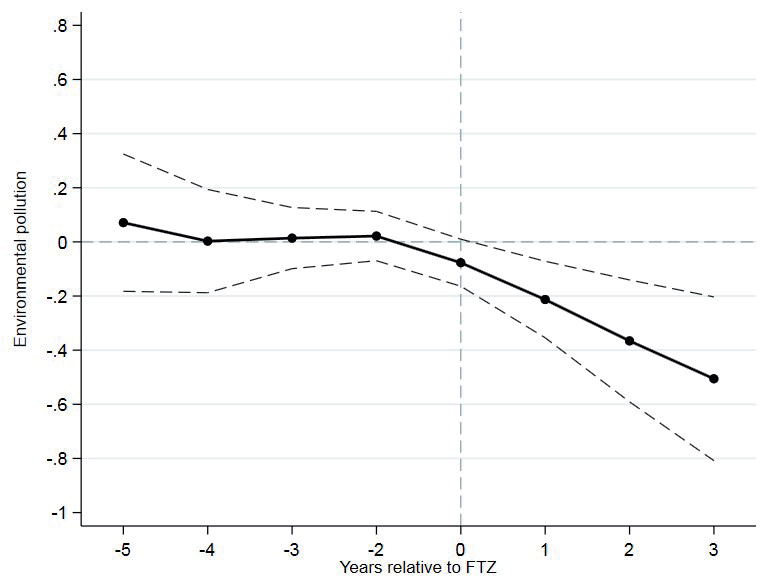
To prove the reliability of our conclusion, we conducted parallel trend tests. The event study provides a reference for our analysis, which can determine the dynamic trends before and after the occurrence of policies [22]. The test equation is set up as follows:
In Eq. (2), didti0+k denotes the FTZ establishment. Specifically, ti0 denotes the time spent by FTZ in different cities, and k denotes the years before and after the city implemented the FTZ. If t – ti0≤–5, then didti0–5 = 1, otherwise, it is 0. If t – ti0 = k (k = –5, –4, –3, –2, 0, 1, 2, 3), didti0+k = 1; otherwise, it is 0. If t – ti0≥3, then didti0+3 = 1, otherwise, it is 0. This study sets k = –1 as the base period, and the coefficient βk reflects the influence of FTZ on urban environmental pollution in the k-th year.
Table 2.
Baseline regression results.
Fig. 1 displays the point estimate of Eq. (2) and the results at the 95% confidence interval. The figure lends strong support to the parallel-trend assumption, which implies that the processing and control groups meet the requirements for counterfactual estimation. Meanwhile, there is a gradual and significant reduction in urban environmental pollution after the FTZ establishment, which suggests that the FTZ has a long-term role in reducing urban environmental pollution.
Placebo Test
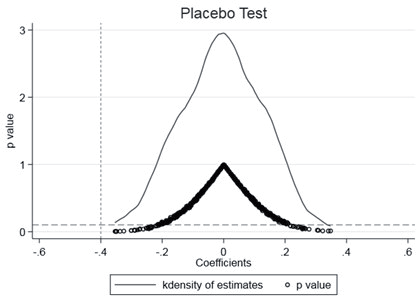
We also conducted a placebo test. Specifically, we counted the number of cities implementing FTZ from 2010 to 2021. Among them, there were 22 cities implemented. Therefore, in order to construct a counterfactual estimation, we randomly select years from the sample period and label them as t. Then, 22 cities were randomly selected in year t as the cities implementing FTZ. Thus, randomly assigned FTZ data is used for the placebo test. To maintain the robustness of the placebo results, we repeated them 500 times.
Fig. 2 shows the distribution of estimated values and baseline estimates for 500 runs. We found that our estimated results are outside the entire distribution, indicating that our results are not caused by unobservable factors.
Robustness Test
To eliminate some other concerns, we conducted some robustness tests.
First, we tested the robustness of the urban environmental pollution index. Considering local government officials may manipulate environmental pollution data to expect a higher chance of being promoted [23], we used PM 2.5 data for robustness testing. This data is sourced from the Atmospheric Composition Analysis Group at the University of Washington, St. Louis, and is a satellite remote sensing image formed by combining satellite images with ground monitoring station data with a resolution of 1 km. Currently, this data has been used in many haze studies [24]. According to Eq. (1), we obtain the result in Column (1) of Table 3.
Secondly, we examined the lagging effect of FTZ establishment. Due to a certain lag in the implementation of the policy, which may result in an underestimate of the baseline results, we have delayed the FTZ establishment by one period and re-estimated Eq. (1). We obtain the result in Column (2).
Third, we narrowed down the sample size. Specifically, we excluded large cities with higher administrative powers. Due to the fact that those cities have higher administrative levels, richer market resources, and more complete social systems, there may be differences in energy use and consumption. Therefore, we deleted the city data. We obtain the result in Column (3).
Fourth, in order to exclude the impact of other policies, we separately controlled the relevant policies for the period from 2010 to 2021. Specifically, we mainly controlled for green finance policy and innovative city policy. We obtain the result in Columns (4) and (5).
Finally, considering the possibility of heterogeneity treatment effects in grouping and time dimensions, there may be some bias in the estimation of staggered DID; therefore, we used the more robust estimators proposed by Sun and Abraham (2020) and Callaway and Sant Anna (2021) for estimation [25, 26]. Among them, Sun and Abraham’s (2020) estimated results are shown in Column (6), while Callaway and Sant Anna’s (2021) estimated results are shown in Column (7) [25, 26]. The regression results show that even after considering the effects of heterogeneity treatment, a more robust estimator is still significant.
As expected, all results are negatively significant in Table 3. Therefore, we believe that our results are robust.
Analysis of Heterogeneity
The baseline regression is a study conducted on 285 prefecture level and above cities in China as a whole, and the estimated results indicate that the establishment of FTZ has a significant inhibitory effect on environmental pollution. However, the differences in economic development status, industrial development direction, and resource factors among different cities may lead to different effects of the establishment of FTZ on environmental pollution. Therefore, 285 cities were divided into two types of samples: resource-based cities and non resource-based cities, central cities and non central cities, to explore the regional heterogeneity of the impact of FTZ establishment on environmental pollution.
Columns (1) and (2) in Table 4 show the regression results after dividing the sample into resource-based cities and non resource-based cities. Observing the data from both columns, it can be seen that the regression coefficient of FTZ establishment on environmental pollution in non resource-based cities is -0.319, which is significant at the 1% level. This indicates that FTZ establishment has a significant improvement effect on the environmental pollution situation of non resource-based cities, but its effect on resource-based cities is not significant. This may be because resource-based cities are cities that develop natural resources such as coal, minerals, and forests, with mining and processing industries as the dominant industries. Although these cities have abundant natural resources, their industrial development relies heavily on resources, and the environmental pollution caused by mining and processing is severe, resulting in the institutional dividends of FTZ establishment for such cities not yet apparent. Compared to resource-based cities, non resource-based cities have a relatively more reasonable and diversified industrial structure, a more complete overall economic structure, and are easier to optimize and upgrade. The gathering capacity of talents, funds, and other factors is also stronger. Therefore, the establishment of FTZ has a more significant effect on improving environmental pollution in non resource-based cities.
Table 3.
Robustness test.
The regression results for central and non central cities are shown in columns (3) and (4) of Table 4. The central cities include municipalities directly under the central government, provincial capitals, planned cities, and 35 other cities, including Yangzhou and Xuzhou, totaling 70 large and medium-sized cities in China. Comparing the results of the two columns, it can be found that the regression coefficient of the establishment of FTZ on environmental pollution in central cities is -0.406, which is significant at the 1% level, while the regression coefficient for non central cities is not significant. This indicates that, compared to non central cities, the establishment of FTZ has a more significant impact on the environmental improvement of central cities. This is because the central city has a large population, a wide urban establishment area, complete infrastructure, and a high level of economic development. The improvement effect brought about by the establishment of FTZ is more obvious, and the regional radiation is relatively wider. Environmental pollution is closely related to economic and urban establishment, and the establishment of FTZ will have a more significant environmental impact on the central city.
Further Analysis
Mechanism Analysis
The previous tests have shown that the establishment of FTZ can effectively reduce regional pollution emissions, and the results are robust. So what are the possible driving factors behind this effect? This article tests using an intermediary model.
1. The path to upgrading industrial structures. According to column (2) of Table 5, the regression coefficient of the establishment of FTZ on industrial structure upgrading is significantly positive at the 1% level, indicating that the establishment of FTZ has a significant positive promoting effect on urban industrial structure upgrading. According to column (3), the coefficient of industrial structure upgrading is significantly negative, indicating that industrial structure upgrading can improve environmental pollution conditions. Comparing the regression coefficients of columns (1) and (3), it can be found that when the industrial structure upgrading variable is used as a mediator variable, the coefficient of column (3) has increased compared to column (1), indicating that industrial structure upgrading is an effective mechanism for the establishment of FTZ to suppress urban environmental pollution and further indicating that industrial structure upgrading has a positive effect on improving environmental quality.
2. The path of technological innovation. According to column (4) of Table 4, the coefficient of the core explanatory variable FTZ establishment (DID) is 0.537, which is significant at the 1% level, indicating that the establishment of FTZ has a positive promoting effect on the level of technological innovation; that is, the establishment of FTZ has improved the level of urban technological innovation. At the same time, it can be seen from column (5) that the improvement of technological innovation level significantly suppresses the aggravation of urban environmental pollution, and when technological innovation serves as an intermediary path, the inhibitory effect of FTZ establishment on environmental pollution in column (5) has decreased compared to column (1), indicating that technological innovation level has an indirect positive effect on the improvement of environmental pollution in the process of FTZ establishment. This also indicates that technological innovation is an effective intermediary pathway for the establishment of FTZ to improve environmental pollution. From the above test results, it can be seen that industrial structure upgrading and technological innovation are both effective paths for the establishment of FTZ to suppress environmental pollution. Therefore, we have proven hypothesis 1.
Table 4.
The results of heterogeneity analysis.
Table 5.
The results of heterogeneity analysis.
Spillover Effect Test
The previous empirical analysis has verified the improvement effect of FTZ establishment on environmental pollution. As the establishment of FTZ not only adds economic growth momentum to the city, but also promotes technology spillover and innovation in adjacent areas, in this section, we examine the spillover effects of FTZ establishment. Specifically, we referred to the method of Zhong et al. (2021) and constructed a spatial weight matrix [15]. Using the spatial Durbin model, we examined the spillover effect of FTZ establishment on urban pollution. From the results in Table 6, we can see that the establishment of FTZ has a significant negative impact on local environmental pollution at the 1% level, indicating that the establishment of FTZ has an improvement effect on urban environmental pollution, which is consistent with the results of benchmark regression. Specifically, from the results in column (2), the coefficient of spatial spillover effect is significantly negative at the 1% level, which means that the establishment of FTZ not only improves local environmental pollution, but also has a spatial spillover effect on the improvement of urban environmental pollution. Therefore, we have proven hypothesis 2.
The spatial lag coefficient in Table 6 is positive and significant at the 1% level, indicating a strong “spatial spillover effect” in the establishment of FTZ. Based on the regression results of SDM, we further estimate the total effect, direct effect, and indirect effect of each variable. From the results in Table 6, it can be seen that for every 1% increase in intensity, the establishment of FTZ will lead to a 0.747% reduction in overall pollution emissions. However, this result will result in a 0.549% reduction in pollution emissions and a 0.198% reduction in pollution emissions from adjacent areas. This indicates that the establishment of FTZ not only reduces local environmental pollution, but also reduces environmental pollution in surrounding areas. From this conclusion, we can see more clearly the positive role of the establishment of FTZ in regional environmental protection.
Table 6.
Spillover effect results of FTZ establishment.
Conclusion
This article uses data from 285 prefecture level cities in China from 2010 to 2021 to investigate the impact of FTZ establishment on environmental pollution using the DID method. At the same time, a spatial econometric model is used to examine the spatial spillover effects of FTZ establishment on urban environmental pollution. The regression results show that the establishment of FTZ has improved the local environmental pollution situation, and after conducting spatial Durbin model estimation, it was found that the establishment of FTZ has a negative spatial spillover effect on the environmental pollution of surrounding cities, that is, the establishment of FTZ has an improvement effect on the environmental pollution situation of neighboring cities. At the same time, it was found that the optimization and upgrading of industrial structures and the improvement of technological innovation levels can enhance the role of FTZ establishment in suppressing urban environmental pollution. In heterogeneity testing, it was found that the impact of FTZ establishment on environmental pollution is influenced by urban types. In non resource-based cities and central cities, the improvement effect of FTZ establishment on environmental pollution is more significant.
Based on the conclusion, some policy implications are as follows: Firstly, Firstly, based on the functional positioning of the free trade zone, each city should optimize resource allocation based on regional functional division of labor and spatial layout, break administrative barriers at the time of the establishment of the free trade zone, learn from other cities, enhance the regional radiation of the free trade zone, and promote the green development of cities.
Secondly, for resource-based cities with relatively single industrial structures, the government should provide more policy support to FTZ, help cities moderately develop resources, recycle resources, guide them to develop environmentally friendly enterprises, combine their resource advantages, extend and supplement chains, attract talents and other innovative elements to gather, promote diversified industrial development, and promote industrial structure optimization and upgrading. For cities with relatively diversified industrial structures, FTZ should focus on top-level design during the establishment process, develop characteristic and high-quality industries, reduce the impact of industrial development on ecology, and achieve coordinated development of the economy and ecology.
Thirdly, in the establishment process of FTZ, the government should take a continuous and open path to cope with various friction risks while fully utilizing various resource elements, integrating the power of universities and enterprises, combining industry, academia, and research, promoting technological innovation and energy structure reform in enterprises, using advanced technology to transform production processes and methods, and achieving true environmental governance from the source through energy conservation and emission reduction in the circular system.

