

Introduction
Apple production is a significant part of fruit production around the world. In 2019 87 million tonnes of apples were produced in orchards occupying a total area of 4,717,000 ha [1]. About 20% of the global apple production volume comes from Europe, where Poland is the leading producer. In 2019 3,080,000 tonnes of apples were produced in Polish orchards, occupying a total area of about 170,000 ha (32% of the area of apple orchards in the European Union). The progressive intensification of fruit production in Poland is evidenced by the fact that in the last few years, the area of apple orchards in Poland has been gradually decreasing. However, this did not result in a lower yield of apples. According to FAOSTAT statistical database [1], in 2014 3.99 million tons of apples were harvested in Poland, which was a record. In 2015, it was 3.17 million tonnes of apples, whereas in 2019 it was 3.08 million tonnes.
Apart from agrotechnical treatments, the normal growth and yield of orchard plants is significantly affected by climatic factors, which may have a direct short-term influence (e.g. strong wind, periodic flood, hailstorms) or an indirect long-term effect (e.g. prolonged drought or cloudiness during the pollination of flowers). Aside from precipitation, air temperature is one of the most important climatic factors. The yield of apples tends to vary from year to year. These fluctuations are significantly influenced by changing weather conditions, especially by temperature during the flowering and formation of buds [2]. The bud formation, cell division, and various other physiological processes also occur at specific temperatures. Periods of low temperature are necessary for apple trees and most other plants growing in the temperate climate to break the bud dormancy period [3]. On the other hand, too high temperature in winter may delay the growth and flowering of plants or even inhibit flowering completely [4,5]. During the flowering time, trees are particularly sensitive to temperature fluctuations. This period is often used for the monitoring of climate change in natural and agricultural ecosystems [6-8]. Depending on the plant species, the temperature thresholds during the flowering period range from 0-4 °C [9]. According to Chamberlain et al. [10], a temperature drop below -2.2 °C, occurring after the buds of plants have burst, is considered an important limiting factor in plant development.
The influence of climatic conditions on the growth and development of apple trees will tend to increase along with the progressive climate change [11]. Rising temperatures, caused by such changes, increase production risks in traditionally apple-producing regions [2]. The growing season is longer and the flowering period starts earlier. In consequence, the flowers of fruit trees are at higher risk of damage by spring frosts. In the last decade, the flowering of fruit trees has started 1.4-3.6 days earlier due to the climate change [7]. A long-term analysis of temperature changes in the Poznań region (western Poland) showed that in the last 25 years it has been increasing at a rate of 0.79 °C per decade, whereas a temperature increase of 1 °C accelerated the flowering of cherry trees by an average of 2.8 days [12].
The effect of changing climatic conditions on fruit trees may be additionally intensified by the stress to which the plants are exposed. One of the stress factors is apple replant disease (ARD), which occurs as a result of replanting, i.e. planting new orchards in the place of old ones. The need to replace plantings frequently is caused by changes in the cultivar assortment, fruit consumers’ preferences, the natural tree ageing process, and progressing globalisation. Both Poland and most other EU countries have a limited number of new locations where orchards can be established. We can expect that ARD will be an increasing problem in horticulture. There have been numerous studies on the effects of ARD, especially in apple orchards. The disease inhibits the vegetative growth of tree shoots, reduces the size of root hairs, which are responsible for the uptake of water and minerals [13-15]. The weakening of the growth of the aerial and underground parts of plants reduces their yield, sometimes by as much as 50%. Liu [16] also noted a lower yield of fruit trees and worse quality of fruit due to ARD.
Scientific publications provide a relatively large amount of information on the influence of weather conditions on plant growth and development. The authors of the experiment assumed that stress conditions, including ARD, may significantly affect the interaction between fruit trees and some climatic factors. Therefore, the aim of the study was to analyse the influence of previous use of soil, air temperature and rainfall on the yield and fruit quality of replanted apple trees of the `Najdared` cultivar. For this, a novel method based on two kinds of canonical variate analysis was used. The first method is based on transformation by linear combination of variables, while the second one is based on a single value decomposition of the data set.
Material and Methods
Research Site Location
Between 2015 and 2017, an experiment was conducted on apple trees of the `Najdared` cultivar growing at the Experimental Station of the Poznań University of Life Sciences, Wielkopolskie Voivodeship, Poland. The trees were grafted on the M.26 rootstock. They were spaced at 3.3 × 1.5 m (2,000 trees/ha) from each other. The trees grew at two sites. The first site was located on replanted soil (RS), which used to be occupied by apple trees. The trees, which had been growing there since 1949, were grubbed up in the autumn of 2008. Before that date, apple trees had been replaced (replanted) three times. In the spring of 2009 new apple trees were planted in the place of the old ones, without any soil improvement treatments. The other site was located on crop rotation soil (CRS), where apple trees also used to grow since 1949. Between 1998 and 2009, wheat, rape, and mustard, which are considered to be phytosanitary crops, were grown there. Four plots with six apple trees in each were randomly selected for observation at each site (24 trees per site, 48 trees in the experiment). The arable layer at both experimental sites included proper luvisol formed from loamy sands deposited on light glacial till. The arable layer was composed of light, highly sanded clay, containing 17-20% of floatable fractions. The soils had the following content of selected macronutrients (mg/100g dm): the replanted soil: phosphorus (P) – 15.0, potassium (K) – 14.2, magnesium (Mg) – 6.0; the crop rotation soil: P – 19.0, K – 24.0, Mg – 9.8. The soil pH (H2O) was 5.4 and 7.2, respectively. The differences in the soil acidity level resulted from the long-term cultivation of phytosanitary crops at the CRS site, which were used to improve soil productivity (green manure).
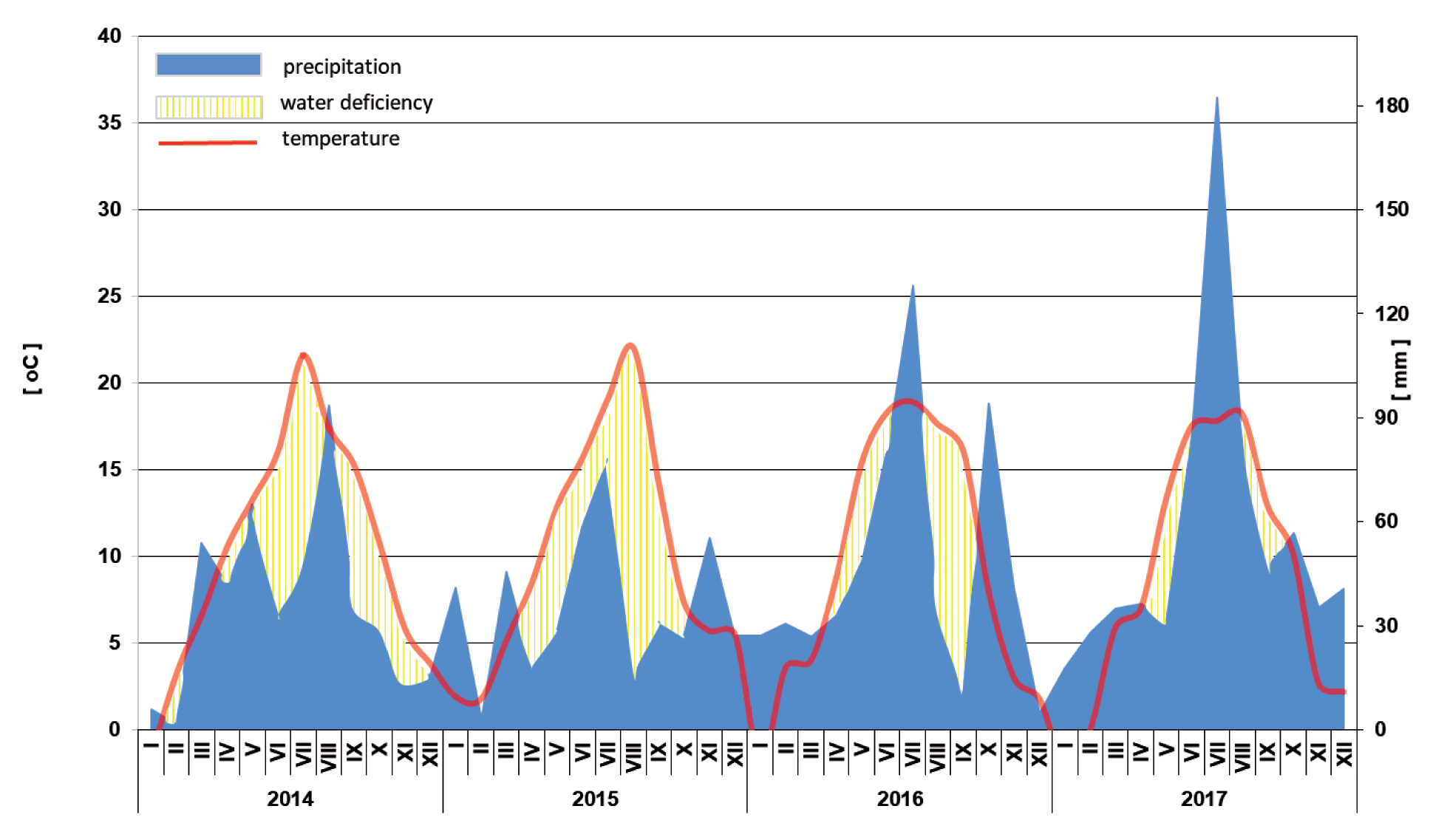
The same agrotechnical treatments were applied at both sites (standard fertilisation, periodic irrigation, weeding). The apple trees grew in the same climatic conditions. The analyses conducted in our study were based on climatic data from the weather station located at the experimental station. Between 2014 and 2017, the average monthly air temperature and rainfall were analysed, and the course of changes in these parameters was shown in a climatogram (Figure 1). It is a graphical representation of average temperatures and monthly rainfall totals at a ratio of 1 °C: 4.5 mm of rainfall.
Climatic Conditions During Research
The analysis of the climatic conditions between 2014 and 2017 revealed a significant variation in the air temperatures and rainfall in individual years. In 2014 and 2015, there was a relatively low rainfall during the growing season. This resulted in water shortage and drought periods, especially in late April and early May – during flowering and fruit setting (Figure 1). In 2016 and 2017, there were lower air temperatures and higher rainfall. During the three-year research period, there were spring frosts in each growing season. They differed not only in the temperature drop, but also in the duration of the frosts. The spring frosts with the greatest potentially negative effect on the apple trees occurred in the season preceding the research cycle (2014) and in the first year of the experiment (2015). In the first half of May 2014 the temperature dropped to -1.5 °C for six hours. In 2015, also in early May, the temperature dropped to -1.2 °C for five hours. In the following years, the frosts occurred earlier (late April) and lasted shorter.
Measurements and Observations
The following measurements and observations were made during the experiment, in the growing seasons of 2015-2017: yield (kg/tree), percentage of fruit set, fruit diameter, fruit quality: weight, extract (TSS – Total Soluble Solid), firmness, acidity. In each growing season, during the flowering of the trees (late April – early May), 50 inflorescences were counted on selected shoots of each apple-tree growing at both sites. During the harvest, all the fruits collected from the same marked shoots were counted to calculate the fruit setting percentage. On harvesting, fifty fruits were randomly selected from each site for quality assessment. The fruit harvesting date was determined on the basis of the degree of starch decomposition. The fruits were calibrated to assess their size class. The fruit diameter was measured with a standard measure, graduated every 0.5 cm. The fruit firmness was measured in a Magness-Taylor test with an FR-5120 Digital Fruit Firmness Tester mounted on a stand. The apple flesh was pierced to a depth of 8 mm from the main side of the fruit and from the intensely ruddy side by means of a rounded-end mandrel with a diameter of 11 mm. The measurements were expressed as kG. The Total Soluble Solids (TSS) was measured with a DR 301-95 KRÜSS Optronic GmbH digital refractometer on the same fruit which had been used for firmness measurements. Slices of flesh were cut from the opposite sides of the apples and the juice was pressed from them onto the plate of the refractometer. Titratable acidity (TA) was measured by pouring 45 ml of distilled water into 5 ml of juice and titrating with 0.1 N NaOH to pH 7.4. The result was expressed as % malic acid.
Statistical Methods
Due to the correlations between the yield and quality of apples, multivariate methods were used to analyze the dataset obtained. It is assumed that
where
Canonical variate coordinates are directions in multivariate space that maximally separate the predefined groups of interest specified in the dataset. In investigating the relationships between apple orchard sites under certain climatic conditions, a certain method was used. This method consists of linear transformation of the matrix
On the other hand, canonical variate coordinates, which determine the relationship between apple orchard sites under certain climatic conditions, made it possible to present the position of selected experimental objects and describe the yield and quality of apples in the space of the canonical variates [19,20]. Canonical variate analysis is widely used in various scientific fields, not only study of agriculture experiments, but also environmental [21,22], biological sciences [23], food science [24] and economic [25]. In this case, the analysis is based on singular value decomposition of the data set matrix
Following the singular value decomposition, the matrix
The tests of hypotheses
where
In investigating the year site interaction effects, the canonical variate analysis consists in transforming the matrix
Table 1.
Estimates of interaction effect in term of yielding and apple fruit quality (RS – replanted soil, CRS – crop rotation soil)
Results
Relations Between Factors – Soil Type, Year of Experiment
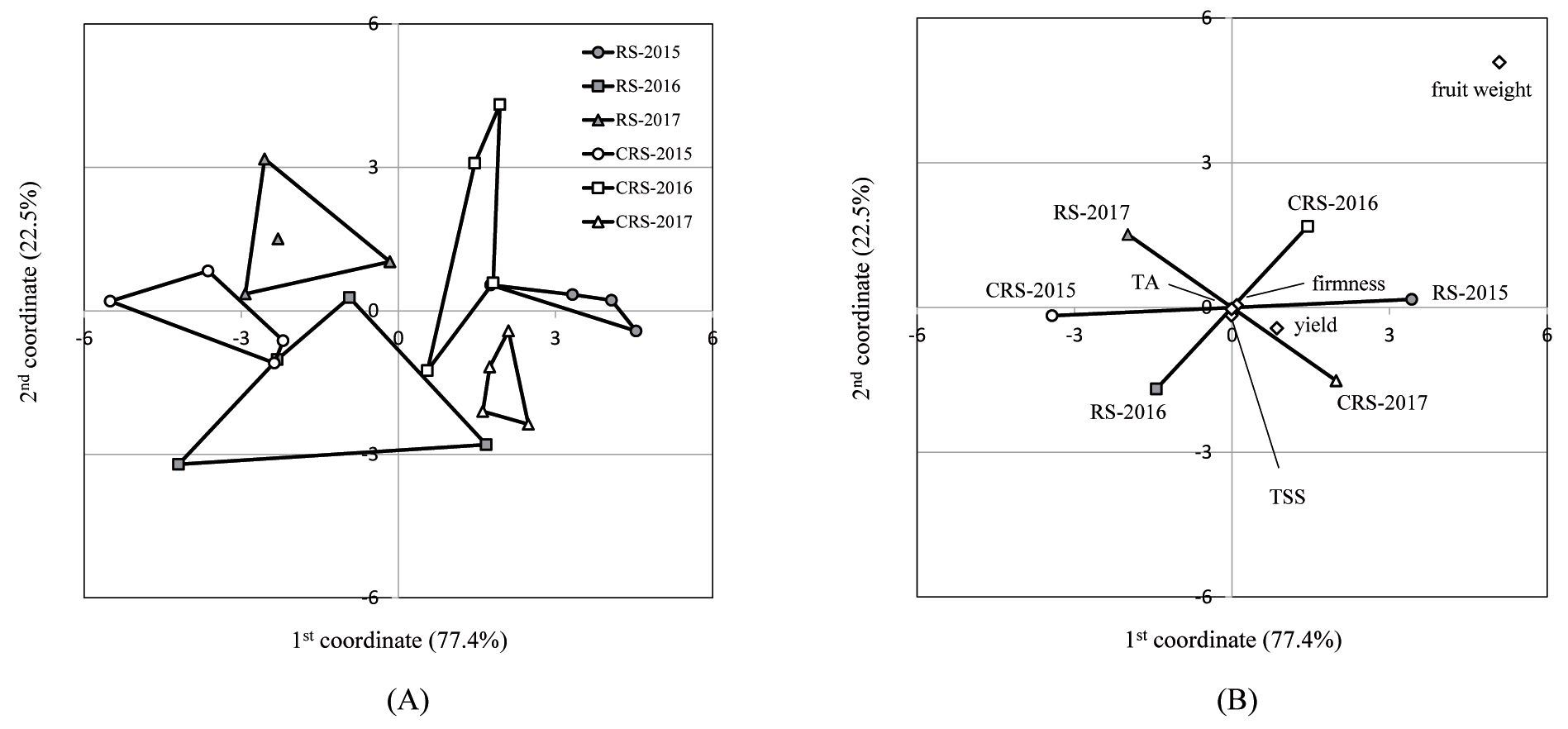
Figure 2A shows the effects of interaction between selected experimental objects in the space of orthogonal variables. It is the interaction between the meteorological conditions in a specific year and type of soil at the plantation site – cultivation on replanted soil (RS) and crop rotation soil (CRS). There were clear boundaries between the interactive effects for individual experimental objects in the space of canonical variables. This means that the trees growing on the soils which had been used differently before reacted differently to the meteorological conditions. The analysis of the statistical significance of the interaction effects listed in Table 1 showed that the interaction effects significantly differentiated the cultivation on the replanted soil and on the crop rotation soil. Apart from that, the negative and positive values of individual interaction effects describing the yield and fruit quality indicate that specific meteorological conditions in each year also significantly influenced the values of the traits under analysis. The apple size and yield were the variables which differentiated the interaction effects to the greatest extent (Fig. 2B).
Table 2.
Estimates of interaction in term of yielding and apple fruit quality (RS – replanted soil, CRS – crop rotation soil)
Table 3.
Share of fruit size classes according to diameter (%) (RS – replanted soil, CRS – crop rotation soil).
| Site - Year | Fruit diameter (cm) | |||||
|---|---|---|---|---|---|---|
| 6.0 | 6.5 | 7.0 | 7.5 | 8.0 | 8.5 | |
| RS - 2015 | 27 | 34 | 36 | 3 | 0 | 0 |
| RS - 2016 | 42 | 32 | 22 | 4 | 0 | 0 |
| RS - 2017 | 38 | 39 | 23 | 0 | 0 | 0 |
| CRS - 2015 | 0 | 0 | 45 | 34 | 34 | 18 |
| CRS - 2016 | 0 | 0 | 33 | 49 | 49 | 11 |
| CRS - 2017 | 0 | 0 | 21 | 47 | 47 | 23 |
Soil Type vs Yield of Trees and Fruit Quality
The experiment showed that the type of soil at the plantation site caused significant differences in the yield of the apple trees and the quality of their fruit. Throughout the research period, the trees growing at the RS site had the lowest yield (Table 2). During the three years of the experiment, the average yield of the trees growing at the CRS site (15.4 kg per tree) was three times greater than the yield of the trees growing at the RS site (5.4 kg per tree). There was a significant decrease in the yield of the apple trees growing on the replanted soil because of the low fruit setting percentage at this site, i.e. 11.2% in 2015, 14.5% in 2016, and 12.3% in 2017. By contrast, the fruit setting percentage on the apple trees growing on the crop rotation soil was several times greater, i.e. 50.3%, 77.8, and 75.5%, respectively.
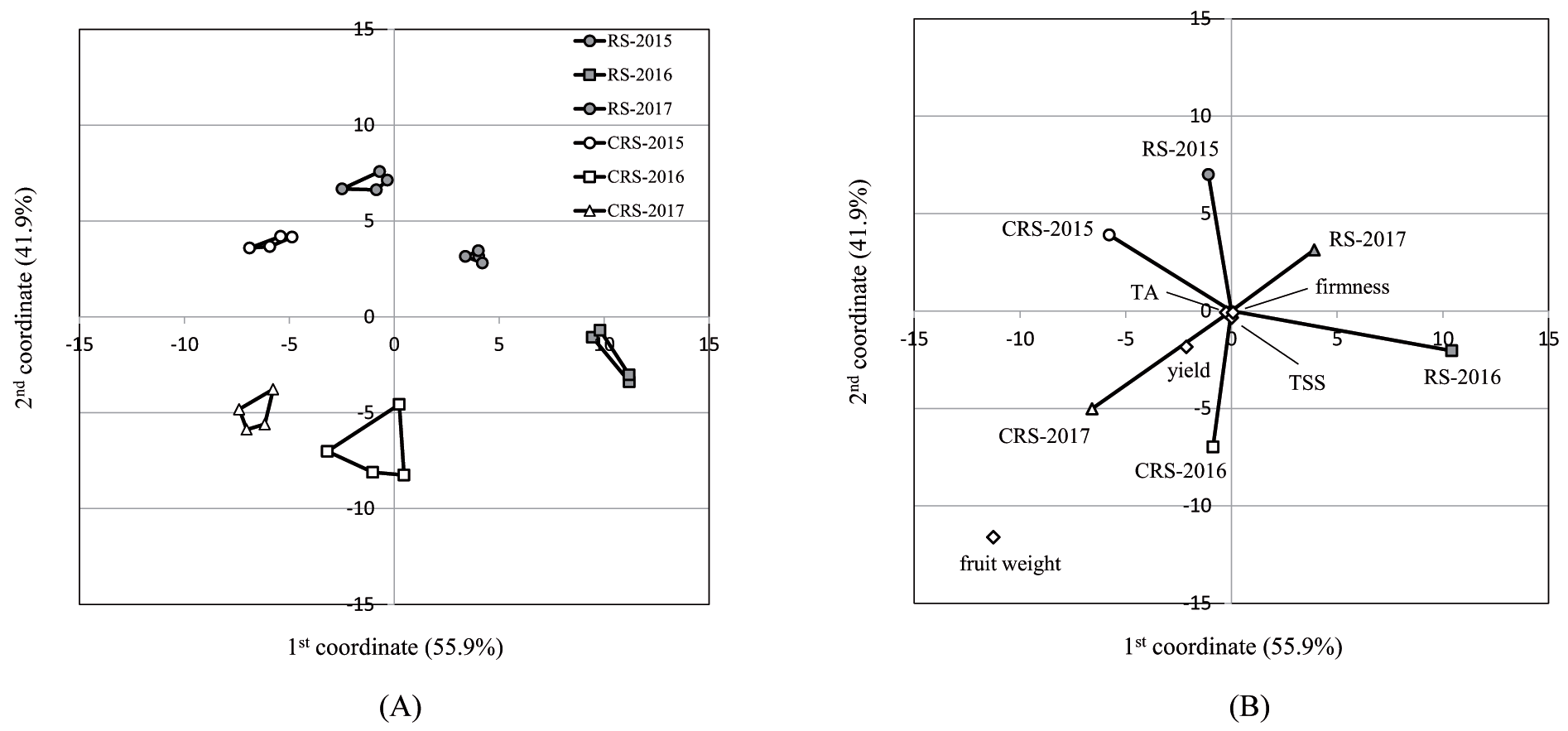
The size of fruit is one of the most frequently used parameters for the assessment of fruit quality. The share of small fruits (6.0-6.5 cm) at the RS site was significantly greater (27-42%) than at the CRS site (Table 3), where much bigger fruits were harvested. The share of apples with a diameter of 7.0-8.0 cm harvested from the trees growing at the CRS site ranged from 18% to 42%, depending on the research year, whereas it did not exceed 4% on the replanted soil (Table 3). The previous soil use, i.e. the type of plantation site, also significantly influenced the other fruit quality parameters. The apples harvested from the trees growing at the RS site had lower weight, firmness, TSS content and higher acidity than the apples harvested from the CRS site. Based on results presented in table 2 (CRS-2015=0.96, RS=-4.265), the difference in apple yield between replant soil and crop rotation soil in 2015 is 5.225 kg (=0,96-[-4,265]). Table 2 is matrix Ω, which is the basis for drawing Figure 3B. Hence, this way of presenting the results of the experiment.
Figure 3A shows the results of canonical variate analysis, based on the comparison of selected qualitative parameters describing the site × year interaction. The individual frequency of distribution of discriminant scores across the first and second canonical variables, which together account for the total variation in the site × year interaction, clearly shows that the variants are differentiated across the two axes, suggesting very clear boundaries for the individual experimental objects. This means that the yield of the apple trees and fruit quality depended not only on the research site but also on the year of the study. The CVA enabled the identification of the variables which differentiated the experimental variants to the greatest extent – the fruit weight and yield (Figure 3B). For example, in 2016 and 2017 the trees growing at the CRS site had the highest yield and their fruits were the heaviest (Table 2). There were differences in the fruit quality parameters (firmness, extract, and acidity) in individual years (Figure 3B). Fruits with the lowest TSS content were harvested from the trees growing at the RS site in 2015 and 2017, whereas at the CRS site such fruits were harvested in 2016 and 2017 (Table 2).
Climatic Conditions vs Yield
The analysis revealed a relationship between the yield of the apple trees and the weather conditions during the growing season. During the three-year research period, the lowest yield of apples was noted in 2015. It may have been influenced by periodic freezing temperatures during the flowering period. There were spring frosts in the year preceding the research cycle (2014) and in the following year (2015). They may have damaged some flowers, which resulted in a lower yield of apples. In 2015 the fruit setting percentage was 11.2%, whereas a year later it was 14.5%. There were higher values of this parameter noted on the crop rotation soil in the same years, i.e. 50.3% and 71.8%, respectively.
Table 4.
Trend of temperatures and rainfall in the growing seasons 2014-2017
The low yield of the apple trees in 2015 may also have been influenced by periodic water shortages, which reduced the number of flower buds in the season preceding the research (2014) and the number of flowers on the trees in the first year when apples were harvested (2015). Both in 2014 and 2015 there was a relatively low rainfall – several dozen mm lower than the long-term average (Table 4). Low rainfall and high air temperature at that time resulted in periods of drought (Figure 2). The water shortage was particularly noticeable in late April and early May – during the flowering of the trees.
Climatic Conditions vs Fruit Quality
During the experiment, the climatic conditions modified the apple quality parameters. For example, the apple juice acidity fluctuated considerably in individual years. In 2015 the apple trees growing at both sites yield fruit of the lowest acidity in the entire research period (Table 2). However, the juice extracted from the apples harvested from the trees growing at the RS site was characterised by higher acidity (1.39%) than the juice extracted from the apples harvested from the trees growing at the CRS site (0.88%). In the growing seasons of 2016 and 2017 there was a much higher rainfall than in 2015 (Figure 1). This may have affected the fruit firmness, which was lower in 2016 and 2017 than in 2015 (Table 2). A higher rainfall may have disordered the uptake and distribution of calcium, which plays a structural role in the formation of cell walls.
Discussion
The experiment showed that the previous soil use significantly influenced the yield of the apple trees and their fruit quality. The trees growing at the RS site yielded much worse than those growing at the CRS site. The results of our experiment confirmed the findings of other study, which showed that apple replant disease limited the yield of fruit trees [26]. The lower yield of the trees affected by ARD is caused by the lower content of soil nutrients [27], which consequently weakens the vegetative growth of plants [26, 14].
The yield and quality of fruit are important elements of the profitability of fruit production in orchards. Currently, consumers pay attention not only to the appearance of fruit but also to the content of health-promoting compounds such as polyphenols, vitamins, and sugars [28]. For a producer, the basic fruit quality criteria are usually fruit weight, firmness, and TSS content. According to the authors of the experiment, the earlier soil use significantly influenced the qualitative traits of the apples. The trees growing on the replanted soil yielded fruits with a lower weight, firmness, and extract content but higher acidity than the trees growing on the crop rotation soil. The differences in the acidity of the fruit may have been caused by the dry periods and water shortages in 2015, as a result of which more light reached the tree crowns. The dry spring and low rainfall in this period weakened the vegetative growth of the trees and resulted in a small number of so-called ‘water shoots’, which often grow in large numbers in years with higher rainfall. The exposure of the fruit to a large amount of light caused an increase in their sugar content and a decrease in acidity.
Climatic conditions, especially the amount of rainfall and air temperature, are the factors influencing the fruit quality parameters. According to Eccel [29], low temperature is the climatic risk factor which limits fruit production in a temperate climate to the greatest extent. Spring frosts are the most troublesome. Early flowering, followed by the late strong frost, causes leaf and flower tissue damage [30]. Severe frost may cause financial losses for fruit farmers in Europe exceeding $3 billion [31]. One of horticultural crops increasingly vulnerable to strong frosts are the apple trees [32]. During the three-year experiment, there were frosts in each growing season. In 2015 the temperature dropped to -1.2 °C. It is assumed that in the initial period of development of apple flower buds (at the pink bud stage) they may become damaged at -4 °C. Fully developed flowers become damaged at -2 °C, whereas fruit buds become damaged at -1 °C. Frost duration is an important factor. In May 2015 the frost period lasted over 5 hours, which may have significantly reduced the number of healthy flowers. The analysis of the degree of fruit setting confirmed this assumption. It showed that in 2015 the percentage of fruit set was lower than a year later, when there were spring frosts in mid-April. This resulted in the lowest yield of the apple trees in this period.
Rainfall is another climatic factor that modifies fruit quality. During the three-year research, apples had relatively low firmness in the years with high rainfall. The heavy rainfall in 2016, and especially in 2017 (Figure 1), may have disrupted the uptake and distribution of calcium, which plays a structural role in the formation of cell walls. The availability of calcium is particularly important during the intensive growth of fruit, when the demand for this element often exceeds its supply.
Apple growers usually increase the intensity of production in order to increase its economic efficiency. They grow more trees in a particular area and accelerate their fruiting period. Apart from that, intensive cultivation shortens the life cycle of trees [33]. In consequence, new trees frequently need to be planted in the place of old ones, which increases the risk of ARD. If ARD occurs, a lower yield of trees and worse quality of fruit should be expected [34]. This may result in lower economic efficiency of fruit production, especially lower profitability. The authors of the experiment indicated that the problem of lower profitability of apple production on replanted soil was even greater if there are unfavorable climatic conditions.
Conclusions
Soil fatigue, spring frosts and drought problems considerably limit the possibility of production of high yield and good quality crops. This may significantly reduce the profitability of production, especially in newly established orchards after replanting. The experiment showed the existence of multidirectional relationships between the previous use of soil, air temperature, and rainfall, which affected the yield and quality of apples. The yield of the apple trees growing on the replanted soil was lower than the yield of the trees growing on the crop rotation soil, due to the low percentage of fruit set on the trees growing at this site. As far as the fruit quality parameters are concerned, the type of soil on which the trees grew had the greatest influence on the size and weight of apples. The other qualitative traits were more diversified, depending on the year of the study due to different weather conditions. The course of air temperature and rainfall during the growing seasons influenced both the yield of trees and the quality of fruit. The yield and qualitative traits of the apples harvested from the trees growing on the crop rotation soil were affected by these weather conditions to a lesser extent than the apples harvested from the trees growing on the replanted soil. Thanks to the research findings, it will be easier to forecast changes occurring in apple orchards as a result of certain climatic factors and stress conditions (Apple Replant Disease).

