

Introduction
With the development of urbanization, populations are becoming increasingly concentrated in cities, with an estimated 68% of the population living in cities by 2050 [1]. Economic activity and innovation are also increasingly concentrated in cities, which are developing as centers of economy, transport, trade, and information flow. The growth of cities, economic prosperity, and rising incomes have led residents to demand easier commuting. Isard, an American scholar, pointed out that “of all the creative innovations in economic life, transport has had the most pervasive impact in promoting economic activity and changing the layout of industries” [2]. Therefore, in many central cities and metropolitan areas in the world, important transport infrastructures such as urban rail transit, represented by high-speed railways, intercity railways, and subways, have been highly valued by the government and huge investments have been made to promote urban development. Over the past 40 years of reform and opening up, many cities in China have initially formed a public transport infrastructure system with subways and buses as the mainstay. However, in the past decade, the governance crisis represented by air pollution, climate warming, and resource and environmental deterioration has constrained the sustainable development of cities [3-5]. The metro system, characterized by its green and efficient nature, is an important tool for achieving green economic growth in the transport sector. Indeed, the transformation of the transport sector is crucial for reducing energy consumption and dependence, achieving dual carbon targets and green economic growth. Previous studies have shown that promoting the energy transition of buses and taxis can significantly reduce environmental impacts [6]. Since the development of metro systems consumes a large amount of energy and accounts for a high proportion of total carbon emissions, it is essential to consider the impact of metro system development on green economic growth from a green development perspective. At present, there are relatively few research studies on how the urban metro system affects the green economic growth of cities, and this paper is based on this background to carry out the corresponding research.
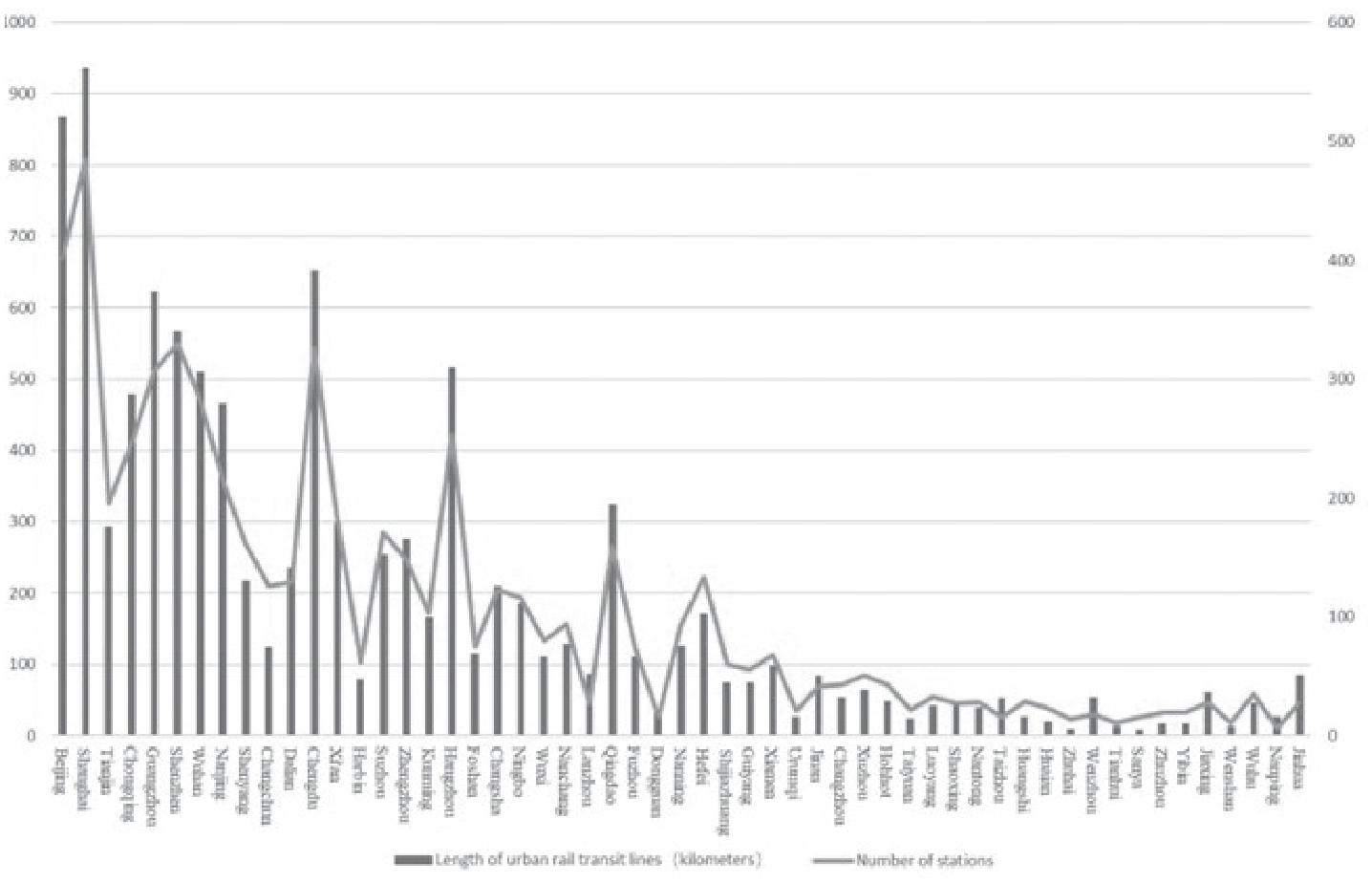
As an important form of public transportation and urban underground space utilization, the metro has been promoted in more and more big cities in China. Metro is an important part of urban rail transit and the backbone of urban public transportation, with the characteristics of energy saving, land saving, large capacity, all-weather, less pollution, safety, etc. It is an important part of the construction of green cities and the development of green transportation in metropolitan areas and is especially adapted to large and medium-sized cities. By the end of 2022, a total of 55 cities in mainland China had opened 308 urban rail transit operating lines, with a total length of 10,287.45 kilometers of operating lines. Among them, a total of 41 cities opened subways, with total subway operating lines of 8008.17 kilometers, accounting for 77.84%, and other systems of urban rail transit operating lines of 2279.28 kilometers, accounting for 22.16%. The length of new operating lines in that year was 1,080.63 kilometers. There are 26 cities with 4 or more operating lines and 3 or more interchange stations, accounting for 47.27% of the total number of cities that have opened urban rail transit operations [7]. This paper organizes the relevant data, as shown in Fig. 1. From the table, we can find that there is a regional imbalance in the development of the metro system, most of the cities that have opened the metro and operate are provincial capitals, and the degree of development of the eastern coastal provincial capitals is higher than that of the central and western regions, and the regional disparity in the length of the lines and the number of stations is expanding.
As a public good, the metro is important for achieving green economic growth in cities. Firstly, most cities have limited space for surface development, and metros have the advantage of using space more efficiently than other modes of transport. In addition, metro systems carry a large number of passengers, so metro transport provides mobility for commuters and improves the accessibility of local residents to their homes, workplaces, shopping, entertainment, and various other activity destinations. The construction and operation of the subway also have a significant impact on the value of the surrounding real estate, e.g. Shi et al. found that rail transit has a significant impact on the development of the building economy [8], and Guo et al. demonstrated that the number of metro stops in Shanghai and the proximity of the metro stations have a significant positive correlation with the price of the surrounding residences [9]. In addition to this, metro development has wider social benefits, such as changing the density of jobs, which affects the productivity and efficiency of the labor market. Foreign literature shows wider economic impacts of the metro system in Istanbul, especially in terms of business investment and sectoral changes. Some parts of the city metro system started to transform its transportation hub areas from industrial and manufacturing-related businesses to service-related businesses, and the clustering of financial and business services created agglomeration economies [10]. Metro operations contribute to the reduction of air pollution and greenhouse gas emissions, such as automobile mode shift, reduction of energy consumption, substitution of roadway operations [11], use of clean energy sources, alleviation of traffic congestion, improvement of air quality [12, 13], increase in residential density, and subsequent energy savings in station areas. The development of the metro changes travel behaviors, such as reducing bus, cab, and car trips [14] and commuting trips by walking, biking, and transit [15]. In fact, the metro is a lasting driving force for the economic development of the entire city, which is closely linked to production, circulation, and people’s daily lives, keeping the city’s functions functioning properly, and is the key to enhancing the city’s comprehensive competitiveness and realizing green economic growth. Given the rapid development and large-scale construction of China’s metro system, it is necessary and valuable to understand the relationship between metro system development and urban green economic growth in order to realize green and sustainable urban development in the context of the current goal of carbon peaking and carbon neutrality.
Today’s China faces the challenge of green growth in social, economic, and ecological terms [16]. How to realize green economic growth has become an important issue for the entire society. The United Nations Environment Programme believes that a green economy is characterized by low carbon, resource efficiency, and social inclusiveness. In a green economy, income and employment growth should be promoted through public and private investment, energy and resource efficiency should be enhanced by reducing carbon emissions and environmental pollution, and the loss of biodiversity and ecosystem services should be prevented. Green economic growth implies both environmental and productive efficiency [17]. Also, it can be realized through appropriate industrial restructuring, reduction of production costs, and environmentally friendly business strategies. The related literature usually adopts the concept of green total factor productivity (GTFP) to represent green economic growth. GTFP additionally considers non-desired outputs, such as pollution emissions, on the basis of the traditional total factor productivity framework. Therefore, GTFP is a good indicator of green growth and provides a more comprehensive measure of productivity growth. Scholars from the fields of economics and environmental sciences have attempted to identify the main factors of resource market distortion [18], environmental regulation [19], fiscal decentralization [20], financial development [21], and market openness [22] to explain China’s green economic growth, while few scholars have explained the green economic growth of Chinese cities in terms of transportation infrastructure, especially the subway system that connects intra-city population movement and commuting. Several recent studies in the literature have found that the construction of subways has positively contributed to the environmental productivity of cities. This is mainly due to the expansion of urban boundaries and the limitation of sulfide emission levels due to the opening of subways, and the impact of subway opening on urban productivity is more prominent in the central and western regions from a regional point of view. In addition, the opening of the metro can improve urban green total factor productivity in two ways. On the one hand, the metro can improve total factor productivity by improving air quality, attracting R&D personnel and FDI, increasing government expenditure on science, and promoting innovation. On the other hand, the opening of the metro can promote the transformation and upgrading of urban industries, reduce industrial emissions, wastewater, and waste, and ultimately realize the improvement of green total factor productivity. However, the above literature is based on the data from prefecture-level cities across the country to compare and analyze the conclusions drawn from the cities where the metro opened during the sample period with those that have not yet opened, ignoring the fact that the development of the metro system requires corresponding conditions. The Opinions of the General Office of the State Council on Further Strengthening the Management of Planning, Construction, and Management of Urban Railway Transportation [23], released in 2018, updates the conditions to the following: a general public finance budget revenue of more than 30 billion yuan, gross regional product of more than 300 billion yuan, urban resident population of more than 3 million people, and the initial passenger intensity of the proposed metro line is not less than 0.7 million passengers per kilometer per day, and the scale of the long-range passenger flow reaches more than 30,000 passengers per hour in one-way peak hour. Cities that meet these basic conditions to develop a subway construction plan go through layers of approval, including the State Council for approval to carry out subway construction.
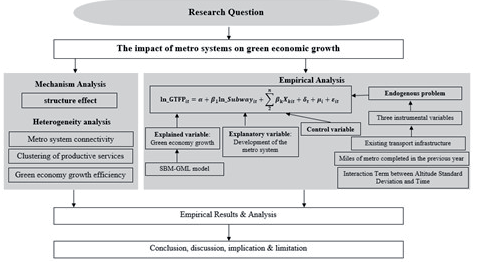
Therefore, this paper focuses on the cities where the metro system has been developed and operated and analyzes whether the development of the metro system can promote green economic growth of the city in the process of transformation and upgrading of green growth of these cities. If it exists, what is the conduction path of this impact? This paper enriches the existing literature in the following two aspects: firstly, when Xiao calculates green total factor productivity, the non-expected output only includes sulfur dioxide emissions [24], whereas the non-expected output in this paper includes industrial wastewater and industrial soot emissions, and thus the measured green total factor productivity is more scientific. Secondly, the study of Jiang shows that urban rail transit has a significant role in promoting the optimization and upgrading of the urban industrial structure [25]. Fu et al. also believe that the opening of the metro ultimately realizes the improvement of green total factor productivity by promoting the transformation and upgrading of urban industries [26], but most of them use multiple DIDs to analyze the impact of whether the metro is opened or not without considering other factors, such as the inconsistent opening time of the metro and the development of the metro system. In contrast, this paper studies the development of the metro system, measures the impact of metro system development on green total factor productivity by the number of metro operating miles, and concludes that the advanced industrial structure is an important mechanism for the development of the metro system to affect the green economic growth of the city, which confirms their viewpoints. The research framework diagram of this paper is shown in Fig. 2.
The first section of this paper contains the introduction, the second section contains the literature review of this paper on urban rail transit and green economic growth, the third section contains the mechanism analysis, the fourth section contains the empirical study, the fifth section contains the mechanism test, and the sixth section contains the conclusions and recommendations of this paper.
Literature Review
This study is based on two major branches of literature. One is the discussion of the economic, social, and environmental impacts of urban rail transit. The other is about the measurement and influencing factors of green economic growth, especially in terms of energy consumption and environmental pollution.
International scholarly research on urban rail transit has been progressively deepening since the end of the last century. For developing economies, which often need to develop their economies at the cost of environmental degradation, metro systems may be an attractive option for infrastructure development that can effectively address traffic congestion and improve transportation efficiency for economic development while protecting the environment. At the same time, metros have been used as an effective way to develop and reshape cities, playing an important role in promoting urban sustainability and urban resilience. Mixed-use development of metros to accommodate multiple functions, such as transportation, commercial, public, and storage uses, has attracted increasing attention in China. Among them, transportation is considered as the basic function of the metro and has emerged as the best solution to address urban, environmental, and transportation issues. Previous studies in China have focused on the economic [27], environmental [28], and social impacts of metro system development [29]. The construction of urban metro has the effect of enhancing the level of urban public services, reducing urban transportation costs, and strengthening the cooperation between enterprises and financial institutions, universities and research institutions, the government, and other related innovation bodies to enhance the level of enterprise innovation [30], and reflecting good governmental planning, which effectively enhances the attractiveness of the city. In addition, the development of the metro can also promote knowledge spillover in the region [31] and enhance the city’s innovation capacity [32]. The mechanism analysis of the relevant studies suggests that the increased communication links between research institutions and enterprises, the agglomeration of human capital, and the inflow of FDI resulting from the opening of the metro are important mechanisms explaining its improvement in the level of urban innovation. Several recent studies have expanded to explore the impact of metro development on green economic growth, and the results of the literature suggest that metro opening can increase urban green total factor productivity through mechanisms such as transportation cost reduction and industrial structure upgrading. In addition, according to Lin et al. [33], green technological innovation and industrial structure upgrading are the channels for achieving green economic growth. While the impact of metro system development on economic growth is seen from an international perspective, the impact of the Istanbul metro is mainly realized in terms of business agglomeration, enterprise development, and investment growth in metro neighborhood projects. This literature provides ideas and methods for this paper to study the impact of the metro on green economic growth.
Research on green economic growth mainly focuses on its influencing factors, as well as on indicator measurements. The definition of green economic growth and the corresponding indicators and calculation methods are explained in detail in the introduction, and in this section, we mainly explain the real meaning of green economic growth and the spatial and temporal differences. Studies on green economic growth in the literature often take energy conservation and emission reduction as the focus of analysis, because energy conservation and emission reduction are important for China to promote the transformation of the traditional high-energy consumption and high-pollution economic growth mode. Improving energy-environmental performance aims to reduce energy inputs and pollutant emissions while balancing economic outputs, and is therefore crucial for promoting green economic growth transformation [34]. Although the analytical frameworks are different, the starting point of the above literature is the measurement of energy-environmental performance. Green Total Factor Productivity (GTFP) incorporates “energy consumption” and “environmental pollution” into the framework of economic growth analysis, emphasizes the green development concept of coordinated development of economy-resources-environment, and is an improvement of traditional TFP. It emphasizes the green development concept of coordinated development of economy-resource-environment, which is an improvement of the traditional total factor productivity. Therefore, green total factor productivity, which takes into account energy inputs and environmental pollution, has become a new indicator for measuring the quality of economic development. Enhancing green total factor productivity implies a win-win situation for both economic and environmental performance, and is a new impetus to change the mode of economic development under resource and environmental constraints. Measuring green total factor productivity at the city level in China is conducive to providing a factual basis for the transformation of China’s economy from high-speed growth to high-quality development from the city dimension. The construction and operation of urban subways in most Chinese cities in the past decade have effectively reduced pollutant emissions and air pollution, so it is of great significance and practical value to study the impact of urban rail transportation on green total factor productivity. In terms of sample selection for green total factor productivity measurement, existing studies are mainly carried out at the inter-provincial level or industrial level, while there are relatively few studies based on city-level data. For example, Yang et al. measured and analyzed the inter-provincial green development efficiency from 1999 to 2012 using the inter-period production frontier SBM model [35], which showed that the green development efficiency at the national level “declined first and then increased” and that the green efficiency of the East and the Midwest began to show a polarized pattern after 2006. The study shows that the green development efficiency at the national level “declines first and then rises” and that the green efficiency of the east and the central and western parts of the country began to polarize after 2006. Based on the SBM model and the Luenberger productivity index, Yue et al. measured the green total factor productivity (GTFP) of 36 industrial industries in China from 2006 to 2015 [36] and found that the average annual growth rate of industrial GTFP during the sample period was 0.356%, and technological innovation was the main driving factor. Therefore, this paper draws on the methodology of related studies to analyze the green total factor productivity of cities that open and operate subways from a city perspective.
In summary, this paper provides a more comprehensive account of the relationship between the development of urban metro systems and green economic growth in the face of insufficient research in related fields. Drawing on a number of preliminary research findings, existing databases, and improved econometric methods, the findings in this paper provide new perspectives for academics and policymakers.
Theoretical Analysis and Research Hypothesis
New economic geography has an important theoretical guiding role in the study of urban rail transit, urban green economic growth, and industrial spatial layout. Urban rail transit promotes urban green economic growth in the following aspects: First, it promotes industrial agglomeration along the subway. The construction of urban rail transit has a significant positive impact on the location of enterprises and the agglomeration of economic activities. Inside the city, with the construction and operation of the subway, the stations around the rail transit will attract a large number of service industries to develop and agglomerate. The reason is that the subway can improve the accessibility of a specific region, reduce the transportation cost of the region, and improve the agglomeration economy of the region, thus affecting the location choice of enterprises and consumer spending decisions, which in turn affects the spatial distribution of urban industrial development and economic activities. For example, Zhou et al. take the urban rail transit in Beijing as the research object, and the results show that the total employment and service industry in the region adjacent to rail transit facilities can benefit from the development of local rail transit, while the manufacturing industry is not suitable for development in the region adjacent to rail transit facilities; in the face of the development of rail transit, the productive service industry will be in the “agglomeration economy”. In the face of the development of rail transit, the productive service industry will be developed in the neighboring regions within the scope of influence of the “agglomeration economy” [37]. According to Zhu et al., the opening of the Guangzhou subway has a significant positive impact on the spatial agglomeration of the service industry in Guangzhou, indicating that the subway facilitates the clustering of service industry businesses [38]. In fact, the productive service industry is an intermediate input sector relying on the manufacturing industry, which improves the resource utilization efficiency by providing specialized and diversified services to the manufacturing sector, and ultimately has a positive impact on the green economic growth of the city. The agglomeration of the productive service industry can promote R&D and innovation of enterprises at the micro level; at the macro level, it can accelerate the transformation and upgrading of the urban industry through the backward and forward linkage of industry, and then promote green growth of the city. The second is to reduce transportation costs. On the one hand, the construction and improvement of urban rail transit will optimize the city’s public transport structure, improve the operational efficiency of the city’s entire comprehensive transportation system, help reduce transportation costs, and improve the city’s social welfare level. Reducing transportation costs will lead to economies of scale and agglomeration economy, prompting the expansion of the production scale of enterprises, which can not only improve the output efficiency and promote the efficiency of economic growth but also promote economic growth through the spillover effect on the economic growth of backward areas of the city. On the other hand, the development of urban rail transit has the advantages of being intensive and efficient, energy-saving and environmentally friendly, and the improvement of urban rail transit can reduce people’s travel costs and can improve its traffic sharing rate with its higher transportation capacity and efficiency, prompting residents to choose public transportation as a mode of travel and reduce the use of private transportation. It can not only ease the pressure of urban transportation but also reduce the emission of pollutants to achieve the purpose of protecting the natural environment of the city and improving air quality, thus promoting the green development of the city.
Accordingly, this paper proposes hypothesis 1: Metro system development can positively promote green economic growth.
In addition, relevant literature, such as Jiang. analyzed the tertiary industry by subdividing it into productive services, consumer services, and public services, and concluded that urban rail transit has the most significant impact on the employment of tertiary industry services, in which productive services and consumer services have obvious pulling effects. The improvement of urban rail transportation can reduce transportation costs. Enterprises within the industry tend to choose locations close to subway stations in order to strengthen economic ties, thus generating agglomeration economic benefits, which in turn generates corridor economic effects such as traffic and passenger flow along the routes and stations. The development of transportation is a prerequisite for the agglomeration of productive as well as living service industries, so the improvement of transportation infrastructure can accelerate the flow of human capital, capital, and other factors, as well as improve accessibility and positively promote the development of productive and living service industries [39]. Zhang et al. believe that the productive service industry possesses the green and clean qualities of high productivity, high value-added, and low energy consumption [40], and thus when the local railway system is continuously improved and developed to promote the clustering of service industries along the line, it can not only improve the productivity of enterprises, realize the transformation and upgrading of the industrial structure within the city, and ultimately reduce the consumption of energy and the emission of pollution, and promote the city’s green and sustainable development.
Accordingly, this paper proposes hypothesis 2: the development of the metro system promotes green economic growth through industrial structure upgrading.
Material and Methods
Econometric Model Construction
This paper argues that the development of the metro system positively affects urban green economic growth, i.e., the operation and development of the metro system can promote the enhancement of urban green total factor productivity, therefore, this paper selects the panel data from 2007 to 2019 of 41 cities that have opened the metro and operated as of 2022 to construct a two-way fixed-effects model, to empirically test the impact of the development of the metro system on the city’s green economic growth, and constructs the econometric model as follows:
ln_GTFPit is the explanatory variable of this paper, which indicates the level of urban economic growth in city i in year t. This paper adopts the SBM-GML model to measure the green total factor productivity of the city that opens the subway as a measure of green economic growth.
ln_Subwayit is the main explanatory variable, indicating the degree of development of urban subway system in city i. This paper adopts the length of subway operating lines in city i to measure, the unit is a hundred miles. β1 is the estimated coefficient of interest in this paper, if β1>0, it indicates that the development of the urban subway system can enhance the urban green total factor productivity, and promote green economic growth. If β1<0, it indicates that the development of the urban subway system has a negative impact on urban green total factor productivity (GTFP) and is not conducive to green economic growth.
Xkit denotes a series of control variables, including the level of economic development, population density, level of financial development, degree of resource dependence, and level of industrial development, in order to control the impact of the city’s own factors on the city’s green economic development.
δt is a time-fixed effect to control for macroeconomic shocks in the time dimension. μi is a city-fixed effect to control for city characteristics that do not change over time. εit is a random disturbance term.
Variables Construction and Data Description
Dependent Variable
The dependent variable in this paper is urban green economic growth. The first difficulty faced in the study of green economic growth is the measurement problem. Because green economic growth itself is not directly observable, it requires the use of mathematical planning methods or econometric techniques. Research on green economic growth transformation in the literature often focuses on energy saving and emission reduction, because energy saving and emission reduction is a breakthrough and an important tool for China to promote the transformation of the traditional high-energy consumption and high-pollution economic growth mode. Improving energy and environmental performance is essential to promoting a green economic growth transition, as it reduces energy inputs and pollutant emissions while balancing economic output. In terms of research methodology, the existing literature on energy-environmental performance measures can be broadly categorized into two types: single-factor indicators and total-factor indicators. The single-factor indicator ignores the substitution of input factors, such as capital and labor for energy, and has certain limitations. Therefore, under the framework of neoclassical production theory, the total factor productivity of the energy environment, which incorporates other input factors such as capital, has been widely developed and applied. In addition to the normal “good” products (desired outputs), pollutants, as a kind of “bad” by-products (non-desired outputs) accompanying the production process, are also “produced” at the same time. “The data envelopment analysis is used in this paper to analyze the production of pollutants. Therefore, in this paper, we use the data envelopment analysis (DEA) method to measure the GTFP of metro cities in China. The SBM super-efficiency model, considering unintended output, puts itself outside the reference set when evaluating any production unit so that its efficiency value is greater than 1, which effectively solves the problem of ranking relatively efficient units. In the measurement of green total factor productivity, the construction and operation of the metro will produce corresponding environmental pollution, which will have a negative impact on green total factor productivity, so it is necessary to consider the problem of unintended output.
Malmquist is widely used in panel efficiency analysis. In order to support the analysis of non-expected outputs, the directional distance function was introduced into Malmquist. Oh constructed the Global-Malmquist-Luenberger (GML) index [41] in order to efficiently solve the problem of linear programming with no feasible solution by including the production units in the global reference set, where (xt, yt, bt; yt, – bt) denotes the vector of inputs and outputs of each decision unit. In this paper, the GML index is defined as:
GMLtt+1 denotes the green total factor productivity in the period t to t+1, where GML is greater than 1, which indicates a decrease in non-desired output, an increase in desired output, and an increase in green total factor productivity; the opposite indicates a decrease in green total factor productivity. GML can be further decomposed into changes in technical efficiency (EC) and changes in technical progress (TC):
ECtt+1 and TCtt+1 denote the technical progress and technical efficiency of EC and TC, respectively, in the period t to t+1. EC and TC greater than 1 indicate technical efficiency improvement and technical progress enhancement, respectively, and vice versa, indicate deterioration of technical efficiency and degradation of technical progress. In this paper, the green total factor productivity of 41 cities with subways opened and put into operation from 2007 to 2019 is measured by the SBM-GML model, with input factors including capital (K), labor (L), and energy (E), desired outputs measured by GDP, and non-desired outputs including soot (D), sulfur dioxide (S) and wastewater (W). In this paper, the input and output variables and data descriptions are shown in Table 1, and the average green total factor productivity and its decomposition of 41 metro-opening cities in 2007-2019 are calculated and collated, and the results are retained to four decimal places as shown in Table 2, from which it can be seen that there is spatial and temporal variability in the green total factor productivity of metro-opening cities. The green total factor productivity of most cities is gradually improving, but there are obvious regional development differences in the degree of development of green total factor productivity in the cross-section comparison of cities, and this difference has a tendency to continue to expand.
Key Explanatory Variable
The key explanatory variable in this section is subway system development, which is measured in this paper using city subway miles of operation in hundreds of Chinese miles (50 kilometers).
Control Variables
The control variables in this section are selected as described in the base regression model, GDP per capita to measure the level of economic development, population per unit area to measure population density, loan balances of financial institutions as a share of GDP to measure the level of financial development, the share of urban extractive industry employees in total urban employment to measure the degree of resource dependence, and the number of large-scale industrial enterprises in the city to measure the level of industrial development. The number of large industrial enterprises in the city is chosen to measure the level of industrial development.
Mechanism Variables
Referring to Gan et al., the proportion of the city’s tertiary industry output to the secondary industry output is used to measure the city’s advanced industrial structure [44].
Data Description
The data used in this paper come from the annual statistical and analytical reports published by the China Urban Rail Transportation Association from 2007 to 2019, the China Urban Statistical Yearbook, the China Regional Economic Statistical Yearbook, and the statistical yearbooks and bulletins of individual cities. Some missing values in the China Urban Statistical Yearbook were supplemented from the China Regional Economic Statistical Yearbook, the statistical yearbooks, and bulletins of each city, or by applying the interpolation method. The main reason for the time choice of 2007 to 2019 is based on the availability of data. There are more missing values in the data before 2007, and the data after 2019 are affected by the epidemic shock. The epidemic shock in late 2019 had a significant negative impact on the number of new metro miles as well as metro ridership, and the impact of the epidemic on economic growth was felt across the board, with most areas shutting down production and work due to concerns about protecting people’s health. On the one hand, because of the poor data, and on the other hand, because of the epidemic shock, it is difficult to identify the impact of the development of the metro system on green economic growth during this period.
In the empirical analysis, this paper takes the logarithm of the explanatory variable green total factor productivity plus 1, takes the logarithm of all control variables, and takes the logarithm again after adding 1 to the data with zero values. This paper constructs a panel dataset of 41 cities that opened and operated subways from 2007 to 2019, and the descriptive statistics of each variable are shown in Table 3.
Table 1.
Description of input-output variables for measuring green economy growth.
Table 2.
Green Total Factor Productivity Means and Decomposition for 41 Cities.
Table 3.
Statistical description of variables.
Results and Discussion
Baseline Model
First of all, this paper depicts a scatter plot of urban green economic growth and metro system development, as shown in Fig. 3, which shows that there is an obvious positive relationship between the two.
Table 4 presents the results of the baseline regression, where the explanatory variable is green economic growth and the explanatory variable is the degree of metro system development. In Table 4, column (1) introduces only the main explanatory variables to examine the separate impact of metro system development on urban green economic growth, and columns (2) through (6) gradually introduce control variables based on column (1). It can be seen that the model’s goodness of fit (R-square) gradually increases from column (1) to (6), indicating that the econometric model set in this paper has strong explanatory power. The regression results show that the coefficients of subway system development (ln_subway) are all significantly positive at the 1% statistical level, indicating that the development of the subway system plays a positive role in promoting the green economic growth, which confirms our hypothesis one. Since the model constructed in this paper is a logarithmic model, the economic meaning of the regression coefficient of the development of the subway system (0.022) in column (6) is that, all other things being equal, the development of the subway system can lead to an increase in the growth of the city’s green economy by 2.2% for every one hundred Chinese miles of increase in the development of the subway system, i.e., 50 km.
From the results of the regression of control variables indicators (6) column, first, the level of economic growth (lnpergdp) coefficient is positive but not significant, indicating that the level of economic growth on the green total factor productivity enhancement is not significant. The coefficient of population density (lnpopden) is significantly negative, indicating that population density has a contributing effect on green economic growth. The coefficient of industrial development (lnSIEN) is significantly negative, indicating that industrial development has a significant negative impact on green economic growth. The coefficient of resource dependence (lncjycyry) is -0.010 but not significant, indicating that the negative impact of resource dependence on green economic growth is not yet significant, the possible reason for this is that most of the samples selected are provincial capitals and central cities, and the sample size is insufficient. The coefficient of financial development (lnfinance) is significantly negative, indicating that financial development plays a negative and significant impact on urban green economic growth, and a possible explanation is that most of the metro cities are provincial capitals, which have a stronger ability to obtain financial resources, and most of the financial resources flow into the sectors with lower resource allocation efficiency, resulting in a significant negative impact on urban green economic growth. The signs of the coefficients of the control variables are all as expected.
Endogeneity and Robustness Tests
To demonstrate the robustness of the benchmark regression results, this paper uses four methods for robustness testing. The first is to use a new method to measure green total factor productivity, specifically to draw on the SBM-DDF model based on the directional distance function of Rolf Fare and Grosskopf for re-measurement [45], and the results are shown in column (1) of Table 5, which indicate that the development of the metro system has a significant positive promotion effect. In addition, considering the time lag in the impact of metro operation on the urban economy and the existence of the reverse causality problem, this paper incorporates the lag period of the metro system development into the regression model, and the results of the lag period are shown in Column (2), with a coefficient of 0.026, which is better than the basic regression results, confirming the existence of lagging, and indicating that the model has robustness. This paper also adopts the way of replacing the explanatory variables to prove the robustness of the results, as shown in column (3), this paper re-selects the indicators of the development of the subway system and selects the number of stations in the cities where the subway has been opened and is in operation as a proxy for the development of the subway system to be measured, and the result also proves the robustness of the model. Finally, considering the conditions related to the construction and operation of the metro, this paper excludes the five special cities of Beijing, Shanghai, Shenzhen, Guangzhou, and Chongqing, the first four of which are municipalities and megacities, and the last one belongs to a municipality directly under the central government. The results also prove the robustness of the results.
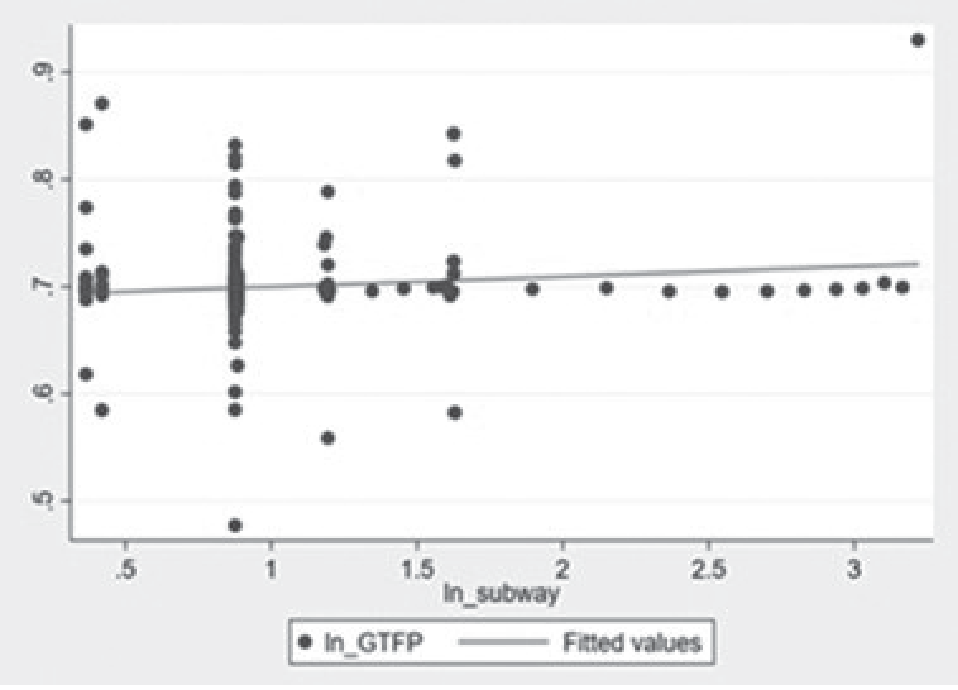
Table 4.
Baseline regression results.
The construction and operation of urban transportation infrastructure, especially subway systems, is affected by many factors. In this paper, we add year and city fixed effects and related control variables to the base regression to solve the endogeneity problem caused by missing variables to some extent. However, the construction and operation of the subway system will still be affected by the city’s economic factors, and a certain degree of economic development is a basic condition for the construction of the subway system [46], so the endogeneity problem of the variables still exists, and we use the instrumental variable (IV) method to solve this problem. An ideal instrument should fulfill two conditions: (1) it must be correlated with the endogeneity variable (height) and (2) it is independent of the disturbance term. In this subsection, we choose three instrumental variables (IVs) to solve the problem using two-stage least-squares regression. The three instrumental variables are as follows:
IV1: Existing transport infrastructure (road miles). Existing transport infrastructure often plays a critical role in economic development by providing basic support for urban business activities and population movements. The existence and expansion of these infrastructures are usually based on long-term urban planning and economic development needs and directly influence subsequent metro construction decisions. Therefore, the size and type of these early infrastructures are naturally associated with new metro projects. Cities with well-developed early transport infrastructure are more likely to build new metros to improve the efficiency and coverage of the existing transport system. Existing transport infrastructure is often built based on past demand and technological conditions, making it relatively independent of current green economic growth, thus fulfilling exogenous conditions.
Table 5.
Robustness test.
IV2: Miles of metro completed in the previous year. The development of metro systems is based on ongoing construction activity, which is often based on long-term planning. Therefore, historical metro construction activity can be used as a predictor of current and future metro construction activity, indicating a strong correlation with the main explanatory variables. As mentioned earlier, decisions and plans for metro construction are often made years in advance, thus qualifying as exogenous.
IV3: Interaction Term between Altitude Standard Deviation and Time. The standard deviation of altitude reflects the diversity and complexity of a region’s terrain, which significantly impacts the construction costs and future planning of the subway system. For instance, cities with varied terrains may face higher construction costs and technical challenges, affecting the pace and decision-making in subway construction. However, considering the dynamic changes in technology, the interaction term between altitude standard deviation and time captures the dynamic effects of terrain on subway construction over time. As technology advances and construction costs evolve, the challenges posed by the terrain may change over time. Yet, as a natural geographical feature, the standard deviation of altitude remains unchanged by urban economic activities or policy decisions, ensuring its exogeneity.
Table 6.
Endogeneity test.
In the three regression results in Table 6, the coefficients of the main explanatory variable are significantly positive, consistent with the results of the baseline regression. This indicates that the original conclusions remain valid even after addressing the endogeneity issue. Additionally, the estimated coefficients from the instrumental variable regression are larger compared to those from the baseline regression. This suggests that the endogeneity problems caused by omitted variables and reverse causality may lead to underestimation in the original estimates. However, the consistency in the sign and significance of the coefficients across different models confirms that the results of this study are robust and reliable.
Mechanism Test
The empirical test in the previous section shows that the development of the subway system has a positive role in promoting urban green economic growth. Then what is the mechanism of the development of a metro system to promote urban green economic growth? As explained in the previous theoretical part, the development of an urban subway system will affect the industrial structure adjustment and upgrading within the city, and promote urban green economic growth through industrial structure adjustment and upgrading. In order to test this mediating effect mechanism, this paper draws on the methods of Wen et al. [47] and Liu et al. [48] for verification.
From column (1) of Table 7, it can be seen that the development of the metro system has a significant positive impact on green economic growth; from column (2), it can be seen that the regression coefficients of the metro system are all significantly positive, indicating that the development of the metro system can significantly promote the industrial structure of the city to be advanced; from column (3), it can be seen that the advancement of the industrial structure significantly contributes to the growth of the green economy and the coefficients of the development of the metro system are still significantly positive so that the mediation mechanism has been verified. Thus, Hypothesis 2 is verified, that is, the development of the metro system promotes the green economic growth of the city through the industrial structure advancement.
Table 7.
Mechanism Test.
Heterogeneity Test
This paper analyzes heterogeneity in the following aspects. First, because of the obvious heterogeneity in the level of green economic growth of the 41 cities that opened and operated subways from 2007 to 2019, this paper distinguishes the efficiency of green economic growth of cities according to whether the green total factor productivity is larger than 1 in that year. The results, as shown in Table 8 (1) and (2) columns, the city of the year the level of green economic growth is better, the development of the subway system plays a positive role in promoting the city’s green economic growth, while the level of green economic development is not good in the year, the role of the subway economic development of the city’s green economic growth is negative and insignificant. Secondly, the most essential feature of metro system development is the connectivity and accessibility of transportation. The development of the subway system makes the population flow within the city more convenient, the opportunity for face-to-face communication increases, and the cost of transportation commuting decreases, which is conducive to the dissemination and diffusion of knowledge, and promotes the improvement of the level of innovation in the city. Therefore, this paper explores the heterogeneity of the connectivity of the urban subway system according to the number of urban interchanges and classifies the degree of connectivity of the urban subway system according to whether the number of interchanges is greater than 5 or not. The results, shown in columns (3) and (4), indicate that the development of metro systems has a differential impact on urban green economic growth depending on the connectivity of the metro system. The development of metro systems in cities with higher connectivity plays a positive and significant role in promoting green economic growth, while the development of metro systems in cities with lower connectivity plays a negative and significant role in promoting green economic growth. Finally, this paper analyzes the heterogeneity of the impact of the development of the metro system on green economic growth according to the different levels of concentration of productive services, because the area around the metro station is a convenient transportation area with a high population density, which is the best geographic location for the concentration of services as well as for the choice of location. This paper distinguishes the level of productive services agglomeration according to whether the locational entropy of productive services is greater than 1. The results, as shown in columns (5) and (6), show that the development of the metro system contributes more to the green economic growth in areas with a higher level of productive service industry agglomeration, with the coefficient shifting from 0.015 to 0.188. In this paper, in order to verify the robustness of the heterogeneity results and whether there are differences in the subgroups that did a Chow test, the results of the test were 31.24, 3.21, and 2.96, respectively, and all passed the Chow test.
Table 8.
Heterogeneity test.
Table 9.
Results of further analyses.
In addition, we explored further as we found that the development of metro systems can have an impact on green economic growth due to differences in connectivity. Previous findings have shown that the formation of metro networks can have a significant impact on innovation and knowledge diffusion, and that metro networks are more conducive to the establishment of firms. This is more significant for firms in technology-intensive industries. A 1 percent increase in the accessibility of business clusters is associated with a 0.44 percent increase in the number of skill-intensive firms established. In addition, the new metro facilitates the flow of knowledge from metro station to metro station and helps to facilitate firms’ access to knowledge from more distant skill clusters [49]. Therefore, we believe that metro connectivity may play an important role in green technological innovation, which in turn affects green economic growth. In this paper, we further collect data on the number of green patents granted in metro-opening cities, and include green technological innovation in the regression equations, and the results, as shown in Table 9, show that the regression coefficients are significant, which indicates that connectivity plays an important role in innovation as well as knowledge spillovers.
Conclusions and Policy Recommendations
Based on the combination of realistic background and literature review, this paper selects 41 cities in China that have opened and operated subways from 2007 to 2019 as samples, and uses the SBM-GML index model to evaluate green total factor productivity (GTFP) as an indicator of green economic growth, and conducts empirical research on the impacts of the development of urban subway systems on green economic growth. The empirical regression results prove the two research hypotheses of this paper and pass the robustness test. The main research conclusions of this paper are as follows:(1) There are obvious regional imbalances both in terms of subway system development and urban green economic growth, and the gap is widening from 2007 to 2019. (2) Metro system development significantly contributes to green economic growth at the city level, and all other things being equal, every one hundred Chinese miles (50km) increase in metro system development can lead to a 2.2% increase in urban green economic growth. (3) In the robustness test, the empirical results are robust and reliable, regardless of whether the green economic growth is re-measured with a new methodology, the number of subway miles is replaced by the number of stations, a special sample of cities is excluded, or one period is lagged. (4) Heterogeneity analysis shows that the impact of metro system development on green economic growth varies according to the degree of connectivity of the metro system, the level of green growth development, and the level of productive service industry agglomeration. (5) Mechanism analysis shows that metro system development promotes green economic growth through industrial structure advancement, which has a significant partial mediating effect.
This paper not only enriches the existing research to a certain extent, but also has a guiding significance for China’s local government to formulate the subway construction plan, realize the rational layout of industrial space, and promote green and sustainable development.
First of all, the government needs to attach great importance to the heterogeneity of cities and avoid “one-size-fits-all” policies and regulations. In the face of the requirements of high-quality development of the national economy and the reality of the new development stage to strengthen green environmental protection, local governments and metro companies should scientifically and reasonably formulate the development goals of dual-carbon and green metro rail, and systematically plan the green and low-carbon implementation actions. Actively build green metro lines, green stations, green yards, green TOD, and green factories, and strive to promote urban green economic growth.
Secondly, the government needs to realize the advanced industrial structure is of profound significance to green and sustainable development. The TOD (Transit-Oriented Development) mode is a new mode of urban development oriented to public transportation. The main feature is to take the public transportation hub site as the core, and through the deep integration of the public transportation site with the surrounding land, to build land-intensive, economical, convenient, and efficient transportation, low-carbon and friendly environment, and green transportation-led, warm, and attractive urban environment suitable for living, working, and traveling, so as to realize the high-quality development of the city. Through the corridor effect and circle effect generated by the application of the TOD mode to attract relevant productive and living service industries, and strive to build the area where the TOD project is located into a modern city center integrating external transportation, shopping, entertainment, leisure, and recreation.
There is a large Pareto improvement in the resource consumption and environmental pollution generated by the whole industry chain in the process of metro construction and operation compared with the economic growth it realizes. To unleash the development potential of the city, it is necessary to adopt green energy-saving standards and green key technologies, innovate operation and management modes, and carry out green emission reduction and energy-saving efficiency actions.
Finally, local governments should focus on future development, scientifically plan metro lines, optimize the layout of interchange stations, enhance the connectivity and accessibility of the metro system, and comprehensively improve the ability of residents to commute over medium and long distances.
There are some limitations to the research presented in this study. Firstly, there is a limitation in the perspective of the analysis, which mainly focused on the 41 cities where metro stations have been opened, and in future analyses, it may be more relevant to explore the issue from the micro perspective of metro stations rather than from the city perspective. In addition, due to the limited availability of data, there is room for more scientific improvement in the measurement of green economic growth in our study, such as using a more advanced green economic growth index. Finally, although some empirical studies have examined the development of metro systems, the solution to the endogeneity problem is still immature. In future studies, we will explore more appropriate IV methods to obtain more accurate estimates.

