

Introduction
The development of energy-efficient construction materials, such as lightweight aggregate concrete (LWAC), holds promise for achieving energy reduction targets. By substituting one or more of the LWAC's components with synthetic lightweight aggregate or organic porous materials, it is simple to minimize heat conductivity [1]. Using an aggregate based on industrial waste, such as various types of ashes, plastics, expanded polystyrene (EP), expanded glass (EG), fly wood ash (FWA), and materials of plant origin, makes it much more difficult to reduce heat conductivity [2]. Due to the abundance of waste glass and EP, which may be utilized as raw materials that are both ecologically benign and give secondary value, they may serve as alternatives to conventional lightweight aggregates [3]. Due to EP's numerous distinctive characteristics, which include being inert, hydrophobic, closed-cell, ultra-lightweight, and low thermal conductivity [4], it is widely desired by various sectors worldwide. After use, the material is disposed of in landfills, where it can last for several generations because of its slow rate of disintegration and low mass-to-volume ratio in comparison to the cost of transportation [5]. As a result, the problem of recycling or reusing discarded EP packaging is a worldwide one.
Literature Review
A total of 4.2 million tons of glass are used annually in home settings, with sheet glass for windows accounting for approximately 36% of the amount, glass fiber goods for 6%, and throwaway glassware for 58% [6]. Comparing EG to several other forms of lightweight aggregate, it seems to be pretty promising [7]. EG is a frost- and chemical-resistant construction material that is hygienic, light, finely porous, flame-retardant, efficient, and simple to use [8]. The compressive strength of EG aggregates, which range from 0.45 to 1.55 MPa [9], is quite low due to the low density of these aggregates. When EG is sintered at 750°C with a 7 wt % Li2CO3 content, a greater compressive strength may be achieved [10]. In EG aggregates produced of sintered amber glass, compressive strength may be increased more significantly (16.7-29.7 MPa) [11]. The experiments show [12] that the LWAC density reduced from 685 to 561 kg/m3, thermal conductivity from 0.163 to 0.140 W/ (m·K), and compressive strength from 5.8 to 4.1 MPa with an increase in EG aggregates (from 300 to 400 kg/ m3).
Several industrial waste materials have shown potential for improving the properties of LWAC:
Metakaolin (MKA) is a highly reactive aluminosilicate, which makes it an excellent alternative to Portland cement (PC) for building concrete. MKA can enhance structural integrity, compressive and flexural strength, and reduce density, capillary water absorption, and alkali-silica reaction [13].
Lignosulfonates act as dispersants, improving workability and reducing the water-to-cement ratio, which enhances the mechanical properties and durability of concrete, and serve as self-curing agents, reducing the need for additional water during curing [14].
Polycarboxylate-based superplasticizers (SP) are high-range water reducers that improve the flowability and workability of concrete without compromising its mechanical properties [15].
Polyacrylates are used in cementitious composites to enhance grout properties. The interaction between calcium ions from cement hydration and carboxyl groups from polyacrylate hydrolysis leads to the formation of a dense, complex network structure that boosts overall performance [16].
Air-Entraining Admixtures (AM) are added to concrete to introduce stable air bubbles, improving its workability and freeze-thaw resistance, and reducing density [17].
Since the volume fraction of aggregate has the greatest impact on the thermal conductivity characteristics of LWAC, EP and its waste are possible aggregates in LWAC [18]. The findings demonstrate that increasing EP significantly lowers the heat conductivity, fire resistance, and compressive strength of concrete [19]. For a given porosity, porous LWAC's compressive strength increases with increasing EP aggregate fineness [20].
The surface-active agents AM for lowering concrete density and increasing porosity, in addition to improving segregation resistance, have a direct detrimental effect on the mechanical characteristics of structural concrete. The ideal dose for AM must be selected based on the physical, mechanical, and pore structure of porous LWAC that has been identified [17]. It is possible to create PC and fly ash-based ultra-lightweight aerated concrete [21] by combining hydrogen peroxide with chemical admixtures. A thermal conductivity of 0.054 W/m·K and a compressive strength of 0.74 MPa were reached for the obtained samples [22]. It was discovered that SP had an impact on pore formation, volume, structure, and stability, in addition to improving the strength of concrete [15]. However, when an SP was present, the effects of various AM kinds (with protein or synthetic origin) on cement paste varied [23]. The compressive strengths of the protein-based AM were around 3-10 times greater than those of the synthetic ones.
The purpose of this study is to investigate the effect of various industrial waste additives (lignosulfonates, polycarboxylates, polyacrylates, and air-entraining admixture) on the quality of lightweight concretes. To achieve this goal, it is necessary to solve the following tasks: 1. Determine the effect of various additives on the initial and final setting time of Portland cement pastes.
2. Determination of dynamic viscosity, density, and porosity of Portland cement pastes. 3. Determination of density, strength, and coefficient of thermal conductivity of lightweight concretes.
Table 1.
Technical details on chemical additives.
Materials and Methods
Materials
For the investigations, a local manufacturer's PC CEM I 42.5 R was employed. The PC had a specific surface area of 4220 cm2/g, a bulk density of 1.15 g/cm3, an initial setting time of 135 min, a final setting time of 185 min, and a maximum alkali content of 0.75%. The percentages of the minerals are as follows: C3S = 56.64, C2S = 16.72, C3A = 8.96, and C4AF = 10.59. PC particles varied in size from 1 to 100 m, with 15 to 30 m particles making up 50% of the total.
EG aggregate, created from waste glass, has a fraction of 0 to 2 mm and a bulk density of 210 kg/m3, whereas crushed waste EP aggregate, acquired from the packaging tare of home appliances, has a fraction of 0.5 to 2.0 mm and a bulk density of 20 kg/m3. In the porous LWAC forming mixes, pozzolanic MKA, which is commercially manufactured, was employed to substitute some of the PC in the composition. MKA's chemical make-up is as follows (in mass percent): 52.1 SiO2, 45.0 Al2O3, 0.5 Fe2O3, 0.2 CaO, 0.2 MgO, 0.3 K2O+Na2O, 0.6 TiO2, and 1.1 additional elements. According to the particle size distribution, particles between 6 and 13 m in diameter made up around 40% of MA. The primary minerals in MKA, according to an X-ray diffraction phase study, are quartz and kaolinite.
All three of the following forms of SP (in liquid form) were utilized in the study: modified lignosulphonate LS, polymer-based synthetic polycarboxylate ester PCX, and polyacrylate-based PA. PC water solution has 27% of the active ingredient, PA contains 27%, and LS contains 31%. In the combinations, the quantities for SPs were constant (0.6% of the PC amount), and they were recalculated in accordance with the concentration of the dry material in the solution of each SP. It was distilled water with a pH of 5.8 and an electrical conductivity of 8 S. The Content of SP was chosen according to a deep review [24] and works [25] in which the estimations of origin and industrial applications of lignosulfonates with a focus on their use as superplasticizers in concrete were performed.
AM is a white powder that is created using sodium alkene sulfonate. It makes sure that the cement paste develops tiny air holes and that the crushed waste EP is hydrophilized. The manufacturer's suggested paste has 0.01 to 0.06% of the PC mass in AM. According to [26], 0.02% of AM should be used for testing in order to prevent the strength qualities from degrading. Table 1 provides more specific information regarding used SPs and AM.
Table 3.
Fresh PC paste formulations for determining dynamic viscosity tests.
Table 4.
Compositions of the developing mixes in the porous LWAC sample series (in mass, %).
Creating Mixes and Sample Preparation
The molds used were made of steel to ensure rigidity and non-reactivity with the concrete mix. The dimensions of the molds were 100x100x100 mm, which is a standard size for creating concrete cubes for compressive strength testing.
The mixing process began with blending the Portland cement (PC) and superplasticizers (SPs) with two-thirds of the total water for 3 min to ensure a homogeneous mixture. The air-entraining admixture (AM) was then dissolved in the remaining one-third of the water and gently mixed for 30 s to avoid excessive foaming. After the initial mixing, metakaolin (MKA) was added, and the mixture was further mixed for 5 min to ensure even distribution of the MKA particles throughout the paste.
Eight compositions were created in order to assess the effects of AM, SPs, and their combinations on fresh PC paste setting behavior parameters (see Table 2). The content of air-entraining additives was chosen according to the review [27], in which an analysis of the behavior of air-entraining additives in fresh concrete and its effects on hardened concrete.
The compositions in Table 2 aim to comprehensively assess the influence of various superplasticizers (SPs) and an air-entraining admixture (AM) on Portland cement (PC) paste properties. By including pure PC paste as a baseline, the study establishes a reference point for comparison. Each composition then systematically introduces different SPs (PA, PCX, LS) and evaluates their individual effects on workability and setting behavior. Additionally, combinations of SPs with AM are explored to understand potential synergies in enhancing mechanical properties while maintaining workability. This approach allows for a thorough investigation of how different additives interact and impact paste characteristics, guiding the development of optimized lightweight aggregate concrete mixes. Through controlled experimentation, the study aims to identify formulations that strike a balance between improved workability, setting time, and mechanical strength, thereby advancing the understanding and application of sustainable concrete materials.
Table 5.
Times at which freshly made PC pastes with various chemical admixtures start and stop setting.LWAC sample series (in mass, %).
| Composition | Time (min) | |
|---|---|---|
| Initial setting | Final setting | |
| PC | 150 | 200 |
| PC+PA | 195 | 285 |
| PC+PCX | 170 | 225 |
| PC+LS | 170 | 235 |
| PC+AM | 155 | 210 |
| PC+PA+AM | 235 | 365 |
| PC+PCX+AM | 195 | 260 |
| PC+LS+AM | 205 | 320 |
Fig. 1.
Dynamic viscosity of fresh PC pastes with different MKA to PC ratios: (a) without AM; (b) with AM.
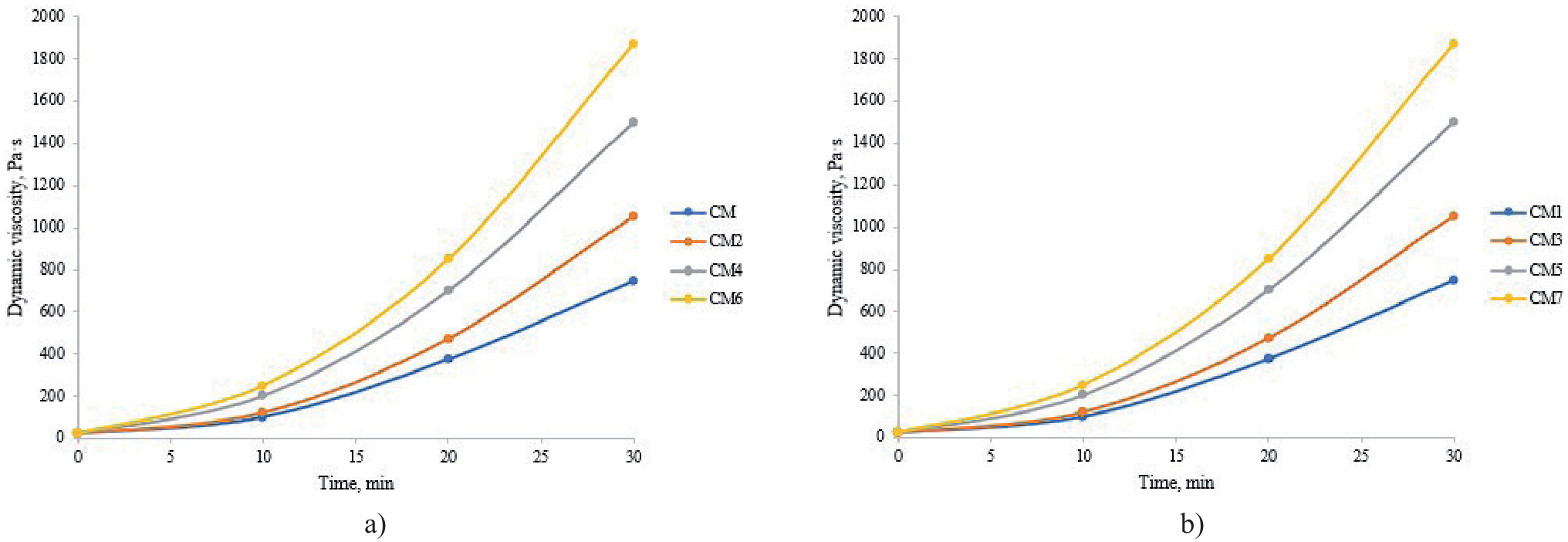
To evaluate the effects of the MKA to PC ratio and AM on the paste's dynamic viscosity fluctuations, eight compositions were made (see Table 3). The content of MKA was chosen according to the results of the study [13]. The quantities of PA and MKA in the forming mixes were fixed and derived from the combined amounts of PC and MKA in percent.
Table 4 lists the compositions of the developing mixes of the porous LWAC samples. In the forming mixes, the water to PC and MKA ratio ranged from 0 to 0.44.
The freshly prepared paste was carefully placed into the steel molds immediately after mixing to prevent segregation or loss of workability. To preserve the structural integrity of the aggregates, the mixture was gently compacted using a wooden board. The mixture was then subjected to further compaction for 1 minute on a vibrating table to eliminate air pockets and ensure a dense and uniform sample.
Results
Fresh PC Pastes that Have Been Altered with Various Chemical Admixtures
Initial and Final Setting Times
Tests on the beginning and final setting timings of fresh PC pastes were carried out in order to choose the optimal SP that (in interaction with AM) assures the minimum setting time delay (see Table 5). With just a 6.4% difference between it and the reference sample, AM has the least impact on the initial setup time, according to the analysis of the data. The new PC paste's first setup time was 9.8% longer due to the composition of PA. It rises by 13.4 to 26.2% for LS and PCX applications. The study demonstrates that the first setup time varies based on the kind of SP.
The initial setup time changed noticeably when AM and SPs were used in conjunction. The initial setup time is longer with PA, LS, and PCX than with the reference samples. The tested samples with LS and PCX started setting almost two times as slowly. In comparison to the reference samples, the final setup time is longer for the AM, PA, LS, and PCX samples. These findings demonstrate that the final setup times for LS and PCX are substantially longer than those for PA. When utilized alone or in conjunction with AM, PA often causes the smallest initial setup and final setup delays.
Different MKA to PC Ratios in Fresh PC Pastes
Dynamic Viscosity
PA was used in both cases (without AM and with AM admixture) for dynamic viscosity testing of PC pastes. The dynamic viscosity of fresh PC paste rose considerably as the MKA to PC ratio (Fig. 1a) increased, notably during the whole test period and the first 5 to 10 min after mixing. After 30 min, when the MKA to PC ratio was at its highest, 0.428, the dynamic viscosity in the MKA-free sample was over three times higher. In freshly manufactured PC pastes, a higher MKA to PC ratio predicts a faster increase in dynamic viscosity over the course of the whole measurement time.
The same experiments of dynamic viscosity were carried out to further understand how AM affected the MKA to PC ratio (see Fig. 1b). Fresh PC paste samples with PA and AM had a greater dynamic viscosity than those without AM. While this is going on, new PC paste samples with AM (CM1, CM3, CM5, and CM7) had dynamic viscosities that are 180, 355, 450, and 875 Pa s greater than the identical CM samples without AM within the first 10 min of mixing, respectively (see Fig. 1a). The dynamic viscosity of the AM-added samples (CM1, CM3, CM5, and CM7) after 30 min of testing is higher than the dynamic viscosity of the control samples with the same composition. Chemical admixtures have a sizable influence on the rheological properties as well as the setting parameters of new PC pastes.
Density
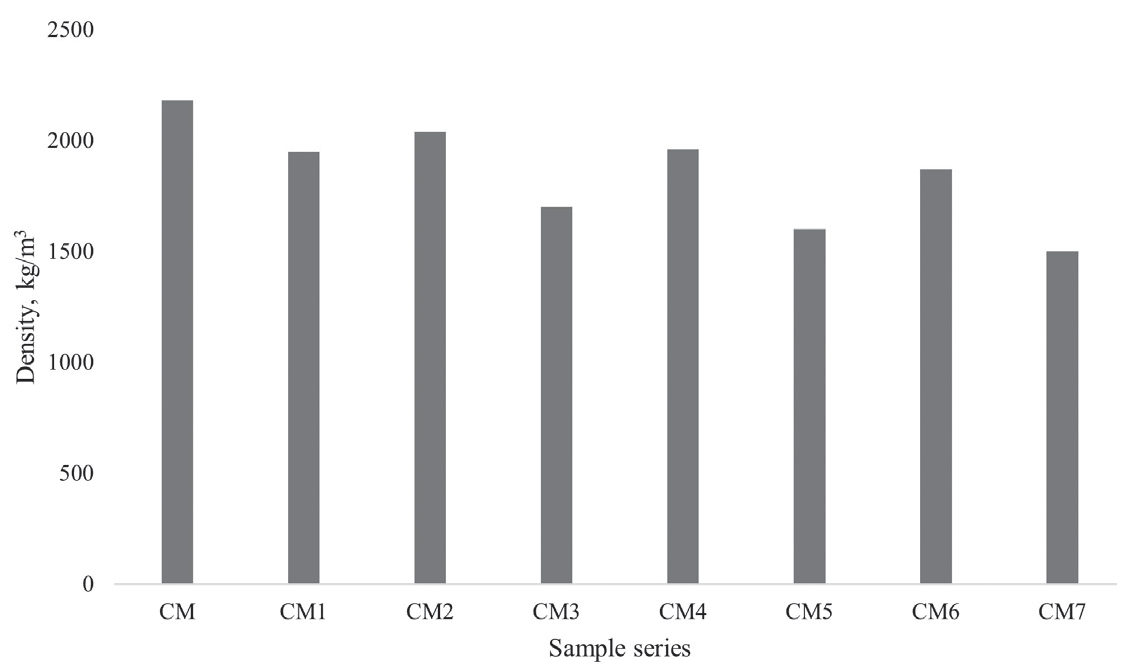
In comparison to compositions without MKA, an increased MKA to PC ratio decreases the density of forming mixes by more than 8.7% (Fig. 2). Air is converted into small, evenly distributed pores when it is combined with AM, and the density of mixtures generated with various MKA to PC ratios reduces from 1995 to 1650 kg/m3. When the MKA to PC ratio was 0.111, 0.25, or 0.428, the combined action of MKA and AM allowed the density of PC paste to be reduced by more than 5.3, 13.5, and 18%.
Porosity
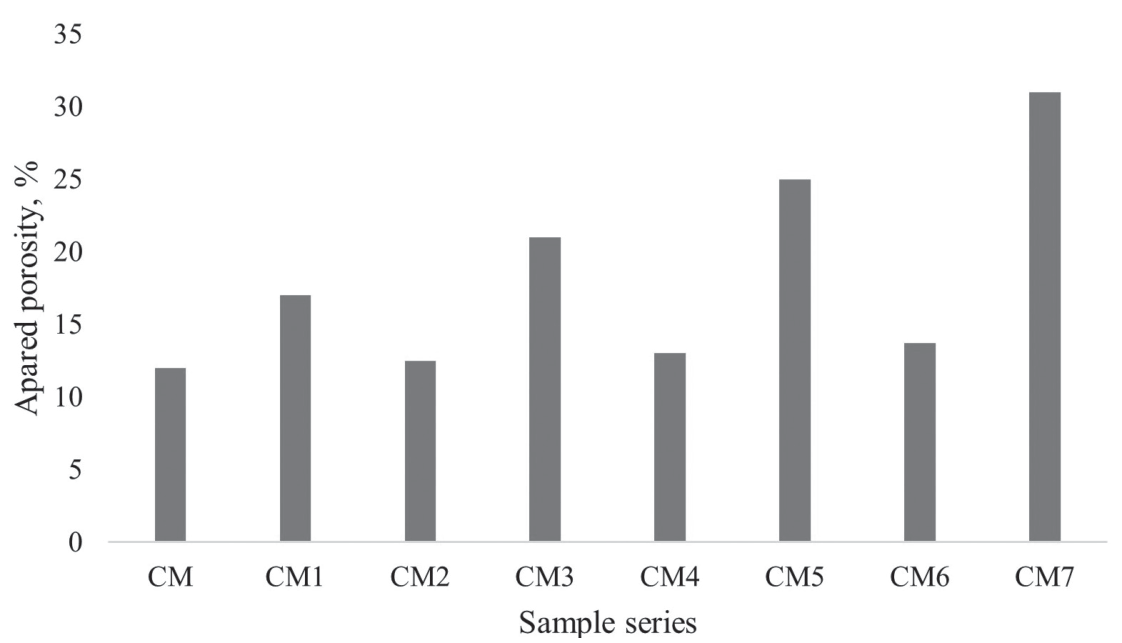
An apparent porosity test on samples that had been curing for 28 days was used to validate density testing (Fig. 3). The samples' apparent porosity rose from 12.3% to 14.3% with a greater MKA to PC ratio (sample series CM, CM2, CM4, and CM6). The samples' apparent porosity rose from 17.2 to 31.0% during the sample series with AM. The apparent porosity rose by 0.8, 1.6, and 2.3% for samples without AM admixture when the MKA to PC ratio was 0.11, 0.24, and 0.428, but by 4.0, 8.0, and 14.0% for those with AM admixture. This demonstrates unequivocally that the porosity in samples containing both MKA and AM was much larger than in samples containing solely AM admixture.
Lightweight Aggregate Concrete (LWAC)
Density; Compressive Strength
Table 6 displays LWAC's physical-mechanical characteristics and structural effectiveness. The estimation of strength after 7, 28, and 56 days was chosen according to EN 12390-3, Testing Hardened Concrete. Compressive Strength of Test Specimens.
Analyzing the strength of lightweight aggregate concrete (LWAC) at 7 days, 28 days, and 56 days offers a comprehensive understanding of its performance over time, addressing both early and long-term considerations.
The structural efficiency test was illustrated by [28]. With a rise in the MKA to PC ratio in the forming mixes, the dry density of the LWAC sample series constantly falls. When compared to sample series K without MKA, the density of sample series K6 is 40.1% lower. However, in our situation, the dry density drops due to a bigger volume of entrained air as well as an increase in the MKA to PC ratio, as can be seen from the data in Figs. 2 and 3. The compressive strength of concrete typically decreases as air content increases. Normally, 1% air results in a 5% loss in concrete's compressive strength. Comparing the compressive strength after 28 days of hardening to the compressive strength after 7 days of hardening, an increase in the MKA to PC ratio from 0 to 0.428 caused increases in 26.0, 22.0, 18.3, 24.0, 23.5, 18.2, and 20.0%. The increase in compressive strength ranges after 56 days of hardening as follows: 32.0, 32.0, 30.0, 40.8, 42.4, 27.3, and 25.7%.
Table 6.
LWAC's physical-mechanical characteristics and structural effectiveness.
In Table 6, "relative strength" and "structural efficiency" are parameters used to assess the performance of lightweight aggregate concrete (LWAC) compositions:
Relative strength is calculated by expressing the compressive strength of each LWAC composition at 7, 28, and 56 days as a percentage of the corresponding strength of the control composition (K).
Structural efficiency is calculated by dividing the load-bearing capacity (measured in Newton meters, N m) of LWAC specimens by their density (measured in kilograms per cubic meter, kg/m³) at 7, 28, and 56 days of hardening.
The increase in the MKA to PC ratio from 0.176 to 0.428 in the K3-K6 composition samples is what is responsible for the decline in the structural efficiency values after 7, 28, and 56 days of hardening. In comparison to control K composition samples, the structural efficiency of the K3-K6 composition samples decreased by 22, 34, 4, 51, and 62.2% after 56 days of hardening. However, the structural efficiency of K1 composition samples is 3.3% higher and only 4.4% lower for K2 samples when compared to control K composition samples. It shows that K1 and K2 compositions have a greater capacity to lower the density compared to K3-K6 samples without significantly changing their mechanical properties. However, in the time period of 28 to 56 days, there is an extremely intriguing correlation between the strength growth and the density ratio of K3 and K4 compositions. In certain compositions, structure efficiency values rise by 16-19%, but in other compositions, they rise by 4-8%.
K1 and K2 mixes showed improved structural performance due to an optimal balance between reduced density and maintained mechanical strength. The inclusion of MKA at lower ratios (0.053 and 0.110 for K1 and K2, respectively) contributed to density reduction without significantly compromising compressive strength.
Discussion
Research indicates that MK can significantly enhance the compressive strength of concrete. The optimal replacement level for maximum compressive strength typically ranges between 10% to 20% [29]. Higher levels of MK (above 20%) tend to reduce workability, as reported by [30].
Our research's electrical conductivity demonstrates that there are significant differences in the quantity of ions present in various SP solutions. Also reported in [31] is a similar EC of SPs. The large number of R-SO3 groups initially present in sulphonates, in accordance with [32], may cause PA to have a high EC, and for PA and PCX, the EC values mostly depend on the amount of carboxyl groups and distinct designs, in accordance with [33].
It might also be impacted by the calcium binders that have formed on top of the anhydrous alkaline cement components. The fundamental cause of PA's retardation is its adsorption on hydrated particles, which results in the creation of ettringite, which prevents hydration from developing. According to studies on PCX, calcium salts created in pastes reduce the system's Ca2+ concentration and impede further hydration [34].
A greater MKA to PC ratio in the freshly made PC pastes foretells a quicker rise in dynamic viscosity over the course of the whole measurement period. Other studies have also noted that MKA thickens freshly made PC paste and worsens its rheological qualities (if used without SP) [14]. This may also be affected by the MKA particle lamellae structure [35].
When compared to sample series K without MKA, the density of sample series K6 is 40.1% lower. Similar to this, the samples with the lowest densities were those that included 30% MKA of PC mass [35], expanded perlite aggregate, and foam glass aggregate [3, 8]. It is well-known that porosity rises and strength values fall as the MKA content exceeds 20-30% [36]. Additionally, the compressive strength of LWAC is decreased by the EP aggregate's weak adherence to PC paste [3, 12].
We can see that samples with an MKA to PC ratio of 0.11-0.25 have the strongest increases in strength. Other studies' experimental findings demonstrate that in samples where PC was substituted by up to 30% MKA by weight, substantial gains in strength were recorded on the 56th and 90th days of cure [37]. However, according to other experimental findings, replacing 10- 15% of PC with MKA boosts flexural strength by up to 50%, improves compressive strength by up to 10%, and decreases porosity by up to 35% [13].
The association between the thermal conductivity coefficient, porosity, density, and PC amount has also been shown by other authors [38].
Conclusions
The air-entraining admixtures, superplasticizers, and their combinations under study all contribute in different ways to the lengthening of the setting time of new PC pastes. The initial and final setting durations of the samples with superplasticizer and air-entraining admixtures in an alkaline medium were lengthened the least, while those in an acidic medium were lengthened the most. When used alone or in conjunction with AM, PA admixture minimally extends the new PC paste's initial and final setting times.
After 30 min of testing, the samples with the greatest MKA to PC ratio have dynamic viscosities that are 2.46 times higher than those of the reference sample devoid of MKA. Fresh PC samples' dynamic viscosity rose by up to 50.8% in response to the AM when compared with the same samples without it.
A higher volume of air can be incorporated into the structure during mixing when the MKA to PC ratio in the pastes is increased, which leads to uniform pore distribution, a 2.2-fold increase in apparent porosity, and a decrease in fresh density compared to the reference sample without MKA.
In LWAC sample series (where AM and PA are combined), increasing the MKA to PC ratio results in a very porous macrostructure, which lowers density by up to 40.1%. The compressive strength in the LWAC sample series was reduced up to 14 times after 7 days of hardening with a higher MKA to PC ratio.
The lightweight concretes (LWAC) developed exhibit enhanced compressive strength, durability, and reduced density, making them ideal for high-rise buildings, bridge decks, precast elements, thermal insulation, marine structures, and rehabilitation projects. These applications benefit from the reduced dead load, improved thermal properties, and resistance to harsh conditions.
The Next Steps for Research are to conduct long-term performance studies, implement field trials, optimize mix designs with additional SCMs, assess environmental impacts through life cycle analysis, utilize advanced characterization techniques, and develop standardized guidelines for practical applications.

