

Introduction
On a global scale, environmental protection and sustainable development have become issues of paramount importance. China has committed to achieving peak carbon emissions by 2030 and carbon neutrality by 2060. Therefore, the dual carbon strategy has placed corporate ESG performance under the spotlight. ESG refers to the efforts of enterprises in the environment (E), society (S), and governance (G). Since its first proposal by the United Nations Global Compact in 2004, the conceptual framework of ESG has progressively been implemented in most business operations [1], establishing itself as an indispensable metric for evaluating corporate sustainability. Analyzing each dimension individually, the environmental dimension focuses on an enterprise’s effect on the natural environment, aiming to sustainably utilize natural resources by controlling greenhouse gas emissions and resource consumption. The social dimension addresses the enterprise’s relationships with its employees and customers, with the understanding that a positive social impact is likely to enhance investor confidence. This is achieved through initiatives such as social welfare programs that contribute to the development of a harmonious society. The governance dimension pertains to the enterprise’s management structure and operational practices, emphasizing transparent decision-making processes and balanced stakeholder participation to reduce investment risks.
Thus, the ESG concept represents a holistic consideration of sustainability, including the environmental, social, and governance dimensions. Its practical implications, including risk reduction and the cultivation of a favorable social reputation, contribute to increased investor recognition [2] and reduced capital costs [3]. In macro-sustainability standards, ESG disclosure frameworks, led by international organizations such as the Global Reporting Initiative (GRI) and the Sustainability Accounting Standards Board (SASB), have achieved widespread adoption. Notable examples include the European Sustainability Reporting Standards (ESRS) promulgated by the European Commission and the two sets of IFRS Sustainability Disclosure Standards issued by the International Sustainability Standards Board (ISSB), all of which mandate the reporting of corporate sustainability information [4]. In China, ESG disclosure can motivate high-quality development, prompting Chinese enterprises to engage in a new phase of actively embracing ESG principles. According to the “Report on ESG Actions of Chinese Listed Companies (2022-2023)” published by the International Institute of Green Finance, a total of 1738 A-share listed enterprises have released ESG reports, demonstrating a year-on-year increase of 22.14%. Specifically, the disclosure rate among state-owned enterprises surpasses 60%. In addition, the average ESG score based on domestic ratings has presented significant improvement, indicating a general trend among Chinese enterprises toward prioritizing the practical implementation of ESG concepts.
However, while the ESG concept has gained traction, the phenomenon of ‘greenwashing’ has also surfaced [5], characterized by the embellishment and exaggeration of enterprises’ environmental protection efforts and achievements. Simultaneously, according to a report [6] issued by the Internet Industry Research Institute at Tsinghua University, the short-term benefits of ESG investment remain ambiguous, leading to a lack of motivation for ESG investment among certain enterprises. Considering these challenges, a crucial question arises: how can enterprises enhance the authenticity and accuracy of their ESG disclosures? Equally important is the question of how to address the short-sighted behavior of enterprises at its root.
The issuance of the “14th Five-Year Plan for Digital Economy Development” in 2022 unequivocally identifies the enhancement of digital infrastructure and the robust advancement of industrial digital transformation as critical objectives. Amid the burgeoning digital economy, the digital transformation of enterprises offers more efficacious instruments for addressing the challenges in ESG practices. Warner [7] hypothesizes that digital transformation represents a continuous process of strategic renewal, leveraging digital technological advancements to update or supersede an organization’s business model, collaborative methodologies, and organizational culture. A wide array of technologies have become integrated with enterprises’ production, sales, and other operational facets [8]. This integration has facilitated the transformation of manufacturing processes [9] and business models [10], significantly propelling improvements in both financial and non-financial performance, including ESG performance. On the one hand, digital technology empowers enterprises to exert global control over production processes, thereby enhancing the level of disclosure pertaining to ESG information; whereas, the traceability of corporate green data reduces the risk of information asymmetry, effectively curbing the practice of greenwashing. Therefore, it can be concluded that digitalization and sustainability are not mutually exclusive but rather necessitate reciprocal reinforcement, particularly under the “Overall Layout Planning for Digital China” issued in 2023. This plan mandates the transformation of digitalization and sustainability to cultivate a green and intelligent digital ecological civilization. Specifically, digital transformation represents a long-term commitment as opposed to a transient solution, aligning with the ESG concept of long-term sustainability.
An additional challenge in digital transformation and ESG practice is the myopic behavior exhibited by managers. This behavior reflects a prioritization of short-term economic gains over long-term sustainability and the utilization of digital technology solely to enhance financial performance at the expense of environmental performance. Such an approach deviates from the fundamental tenets of ESG and impedes the advancement of corporate ESG performance [11]. Accordingly, the personal characteristics of executives in enterprises assume a supportive role in the relationships between digital transformation and corporate ESG performance. Specifically, foreign experience significantly affects the fulfillment of social responsibility through cognitive and competence imprinting [12].
Therefore, this study empirically evaluates the effect and mechanism by which digital transformation affects corporate ESG performance. Utilizing a two-way fixed effect model and a moderated mediation model, the study analyzes A-share listed companies in China from 2010 to 2021, aiming to offer impetus to the objectives of digital economy and dual carbon.
The marginal contributions of this study are twofold:
(1) On a theoretical level, it explores the effect of digital transformation on corporate ESG performance through the perspective of corporate governance theory, explaining the mediating effect of green innovation based on information asymmetry theory and resource-based theory. Moreover, it analyzes the moderating role of executives’ foreign experience, adopting a micro-level perspective of individual characteristics according to upper echelons theory. (2) On a practical level, this study aligns with the prevailing context of the digital economy and dual carbon goals. It not only seeks to deepen ESG responsibility through digital transformation and unleash a surge of vitality to carry out green innovation, but also seeks to inspire the recruitment of talent, finally aiming to achieve targets of energy conservation, emission reduction, and green production.
Literature Review
Digital Transformation and Corporate ESG Performance
In terms of the effect of digital transformation on corporate performance, the extant literature primarily concentrates on economic effects, notably financial performance. Indeed, digital transformation acts as a driving force across all dimensions of ESG. Nicola and Karen hypothesized that digital transformation can facilitate ESG strategies in companies by promoting their implementation, cultivating ESG assessment and monitoring methodologies, and enhancing information transparency [13]. Kwilinski, employing a spatial Durbin model, evaluated the effect of digitization on the three core ESG dimensions – environment, society, and governance – in EU countries. The study indicated significant spatial spillover effects and identified technological innovation as a critical channel through which digital transformation translates into ESG performance enhancements [14].
For the measurement of ESG performance in China, the Huazheng ESG rating system is the predominant choice. Analyses of the mechanisms by which digital transformation influences ESG performance have primarily centered around mediating pathways such as financing constraints, information asymmetry, and green innovation. Hao and Zhang determined that digital transformation can significantly enhance the fulfillment of ESG responsibilities in manufacturing enterprises by reducing financing constraints. Their research further indicated that this promotional effect is particularly significant in state-owned enterprises and enterprises characterized by a lower proportion of management shareholding [15]. Analyzing the role of information asymmetry, Han and Zhang hypothesized that digital transformation can stimulate ESG performance by enhancing corporate information transparency, and this enhancement effect is more significant in high-tech enterprises and enterprises operating in low-pollution industries [16]. Wu and Li, focusing on the perspective of green innovation, determined that a higher degree of digital transformation cultivates green innovation, thereby promoting corporate ESG performance, with large-scale enterprises experiencing the most significant effect [17]. In contrast, Zeng, also analyzing the mechanism of green innovation, observed an inverted U-shaped relationship between digital transformation and corporate ESG performance in high-carbon emission enterprises. This suggests a double-edged role of digital transformation in ESG performance [18].
Executives’ Characteristics
For corporate executives, the effectiveness of ESG governance represents a critical factor in ensuring sustainable development in a globalized business environment. However, many executives who demonstrate a lack of familiarity with ESG principles often exhibit short-sighted and opportunistic behavior. This behavior significantly reduces the authenticity of corporate ESG information. Therefore, it is essential to consider executives’ characteristics, including gender, age, and others [19]. In sustainability’s moderating effect, research perspectives primarily concentrate on age, educational background, and tenure. Liu [20] identified the aforementioned three executives’ characteristics as moderating variables between equity-based incentives and enterprise sustainability. The study determined that younger executives, those with higher levels of education, and executives with longer tenures exhibit a greater likelihood to embrace change, capitalize on opportunities, and prioritize long-term development. Similarly, Zhang [21] selected gender, age, and tenure as moderators to study the role of these executive characteristics in the relationship between ownership structure and environmental information disclosure. The research indicated that as executives age, they tend to reduce the effect of ownership structure on environmental information disclosure; whereas gender and tenure demonstrated no significant moderating effect in this process. The study hypothesized that older executives may prioritize their career development, leading to risk aversion, a practice that does not contribute favorably to environmental sustainability. Specifically, both the two studies observed that younger executives positively moderate the promotional effect of equity-based incentives or ownership structure on sustainability. However, differences are present regarding the characteristics of executives’ tenure. The former study further explained the moderating effect of executives’ education.
It is evident that in enterprise sustainability, existing literature has undertaken in-depth analyses of the differences in age and tenure among executives. However, fewer studies have addressed the moderating effect of executives’ foreign experience, a significant executive characteristic. Most executives with foreign experience have a blend of international perspectives and sustainable development concepts. Wu [22] determined that executives’ foreign experience exerts a positive effect on corporate ESG performance, with environmental dimension performance improvement being the most significant. Bu [23] further corroborated this finding, indicating that executives with foreign experience significantly enhance enterprises’ ESG scores. This effect is particularly evident in state-owned enterprises.
In summary, the literature analyzing the effect of digital transformation on corporate ESG performance presents two viewpoints, resulting in varied perspectives on heterogeneity analysis. A majority of studies employed the Huazheng ESG rating index as the explanatory variable, utilizing the fixed-effect model research method. This approach sought to unravel the mechanisms of financing constraints, information transparency, and green innovation based on information asymmetry theory. Despite the consistency in core variables and model selection, opinions diverge regarding the main effect, including both positive promotion and inverted U-shaped viewpoints. Hence, exploring the effect of digital transformation on corporate ESG performance holds significant value. Moreover, research perspectives on heterogeneity analysis have primarily focused on the macro level, with equity nature and firm size as primary areas of inquiry. Few studies have analyzed the mechanism of the moderating effect, particularly from the micro level of internal driving factors. This constitutes a gap in current research. Concerning the literature on executives’ characteristics, relevant studies evaluating their effect on sustainability are becoming increasingly abundant. However, discussions based on the perspective of digital transformation remain relatively scarce. Therefore, assessing whether executives’ foreign experience exerts a moderating effect on the relationship between digital transformation and corporate ESG performance necessitates further exploration. Accordingly, this paper empirically evaluates the effect of digital transformation on corporate ESG performance, specifically from the vantage point of executives’ foreign experience. This analysis aims to offer potential strategies for enterprises to enhance ESG performance through digital transformation.
Theoretical Analysis and Hypothesis
Digital Transformation and Corporate ESG Performance
Based on corporate governance theory, digital transformation empowers enterprises to fulfill their ESG responsibilities primarily through two mechanisms: internal management optimization and external information disclosure enhancement.
From an internal standpoint, digital transformation can significantly enhance the efficiency of operational management. In production operations, enterprises leverage advanced digital technologies to quantify their production and environmental costs. This enables a reduction in energy consumption, a decrease in emissions, and the realization of green production objectives through the comprehensive control of information relevant to corporate ESG performance across the entirety of the energy use, production, and innovation chain [24]. Regarding organizational control, enterprises can utilize these digital tools to expedite the circulation and integration of internal data. This data-driven approach facilitates the optimization of internal databases, enabling enterprises to identify potential governance vulnerabilities, and finally inform operational efficiency in the organization.
From the external standpoint, digital transformation significantly enhances information transparency through the tracking of green data. Considering the absence of mandatory stipulations for corporate ESG disclosure in China, numerous companies engage in selective ESG reporting, primarily to conform to various ESG rating systems, with simultaneous potentially deceptive greenwashing practices. The form of self-interest is often reflected through a desire to cultivate a favorable public image and secure government subsidies, which can supersede the prioritization of social responsibility. This prioritization discrepancy can lead to data distortion and present obstacles to carbon footprint reduction practices. However, the integration of digital tools enables tracking of all enterprise activities where the extent to which a company engages in genuinely commits to green production can be accurately determined. This technological integration significantly increases the transparency of internal information, effectively reducing stakeholder investment risk. From the aforementioned analysis, it can be inferred that a company’s degree of digital transformation is positively correlated with its ESG performance. Therefore, the following hypothesis is proposed:
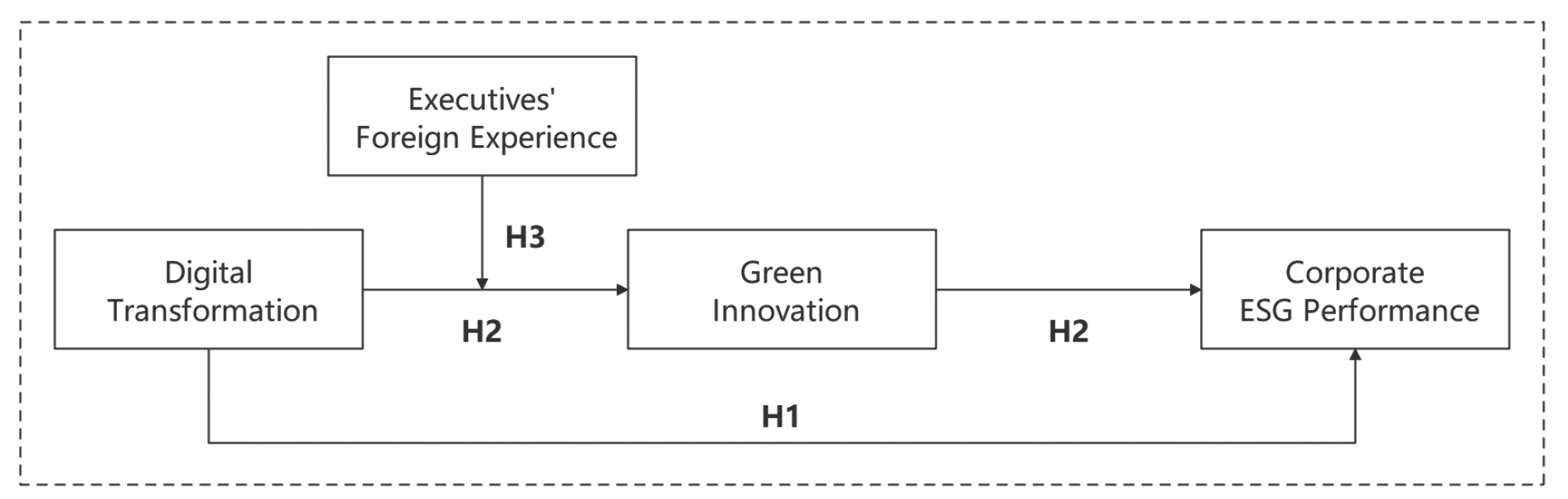
H1: Digital transformation has a significant contribution to corporate ESG performance.
The Mediating Role of Green Innovation
Brain and Wield first hypothesized the concept of green innovation as an overarching term for technologies, products, or processes exhibiting the capacity to reduce environmental pollution and enhance energy efficiency [25]. Digital transformation can promote green innovation by enhancing information asymmetry, also simultaneously optimizing resource integration. Drawing upon information asymmetry theory, digital transformation effectively enhances interdepartmental communication efficiency, reduces management costs incurred during the research and development process [26], and conveys environmental information to investors [27], thereby offering financial assurances for enterprises to engage in green innovation. Simultaneously, leveraging resource-based theory, the effective integration of internal resources, such as human resources [28] and technological resources [29], can propel green technological transformation, finally establishing a wellspring of competitive advantage for enterprises. Thus, digital transformation can lay the groundwork for green innovation. In addition, green innovation reciprocally exerts a driving influence on corporate ESG performance. In the tripartite dimensions of environment, society, and governance, green innovation not only reduces corporate reliance on conventional energy sources in the production process [30] but also caters to consumer predilections for environmentally benign products [31] while simultaneously conveying positive market signals concerning the fulfillment of social responsibilities [32], thus enhancing corporate ESG performance.
H2: Green innovation has a mediating effect on the impact of digital transformation on corporate ESG performance.
The Moderating Role of Executives’ Foreign Experience
Foreign experience is operationally defined as having overseas study or work experience [33]. In conjunction with upper echelons theory, the foreign experience of managers, who function as risk decision-makers, significantly affects their cognitive capacity and strategic choices, which affects corporate decision-making [34]. Its mechanism of action towards green innovation may manifest through the following facets:
Firstly, in the domain of cultural literacy, executives with foreign experience, by virtue of their protracted exposure to the international environment and education in social responsibility, exhibited significantly different values and behavioral patterns compared to their domestic counterparts who exhibit a predilection for conservatism, thereby demonstrating creative modes of thinking and a higher tolerance for innovation risks [35]. This proclivity leads to a greater emphasis on long-cycle R&D investment in the enterprise [36], rendering them more inclined to prioritize green achievements concomitant with digital transformation. Secondly, in social networks, executives’ foreign experience confers upon them international connections and social capital. Thus, they can gain access to cutting-edge green technology research directions, offering theoretical and practical guidance for corporate green innovation [37], thus amplifying the effect of digital transformation.
H3: Executives’ foreign experience has a positive moderating effect on the relationship between digital transformation and corporate green innovation.
Based on the above analysis and hypothesis, this paper constructs the related theoretical model as is shown in Fig. 1.
Research Design
Source of Data
In this study, A-share listed companies in China during the period from 2010 to 2021 constitute the research cohort. The samples were processed through the following processing steps: (1) Sample enterprises classified as ST and *ST, as well as financial enterprises, were excluded;
(2) Samples exhibiting missing values in any variable were excluded; (3) To reduce the effect of outliers on the study, the continuous variables were subjected to winsorization at the 1st and 99th percentiles. Finally, this study comprises 960 listed enterprises with 11,520 observations. The data for this study were culled from the Wind, CSMAR, and CNRDS databases, with Stata17 employed as the data processing software.
Variable Selection
The Explained Variable
Currently, the standardization of ESG disclosure statements in China remains absent, leading to the emergence of various third-party rating agencies, such as Huazheng, Wind, and SynTao Green Finance. Drawing upon the research conducted by Hao [15] and Wang [38], this study employs the Huazheng ESG rating index, a nine-grade scale ranging from CCC to AAA with corresponding numerical values from 1 to 9, to operationalize the explained variable, corporate ESG performance (ESG).
The Explanatory Variable
As corporate annual reports serve as a dual-purpose document, including both retrospective analysis and prospective outlook, the frequency of keywords in these reports is directly proportional to the actual significance attributed to them by the organization. Therefore, building upon the methodology employed by Wu [39], this study carried out a textual analysis of the annual reports published by listed enterprises. Firstly, a comprehensive digital dictionary was constructed, including five key dimensions: artificial intelligence technology, big data technology, cloud computing technology, blockchain technology, and digital technology application. Then, a word frequency analysis was performed on the annual reports, aggregating the keywords in each dimension to derive the total word frequency associated with digital transformation. A logarithmic transformation was then applied to this aggregate value, yielding the explanatory variable, digital transformation (Dig).
Table 1.
Definition of the variables.
The Mediating Variable
Green innovation, as a construct, can be measured through the number of green patents held by an enterprise. However, the patent application process is time-intensive, and its potential effect on corporate ESG performance may precede the approval of the patent. Therefore, this study draws inspiration from the research of Li [40] and utilizes the natural logarithm of the total number of green patents applied for by enterprises in the same year, incremented by one, as a measure of the mediating variable, green innovation (lnGT).
The Moderating Variable
The measurement of executives’ foreign experience has been approached in diverse ways in the literature [41]. The first approach involves summing the number of corporate executives with foreign experience and applying a natural logarithmic transformation. The second approach utilizes a binary (0–1) dummy variable, where 0 signifies the absence of executives with foreign experience in the firm, while 1 indicates the presence of at least one executive with an overseas background. The third approach quantifies this variable through the ratio of executives with foreign experience to the total number of executives in the organization. In accordance with the study conducted by Wen [42], this study adopts the third approach to construct the moderating variable, executives’ foreign experience (Overseas).
Model Setting
To test the impact of digital transformation on corporate ESG performance and the mediating path of green innovation in it, the following model is constructed:
Table 2.
Descriptive statistics of variables.
Where i denotes the firm, t denotes the year, β0 denotes the intercept term, β1~βm denotes the regression coefficients of each variable, Controls denotes the control variables, and the last three items denote the time-fixed effects, industry-fixed effects, and random error terms, respectively. The meanings of the above model are as follows: model (1) is employed to test the direct effect of digital transformation on corporate ESG performance. Models (2) and (3) are designed to test the mediating role of green innovation.
Then, moderated mediation effect models (4) to (6) are constructed, following the methodology of Wen [45]. Model (4) analyzes the direct moderating effect of executives’ foreign experience on the relationship between digital transformation and corporate ESG performance. Model (5) evaluates its moderating effect on the initial pathway, “Digital Transformation - Green Innovation.” Model (6) evaluates the moderating effect of executives’ foreign experience on the pathway, “Green Innovation - Corporate ESG Performance.”
Results and Discussion
Descriptive Statistics
Descriptive statistics are presented in Table 2. Corporate ESG performance exhibits a minimum of 1.25 and a maximum of 6.25, with a standard deviation of 1.011. This suggests a significant difference in ESG performance among the sampled enterprises while indicating a moderately high level. Digital transformation scores range from 0 to 3.761, with a mean value of 1.592, implying a generally low level of digital transformation in the sampled enterprises.
Correlation Analysis
Table 3 presents the results of Pearson and Spearman correlation analyses conducted on the main variables. Pearson correlation coefficients are displayed below the diagonal, while Spearman correlation coefficients are presented above the diagonal. Specifically, digital transformation demonstrates a significant and positive correlation with corporate ESG performance. In addition, executives’ foreign experience exhibits a significant and positive correlation with corporate ESG performance. These findings offer initial support for the hypotheses proposed in this study. Besides, a variance inflation factor (VIF) test is performed on the variables. The VIF values range from 1.27 to 1.67, significantly lower than the critical threshold of 10, indicating the absence of severe multicollinearity among the variables.
Analysis of Main Effects
Prior to the regression analysis of main effects, this study employed the Hausman test to determine the appropriate fixed effect model, incorporating controls for year and industry. Table 4 presents the results of the first three models. The regression results of model 1 demonstrate that digital transformation exhibits a coefficient of 0.114, significant at the 1% level. This finding suggests that digital transformation can positively affect corporate ESG performance. Specifically, holding all other variables constant, a 1% increase in digital transformation is correlated with a 0.00114 improvement in corporate ESG performance. Therefore, H1 is confirmed. This positive relationship can be attributed to several factors. Firstly, digital tools facilitate production automation, leading to reduced energy and raw material consumption. This efficiency gain enables enterprises to better identify and manage ESG-related risks, thereby reducing the occurrence of environmental incidents and enhancing environmental performance. Secondly, digital tools offer enterprises the means to readily publish and update ESG reports. This enhanced transparency allows them to communicate their ESG achievements effectively, cultivating a positive brand image, strengthening the trust of external stakeholders, and attracting a wider base of customers and investors. The integrated effect of these two aspects empowers enterprises to fulfill their ESG responsibilities effectively and to generate non-economic value through digital transformation. Building upon this analysis, enterprises should prioritize the ESG application of digital transformation by integrating advanced digital technologies into their internal control and external disclosure processes, thus achieving concurrent progress in both digitalization and sustainability.
Model (2) seeks to verify the relationship between green innovation and digital transformation. The regression analysis indicates a coefficient of 0.116 for digital transformation, significant at the 1% level. This indicates that for every 1% increase in digital transformation, green innovation improves by 0.116%, confirming the positive effect of digital transformation on green innovation in enterprises, and signifying a transformation towards greener results. Model (3) builds upon model (1) to study the mediating role of green innovation in this process in conjunction with model (2). The results indicate that the coefficient of 0.090 for digital transformation remains significant at the 1% level, as does the coefficient for green innovation. Under the mediating effect of green innovation, a 1% increase in digital transformation leads to a 0.0009 improvement in ESG performance, which is less than that observed in model (1). This finding offers robust evidence for the partial mediating role of green innovation. Therefore, H2 is confirmed. This paper hypothesizes that the utilization of digital tools for ESG risk identification reduces information costs, thereby enabling enterprises to allocate resources toward targeted green technology research and development. In addition, these tools offer simulation, testing, and optimization support, leveraging the integration of internal resources such as human capital and organizational infrastructure, finally driving the innovative application of green technology. By embracing green innovation, enterprises can assume greater environmental responsibility, cultivate a green brand image, and make more sustainable strategic decisions, leading to enhanced ESG performance across the environmental, social, and governance dimensions. Based on this analysis, enterprises should fully acknowledge the significance of green innovation in the relationship between digital transformation and corporate ESG performance. Through the design, production, and application of environmentally friendly technologies, enterprises can simultaneously pursue economic benefits and fulfill their responsibility for sustainability.
Analysis of Moderating Effect
Table 5 presents the results of the moderation effect analysis. The regression coefficient for the interaction term (Dig×Overseas) in model (4) is not significant, suggesting that executives’ foreign experience does not exhibit a moderating effect on the direct relationship between digital transformation and corporate ESG performance. However, in model (5), the coefficient of Dig×Overseas is significantly positive at the 5% significance level. This finding indicates that executives’ foreign experience positively moderates the hypothesized “digital transformation-green innovation” pathway. In contrast, the coefficient of Dig×Overseas in model (6) is not significant, implying that executives’ foreign experience does not moderate the relationship between green innovation and corporate ESG performance. Integrating these results, it can be concluded that executives’ foreign experience moderates the relationship between digital transformation and green innovation, specifically facilitating the realization of green results during the digital transformation process. Therefore, H3 is supported.
Table 4.
Results of main effects.
Treatment of Endogeneity Problems
Instrumental Variable Method
As a potential bidirectional causal relationship may exist between digital transformation and corporate ESG performance – i.e., digital transformation may drive corporate ESG performance, and conversely, strong ESG performance may further emphasize the impetus for digital adoption – this study, following the approaches of Zhang [46] and Tu [47], employs a two-stage instrumental variable method utilizing a one-period lagged digital transformation variable (L.Dig) as an instrumental variable. This selection rationale is based on the premise that the effect of digital transformation on corporate ESG performance exhibits a lagged effect. Therefore, one-period lagged digital transformation will affect a corporation’s current emphasis on digital transformation but will not be directly related to future ESG performance.
Table 5.
Results of the moderating effect.
The left side of Table 6 presents the regression results of the instrumental variable analysis. In the first stage, the regression coefficient of L.Dig (0.636) is significantly positive at the 1% significance level, indicating that the instrumental variable satisfies the relevance condition. In the second stage, the Kleibergen-Paap rk LM statistic is significant at the 1% level, successfully passing the underidentification test. The Kleibergen-Paap rk Wald F statistic exceeds the critical value of 16.38 at the 10% level for the Stock-Yogo weak ID test, confirming the absence of a weak instrumental variable issue. Importantly, the coefficient of digital transformation (0.163) remains significantly positive at the 1% level, strengthening the robustness and reliability of the study’s findings.
Propensity Scores Matching
To further address potential sample selection bias in the model, propensity score matching was employed as an additional endogeneity treatment method. First, a dummy variable (Dum_Dig) was created, assigning a value of 1 to enterprises that had carried out digital transformation (representing the experimental group) and 0 otherwise. Then, a Logit regression was performed to calculate the propensity scores, and samples were matched utilizing three methods: one-to-one matching, kernel matching, and radius matching. Finally, regression analyses were conducted utilizing the matched samples. The results, presented on the right side of Table 6, demonstrate that the coefficients of digital transformation are significant at the 1% level across all three matching methods. Therefore, these findings offer additional support for H1.
Robustness Tests
Robustness Tests for the Main Effects
Following the research of Wang [48], the robustness of the main effects was assessed by replacing the explained variable (ESG) with Bloomberg ESG score data (B-ESG). The results, demonstrated in Table 7, reaffirm the significant positive effect of digital transformation on corporate ESG performance, with green innovation exhibiting a partial mediating effect.
Table 6.
Results of Treatment of Endogeneity Problems.
Table 7.
Results of replacing the explained variable.
Robustness Tests for the Mediating Effects
This study further evaluated the mediation pathway of “digital transformation – green innovation – corporate ESG performance” utilizing Bootstrap and Sobel methods, with the results presented in Table 8. The Bootstrap method, employing 1000 repeated samples, indicated that none of the confidence intervals include zero. The Sobel test results also indicate that both the indirect and direct effects are significant at the 1% level. Based on these results, it can be concluded that green innovation plays a mediating role in the relationship between digital transformation and corporate ESG performance, further verifying H2.
Table 8.
Results of Bootstrap and Sobel tests.
| Observed Coef. | Bootstrap Std. Err. | P [95% conf.interval] | BC [95% conf.interval] | Sobel | |||
|---|---|---|---|---|---|---|---|
| Indirect | 0.0200 | 0.0020 | 0.0160 | 0.0242 | 0.0160 | 0.0241 | 0.020 |
| Direct | 0.1109 | 0.0106 | 0.0918 | 0.1312 | 0.0911 | 0.1302 | 0.111 |
Table 9.
Results of heterogeneity analysis.
Heterogeneity Analysis
Heterogeneity Analysis Based on Different Regions
Enterprises exhibit significant regional differences in their approaches to digital transformation, ESG performance, and the prevalence of executives with foreign experience. To appraise these differences, enterprises were categorized into three geographic regions: East, Middle, and West. Regression analyses were conducted utilizing models (1) and (5), with the results presented in Table 9. Digital transformation demonstrates a strong positive correlation with ESG performance in eastern enterprises, with statistical significance at the 1% level. This relationship is also observed in middle enterprises, albeit with a lower significance level of 10%. However, for western enterprises, the coefficient is positive but lacks statistical significance. In addition, executives’ foreign experience exhibits a significant positive moderating effect at the 10% level in eastern enterprises; whereas, this effect is not significant in middle and western enterprises, and even exhibits the opposite signs. This difference may be due to several factors. Firstly, eastern enterprises tend to prioritize sustainability, making them prefer digital transformation and green innovation. Secondly, the economic advantage of the eastern region, compared to the relatively stable middle region and the underdeveloped western region, may attract a higher concentration of executives with foreign experience.
Heterogeneity Analysis Based on Different Ownership Structures
To explore the heterogeneity among enterprises with varying ownership structures, enterprises were classified as either state-owned enterprises (SOEs) or non-state-owned enterprises. Regression analyses were conducted, with the results displayed in Table 9. The regression results indicate a significant positive correlation between digital transformation and ESG performance for both SOEs and non-SOEs at the 1% level. Specifically, SOEs exhibit a larger coefficient compared to non-SOEs, suggesting a more significant role of digital transformation in driving ESG performance in SOEs. Analyzing the moderating effect, the coefficient of the interaction term achieves statistical significance for SOEs, but not for non-SOEs. This discrepancy could be attributed to several factors. Firstly, SOEs often have greater resource endowments, including capital, technology, and skilled personnel, enabling them to implement digital transformation more effectively to enhance ESG performance. Secondly, SOEs shoulder the responsibility for implementing national policies, particularly in the digital economy and dual carbon goals, which incentivizes them to prioritize ESG performance.
Conclusions and Policy Implications
This study evaluates Chinese A-share listed enterprises from 2010 to 2021, utilizing empirical analysis based on the frequency of digital transformation references in annual corporate reports and ESG ratings assigned under the Huazheng rating index. The research aims to evaluate the effect of digital transformation on corporate ESG performance, with a particular focus on the mediating role of green innovation and the moderating effect of executives’ foreign experience in the first half pathway.
The findings of this study indicate that digital transformation significantly enhances corporate ESG performance. In addition, green innovation acts as a partial mediator in this relationship, indicating that digital transformation’s positive effect on ESG performance is partially achieved through the facilitation of green innovation. Specifically, executives’ foreign experience exerts a significant moderating effect on the environmental outcomes of digital transformation. A higher prevalence of executives with international backgrounds in an enterprise correlates with a stronger ability of digital transformation to cultivate corporate green innovation. Heterogeneity analysis, conducted on the basis of geographic regions and ownership structures, indicates that the main effect of digital transformation on corporate ESG performance, as well as the moderating effect of executive foreign experience, are more significant in eastern and state-owned enterprises compared to their counterparts.
Based on these findings, this study proposes the following recommendations:
Firstly, enterprises should prioritize the advancement of green results of digital transformation to effectively integrate ESG principles into operational practices. Internally, this can be achieved by establishing comprehensive ESG scorecards and developing robust ESG information databases to systematically monitor and regulate energy conservation and emission reduction practices across the entire value chain. Externally, enterprises should leverage digital platforms as effective mechanisms for transparent ESG information disclosure, ensuring the fulfillment of their responsibilities towards stakeholders.
In addition, governmental bodies should prioritize the development and implementation of robust ESG systems. While the significance of ESG is steadily increasing in China, the absence of a standardized ESG rating system, coupled with diverse third-party rating methodologies, hinders the accurate assessment of corporate ESG practices and creates opportunities for greenwashing. To address this, the government should assume an active role in guiding enterprises, particularly those situated in the middle and western regions where ESG awareness remains at a low level. This guidance should involve the establishment of dynamic monitoring and control technologies for pollution emissions and energy consumption, thereby promoting corporate ESG performance in these regions.
Moreover, in the evolving digital economy and the pursuit of dual carbon targets, corporate executives should cultivate international and diversified perspectives. This involves cultivating a deep understanding of best governance practices on a global scale and developing strategies to capitalize on global market opportunities effectively. Only by embracing an international mindset can executives navigate the complexities of different countries and regions, driving the attainment of environmentally sound production goals that contribute to both business growth and long-term sustainable performance.
Finally, enterprises should leverage digital intelligence to empower ESG practices, recognizing that digital transformation and dual carbon objectives are closely associated. Moreover, enterprises should proactively pursue the dual carbon goal with ESG principles as a guiding framework and digital transformation as an enabling tool.

