

Introduction
The three industrial revolutions since modern times have significantly enhanced social productivity and provided mankind with a substantial material foundation. However, the relentless march of technological progress has exacerbated humanity’s exploitation and depletion of natural resources, resulting in ecological deterioration and giving rise to a myriad of environmental challenges, including climate warming and resource scarcity. In response to these pressing issues, countries worldwide have gradually forged a consensus on the imperative of green development. For China specifically, characterized by its vast population and relatively limited per capita share of natural resources, environmental problems assume an even more pronounced significance. According to “China’s Ecological and Environmental Status Bulletin” as well as the “Ecological and Environmental Statistics Annual Report,” alarming statistics from 2021 reveal that emissions of sulfur dioxide from surveyed enterprises reached an astonishing 2,097,000 tons. Furthermore, chemical oxygen demand emissions from wastewater within the purview of emission source statistics amounted to 25,310,000 tons during the same period. Disturbingly enough, urban air quality standards remained unmet for approximately 43.1% in 2021, while rivers and lakes exhibited water quality below Class III at rates of 13% and 27.1%1, respectively. Moreover, rural centralized drinking water sources continued to exhibit an alarmingly high substandard rate, reaching up to 22%. Consequently, there exists an urgent need to promote green development initiatives with particular emphasis on facilitating enterprise-level transformations.
However, firms face challenges in achieving green transformation on their own. Firstly, they confront the dilemma of balancing environmental protection costs with maintaining performance growth [1]. Secondly, there is a high level of uncertainty surrounding green transformation efforts for firms, and any benefits generated are shared by the entire economy [2], which may discourage enterprises from pursuing such transformations. Enterprises can rely on market forces like green finance and resource and environmental market mechanisms, as well as government support, to facilitate their green development. Nevertheless, market forces have limitations due to the insufficient volume of green financial products in China and the dominance of green credit. Additionally, disparities exist in terms of policies and systems across different regions within the country that hinder the formation of a unified national green financial market [3]. Recognizing the relatively limited influence exerted by market forces, the government has implemented various policies to bolster enterprises’ endeavors toward green transformation.
This paper argues that corporate green transformation is only achievable through policies that effectively balance economic growth and ecological protection. However, there are limited policy options that meet this requirement, with the Belt and Road Initiative (BRI) being a notable example. The BRI, proposed in 2013, prioritizes connectivity with countries along its route and has significantly contributed to the economic growth of both China and these countries [4]. Since 2015, BRI has also emphasized the importance of green development. In particular, the joint construction of a Green Silk Road was proposed by three departments, including the Development and Reform Commission (DRC), in their Vision and Action for Promoting the Construction of the Silk Road Economic Belt and the 21st Century Maritime Silk Road. Furthermore, in 2017, a report titled “Guiding Opinions on Promoting the Construction of Green ‘Belt and Road’” was jointly issued by five departments, including the Ministry of Environmental Protection, which outlined key tasks such as promoting green infrastructure construction, facilitating green trade development, establishing green platforms, and fostering overall green development. Additionally, in early 2022, the content related to green science & technology cooperation, green industry promotion, and collaboration on setting up environmental standards were incorporated into NDRC Open Document No.408 (2022), further enriching the concept of green development within the framework of the BRI.
Despite the BRI’s emphasis on green development, current research on its role in promoting green governance remains contentious. Detractors argue that the initiative may harm the environment by relocating polluting industries to developing countries [5] or reducing firms’ incentives for green investment due to ecological externalities, low economic efficiency, and cross-cultural conflicts [6]. However, proponents contend that the BRI can enhance enterprises’ green innovation capacity and resource allocation optimization through technological spillovers [7]. To contribute to this literature, this paper examines how the BRI affects enterprise-level green transformation.
The contributions of this paper are as follows: Firstly, it enhances the existing research on the effects of green governance in relation to BRI. As previously mentioned, there is a controversial debate surrounding the impact of BRI on enterprises’ green governance, with conflicting theories suggesting both harmful and beneficial outcomes. This paper aims to examine how BRI influences enterprise green transformation and explores its underlying mechanisms, thereby advancing relevant theoretical frameworks while providing practical insights for further implementation of the initiative and promotion of enterprise green transformation.
Secondly, it contributes to understanding the driving factors behind corporate green transformation. Existing studies primarily focus on environmental and financial policies as catalysts for policy-driven enterprise green transformation. In contrast, this paper adopts an industrial policy perspective by investigating how BRI plays a role in driving enterprise green transformation, thus enriching research on industry-driven corporate green transformation.
Thirdly, the method of defining variables for corporate green transformation is enhanced. A related study employed the text recognition approach to utilize the frequency of green keywords in CSR reports as a proxy variable for measuring green transformation [8]. Building upon this, we made three improvements. Firstly, we enhanced the keyword lexicon. Secondly, while related studies measured green transformation solely based on the number of keywords without considering text length and focusing primarily on absolute numbers [8], our approach considers both the relative level of keywords and overall word count by measuring green transformation as the ratio of green keywords to total words in the text, resulting in a more reasonable assessment. Thirdly, recognizing that some companies may only disclose information about their green transformation in specific years without maintaining continuity over time, measuring green transformation solely based on word frequency ratios within a single period may lead to overestimation. Therefore, this study calculates the average value of enterprise-specific word frequency shares related to their green transformation keywords over a rolling three-year period, which provides lower and more reasonable indicators for cases lacking continuity in their greening efforts.
Theoretical Analysis and Hypothesis Formulation
Institutional Background
As early as 1978, China recognized the imperative of embracing globalization and opening up to the international community for long-term development. To materialize this strategy, the Chinese government adopted the historical concept of the Silk Road and initiated a collaborative endeavor known as the Belt and Road Initiative (BRI), encompassing both the New Silk Road Economic Belt and the 21st Century Maritime Silk Road. The Decision of November 2013 by the Central Committee of the Communist Party of China on Several Major Issues Regarding Comprehensive Reform emphasized that BRI is a significant measure aimed at adapting to economic globalization while further enhancing China’s global engagement.
On March 28, 2015, China’s Development and Reform Commission (DRC), Ministry of Foreign Affairs (MFA), and Ministry of Commerce (MOFCOM) jointly released the Vision and Actions for Promoting the Joint Construction of the Silk Road Economic Belt and the 21st Century Maritime Silk Road. This document presents specific implementation strategies for the Belt and Road Initiative encompassing policy coordination, facility connectivity, unimpeded trade, financial integration, and people-to-people bonds. Policy coordination entails enhancing governmental cooperation to collaboratively formulate regional cooperation and development plans. Facility connectivity involves strengthening transportation infrastructure, energy networks, and communication channels between China and countries along the route. Unimpeded trade aims at eliminating investment barriers while expanding trade areas between China and participating nations. Financial integration seeks to enhance financial cooperation through systems such as an Asian currency stabilization mechanism, an investment financing framework, and a credit system that guides private sector involvement in key Belt and Road projects. People-to-people bonds focus on fostering collaboration in culture, science & technology advancements, as well as talent cultivation.
In October 2023, a decade after the inception of BRI, the China Development and Reform Commission declared the efficacy of its construction. With regard to policy coordination, China has entered into over 230 cooperation agreements pertaining to Belt and Road development with more than 150 nations and 30 international organizations. Concerning facility connectivity, trade transportation time between economies along the Belt and Road has been reduced by an average of 4 percent, accompanied by a corresponding decrease in trade costs by 3.5 percent. Notably, the China-Europe Railway Express has established connections with 217 cities across 25 European countries. Additionally, rail-sea intermodal trains have extended their reach to encompass 18 provinces in central and western China while facilitating goods flow through over 300 ports spanning more than a hundred countries worldwide. In terms of unimpeded trade, the average annual growth rate of China’s merchandise import and export with countries along the routes has reached 8.6%, while bilateral investment has surpassed a cumulative total of 270 billion U.S. dollars. In terms of financial integration, the Asian Infrastructure Investment Bank (AIIB) has witnessed a significant increase in its membership from 57 countries at its inception to 106 countries presently, resulting in a total financing amount exceeding $41 billion. Furthermore, renowned international financial institutions such as the World Bank and the Asian Development Bank have actively participated in the development of Belt and Road projects. In terms of people-to-people bonds, the overseas economic and trade cooperation zones built by Chinese enterprises in the co-established countries have created 421,000 local jobs. According to World Bank research data, it is expected that by 2030 it will enable 7.6 million people in the countries along the route to get rid of extreme poverty, 32 million people to get rid of moderate poverty, and global income to increase by 0.7%-2.9%.
Theoretical Analysis
This paper argues that in the face of an increasingly fragile ecological environment and the gradual greening of the Belt and Road, the Belt and Road policy should play a role in facilitating the green transformation of enterprises. Specific impact mechanisms encompass “financial support,” “technical support,” and “environmental management”.
Financial Support Mechanism
The BRI serves as a platform for international cooperation, aiming to establish a community of shared destiny and responsibility in both political and economic aspects. As such, it has garnered significant attention from various stakeholders [9]. Regulators monitor participating enterprises to assess policy effectiveness, while overseas partners seek to mitigate information asymmetry risks. Analysts and the media also track these enterprises closely [10]. Such scrutiny helps alleviate information asymmetry between Belt and Road participants and all parties involved, increasing financing support for enterprises by reducing financing costs and increasing funding availability. Moreover, society provides substantial support for these enterprises through tax incentives domestically from the government, banking industry, and securities industry [11], as well as financial support internationally from host countries along the route [12]. This creates a favorable financing environment that effectively mitigates enterprise financing constraints and financing costs. It is noteworthy that the government assumes an implicit guarantee role for BRI enterprises by fostering positive expectations of capital supply towards them [13], facilitating their access to stable capital inflows. Financial support serves as a catalyst for promoting the green transformation of enterprises. Firstly, in alignment with the Chinese government’s integration of green development requirements into the BRI, participating enterprises will proactively augment their investments in environmentally friendly initiatives by allocating additional funds towards pollutant treatment costs. Furthermore, confronted with fierce competition from both domestic and international markets, participants in the BRI project can enhance their capacity for sustainable governance by actively increasing investments in eco-friendly transformations to bolster core competitiveness. This encompasses amplifying preventive expenditures such as pollution prevention and control fees, reinforcing safety production protection expenses, upgrading technological infrastructure for environmental protection facilities, as well as elevating expenditure on environmental conservation measures. Ultimately, the BRI alleviates financing constraints on enterprises while reducing financing costs and providing essential financial support to facilitate their green transformations.
Technical Support Mechanism
The R&D costs of Chinese enterprises in the BRI can be reduced by leveraging market scale sharing with countries along the route [14]. Additionally, domestic policies can provide support for green project R&D and talent team building, thereby facilitating increased R&D expenditures and technical personnel dedicated to research and development. This assistance also aids enterprises in acquiring the necessary capital and labor factors required for green innovation activities while enhancing their overall capacity for green innovation. Moreover, Chinese enterprises along the BRI will engage in “reverse transfer,” learning advanced green technologies from technologically developed countries along the routes to improve their own green innovation capacity [15]. The BRI program represents a novel approach to fostering green technology development within China. Furthermore, this initiative helps mitigate policy risks and cultural conflicts associated with cross-border cooperation while fostering trust between Chinese enterprises and cooperative partners. These outcomes are conducive to long-term collaboration on green technology initiatives between both sides while supporting ongoing efforts by Chinese enterprises towards promoting green innovation activities [16]. Under the combined influence of green innovation capital and labor factors, enterprises can swiftly implement their green innovation achievements in areas such as environmental protection facility renovation and upgrading. On one hand, enterprises can develop and utilize technologies like clean energy, enhanced production processes, and material greening to achieve energy savings and reduce pollutant generation. On the other hand, they can enhance pollution treatment technologies, strengthen established pollutant treatment capacity, minimize pollutant emissions, and improve overall green management capabilities by focusing on source prevention. Moreover, enterprises with robust green innovation abilities are proficient in identifying pollution sources and possess advantages in environmental testing and assessment. This not only reduces environmental risks but also aids enterprises in understanding their own progress towards green transformation – a guiding factor for future stages of transformation. In summary, BRI enhances R&D expenditure along with personnel resources while bolstering enterprises’ green innovation capacities – providing technical assurance for successful green transformations.
Environmental Management Mechanism
BRI-participating enterprises face increasing pressure from countries along the route in terms of environmental pollution. Firstly, BRI prioritizes the protection of the ecological environment as a crucial top-level design, thereby elevating the significance of environmental preservation in countries along the route. Consequently, this leads to stringent environmental policies being implemented by these countries, imposing restrictions on investment activities conducted by Chinese enterprises. Investment practices that disregard natural environments are readily rejected by host nations. Secondly, the BRI has significantly contributed to economic growth and social development in countries along its routes, resulting in an elevated demand for green products and ecological well-being [17]. This places greater emphasis on environmentally friendly production methods for Chinese enterprises. In order to obtain investment licenses and meet the green development requirements set forth by countries along the BRI, participating enterprises may focus their efforts on two aspects: firstly, proactively disclosing information regarding their eco-friendly initiatives so that nations along the BRI can fully comprehend their commitment towards environmental protection while alleviating concerns about pollution; secondly, adopting voluntary measures for environmental regulation while enhancing green planning and management capabilities through international certification based on recognized environmental standards. These measures can enhance the environmental management capacity of Chinese enterprises, enabling them to incorporate environmental impacts into their decision-making processes, develop comprehensive and detailed environmental strategies and plans, provide guidance for green transformation initiatives, strengthen the implementation of environmental assessments, adjust the direction of green transformation based on assessment results, and ensure effective management support for enterprises transition towards sustainability. In summary, BRI can bolster enterprises’ disclosure of green information, promote environmental protection certification programs, and offer managerial assurance for enterprises’ green transformations.
Based on the above analysis, this paper proposes research hypotheses:
H1: The Belt and Road Initiative can promote the green transformation of Chinese enterprises.
Material and Methods
Data Sources
The research focus of this paper encompasses the A-share listed enterprises in Shanghai and Shenzhen, China, spanning from 2007 to 2020. Financial data and annual reports of these enterprises were obtained from the CSMAR database and Juchao.com, respectively. Prior to conducting empirical analysis, a series of data cleansing procedures were performed: firstly, companies belonging to the financial industry were excluded; secondly, ST, ST*, and delisted companies were removed; finally, all micro-level data underwent a shrinkage process by applying an upward and downward adjustment of 1%.
Variable Setting
Enterprise Green Transformation (GTE).
In this paper, we quantify enterprise green transformation by analyzing the word frequency distribution of green transformation keywords in corporate annual reports [8]. Enterprise green transformation encompasses three levels: green planning transformation, green action transformation, and green transformation assessment. Firstly, at the level of green planning transformation, enterprises are required to establish environmental planning and adopt a mindset focused on achieving sustainable development goals in the future. Secondly, at the level of green action transformation, enterprises aim to shift their focus from energy conservation and environmental protection towards providing comprehensive environmental solutions: on the one hand, they strive to obtain emission permits and construct environmental protection facilities while simultaneously optimizing processes and enhancing environmental protection technologies; on the other hand, it is crucial for enterprises to ensure employee safety during production activities as well as effective management of environmental resources throughout the transitional period. Finally, at the level of transformation assessment, once progress has been made in terms of implementing greener practices within an organization’s operations, it becomes essential for enterprises to evaluate the outcomes achieved through such transformations.
After identifying the key concepts and secondary indicators of enterprise green transformation, this study commences by examining important policy documents such as the 13th Five-Year Development Plan for National Environmental Protection Standards, industry reports like the White Paper on Low-Carbon Science and Technology (2021), as well as relevant academic papers [8, 18]. Initially, keywords associated with each sub-indicator are identified within the respective expressions (refer to Appendix Table A1). Subsequently, machine learning techniques are employed to identify words that exhibit higher relevance to these keywords. These identified words collectively form a comprehensive lexicon for text recognition, thereby reducing potential human bias in keyword selection. Next, Python’s word segmentation function (Jieba) is utilized to match all keywords related to transformation planning, action, assessment, and compensation across annual reports of enterprises. The total frequency count of green transformation keywords for each enterprise in every year is denoted as GTi,t To calculate the percentage of word frequencies accurately, it is essential to determine the total number of words present in the annual reports of enterprises simultaneously (NWARi,t).
To mitigate the potential exaggeration of green transformation intensity caused by sporadic implementation in specific years, this study adopts a rolling three-year period (from year t-1 to year t+1) to calculate the average value GT_meani,t of keyword word frequency GT representing enterprises’ green transformation on an ongoing basis (Equation (1)). This approach ensures that samples lacking continuity in green transformation are assigned lower and more reasonable green transformation indexes.
Similarly, Equation (2) is employed to compute the corresponding rolling three-year mean NWAR_meani,t based on the total number of words NWAR in corporate annual reports from year t-1 to year t+1.
By dividing GT_meani,t with NWAR_meani,t, which represents the mean value of total annual report vocabulary over a rolling three-year period, we obtain the share of green transition word frequency – GT_ ratioi,t (Equation (3)).
Finally, Equation (4) is utilized to normalize enterprise green transformation word frequency share GT_ratioi,t and derive the ultimate indicator for enterprise green transformation – GTEi,t.
The Belt and Road Initiative (Treat×Post).
In this paper, we classify the enterprises supported by the Belt and Road Initiative as the experimental group (Treat is taken as 1) and the rest of the enterprises as the control group (Treat is taken as 0) [6]. Since the BRI was formally implemented in late 2013, Post was assigned a value of 1 for 2014 and later years, and Post was assigned a value of 0 for 2013 and earlier years.
Control Variables
To enhance the precision of our study, we introduce micro- and macro-level control variables. The micro-level control variables include logarithmic total assets of the firm (Size), leverage ratio (Lev), proportion of QFII shareholding to total equity (QFII), proportion of the first largest shareholder’s shareholding (First), logarithmic age at establishment (Age), return on equity (ROE), and Tobin’s Q value (Tobin). The macro-level control variables consist of rationalization of urban industrial structure (RSC), heightened urban industrial structure (HIC), and logarithmic provincial environmental protection expenditure (EPE).
Model Specification
In order to investigate the impact of the BRI on corporate green transformation, this study constructs Model (5) for empirical testing.
The explanatory variable in the model is corporate green transformation (GTE), with the core explanatory variable being the Belt and Road Initiative (Treat×Post). CVs serve as macro and micro level control variables, while Firm and Year are utilized as individual (firm) and time (year) fixed effects, respectively, aiming to account for unobservable factors across different individual and time periods. μ represents the residual term.
Results and Discussion
Baseline Regression Results
The results of the baseline regression on BRI and enterprise green transformation are presented in Table 1. In Column (1), time-individual fixed effects are controlled for without adding control variables. The regression coefficient of Treat×Post on firms’ green transformation is found to be 0.016, passing the significance test at a 5% level. Moving to Column (2), both two-way fixed effects and control variables are included, resulting in an increased coefficient of Treat×Post at 0.019 with enhanced significance. These findings suggest that compared to unsupported enterprises, those supported by the BRI exhibit higher intensity in their green transformation efforts, thereby confirming that hypothesis H1 is valid.
Table 1.
Baseline regressions.
Robustness Tests
When examining the fundamental conclusion of “Promoting Enterprises’ Green Transformation through BRI,” there are still five uncertainties that warrant further investigation. Firstly, it is necessary to assess whether a significant disparity exists between the experimental group and the control group prior to the implementation of BRI, which can be determined through a parallel trend analysis. Secondly, as BRI does not constitute a natural experiment and firms cannot be completely randomized into experimental and control groups, this issue can be mitigated by controlling for observable factors. Thirdly, potential unobservable factors during the sample period may have influenced the core findings; however, this possibility can be eliminated by conducting counterfactual tests with randomized assignment of the experimental group. Fourthly, since the green transition variable is identified using textual analysis of firms’ annual reports, it may be confounded by their inclination toward disclosure. To enhance confidence in our core findings, this study employs propensity score matching techniques along with placebo tests and robustness checks that exclude strategic disclosures from annual reports. Lastly, during the same period of BRI implementation, the government also implemented other environmental policies that may affect firms’ green transformation. To increase the credibility of the fundamental conclusion, it is necessary to exclude the interference of other policies.
Parallel Tendency Test
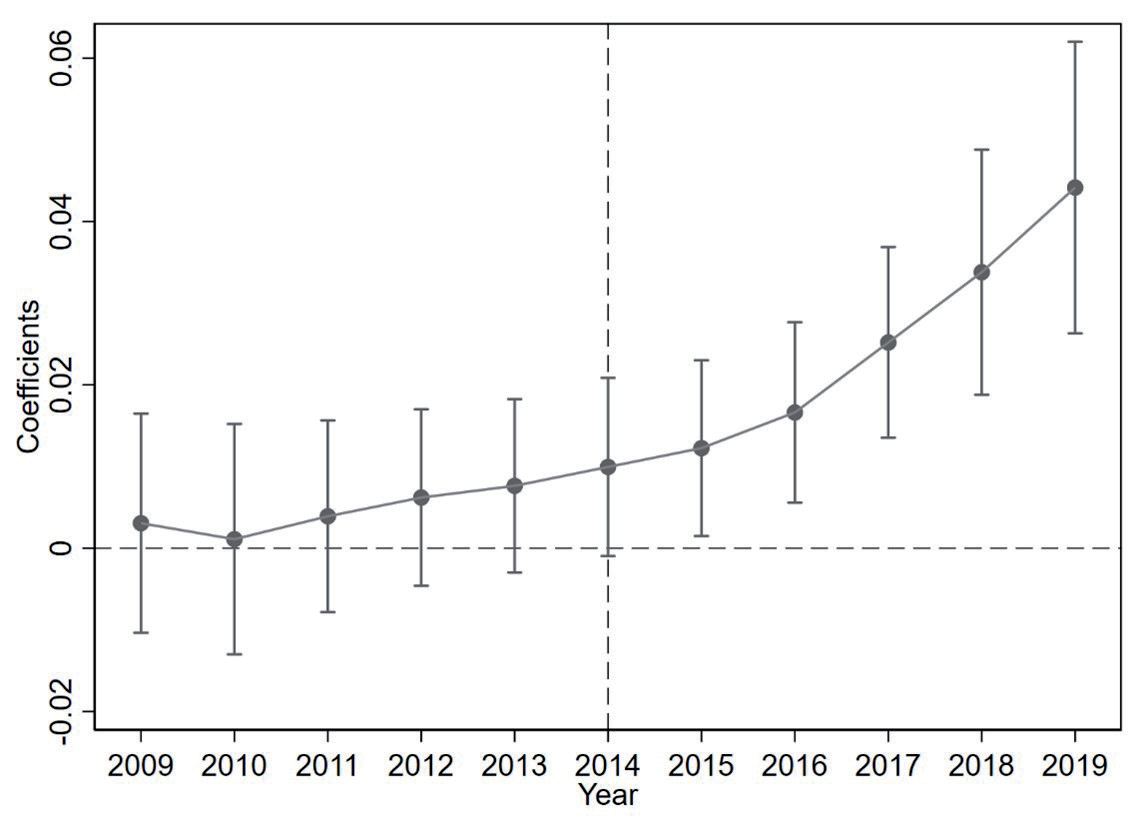
A crucial assumption of the difference-in-difference model is that there should not be a substantial disparity in the magnitude of green transformation between firms in the experimental group (affected by BRI) and firms in the control group (unaffected by the policy). To examine this hypothesis, this study generates policy trend terms for the year of implementation of BRI (2014), as well as for five years before and after (2009-2013, 2015-2019), incorporates them into regression equations, and presents the regression results through parallel trend test plots. As depicted in Fig. 1, prior to the implementation year of the BRI (2014), the 95% confidence intervals of the coefficients for policy trend terms encompassed zero, suggesting a convergence in green transition intensity between the experimental and control groups. Thus, it can be inferred that before the introduction of BRI, both groups exhibited similar levels of green transformation intensity. Although there was no significant difference observed in enterprise green transformation between the experimental and control groups during the policy implementation year (2014), enterprises influenced by BRI demonstrated significantly higher levels of green transformation intensity compared to those unaffected by it from years one to five (2015-2019). Moreover, over this period, there was an increasing divergence in green transformation intensity between enterprises affected by BRI and those not affected. In conclusion, before and after the policy implementation of BRI, there has been a shift from negligible differences to substantial disparities in enterprise green transformation intensity between the experimental group and control group, thereby satisfying parallel trend test requirements.
Propensity Score Matching
In order to mitigate the confounding effect of observable factors, this study employs the propensity score matching method by utilizing important variables at both micro enterprise and macro city levels (i.e., control variables mentioned above) as the basis for matching. The regression analysis is then conducted on the successfully matched samples, and the results are presented in Table 2. Given that the sample size ratio between the BRI experimental group and the control group is approximately 1:6, column (1) adopts a nearest-neighbor matching method with a ratio of 1:6. The coefficient of Treat×Post on green transformation of enterprises during this period is found to be 0.015, passing a significance test at a level of 10%. Columns (2) and (3), employing radius matching and kernel matching methods, respectively, also yield significantly positive coefficients for Treat×Post. These findings suggest that even after accounting for observable factors, BRI still demonstrates a substantial contribution to promoting green transformation among enterprises.
Placebo Test
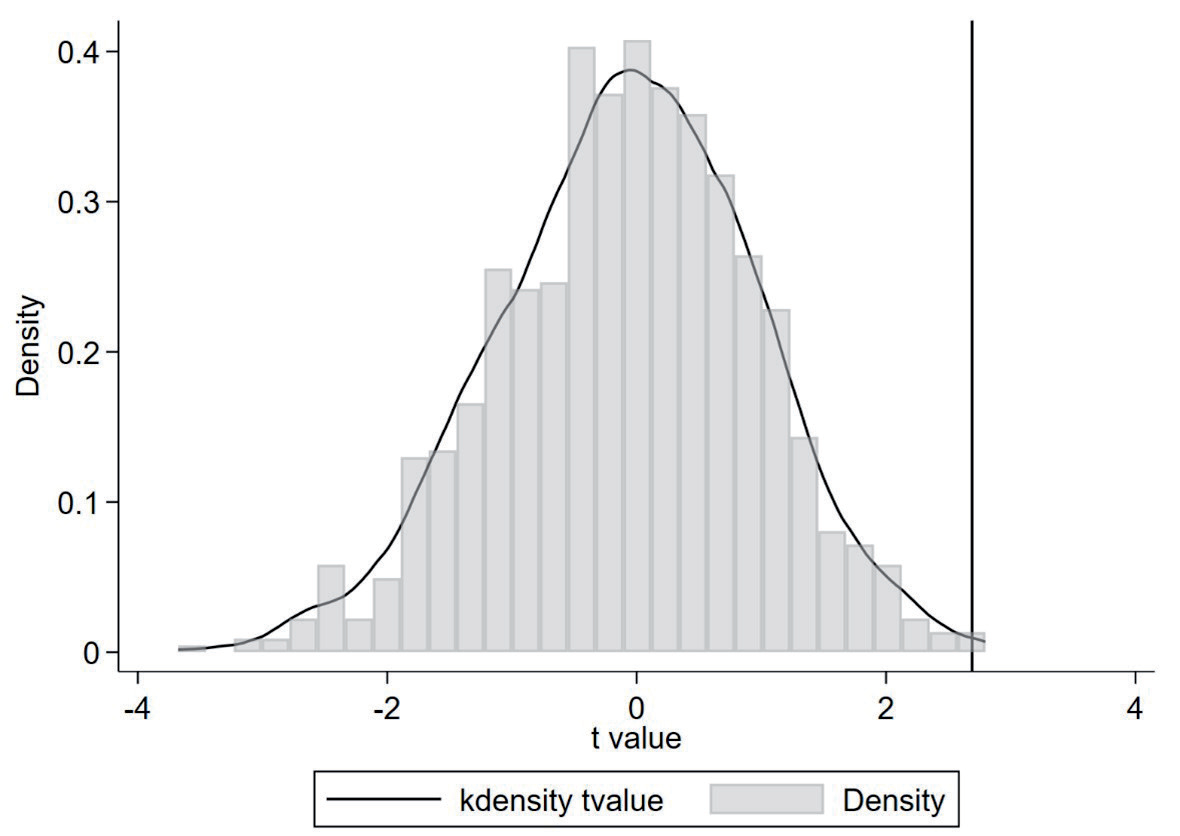
The placebo test serves to mitigate the potential confounding effects of unobserved factors on the core findings, specifically by creating fictitious experimental and control groups to assess whether the policy effect can still be observed. If not, it indicates that the influence of unobserved factors is relatively limited and confirms that the actual policy has a genuine impact. Following this principle, this study randomly assigns enterprises that have implemented BRI and those that have not into experimental and control groups, respectively. A total of 1,000 samples are tested, recording t-statistics for all regression coefficients measuring the impact of BRI on green transformation in enterprises. These statistics are then visualized through histograms and kernel density curves, as shown in Fig. 2. The histogram and kernel density curve in Fig. 2 demonstrate that t-values associated with fictitious policies generally conform to a normal distribution centered around zero; however, the true t-value stands at 2.69 (indicated by a black vertical line), surpassing most values derived from fictitious policies. This suggests an absence of BRI effects within both experimental and control groups while also indicating minimal influence from unobservable factors during the sample period on the core conclusions presented in this paper.
Retaining Firms with Better Disclosure
Given that the green transformation variable is determined using a textual identification method based on corporate annual reports, it becomes imperative to consider disclosure quality in these reports for a more accurate assessment of the intensity of corporate green transformation. However, certain factors influencing disclosure quality are difficult to measure directly through variables, making it more reasonable to exclude samples with poorer disclosure quality. In this study, two approaches were employed: one involved retaining firms whose internal disclosure index exceeded the median value, while the other focused on firms with excellent and good results in the China Securities Regulatory Commission’s disclosure assessment. Both treatments resulted in a reduced bias in annual report disclosures among the retained sample firms. The corresponding test results are presented in Table 3, where regression coefficients of Treat×Post on firms’ green transformation (columns (1) and (2)) consistently exhibit positive values and pass at least a 5% significance level.
Excluding Other Environmental Policies
During the implementation of BRI, the green transformation of enterprises may be influenced by other environmental policies. To strengthen the robustness of our findings, we introduced dummy variables for five specific environmental policies in our regression model to eliminate potential interference from these policies. The results are presented in Table 4, where column (1) includes a dummy variable for the pilot low-carbon city policy (LCC), column (2) incorporates a dummy variable for the pilot green financial reform and innovation zone policy (GFR), column (3) includes a dummy variable for the pilot low-carbon transportation system policy (LCT), column (4) adds a dummy variable for the pilot carbon emissions trading policy (CET), and column (5) introduces a dummy variable for the green credit policy (GC). In all columns, the regression coefficient of Treat×Post on GTE is significantly positive, which indicates that the conclusion that BRI still promotes the green transformation of firms still holds true even if the interference of other policies is excluded. Following these robustness tests, our core finding that BRI promotes enterprise green transformation remains unchanged and can be considered robust.
Mechanism Analysis
The previous part has demonstrated that the BRI facilitates the green transformation of enterprises; however, it has not yet explored the specific channels through which this influence occurs. Theoretically, BRI may have three main impacts on enterprise green transformation: firstly, it can expand financing channels for enterprises and optimize their financing environment to establish a financial foundation for green transformation; secondly, it can promote the flow of innovation factors and enhance enterprise green transformation capabilities; thirdly, it can increase environmental pressure on enterprises while improving their environmental management abilities as a guarantee for green transformation. Based on these analyses, this section will delve into the impact of BRI on enterprise green transformation by examining its effects on “financial support,” “technical support,” and “environmental management,” thereby elucidating its mechanism in promoting such transformations.
Table 3.
Robustness tests: Retaining firms with better disclosure.
Table 4.
Robustness: Excluding other environmental policies.
Financial Support Mechanism
In order to examine the mechanism of “financial support,” this study examines the role of corporate financing constraints and the financing cost as a channel for the Belt and Road and corporate green transformation. Following related research, we define a proxy variable for financing constraints as the absolute value of the SA index, where a larger SA indicates stronger financing constraints [19]. Financing cost (Cost) is measured as the ratio of finance charges to debt, with larger values indicating higher financing costs. Regression coefficients in Table 5 reveal that Treat×Post has significant negative effects on the SA index and Cost at least at a 5% significance level, suggesting that BRI can alleviate financing constraints and reduce financing costs for Chinese firms. The results in columns (3) and (4) of Table 5 demonstrate a significant negative relationship between the regression coefficients of SA and Cost on GTE, indicating that higher financing constraints and costs are associated with greater hindrance to the green transformation of enterprises. By integrating the findings from columns (1)-(4) of Table 5, it can be concluded that BRI mitigates corporate financing constraints and costs, thereby facilitating corporate green transformation. The potential explanation lies in the prominent position of BRI in international cooperation and economic development, which enables domestic and foreign financial markets as well as government departments to offer substantial support for enterprise financing activities, thereby enhancing the financial situation of enterprises. In China, corporate bonds and bank loans serve as crucial sources of financing for Chinese enterprises through direct and indirect channels. Domestically, these channels provide incremental low-interest credits for BRI enterprises while the government implements tax incentives specifically tailored for them. Internationally, countries along the route present new avenues of financing through their respective financial systems for BRI enterprises. Given the emphasis on green development within the framework of BRI enterprises, they will also prioritize this aspect, particularly after experiencing an improvement in their financial situation. This will enable them to fully embrace the concept of green development and increase their investment in environmental governance, thereby contributing to the green transformation.
Technical Support Mechanism
In order to examine the mechanism of “technical support,” this study investigates the role of corporate innovation factors and outcomes as a channel between the Belt and Road Initiative and corporate green transformation. The innovation factors encompass capital (R&D_K) and labor (R&D_L), which are measured by the ratio of R&D expenditures to operating revenues and the ratio of R&D personnel to total employees, respectively. Innovation outcomes are assessed through green patents (logarithmic value of application numbers). To assess innovation quality, a distinction is made between substantial green invention patents (IG) and insubstantial green utility model patents (UG) [20]. Table 6 presents the findings regarding the “technical support” mechanism. Columns (1) and (2) show that the regression coefficients of Treat×Post on R&D_K and R&D_L are significantly positive, suggesting that BRI can provide green innovation factors for enterprises. This is attributed to the bridging role of BRI, which enables Chinese enterprises to relocate industries with comparative advantages to countries along the route in exchange for innovative elements. Additionally, they can engage in collaborative innovation activities with technologically advanced foreign companies, thereby acquiring innovative elements through both upward and downward gradient approaches. In columns (3) and (4), the regression coefficients of R&D_K and R&D_L on IG and UG are significantly positive, indicating the substantial role played by innovation factors in facilitating firms’ green innovation outcomes. In Columns (5) and (6), the regression coefficients of IG and UG on GTE are both significantly positive, indicating that innovation outcomes can promote the green transformation of enterprises. Overall, BRI can further facilitate the conversion of innovation factors into tangible green innovation outcomes through their cumulative impact on enterprises. By leveraging green innovation inputs and outputs, enterprises are capable of achieving breakthroughs in technology-driven environmental protection domains such as energy-saving technologies and environmental upgrading initiatives, thereby fostering technological-level greening transformations.
Table 5.
Mechanism analysis: Financial support Mechanism.
Table 6.
Mechanism analysis: Technical support mechanism.
Environmental Management Mechanism
In order to validate the mechanism of “environmental management”, we test the role of environmental management behavior as a channel in BRI and the corporate green transformation. We examine two types of corporate environmental management behavior: environmental disclosure and environmental certification. Environmental information encompasses the disclosure of the enterprise’s environmental incident response mechanism and environmental management system (EIRM; EMSS), where disclosure is represented by 1 and non-disclosure by 0. Environmental certification refers to the ISO14001 certification system (EMSC); obtaining certification takes the value of 1, otherwise 0. The empirical results of the mechanism are presented in Table 7. Columns (1)-(3) show that the regression coefficients of Treat×Post on EIRM, EMSS, and EMSC are significantly positive, which indicates that the Belt and Road is conducive to the improvement of corporate environmental management behavior. Columns (4)-(6) show that the regression coefficients of EIRM, EMSS, and EMSC on GTE are significantly positive, which suggests that environmental management behaviors can promote the green transformation of enterprises. The underlying rationale is that BRI enterprises, in order to address potential environmental risks, will make necessary adjustments. Firstly, they will disclose their systems related to environmental emergency management while embracing social oversight and promptly adapting their environmental systems based on feedback. Second, they will strive towards meeting internationally recognized standards for environmental protection certification with the aim of alleviating concerns about the environment. Essentially, both disclosure of environmental information and obtaining relevant certifications not only strengthen the ecological consciousness of enterprises but also constitute a crucial aspect of their green transformation. Furthermore, these positive incentives and feedback mechanisms drive enterprises towards deeper engagement in green transformation activities.
Peer Spillover Effect Test
Merely achieving the green transformation of individual enterprises or a few companies is insufficient; it is imperative for the entire industry, and even all corporations, to undergo prompt green transformations. Expanding on previous findings that highlight how the Belt and Road Initiative can facilitate the green transformation of enterprises, it is worthwhile to further investigate the spillover effects of green governance along this initiative. This article focuses on two types of spillover effects: inter-industry effects, which are determined by the average level of green transformation among other companies within the same industry excluding the focal company; and intra-firm effects, defined by the average level of green transformation among all companies excluding the focal company. The empirical testing model for spillover effects is presented in Equation (6).
Table 7.
Mechanism analysis: Environmental management mechanism.
The variable GTEHE represents the intra-group effect, specifically indicating the green transformation intra-group effect between industries and firms. It is denoted as GTE_IND for industries and GTE_FIRM for firms. To examine the spillover effects of the BRI on this intra-group effect, our model incorporates an interaction term between them. Additionally, we include individual-time fixed effects for firms and years in the model, along with control variables from previous research designs.
The regression results are presented in Table 8, as depicted in columns (1) and (2), where both the coefficients of Treat×Post×GTE_IND and Treat×Post×GTE_FIRM exhibit significant positive effects on GTE. This implies that a higher green transformation index among peer companies enhances the impact of BRI on promoting green transformation within benchmarked enterprises, regardless of whether it is within industries or across all firms. In other words, with the influence of peer effects, BRI can effectively support corporate green transformation. There could be three potential explanations for this. Firstly, at the subjective level of the subject enterprise, there exists a strong inclination towards green transformation and a willingness to learn from similar enterprises within the cluster in order to fully seize the opportunities presented by a series of green development support policies under BRI, thereby promoting its own green transformation. Secondly, at the objective level of the target enterprise, the green transformation undertaken by other enterprises within the same group exerts environmental pressure on it, compelling an enhancement in its green competitiveness. Moreover, those enterprises supported by BRI will also face environmental pressures from host countries, thus providing them with stronger incentives for carrying out their own green transformations. Thirdly, at a policy level, emphasis is placed on green development within the framework of BRI, necessitating the aggregation and cluster development of environmentally friendly enterprises and industries. Consequently, those enterprises supported by this initiative are more likely to establish comprehensive joint models for sustainable development. The clustering effect itself facilitates the dissemination of information regarding eco-friendly practices as well as technological advancements in this domain; these two effects can integrate with each other and mutually promote progress toward achieving greener outcomes for target enterprises. In summary, BRI can enhance the spillover effect of green governance among related enterprises, exerting a positive cumulative impact on their green transformation. This is conducive to achieving an economic transition towards sustainability.
Table 8.
Peer spillover effect test.
Conclusions and Policy Implications
Conclusion
In order to enhance the level of openness and adaptability to economic globalization, the Chinese government has proposed the Belt and Road Initiative, which offers comprehensive support to Chinese enterprises while also imposing higher demands for their sustainable development. To accurately evaluate the environmental impact of BRI, we employ a novel text identification method to assess the extent of green transformation within enterprises and investigate the influence of BRI on such transformation using a difference-in-difference model. Based on the data of A-share listed companies in China’s Shanghai and Shenzhen stock exchanges for the period from 2007 to 2020, the empirical study draws the following conclusions:
First, BRI significantly facilitates the green transformation of implementing firms compared to non-implementing firms. This conclusion remains robust even after conducting rigorous tests such as the placebo test, parallel trend test, and exclusion of other policy interferences.
Second, the channels through which BRI promotes the green transformation of firms encompass financial support, technical support, and environmental management. Specifically, the initiative alleviates corporate financing constraints and reduces financing costs while fostering corporate green innovation in terms of inputs and outputs. Moreover, it enhances corporate disclosure quality and environmental certification, thereby facilitating corporate green transformation.
Third, BRI also exhibits peer spillover effects, whereby a higher level of green transformation index among peer enterprises strengthens its promotion effect on the subject enterprises’ green transformation.
Policy Implications
The findings of this study have significant implications for promoting the development of BRI and facilitating green transformations in enterprises.
Firstly, it is imperative for enterprises to proactively seize the opportunities presented by the Belt and Road Initiative. Enterprises’ managers should actively devise development strategies, take proactive measures in response to the Belt and Road Initiative, and leverage governmental support to bolster their capabilities. Furthermore, in order to foster an environmentally sustainable Belt and Road framework, the Chinese government has established mechanisms to ensure green collaboration and finance. Enterprises should take the initiative in applying for green funding within the ambit of BRI, engage in international technology exchanges, and actively participate in green platforms for cooperation with countries along the route. This collaborative approach will facilitate the green transformation process through leveraging funds and technologies, as well as advanced environmental management practices provided by BRI.
Secondly, the Chinese government should fully consider the potential challenges faced by Belt and Road enterprises and provide corresponding assurances for their green transformation. On one hand, there might be insufficient support for the green development of Belt and Road enterprises. The Chinese government should imbue the Belt and Road Initiative with a stronger emphasis on environmental considerations and enhance its support for green transformation. This can be achieved by expanding the scope of green funds within the initiative, reducing barriers to accessing green project funding for enterprises, strengthening the establishment of a collaborative platform for green cooperation along the Belt and Road, facilitating information sharing on environmental protection among enterprises, promoting collaboration in green technology, and providing subsidies to facilitate necessary transformations towards sustainability. On the other hand, variations in environmental standards among countries along the Belt and Road may pose challenges to the international investment activities of enterprises. To address this issue, it is imperative for the Chinese government to enhance communication and cooperation with these countries, aiming to establish a consensus on sustainable development. Specifically, countries along the Belt and Road should strive towards an internationally harmonized framework of environmental policies and regulations, accompanied by complementary measures for international environmental monitoring and governance, thereby providing enterprises with universally recognized environmental standards.
Finally, it is imperative for other institutions and organizations to respond positively to the Belt and Road Initiative and actively support the green transformation of enterprises. Media organizations should enhance their attention to and oversight of enterprises, urging them towards a sustainable transformation. Additionally, international organizations such as the IMF and the World Bank should engage in collaborative efforts with regard to Belt and Road construction while increasing financial support for enterprises involved in order to facilitate their green transformation.

