

Introduction
Enterprises must accelerate their green transformation to support carbon peak and carbon neutrality goals. Efforts should be made to achieve sustainable environmental protection at the national strategic level, promote green and low-carbon development of the social economy, and emphasize the coordination and long-term nature of environmental development. To this end, the state has issued a series of environmental protection and economic restructuring policies. Environmental regulation is a critical tool for encouraging enterprises to adopt environmental protection measures [1]. On July 1, 2015, the Central Leading Group for Comprehensively Deepening Reform deliberated and adopted the “Environmental Protection Supervision Program (Trial)” and proposed the establishment of an environmental protection supervision mechanism. This system has broken down barriers in environmental management and transformed environmental regulation from “supervising enterprises” to “supervising government” and then to “government and enterprise responsibility” [2].
Since its implementation in 2016, the central environmental protection supervision system has completed inspections in 31 provincial-level administrative regions nationwide, effectively promoting the construction of China’s ecological civilization. Existing literature shows that central environmental protection inspectors can improve air quality [3], reduce pollution emissions [4], and decrease the “greenwashing” level of polluting enterprises in supervised areas [5], these findings indicate that the central environmental protection inspector policy can effectively encourage enterprises to rectify pollution [6]. Compared to previous environmental regulation methods, the central environmental protection supervision system represents the authority of the central government, exerting strong pressure on local governments and enterprises. The supervision results are also linked to the performance evaluation and career advancement of local government officials. Consequently, local governments have to strengthen environmental protection efforts and increase penalties for related illegal enterprises. Under such pressure, heavy polluting enterprises are compelled to assume greater environmental responsibility, achieving the goals of emission reduction and pollution control through technological and management innovations [7].
With the development of central environmental protection supervision, the pressure on local governments and heavy polluting enterprises to govern the environment has increased, forcing more and more enterprises to adopt Green M&A for green transformation. Green M&A serves as an important means to realize industrial transformation and upgrading and industrial restructuring [8]. On one hand, it facilitates the green transformation of heavy polluting enterprises and puts them on the path to high-quality development. On the other hand, Green M&A can continuously and significantly promote green innovation [9], enabling heavy polluting enterprises to rapidly acquire green and clean technologies, offset the incremental costs of environmental governance, and achieve a win-win situation between environmental and economic benefits [10]. Thus, what impact will the central environmental protection supervision system have on the Green M&A activities of heavy polluting enterprises in the process of promoting environmental governance and upgrading industrial structures? Through what mechanisms and channels does it have an impact? What are the differences in the effects under different circumstances?
To address these questions, this paper selects A-share listed heavy polluting enterprises from 2010 to 2023 as a sample and uses the implementation of the central environmental protection supervision policy as a quasi-natural experiment to explore its impact on the Green M&A behavior of heavy polluting enterprises and the underlying mechanisms. The main contributions of this paper include: First, it expands the research on Green M&A by examining the micro-impact of the central environmental protection supervision system on corporate Green M&A, providing a new direction for heavy polluting enterprises to achieve green transformation and implement green development strategies. Second, it enriches the understanding of the driving factors behind heavy polluting enterprises’ implementation of Green M&A. Most existing research on Green M&A focuses on environmental regulation and government officials’ environmental performance appraisal pressure. This paper further explores the driving factors based on the implementation of specific environmental policies. Third, this paper provides theoretical support for the central environmental protection supervision system’s influence on the internal and external mechanisms of Green M&A in heavy polluting enterprises.
Literature Review and Research Hypothesis
Central Environmental Supervision System and Green M&A of Heavy Polluting Enterprises
As an environmental protection policy, the central environmental protection supervision system primarily ensures the full implementation of the party’s environmental governance concepts and strategies by strengthening the supervision of local environmental protection work, thereby influencing the environmental governance behavior of enterprises. Driven by the external system, Green M&A is a crucial measure in the current development of environmental protection and the green transformation of enterprises. This measure helps enterprises obtain advanced green technologies and resources, providing legitimacy for the survival and development of heavy polluting enterprises [11].
From the perspective of Porter’s hypothesis, the central environmental supervision system, as a reasonable and strict environmental regulation, can promote green innovation in enterprises and generate an innovation compensation effect, thereby making enterprises more competitive [12]. The central environmental protection inspector has brought strong political pressure to local governments through “supervising the government”, thus increasing the governance of environmental work, forcing enterprises to improve environmental protection measures, and achieving the goal of “supervising enterprises”. Faced with environmental protection requirements and regulatory pressure, rational decision-makers will incorporate environmental protection standards into their production and operation decisions in a timely manner according to changes in the external business environment. However, they cannot obtain immediate results to offset the high costs of pollutant treatment, which undoubtedly increases the cost of the enterprise [13]. At this time, acquiring or merging with enterprises that possess advanced environmental protection technology and experience can help them learn from best practices, quickly alleviate operational pressure, and achieve the goal of green development.
From the perspective of stakeholders, the central environmental protection supervision system emphasizes public participation and CPPCC interaction. With the implementation of the system, the public’s demand for a better living environment and the requirements of various stakeholders for the green development of enterprises have prompted heavy polluting enterprises to focus on green transformation and green investment. Investors and social groups promote heavy polluting enterprises to embark on the path of green development through the evaluation and supervision of corporate environmental performance. Under the impetus of the central environmental protection supervision system, stakeholder pressure encourages heavy polluting enterprises to implement Green M&A to gain the trust and support of various stakeholders and facilitate the acquisition of various resources [14].
In summary, the central environmental protection supervision system provides an external stimulus, prompting enterprises to engage in environmental innovation and technological upgrading and promoting the Green M&A of heavy polluting enterprises to achieve green transformation. The participation and role of stakeholders enable heavy polluting enterprises to implement green development strategies under the pressure of environmental protection inspectors, striving for a “win-win” between economic development and environmental protection. This paper proposes the following hypothesis:
Hypothesis 1: The central environmental supervision system can increase the probability of Green M&A of heavy polluting enterprises.
Central Environmental Protection Supervision System and Compliance Pressure
New institutional theory suggests that enterprises will conduct production and operations under the pressure of the external environment, adhering to and supporting the existing system and further establishing organizational legitimacy [15]. The central environmental protection inspector aims to promote the construction of an ecological civilization system, fully implement environmental regulations, and create stronger compliance pressure. Existing literature shows that different environmental regulations have varying effects on Green M&A by exerting different pressures [16]. The central environmental supervision system has strengthened the enforcement of environmental regulations, and local officials will be severely punished for environmental malfeasance and regulatory violations. This effectively reduces the discretion of local governments in implementing environmental policies and collusion and arbitrage with enterprises, indirectly strengthening the environmental supervision of enterprises [17].
The CEPI policy compels heavy polluting enterprises to pursue compliance-driven strategies that reconcile competitive resource acquisition with environmental legitimacy imperatives. Additionally, the pressure of environmental compliance will have a long-term impact on heavy polluting enterprises. Although the cost of adopting a short-term ‘greenwashing’ strategy is low, it will increase in the long run, which is not in line with the principle of cost-benefit [18]. Therefore, the increase in compliance pressure will encourage enterprises to implement green transformation strategies, improve the quality of green innovation, and achieve green transformation [19]. The central environmental protection supervision system subjects both enterprises and local governments to environmental legitimacy pressures. The increase in illegal costs will also lead to heavy polluting enterprises choosing Green M&A strategies with speed advantages. Based on this, this paper proposes the following hypothesis:
Hypothesis 2: The way for the central environmental protection supervision system to promote Green M&A of heavy polluting enterprises lies in the external application of stronger compliance pressure.
Central Environmental Supervision System and Enterprise Environmental Performance
As an important means to urge local governments and enterprises to fulfill their environmental responsibilities, the implementation of the central environmental supervision system has a significant role in promoting corporate environmental performance, ESG performance, and the quality of corporate environmental information disclosure [20]. The effectiveness of corporate environmental governance depends to a certain extent on the implementation of environmental policies by local governments, which is influenced by local economic development and performance assessment. This also determines whether the pressure of environmental governance can be transmitted to the primary manufacturers of pollution sources-enterprises. After the implementation of the central environmental protection supervision system, its supervision has increased the cost of pollution control for heavy polluting enterprises, especially for those lacking clean technology, whose production costs have multiplied. To alleviate cost pressure and maintain the normal operation of enterprises, heavy polluting enterprises have the motivation to actively increase environmental protection investment and seek green transformation. Under the pressure of central environmental supervision, to reduce the negative impact of stakeholders on corporate pollution and gain the recognition of government and social legitimacy, enterprises have the motivation to actively fulfill their environmental governance responsibilities, increase environmental protection investment, improve pollution control technology, and enhance environmental performance. Moreover, good environmental performance can convey positive signals to the outside world, demonstrate a good corporate social responsibility image, and provide support for Green M&A. With the improvement of stakeholders’ requirements for enterprises’ green production behavior, enterprises can reduce the risk of green credit through good environmental performance information, thereby obtaining more financial support to conduct Green M&A, helping enterprises quickly enhance their competitiveness and achieve green sustainable development. This paper proposes the following hypothesis:
Hypothesis 3: The central environmental supervision system can promote Green M&A by improving the environmental performance of heavy polluting enterprises.
Materials and Methods
Sample Selection and Data Sources
This paper selects A-share listed heavy polluting enterprises in China from 2010 to 2023 as the research object to explore the impact of the implementation of the central environmental supervision system on the Green M&A of heavy polluting enterprises. Based on this, this paper screens the samples: (1) excluding ST, *ST, provisionally listed, and delisted samples; (2) eliminating samples with missing data for main variables. Finally, 28,868 observations were obtained. To eliminate the influence of extreme values, all continuous variables were winsorized at the 1% level. The original data come from the Guotai’an database and the Huazheng database, and Stata 17 is used for data processing and analysis.
Variable Definition
Explained Variable: Greenma. Drawing on the practice of scholars such as Qiu J.L. and Pan A.L. [21], a text analysis method is used, combined with the analysis of enterprise M&A events, the transaction target, transaction overview, and the background and purpose of M&A, including environmental protection, energy saving, green, low-carbon, and other information to determine whether the M&A event is a Green M&A. This variable is a dummy variable. If the enterprise implements Green M&A in the year, the value is 1; otherwise, the value is 0.
Explanatory Variable: Central Environmental Inspection Policy (CEPI). In this paper, the value of this variable is established according to the year when the inspection group first entered the area where the enterprise is registered. If the first entry of the inspection group has occurred in the area where the enterprise is located, CEPI = 1 in the current year and subsequent years; otherwise, CEPI = 0.1
Control Variables: Based on the research of scholars such as Pan A.L. and Wu Q., this paper selects Size, Lev, ROA, REC, FIXED, Loss, Top10, and BM as control variables. Additionally, this paper controls the year and region of the enterprise.
Model Construction
According to the research of scholars such as Shen H.T., the central environmental protection supervision system is an exogenous policy impact for enterprises, which can have a differential impact according to the different environmental attributes of enterprises and meets the basic assumptions of the difference-in-differences method [22]. Additionally, the supervision group is stationed in batches in various provinces and cities, and different regions have different times to accept environmental supervision, which in turn satisfies the setting of the multi-time difference-in-difference model. In view of this, this paper analyzes the impact of the central environmental supervision system on the Green M&A of heavy polluting enterprises by constructing a multi-time point difference-in-differences model. The specific model is constructed as follows:
Where: Greenmait is the explained variable Green M&A; CEPIti represents the dummy variable of the central environmental supervision system; Controlsit is the control variable; γi, μt are individual and year fixed effects, respectively; εit is a random disturbance term. This paper focuses on the parameter α1. If α1 is significantly positive, it indicates that the central environmental protection supervision system can promote the implementation of Green M&A by heavy polluting enterprises.
Results and Discussion
Descriptive Statistical Analysis
The mean value of Green M&A is 0.235, and the standard deviation is 0.432, indicating that about one-third of heavy polluting enterprises implement Green M&A during the sample period. Green M&A has become one of the paths for heavy polluting enterprises to achieve green transformation and meet environmental regulation requirements. The average value of the central environmental supervision system is 0.144, indicating that 14.4% of heavy polluting enterprises have implemented the system. The mean distribution range of the control variables is consistent with existing research, and there are no special outliers.
Analysis of Relationship
Table 1 shows the results of the correlation analysis. The correlation coefficient between the central environmental supervision system and the Green M&A of heavy polluting enterprises is significantly positive at the 1% level. This result preliminary verifies Hypothesis 1 proposed above.
Baseline Regression
This paper uses the multi-period difference-in-differences method to test the impact of the central environmental protection supervision system on the Green M&A of heavy polluting enterprises. The multi-period difference-in-differences results are reported in Table 2, where Column (1) does not add control variables for regression, and Column (2) adds each control variable on the basis of Column (1) for regression results. Columns (1) and (2) show that the central environmental supervision system is significantly positively correlated with Green M&A at the 1% level, indicating that the implementation of the central environmental supervision system can significantly promote the implementation of Green M&A by heavy polluting enterprises. The above results provide preliminary evidence for the positive impact of central environmental protection inspectors on promoting Green M&A of heavy polluting enterprises, and the research hypothesis 1 proposed above is verified.
Robustness Test
Parallel Trend Test
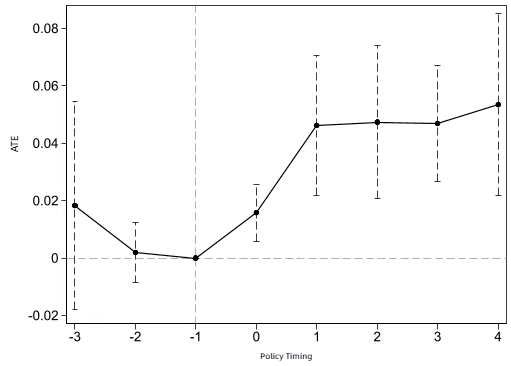
The premise of the multi-period difference-in-differences model is that the experimental group and the control group have similar time-varying trends before the policy intervention. This paper draws on the practice of Beck et al. and sets virtual variables before and after the implementation of policies for enterprises in regions affected by policies [23]. The parallel trend test and policy dynamic effect analysis regression model is as follows:
Among them, the negative value of t indicates the three years before the first stationing of the Central Environmental Protection Supervision Group, and the positive value of t indicates the four years after the stationing of the Central Environmental Protection Supervision Group; αt denotes the coefficient estimates between different years. The definition of the remaining variables is the same as that of Model (1).
The regression results are shown in Fig. 1. The regression coefficients of the core explanatory in the pre-policy periods were not significant, indicating that there was no significant difference in the development of Green M&A between the two groups before the policy implementation. After the policy implementation, the impact of the policy on Green M&A behavior has increased significantly over time, indicating that the implementation of the central environmental protection supervision policy has a continuous effect on Green M&A behavior.
Placebo Test
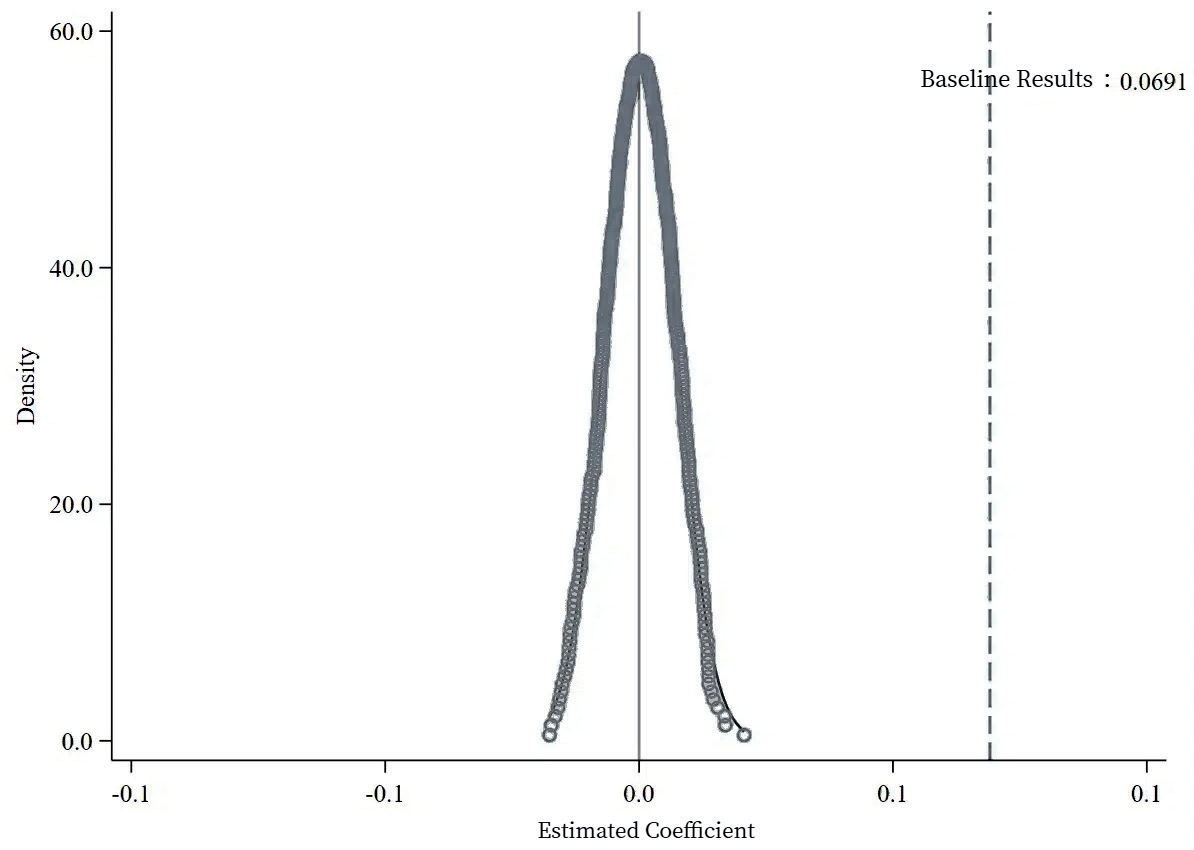
To eliminate the interference of other random factors and the possibility of being confused by omitted variables in the policy effect of the central environmental protection supervision, and to ensure that the regression results are related to the central environmental protection supervision system, this paper refers to the practice of Chetty R. and other scholars and randomly generates a central environmental protection supervision experimental group in the entire sample through independent sampling for a placebo test [24]. Taking 2016 as the policy implementation time, heavy polluting enterprises were selected from all samples as the experimental group, and the false policy implementation time was set, and then the random process was repeated 500 times, and Model (1) was used for benchmark regression analysis. The probability density distribution of the estimated coefficients of random sampling is shown in Fig. 2, and it can be found that the estimated coefficients are concentrated near 0. Through the test, it is found that most of the p-values are above 0.1, which is quite different from the benchmark regression results. This shows that the above benchmark regression results are not accidental and reliable, indicating that the implementation of Green M&A activities by heavy polluting enterprises during the sample period is due to the development of the central environmental protection supervision system, and the policy effect is unlikely to be driven by other observed factors.
Table 1.
Analysis of Relationship.
Table 2.
Baseline Regression and Robustness Test.
Delete Special Samples to Alleviate Endogeneity
The first implementation area of environmental policy is generally in areas with more severe pollution and more problems. The first implementation area differs from other areas in terms of economy and environment. Some unknown factors may have an impact on the policy implementation effect and enterprise behavior, making the above regression results biased. Additionally, the regions that take the lead in implementing environmental policies are the focus of demonstration, and the intensity of environmental regulation is often stricter than that of general regions, which may lead to an overestimation of the promotion effect of policies on the Green M&A of heavy polluting enterprises. To alleviate potential endogenous problems, we use the practice of Wang and other scholars to eliminate the two batches of samples that took the lead in implementing the central environmental protection supervision policy and re-estimate the multi-period difference-in-differences [25]. The regression results are as shown in Column (3) of Table 3, and the estimation coefficient of the central environmental protection inspector for the Green M&A behavior of heavy polluting enterprises is still significantly positive, which once again verifies the robustness of the above research results.
Change the sample period
The sample period of this paper is 2010-2023. To avoid the possible impact of the promulgation and implementation of other policy measures on the estimation results, this paper retests Model (1) by changing the sample period. In 2013, the Ministry of Industry and Information Technology and 12 other ministries and commissions issued the “Guidance on Accelerating the Merger and Reorganization of Enterprises in Key Industries” to encourage enterprises to actively merge and reorganize, speeding up the merger and reorganization of enterprises in key industries. In 2020, the state proposed the concept of “double carbon” targets, and in 2021, issued “On the Complete and Accurate Full Implementation of the New Development Concept to Do a Good Job of Carbon Peak and Carbon Neutralization Work”. To exclude the combined effects of the above policies on the regression results, this paper draws on the research of Wang H.F. [26], and retains the sample data from 2013 to 2020, the results are shown in Column (4) of Table 2. Additionally, in estimating the impact of the central environmental supervision system on the Green M&A of heavy polluting enterprises, there may be other environmental policies that affect Green M&A, making the estimation results biased. Therefore, this paper refers to the research of LIU J.K. and XIAO Y.Y. and deletes the samples of carbon emission trading pilot areas to regress again [27]. The results are shown in Column (5) of Table 2. The above results are verified, and the research conclusions drawn in this paper are robust.
Mechanism Test Analysis
The above research results show that the central environmental protection supervision system has significantly promoted the implementation of Green M&A by heavy polluting enterprises. What is the mechanism through which the central environmental protection supervision system promotes the Green M&A of heavy polluting enterprises? This paper will further analyze the impact of central environmental protection supervision on the Green M&A behavior of heavy polluting enterprises from the perspective of internal corporate environmental performance and the legitimacy pressure faced by external enterprises. Based on the research of Wen Z.L. [28]. This paper constructs Model (3) to test the specific mechanism path of the central environmental supervision policy, where Medit is the enterprise environmental performance (E) and legitimacy pressure (EID), and the remaining variables are consistent with Model (1).
Corporate Environmental Performance
To test the mechanism of corporate environmental performance, this paper uses the E (environment) score in the Huazheng ESG score as a variable index to measure corporate environmental performance. The higher the E score, the better the environmental performance of the enterprise, and vice versa. Table 3 Columns (2) and (3) show that when the explanatory variable is corporate environmental performance, the central environmental protection supervision system is significantly positive above the 1% level, indicating that the central environmental protection supervision system promotes the implementation of Green M&A of heavy polluting enterprises through the internal environmental pressure effect of the enterprise, bringing better environmental performance to the enterprise.
Table 3.
Mediating Effect Test.
Legitimate Pressure
Legitimacy includes regulatory legitimacy, normative legitimacy, and cognitive legitimacy [29]. This paper uses the legitimacy of regulation to measure the pressure of legitimacy, and further refers to the research of scholars such as Wang W.J., and uses the quality of corporate environmental information disclosure (EID) to measure the pressure of corporate legitimacy [30]. The higher the quality of corporate environmental information disclosure, the more the company abides by the law and the more legitimate it is. As shown in Columns (5) and (6) of Table 3, when the explained variable is the quality of environmental information disclosure, the central environmental protection supervision system is significantly positive at the level of 1%, indicating that the central environmental protection supervision policy makes heavy polluting enterprises promote Green M&A under the pressure of legitimacy. That is to say, the implementation of the central environmental supervision system will help to fundamentally enhance the rigidity, mandatory, and normative nature of environmental law enforcement and impose stronger pressure on local governments and enterprises on environmental legitimacy. When heavy polluting enterprises face tough environmental legitimacy pressure, enterprises have the motivation to meet higher environmental legitimacy requirements through Green M&A. The research hypotheses H2 and H3 are verified.
Heterogeneity Analysis
Inspector Batch
The central environmental protection supervision is carried out in batches. From the first implementation of the pilot city to the first and second batches, the scope of supervision is gradually expanded. In order to analyze whether the three batches of different supervision effects will be affected by the cumulative learning effect, this study rigorously aligns the model design with the phased implementation schedule of the CEPI policy, namely: the first batch of pilot cities is Hebei Province; the first batch of supervision provinces in 2016; the second batch of provinces was supervised in 2017, and the heterogeneity analysis was carried out. To mitigate endogeneity concerns, the model defines the initial year of enterprise supervision as the exogenous policy shock event. Additionally, batch-specific dummy variables are incorporated to quantify dynamic policy effects across implementation phases. In this paper, the dummy variable of the central environmental supervision batch and the explained variable CEPI are added to the model to form the interaction items ec_pilot (pilot), ec_batch1 (first batch), and ec_batch2 (second batch). The regression results are shown in Columns (1), (2), and (3) of Table 4. The results show that in addition to the first batch of pilot batches, the other two batches can significantly improve the Green M&A behavior of enterprises.
Table 4.
Heterogeneity Test Analysis.
The Influence of “Government-Enterprise Collusion”
The central environmental supervision system is to implement environmental supervision in the form of vertical environmental supervision. Compared with traditional means, this method is conducive to resolving the phenomenon of “government-enterprise collusion” between local governments and enterprises in order to achieve a “win-win” goal. At present, “government-enterprise collusion” has become an important cause of serious environmental pollution in many regions. Enterprises with higher operating income and stronger political context can have a close interest relationship with the local government, which is more likely to cause the phenomenon of “government-enterprise collusion”[31].
Heterogeneity Analysis Based on Operating Income
Local governments have the pressure of performance appraisal, and the business income of enterprises plays a greater role in it. Local government officials will provide a better business environment for enterprises with higher business income for promotion, performance appraisal pressure, and other motives, and even help such enterprises avoid environmental regulation. The incomplete implementation of this environmental policy has further contributed to the phenomenon of “collusion between government and enterprises”. This paper refers to the practice of Yang L.Y. and Chen Q., and sets the virtual variable (Income) to 1 if the operating income of the enterprise is higher than the median operating income of the enterprise in the year before the implementation of the policy (2015), and vice versa It is 0 [32]. The dummy variable Income and the explained variable CEPI form an interaction term Income_ec, which is added to Model (1). For estimations shown in Column (4) of Table 4, the income_ec regression coefficient of the interaction term is significantly positive at the level of 1%, indicating that the central environmental protection supervision system weakens the environmental regulation protection obtained by high-income enterprises and local government’s government-enterprise collusion, and significantly promotes the implementation of Green M&A by heavy polluting enterprises.
Heterogeneity Analysis Based on Property Rights Attributes
Compared with non-state-owned enterprises, state-owned enterprises have an “innate” political advantage and are more likely to be sheltered by local governments even if violations occur, which means that state-owned enterprises are more likely to produce “government-enterprise collusion” in the process of environmental governance [33]. This article refers to the practice of Chen Q. and other scholars, setting the virtual variable (SOE) of state-owned enterprises. If it is a state-owned enterprise, the SOE is 1, and the non-state-owned is 0. The interaction term SOE_ec is formed with the explanatory variable CEPI and added to the model (1) for regression. As shown in Column (5) of Table 4, the regression coefficient of the interaction term SOE_ec is significantly positive at the level of 5%, indicating that the promotion effect of the central environmental supervision system on the Green M&A behavior of enterprises is significant in the sample of state-owned enterprises.
Conclusions
As a stringent environmental regulation, the central environmental protection inspectors continue to promote heavy polluting enterprises to acquire green clean technology through Green M&A, thereby enhancing both economic and environmental benefits. The empirical analysis revealed several key findings: First, the central environmental protection supervision policy, acting as an exogenous shock, significantly encourages heavy polluting enterprises to pursue Green M&A. Second, the mechanism test indicates that the central environmental protection supervision policy enhances the likelihood of Green M&A among heavy polluting enterprises by exerting stronger external legitimacy pressure and improving internal corporate environmental performance. Third, further heterogeneity analysis demonstrates that the policy’s implementation effect is more pronounced in central and western regions, in enterprises with higher operating income, and in state-owned enterprises. The implementation of the Central Environmental Protection Inspection system has incentivized firms to respond to market-based environmental policies (e.g., carbon emission trading, environmental taxes) while revealing synergistic interactions between command-and-control regulations and economic instruments. These interactions demonstrate the potential for innovation compensation effects through Green M&A-driven resource integration. Although multi-period DID designs and sample stratification mitigate potential biases from local governance dynamics, residual endogeneity concerns (e.g., unobserved regional policy preferences) necessitate further validation.
Future studies could employ instrumental variables linked to officials’ tenure cycles or leverage quasi-experimental variations in policy rollout phases to disentangle the causal impacts of such policy mixes on environmental-economic outcomes.
The conclusions of this paper offer important policy implications for refining the central environmental protection supervision system, fostering the high-quality development of heavy polluting enterprises, and advancing the national green development strategy: First, continued promotion of central environmental protection supervision. Continue to advance the central environmental protection supervision work, focusing on the implementation of ecological and environmental protection requirements within major regional strategies. Balance the positive and negative incentives arising from environmental governance during the supervision process to further promote green technology innovation and production. The ultimate goal of the supervision should be reflected in the resolution of specific environmental issues.
Secondly, tailored environmental protection supervision actions. Implement the central environmental protection supervision actions considering the differences in regional, industry, and enterprise characteristics. Fully account for the varying levels of economic development and resource availability across different regions. Formulate targeted actions to address specific issues, taking into consideration the potential for cost transfer by enterprises. During environmental supervision, appropriately reduce penalties for enterprises that actively embrace the green development strategy to encourage their green transformation.
Third, active response by heavy polluting enterprises. Heavy polluting enterprises should proactively respond to the central environmental protection supervision policy by adopting a green strategy that aligns environmental and economic development. Utilize Green M&A to swiftly acquire the necessary equipment and technology for low-carbon energy conservation, thereby improving pollution control and production efficiency. Actively seek to understand and leverage policy-related environmental subsidy policies to offset the additional costs associated with environmental regulation.
These findings and recommendations underscore the importance of a comprehensive and adaptive approach to environmental protection, emphasizing the need for both regulatory oversight and corporate initiative to achieve sustainable and green development.

