

Introduction
Municipal solid waste (MSW) production has increased daily due to population growth, changing lifestyles, and economic development [1]. MSW is composed of putrescible, paper, cardboard, plastic, composite, textile, and others; the proportions of these categories are unstable and vary with seasons, the economy of the country, and urbanization.
In Algeria, municipal solid waste production has been estimated at 13.5 million tonnes in 2020 [2]. More than 160 tonnes/day are generated by the population of Chlef City [3]. This waste is buried in two technical landfill centers and in uncontrolled dumps. This treatment is considered the last link in the MSW treatment chain, due to its drawbacks such as groundwater pollution, odor emissions, and soil contamination [4]. The incineration, for manufacturing and construction purposes, of these colossal quantities of MSW in Chlef in particular, and in Algeria in general, is a promising avenue, given that Chlef is an industrial department.
All developed countries aim to exploit the enormous amounts of MSW produced by valuing it to achieve a circular economy. The incineration of MSW is an excellent way to valorize it, as it recovers energy and reduces the mass and volume of waste by 70% and 90%, respectively [5]. MSW incineration (MSWI) process generates two main solid products: fly ash (FA) and bottom ash (BA) [6]. BA is discharged at the bottom of the incinerator, and FA is produced by adsorbing the flue gases and separating dust [7]. MSWIBA is the main by-product, accounting for nearly 90% of the total mass of ashes generated and 20-30% of the initial MSW by mass [8]. It consists of unburned organic matter and coarse non-combustible materials, such as stones, sand, glass, ceramics, metals, and ashes [6, 9]. MSWIBA is mainly composed of Si, Ca, Fe, Al, Mg, K, and Na oxides, and contains lower levels of heavy metals compared with fly ash [10, 11].
The application of MSWIBA in various sectors depends on many factors, such as its suitability for processing, technical performance, and environmental impact [12]. The literature reports various utilizations of MSWIBA, namely in road pavement, concrete, glass and ceramics, agriculture, and adsorbent production [5]. MSWIBA has a composition similar to common construction materials [13], and its recycling as a partial substitute for cement can have beneficial environmental effects, such as reducing greenhouse gas emissions, decreasing the extraction of non-renewable raw materials necessary for clinker production, and saving landfill space needed to dispose of this ash [7, 14]. Recently, BA has also been used as a raw material for producing Portland cement clinker [15, 16].
According to previous studies, BA was used as a supplementary cementing material (SCM) in cement mixtures [14, 17-23]. Loginova et al. (2023), X.G.Li et al. (2012), and Yang et al. (2018) concluded that the high content of BA in cement affects the mechanical strengths of mortar and the hydration process; the adverse effects are due to the lower reactivity of BA and to the heavy metals contained in BA which can delay the setting time of cement paste; they found that the maximum replacement levels of BA should be below 30 wt% [18], 20 wt% [19], and 10 wt% [17].
Loginova et al. (2021) used BA as a Minor Additional Constituent (MAC) in cement, which cannot exceed 5 wt% [20]. The milled fines were produced from MSWIBA fines (0.125-3 mm). They found that the physical, chemical, and mechanical properties of the prepared cement supported the use of all bottom ash fines as a MAC [21].
Ana Mafalda Matos et al. (2022) investigated the viability of using finely ground bottom ash (GBA) from MSW incineration as an SCM (10 wt%, 20 wt%). According to their results, the fresh-state characteristics, water demand of the cement paste, and workability of the mortar were comparable to those of the reference sample and found to be unchanged. The inclusion of GBA affected the setting time and soundness of the cement paste. The negative impact of GBA mortar was the loss of mechanical strength [14].
To use individual compounds of MSWIBA (glass, ceramic, concrete, and slag) as SCMs, Tang et al. (2020), and Magnuson et al. (2023) investigated the physical and chemical characteristics of each constituent. They discovered that the ground ceramic and glass fractions can be used as SCMs due to their similar composition and strength to those of SCMs currently used in cement production, while other BA fractions, such as slag and concrete, can be used as fillers [22, 23].
Few researchers studied the effect of the chemical composition of BA on the hydration and setting time of cement [24, 25]. Chen and Yang (2017) examined how various BA size fractions affected the early cement hydration process. They found that the particle size of BA affects its chemical composition. They demonstrated that the presence of higher concentrations of calcium and heavy metals in smaller BA particles results in a more retarding effect on cement hydration compared to bigger particles [24]. According to Kumar and Garg (2022) and their study on the reactivity of various MSWI ashes and their impact on cement hydration, the substitution of MSWI ashes can either speed up or slow down cement hydration depending on their chemical composition. In several MSWI ashes, the chemical components Cu, Fe, Al, Ti, Si, K, Zn, and Sr seem to retard the cement hydration process, whereas Pb, Br, S, Ca, and Cl seem to accelerate it [25].
In line with the objectives of this work, the above-mentioned research focused solely on the valorization of the bulk and various fractions of MSWIBA generated by incineration plants directly into cement, without any variation in the composition of raw MSW prior to incineration. The MSW categories influenced the chemical composition, in particular the heavy metal contents in the MSWIBAs, which adversely affect the hydration and setting time of the cement. It is very important to study how the components of incinerated MSW affect the properties of the resulting BA, as this helps us to know what type of BA we can use as additional material for cement production.
This work/action aims to incinerate the colossal quantities of MSWs generated by the population of the town of Chlef. This treatment method was implemented for the first time in Chlef (Algeria). The effect of the composition of the raw MSW prior to incineration on the chemical characteristics of the BA, particularly its heavy metal content, was studied. Other objectives of this research include the valorization of MSWIBAs as SCM (replacement levels of 5 wt%, 10 wt%, and 20 wt%) and the evaluation of their influence on the properties of the cement produced.
Materials and Methods
Municipal Solid Wastes (MSWs)
The MSWs destined for incineration were collected from the landfill site in the City of Chlef. For the first incineration, a wide variety of wastes, including the 13 categories of MSW (MODECOM categories) were burnt in their raw state. For the second incineration, we sorted the waste selectively by choosing three organic MSW categories (putrescible, paper, cardboard), the organic MSWs were air-dried for a week in June (temperatures between 21 and 39ºC). The composition of the MSWs and organic MSWs is shown in Table 1.
Incineration Process
One tonne of MSWs and 500 kg of organic MSWs were incinerated in a rotary kiln incinerator (KALFRISA MODEL ROT-1500); incineration temperatures ranged from 600 to 1270ºC in the first combustion chamber. After the incineration process, 10% of the MSWIBA1 and 11% of the MSWIBA2 were produced. The fraction (0–5 mm) of the two MSWIBAs was pretreated after sampling by using magnetic separation to remove metals, then ground in a ball mill to obtain powders with a particle size of less than 80 µm. Ordinary Portland Cement (OPC) class CEMI 42.5 N was obtained from Chlef Cement Plants (ECDE). The physical properties (specific gravity and specific surface area (SSA)) of the materials are presented in Table 2. Standard sand was used to prepare the mortars.
Table 1.
Composition of MSWs.
Methods for Characterization
Fused Bead Preparation, Chemical Composition on Oxides
The solution to be analyzed was prepared by the fusion of 0.5 g of BA powder mixed with 1.5 g of sodium carbonate (Na2CO3) in a muffle furnace at 1000ºC for 1 h. After the fusion was complete, the fused sample was dissolved in hydrochloric acid (HCl), and the cement standard method testing (1997) was followed in the analysis of the chemical oxides in the solution [26]. The chemical composition of cement Portland was analyzed using XRF analysis.
Loss On Ignition
The loss on ignition (LOI) was measured by igniting the fines at 950±25ºC in a muffle furnace according to EN 196-2 [27].
Mineralization
Heavy metal concentrations were determined after microwave acid digestion. 0.25 g of each BA was placed in Teflon tubes, and 2 mL of hydrogen peroxide (H2O2), 6 mL of nitric acid (HNO3), 3 mL of hydrochloric acid (HCl), and 2 mL of fluoric acid (HF) were added to the Teflon tubes. The mixtures were digested at 180ºC for one hour in the microwave oven (Multiwave GO, Anton Paar); after the mixtures had cooled completely, the excess HF was neutralized using 6 mL boric acid (H3BO3) at 160ºC for 30 min. The final digested mixtures were diluted with ultrapure water to 50 mL and then filtered through a membrane filter (0.45 µm).
Inductively Coupled Plasma Mass Spectroscopy
The solubility of heavy metals in BAs and leachates was determined by inductively coupled plasma mass spectroscopy (ICP-MS, Agilent Technologie, 7700). The leaching test (24 h shaking, L/S10, 250 rpm) was carried out according to EN 12457-4 [28].
Ion Chromatography
Ion chromatography (IC, Metrohm) detected chloride and sulfate in leachates. Eluent (1 mM NaHCO3+3.2 mM Na2CO3) was used.
X-ray Diffraction
The mineral phases of the BAs were identified by X-ray diffraction (XRD, Rigaku Miniflex 600) with Cu Kα radiation (λ =1.54059 Å), a detection angle between 5 and 90º (2-theta), and a step size of 0.01. The phases were identified using X’Pert HighScore Plus.
Fourier Transform Infrared Spectroscopy
Fourier transform infrared spectroscopy (FTIR) analysis of compressed KBr-BA pellets was carried out using a Thermo-Scientific Nicolet 8700 spectrometer (USA). The FTIR spectra were recorded in the wave number range 4000-400 cm-1 with a resolution of 4 cm-1.
Physical Properties of Cement Pastes
The standard consistency was determined for all cement pastes. The water required for normal consistency was determined by paste penetration tests with a variation in the quantity of water for each test [29], using a manual Vicat apparatus. A good test was achieved after obtaining a distance between the plunger and the base plate containing the paste d = 6±2 mm.
Initial setting time was measured using standard consistency pastes and an automatic Vicat apparatus (Toni Technik, ToniSET) according to EN 196-3. Soundness was determined using the Le Chatelier apparatus following EN 196-3.
Mechanical Properties of Mortar Samples
The mortars were prepared according to EN 196–1 [30]. The samples contained 450 g of cement with (0 wt%, 5 wt%, 10 wt%, and 20 wt%) MSWIBAs, 225 g of water, and 1350 g of sand. These ingredients were mixed in a standard laboratory mixer, and the mixtures obtained were cast into 4×4×16 cm molds, then sealed with polyethylene sheets for 24 h. After demolding, the mortars were stored in a curing room at a temperature of 20ºC and a relative humidity of 96%. The compressive and flexural strengths of the mortars were tested after 2, 7, 28, and 90 days of curing. The results obtained were expressed as the averages of three samples.
Fig. 1 presents the outline of the experimental protocol followed in this study.
Results and Discussion
Chemical Characteristics
Chemical Composition of both MSWIBA, OPC
The chemical composition of the investigated powders (MSWIBA1, MSWIBA2, and OPC) is shown in Table 3. The chemical composition of MSWIBAs is influenced by the MSW composition input in the incinerator, the process parameters (temperature, air, turbulence, residence time), and the type of the incinerator [31, 32]. A comparison of the two bottom ashes shows that MSWIBA1 has a higher SiO2 content (37.86%) than MSWIBA2 (15.80%) and a lower CaO content (25.23%) than MSWIBA2 (39.06%). The lower SiO2 content in MSWIBA2 is due to glass sorting before the incineration process, while the higher CaO content in MSWIBA2 is attributed to the composition of the raw MSW, which is rich in organic MSW (putrescible, paper, cardboard). The Al2O3, Fe2O3, and MgO contents are relatively lower in both MSWIBAs compared to their SiO2 and CaO contents; a similar composition is reported in the literature [33, 34]. Loss on ignition (LOI) for both MSWIBAs is very high, indicating the presence of large amounts of carbonaceous material in MSWIBA1 and MSWIBA2 [35]. OPC contains the same oxides as the two MSWIBAs, but there is a difference in their contents: it has higher CaO (62.95%) and lower SiO2 (22.16%).
Heavy Metals and Leachability
Heavy metal concentrations in MSWIBA1 and MSWIBA2 are presented in Table 4. The elements Cr, Ni, Cu, Zn, Cd, Sb, Ba, and Pb are the main heavy metals which are remarkable with higher concentrations in MSWIBA1 than in MSWIBA2. The concentrations of Cr, Ni, Cu, Zn, Cd, Sb, Ba, Pb in MSWIBA2 are 64%, 62%, 15%, 42%, 95%, 51%, 13% and 49% respectively, lower than those in MSWIBA1. Dezhi et al. (2018) found that the bottom ashes contain high concentrations of Pb, Cu, Zn, Cr, and Mn and lower concentrations of Cd [36]. The lower heavy metal concentrations in MSWIBA2 are linked to the composition of the raw MSW, which is free of any metal sources thanks to the selective sorting carried out before the incineration process. These findings align with the results of Dezhi Shi et al. (2018), which demonstrated that removing hazardous waste, including mercury thermometers, fluorescent lamps, and batteries before incineration reduces heavy metal contents in bottom ashes [36].
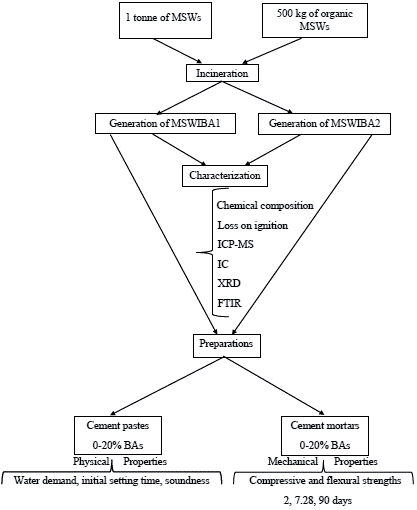
Table 3.
Chemical composition of MSWI bottom ashes and OPC (wt %).
| OPC wt% | MSWIBA1 wt% | MSWIBA2 wt% | |
|---|---|---|---|
| SiO2 | 22.16 | 37.86 | 15.80 |
| CaO | 62.95 | 25.23 | 39.06 |
| MgO | 0.93 | 0.23 | 1.15 |
| Fe2O3 | 3.47 | 1.15 | 1.60 |
| Al2O3 | 4.88 | 5.58 | 7.60 |
| SO3 | 2.25 | / | / |
| f-CaO | 1.05 | / | / |
| LOI | 1.22 | 25.31 | 29.12 |
Table 4.
Heavy metal contents in MSWIBA1, MSWIBA2.
| Elements | MSWIBA1 (mg kg-1) | MSWIBA2 (mg kg-1) |
|---|---|---|
| V | 27.74 | 21.70 |
| Cr | 642.47 | 233.90 |
| Co | 12.93 | 8.23 |
| Ni | 270.09 | 103.30 |
| Cu | 393.11 | 333.18 |
| Zn | 2374.95 | 1382.54 |
| As | 7.88 | 5.87 |
| Mo | <6 | 40.16 |
| Cd | 64,96 | 3.04 |
| Sb | 54.09 | 26.42 |
| Ba | 738.25 | 640.75 |
| Pb | 236.42 | 120.24 |
The contents of heavy metals from leachates of MSWIBA1 and MSWIBA2 are summarized in Table 5. The concentrations of heavy metals in leachates from MSWIBA1 and MSWIBA2 are approximately similar. The leachate from MSWIBA2 contains high concentrations of Ba, Mo, and Cr, while the leachate from MSWIBA1 contains a high concentration of Sb. It can be remarked that the leachate from MSWIBA2 has a higher content of contaminants compared to the leachate from MSWIBA1, which might be due to the high surface area of MSWIBA2 (6636.64 cm²/g). These results are comparable to those of Caprai et al. (2019), who detected excessive leaching of Sb, Cr, Cu, and Mo heavy metals [37].
The concentration of sulfate ion (SO32-) in the leachate from MSWIBA1 is higher than that in the leachate from MSWIBA2. In contrast, the concentration of chloride ion (Cl⁻) in the leachate from MSWIBA2 is higher than that in the leachate from MSWIBA1. The leaching results for the two MSWIBAs indicate that the concentrations of heavy metals and sulfates are below the hazardous limit [28]. According to European landfill limits, chloride in the leachate is in the hazardous waste range, which accords with results reported in the literature. Tang et al. (2015) found that the leaching of chloride and sulfate in the investigated bottom ashes exceeds the relevant limit values [38].
XRD Analysis
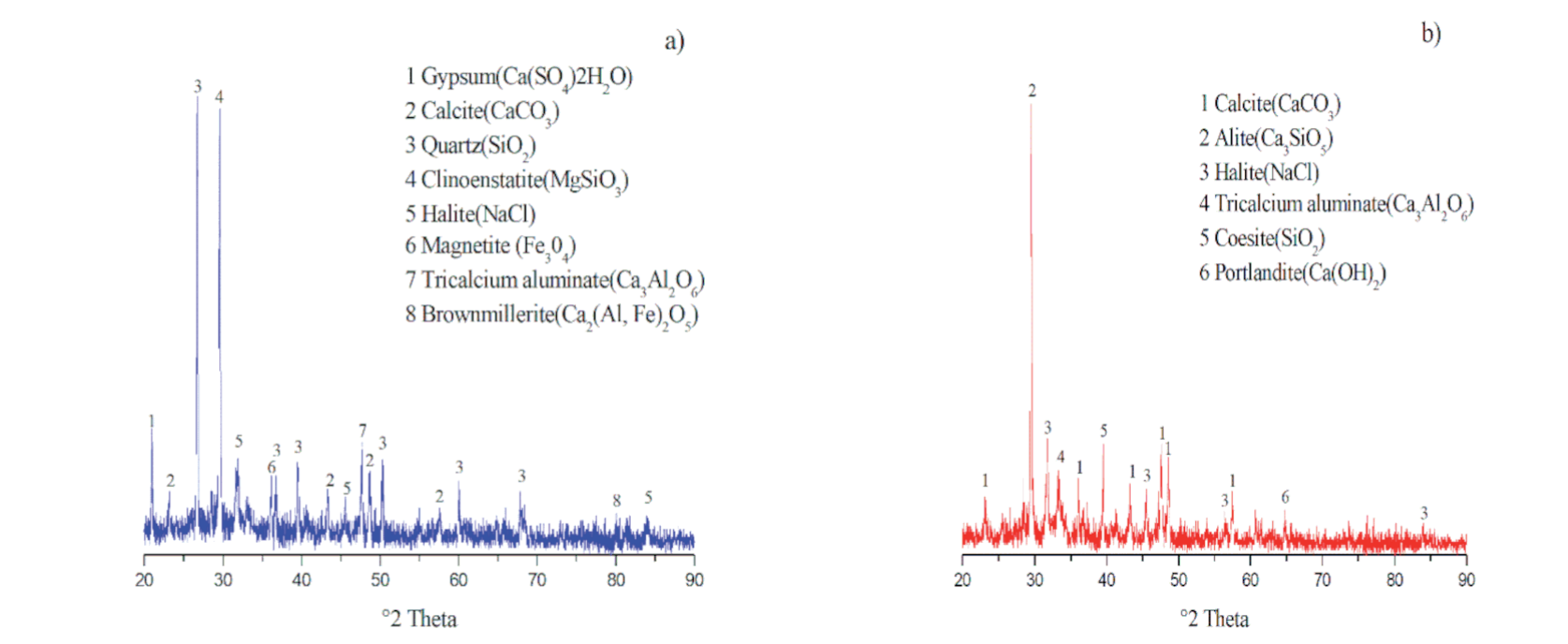
For XRD analysis, Fig. 2 shows that the mineralogical composition of the two MSWIBAs differs slightly. The predominant crystalline phases in MSWIBA1 (Fig. 1a)) are quartz (PDF. No 96-500-0036) and clinoenstatite (PDF. No 96-900-2716) with strong peaks; the gypsum (PDF. No 96-901-3170), calcite (PDF.No 96-101-0929), halite (PDF. No 96-900-3309), magnetite (PDF. No 96-900-2324), tricalcium aluminate (PDF. No 96-901-4360), and brownmillerite (PDF. No 96-901-4662) present with weak peaks. The MSWIBA2 (Fig. 1b)) contains alite (PDF. No 96-154-0706) with a high peak, calcite (PDF.No 96-101-0929), and halite (PDF. No 96-900-3309) with many minor peaks, it contains also tricalcium aluminate (PDF.No 96-901-4360), coesite (PDF. No 96-900-7171), and portlandite (PDF. No 96-900-0113). Some of the phases detected in both MSWIBAs are reported in previous studies [39, 40]. The presence of alite (cement component) in MSWIBA2 is due to the high incineration temperature. Based on the chemical analysis, both MSWIBAs contain Si, Ca, Al, Fe, and Mg; the results obtained by XRD analysis confirm this composition, and these elements are distributed in detected phases [41].
FTIR Analysis
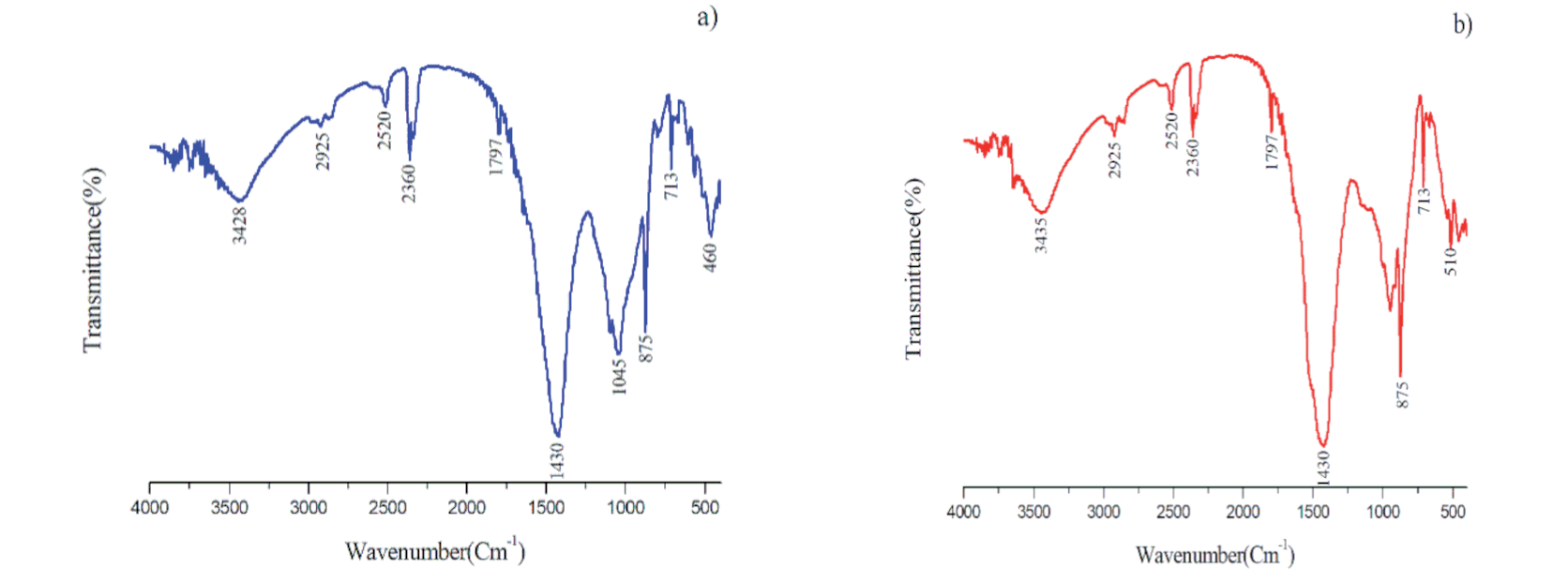
The FTIR spectra of MSWIBA1 and MSWIBA2 are shown in Fig. 3. It can be seen that both spectra are approximately similar. The large bands around 3435 and 3428 cm⁻¹ are linked to vibrations of O-H stretching of bonded and non-bonded hydroxyl groups and water, indicating some humidity in both MSWIBAs [42]. Carbonate (C-O) vibrations are identified by small peaks centered at 2520, 1797, and 714 cm⁻¹, as well as strong peaks at 1430 and 875 cm⁻¹ [43]. Absorbances at 1045, 510, and 459 cm⁻¹ indicate the presence of Si-O-Si (quartz) [44, 45]. The low peaks located at 2925 cm⁻¹ are related to C-H stretching (as) of the aliphatic methylene group [42], and the peaks observed at 2360 cm⁻¹ are due to CO2 molecules [46]. These results agree with the chemical and XRD analyses, which confirm that the main components of both bottom ashes are Ca, represented by calcium carbonate [47], and Si, represented by quartz.
Physical Properties of Cement Pastes
The water demand for normal consistency, initial setting time, and soundness of the blended cements are shown in Table 6. It can be seen that the incorporation of the two MSWIBAs in cement slightly increases the water demand for normal consistency compared with that of the reference cement, which is 145 g. For cements prepared with 5 wt%, 10 wt%, and 20 wt% of MSWIBA1, the water demand is 150 g, 155 g, and 155 g, respectively. It can be remarked that the water demand of cements with 10 wt% and 20 wt% of MSWIBA2 is higher (160 g and 170 g, respectively) than that of cements prepared with 10 wt% and 20 wt% of MSWIBA1. The increase in water demand was also observed by Xiang-Guo Li (2012), who replaced different proportions of cement with bottom ash. The calcium oxide content is higher in MSWIBA2 than in MSWIBA1, so the reaction between calcium oxide and water increases the water demand [19]. The high loss on ignition of both MSWIBAs is also responsible for the increase in water demand when unburned carbon particles in MSWIBAs absorb free water [48].
The initial setting time of cement prepared with 5 wt% of both MSWIBAs is approximately similar to that of the control cement. The initial setting time is delayed with increasing levels of MSWIBA1 in the cement; this delay is observed when the cement is replaced with 10 wt% BA1 (39 min) and 20 wt% BA1 (157 min) compared to that of the control cement. It can be noted that the high addition of MSWIBA1 (10 wt%, 20 wt%) caused a retarding effect on the hydration process of the cement paste. This delay can be explained by the decrease in alite (C3S) content when cement is replaced by MSWIBA1, as this component is essential for the hydration process during the early hours. The high content of heavy metals in BAs is another factor for the delay of hydration as reported in previous studies [14, 18, 19]. The MSWIBA1 contains high content of Zn, Cu, Cd, Cr, and Pb [49-51], their hydrolysis forms metals hydroxide which are precipitated on the surface of C3S and retard the nucleation of portlandite (CH) and calcium silicate hydrate (C-S-H) during the early period [24]. The initial setting time of cement pastes containing 10 wt% and 20 wt% of MSWIBA2 is reduced by 11 min and 9 min compared to that of cement paste without MSWIBA2. This decrease is explained by the presence of alite (C3S) and tricalcium aluminate (C3A) in MSWIBA2, as shown in the XRD results. These compounds hydrate in blended cement in the presence of water during the early hours, forming CH, C-S-H, and ettringite. In addition, the lower contents of heavy metals in MSWIBA2 compared with MSWIBA1 result in a decrease in the initial setting time. The higher content of calcium oxide in MSWIBA2 (39.06%) may accelerate the hydration process because its dissolution results in the formation of the CH compound.
Table 6.
Physical properties of cement pastes.
The soundness of all cement pastes is found in the range of 0-2 mm. The values of soundness are slightly higher than that of the reference cement, but they are lower than the limit value of 10 mm recommended by EN 197-1 [20]; these results are consistent with previous studies [14].
Mechanical Properties
Flexural Strengths
Fig. 4 shows the impact of MSWIBA1 and MSWIBA2 on the flexural strengths of mortars at 2, 7, 28, and 90 days of curing. The flexural strengths of the cements containing 5 wt% and 10 wt% levels of MSWIBA1 and MSWIBA2 show a small increase at 2 days and a slight decrease at 7 days compared to the strength values of the control cement, which are 3.46 MPa at 2 days and 6.90 MPa at 7 days. The flexural strengths of cement containing 20 wt% of MSWIBA1 are 3.46 and 5.16 MPa at 2 and 7 days, respectively; the flexural strengths of cement with 20 wt% of MSWIBA2 are 3.41 and 4.77 MPa at 2 and 7 days, respectively. Flexural strength readings at 7 days of curing are lower than that of the control mortar; this is because the cement has been diluted by the addition of 20 wt% of bottom ashes.
After 28 and 90 days of curing, the flexural strengths of the reference cement are 7.68 and 7.79 MPa, respectively. Flexural strength decreases gradually with increasing contents of both bottom ashes in the cement. After 28 days, replacing 5 wt%, 10 wt%, and 20 wt% of the cement with MSWIBA1 gives flexural strengths of 7.02, 6.97, and 6.24 MPa, respectively, while at 90 days, the flexural strengths are 7.21, 6.86, and 5.98 MPa, respectively. On the other hand, the flexural strengths of cements with 5 wt%, 10 wt%, and 20 wt% of MSWIBA2 are 7.30, 6.73, and 6.14 MPa, respectively, at 28 days; furthermore, the flexural strengths are 7.55, 6.79, and 5.60 MPa, respectively, at 90 days.
Compressive Strengths
The effect of MSWIBA1 and MSWIBA2 on the compressive strengths of mortars at 2, 7, 28, and 90 days of curing is depicted in Fig. 5. The compressive strengths of the reference cement at 2 and 7 days are 15.78 and 41.98 MPa, respectively. It can be noticed that the compressive strengths of cements with 5 wt% and 10 wt% of MSWIBA1 after 2 days are 19.68 and 20.86 MPa, respectively, while the compressive strengths after 7 days of these mixtures are 42.94 and 45.12 MPa, respectively. The same applies to the cements prepared with 5 wt% and 10 wt% of MSWIBA2; after 2 days, the compressive strengths are 21.30 and 21.83 MPa, respectively, while the compressive strengths after 7 days are 44.93 and 43.93 MPa, respectively. Compared with the compressive strength results at 2 and 7 days for the control cement, there is an increase in the compressive strengths of cements with 5 wt% and 10 wt% of MSWIBA2. This growth in strength at early ages indicates that the addition of MSWIBA2 accelerates the hydration process during the early period. The hydration occurs through the reaction of different compounds in the cement and BAs (C3A, C3S, CaO) with water, forming hydrates like ettringite, CH, and C-S-H. As seen in the previous results for the setting time, the heavy metals delay the hydration process of cement with MSWIBA1. Thus, the compressive strengths at 2 and 7 days for this blended cement increased compared to those of the control cement. This increase is attributed to the nucleation of C-S-H when all trace metals precipitate with calcium hydroxide [50].
Fig. 4.
Effect of bottom ashes on flexural strengths of hardened blended cement: a) MSWIBA1, b) MSWIBA2.
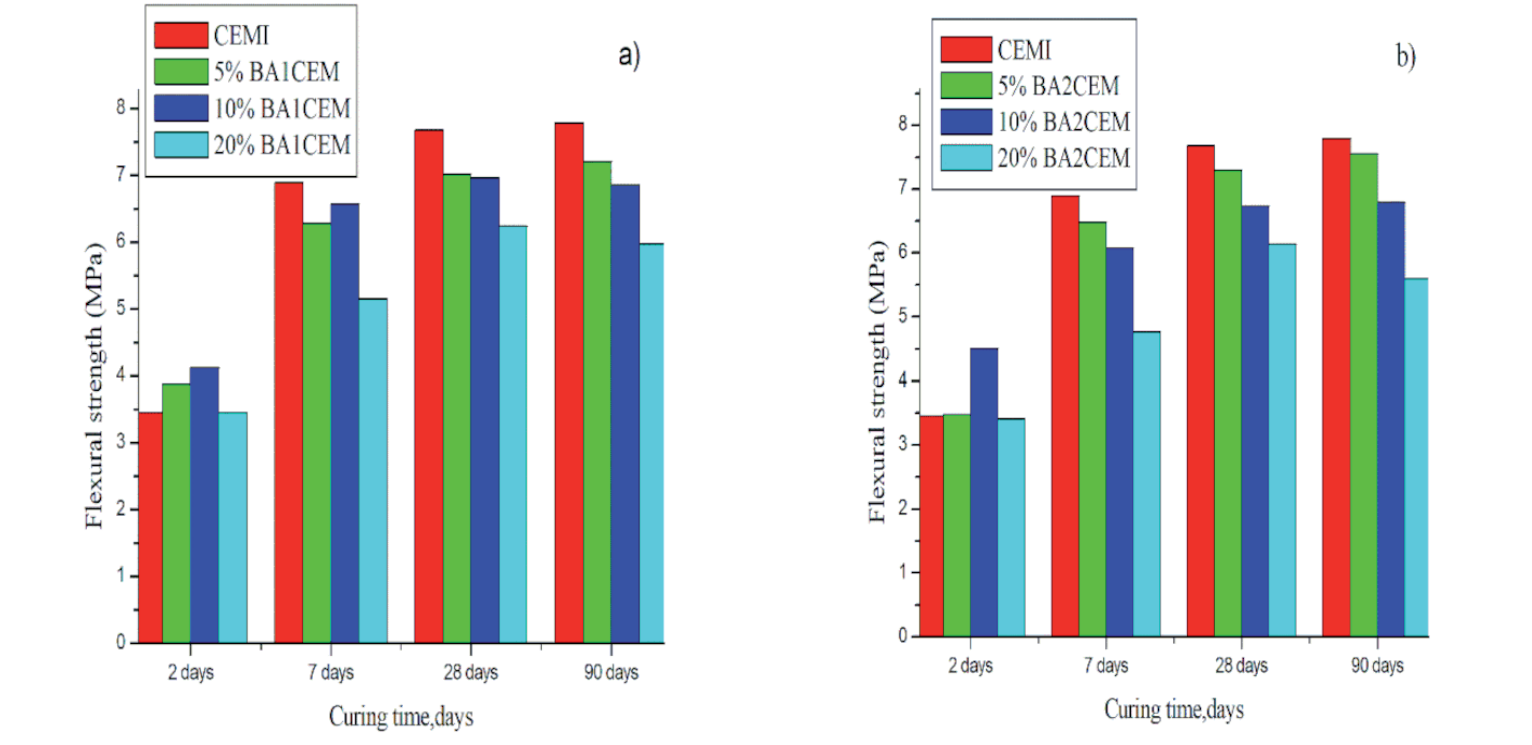
Fig. 5.
Effect of bottom ashes on compressive strengths of hardened blended cement: a) MSWIBA1, b) MSWIBA2.
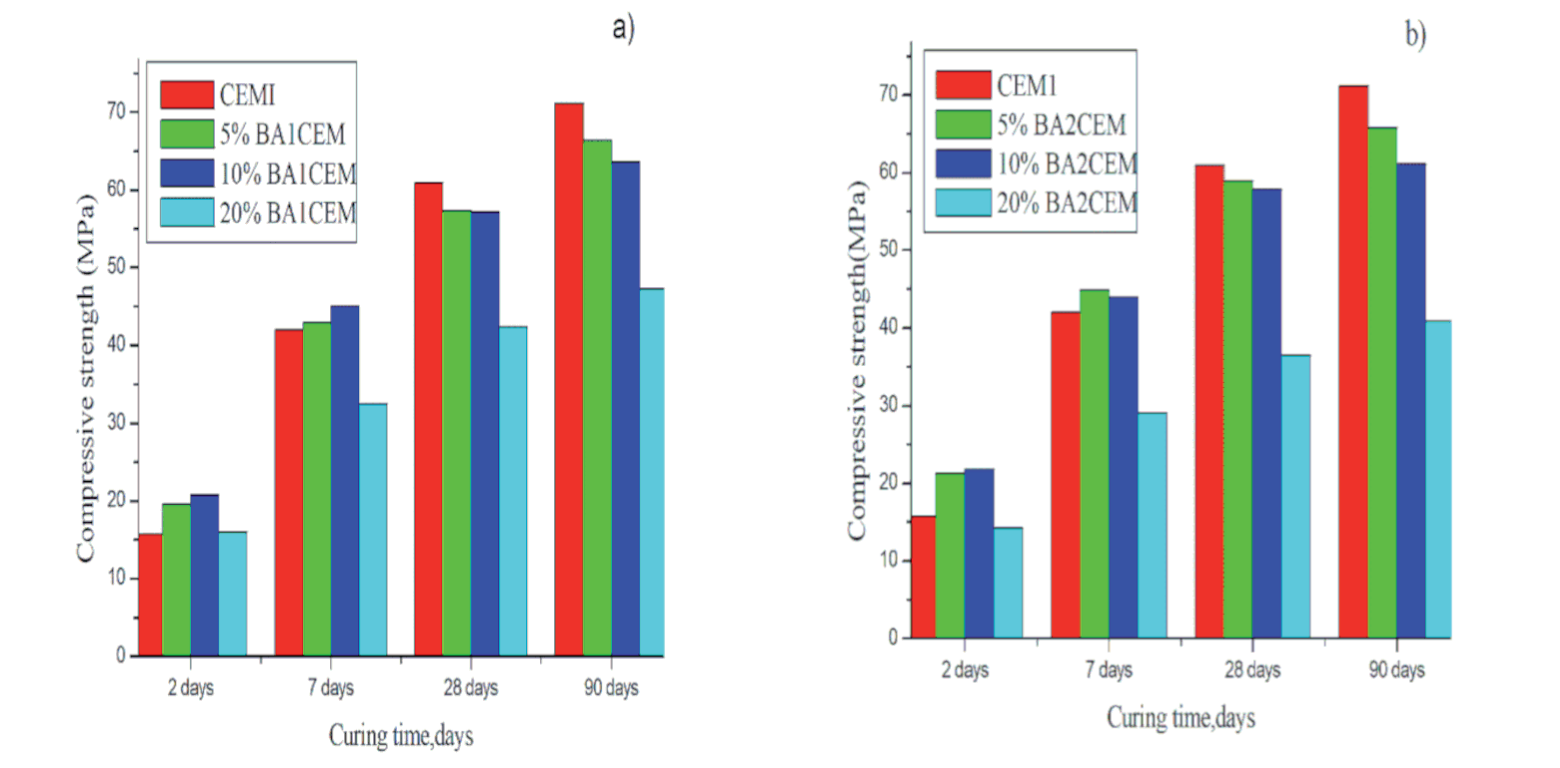
The compressive strengths of cements with 20 wt% of MSWIBA1 and 20 wt% of MSWIBA2 after 2 days are 16 and 14.29 MPa, respectively, while the compressive strengths after 7 days of these mixtures are 32.59 and 29.11 MPa, respectively. There is a remarkable decrease in compressive strengths compared to those of cements with 5 wt% and 10 wt% of both types of bottom ashes. This reduction is related to the decrease in the quantity of alite (C3S) when replacing cement with 20 wt% of both MSWIBAs [37]. It is observed that the compressive strengths of cement with 20 wt% MSWIBA2 are slightly higher than those of cement with 20 wt% MSWIBA1. This is explained by the lower contents of heavy metals in MSWIBA2 and its higher fineness, allowing MSWIBA2 to react more easily with cement.
At delay ages, the compressive strengths of cements with 5 wt% and 10 wt% of MSWIBA1 are 57.31 MPa and 57.18 MPa at 28 days, and 66.41 MPa and 63.67 MPa at 90 days, respectively. For cements prepared with 5 wt% and 10 wt% of MSWIBA2, the compressive strengths are 58.90 MPa and 57.80 MPa at 28 days, and 65.86 MPa and 61.12 MPa at 90 days, respectively. By comparing these results with those of the control mortar (60.94 MPa at 28 days and 71.16 MPa at 90 days), it can be seen that there is a slight decrease in compressive strengths because the cement was replaced with small proportions of BAs (5 wt% and 10 wt%). Loginova et al. (2021) found in their study that replacing cement 42.5N with 5 wt% of BA slightly decreased the compressive strengths by 7% and 2% at 28 and 91 days, respectively, compared with the control mortar, which agrees with our results [21]. Loginova et al. (2023) also found a slight decrease in the compressive strength of cement 52.5R blended with 10 wt% of BA after 2 days, with a remarkable decrease in strength after 28 days [17]. For cement preparations containing 20 wt% of MSWIBA1 and 20 wt% of MSWIBA2, the compressive strengths are 42.39 MPa and 36.44 MPa, respectively, after 28 days of curing, while after 90 days, the compressive strengths are 47.28 MPa and 40.91 MPa, respectively. The reduction in compressive strengths is related to the decrease in the content of belite (C2S), a phase responsible for strength at delay ages, when cement is substituted with a high level of BAs (20 wt%). Cheng et al. (2022) demonstrated that the reduction in compressive strength increases with higher BA content in cement after 28 days of curing [52]. It can also be observed that the compressive strengths of cement with 20 wt% of MSWIBA1 are higher than those of cement with 20 wt% of MSWIBA2; the main explanation for this observation is the lower pozzolanic reactivity of MSWIBA2 at delay ages. The MSWIBA1 contains a high amount of SiO2 (37.86 %.), so it reacted with CH from the hydration of active compounds of cement and formed additional C-S-H. The results of the compressive strengths of cement types containing high amounts of MSWIBA1 and MSWIBA2 (20 wt%) at 28 days are similar to those obtained in previous studies [17-19, 52]. The results suggest the utilization of bottom ashes as SCM up to 10 wt% replacement because the compressive strength of CEMI 42.5N with 5 wt% and 10 wt% is in accordance with the standards (>40 MPa at 28 days).
Conclusions
This study focuses on the characterization of bottom ashes generated from the incineration of municipal solid wastes in Chlef City and their recycling as a partial substitute for cement. The main findings are summarized below: – The main chemical components of both MSWIBAs
were SiO2, CaO, Al2O3, and Fe2O3, while their main
mineral phases were quartz, clinoenstatite, alite,
calcite, halite, gypsum, portlandite, tricalcium
aluminate, magnetite and brownmillerite. – The categories of wastes incinerated have influenced
the chemical composition of BAs; it was found that
the heavy metal contents in MSWIBA2 decreased
compared to those of MSWIBA1. – The increased replacement of cement with both
BAs caused a high increase in the water demand
for the cement mixed with MSWIBA2 and a slight
increase in the water demand for cement mixed with
MSWIBA1. – The partial substitution of cement with MSWIBA1
increased the initial setting time; however, the
incorporation of MSWIBA2 reduced the initial
setting time compared to that of the reference
cement. The soundness of all cements blended with
MSWIBA1 and MSWIBA2 was lower than the limit
value. – The compressive strengths of cement mortar at
an early age increased when cement was replaced
with 5 wt% and 10 wt% of both MSWIBAs;
however, the compressive strengths at delay age
decreased gradually with increasing contents of
both MSWIBAs, with the loss being significant
at a replacement rate of 20 wt%. To guarantee the
mechanical strengths of cement mortars, maximum
MSWIBA substitutions in OPC should be controlled
at 5 wt% and 10 wt%. The results indicate that both
MSWIBAs can be recycled as SCMs in cement, but
their treatment is necessary to improve the cement’s
physical and mechanical properties. – In Chlef (Algeria), the study of the incineration of
different waste compositions and the characteristics
of the different BAs generated is a new approach
in the field of MSWs treatment. According to this
experimental study, the results confirmed that
the characteristics of MSWIBAs change according
to the categories of MSW incinerated. The addition
of MSWIBAs as an additive to cement production
affected the physical properties of cement pastes
(water demand, initial setting time). The mechanical
properties of mortars decrease when cement is
replaced by a high proportion of MSWIBAs.

