

Introduction
The nutrient content of aquatic organisms is a con-cern for public health [1]. Heavy metals released from anthropogenic and natural sources into aquatic ecosystems are very serious hazards due to their bioaccumulation, toxicity, and effects on the food chain [2]. Crayfish are keystone species of freshwater ecosystem communities and are the flagship species of conservation efforts in highly endangered freshwater habitats [3]. Crayfish species are important benthic invertebrates, with more than 640 species in the families Astacidae, Cambaridae, and Parastacidae [4, 5]. Freshwater crayfish, one of the economical water organisms, is in the Astacidae family of the Decapoda order of the Crustacea class of the Arthropoda phylum [6, 7]. It naturally lives in the inland waters of the north-ern hemisphere. Astacus leptodactylus Esch., 1823, which is called “narrow-clawed crayfish” in the inland waters of Turkey, is distributed as a single natural species. This species is naturally found in many dams, lakes, ponds, and streams in Turkey [8, 9]. This freshwater crayfish species has economic value as it is popularly consumed in many countries. However, their stocks have dwindled due to overfishing, water pollution, and the crayfish plague in Turkey [10, 11]. Crayfish are benthic organisms that have an important function in inland water ecosystems due to their accelerating effects on organic matter conversion [12]. Crayfish feed on plant and animal materials, fish, and other small aquatic organisms. The nutritional value of crayfish is quite high, and it is an important food source, especially in terms of protein amount and quality [13]. In addition, crayfish meat has a dietetic feature due to its low energy value. The edible meat of freshwater crayfish is mostly found in the abdomen [14].
Heavy metals are the most important sources of inor-ganic contaminants in water. These are collected by living things in aquatic ecosystems, accumulate in their tissues, and can reach humans via the food chain [15, 16]. Some heavy metals may accumulate differently in males and females due to differences in kinetics, mode of action, or sensitivity [17]. There are very few studies examining heavy metal accumulation in males and females of crayfish. This study was carried out to compare the heavy metal accumulation levels in the abdominal muscles of female and male freshwater crayfish (A. leptodactylus) living in Kılıçkaya Reservoir.
Material and Methods
Study Area
This study was carried out with freshwater crayfish samples obtained from Kılıçkaya Reservoir in Suşehri district of Sivas province in northeastern Turkey. Kılıçkaya Reservoir is located on Kelkit Stream, approximately 130 kilometers from Sivas province. Its height from the streambed is 134 meters, and the maximum depth of the reservoir is around 100 meters. Kılıçkaya Reservoir has a lake area of 64.4 square kilometers and became operational in 1989 [18]. Kılıçkaya Reservoir is used for energy, irrigation, and fishing. In addition, agriculture and animal husbandry are carried out around the Kılıçkaya Reservoir, which has been chosen as the study area.
Sampling
In this study, 10 samples of freshwater crayfish were caught with 30 and 50 mm mesh nets in the summer of 2021 from Kılıçkaya Reservoir. The total length of the crayfish brought to the laboratory in a heat-insulated package with a cold chain was measured with a 0.01 mm sensitive digital caliper. Their weights were weighed with a digital precision scale with a sensitivity of 0.01 g. The gender distinction between crayfish was made by looking externally [19]. Accordingly, the gonopods of males were used in determining the genders.
Preparation of Samples
For heavy metal analysis, the abdomens of 5 female and 5 male crayfish samples were opened, and approximately 1.5–2 g of muscle tissue was taken and stored at -20°C in a deep freezer. For measurement, the samples were dried in the electrical drying oven for 24 hours at 105°C. Then, 3 ml HNO3 was added to the samples and kept at normal room temperature for 24 hours. By ensuring that the samples were completely mineralized on the low-temperature metal plate, 1 ml H2SO4 was added. Dissolved samples were com-pleted in 50 ml of distilled water, and 1–2 drops of HNO3 were added and filtered through a 0.45 μm nitrocellulose membrane filter and made ready for analysis [20]. In addition, the blind sample was prepared by applying the above procedures in the same way. The solutions prepared from the samples were measured at the wavelengths of Cd: 228.80 nm, Cr: 428.90 nm, Cu: 327.39 nm, Pb: 220.35 nm, and Zn: 213.90 nm in an Avanta flame atomic absorption spectro-photometer. Results are given in μg/g wet weight [15, 39].
Statistical Analysis
In this study, statistical G Power analysis was applied to specify the adequacy of the sample size. The actual power value was calculated as 0.9582525 for this study. According to the G Power analysis, it was concluded that a total of 10 data points, 5 females and 5 males, with a 5% margin of er-ror and 95% power, were sufficient for this study. Power analysis was performed with the G Power 3.1.9 program. In the study, an analysis of conformity to normal distribution was performed to determine the appropriate statistical methods. Accordingly, while total length, Cr, and Zn parameters are suitable for a normal distribution, weight, Cd, Cu, and Pb parameters do not come from normal distribution. The independent samples t test, Mann Whitney U test, and cluster analysis were used for data analysis. SPSS v.22 was used for statistical analysis.
Results and Discussion
A total of 10 A. leptodactylus, five from each sex, were obtained from Kılıçkaya Reservoir. The sex ratio in Kılıçkaya Reservoir was found to be 1:1. The distribution of the total length and weight results of the A. leptodactylus population obtained from Kılıçkaya Reservoir by gender is presented in Table 1. In the population, total length values varied between 97–116 mm in female specimens and 102– 117 mm in male specimens in Kılıçkaya Reservoir. Body weight values varied between 26.95-36.85 g in females and 29.57–67.82 g in males (Table 1). A statistical difference was not found between the total length and weight values of the female and male specimens (P > 0.05).
The heavy metal levels in the abdominal muscles of female and male crayfish in Kılıçkaya Reservoir were compared, and significant differences were found (Table 2). As a result of the statistical tests performed to determine the difference between Cd, Cu, Cr, Pb, and Zn heavy metal levels and the gender variable, the differentiation of Cu according to gender status was found to be significant (P < 0.05). The Cu mean value (x– = 1.22) level of males was determined to be higher than females (x– = 0.28) in Kılıçkaya Reservoir. Similarly, the differentiation of Zn levels according to gender was found to be significant (P < 0.05). The average Zn (x– = 9.48) level of males was determined to be higher than females (x– = 3.69) (Table 2).
Table 1.
Distribution of total length and weight results of A. leptodactylus by gender.
| Property | Gender | N | Min-Max | Average±SD | Test | P |
|---|---|---|---|---|---|---|
| Length | Female | 5 | 97-116 | 106.00±7.44 | -1.280* | 0.236 |
| Male | 5 | 102-117 | 116.00±15.79 | |||
| Weight | Female | 5 | 26.95-36.85 | 31.38±5.13 | -1.567** | 0.117 |
| Male | 5 | 29.57-67.82 | 43.49±14.90 |
Table 2.
Comparison results of Cd, Cu, Cr, Pb and Zn levels in female and male crayfish.
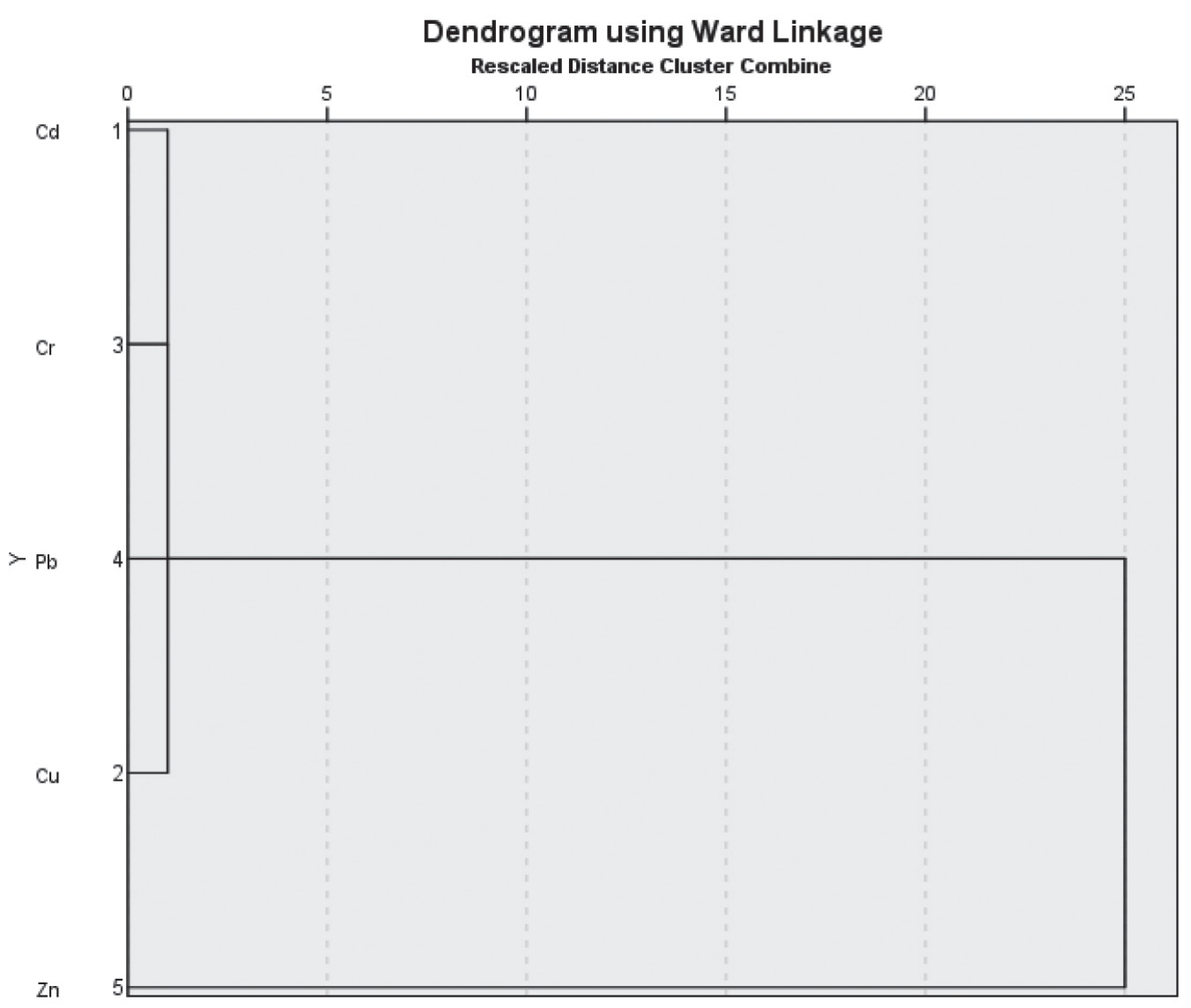
The similarity dendrogram obtained as a result of the hi-erarchical cluster analysis performed to determine the similarity between Cd, Cu, Cr, Pb, and Zn levels in the abdominal muscle tissue of female crayfish in Kılıçkaya Reservoir is presented in Fig. 1. Since the similarities between Cd, Cu, Cr, and Pb are very strong for female crayfish, these profiles formed a group at a distance of one unit. Zn was included in other heavy metals at a distance of 25 units (Fig. 1).
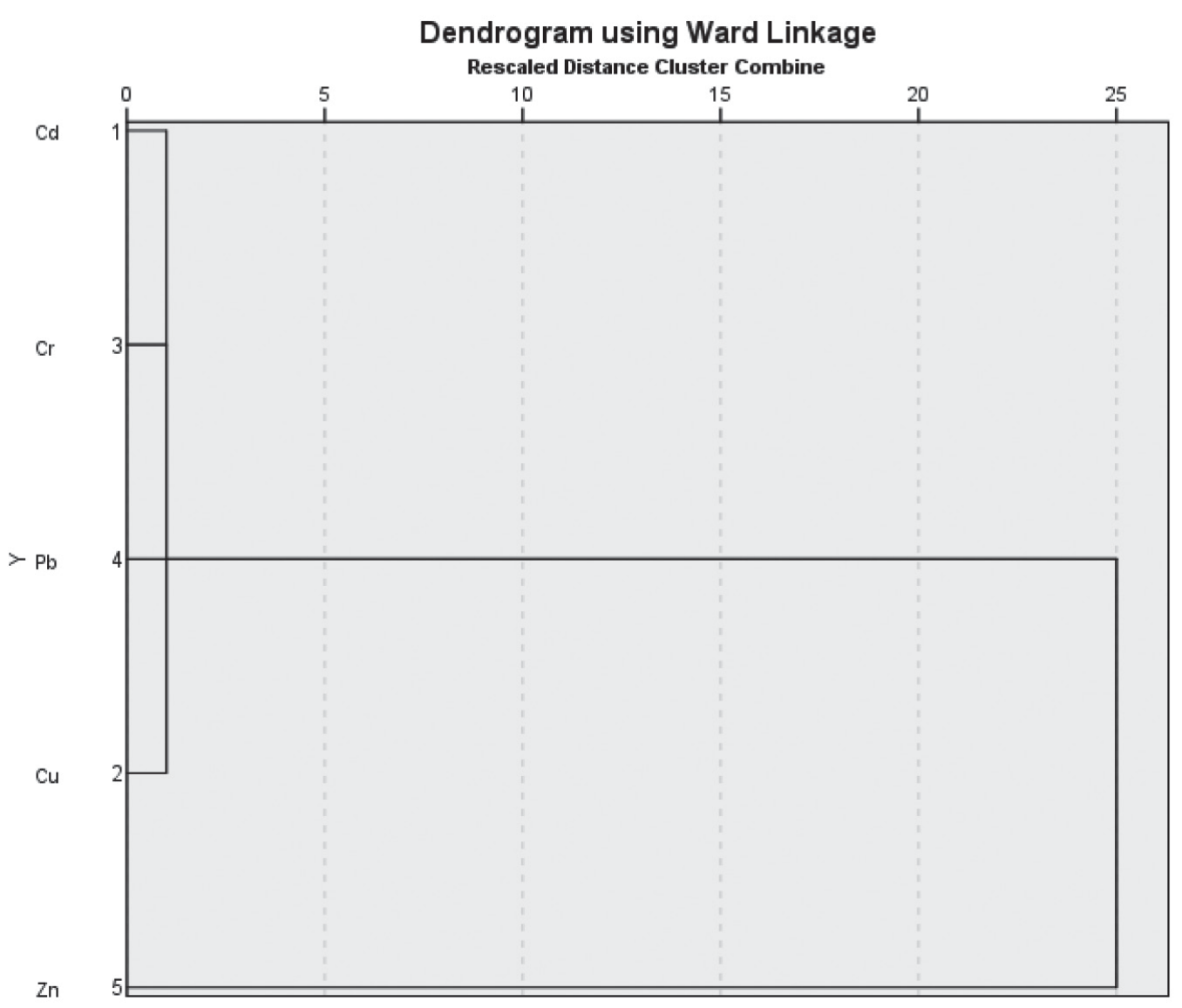
Dendrogram has delineated two major clusters, which were mainly segregated based on the accumulation of heavy metals (Fig. 2). Since the similarities between Cd, Cu, Cr, and Pb are very strong for male crayfish, these profiles formed a group at a distance of one unit. Zn was included in the group formed by Cd, Cr, Cu, and Pb from a distance of 25 units (Fig. 2).
The average total length of the female crayfish samples captured in Kılıçkaya Reservoir was 106.00±7.44 mm, and the average weight was determined as 31.38±5.13 g. It was also found that the average total length of male crayfish samples was 116.00±15.79 mm, and the average weight was 43.49±14.90 g (Table 1). According to the statistical tests, no statistical difference was found between the total length and weight results of female and male crayfish (P > 0.05). The gender ratio of the crayfish populations of the Astacidae family in natural ecosystems is very close to one [21]. In this study, the gender ratio was found to be one-to-one. Crayfish grow by changing their shells. In crayfish, generally, young specimens change their shells 2–3 times a year, and older specimens once a year. Female crayfish protect their young under their abdomen for a long time during the breeding period. During this period, females were fed less than males and did not change their shells. Therefore, in studies conducted with crayfish, it was determined that males were heavier and taller [19]. Considering the weight and length average of male and female crayfish examined in this study conducted in Kılıçkaya Reservoir, it was determined that males were taller and heavier than females. Accordingly, this study is similar to the studies by Bolat and Kaya [19], Kuşat and Bolat [22], and Harlıoğlu [23].
The toxicity of heavy metals varies according to many factors, such as the nature of the metal, the biological role of the metal, the exposure time, and the exposed organism [24–27]. When an organism is affected, it affects the en-tire food chain. Concentrations of metals increase along the food chain. People will generally accumulate more heavy metals as they are at the last link of the food chain. In this case, it will affect people more [28–31]. Freshwater crayfish are biological indicators of water pollution and are often used for heavy metal assessment [32–34]. The average heavy metal levels in the abdominal muscle tissue of females and males of A. leptodactylus were found to be Zn > Cu > Pb > Cr> Cd and Zn > Cu > Pb > Cd > Cr, respectively (Table 2). These results showed that Zn heavy metal accumulation was higher in the abdominal muscle tissue of A. leptodactylus in both males and females. This heavy metal is followed by Cu and Pb in Kılıçkaya Reservoir. Similarly, Naghshbandi et al. [35] reported that the most accumulated metal in the muscle tissue of A. leptodactylus of both males and females caught from Aras Dam in Iran is Zn, followed by Cu. The comparison of the levels of heavy metals analyzed in this study with similar studies is given in Table 3. In the study, the average Cd level obtained in females is higher than the level reported for females by Kurun et al. [36] from Lake Terkos, Turkey. On the contrary, the average Cd level obtained in males in the study is lower than the level reported for males by Kurun et al. [36] from Lake Terkos, Turkey. Naghshbandi et al. [35] reported that Cu, Pb, and Zn levels were higher in males in the A. leptodactylus population living in Aras Dam, while Kurun et al. [36] reported that Cu levels were higher in females in the A. leptodactylus population in Lake Terkos, Turkey. These reported differences may be largely due to the environmental levels of heavy metals in these aquatic ecosystems and the different geological character-istics of the regions.
Cd accumulation varied between (0.01–0.02 μg/g) male crayfish, while Cd accumulation varied between (0.01–0.25 μg/g) female crayfish. The average Cd level (0.01±0.01 μg/g) was found to be lower in the group of female crayfish than in the group of male crayfish (0.07±0.10 μg/g) in Kılıçkaya Reservoir (Table 2). However, the Cd difference between the genders is not statistically significant (P˃0.05). FAO [37] recommended 0.30 μg/g in crustaceans for Cd. Also, the EU [38] reported the maximum level for Cd as 0.50 μg/g in the regulation of certain contaminants in foodstuffs. Accordingly, the Cd levels analyzed in the muscle tissue of female and male crayfish samples captured from Kılıçkaya Reservoir were determined to be below the maximum allowed by FAO [37] and EU [38].
The average Cu level (0.28±0.44 μg/g) in female crayfish was lower than that of male crayfish (1.22±0.93 μg/g). Cu showed the highest accumulation after Zn among the heavy metals detected in the abdominal muscles of both female and male crayfish. In the study, the average Cu levels obtained in both males and females were lower than the levels reported by Naghshbandi et al. [35] and Kurun et al. [36] in both males and females (Table 3). The heavy metal levels detected in the muscle tissue of males and females of A. leptodactylus were compared with the results of the heavy metal study conducted by Dirican et al. [39] on three Cyprinid species in Kılıçkaya Reservoir. Accordingly, in this study, the average Cu levels analyzed in both female and male crayfish were found to be less than the average Cu levels detected in the muscle tissue of B. plebejus, C. carpio, and S. cephalus in Kılıçkaya Reservoir by Dirican et al. [39]. The maximum acceptable limit for Cu was suggested by FAO [37] as 10 μg/g in fish and fish products. Accordingly, Cu levels measured in the muscle tissue of male and female crayfish samples captured from Kılıçkaya Reservoir remained below the maximum limit suggested by FAO [37].
While the maximum Cr accumulation was observed in male crayfish at 0.09 μg/g, the minimum Cr accumulation was observed in females at 0.03 μg/g in Kılıçkaya Reservoir. However, it was determined that the difference between genders for Cr was not statistically significant (P ˃ 0.05). While the maximum limit suggested by FAO [37] for Cr is 1 μg/g in fish, crab meat, oysters, prawns, and shrimp, the maximum limit suggested by USEPA [40] for Cr is 0.5 μg/g. According to these maximum limits, Cr levels measured in the muscle tissue of female and male crayfish samples captured from Kılıçkaya Reservoir are below the maximum limits allowed by FAO [37] and USEPA [40].
Pb level was determined to be higher in the group of male crayfish (0.35±0.35 μg/g) than the group of female crayfish (0.08±0.12 μg/g) in Kılıçkaya Reservoir. However, it was found that the difference between genders for Pb was not statistically significant (P˃0.05). In this study, the average Pb levels obtained in both males and females are higher than the levels reported by Kurun et al. [36] in both males and females (Table 3). FAO [37] and EU [38] reported the acceptable limit for Pb as 0.50 μg/g in fish and crustaceans.
Table 3.
Comparison of heavy metals levels in this study with other studies (μg/g).
Zn level is higher in the group of male crayfish (9.48±2.64 μg/g) than in the group of female crayfish (3.69±2.29 μg/g). In the study, Zn showed the highest accumulation of metals determined in the abdominal muscles of both male and female crayfish. The maximum Zn level was found to be 12.96 μg/g in the male group and the minimum in the female group was 1.65 μg/g. Zn levels were statistically significantly different between male and female groups (P<0.05). In this study, the Zn levels obtained in both males and females were lower than the levels determined by Naghshbandi et al. [35] in both male and female muscle tissue of A. leptodactylus from Aras Dam, Iran. The average Zn levels analyzed in female crayfish are similar to the value determined by Dirican et al. [39] to be higher than the average Zn levels detected in the muscle tissue of B. plebejus and S. cephalus in Kılıçkaya Reservoir. On the other hand, in this study, the average Zn levels analyzed in male crayfish were found to be less than the average Zn levels detected in the muscle tissue of the C. carpio in Kılıçkaya Reservoir by Dirican et al. [39]. According to FAO [37], the maximum allowable Zn level is recommended as 50 μg/g in fish and fish products. Accordingly, the Zn levels examined in the muscle tissue of male and female crayfish samples captured from Kılıçkaya Reservoir are below the maximum level recommended by FAO [37].
According to the classifications in the similarity den-drograms, the first cluster consists of Cd, Cr, Pb, and Cu metals, while the second cluster consists of only Zn metal. This indicates that Cd, Cr, Pb, and Cu metals are very close and similar to each other in terms of the values of the heavy metal variables. Zn is quite different from Cd, Cr, Pb, and Cu in terms of the values of heavy metal variables. There is a different deposition profile between Zn and the other heavy metals analyzed. Because Zn alone forms a cluster, it is at a great distance from the other heavy metals.
The accumulation levels of Cd, Cu, Cr, Pb, and Zn heavy metals in the muscle of A. leptodactylus samples captured from Kılıçkaya Reservoir were compared depending on gender. It has been found that the accumulation levels of Cd, Cu, Cr, Pb, and Zn are slightly higher in male crayfish compared to female crayfish. Also, the accumulation of Cu and Zn metals in crayfish, depending on gender, was found to be statistically significant. (P<0.05). The gender of the crayfish can affect the accumulation of heavy metals. In this study, it was determined that male crayfish have higher levels than female crayfish in Kılıçkaya Reservoir for gender differences in heavy metal accumulation. These differences in heavy metal accumulation due to the gender of crayfish may be metal-specific and physiological. However, the levels of Cd, Cu, Cr, Pb, and Zn metals observed in female and male crayfish in Kılıçkaya Reservoir were within safe limits according to international standards.
Conclusion
Kılıçkaya Reservoir is an ecologically and eco-nomically important wetland. The levels of Cd, Cr, Cu, Pb, and Zn metals observed in the analyzed crayfish samples showed that both female and male crayfish living in Kılıçkaya Reservoir were not contaminated with heavy metals much. Also, heavy metal levels detected in male and female crayfish were within safe limits according to international standards. In conclusion, both crayfish genders living in Kılıçkaya Reservoir are safe for consumption.

