


Introduction
Crop yield is primarily dependent on the successful establishment of strong seedlings, which need sufficient nutrients [1]. Maize (Zea mays L.) is an important cereal crop that belongs to the Gramineae family and is mainly cultivated all over the world. Production of maize in cereal crops in Pakistan is considered third ranking after wheat and rice [2]. Maize is grown in almost equal amounts in both tropical and temperate regions; the majority of its production, approximately 70%, occurs in temperate climates [3]. Maize crops are major sources of food, feed, and energy for poultry and livestock. The early stages of maize growth and development are critical determinants of overall crop productivity [4]. However, high temperatures, inadequate soil and crop management, intense winds, and extreme temperatures are the causes of low crop productivity [2, 5]. Although several technologies to maintain soil fertility have been developed to enhance the growth of vigorous seedlings, adoption of these technologies by resource-poor farmers is still low because they are either too costly or inadequate for these farmers [6].
Germination is a vital and fundamental process in the life cycle of plants, playing a crucial role in the overall success of plant growth and development [7]. Fast germination and emergence are necessary for effective plant growth, and seed priming may help with these processes. This pre-sowing method alters the metabolic activities of the seeds of various crops, which can enhance the germination of roots, germination percentage, seedling vigor, formation, and crop yield production [8]. Similarly, priming also enhances the seed vigor, which in turn promotes initial and consistent emergence as well as strong stand establishment [9]. Seed priming treatment improves seed performance and provides faster and more aligned germination. It can be used to increase germination and crop yield [10]. There are several seed priming approaches introduced by various studies, for example, bio-priming, thermo-priming, hydro-priming, matrix priming, halo-priming, hormonal priming, osmo-priming, and nutria-priming that have been implemented to produce the highest quality seeds and increase seedling growth [11]. Our focus is on the hydro-priming method because it involves soaking seeds in water or an appropriate solution for a predetermined amount of time to initiate biochemical processes, followed by re-drying them shortly before the radicle appears [12]. Hydro-priming plays a major role in the germination process, and radicle and plumule appearance in several crop species [13].
The soaking makes a variety of biochemical changes in the seed that are necessary to start the germination process, such as breaking of dormancy, hydrolysis, and metabolization of inhibitors, imbibition [14]. The important purpose of seed priming is to partially hydrate the seed to a point where germination processes are started but not completed. Moreover, seed germination is one of the fundamental phases of the plant life cycle, which is influenced by a variety of environmental and genetic factors [15]. Utilization of priming approaches could minimize the germination period, boost quick germination, enhance nutrient uptake, and increase enzyme activation [16]. This method can reduce excessive use of fertilizers by using seed priming, a low-risk, low-cost technique [17]. The promotion of seed germination and seedling growth has been studied concerning various priming techniques [8]. Due to various processes, including metabolic repair of seeds during imbibition [18], metabolite accumulation that enhances germination [19], osmotic adjustment [20], and a simple decrease in the imbibition period, priming increases germination rate and uniformity.
Numerous field crops, including wheat [20], maize [21] sugar beet [22], soybean [23], and sunflower [8], have shown the positive effects of priming. To improve the formation, physiological yield, and quality parameters of plants under late-sown conditions, different seed priming techniques employed a variety of exogenous applications [8]. Rashid et al. [24] reported the direct advantages of seed priming for crops such as wheat, rice, and maize. These benefits included quicker development, strong plants, improved resistance to drought, earlier flowering, an earlier harvest, and increased grain production. Seedlings emerge uniformly because of this reduction in endospermic starch metabolism. Secondary metabolites, antioxidants, and the activation of enzymes like lipase and amylase are produced in large quantities as a result of this process [25]. High crop production and greater seedling vigor are critical components that determine crop success because they promote consistent plant growth and maturity, improved weed competition, high productivity, branching or tillering as well as yield [26, 27]. The slow germination and development of a plant could enhance the risk of pests and delay crop performance, which adversely affects seed yield. Earlier studies demonstrated that the priming method with different substances enriched crop yield and quality under stress conditions [28].
However, the influence of hydro-priming treatments on germination and early growth stage parameters of three different maize varieties has not been investigated. Keeping this view in mind, the current study focuses on the effects of hydro-priming duration on the germination and emergence of maize early seedlings. Our study aims to investigate and understand how different durations of priming affect the early growth and development parameters of different varieties of maize seedlings.
Experimental
Study Area and Experimental Conditions
A laboratory experiment was carried out in the seed testing laboratory, Department of Agronomy, Faculty of Crop Production, Sindh Agriculture University (SAU), Tando Jam, Pakistan latitude 25°42′34′′N and 68°54′08′′E longitude. Soils for the laboratory experiment were collected from the Students’ Experimental Farm, Department of Agronomy, Sindh Agriculture University (SAU), Tandojam. However, a total of twenty soil samples were collected from the topsoil layer at a depth of 0 to 20 cm with the help of Augur. The collected soil samples were taken to the laboratory and air-dried at room temperature. After that, a 2 mm sieve was used to pass the soil samples for physicochemical properties analyses. After soil preparation, a completely randomized design (CRD) was chosen for the laboratory experiment, with factorial arrangements (three different maize varieties such as Akbar, P1429, and P4040, and seed priming treatments), and each variety had three replicates. The seed of maize varieties was evaluated for hydro-priming stages of the experiment as follows: P0, P1, P2, P3, and P4, i.e., 0, 3, 6, 9, and 12 h, respectively. Each treatment contained 50 g of dry soil and was placed (diameter: 9.0 cm; height: 1.5 cm) in a sterilized Petri dish on March 20, 2021. Twenty seeds were sown in each petri dish, and the seeds were kept in an illuminated incubator at a temperature of 25°C. To provide the 15 ml of distilled water for irrigation, it was added to each petri dish every second day using a pipette. After five days of the development of maize varieties, four vigorous plants in each petri dish are permissible to be evaluated. The rate of seed germination was examined every day, and the effectiveness of seed priming applications was evaluated based on germination dynamics and seedling growth status.
Soil Analysis
The collected soil samples for laboratory experiments were determined for basic soil properties; the pH was 7.11, and the EC was 0.38 (dS m-1), while the soil organic matter content was 0.69%. The percentages of clay, silt, and sand were 37%, 23%, and 40% with clay loam textural class. The soil pH and electrical conductivity (EC) were analyzed by a 1:2.5 soil-to-water ratio. We used an EC meter (Hanna Model-8733, Germany) to measure the soil’s EC and a pH meter (NANNA HI 8520) to measure the pH [29]. Soil organic matter (SOM) was examined by a previously described Walkley-black method [30].
Data Collection
All maize varieties were harvested after 52 days, on 12th May 2021, at the first plant shoot, and samples were separated from the petri dishes. After that, plant root samples were removed from the dish and washed with tap water to remove any remaining soil. Plant shoot and root samples were weighed on a weight balance machine and kept in an oven for 72 h at 65°C to be dried to investigate the shoot root dry weight. The data recorded were seed germination rate (%), shoot, root fresh weight (mg), dry weight (mg), shoot, and root length (cm). Meanwhile, seed germination rate (SGR) and vigor index (VI) were recorded through Equations 1 and 2.
Data Analysis
Data collected from laboratory experiments (seed germination (%), shoot and root fresh and dry weight, and root length density) were determined using a two-way analysis of variance (ANOVA) between the varieties, treatment, and their interactions average mean±standard error, and tested with Tukey’s test for significant difference at p ≤ 0.05. A regression analysis was used to show a significant relationship between priming treatments and seed germination parameters.
Results
Seed Germination Rate and Vigor Index
Fig. 1 demonstrates that seed priming duration, varieties, and their interaction have highly significant effects on maize seedling early growth parameters such as germination percentage (GP), and vigor index (VIndex). The main influence appeared to be variety > treatments > interaction overall. Multiple comparison results showed that the maximum germination rate was the P4040 maize variety at 95.2%, while the minimum seed germination rate (73.5%) was noted in the P1429 compared to the Akbar variety (Fig. 1, Table 1). In comparison between different hydropriming durations, the P4 (12-h priming) treatment greatly improved the GP (48%) for maize variety (P4040) seedlings. Compared with the control, the P1 (3-h priming) treatment enhanced the minimum germination rate. In comparison between the three maize varieties, a higher vigor index was seen in the P4040 maize variety by 298.7, and the lowest Vindex was observed in the Akbar variety, i.e., 169.8. The P4 treatment was highly significant compared to the other priming treatments. However, P1, P2, and P3 treatments were significantly different from each other.
Fig. 1.
Influence of hydro-priming treatments on GP (germination percentage) and Vindex (Vigor Index) of maize seedlings. Different capital letters present a significant difference between treatments using Tukey’s test, significant at p ≤ 0.05, repeats n = 3.
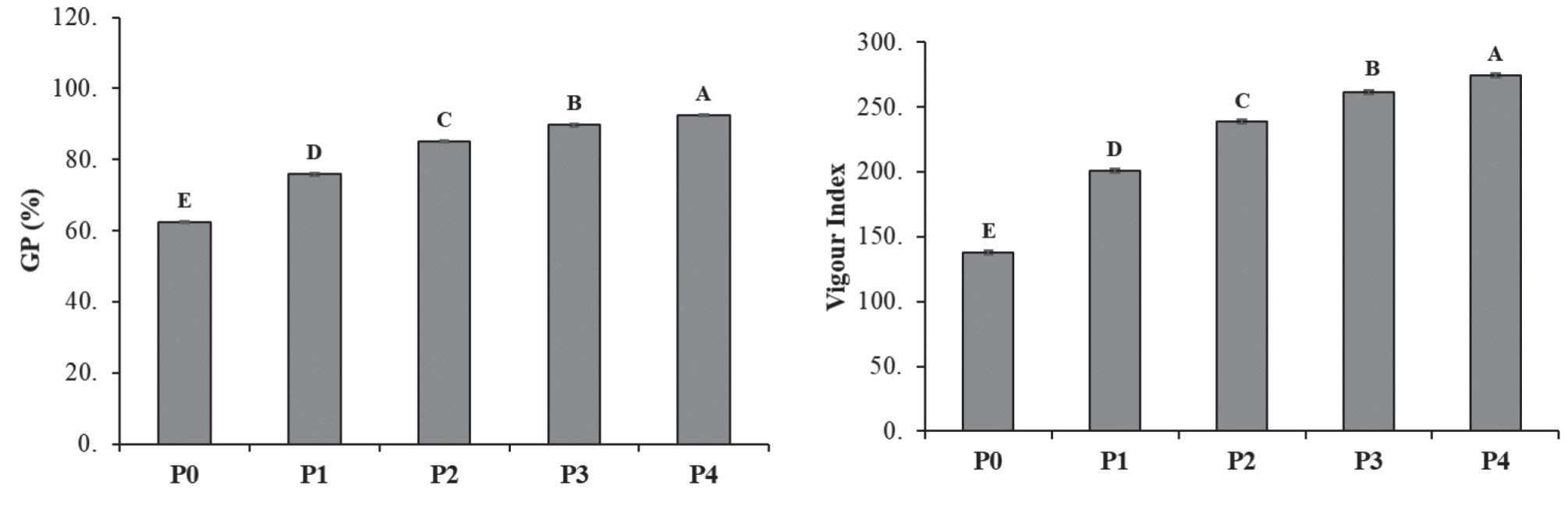
Table 1.
Two-way ANOVA analysis for hydro-priming treatments and varieties on the early growth parameters of maize seedlings.
Table 2.
Influence of different treatments on different maize varieties seedling parameters. Average mean±standard error replicates n=3 and different capital letters indicate a significant difference between treatments (Tukey’s test, significant at p≤0.05).
Table 3.
Influence of hydro-priming duration on early growth parameters of maize varieties’ seedlings. Average mean±standard error, replicates n=3 and different capital letters indicate a significant difference between varieties (Tukey’s test, significant at p≤0.05).
Shoot and Root Fresh Weight
Seed priming techniques showed changes in the shoot fresh weight (SFW) and root fresh weight (RFW) of maize seedlings. Although the influence differed between varieties and across the treatments, as presented in Tables 2–4. Comparing the different varieties, the P4040 showed higher SFW and RFW, i.e., 37.8% and 45.5%, respectively. However, in comparison with different treatments, P4 treatment for 12 hours increased the SFW by 59.1% compared to non-priming seed. Other priming treatments developed SFW in the following directions: P1 > P2 > P3, i.e., 38.9%, 49.1%, and 58.4%, respectively. Therefore, the RFW of maize seedlings increased with increased priming duration by P1 > P2 > P3, and P4, which were 42.8%, 51.5%, 60.4 and 60.9% greater than P0.
Shoot and Root Dry Weight
Tables 2–4 show significant variation in shoot dry weight (SDW) and root dry weight (RDW) of different maize varieties, as well as among all different treatments of maize seedlings. On average, the Akbar > P1429 > P4040 maize seedlings showed improvements in SDW and RDW (Table 2). Further, priming treatment varies with priming duration. All treatments have a higher SDW, i.e., P1 (82.1%), P2 (98.3%), P3 (115.1%), and P4 (118.1%), than the P0 treatment. A similar treatment pattern was recorded for the SDW of maize seedlings, such as P0 > P1 > P2 > P3 and > P4.
Influence of Priming Duration on Shoot and Root Length
The shoot length (SL) and root length (RL) of the maize seedlings showed significant differences across the varieties and various hydro-priming treatments (Tables 2–4). Akbar > P1429 > and P4040 recorded the highest SL value among the three maize varieties, with values of 24.1 > 27.6 > 29.2, respectively. The RL of maize seedlings increased by 9.0, 12.1, and 15.6, respectively, followed by the varieties Akbar > P1429 > and P4040. In comparison between priming duration, the highest SL was recorded in P4 by 34.1% compared to the non-priming treatment. While P3, P2, and P1 also increased, SL was 31.6%, 27.1%, and 19.8%, respectively, which was higher than the control. A longer RL of maize seedlings among the three varieties was seen in P4040 in comparison to P1429 and Akbar. Comparisons across the different priming durations showed significant variation for RL. Extensive RL was noted in the P4 treatment by 104.1% and lower RL was developed by P1, which was greater than the P0 treatment.
Fig. 2.
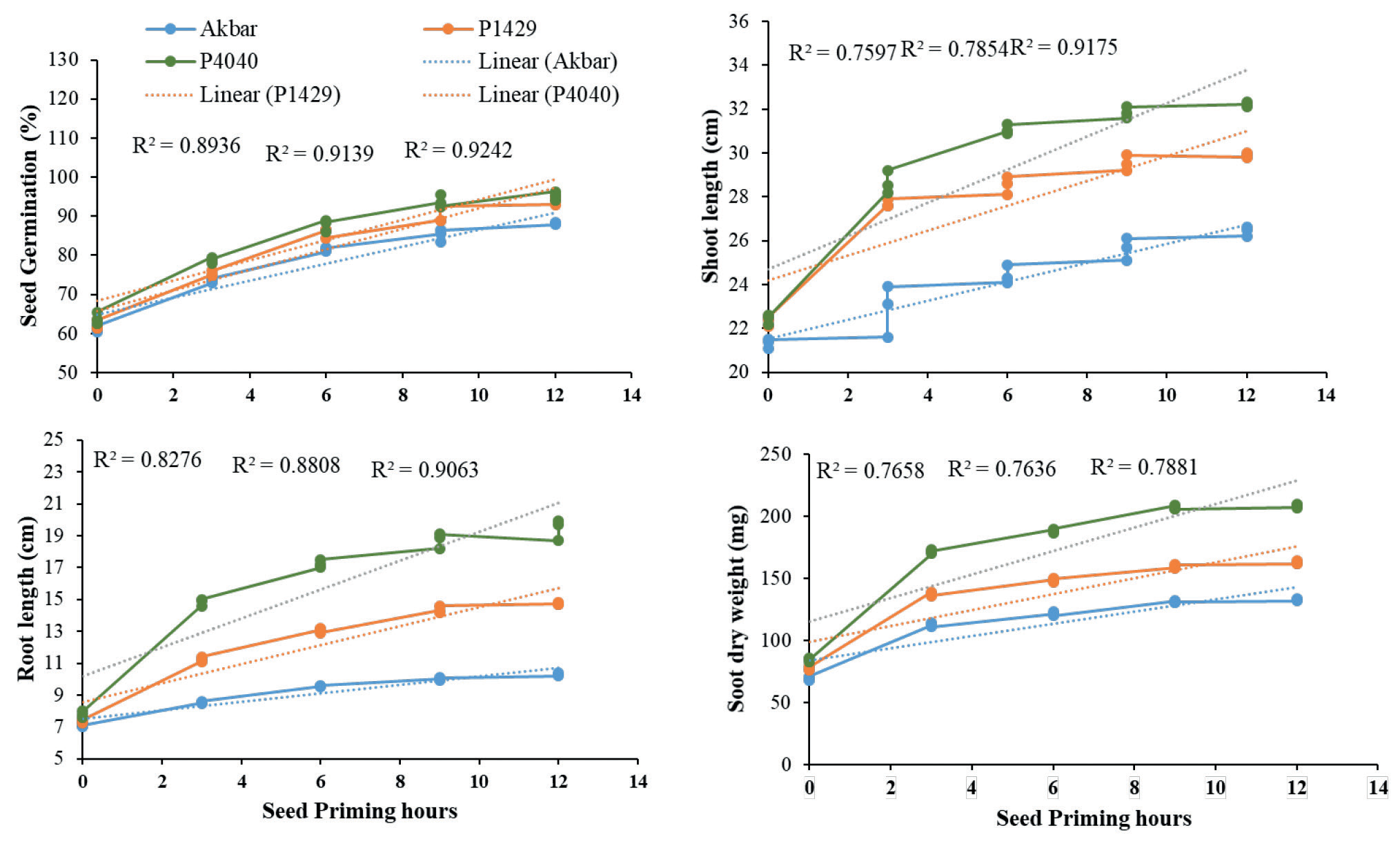
Regression analysis of different hydro-priming treatments and various parameters (seed germination (%), shoot length (cm), root length (cm), and shoot dry matter (mg)) of maize seedlings. Different capital letters indicate a significant difference (Tukey’s test, significant at p ≤ 0.05, repeats n = 3).
Relationship between Growth Parameters of Maize Seedling and Priming Duration
Maize seedling growth parameters showed a linear relationship with priming duration (Fig. 2). This research shows that seed germination, shoot, root length, and shoot dry weight significantly increased with priming duration. Relationship between seed development time and maize seedling characteristics were measured within each seed priming treatment and the highest R2 = 0.924 was observed for P4040 compared to the other two varieties. The maximum R2 values for shoot dry matter and shoot root length are also noted for P4040 at 12 h of seed priming duration.
Discussion
The present study provides valuable knowledge about maize seedlings’ early growth parameters during hydropriming treatments. The hydro-priming of seeds under control conditions usually improves the germination parameters of maize seedlings. According to many researchers, hydro-priming increased the germination of various plant species by improving the germination factors and seedling growth, including the vigor index, dry weight, and germination rate [31–33]. The present study results showed that P4040 had higher germination and early growth parameters; non-primed seeds germinated slowly compared to Akbar and P1429 (Table 4). The preliminary findings align with previous research; priming effects would be greater in the slower groups, as they would have likely experienced more deterioration and thus benefited the most from priming repair processes [34]. This study showed seed priming treatment could produce a higher germination rate and stronger maize seedlings compared to non-priming seed. Similarly, hydro-priming can accelerate germination in several crop species, especially in unfavorable growing conditions [8, 35]. According to [36], hydro-priming was the most suitable technique for enhancing onion seed germination, particularly when the seeds were hydrated for 96 h rather than 48 h. These findings also support the current data, where an improved germination rate and percentage were observed following hydro-priming for 48 h in wheat [37]. This is a very easy and simple technique where seeds are partially hydrated until the emergence of radicles and plumule, which is the signal for the start of the metabolic activities necessary for the germination of the seed.
However, in the examination of vigorous seedling potential for quick germination in many crop species, hydro-priming is crucial for plumule, radicle, and seed germination [18]. This study demonstrates that primed seeds produced more vigorous seedlings than non-primed seeds, in terms of seedling vigor index [38]. Early vigor of seedlings refers to their initial growth and formation as strong plants in any type of environment. Additionally, priming improves seed Vindex, resulting in vigorous seeds early and uniform emergence as well as good stand establishment [39]. In this current research, seed-priming duration has significant effects on the shoot and root fresh and dry weights of different varieties of maize seedlings. As described in an earlier study, the duration of hydro-priming for 8 h is a beneficial advantage for the plant’s fresh mass in both years [38]. Additionally, hydro-priming enhanced the formation of dry matter in upland rice, expediting physiological processes until maturity [40]. Primed seedlings probably have developed root systems, which led to greater nutrient uptake and, ultimately, higher dry matter accumulation and yield, as compared to non-primed seedlings, which may explain why hydro-priming promotes plant growth. Comparable results have been documented for wheat and maize [41, 42]. Cell elongation, cell division, and cell enlargement all contributed to higher plant fresh and dry matter, which improved vegetative growth and increased the production of dry mass in crops.
Table 4.
Interaction between varieties and treatments under hydro-priming duration on early growth parameters of maize seedlings. Average mean±standard error, replicates n=3 and different letters indicate a significant difference between varieties (Tukey’s test, significant at p≤0.05).
An earlier study investigated four different seed priming treatments, including control, osmo-hardening, water hardening, and hydro-priming, to improve the performance of dry matter in basmati rice seeded. Hydro-priming a crop produces better results than other seed-priming methods. Pusa Basmati 1121 produced its highest grain production when hydro-priming was used, applying 60 kg ha-1 of N in three splits. More panicles (291 m-2), full grains per panicle (67), 1000 grain weight, and spikelet sterility (25.9 g and 21.9%) were produced by hydro-primed seeds. Seed priming approaches enhanced the leaves’ photosynthetic efficiency, which ultimately increased dry matter yield. Generally, priming duration showed significant effects on shoot and root length. This is mostly explained by the primed seeds’ faster metabolism, which speeds up imbibition in sorghum as compared to unprimed seeds [43]. When compared to seedlings derived from non-primed seeds [44] found that hydro-priming demonstrated three to four times more growth in terms of root and shoot length. A previous study by [45] carried out a pot experiment with cotton and maize in Zimbabwe. They showed that priming improved the emergence and early growth of maize and cotton in drying soils in the laboratory. Priming increases emergence from 75 to 99 % at soil matric potentials. Primed cotton seedlings had longer roots than non-primed seedlings at all initial matric potentials. Some studies have evaluated the relationships between seedling growth parameters and priming hours [46].
This study determines relationships between three maize varieties’ growth parameters and seed priming techniques. According to current research, priming duration improves GP compared to non-primed seed. An earlier study observed similarities, demonstrating that 8-h optimal hydro-priming promotes different soybean varieties’ growth at two different locations [47]. According to Kaur et al. [48], treated okra seeds showed a noticeably higher germination percentage compared to seeds soaked for a full day. This is likely due to the unique seed coat of the soaked seeds, which significantly increased their level of permeability. The present study showed a significant interaction between shoot root length and fresh and dry biomass of maize seedlings. Our study, supported by previous research, shows that the beneficial influence of hydropriming on wheat and maize growth could be related to a better-established root system of the plants from primed seeds, which significantly contributed to high nutrient dry biomass accumulation and yield as compared to without priming seed. In our study, seed priming duration showed a positive relationship with the root length of maize seedlings. In addition, this study found an increase in shoot and root length as well as shoot dry matter, indicating that the quick supply of nutrients required for cell development, obtained through seed priming, causes the acceleration of shoot elongation rate [49]. Seed priming enhances the biochemical activity of pre-germinated seeds [18]. Longer priming had a positive effect on plant growth because it improved the plant’s root system, which made it better at taking in nutrients and producing a higher dry matter yield [50].
In other words, priming duration often induces physiological and biochemical seed changes during seed treatments. The overall relationship between priming duration and the early growth of maize varieties suggests that soaking the seed in water for 12 h longer than the non-primed seed may not depend on shortening, but rather, it could increase metabolic activity due to the advancement of water absorption.
Conclusions
The present research focuses on how different durations of priming, such as 0, 3, 6, 9, and 12 h, affect the early growth parameters of different varieties of maize seedlings, namely Akbar, P1429, and P4040. This research highlights the effectiveness of hydro-priming, particularly with a 12-hour duration, in improving germination (%), early growth parameters (including shoot, root length, and shoot, root fresh, and dry weight), and overall seedling performance. In comparison with three different varieties, the P4040 maize variety performed better than the Akbar and P1429. The study emphasizes hydro-priming simplicity and suggests its potential for mitigating climate change effects on crop productivity. Overall, this study provides valuable insights for optimizing seed priming techniques, paving the way for more sustainable agricultural practices. Further research is needed to explore its adaptability under diverse environmental conditions and assess different priming options for various crops in agroecosystems.

