

Introduction
China’s industrial realm, particularly its manufacturing sector, is in the midst of a pivotal transformation, a change highlighted by the “Made in China 2025” strategy [1]. This shift is recognized not solely as an economic mandate but as a move towards environmental stewardship [2-4]. The manufacturing industry, which plays a critical role in the Gross Domestic Product (GDP), is transitioning from a model dependent on low-cost labor and land to one that prioritizes technological advancement. This evolution is essential for environmental sustainability, aligning with the global focus on diminishing carbon footprints and enhancing eco-friendly practices [5-9].
Previous research has underscored the significant influence of venture capital on innovation within Chinese SMEs. Hua et al. [10] posited that while venture capital financing boosts innovation in the Chinese market, it also substantially benefits the financial performance of SMEs. Concurrently, the environmental implications of such advancements are crucial. Luo et al. [11] highlighted that facing issues of environmental pollution and resource misuse, Chinese manufacturing SMEs need to transition towards green manufacturing. This move emphasizes the pivotal role of technological innovation in facilitating this change.
The interconnection between venture capital and environmental sustainability in Chinese manufacturing SMEs is ambiguous [12]. On the one hand, venture capital has impelled innovation that has resulted in the emergence of more eco-efficient production processes. A study by Shi and Li [13] determined that technological progress in sustainable development was made possible through the use of green total factor productivity in Chinese manufacturing. On the other hand, innovative growth bias could lead to environmental degradation since startups focused primarily on achieving fast success through innovation and growth strategies sometimes neglect ecology.
Another major element has been the dynamic between environmental restrictions and innovations funded by venture capital. According to Yuan et al. [14], eco-efficiency in the manufacturing industries is determined by the level of environmental regulations; this factor explains the role of venture capital in technological innovations’ eco-efficiency. Therefore, it can be depicted that regulatory constructs are essential in appointing venture capital to be directed in more eco-friendly manners.
The development and success of SMEs have also greatly relied on venture capital in the GEM. Cao et al. [15] are among the scholars who have researched the decision factors associated with investing in private equity by GEM-listed companies and the prices that are also dependent on the financial help of venture capital.
Although much attention has been given to venture capital’s role in fostering innovation, there remains a large gap in understanding its specific environmental consequences within the manufacturing SMEs in China. The key aim of this study is to investigate how venture capital facilitates manufacturing SMEs’ technological innovation capacity, explicitly addressing its influence on the latter’s environmental sustainability. The study is based on data from GEM-listed firms, which are measured for innovation in terms of such indicators as patent counts and R&D spending ratios, which are then linked to their environmental outcomes. The authors also use data from a range of equity databases and corporate filings to research how various VCs, including corporate and government-supported ones, encourage environmentally sustainable innovation.
This study makes three key contributions. Firstly, it provides a comprehensive analysis of how venture capital influences the adoption of environmentally sustainable technologies in these enterprises. Secondly, the research examines the alignment of venture capital-funded innovations with China’s environmental policies, offering insights into the integration of economic growth and ecological responsibility. Thirdly, it uniquely quantifies the impact of different types of venture capital, namely corporate and government-backed, on fostering eco-efficient practices in manufacturing SMEs. These contributions collectively present a nuanced understanding of the intersection between venture capital, technological innovation, and environmental sustainability in a critical sector of China’s economy.
The article starts with an introduction and then explores the theory and hypotheses. We detail our methodology, followed by presenting and interpreting our results and discussion. The conclusion summarizes key findings and implications, suggesting future research.
Theory and Construction of Hypotheses
The relationship between venture capital (VC) and technological innovation in manufacturing SMEs has been extensively explored, revealing a complex and nuanced interplay. Studies, particularly in the Western context, have generally highlighted VC’s positive impact on innovation. Admani and Pfleiderer [16], Kortum and Lerner [17], and Hellmann and Puri [18] underscored VC’s ability to address information asymmetry and foster innovation, particularly in technology-intensive sectors. This view is supported by more recent findings from researchers like Parris et al. [19] and Paula Faria et al. [20]. Conversely, some studies, such as those by Engel and Keilbach [21], have questioned the extent of VC’s impact on corporate innovation.
In the context of Chinese studies, the discourse has been influenced by market-specific factors and the current stage of the development of the venture capital industry. Indeed, initial studies such as Zhang et al. [22] and Sun & Xia [23] supported the idea that VC can address financing constraints and promote innovation. After 2015, the growth of the VC market allowed for more nuanced discussion, such as that presented by Silva [24]. Specifically, it focused on the impact VC has through introducing R&D talent and resources. However, different opinions have not been lacking, as demonstrated in a previous study by Hua et al. [10].
The complex relationship between venture capital, VC, and technological innovation is influenced by several dimensions and should be explored. The first one is the main role of VC, which is an umbrella concept for the multifaceted impact of VC on a firm. Specifically, it changes not only the financial side of the company but also the strategic moves and innovation paths. The matrix points most significantly to the manufacturing side of SMEs in China, where the evolution of business was outdated with innovative-led strategies, and VC firms are the ones that filled the potential vs. realization gap. Due to the known role of VC as a mitigator of informational asymmetry in start-up financing, the in-depth knowledge and networks in the industry provided by a VC are of value for the growth and innovation of an SME [25]. Part of VC’s dual role includes managerial expertise. Hence, one can agree that manufacturing SMEs supported by VC will be more likely to develop technological innovation. This leads us to the first hypothesis: H1: The presence of venture capital investment significantly enhances the technological innovation capabilities of manufacturing SMEs, compared to those without such investment.
The argument can be extended to Corporate Venture Capital, where “CVCs are interested in the strategic value of the target companies and want to leverage their parent companies’ operations by having access to new technologies, markets, or innovation streams”. The connection of CVCs to their parent companies, combined with the strategic benefits derived from the general picture of the industry, also helps SMEs come up with more impactful innovations [26]. Given the strategic connotation and presence of resources for innovations provided by CVCs, manufacturing SMEs in which such CVCs have stakes are expected to show higher levels of technological innovation [27]. The next hypothesis can be formulated: H2: Manufacturing SMEs that receive backing from Corporate Venture Capital tend to exhibit more substantial technological innovation compared to those financed by traditional venture capital.
Lastly, taking into consideration Government-Backed Venture Capital, which is more likely to pursue social priorities and governmental strategic goals and objectives, another type of influence is discerned. Unlike private VCs, GVC is more likely to ensure the creation of innovations that comply with certain national or regional goals and priorities. As a result, SMEs will be directed towards the respective areas, including social sustainability areas or key technological areas. Therefore, the other hypothesis can be proposed as: H3: SMEs receiving support from Government-Backed Venture Capital are likely to focus their technological innovations on areas aligned with government priorities, differing from the innovation focus of SMEs supported by private venture capital.
Overall, the role of different types of venture capital in fostering innovation within manufacturing SMEs in China is a layered phenomenon. Each type of VC brings its own set of influences and resources, shaping the innovation landscape in distinct ways.
Materials and Methods
Data Sources and Sample Selection
The primary data for this study is sourced from various comprehensive databases and company reports. These include the iFind database, the annual reports and prospectuses of companies, the Zero2IPO private equity database, and the CVsource investment database. The sample selection is focused on industrial manufacturing enterprises listed on the GEM from 2009 to 2019. The companies were chosen based on the CITIC industry classification standard. To ensure the reliability and relevance of the data, the study excludes all companies categorized under the ST and ST* industries. Additionally, any data entries with missing relevant variables were removed from the sample. To mitigate the impact of outliers on the analysis, the data was winsorized at 1% and 99% points.
A quantitative research method is employed in the study, and the multiple regression model is used to examine the effects of venture capital on the technological innovation ability to manufacture SMEs listed in China’s Growth Enterprise Market. Specifically, this study design was selected based on its appropriateness for reflecting the dynamics of developing industries of small and medium enterprises in China and helping to establish a link between various types of venture capital and innovation, which constitutes a research and empirical gap in the existing literature.
Operationalization of Key Concepts
The key concepts operationalized in this study include venture capital (VC), corporate venture capital (CVC), and government-backed venture capital (GVC). VC is defined as equity investments primarily targeted at unlisted startups with potential for technological innovation. CVC refers to venture capital investments made by corporate entities, characterized by strategic objectives that align with the parent company’s interests. GVC denotes venture capital investments where the primary investor is a government entity or a state-funded group, typically focusing on strategic and policy-driven objectives.
The classification of VC, CVC, and GVC within the study is based on specific criteria. For an institution to be classified as a VC, it must be categorized as either PE or VC in the CVsource database and have a record of at least five investment and exit events since its establishment. For an institution to be considered CVC, its parent company’s main business should be non-financial. If a venture capital institution’s actual controller is the government or a state-funded investment group, it is classified as a GVC. These criteria ensure that the venture capital support in the sample is accurately categorized for the analysis.
Measurement of Variables
Estimating the Performance of Innovation
Innovation performance in this study is operationalized through a combination of indicators reflecting both innovation inputs and outputs. Following Schumpeter’s definition of innovation as “establishing a new production function,” the study measures innovation in two dimensions: management innovation and technological innovation. Management innovation involves significant changes in organizational management or processes to improve efficiency or productivity. It can include new business models, organizational structures, or strategies. Technological innovation, on the other hand, entails developing new technologies or significantly improving existing ones, affecting products, processes, or services to enhance performance, reduce costs, or create new markets. Technological Innovation: This is assessed primarily through patent data, which is a tangible output of innovation efforts. The number of patents filed and granted to the company in the year of listing, the following year, and the third year post-listing are used as key indicators. This data is sourced from the iFind database and company annual reports.
Innovation Input: Measured as the ratio of R&D expenditure to sales revenue. This ratio indicates the intensity of a firm’s investment in innovation-related activities and is calculated for the year of listing, the following year, and the third year post-listing.
Explanatory Variables
The primary explanatory variables in this study focus on the impact of different types of venture capital support:
Venture Capital Support (VCdum): This dummy variable indicates whether a firm received venture capital support in the pre-IPO stage. It is coded ‘1’ for firms with VC support and ‘0’ for those without.
Corporate Venture Capital Support (CVCdum): Like VCdum, this variable indicates the presence of CVC support in the pre-IPO stage.
Government Venture Capital Support (GVCdum): This variable is used to identify firms that received GVC support in the pre-IPO stage.
These variables are manually coded based on information from the Zero2IPO Private Equity database, CVsource investment database, and iFind database.
Control Variables
Several control variables are included to account for other factors that might influence a firm’s innovation performance:
Enterprise Scale: Measured as the logarithm of total assets in the year of listing and the subsequent two years. This reflects the size and resource capacity of the enterprise.
Asset-Liability Ratio (AtoD): This ratio provides insights into the financial leverage of the company.
Return on Total Assets (ROA): Indicative of the overall efficiency of the company in generating profits from its assets.
Equity Concentration (Stahold): Measured as the shareholding ratio of the largest shareholder, which can impact corporate governance and strategic decisions.
R&D Investment: Total R&D expenditures are used to measure the financial commitment of the company to innovation activities. The definitions of variables are given in Table 1.
Specification of the Econometric Model
To assess the impact of venture capital on the technological innovation performance of manufacturing SMEs, the study employs multiple regression models. The model is designed to isolate the effect of venture capital involvement while controlling for other factors that could influence a firm’s innovation performance. The following equations represent the econometric models used:
Table 1.
Summary of variables
Where InnovPerformit is the innovation performance of the company, VCdumit, CVCdumit, and StateoVCdumit are dummy variables representing the type of venture capital support. ControlVariablesit+n are the control variables for the firm in year t plus n years. The year is a control for the year of the IPO to account for macroeconomic and market conditions. α, β1, β2, and β3 are the parameters to be estimated, and ϵ is the error term, which is assumed to be normal at a zero mean value and constant variance [28].
The subscript it represents the company i at time t. The summation over n control variables accounts for various other factors that might influence innovation performance, such as the company’s size, asset-liability ratio, return on total assets, equity concentration, and R&D investment.
Addressing the Potential Bias
To rule out potential biases like endogeneity resulting from unobserved heterogeneity or reverse causality, we applied the Propensity Score Matching (PSM) method. The PSM method has been widely used in previous studies [29-31]. The PSM method Supplementary allows for the creation of a control group that is statistically similar to the treatment group based on observed covariates to model the conditions of a randomized controlled experiment. Using this technique can help prevent what we are measuring from being influenced by selection bias, i.e., the estimated effect of venture capital participation on innovation performance.
Data Processing and Preparation
Data processing involves several steps to ensure quality and consistency. First, companies in the ST and ST* industries are excluded due to their atypical financial situations. Then, missing data for relevant variables is identified and omitted from the analysis. To limit the effect of extreme values, the data is winsorized at 1% and 99% levels, thereby trimming outliers that could skew the results. The verification of venture capital support for each company is conducted by cross-referencing financing events from the iFind database with investor information from the Zero2IPO Private Equity and CVsource investment databases.
Strategy of Empirical Analysis
The empirical analysis follows a structured approach, which includes regression analysis for each year after an IPO (0, 1, and 2 years). The relationship between venture capital involvement and innovation performance was therefore tested at each time point. As a robustness check and to allay endogeneity concerns, regression analysis is first run on the original sample and then on the PSM-matched sample. Instead, the study presents a detailed and thorough review of how venture capital investment affects innovation performance over time.
Results and Discussion
In this section, a detailed investigation is conducted on the role played by venture capital in technological innovation among small- and medium-sized private enterprises manufacturing (SMPEs). Based on the blueprint data, we look at the statistical relationships and possible causal links between venture capital interventions and innovation performance. The descriptive analysis includes correlations as well as regressions.
Venture Capital Influence on SME Innovation
Descriptive Statistics
Many variables include the existence of venture capital (VCdum), performance indicators for innovation (Perform), the ratio between research and development revenue and total revenue (RDrev), the number of patents (Paten), company asset size (Asset), debt-to-equity ratio (AtoD), whether a single individual holds all or most shares in a corporation (Stahold), return on investment (ROA), and year of company listing (Year).
Table 2.
Descriptive statistics of variables in VC analysis
According to the descriptive statistics, with over half of them having venture backing and less than half not, VC enters everywhere among sample SMEs. The situation changes after the VC’s involvement in innovation performance. Judging from the multiple performance metrics, there was a relatively stable trend for outputs. It can also be seen from the R&D Revenue Ratio and Patents numbers. Correlation analysis suggests that asset size has a significant impact on post-VC innovation outputs. Shareholder concentration may also play some part in changing productivity levels these days. The description statistics of the basic variables are given in Table 2.
Correlation Analysis
The correlation analysis in Fig. 1 explores the relationships between the different variables for three consecutive years following the company’s listing. This analysis assists in identifying patterns and potential predictive relationships. The figure illustrates that there is a strong correlation between the variables of interest, which makes them suitable for further analysis.
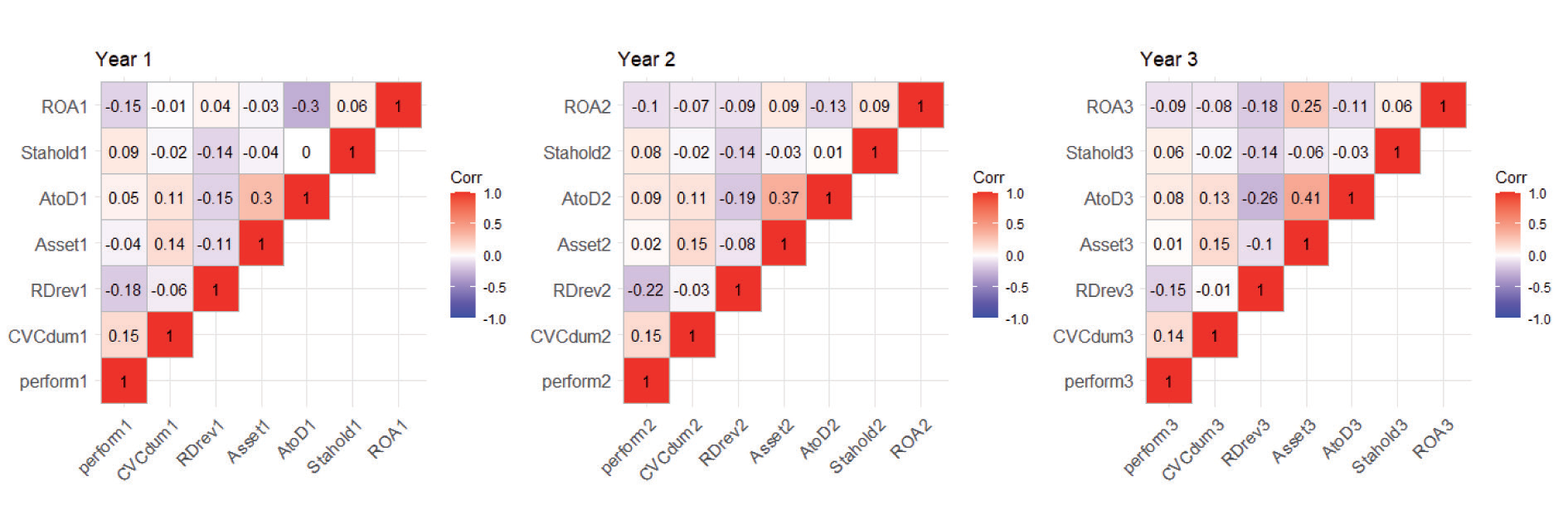
Table 3.
Results of regression analysis for the Impact of VC on SME innovation
Regression Analysis of VC Impact on SME Innovation
Regression results in Table 3 are highly beneficial because they allow us to identify the importance of venture capital for the innovation performance of SMEs in the manufacturing sector. Given that the results are provided for the three years spanning t1, t2, and t3, they provide a multi-year basis for analyzing VC’s effect. Notably, the positive coefficients for VC involvement in all three years illustrate the significant importance of the analyzed factor. In this manner, the evidence indicates that VC represents more than a simple “financial playground” because it drives innovation, as reflected in these SMEs’ performance metrics. Because these SMEs show that VC investment in R&D and patent production generates tangible outcomes in terms of technological development, these results support prior studies [32, 33]. Thus, overall, the results obtained via the described regression analysis are not only statistically significant but also have substantial implications for SMEs’ future directions.
Corporate Venture Capital’s Impact on SME Tech Innovation
An examination of the descriptive statistics reveals the central tendency and distribution spread of our variables of interest. The presence of Corporate Venture Capital (CVCdum) is observed in approximately 20.2% of the sample, indicating a moderate level of corporate venture capital investment in the analyzed manufacturing SMEs. The average innovation performance across the first three years post-IPO (perform1, perform2, perform3) exhibits a progressive increase, suggesting a trend of growth in innovation following CVC engagement. The R&D investment ratio (RDrev1, RDrev2, RDrev3) and patent counts (Paten1, Paten2, Paten3) display a significant range, highlighting the variability in the innovation activities among the firms. Figures for assets, debt ratios, stakeholder concentration, and return on assets further contextualize the financial landscape within which these SMEs operate (Table 4).
Influence of CVC on SME Technological Advancement
The regression results in Table 5 underscore the positive impact of CVC on innovation performance, with significant coefficients across all three years (t1, t2, t3). CVCdum predicts perform1, perform2, and perform3, with p-values indicating robustness (p<0.05). Interestingly, the negative coefficients on R&D investment (RDrev1, RDrev2, RDrev3) suggest that while CVC appears to bolster innovation, there may be diminishing returns on R&D expenditures or alternative paths to innovation that CVC enables. The influence of control variables on innovation performance varies; asset size and stakeholder concentration are occasionally linked positively with innovation output, but this connection is not always significant. The constant terms in each model are significant, indicating that factors outside the scope of the included variables may have a considerable impact on innovation performance.
Table 4.
Descriptive statistics of variables in CVC analysis
The regression models show moderate explanatory power, with R-squared values ranging from 0.090 to 0.114, indicating that while CVCdum is an important factor, it is one of several contributors to the innovation performance of manufacturing SMEs. These findings suggest a need for a multifaceted approach to innovation strategy, considering both venture capital support and broader financial and structural company characteristics.
In summary, the evidence points toward corporate venture capital as a potentially valuable resource for bolstering innovation within manufacturing SMEs. The consistent positive relationship across multiple years post-IPO suggests that CVC involvement may provide not only capital but also strategic benefits that foster an environment conducive to innovation. However, the influence of CVC should be considered within a broader context of company characteristics and innovation strategies. Further research could illuminate the mechanisms through which CVC supports innovation, offering deeper insights into effective innovation policy and practice in the SME sector.
Table 5.
Results of regression analysis for the impact of CVC on SME innovation
The Impact of Government Venture Capital on SME Technological Innovation
The data in Table 6 provides insight into the role of Government Venture Capital (GVC) in small and medium-sized enterprises (SMEs). The State-Owned Venture Capital (StateoVCdum) is present in 34% of the sample, reflecting a substantial government investment presence in these enterprises. The performance indicators (perform1, perform2, perform3) suggest a steady state of technological advancement across the years. Variability in R&D investment and patenting activity (RDrev1, RDrev2, RDrev3, Paten1, Paten2, Paten3) indicates a diverse approach to innovation within the sector. In addition, the financial structure and performance metrics, such as asset size, debt ratios, shareholder concentration (Stahold1, Stahold2, Stahold3), and return on assets (ROA1, ROA2, ROA3), highlight the economic environment of these SMEs, which could influence their innovation capacities. The results are in line with the previous studies [34, 35].
Role of GVC in SME Innovation
The regression analyses in Table 7 further elucidate the relationship between GVC and SME innovation. Across all three periods (t1, t2, t3), the influence of StateoVCdum on performance indicators is negative, albeit not reaching statistical significance. This suggests that the presence of GVC does not significantly alter the innovation trajectory of manufacturing SMEs when compared to private venture capital or no venture capital involvement. The other variables in the model exhibit varying degrees of influence, with R&D investment showing a consistently negative relationship with performance, which raises questions about the effectiveness of these investments in generating innovation outcomes. The control variables display a mixed pattern, with some positively influencing performance and others not, which underscores the nuanced and complex nature of innovation dynamics within SMEs. The modest R-squared values suggest that the models explain a small portion of the variance in innovation performance, indicating that there are other unaccounted factors influencing the innovation process.
Table 6.
Descriptive statistics of variables in GVC analysis
The findings do not validate the argument that government venture capital substantially promotes innovation relative to its absence as well as when compared to private venture capital in manufacturing SMEs. The results imply that the strategies of GVCs need to be re-evaluated regarding innovation building, and other aspects that may affect the innovativeness of SMEs need to be factored in as well. This study could be extended to find out exactly how GVCs stimulate the innovativeness of their investee firms and uncover the connection between government funding and other innovation amenities.
Robustness Analysis through the Propensity Score Matching Method
Throughout the previous sections, we explored the impact of Venture Capital, Corporate Venture Capital, and Government-backed Venture Capital on the technological innovation of manufacturing SMEs. Despite the correlation between different models, the effects of venture capital on innovation are more complex. To increase the robustness of the obtained results, it is essential to take into consideration endogeneity concerns. We apply the Propensity Score Matching approach to address this issue and enhance the overall quality of the investigated relationship. PSM significance is the possibility of comparing the results of the technology and innovation analysis for the set of matched firms. The matching methodology is particularly relevant in our context because it helps overcome the possible differences in R&D investment value and enterprise asset scale. The PSM evaluates how the differences between treated and control companies would have looked if they were not treated. This allows treating the differences between treated and control SMEs as causational. Table 8 presents the comparison results of the treated and control samples before and after the matching. Moreover, it indicates the balance achieved between the groups at a 0.05 and 0.01 significance level. The PSM matching is further confirmed through the T-statistics integration.
Table 7.
Results of regression analysis for the impact of CVC on SME innovation
Table 8.
Results of robustness analysis using the PSM method
The analysis after PSM shows that venture capital, especially from corporations, significantly impacts the innovation of small and medium-sized enterprises (SMEs). The regression coefficients, standard errors, and significance levels are reported for each variable across the three years.
Discussion
The research of venture capital on Chinese manufacturing SMEs enables us to recognize the contribution made by their technological innovations under their drive to the environment. VC, especially the type of CVC, makes a substantial contribution by guiding small firms to innovate with the environment in mind. The innovations are not only about the final product but also about the process, ensuring that a sustainable manufacturing environment continues to grow. The contribution of VC to enhancing green innovation comes to light from the nature of innovation sponsored by their funds. The level of energy, waste, and eco-friendly equipment in the final product of VC SMEs is fascinating. This provided a way to show China’s growing concern for the environment, as shown in the Made in China 2025 regulations and the green development policy. The very strong positive relationship between venture capital and VC finance and SME innovation on the environmental measure gives one an insight into how the VC fosters a culture of innovation that prioritizes environmental contributions.
The effect size of GVC on environmental innovation is significantly less than that of CVC. This trend may be due to different priorities or means of conducting business at GVC compared to its private companies. Nevertheless, the calculation results indicate that the state is actively promoting environmentally focused, innovative implementation, and this vector simply needs some rebalancing for maximum efficiency. In addition, the methodological approach of the research, including PSM, suggests that its results are robust. Thus, an increase in venture capital, especially CVC, is beneficial for environmental innovation and can act as a stimulus for environmentally friendly development in industry. These results may also imply that VC can critically help SMEs direct their innovative progress toward environmental issues.
Overall, the study has important implications not only for scholars but also for policymakers and investors. The research shows the necessity of creating conditions that encourage investments in green technologies by venture capital, which takes the form of the suitability of policymakers. Moreover, the results of the study reveal the perspectives of investing in technological and ecologically oriented innovations in the manufacturing sector. The obtained findings make their contribution to understanding the centrality of venture capital as a factor in stimulating innovations in China’s manufacturing SMEs. Thus, it reveals the importance of finance in modernity’s recovery without damaging the ecological balance.
Conclusion and Policy Implications
This study is designed to explore the role of venture capital in promoting technological innovation in Chinese Manufacturing Small and Medium Enterprises, specifically focusing on the environmental results and conclusion. This study classified enterprises as venture capital participants from 2009 to 2019 using data from China’s Growth Enterprise Market, which incorporates corporate and government-backed venture capital and the traditional model, multiple regression, and the Propensity Score Matching method. This ensured the accuracy of its outcomes was not skewed by selection error. An analysis of the results revealed that venture capital plays an important role in the field of innovation in manufacturing Small and Medium Enterprises. In general, the impact created by corporate venture capital surpassed that of government-backed venture capital and renowned venture capital. Moreover, this study found a link with environmental outcomes. Innovations resulting from venture capital have shown substantial benefits, including enhanced efficiency in harnessing energy, processing, disposal, reduced levels of gases, and increased compliance with the country’s environmental regulations. The information gathered from this study also contains policy implications. For instance, it exposes the possibility of using venture capital in the manufacturing sector to drive environmental innovation. As previously stated, suitable platforms and policies for investing in green technologies will boost venture capital investment prospects. Additionally, the study demonstrated the presence of traditional approaches for venture capital, but with less reported impact. Such a low-impact area reveals that the government has an opportunity to enhance its approach through policy and simplification modifications for optimal effects on environmental efforts in the manufacturing sector. Overall, this is one of the most crucial studies in identifying interactions between venture capital and green outcomes in the context of Chinese manufacturing SMEs. It demonstrated an informed and experienced perspective of venture capital in influencing small businesses to adopt environmental approaches and support green technologies. This sets the stage for sustainable industrial development. This study may provide references for scholars and practitioners in similar sectors and nations striving for a sustainable and functional economy.

