

Introduction
In the context of global recognition of green and sustainable development, China proposed the “dual-carbon” target in 2020, aiming to achieve carbon peaking by 2030 and carbon neutrality by 2060. According to estimates by the Institute of Climate Change and Sustainable Development at Tsinghua University, China will need approximately 130 trillion yuan in total investment from 2020 to 2050 to achieve the 2°C temperature control target and about 170 trillion yuan to meet the 1.5°C target. Currently, financial resources can only cover 10%-15% of the green investment demand, placing immense financial pressure on local governments, which are primarily responsible for environmental governance. Therefore, local governments should fully leverage green financial tools, innovate in green local government special bond varieties, and utilize the synergy between the financial and fiscal systems to drive sustainable environmental development.
The role of various fiscal instruments in carbon emissions governance is not merely additive; it requires organic integration. The role of green fiscal expenditure lies in guidance and coordination, providing financial support through fund redistribution [1]. Green fiscal expenditure policies in environmental protection, pollution prevention, and ecological restoration directly address the externality problems associated with the ecological environment [2]. Green taxes operate through positive incentives and negative constraints [3]. By internalizing the negative external costs of pollution, green tax policies encourage the formation of green production and consumption models and offset the technical costs of low-carbon transformation [4]. However, due to the limited scope of the green tax system, the revenue generated is often insufficient to meet the ecological environment’s expenditure needs, resulting in a fiscal gap. Green government debt can effectively bridge this fiscal gap, guiding social capital into ecological protection [5]. Unlike other green fiscal instruments, green government debt has the dual advantages of reducing fiscal burdens and improving the ecological environment, making it a crucial supplement to the existing green fiscal and taxation system [6].
Compared to existing studies, this paper makes several contributions. First, it enriches the theoretical framework of green finance. While existing research has extensively discussed green fiscal expenditure and taxation, there has been less focus on green government debt. Government debt is a critical financial tool for local governments to promote infrastructure development and provide public services. Second, it improves the measurement of green government debt. Many government bonds fund multiple projects, and categorizing the entire bond as green may inaccurately reflect the allocation of funds to ecological and environmental protection. This paper refines the classification by analyzing bond disclosure documents and identifying the portion of funds specifically invested in green projects. Third, it examines the impact mechanism of green government debt. This paper reviews existing literature and develops an analytical framework to systematically verify the impact mechanisms of green government debt.
The remainder of the paper is organized as follows: The second section reviews the existing literature and presents research hypotheses. The third section constructs the model and measures indicators. The fourth section empirically tests research questions. The sixth section summarizes the research findings and offers policy recommendations.
Green Fiscal and Carbon Emissions
Government debt has received considerable attention as a critical source of funding for ecological protection and green development [7]. By issuing green debt, governments can secure additional funds for environmental protection projects and green infrastructure construction, which are crucial for achieving carbon emission reduction and carbon neutrality goals. However, China’s green debt market is still in its initial stage of development. Consequently, finding a balance between green transformation and fiscal sustainability has become an urgent issue.
Before the debt system reform, local governments in China primarily raised debt through financing platforms [8]. Green municipal bonds issued by these financing platforms enhanced support for ecological construction and contributed to environmental pollution governance. The issuance standards for green municipal investment bonds are higher than those for ordinary municipal investment bonds, with stricter regulatory requirements for the investment of raised funds, fund management, and information disclosure [9]. However, the lack of oversight of financing platforms has led to debt risks associated with the mass issuance of municipal bonds [10]. In 2015, the Chinese government implemented a debt system reform. It granted local governments the direct authority to issue government bonds [11]. Special bonds, in particular, are designed to raise financial funds for specific projects with defined returns [12]. Special bonds allocated for environmental protection projects can thus be categorized as green government debt.
There are two main perspectives on the impact of green government debt on carbon emissions. The first perspective posits that green government debt can control air pollution through several mechanisms, including reducing financing constraints, promoting technological upgrading, facilitating industrial development, and optimizing energy consumption structures. Specifically, green fiscal policy can increase the financing costs for polluting industries, thereby compelling heavily polluting sectors to upgrade their technologies. This sends a signal promoting green development and significantly reduces carbon emissions. Effective carbon emission suppression can be achieved by optimizing energy consumption structures and advancing substantial green technological innovations [13]. The second perspective argues that green government debt has not produced significant air pollution control effects. This view suggests that while the development of financial markets may benefit the environment in some respects, financial expansion is often accompanied by increased economic activity. When funds intended for green projects are redirected to other economic development projects, carbon emissions may actually increase [14]. These two perspectives reflect the differing views within academia on the role of green government debt in carbon emission control. This debate underscores the need for more empirical research to comprehensively assess the real impact of green government debt on achieving carbon emission reduction targets.
Based on these perspectives, this paper proposes the following hypotheses:
H1a: Green government debt can exert air pollution control effects and effectively curb carbon emissions.
H1b: The effectiveness of green government debt is not realized, and the funds are diverted to other economic development projects, thereby increasing carbon emissions.
Impact Mechanism and Moderating Effect
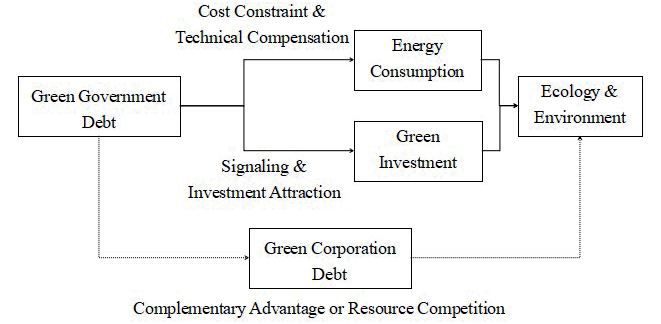
Green government debt can optimize the energy consumption structure and enhance energy use efficiency through cost constraints and technical compensation. Primarily supporting the development of green industries, green government debt provides financial backing to facilitate the green transformation and upgrading of industries [15]. This not only promotes the cleanliness of consumed energy but also compels polluting enterprises to expedite the upgrading of carbon-emitting equipment and technology, thus increasing the cost of using non-clean energy and boosting the proportion of clean energy usage [16]. Additionally, green government debt offers crucial financial support for the R&D and application of low-carbon technologies. These debt funds can be allocated to support the development and promotion of clean energy technologies, energy efficiency technologies, and carbon capture and storage, thereby fostering continuous innovation and advancement in low-carbon technologies [17]. Supported and guided by government policies, green government debt can incentivize investment in low-carbon technology projects through measures such as preferential interest rates and tax breaks [18]. Furthermore, green government debt signals a clear commitment to environmental and low-carbon goals for the market, attracting more investors and capital to the low-carbon technology sector and expanding the market’s size and influence [19].
Green government debt can serve as a signaling mechanism, attracting capital and driving green investment in society. The traditional crude economic development model has created a substantial demand for funds to address pollution in the green industry market. However, there remains a significant gap between the funds required for green projects and the actual funds mobilized, which directly impacts the quantity and quality of ecological and environmental projects [20]. Green government debt plays a crucial policy guidance role by directing social capital towards green sectors, offering financial and tax incentives, and providing financial support for the development of regional environmental protection industries [21]. This approach also enhances the efficiency of corporate investment [22]. Regarding the issuance period, green projects typically have long construction cycles, and the issuance period of green government debt is generally extended to match these cycles. This alignment ensures a stable supply of green capital throughout the construction period, facilitating the timely completion of green projects and attracting social capital through government investment [23].
Based on these perspectives, this paper proposes the following hypotheses:
H2: Green government debt may impact carbon emissions by influencing energy consumption efficiency.
H3: Green government debt may impact carbon emissions by promoting social green investment.
In financial markets, alongside green government debt, green corporate debt serves as a green financing tool for microenterprises and theoretically impacts carbon emissions. There are both cooperative and competitive dynamics between green government debt and green corporate debt. Some studies suggest that these two forms of debt can be complementary. The public good nature and stability of financial funds inherent in green government debt can effectively balance the profitability and volatility of finance [24]. The financial scale and efficiency advantages help to mitigate the limitations posed by insufficient total financial resources and inefficiencies [25]. Dual support from fiscal and financial policies may be more conducive to green market development than relying solely on fiscal policy [26]. However, other studies argue that green government debt may compete with green corporate debt if the debt system is poorly designed and local governments do not set reasonable boundaries. Government debt has a comparative advantage, and when financial market investors aim to maintain a relatively stable proportion of bonds and equities in their portfolios, an increase in government debt supply can raise the expected return on alternative bonds. This, in turn, raises the financing costs for firms, a situation particularly prevalent among smaller or riskier companies [27]. This crowding-out effect of green government debt on green corporate debt can adversely impact green market development.
H4a: Green government debt and green corporate debt may complement each other, potentially reducing carbon emissions.
H4b: Green government debt might crowd out financial resources for green corporate debt, hindering efforts to reduce carbon emissions.
In summary, the framework diagram of this paper is shown in Fig. 1.
Experimental Procedures
Model and Indicator
To test Hypothesis 1, this paper establishes the following benchmark regression model:
In this model, i and t represent regions and years, respectively, with regions defined at the prefecture-level city scale. The dependent variable is carbon emissions, and the key independent variable is green government debt. Proxy variables are all relative to the GDP ratio. The vector Xit includes a series of control variables. The terms Dt and Di denote year and individual fixed effects, respectively. εit represents the random error term.
Referring to the methodology of existing literature [28], the following Equation can be adopted to calculate carbon emissions:
Where Ek denotes the energy consumption of type k, which includes seven types of fossil fuels. CFk represents the calorific value of energy, CCk indicates the carbon content of energy, and COFk denotes the oxidation factor of energy, which is multiplied by the carbon emission coefficient of fossil fuels. The product of the three is the carbon emission factor. The factor 44/12 represents the ratio of the relative molecular weight of CO2 to that of C. Q denotes the amount of cement production, and m0 represents the carbon emission factor of the cement production process. Specifically, the carbon emission factors for seven fossil fuels, including coke, coal, kerosene, diesel, gasoline, fuel oil, and natural gas, as well as for cement production, are 2.848, 1.647, 3.174, 3.150, 3.045, 3.064, 21.670, and 0.527, respectively [29].
Green government debt is measured by the funds from special bonds invested in green projects. Based on bond disclosure documents and the Common Classification Catalog for Sustainable Finance by the International Platform for Sustainable Finance (IPSF) in 2022, a total of 4,530 green projects were identified. These projects encompass ecological restoration, sewage/wastewater treatment, garbage treatment, and the construction of scenic spots. The bond funds are then aggregated by region based on the location of these green projects.
Control Variables. Economic development is quantified by GDP per capita; industrial development is represented by the ratio of secondary sector output to GDP; fiscal status is assessed by the ratio of fiscal revenues to fiscal expenditures; financial development is measured by the ratio of loans from financial institutions to GDP; and environmental greening is indicated by the percentage of green coverage.
To test Hypothesis 2 and 3, this paper establishes the following mediation effect model:
The mediating effect model builds on the baseline regression model by incorporating mediating variables, specifically energy consumption efficiency and social green investment. The definitions of the other variables remain consistent with those in Model (1). Following existing literature, regional energy efficiency is measured using the non-desired output super-efficiency SBM method. In this method, regional energy consumption serves as the input variable, GDP as the desired output, and regional wastewater and exhaust emissions as the non-desired outputs. Social green investment is quantified by the ratio of green project investment to GDP.
To test Hypothesis 4, this paper establishes the following moderating effect model:
Building upon model (1), this study introduces an interaction term between green government debt and green corporate debt to develop a moderation effect model. The ratio of green corporate debt issuance to GDP serves as a proxy variable for green corporate debt, while other variables maintain the same meanings as in model (1).
Data Resource
The sample for this study comprises data from 30 provinces in mainland China, excluding the Tibetan region, covering the period from 2015 to 2021. Government debt was obtained from the China Electronic Local Government Bond Market Access (CELMA). Additional regional variables were extracted from the China Statistical Yearbook. To mitigate the influence of outliers, continuous variables were winsorized at the 1% level.
Table 1.
Descriptive statistics of main variable.
Descriptive statistics of the main variables in this paper are shown in Table 1.
Statistical Analysis
Before conducting empirical tests, this paper performs a preliminary statistical analysis of the effect and mechanism of green government debt on carbon emissions. Table 2 presents the descriptive statistics results, grouped by the mean value of regional green government debt issuance. The results indicate that in regions with high green debt, the mean carbon emissions value is 0.732, which is 20% lower than in regions with low green debt. This suggests a negative relationship between green government debt and carbon emissions, independent of other factors. Regarding the influence mechanism, regions with higher green debt issuance exhibit greater energy consumption efficiency and green investment compared to the control group. Thus, green government debt may reduce carbon emissions by enhancing energy efficiency and increasing green investment.
Results and Discussion
Baseline Regression Result
The impact of green government debt on carbon emissions, as estimated by Model (1), is presented in Table 3. Columns (1) and (2) display the results with and without control variables, respectively, both indicating that the estimated coefficients of green government debt are negative and significant. To address potential time-series correlation in the panel data, column (3) includes a correction for cluster-robust standard errors at the provincial level. The baseline regression results initially validate Hypothesis 1a proposed in this paper, indicating that the issuance of green government debt contributes to the reduction of carbon emissions.
Considering the significant regional disparities in economic development, resource and energy endowments, industrial structure, technological innovation, institutional policies, and environmental pressures, the impact of green government debt as a fiscal policy on carbon emissions varies across regions. Therefore, it is essential to formulate and implement differentiated ecological and environmental protection policies based on regional spatial patterns to promote green and sustainable synergistic development among regions.
Table 2.
Green government debt and carbon emission.
| High Green Debt Ratio Group | Low Green Debt Ratio Group | |||
|---|---|---|---|---|
| Variable | Mean | Std | Mean | Std |
| CO2 | 0.732 | 0.890 | 0.915 | 0.984 |
| energy | 0.393 | 0.202 | 0.334 | 0.148 |
| invest | 0.021 | 0.021 | 0.001 | 0.003 |
Table 3.
Result of baseline regression.
Estimated Result by Region
Unlike the flat urban management systems in Europe and the United States, Chinese cities have a distinct administrative hierarchy [30]. Based on this hierarchy, Chinese cities are categorized into four levels: ordinary prefecture-level cities, general provincial capitals, sub-provincial cities, and municipalities directly under the central government. Cities with higher administrative levels typically receive more investments in public facilities and favorable policy tilts [31]. Compared to ordinary cities, these higher-level cities generally have stronger fiscal revenues, better infrastructure, and greater authority in resource allocation. This disparity further leads to significant imbalances in urban development opportunities. This paper classifies provincial capital cities, sub-provincial cities, and municipalities as key cities, and the remaining cities as ordinary cities. The regression results for these two samples are shown in columns (1) and (2) of Table 4. The results indicate that green government debt has a more pronounced inhibiting effect on carbon emissions in key cities. These key cities, which have higher administrative levels, are prioritized for national and local government support and development. Consequently, they receive more favorable fiscal and tax policies, as well as preferential support for local development planning.
There are significant differences between the eastern and western regions in terms of natural resource endowment, geographic advantages, and population distribution. The disparities on both sides of the Hu Huanyong Line (Hu Line) are particularly pronounced [32]. This line is a crucial geographic demarcation for population density and environmental differences in China. The southeastern side of the Hu Line, comprising only 36% of the country’s area, contains 96% of the population. Conversely, the northwestern side covers a larger area but holds only 4% of the population. In this paper, the Hu Line is used to categorize cities into southeastern and northwestern groups, with regression results presented in columns (3) and (4) of Table 4. The findings indicate that green government debt significantly reduces the carbon emissions of cities on the southeastern side of the Hu Line. Considering differences in climate, natural environment, geographic location, and development opportunities, the better institutional environment of southeastern cities provides stronger support for green initiatives. In contrast, the sparsely populated nature of the northwestern region limits the economic development capacity and factor mobility of its cities. This implies that future fiscal policies and financial support should be increased for the central and western regions to narrow the regional development gap.
Resource-based cities (RBCs) provide crucial energy security and strategic support for China’s economic development. However, due to historically inherited issues such as a crude development model, these cities face significant pressure to transform and upgrade [33]. Thus, promoting the sustainable development of RBCs is an important issue that needs to be addressed. The sample is divided into RBCs and non-RBCs according to the State Council of China, with the regression results presented in columns (5) and (6) of Table 4. Overall, green government debt has a more substantial impact on reducing the carbon emissions of RBCs. On the one hand, as resources in RBCs become increasingly depleted, these cities face enormous pressure to undergo economic transformation and upgrading. Green government debt not only provides financial support to these cities but also addresses their limited capacity to attract talent and capital, effectively ensuring their green development. On the other hand, under the “dual-carbon” targets, RBCs face significant pressure to transform their economic development models. Local governments in these cities are likely to embrace new economies and models more actively, making the need for green development even more urgent.
Robustness Check
Change the measurement of proxy variables. The explanatory variable is replaced with the logarithmic value of green government debt, and the explained variable is replaced with the logarithmic value of industrial emissions. This modification avoids using GDP as a ratio variable, thereby excluding the possibility that the relationship between green government debt and ecological quality is driven by GDP changes. The results after changing the measurement method are shown in column (1) of Table 5.
Table 4.
Result of different regions.
[i] Note: Robust standard errors are given in parentheses; ***, **, * denote significance at the 1%, 5%, and 10% levels, respectively. The total number of cities is 293, with 36 key cities in column (1), 108 cities in the north-western part (including border areas) in column (3), and 116 resource-based cities in column (5).
Excluding part of the sample. To eliminate the influence of local government behavioral patterns, this paper removes the municipality samples (Beijing, Tianjin, Shanghai, and Chongqing) and retains only the prefecture-level city samples. The results after removing the municipality samples are shown in column (2) of Table 5.
Excluding extreme value interference. Samples with carbon emissions in the top 25% and bottom 25% quartiles are excluded to eliminate values that may have an extreme effect on the results. The results after excluding extreme values are shown in column (3) of Table 5.
Changing the estimation method of the model. The Fama-MacBeth model (FM model) estimation method was used to control for potential overestimation of t-values due to residual cross-sectional correlations and to ensure the reliability of the results [34]. This method involves regressing the cross-section for each single year, averaging the estimates of the regression coefficients over the time series, and calculating standard deviations and statistics to test the consistency of the regression coefficients with the assumptions. Additionally, within-group de-meaning was performed in the estimation process to remove individual effects. The results after changing the estimation method are shown in column (4) of Table 5.
Endogeneity analysis. To address potential endogeneity issues, this paper employs the instrumental variables approach. Following the existing literature [35], the share of defense expenditures in fiscal expenditures to GDP is chosen as an instrumental variable. In terms of correlation, government defense expenditure is related to the public finance balance, which is related to government debt. Regarding exogeneity, defense expenditure, as a basic livelihood expenditure, is less influenced by the macroeconomic environment and is a relatively exogenous part of government fiscal expenditure, with a weaker correlation with carbon emissions. Additionally, this paper validates the exogeneity of the instrumental variables by conducting a falsification test. This involves regressing the explanatory variables lagged by two periods on the instrumental variables and other control variables. If the coefficients of the instrumental variables are not significant, it suggests that there is no systematic relationship between them, supporting the exogeneity hypothesis of the instrumental variables. As shown in column (5) of Table 5, the coefficients of the instrumental variables are not significant, thus confirming the exogeneity hypothesis. Column (6) of Table 5 reports the first stage estimation results, where the weak instrumental variables test passes with an F-statistic greater than 10, and the unidentifiable test passes with a p-value less than 0.1. Column (7) reports the second stage estimation results.
Table 5.
Result of robustness check.
Combining the results in Table 5, the estimation results from a series of robustness tests are consistent with the previous findings, indicating that the estimation results in this paper are highly robust.
Further Discussion
Green Government Debt and Energy Consumption. Energy consumption is a primary source of environmental pollution. If green government debt can promote technological innovation, particularly in green technologies, it can shift industrial production from reliance on rigid inputs like resources and energy to flexible inputs. This transformation can enhance the value-added of products, optimize the input-output structure of energy factors, and ultimately improve energy efficiency [36]. On one hand, green government debt support for green industries can diffuse the positive externalities of green technologies. This helps in bolstering industrial structures and improving energy efficiency levels [37]. On the other hand, when paired with local government industrial support policies, green government debt can optimize the allocation of energy resources and enhance energy use efficiency. By improving energy efficiency, pollutant emissions are reduced, thereby enhancing regional ecological environment quality [38].
The estimation results based on models (3) and (4) are shown in columns (1) and (2) of Table 6. In column (1), the coefficient of green government debt is significantly positive, indicating that green government debt can improve energy efficiency. In column (2), the coefficient of green government debt is significantly negative, but its magnitude and significance are reduced compared to the baseline regression model (column (2) of Table 3). This indicates that improving energy efficiency is the mechanism through which green government debt affects carbon emissions, thereby verifying Hypothesis 2.
Green government debt and green investment. As a crucial funding source for local construction projects, special bond financing supports public service projects with a certain return, aiming to leverage social investment through the multiplier effect. Green government debt stimulates social green investment via public services, as public services can complement private investment, creating a positive interaction between public and private investments [39]. On one hand, specialized debt funds government-led, revenue-generating infrastructure and public service projects, are areas typically avoided by social investment. On the other hand, public infrastructure projects offer productive services for firms and generate associated demand for social investment, leading to increased productivity and investment demand in the private sector. This dual effect results in crowding in social green investment [40].
Table 6.
Result of further discussion.
The estimation results based on models (3) and (4) are presented in columns (1) and (2) of Table 6. In column (1), the coefficient of green government debt is significantly positive, indicating that green government debt can increase social green investment. In column (4), the coefficient of green government debt is positive but not significant, suggesting that increasing green investment is the mechanism through which green government debt affects carbon emissions, thereby verifying Hypothesis 3.
The investment projects funded by green government debt are similar to those supported by green corporate debt, and together they promote ecological enhancement, potentially providing complementary benefits. However, resource competition may also occur. On one hand, profit-oriented corporate debt can leverage capital scale and efficiency, while public welfare-oriented government debt can support ecological and environmental projects with lower yields. The combination of both can cover a broader range of environmental protection projects. On the other hand, green bonds issued by the government, due to their lower risks and stable returns, tend to attract a large number of investors, especially conservative and institutional ones. This may reduce the funds available in the market for green corporate debt financing, thus affecting the overall effectiveness of green debt.
The estimation results based on model (5) are shown in column (5) of Table 6. In these results, the coefficient for green government debt is significantly negative, while the coefficient for the interaction term is significant and positive. This interaction term attenuates the effect of the core explanatory variable, suggesting that green government debt and green corporate debt compete for resources rather than synergizing, which confirms Hypothesis 4b. This finding highlights a potential resource allocation issue in the green debt market and indicates the need for further exploration of how to optimize the allocation of green debt. Future research should consider other potential moderating factors to better understand the interactive effects of green debt.
Conclusions
Green government debt bridges the funding gap for ecological and environmental protection programs, enabling local governments to have sufficient financial resources to perform essential functions and provide basic public services. This paper evaluates the effectiveness of green government debt using data from prefecture-level cities in China from 2015-2021.
First, the financial support provided by green government debt for green projects significantly reduces regional carbon emissions. This finding remains robust through various robustness checks and endogeneity analyses. Differences in resource and energy endowments, among other factors, lead to variations in the emission reduction effects of green government debt across regions. Key cities, cities located southeast of the Hu Line, and RBCs exhibit better policy implementation effects.
Second, green government debt primarily reduces regional carbon emissions by improving energy efficiency and promoting green investment. Specifically, it channels funds into energy-saving, emission reduction, and clean energy projects, thereby enhancing energy efficiency and reducing pollutant emissions through technological innovation and industrial upgrading. Additionally, green government debt attracts social capital by supporting green infrastructure construction, fostering green industry development, and increasing the enthusiasm for social green investment.
Third, green government debt and green corporate debt have not formed a complementary relationship. Despite both types of debt supporting ecological and environmental projects, there is competition for financial resources between them. Particularly, when government debt has a comparative advantage, it can crowd out corporate financing, thereby impacting the overall emission reduction effect of the green debt market. The current green debt market needs to address the issue of resource allocation.
Recommendations
The findings of this paper suggest policy recommendations for carbon emission reduction:
First, enhance the debt management system and support the issuance of green government debt. As a crucial financial tool to bridge the funding gap in ecological and environmental protection projects, green government debt plays a key role in achieving carbon emission reduction. However, the current framework for defining and classifying green government debt is underdeveloped and requires further standardization and refinement. The issuance process should establish clear and unified criteria to ensure the precise allocation of funds. Governments at all levels should develop detailed guidelines for green debt issuance, specifying which projects are eligible for support. Additionally, strict auditing and supervision mechanisms should be established to ensure that green debt funds are effectively utilized for qualifying green projects, preventing wastage and misuse of funds.
Secondly, the mechanism for influencing green government debt should be strengthened to maximize its impact. Green local government bonds should be issued according to regional conditions, aligning with local geographic and resource characteristics. In high-carbon-emitting regions, the focus should be on issuing green government debt for direct energy-saving and carbon-reducing projects. These areas, typically industrial hubs with high energy consumption, should prioritize support for initiatives that enhance energy efficiency, promote clean energy technologies, implement industrial emission reductions, and facilitate transformations to lower overall carbon emissions. This financial support through green debt can drive regional low-carbon transformation and sustainable development. Conversely, in regions with fragile ecological environments and significant carbon reduction challenges, priority should be given to issuing green government debt for ecological and environmental protection projects. These areas may have urgent needs for ecological restoration and environmental governance. By issuing green government debt, they can secure the necessary financial support for projects aimed at ecological protection and environmental restoration, addressing pressing ecological concerns and promoting regional environmental sustainability.
Thirdly, the boundaries of government should be clearly defined to foster a complementary relationship between green government debt and green corporate debt. Green corporate debt is primarily profit-oriented, financing projects with strong profitability and high market returns. These projects typically generate revenue quickly and attract substantial social capital, enhancing the competitiveness and market share of the enterprises involved. In contrast, green government debt is primarily aimed at providing public services and realizing social benefits, financing projects that are less profitable but offer significant social and environmental advantages. Although these projects do not directly yield high economic returns, they are crucial for long-term societal development and ecological improvement. Given these differences, it is essential to rationally allocate resources within the region, leveraging the respective strengths of both types of debt. This rational allocation not only maximizes the overall benefits of green debt but also avoids inefficient resource competition, promoting synergy between green government debt and green corporate debt. Additionally, policy guidance and supervision should be strengthened to ensure the effective use of funds and the successful implementation of projects, achieving a win-win outcome for both economic and environmental benefits.