

Introduction
China’s development has been speeding up in recent years. Government functions must be modified, and market-oriented resource allocation must be accelerated, to accelerate the development of a high-quality economy. Two of these have piqued the interest of academic and governmental circles alike: promoting the reform of the system for trading public resources and enabling innovative growth of the real economy through the market-based allocation of public resources. According to Renmin University of China's "Report on the Development of China's Public Resource Transactions (2022)," as a result of China's recent rapid development of information technology, the country's public resource transactions have undergone significant changes in terms of investment, trading organization, and trading system. It is particularly effective in improving the efficiency of market-based public resource allocation.
The establishment of a public resource trading center is an effective experiment for urban sprawl and achieving market-driven distribution of public resources from point to point. In 2002, Shaoxing City, Zhejiang Province, established China's first municipal-level public resource trading center. China had approximately 600 public resource trading platforms at various levels by the end of 2020, including national, provincial, municipal, and county levels, and the volume of transactions achieved through the platforms amounted to around 20% of GDP in that year. In Beijing, Shanghai, Guangdong, Shenzhen, Jiangsu, Zhejiang, Fujian, Shandong, and other provinces or cities, the transaction value of public resources accounted for more than 30% of GDP [1]. The public resources trading platform has played a crucial part in China's economic development, serving as a convenient, transparent, and fair platform for transactions involving government procurement, engineering construction, and land transfer.
In 2021, the State Council issued the "Action Plan for Carbon Peaking by 2030." This action plan's primary purpose is to aggressively encourage and accelerate business innovation in green and low-carbon technology, which is important for achieving "Carbon Peaking," "Carbon Neutrality," and green sustainable development. Green innovation, as opposed to traditional technological innovation, involves a significant financial investment on the part of businesses. However, when businesses commercialize their green innovation achievements, they will confront imitation and duplication from competitors. Other competitors will now be able to share the company's market profits at a lesser cost. To some extent, this has dampened enterprise enthusiasm for green innovation. Furthermore, because of the necessity for a fairly strict pricing mechanism for pollution emissions, the cost for businesses to undertake environmentally detrimental behaviors, such as the release of waste gas, wastewater, and pollutants, is relatively low. As a result, businesses are less motivated to participate actively in green innovation [2].
Several studies have been performed to examine the factors driving corporate green innovation from the perspectives of environmental regulation [3- 5], government subsidies [6,7], and firm digital transformation [8,9]. These studies suggested that government policies and firms’ interests would influence the level of corporate green innovation, but the research findings were inconsistent. With green innovation gaining widespread attention in academic and political circles, it is critical to investigate the influencing factors of corporate green innovation and reveal its mechanism of action to accelerate corporate green transformation and achieve a win-win situation for both economic development and environmental protection.
The public resource trading center, as a highly regulated and unified platform for trading public resources, gives enterprises access to a broader market. It successfully enhances the amount of innovation among enterprises by cutting transaction costs and increasing transaction efficiency. With the publishing of the “Guidelines for the National Public Resource Trading Catalogue” in January 2020, the scope of public resource trading has increased to include more resources such as pollutant emission rights, carbon emission rights, and energy consumption rights1. This suggests that the public resource trading center might provide enterprises with not just more comprehensive and diverse resource trading services, but also more opportunities and support for environmentally aware innovation.
So, will the public resource trading center promote corporate green innovation? Existing research rarely addresses this issue, and research on the influence of the establishment of public resource trading centers is still in its infancy. As compared to previous studies, this paper's marginal contributions are mostly the three listed below. To begin, this article adopts a policy evaluation approach to investigate the influence of establishing public resource trading centers on corporate green innovation, which significantly expands research in the field of market-based public resource allocation. Second, this paper investigates the intrinsic mechanism of public resource trading centers influencing enterprise green innovation in ways related to the standardization of public resource trading and regional environmental governance supervision responsibilities, effectively expanding research ideas on the factors influencing enterprise green innovation. Third, this work contributes to the interdisciplinary research field of institutional economics and environmental economics by providing a better scientific reference for decision-making in the development of public resource trading centers and the promotion of company green innovation.
The rest of this paper is organized as follows. Section 2 contains a theoretical analysis as well as a research hypothesis. The quasi-natural experiment is described in Section 3. The research design is covered in Section 4. Section 5 examines the empirical results, while Part 6 presents the study's conclusions and implications.
Theoretical Analysis and Research Hypothesis
As opposed to general innovation theories, the “double externality” of green innovation determines that enterprises’ motivation to carry out green innovation is impacted not only by technology push and market pull but also by government behavior [10]. According to Hojnik and Ruzzier [11], the backing of stakeholders such as the government may provide enterprises with resources for their development, which is more conducive to enterprise green innovation. One of the government's efforts to guide the market-oriented allocation of public resources is the development of a public resource trading center. This strategy will undoubtedly have an impact on the green innovation behavior of enterprises after the establishment of a public resource trading center.
The public resource trading center can help to promote the standardization and normalization of public resource transactions across the country, as well as improve transaction efficiency and fair competition. It gives greater chances and assistance for enterprise green innovation by offering enterprises a fairer, more transparent, and more efficient trading platform. A management system that meets the status quo of industrial development is an important support in the modern market environment to ensure the smooth operation and long-term development of the industry. A standardized, efficient management system that corresponds to the current quo of industry development can play a crucial part in encouraging industrial development. A chaotic, inefficient management system that is out of touch with the status quo of industry development, on the other hand, might hinder industry development [12]. The establishment of the public resources trading center optimizes the management system of market-oriented allocation of public resources, efficiently streamlines corporate business processes, and reduces administrative and time costs. The information asymmetry between the government and enterprises will raise the cost of the government's supervision of enterprise behavior, reducing the supporting role of the government's green preferential policies on green technology innovation in enterprises [13, 14]. Enterprises can better get the resources needed for innovation and achieve the transition of innovation advantages with the development of a public resource trading center, resulting in stronger practical capacity and intrinsic motivation to apply innovative behaviors [15]. The public resource trading center provides clearer standards and direction for enterprises by optimizing the standard system in terms of market, society, and corporate governance, lowering the cost of environmental protection and enterprise technology research and development. In this situation, the government's support and guidance in the allocation of public resources in the market can promote and develop firms' green innovation behavior and motivation.
The public resource trading center is responsible not only for the market-oriented allocation of environmental resources but also for the government's supervision and management of environmental protection and pollution control. On the one hand, the public resource trading center is committed to integrating relevant information on regional public resource trading platforms, enabling the connection, sharing, and disclosure of market subject data via platform interconnection, and enabling online and intelligent public resource trading. Obtaining sufficient data, in particular, in the face of a large number of scattered and concealed environmental damage behaviors, can effectively supervise violations and policy implementation, strengthen the environmental protection system, and supervise regional environmental protection and pollution control.
The public resource trading center, on the other hand, strictly controls regional environmental risk projects, supports institutions and projects that help establish environmental protection concepts, and guides enterprises to strengthen green technology innovation and application, following the environmental protection goals and governance tasks of local governments. To carry out responsibilities such as energy conservation and environmental protection, and to increase public value, public resource trading centers can generally take measures such as compulsory procurement, priority procurement, the formulation of procurement demand standards, reserved procurement shares, and preferential price reviews [16]. For example, the public resources trading center implements the government green procurement system following regional environmental governance objectives and prioritizes purchasing and using products and services that meet national green certification standards, which encourages enterprises to strengthen green technology innovation and application and plays a role in green consumption in society. According to this viewpoint, the public resource trading center can encourage corporate green innovation behavior by supervising corporate pollution and producing corporate green innovation demand.
Based on the above analysis, this paper proposes the following hypothesis:
Hypothesis H1: The establishment of public resource trading centers has an obvious innovation-driven effect, which is mainly played by improving the standardization and normalization of public resource transactions and strengthening regional environmental supervision and management responsibilities.
The establishment of public resource trading centers has an innovation-driven effect, but this effect varies due to differences in enterprises and industries, i.e., the innovation-driven effects of public resource trading centers differ in the aforementioned dimensions.
Due to the differences in the nature of business ownership in China, enterprises are classified as either state-owned or non-state-owned. In terms of resource acquisition, business objectives, and incentive mechanisms, state-owned enterprises and non-state-owned enterprises differ significantly [17]. From the perspective of economic goals, state-owned firms often face more social duties, thus they pay more attention to the complete benefits of environmental and social benefits than the goal of maximizing corporate profits. Non-state-owned firms frequently focus on economic benefits, prioritize short-term profit maximization, and lack consideration of environmental benefits [18]. Enterprise green innovation efforts, on the other hand, have positive externalities such as knowledge spillovers and environmental protection. To some extent, this will cause enterprise rates of return to be lower than societal rates of return, eventually leading to non-state-owned enterprises avoiding green innovation research. State-owned firms, as an important tool for the government to address innovation market failures, tend to engage in more innovative and green behaviors under the supervision of various government institutions. As a result, in the context of China's economic development adhering to the principle of ecological economy and actively carrying out green industrial transformation and upgrading, the political organization attributes of state-owned enterprises will inevitably make them bear more environmental governance burdens, thus adopting an innovation-based connotative development model [19]. This means that the green innovation effect of public resource trading centers is more significant in state-owned enterprises.
Given China's unique political and economic framework, as well as the practical necessities of firm development, Chinese enterprises have a strong desire for vast and comprehensive size [20]. In actuality, scale usually serves as a market signal, impacting the probability of an organization acquiring external resources [21]. In theory, relatively small-scale enterprises typically exhibit relatively serious opportunistic behaviors, causing government subsidies, tax incentives, and other policies directly allocated to enterprises to previously pay more attention to large-scale enterprises under the influence of factors such as information asymmetry and "rip-offs," neglecting smaller enterprises [22]. Relatively small-scale enterprises can also participate in government procurement through fair bidding and other methods through the public resource trading center, which promotes the market-oriented allocation of public resources. This means that small and medium-sized enterprises can more easily obtain the resources required for innovation and realize the benefits of R&D, allowing them to better realize that innovation drives development. In practice, the current public resource trading centers in various cities are actively implementing policies related to government procurement to support small and medium-sized enterprises, assisting small and medium-sized enterprises to participate in fair and efficient public resource transactions. For example, preferential pricing for small and micro enterprises; special bidding projects for small and medium-sized enterprises; United Bank launched the "Winning Bid Loan" financial service product to address the problems of difficult, expensive, and slow financing; winning bidders can apply for special loans, and so on. These policies ensure that small and medium-sized firms have equal access to public resource transactions and enhance their competitiveness in the market-oriented allocation of public resources, thereby encouraging enterprise innovation. As a result, this paper assumes that the establishment of public resource trading centers can foster green innovation in businesses, particularly in small-scale businesses.
Since high-pollution businesses differ from other industries in terms of technical qualities and environmental impact, the influence of public resource trading center regulations on corporate green innovation will differ by industry. With the strengthening of domestic environmental protection in recent years, environmental information disclosure has become a significant signal that market actors consider when doing transactions with high-polluting firms [23]. When participating in public resource transactions, enterprises in high-pollution industries demonstrate good environmental performance and can communicate their green business philosophy and social responsibility to the outside world, gaining the recognition and favor of market players [24, 25]. The public resource trading center's standardization and normalization of public resource transactions make it difficult for enterprises to hide relevant information, increasing the pressure on high-polluting enterprises in terms of environmental protection and business performance [26]. Furthermore, good environmental performance can help improve financial institutions' credit evaluation level for high-polluting enterprises, and assist enterprises in obtaining more bank loans at lower financing costs, thereby improving financing constraints and improving enterprise economic performance [27]. As a result, when it is more important to consider both economic and environmental performance, as compared to other industries, the establishment of public resource trading centers will play a stronger role in promoting green innovation activities of enterprises in high-pollution industries.
Based on the above analysis, this paper proposes the following hypothesis:
Hypothesis H2: The impact of public resource trading centers on corporate green innovation will vary depending on business ownership, corporate scale, and industry. The green innovation incentive effect is stronger for state-owned enterprises, small-scale enterprises, and businesses in polluting industries.
The Public Resource Trading Center
The transaction of public resources is a market-oriented and socialized method for the government to supply public services and products to the public. Public resource transactions include not only the purchase of public resources by the government with fiscal revenue or special funds but also the transfer of the right to use public resources or the transfer of property rights by the government to society via legal procedures, as well as other transactions involving public interests and public security [28]. The existing research has generally focused on government procurement and has mostly explored public resource transactions from the perspective of property rights transactions based on the notion of public goods.
Evenett and Hoekman [29] investigate the impact of two public procurement practices on national welfare and market access, finding that increased domestic competition and transparency in public resource procurement markets improve economic welfare. Atallah et al. [30] studied the effectiveness and manner of public expenditure in investment by examining project allocations signed by Lebanon's Council of Development and Reconstruction (CDR) between 2008 and 2018. According to the study, the general pattern of public resource allocation results in regional differences in the number of public resources as well as cross-regional investment. The non-competitive bidding process gives some firms a monopoly in specific areas. Concerns have been made concerning the fairness of the public tendering process, and there is an urgent need to make the procurement and tendering process open and fair to maintain the efficiency of public infrastructure spending. According to Basheka [31], corruption in public resource procurement severely limits South Africa's long-term economic development. As a result, he proposed that corporations face penalties for noncompliance and exploitation of public resources and that agencies ensure full compliance with government procurement legislation and processes. Lv et al. [32] thoroughly examined the entire process of reforming public resource transactions in Suzhou, China, and discovered three major issues: the difficulty of defining positioning attributes, vast differences in platform construction, and disparities in technical rules and standards. The integration of public resource transactions is recommended to preserve policy unity, rule consistency, and execution coordination.
In China, a public resource trading center is a fully standardized and unified public resource trading platform that provides public resource trading venues and services. Its main function is to publish and consult public resource transaction information, manage the process of public resource transaction projects, and provide a platform for the public resource transaction industry and administrative supervision [33]. The public resource trading center offers a complete public resource trading service system for market entities, the general public, administrative supervision and management departments, and so on. The Public Resources Trading Center is a complete service system that provides public resource trading to market participants, the general public, administrative supervision and management departments, and others [16].
To promote the market-oriented allocation of public resources, Shaoxing City, Zhejiang Province, established China's first municipal-level public resource trading center in 2002. It was the first to combine construction bidding and bidding, government procurement, public land use auctions, and public asset transactions in a single public resource transaction center. As a result, some referred to this reform legislation as a "four-in-one platform" [34]. Since then, all cities have learned from one another and initiated a spontaneous reform of public resource trading institutions by local governments [35]. According to the author's figures, as of 2022, a total of 306 cities around the country have constructed unified public resource trading centers, as illustrated in Fig. 1. Before 2012, the development of public resource trading centers in these cities was rather gradual, with fewer than 20 cities establishing public resource trading centers. The number of public resource trading centers expanded dramatically between 2012 and 2017. By the end of 2017, there were 232 public resource trading centers. After 2017, the number of public resource trading centers tends to fall, and this tendency is related to the saturation of the number of public resource trading centers at the city level.
Fig. 1.
Time distribution of the establishment of public resource trading centers in various cities in China.
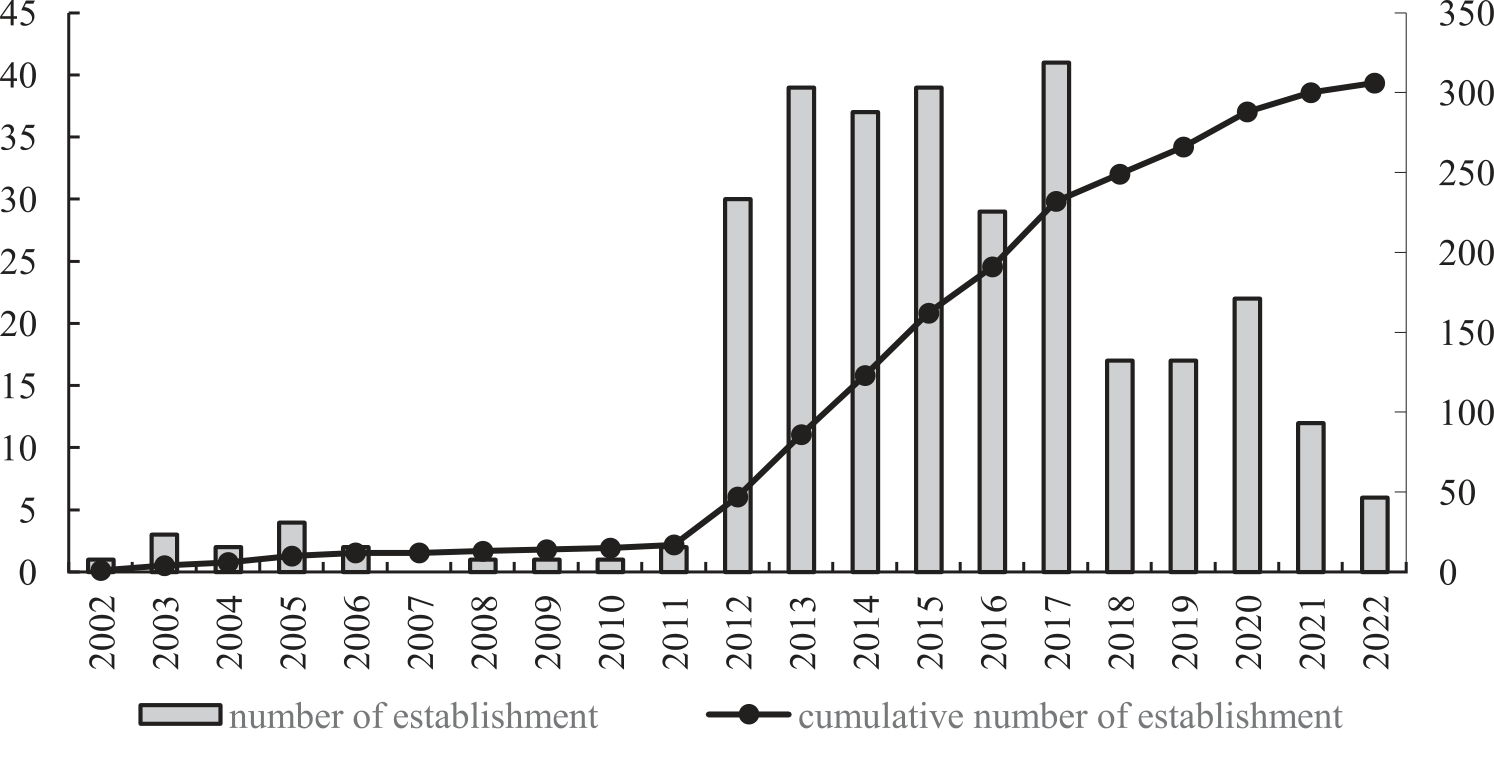
The degree of market allocation of public resources has steadily improved as the public resource trading center policy has advanced. According to the national public resources trading platform's data, as of May 10, 2023, 1,006,245 market entities had been collected, and 5,423,366 transactions had been completed. Although there are variances in the establishment period of public resource trading centers in various cities, their basic goals remain the same, that is, to integrate public resource transactions and promote market-based allocation of public resources.
The establishment of public resource trading centers at the city level was an exogenous event that altered the local regulatory system for public resource trading and constituted a quasi-natural experiment. Firms cannot forecast whether or not a public resource trading platform will be built in their city, and they cannot intervene in government decision-making. As a result, the establishment of a city-level public resource trading center has an exogenous impact on local companies. This is an excellent opportunity for this research to explore the policy implications of market-oriented allocation of public resources using the difference-in-differences model. Accordingly, this article considers the establishment of public resource trading centers as a quasi-natural experiment, employing policy evaluation methodologies to verify the relationship between the market-oriented allocation of public resources and green enterprise innovation.
Research Design
Model Settings
The empirical aim of this study is to first analyze the policy benefits of public resource trading centers on green innovation before investigating the impact mechanism. Since different cities established public resource trading centers during various times, a multi-period DID model was constructed by referring to the research of Beck et al. [36]. The specific model is constructed as follows:
where the subscripts i, j, and t represent city, firm, and time, respectively. Gresumia is the firm’s green innovation level. DID is a dummy variable reflecting the establishment of a public resource trading center: if the city i where enterprise j is located has established a public resource trading center in year t, the value is assigned to 1 for that year and subsequent years, otherwise, it is 0. Controls are a series of control variables at the individual and city levels, λi and ηt denoting individual and year-fixed effects, respectively, and εijt denoting the random disturbance term. In this study, β1 is the largest concern coefficient. If Hypothesis 1 is correct, β1>0 is expected. This implies that the establishment of a public resource trading center leads to an increase in green innovation.
Variable Description
Firm’s Green Innovation
The explained variable in this study is the firm’s level of green innovation. According to Zhang et al. [37], green patent applications are used to evaluate the level of green innovation. Patent applications, in particular, can better measure a firm's innovation capabilities as they represent a focused statement of resource input and output efficiency. As a result, in this study, the total number of green patent applications (including green invention patents and green utility model patents) plus 1 and the natural logarithm were utilized to calculate the firm's green innovation level.
Public Resource Trading Center
The establishment of a public resource trading center is the explanatory variable in this study. A dummy variable is used in this study to represent the establishment of a public resource trading center: if the city i where enterprise j is located established a public resource trading center in year t, the value is set to 1 for that year and subsequent years; otherwise, the value is 0. Data from public resource trading centers were manually collected and sorted. The sources of data include (1) “Tianyancha” enterprise collection website;
(2) the Agency code assignment and public institution registration management network; (3) the National Public Resource Trading Center platform. On this basis, we constructed a database of public resource trading centers in prefecture-level cities in China.
Control Variables
In this study, in addition to the main variables, city- and firm-level control variables were added to the model to increase the study’s accuracy. The levels of city economic development and industrial structure are city-level control factors. Firm-level control variables include company size (Size), financial leverage (Lev), return on total assets (ROA), growth capacity (Growth), equity concentration (Top1), enterprise market value (TobinQ), as well as significant shareholder capital occupation (Occupy), according to existing research.
Data Source
Data from public resource trading centers were personally collected and compiled. The enterprise green patent data was obtained from the Chinese Research Data Services (CNRDS) database, financial statement information and governance data were obtained from the China Security Market and Accounting Research (CSMAR) database, and city-level variables were primarily obtained from the “China Statistical Yearbook.”
The research sample for this study involves data from Chinese-listed firms from 2008 to 2021. The final sample size is 29240 firm-year observations after matching with city-level and firm-level control variable data. We identified 18079 samples in the treatment group and 11161 samples in the control group. 1% Winsor processing is used on continuous variables to reduce the effect caused by extreme values.
Descriptive Statistics
The interpretation and descriptive statistics for the main variables are presented in Table 1. Gresumia has a mean value of 0.3018 and a standard deviation of 0.7172. It demonstrates that the level of green innovation is low, and there are significant differences in green innovation among different enterprises within the sample interval. The mean values of Greinvia and Greumia are 0.1985 and 0.1801 respectively. It illustrates that as the quality of patent innovation improves, the difficulty of applying for green patents increases.
Table 2 compares the means of the treatment and control groups. It demonstrates that the mean Gresumia for the treatment group is 0.3444 and 0.2328 for the control group for the sample period, which is substantially different at the 1% level. Greinvia and Greumia likewise varied greatly between the two groups. The preliminary finding indicates that public resource trading centers have a considerable green innovation effect on enterprises.
Empirical Results
Benchmark Regression Results
The baseline regression results are shown in Table 3. The outcomes of the stepwise addition of firm- and city-level control variables are shown in columns (1), (2), and (3). The findings show the coefficients for public resource trading centers are all significantly positive, demonstrating that the establishment of public resource trading centers greatly enhances enterprises' levels of green innovation. The empirical results back up Hypothesis 1.
Table 1.
Descriptive statistics.
Table 2.
Mean comparison between treatment and control groups.
| Variables | G (DID = 1) | Mean (DID = 1) | G (DID = 0) | Mean (DID = 0) | MeanDiff |
|---|---|---|---|---|---|
| Gresumia | 18079 | 0.3444 | 11161 | 0.2328 | 0.1116*** |
| Greinvia | 18079 | 0.2326 | 11161 | 0.1431 | 0.0895*** |
| Greumia | 18079 | 0.202 | 11161 | 0.1447 | 0.0574*** |
Based on the work of Qi et al. [38], this study divides green innovation indicators into two dimensions to better evaluate the impact of public resource trading centers on enterprises' levels of green innovation: green invention patents and green utility model patents. We specifically replace the green innovation index with these two sub-indices while leaving the others alone in Equation (1).
The regression results are shown in Table 3 columns (4) and (5). The results show that even after the explanatory variables are replaced, the estimated coefficients of public resource trading centers remain significantly positive. This suggests that the establishment of public resource trading centers can catalyze various forms of green innovation activity. It is worth noting that when innovation patents are used as explanatory variables in regressions, the coefficient values are higher than when utility model patents are used. This means that the public resource trading center can encourage various sorts of green innovation activities, and it plays a more significant role in fostering the substantial development of green invention patents. Possible explanations include the fact that green invention patents have a high technical content and are difficult to develop, yet have larger energy-saving and emission-reduction impacts later on. Green utility model patents, on the other hand, contain less technical content and are easier to develop, but they have little obvious impact on increasing firm energy usage efficiency.
DID Validity Test
Parallel Trend Test
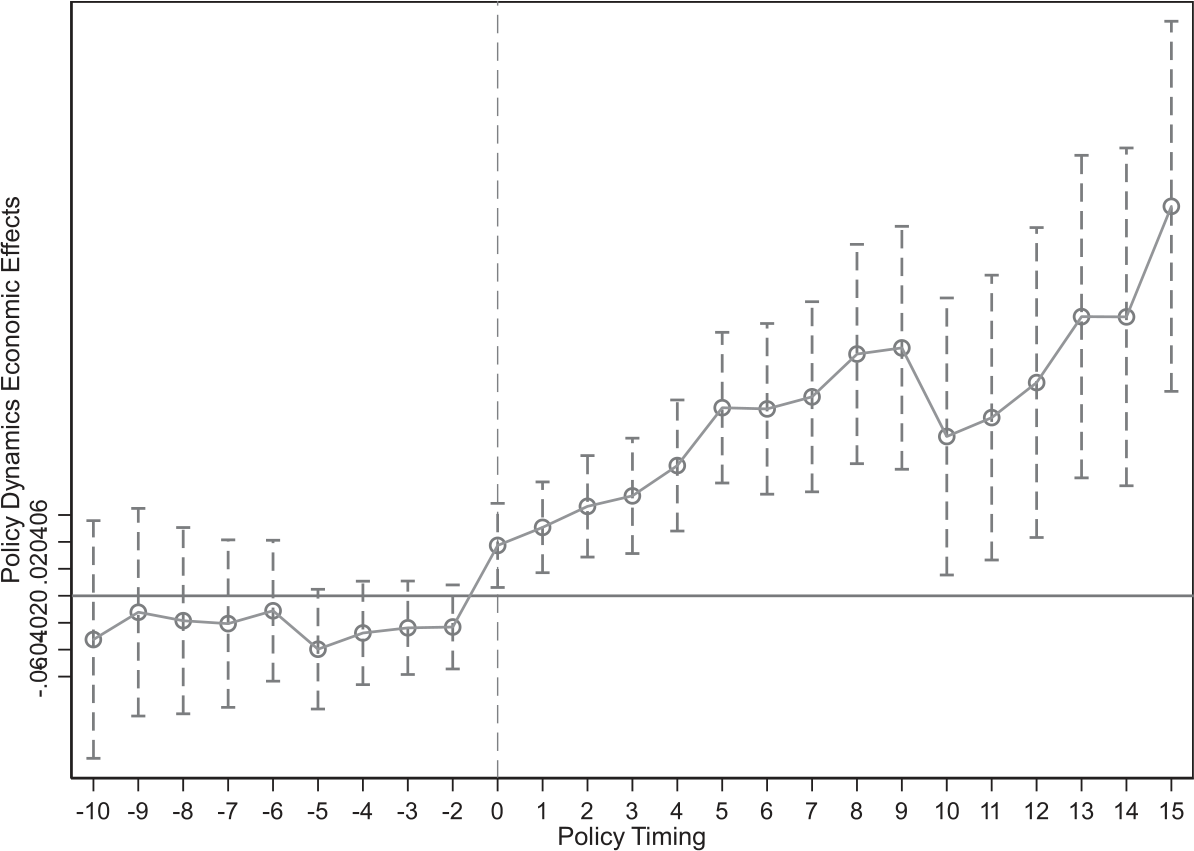
The parallel trend test is used as a foundation for studying the effect of public resource trading centers on corporate green innovation using the DID method. This suggests that earlier to the establishment of public resource trading centers, the degree of green innovation in both the treatment and control groups followed the same trend. The event study approach is used in this study to evaluate the parallel trend to see if the treatment and control groups have a common trend before policy implementation. We refer to the study of Guo et al. [39] and set the estimation equation as follows:
where m is the year of establishment of the public resource trading centers and n is the length of time before and after establishment. Other settings are consistent with Equation (1).
Taking the dynamic economic consequences of policy from 10 years before the center’s establishment to 15 years after the center’s establishment into account, the study treats k<-10 as -10 periods, k>15 as 15 periods, and k = -1 as the base period. Fig. 2 depicts the result. The results demonstrate that the coefficients of each dummy variable were not significant before the establishment of the public resource trading center. All of the coefficients have been significantly positive after the establishment of the public resource trading center. This indicates the positive influence of the public resource trading center on enterprise green innovation. The parallel trend test is satisfied.
Placebo Test
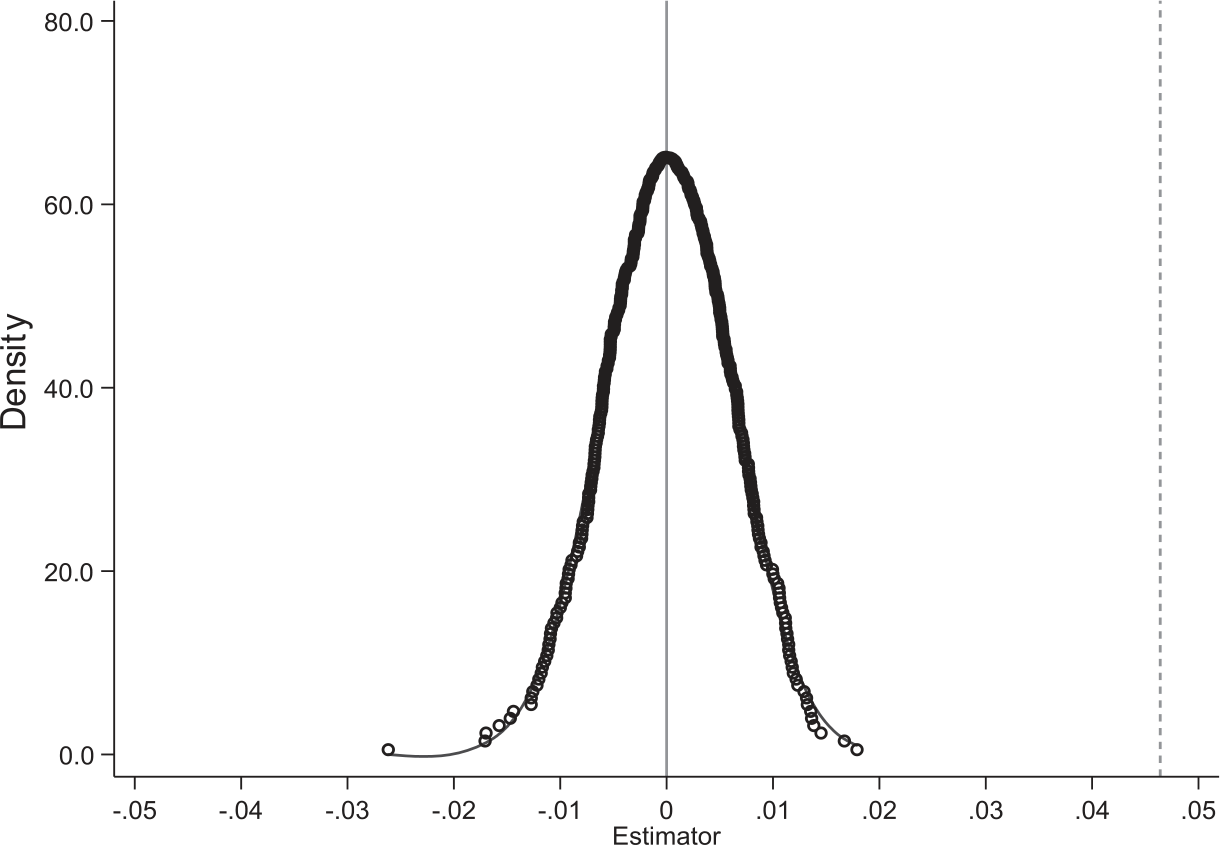
Other factors may influence the level of corporate green innovation, resulting in a bias in the conclusions of this study's benchmark test. The nonparametric technique is employed in this paper for placebo testing to check whether there is an estimating bias, drawing on the work of Alder et al. [40].
In particular, the computer was allowed to generate policy shocks for the public resource trading center at random, and the process was repeated 500 times. The regressed DID coefficients were then submitted to kernel density analysis, with the results shown in Fig. 3. The results show that the coefficient mean of the explanatory factors is not significant and is very close to 0. This demonstrates that unobserved variables have essentially no impact on firms’ green innovation. As a result, the benchmark regression results are unlikely to have been generated by other unobservable variables in the study. This finding backs up the previous benchmark conclusion.
Table 3.
Results of benchmark regression.
Robustness Check
To assess the robustness of the baseline findings, the following six methods are employed in this paper: replacing the explained variable, lagging the explanatory variables by one period, changing the period, shrinkage tests, replacing the regression model, and excluding other policy interference.
(1) Replacing the explained variables. For robustness testing, the firms' green patent authorization is utilized as a proxy for the green innovation level. Column (1) of Table 4 shows the regression results. The results show that the effect of public resource trading centers on firms' green innovation is still significantly positive and the benchmark results are reliable.
(2) The explanatory variables lagged by one period. From input to output, enterprise green innovation takes time, and there may be lags in the effect of the establishment of public resource trading centers on the degree of enterprise green innovation. As a result, the explanatory variables are regressed with a one-period lag here. The results are reported in Column (2) of Table 4. The results show that the coefficient of the public resource trading center remains significantly positive over the lagged period, confirming the study's initial findings.
(3) Change the period. Given that the State Intellectual Property Office revised the statistical method for patent application data in 2017, the statistical scope no longer includes all patent applications, but only those for which application fees have been paid, which may have an impact on the regression results. For robustness testing, we restrict the research period to 2008-2017. The coefficient of the public resource trading center is still significantly positive, as shown in Column (3) of Table 4, and the baseline conclusions are reliable.
(4) Shrinkage tests. This study employs the use of micro-level data with significant inter-individual variations. To minimize the impact of outliers on the study's conclusions, the tails of the explanatory variables have been reduced at the 5% and 95% quartiles. Column (4) of Table 4 shows that the coefficient of the public resource trading center is still significantly positive, indicating that the benchmark findings are valid.
(5) Replace the regression model. The number of green patent applications includes more than 50% zero values, which may cause variances in the mean effect estimation model's conclusions. As a result, model (1) is tested using the Tobit model. Furthermore, since the number of green patent applications is a non-negative integer with Poisson distribution features, the Poisson model and negative binomial regression model were used for robustness testing. Columns (5)-(7) of Table 4 show that the coefficient of public resource trading center establishment is still significantly positive, which is consistent with the study's baseline findings.
(6) Excluding other policy interference. To avoid other policies interfering with the effectiveness of the public resource trading center policy, this article considers other policies that may affect enterprise green innovation over the sample observation period. We create dummy variables LCC and SC for "low carbon city pilot policy" and "smart city pilot policy," respectively, and add them to the regression equation (1) in turn, performing robustness testing. The results in Table 4 column (8) and column (9) demonstrate that the coefficients of the core explanatory variables change less after the policy dummy variables are included, and all of them pass the 1% significance level test. This suggests that even after considering the effects of other related policies, the establishment of public resource trading centers has a significant positive effect on enterprise green innovation.
Heterogeneity Analysis
The impact of public resource trading centers on innovation may vary based on the industry features of firms, the structure of enterprise ownership, and the size of enterprises. This section employs subsample regression to investigate the heterogeneity of the innovation impact to further explore the optimization direction of the green innovation effect caused by the public resource trading center.
Industry Attributes Heterogeneity
Given the differences in technical characteristics and environmental impacts, the establishment of public resource trading centers in various industries may have varying effects on firms' green innovation. We divided the samples into two groups based on the literature [18,41], one for heavily polluting industries and one for non-heavy polluting industries. Heavily polluting enterprises include mining (B), manufacturing (C), electricity, heat, gas, and water production and supply (D). Other industries are left as non-heavy polluters.
Columns (1)-(2) of Table 5 show the grouping regression results. The results suggest that the introduction of public resource trading centers can significantly boost enterprises' green innovation in both heavily polluting and non-heavy polluting industries, with the benefit being greater in heavily polluting industries. One possible explanation is that the public resource trading center develops a consistent institutional organization and trading norms, and all industries must follow the trading regulations. Massive pollutant discharge has a greater effect on heavily polluting industries and less effect on non-heavy polluting industries.
In addition, we explored the differences between groups by inserting dummy variable interaction items of industry attributes. Table 6 column (1) shows the results. The results demonstrate that the interaction term's coefficient is significantly positive. It indicates that the green innovation effect of establishing public resource trading centers differs significantly between heavily polluting and non-heavy polluting industries.
Firm Ownership Heterogeneity
According to the theoretical analysis, we anticipate that the establishment of public resource trading centers will have a greater impact on the development of green innovation in state-owned enterprises. Based on firm ownership, we separated the samples into two groups: one for state-owned firms and one for non-state-owned firms.
Table 5 columns (3) and (4) show the grouping regression results. The results show that public resource trading centers have a positive impact on firms' green innovation in both state-owned and non-state-owned groupings, but have a much greater effect on state-owned enterprises. This observation supports earlier theoretical analyses. Furthermore, we explored group differences by including dummy variable interaction items related to firm ownership. Table 6 column (2) shows the results. The results show that the interaction term's coefficient is significantly positive. It indicates that the green innovation effect of establishing public resource trading centers differs dramatically between state-owned and non-state-owned firms.
Table 4.
Robustness tests.
Firm Scale Heterogeneity
Scale is frequently used as a market signal and greatly influences the probability of an enterprise acquiring external resources. As a result, business size may have an impact on the green innovation effect of public resource trading centers. We drew on the categorization methodology of the existing literature [42,43], and divided the total sample into two groups based on the total assets of the firms compared to the annual median, one for large-scale firms and one for small-scale firms.
Table 5 columns (5)-(6) show the grouping regression results. The results reveal that the establishment of the public resource trading center improves not only the large-scale group's green innovation but also the small-scale group's, with a greater promotion effect on the small-scale group. This is consistent with earlier theoretical hypotheses, as well as the public resource trading center's present practice trend. In addition, we investigated the differences between groups by including dummy variable interaction firm scale items. Table 6 column (3) reports the results. The results show the interaction term's coefficient is significantly positive. It suggests that the green innovation benefit of establishing public resource trading centers differs dramatically between large and small-scale enterprises.
It can be observed that the public resource trading centers have a greater driving effect on green innovation for significantly polluting industries, state-owned enterprises, and small-scale firms, supporting the research hypothesis H2 of this work.
Mechanism Inspection
The empirical findings show that establishing public resource trading centers improves enterprises' green innovation greatly, and the findings remain up after several robustness tests. Based on the theoretical analysis, this study investigates the impact mechanism of public resource trading centers on green innovation levels through two channels: improving public resource trading standardization and regulation and strengthening regional environmental supervision and management responsibility.
Based on the work of Wang et al. [15], the interaction term was employed in this study to verify the mechanism between variables. Dummy variables are generated in terms of the mechanism of action, and the dummy variables, as well as their interaction terms with the explanatory variables, are simultaneously added to Equation (1) to build the mechanism test model. The mechanism is proven to be valid if the estimated coefficient of the cross-product term is significant. The specific model is as follows:
where M’ is the mechanism variable, which has a value of 1 when the sample firms’ mechanism variable data is greater than their sub-annual median and 0 otherwise. Md is the M sub-annual median. The other settings follow Equation (1). This section focuses on the coefficients of the interaction terms, namely β3. If the β3 is significant, the mechanism is reliable.
Table 5.
Results of heterogeneity test.
Table 6.
Results of heterogeneity between-group difference test.
Standardization of Public Resource Trading
In the old public resource allocation process, the problems of inconsistent standards, irregular processes, and opaque information were effectively overcome by the public resource trading center. The sharing of information is a key step toward transaction standardization and normalization. Scholars primarily measure the level of corporate information disclosure from the perspectives of risk information disclosure [44-47], environmental information disclosure [48-50], social responsibility information disclosure [51-54], and ESG information disclosure in current research on information disclosure and public supervision [55-57].
In terms of measuring information disclosure, ESG information disclosure, in particular, has obvious advantages. Initially, ESG information disclosure covers a wide variety of topics, including information on the environment, society, and governance to create a comprehensive set of concepts. Second, the indicator is more representative due to firms' relatively high knowledge and disclosure rate of ESG information disclosure. Third, China is gradually developing the necessary systems for ESG information disclosure, ensuring uniformity and standardization of information disclosure. As a result, we use ESG disclosure as a proxy variable to measure the degree to which public resource transactions are standardized and regularized.
The HuaZheng ESG rating data from the WIND database was used in this paper for enterprise ESG information disclosure. When an enterprise's ESG score exceeds the annual median, the value is 1; otherwise, it is 0. The results are shown in Table 7, column (1). The interaction term's coefficient is 0.0432, which is significant at the 1% level. It indicates that the establishment of public resource trading centers promotes green innovation by boosting ESG performance. This implies that establishing a public resource service center encourages green innovation by improving enterprise ESG performance. The explanation for this could be that ESG performance delivers a positive signal to society about the enterprise's long-term beneficial development, which in turn helps the enterprise get greater external resources. As a result, financial constraints are alleviated, and green innovation activities are on the rise [55].
We sink the mechanism variables into the secondary sub-indicators for inspection to further refine the mechanism's influence. That is, the environmental (E), social (S), and corporate governance (G) sub-indices are also analyzed in the same way as before, to investigate whether public resource trading centers affect green innovation through various detailed channels. Columns (2)-(4) of Table 7 report the results. At the 1% level, all interaction coefficients are significantly positive. This result suggests that the public resource trading center's green innovation effect can benefit the environment, society, and corporate governance all at the same time.
The above analysis proves that promoting the standardization of public resource transactions is an important channel for the public resource transaction centers to promote firms’ green innovation.
Table 7.
Results of mechanism test.
Responsibilities for Environmental Supervision and Management
The public resource trading center oversees and manages part of the government's environmental protection and pollution control obligations. The public resource trading center can drive business innovation by enhancing environmental pollution control in the region. The potential benefits and drawbacks of social surveillance of corporate conduct are major factors influencing government behavioral decisions [58]. The notion that "the province bears overall responsibility, and cities and counties implement it" governs environmental protection and pollution management in China. The "Environmental Protection Law" grants provincial governments the authority to establish local environmental quality criteria. Provincial governments may adopt local pollutant discharge requirements that are stricter than national pollutant discharge limits, and local pollutant discharge rules must be implemented first. The provincial governments decompose and execute the State Council's overall discharge control indicators for key pollutants. Environmental protection authorities at or above the provincial level release bulletins on the state of the environment regularly. It is clear that in China, the management of environmental protection and pollution control of various market participants has been unified at the province level. Based on the foregoing principles, and subject to data gathering constraints, we employ the provincial environmental pollution control index to measure the environmental supervision and management responsibilities of urban public resource trading centers.
Table 8.
Results of mechanism test.
| Variables | Gresumia |
|---|---|
| DID*EPCI | 0.0790*** |
| (3.70) | |
| DID | 0.0528*** |
| (2.59) | |
| EPCI | -0.0208** |
| (-2.20) | |
| Constant | -1.5750*** |
| (-3.81) | |
| Controls | Yes |
| Individual fixed effects | Yes |
| Time fixed effects | Yes |
| Observations | 10583 |
| Adj R-square | 0.7108 |
The Environmental Pollution Control Index (EPCI) that we utilize is obtained from the China Science and Technology Database. The value is 1 when the EPCI of the city where the enterprise is located is greater than the annual median, otherwise, it is 0. The mechanism is then tested using Equation (3). Table 8 reports the results. The results show that the coefficient of the interaction term is 0.0790, which is significantly positive at the 1% level. It shows that the establishment of public resource trading centers helps guide enterprises to implement green innovation behaviors by improving environmental pollution control. The possible reason is that the better the environmental pollution control in the area where the firm is located, the more likely the firm will be compelled to increase investment in green innovation, adopt advanced technology, and innovate production processes to improve resource utilization.
The above analysis demonstrates that strengthening environmental oversight and management responsibilities is a critical channel for public resource trading centers to promote firms' green innovation. So far, Hypothesis 1 has been completely verified.
Conclusions
Research Findings
High efficiency, uniformity, fair competition, and complete transparency characterize the unified national market. Promoting the integration of public resource trading platforms is essential for the development of a unified national market. At the same time, it benefits green innovation and enterprise sustainable development. As a result, this paper investigates the impact of the establishment of public resource trading centers on enterprises' green innovation behavior in China. According to the findings, the establishment of public resource trading centers has resulted in better levels of green innovation among firms. It is more conducive to promoting high-quality green innovation. According to the mechanism tests, this influence is mostly caused by improved standardization and normalization of public resource trade, as well as strengthened regional environmental supervision and management responsibilities. Furthermore, the heterogeneity regression results reveal the establishment of public resource trading centers has a greater green innovation effect in state-owned firms, enterprises in heavily polluting industries, and small-scale enterprises.
Policy Recommendations
The public resource trading center, according to the findings above, is crucial in increasing enterprises' green innovation. The following are the study's policy implications. (1) The government ought to promote the establishment of a public resource trading center and continuously improve the reform plan for market-based public resource allocation. The government should constantly improve laws, regulations, and institutional norms so that the trading center can perform legal supervision and management functions. This is beneficial to the fairness, transparency, standardization, and organization of public resource transactions, and continues to stimulate firms’ green innovation. (2) Firms should make full use of the public resource trading center to improve their participation in the market-oriented allocation of public resources based on their needs. Furthermore, businesses should accelerate digital transformation, boost resource utilization for innovation, and encourage green innovation. (3) To establish green information sharing and credit evaluation systems for businesses, public resource trading platforms should make extensive use of digital and information technology. Improving the green information pricing system can assist firms in increasing their green reputation risk and transparency.
Limitations and Prospects
Furthermore, two limitations of this work require further investigation. The sample size is the first limitation. Due to data constraints, the research sample for this work is limited to publicly traded companies. As a result, the findings of this article cannot yet accommodate the impact of market-based public resource allocation on green innovation in SMEs. Another disadvantage of this investigation is the inability to measure dependent variables. This paper only employs patent data to quantify enterprise innovation output and ignores crucial indications of enterprise innovation input and innovation efficiency, which need to be developed and deepened.

