

Introduction
The environment we live in is important for social development, as forest resources play a major role in maintaining the environmental balance of the Earth [1–2]. Forest resources not only provide some of the necessary products that can be exploited in the manufacture and installation of lumber and products needed for construction, particularly in urban areas [3–4], but they also store water, release oxygen, and regulate the climate to mitigate the urban heat island effect [5]. In the past, the management of forest resources was aimed at obtaining simple economic benefits, but now it is oriented towards economic, human, and environmental benefits [6]. Forest resources also play an important and valuable role in tourism and recreation [7–9]. Forest tourism, based on forest resources, is of great interest to tourists. With the development and increased interest in this type of tourism, the exploitation of forest resources specifically for tourism purposes began to pose certain environmental problems [10]. Monitoring forest areas for protection and security purposes based on remote sensing technology is very useful in the context of sustainable development and effective management [11]. One of the current techniques is to use remote sensing in many studies, such as monitoring forest areas, wetlandls, agricultural lands, and urban areas [12–15]. The information that can be obtained from satellite images is very useful and very precise, allowing large areas of territory to be easily distinguished [16]. Protecting and preserving forest wealth has become an imperative necessity for countries because of the major role they play in the stability and functioning of ecosystems in the face of the spread of certain natural risks that humanity faces, notably climate change. The vast forest areas of the world today, considered the lungs of humanity, are exposed to horrific fires every year, especially in the forests of Mediterranean countries like Algeria. The phenomenon has become alarming in Algeria; every year, thousands of hectares of dense forests are destroyed, in addition to the loss of human lives in some cases, which is precisely the case of El Kala National Park, located in the far northeast of Algeria. The forest wealth that characterizes this park is unique in Algeria and the Mediterranean basin [17]. This forest wealth has not escaped almost daily attacks, illegal logging, urban expansion, land clearing, and especially forest fires [18]. From this point of view, the use of remote sensing technology to manage, monitor, and track the forest wealth of this park is considered an urgent necessity to reduce the factors of deterioration. To analyze forest resources from satellite images, this work is based on the calculation of vegetation coverage by combining the normalized differential vegetation index (NDVI) with a dimidiate pixel model. The main objective of this research is to monitor the forest environment and follow the dynamics of the forest cover within El Kala National Park using satellite images from the Landsat program.
Materials and Methods
Study Area
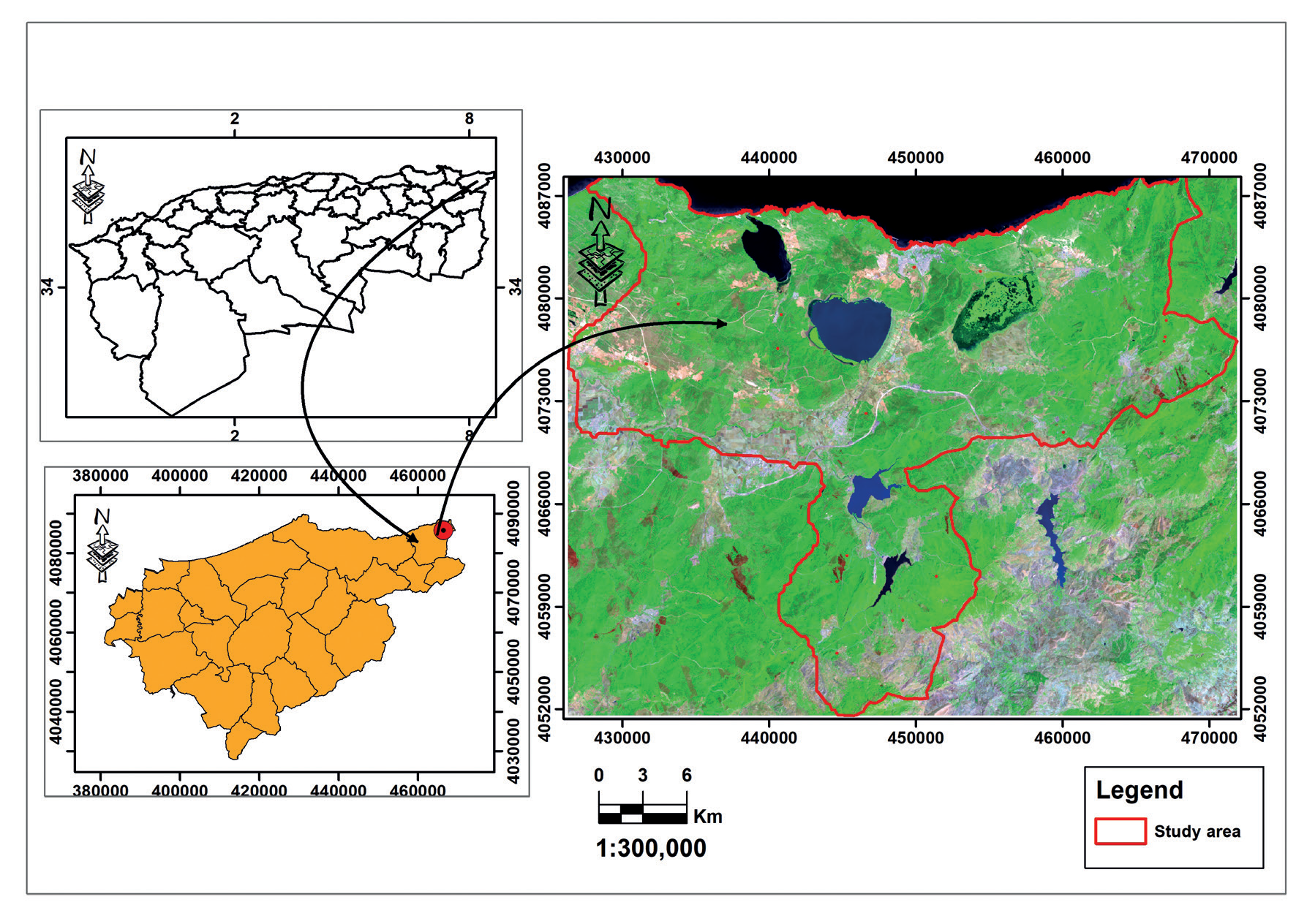
El Kala National Park is a natural jewel, created in 1983. It was included on the UNESCO World Heritage List in 1990 because of its exceptional biodiversity. It is located in the northeastern corner of Algeria, in the Wilaya of El Taref, bordering the Mediterranean. It shares a border with Tunisia, which gives it a unique location and a mix of cultural and natural influences. It covers an area of 80,510 hectares, encompassing terrestrial and marine areas (Fig.1).
Table 1.
Satellite data.
| Satellite | Sensor | Spatial resolution (m) | Acquisition date |
|---|---|---|---|
| Landsat 8 | OLI/TIRS | 30 | 19/08/2013 |
| Landsat 9 | OLI-2 | 30 | 15/08/2023 |
This park is renowned for its rich biodiversity. A variety of ecosystems can be found here, such as Mediterranean forests, lakes, marshes, beaches, and coral reefs. The park is home to several lakes, the largest of which is Lake Oubeïra. These lakes serve as habitat areas for many species of birds and contribute to the natural beauty of the park. The flora of El Kala National Park is varied, with a great diversity of plant species adapted to the Mediterranean climate. There are forests of Aleppo pine, eucalyptus, Zen oak, cork oak, Kermes oak, and Mediterranean scrub, as well as endemic species. The forests of Aïn Séfra, Ghorraia, Bougous, and others offer picturesque hiking trails amid lush green forest landscapes. These forests constitute ideal tourist areas for nature lovers. These tourist forests in El Kala National Park offer visitors a unique opportunity to connect with nature, explore preserved ecosystems, and appreciate the biodiversity of the region. Activities such as hiking, wildlife watching, and photography are popular among visitors who want to experience the natural beauty of these forests. The region has beaches bordering the Mediterranean, offering visitors opportunities for relaxation, swimming, and coastal recreation. El Kala Beach is one of the popular destinations to enjoy the coastline. Oued Zitoun Waterfall represents a popular destination for those seeking natural beauty and the calm of nature. As a World Heritage Site, El Kala National Park benefits from sustained conservation efforts to preserve its unique ecosystem. These initiatives aim to ensure the sustainability of biodiversity and raise public awareness of the importance of nature preservation.
Data Collection
Two medium-resolution (30 m) Landsat program images covering the study area, taken in 2013 and 2023 and available free online at https://earthexplorer.usgs.gov, were used to monitor the dynamics in forest resources of this protected area (Table 1). The date the Landsat program images were taken was during the dry season (summer) to avoid cloudy conditions.
The two images from the Landsat program, which form the basis of the present study, undergo preprocessing. For this research, the images from both acquisition dates were calibrated using Envi 5.6 software. It is important to note that the images in this program for level 1 are geometrically correct. To evaluate, monitor, and characterize the forest cover of El Kala National Park, three types of software were used (ENVI 5.3, ArcGIS 10.6).
Selection of Vegetation Index
The vegetation index refers to the numerical values obtained by jointly exploiting different wave bands acquired by remote sensing, which can reflect the growth status of plants in remote sensing images. The calculation of the vegetation index generally involves the visible red and near infrared bands.
Forest Cover Monitoring Model
The forest cover monitoring model employed in the study combines the Normalized Difference Vegetation Index (NDVI) with a dimidiate pixel model.
Normalized Difference Vegetation Index (NDVI)
The Normalized Difference Vegetation Index (NDVI) is an indicator of the greenness of biomes. Even if it is not a physical property of the plant cover, its formulation is very simple [19].
Where NIR and RED are the spectral reflectances measured in the near-infrared and red wavebands, respectively, making them widely used for forest monitoring.
Dimidiate Pixel Model
The dimidiate pixel model is a linear, unmixed model that assumes that the target vegetation and soil are invariant in terms of surface reflectance and that a pixel signal includes two components: soil and vegetation [20]. If we assume that each pixel consists of the following elements: a ground surface covered with vegetation and a ground surface not covered with vegetation, then the two components constitute the spectral information of the pixel; the proportion of their surface in the pixel is the weight, and the proportion of the ground surface covered with vegetation corresponds to the vegetation coverage of the pixel [21]. By approaching the formula of equation n°1, we obtain the following equation:
Such as
Where fc is the vegetation coverage, S denotes all remote sensing information, Ssoil denotes the per-pixel remote sensing information for soil, and Sveg denotes the per-pixel remote sensing information for all vegetation pixels. Integrating equation (2) with the NDVI, we obtain the following equation:
Where NDVIsoil refers to NDVI values without vegetation pixels and NDVIveg refers to NDVI values for all vegetation pixels. By applying equation (3), the vegetation cover can be calculated.
Results
The application of remote sensing technology made it possible to monitor the tourist forests of El Kala National Park for two observation dates in 2013 and 2023.
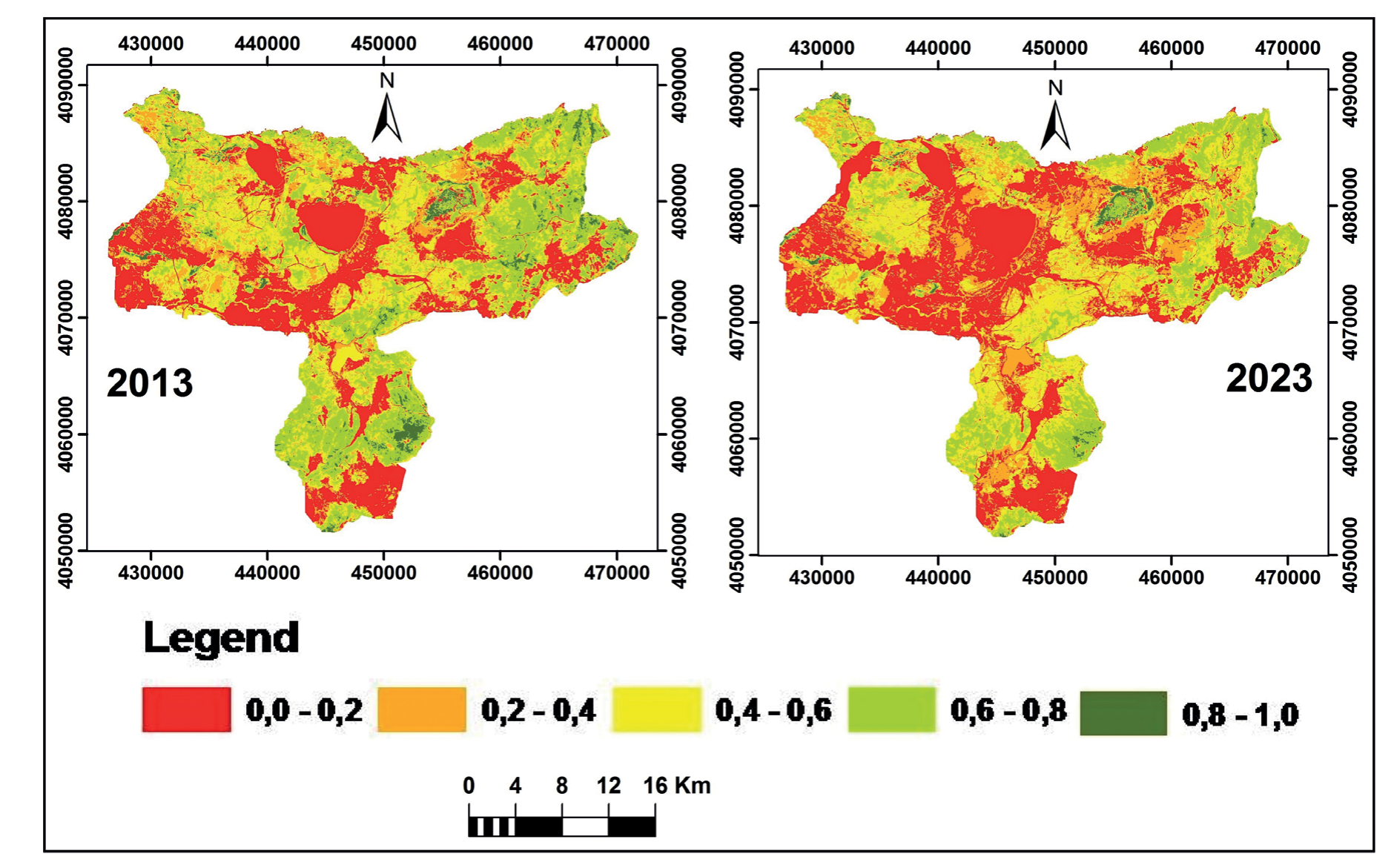
The remote sensing data used during the years 2013 and 2023 was chosen as a research reference to produce a preliminary assessment of the current situation of this park between its tourism potential and ecological constraints. Fig. 2 illustrates the vegetation cover of El Kala National Park in 2013 and 2023. Fig. 2 shows that the vegetation coverage of El Kala National Park has changed considerably over ten years of observation. The calculation of the vegetation coverage rate at different levels made it possible to identify the changes produced during this shooting period. Table 2 shows that the area of bare soil has continued to increase while the areas of forest cover have decreased in this park over the ten years of observation.
Areas with high vegetation coverage have decreased, particularly in the North-West, North-East, and South. These areas are generally state forests and consist of species of cork oak, Zeen oak, Kermes oak, and reforestation. Generally speaking, the vegetation cover in El Kala National Park shows a decreasing state. The vegetation coverage for the two observation dates can be obtained by processing the probability distribution of NDVI. The evolution of forest cover from 2013 to 2023 was established by calculating the area of each level for the two reference dates. Table 2 shows that forest cover in El Kala National Park in 2023 increased by 0.02% at levels 0.4–0.6 and decreased by 9.83% at levels 0.6–0.8 and 2.02% at the 0.8–0.1 level. This study provides evidence that tourism forests in El Kala National Park have suffered geographically varied degradation. In most areas from the northeast to the North West, the extent of the forest has decreased; this can be explained by the repeated fires, which each destroy thousands of hectares of this forest wealth. However, it cannot be conclusively proven that this change is directly caused by the fires, but there are other factors that also contribute to the worsening situation. Other factors mainly include urban expansion, agricultural expansion, illegal logging, land clearing, and overgrazing. The field inspection showed that the forests of the northeast and northwest regions are easily accessible, which has led to an increase in attacks on them daily. Another reason for the difference in forest change between the northern and southern regions is that the northern region is close to the coast and has easy access due to the large number of forest roads and tracks, making it generally exposed to fires, especially during the summer season, because the forests are the real refuge of most tourists.
Discussion
This paper focuses on the monitoring and protection of tourism forests within the El Kala National Park in Algeria, using Landsat data over the period 2013 to 2023. The analysis involves satellite imagery, the calculation of the normalized differential vegetation index (NDVI), and the application of a dimidiate pixel model to assess changes in vegetation coverage and identify factors contributing to forest degradation. It highlights the importance of forest resources in maintaining environmental balance, providing economic benefits, and supporting tourism and recreation. This sets the context for the study by highlighting the importance of preserving the forests of El Kala National Park. It draws on the utility of remote sensing technology, particularly Landsat data, to monitor and manage forest resources. Remote sensing provides a cost-effective and efficient way to assess changes in vegetation cover over large areas, which is crucial for conservation efforts. The results obtained reveal a significant decrease in forest cover within El Kala National Park over the ten-year period. This decline is attributed to various factors, including fires, urbanization, agricultural expansion, illegal logging, land clearing, and overgrazing. Spatial analysis of land cover changes provides valuable information on the dynamics of forest degradation. This result highlights the multiple threats facing the forests of El Kala National Park, such as fires and human activities. The study highlights the need for urgent conservation measures to address these challenges and prevent further degradation of the forest ecosystem. The article suggests several conservation measures to protect the forests, including increased monitoring, enforcement of laws against illegal logging, public awareness campaigns, and enhanced firefighting efforts. These measures are essential for safeguarding the biodiversity and ecological balance of the region. The study emphasizes the importance of collaboration between various stakeholders, including local authorities, communities, environmental experts, and conservation organizations, to effectively manage and preserve the forests of El Kala National Park. An integrated approach is essential for achieving sustainable conservation goals. The article could further discuss potential future research directions, such as the application of advanced remote sensing techniques, modeling of forest dynamics, and evaluation of the effectiveness of conservation interventions. Additionally, exploring the socio-economic impacts of forest degradation and the benefits of ecotourism could provide valuable insights for policy formulation. While the study focuses on a specific region in the far north of Algeria, its findings and methodologies have broader implications for forest conservation efforts throughout the country. The challenges faced by El Kala National Park are emblematic of broader issues related to deforestation, habitat loss, and biodiversity conservation at the local, regional, and national levels.
Conclusion
The study, based on the monitoring and protection of tourist forests in El Kala National Park using Landsat data, revealed significant changes in vegetation coverage during the period from 2013 to 2023. The results obtained from the analysis of satellite images and the use of the normalized difference vegetation index (NDVI) combined with a dimidiate pixel model made it possible to document changes in forest dynamics. The application of remote sensing technology has highlighted a notable decrease in forest cover in the park, with specific areas, notably in the northwest, northeast, and south, experiencing significant degradation. This worrying trend is attributed to various factors, such as repeated fires, urban sprawl, agricultural expansion, illegal logging, land clearing, and overgrazing. These combined threats have contributed to the geographically varied degradation of the park’s forest resources. This study highlights the urgency of taking conservation and sustainable management measures to protect the forests of El Kala National Park. These measures could include improving surveillance, strict enforcement of laws against illegal logging, raising public awareness of the importance of preserving biodiversity, and strengthening firefighting efforts. Protecting the tourism forests of El Kala National Park requires an integrated approach involving collaboration between local authorities, local communities, environmental experts, and conservation organizations. It is imperative to act quickly to ensure the sustainability of this precious forest wealth and maintain the ecological balance of the region.

