

Introduction
In Saudi Arabia, a number of insect pests can infest date palm trees [1]. The date palm plantations are threatened by a highly deadly pest, the red palm weevil (RPW) [2], scientifically known as Rhynchophorus ferrugineus (Oliv.) (Coleoptera: Dryophthoridae) [3]. It is considered one of the main pests that affect date palms in some Arab Gulf countries, including the Kingdom of Saudi Arabia [4]. It primarily infests palm trees and can affect various species, including date palms, coconut palms, and oil palms [5]. The infestations can cause significant damage to palm trees. The larvae bore into the tree’s trunk, feeding on the tissues responsible for water and nutrient transport. This weakens the tree and can lead to its death if left untreated. Signs of infestation include wilting or drooping fronds, holes or tunnels in the trunk, and the presence of adult weevils or larvae [6]. Besides causing direct damage, R. ferrugineus can also facilitate the spread of diseases. The weevils introduce fungi and bacteria into the palm tree’s tissues, creating entry points for pathogens. This can further weaken the tree and make it more susceptible to infections and other pests [7].
The invasions of red palm weevils have significant economic consequences, particularly in regions where palm trees are vital for industries such as date production or landscaping. The loss of palm trees can result in decreased agricultural yields, reduced aesthetic value, and higher costs for pest control and tree replacement [8]. In addition to the activities of the red palm weevil, a variety of other issues account for thirty percent of the losses in date palm output. This demonstrates the sincerity of RPW in light of the date palm’s economic significance given its high infection rate [9]. Studying the physiological transformations brought on by RPW-invaded palms can offer valuable insight into devising a fresh approach for detecting the pest early on [10]. The distinct agricultural and environmental elements of this area, combined with the advanced techniques used in date palm cultivation, have established a perfect breeding ground for this pest. Presently, RPW is present on every continent, and projections from ecological niche models suggest that it will soon spread to new territories [11]. This enigmatic habitat of RPW has a significant impact on the ability to detect and control infestations, making it a challenging task. Moreover, this behavior also serves as a shield against extreme weather conditions, allowing RPW to thrive in diverse environments. This presents the greatest obstacle in controlling RPW [12]. Pheromone traps, on the other hand, can be used in an Integrated Pest Management (IPM) approach to provide a sustainable and user-friendly solution that eliminates the danger of resistance [13]. Pheromone traps have been successfully used by several nations, notably Saudi Arabia [14], as a component of their integrated RPW management methods [15].
The red palm weevil is the subject of continuous and expanding research in the Makkah Al-Mukarramah region, with consideration given to Saudi Arabia’s ambitious Vision 2030 plan. The plan focuses on diversifying the country’s production base and ensuring food security by strengthening the agricultural sector. In addition, the program aims to promote economic development and reduce red palm weevil infestation [16]. To fight against RPW, for decades, date palm growers have relied on synthetic chemical insecticides and fumigants, which proved to be the most efficient. However, the enigmatic nature of RPW poses a challenge when using chemical insecticides. On top of that, careless application of these insecticides has resulted in detrimental effects on both the environment and human health. Not only that, but it has also been an expensive method of control, not to mention the negative social and economic consequences [17]. As if that wasn’t enough, the traditional control methods have inadvertently caused genetic mutations in RPW populations, giving rise to new species or haplotypes. This is evident in Qassim, where two different species have been identified [18]. Unfortunately, despite the use of chemicals, RPW has developed formidable resistance, rendering the measures useless and causing a severe crisis in date palm farming and associated industries [19]. So, the main objective of this work is to monitor red palm weevil population fluctuations and determine seasonal changes in adult numbers using pheromone traps. Furthermore, the study of the impact of temperature and relative humidity on weevil activity and its control was also studied throughout the two years in Makkah Al-Mukarramah City, Kingdom of Saudi Arabia.
Materials and Methods
These studies were carried out in the years 2021 and 2022 on a private farm in the Kingdom of Saudi Arabia’s Makkah Al-Mukarramah, which is home to date palm trees infested with the red palm weevil (RPW).
Population Abundance of Red Palm Weevil, R. ferrugineus (Oliv.)
Five traps emitting pheromones were placed in the selected orchard [20]. These traps were designed and implemented based on the methods outlined by Solano-Rojas et al. [21]. A ten-liter plastic container with four circular holes on the cover and six holes close to the top of the walls was used to build the traps. The 700 mg of R. ferrugineus male aggregation pheromone, which was made up of 9 parts 4-Methyl-5-Nonanol and 1 part 4-Methyl-5-Nonanon, was contained in a dispenser within each trap. Under the brand name PO28 Ferrolure, this particular pheromone lure was manufactured in Costa Rica by Chim Tica International S. A. with a 95% purity level and a release rate of 3-10 mg daily. Each trap contained a dispenser containing 45 mL of ethyl acetate, a kairomone with a minimum purity of 95%, and a release rate of 200-400 mg daily, along with a colorant. The company Chim Tica International S.A. also produced this kairomone. The pheromone was replenished every two months in the summer and every three months in the winter to keep adult weevils from escaping the traps and laying eggs on date palm plants. The traps were placed 4 meters apart from the trees and 100 meters apart in order to retain the best possible trapping location. In order to reduce water evaporation, the traps were carefully positioned in shady regions, as reported by Al-Saoud et al. [22]. Every two weeks, the weevils captured in the traps were meticulously collected, classified according to gender, and precisely recorded. Half-monthly data on date palms were used to discuss population estimates for R. ferrugineus by calculating the mean number of males and females per trap, either plus or minus (±) standard error, which was applied to evaluate population estimates for males and females separately.
Mean Crowding Intensity (M*)
This indicator expresses the extent of crowding of individuals [23].
Where x̄ refers to the mean of the population and S2 variance of the population in each investigation date.
Rate of Increase in Abundance Estimates
To determine the amount of oscillation in total live population estimates per trap throughout half-monthly sampling periods, the rate of half-monthly variation was computed by dividing the average number registered on the current investigation date by the number registered on the date of the previous investigation. Bakry and Fathipour [24] conducted this method.
Impact of the Meteorological Variables on Total Live Population Estimates (Male and Female Adults) per Trap on Date Palm Ttrees
Meteorological variables include the daily average temperature and relative humidity throughout the period from January 2021, continuing until December 2022, and this data was obtained from the website www.meteomanz.com, two weeks before examining the samples. Within the half-monthly periods, the data were subjected to multiple linear regression analyses to determine the relationship between them. The MSTAT-C program was utilized for this purpose. Bakry and Abdel-Baky [25] applied this method. All values within the tables and figures were evaluated and calculated utilizing Microsoft Excel 2010.
Toxicity Evaluation of Certain Insecticides on R. ferrugineus on Date Palm Trees
Insect Samples
The adult insects were manually gathered from the infected date palm trees on various farms within the study area (Makkah Al-Mukarramah city) using pesticide-free traps.
Rearing of the Red Palm Weevil
In a laboratory setting with a temperature of 27±2ºC and a relative humidity of 65±5 %, red palm weevils were raised on date palm offshoots in order to produce a sufficient number of insects for the research’s experiments [26]. The trunk was split lengthwise into two halves, fronds and roots were removed, and a square chamber was made to house the insects after choosing offshoots that were three to four years old. A 1:2 ratio was used to organize the men and girls. To keep the insects in, the trunk was sealed again with strong thread that was glued firmly. The exterior of the trunk was then covered with a metal mesh [27]. The infected offshoots were placed in a specially designed box with three facades: two made of aluminum to increase safety and ensure the insects didn’t leak outside the lab, and one with metal mesh ventilation on the upper and lower halves. When the offshoots were finished, they were cut into little pieces, placed in plastic bags with kerosene covering them, and torched to prevent the infestation from spreading [28].
Tested Insecticides
The following five frequently used pesticides for managing the red palm weevil in the Makkah Al-Mukarramah region were the subjects of the bioassay experiments: 1. Fipronil 5% (W/V), 2. Imidacloprid 5% (W/V), 3. Methidation 40% (W/V), 4. Spinosad 2.5% SC., 5. Chlorpyrifos 48 % EC.
These pesticides were acquired from the Makkah Al-Mukarramah Region Department of the Ministry of Environment, Water, and Agriculture.
After being submerged in the assessed concentration for 30 seconds using hill bags, the larvae were fed using the method with a few minor modifications [29, 31]. In the control group, the larvae were immersed in water for 30 seconds prior to being fed, and five concentrations of each insecticide were tested, with five duplicates for every concentration [32]. The outcomes were noted after two and four days [33]. The larvae were considered dead if they did not move or if any movement or touch caused them to react negatively [34]. The laboratory toxicity results were analyzed using the Ldp Line Program, a standardized statistical program, creating a laboratory toxicity curve for the pesticides under test and using specialized statistical software to extract statistical constants [35]. The purpose of this study was to determine how sensitive the red palm weevil larvae (R. ferrugineus) were to pesticides that were often utilized in the Makkah Al-Mukarramah area.
Results
Population Estimates of R. ferrugineus Adults on Date Palm Trees and Their Percentages Out the Year Total
Population Abundance of R. ferrugineus Adults
Half-monthly counts of R. ferrugineus adults (male and female) were registered throughout the tested intervals from January 2021 to December 2022 years and tabulated in Tables 1 and 2 and Fig. 1 and 2. The half-monthly mean counts, variance, and mean of crowding by R. ferrugineus adults are also shown. The population estimates of R. ferrugineus adults (male and female) were assessed based on calculating the average number of adults per trap on the examination date. Data presented in Tables 1 and 2 and illustrated in Fig. 1 and 2 showed that R. ferrugineus infestation was present throughout the year, and there were four peaks throughout the year. The male and female weevils were first observed in traps with relatively few numbers at the beginning of January during the first season (1.54±0.04 adults/trap) and second season (0.88±0.06 adults/trap). It fluctuated and then gradually increased to reach the first peak at the beginning of March, at 11.99±0.34 adults per trap in 2021 and 12.10±0.67 adults per trap in 2022. After that, the mean of live total captured weevils declined at the beginning of April, then increased at the midpoint of April and continued to increase gradually until it reached the peak of the second peak at mid of May (12.75±0.50 adults/trap) in 2021 and at the beginning of May (13.87±0.66 adults/trap) in 2022. Then it decreased rapidly and gradually increased again until it reached the third peak in mid-July (15.73±0.49 adults/trap) in 2021 and at the beginning of July (15.60±0.87 adults/ trap) in 2022. Again, it gradually decreased rapidly until mid-August and then gradually increased again until it reached the fourth peak at the beginning of October (16.87±0.39 adults/trap) in 2021 and in mid-September (16.93±1.30 adults/trap) in 2022. The adult estimates then began to slowly decline until the end of each year in 2021 and 2022.
Statistically, there were highly significant variances between the adult estimates at different inspected dates during each season (L.S.D. values were 0.80 and 2.19) in 2021 and 2022, respectively (Table 1 and 2).
The impact of R. ferrugineus infestation on date palm trees was higher in the second season than in the first one. The mean total population of weevils per trap over the whole first year (2021) was 8.86±0.44 adults, and for the second year (2020), it was 9.57±0.49 adults. Also, the estimates of R. ferrugineus females per trap were higher, as a general average of (5.83±0.29 and 6.31±0.34) in the two years than in the males (3.03±0.16 and 3.25±0.17), respectively. The results also indicated that the number of females caught was 1.92 and 1.94 times greater than males during the entire years of 2021 and 2022, respectively.
Fig. 1.
Half-monthly mean counts of R. ferrugineus adults on date palm trees in relation to climatic factors in Makkah Al-Mukarramah city during the first year of (2021).
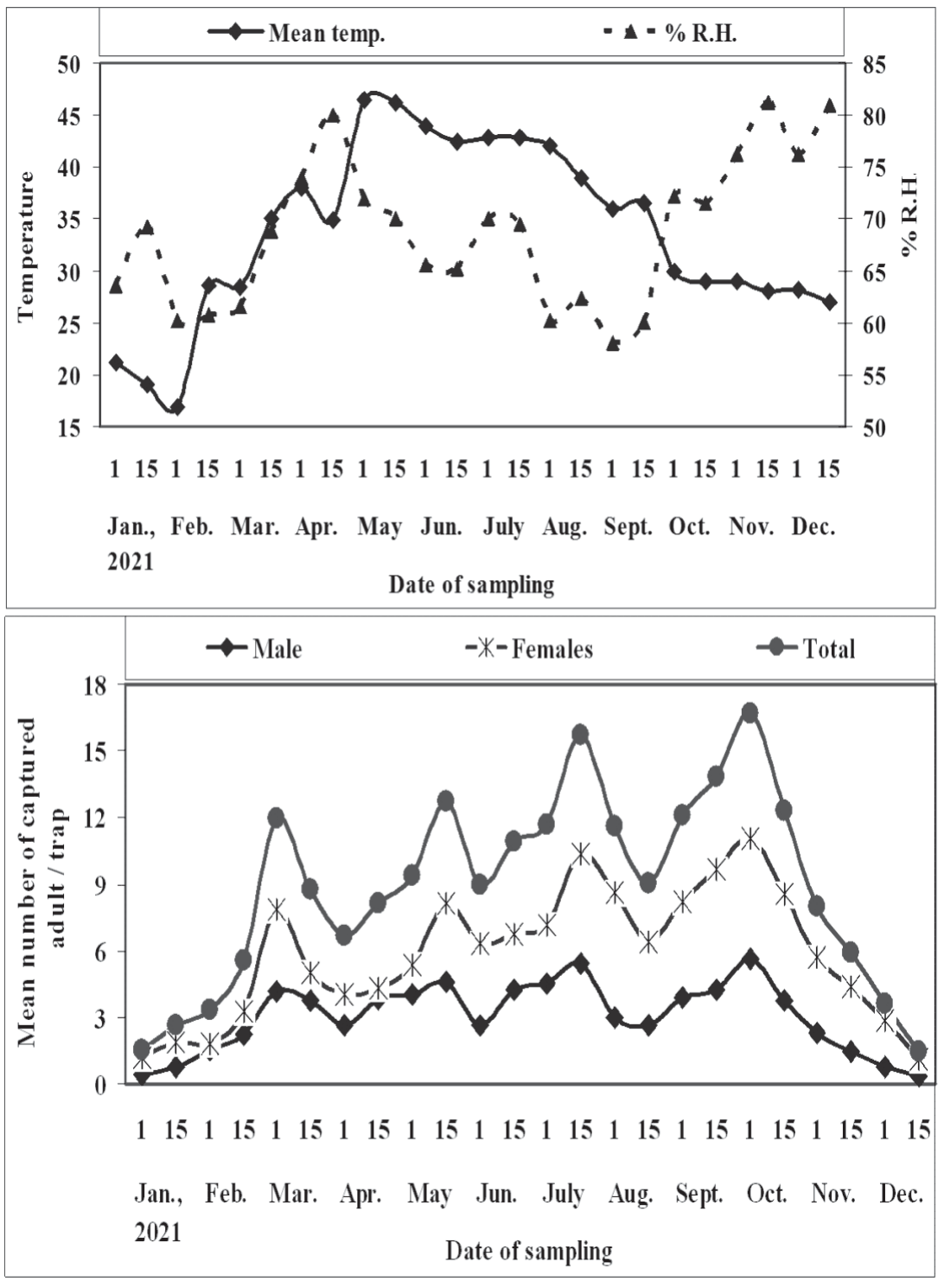
Fig. 2.
Half-monthly mean counts of R. ferrugineus adults on date palm trees in relation to climatic factors in Makkah Al-Mukarramah city during the second year of (2022).
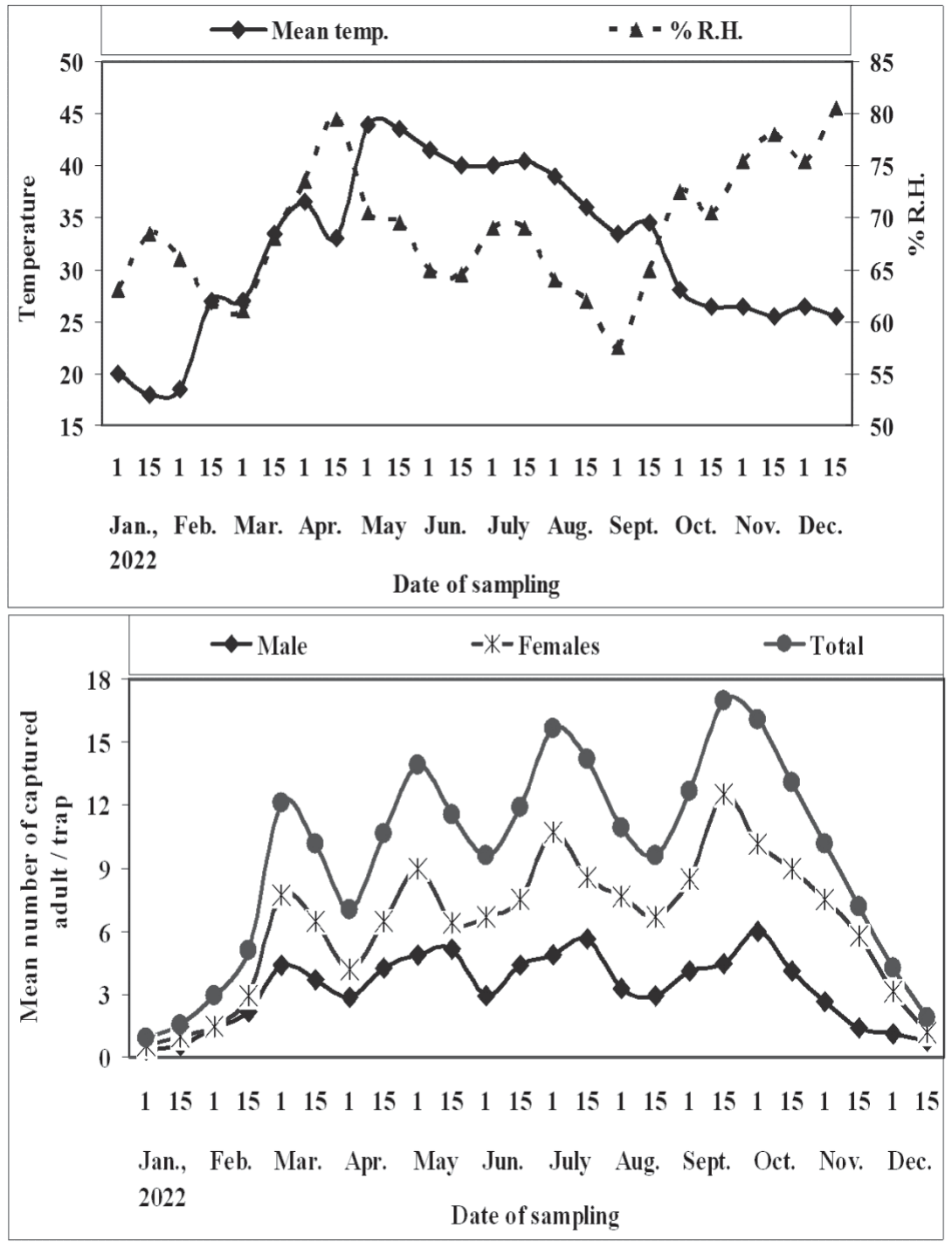
Generally, the population oscillation of adult males and females of RPW exhibited the same trend as indicated by the total live adult counts during 2021 and 2022.
The Percentage of R. ferrugineus Counts Out of the Year Total
To make comparisons between population estimates easier across the year, the population density is reported as a percentage of numbers counted in each fortnight examined compared to the total for the entire year.
These indicate that the highest percentages of R. ferrugineus counts were noted at the beginning of March, mid-May, mid-July, and beginning of October in 2021; it was recorded to be 5.64, 6.00, 7.40, and 7.86% of the total, respectively.
Over the year 2022, the highest percentages of R. ferrugineus numbers were exhibited at the beginning of March, the beginning of May, the beginning of July, and mid-September; it was estimated to be 5.27, 6.04, 6.80, and 7.37% of the total, respectively.
Mean Crowding Intensity R. ferrugineus Counts
At the beginning of October 2021 and the midpoint of September 2022, it was the most suitable time for growth in male and female weevils estimates to increase, while the beginning of January in the second year was the least suitable for activity in both years. As well, the greatest values of the log mean population and the average crowding of the male and female weevil counts had been registered; it was recorded at the beginning of October 2021 and the middle of September 2022 in both years (Tables 1 and 2).
The Rate of Increase of R. ferrugineus Counts
The rate of R. ferrugineus population increase in periods each fortnight is used to determine the best fortnight for insect activity, which is defined as the fortnight with the highest insect population growth over the course of the season. When the rate of increase was greater than one, it pointed to an increase in activity; smaller than one, it pointed to a decrease in activity, and equal to one, it pointed to no change in activity [36].
As shown in Tables 1 and 2, the favorable periods of increase for R. ferrugineus counts were exhibited in mid-January to the beginning of March, from the mid of April to mid of May, from the mid of June to mid of July, and from the beginning of September to beginning of October throughout the first year (2021), when the rates of increase were greater than one.
Table 1.
Half-monthly mean counts, variance, mean of crowding of R. ferrugineus adults on date palm trees in Makkah Al-Mukarramah city during the first year of (2021).
However, over the second year (2022), it seems that the favorable periods of the increase appeared to be in mid-January to the beginning of March, from mid-April to the beginning of May, from mid-June to the beginning of July, and from the beginning of September to mid-September, when the rates of increase were greater than one.
Impact of the Meteorological Variables on the Total Live Population Estimates (Male and Female Adults) per Trap on Date Palm Trees
Effect of Daily Mean Maximum Temperature
Simple correlation analysis (Table 3) revealed highly significant positive correlations between daily mean temperature and weevil numbers over the two years (r-values were 0.62 and 0.67), respectively. Over the two years of study, the regression coefficient showed that an increase in daily mean temperature by 1ºC increased the number of weevils by 0.31 and 0.40 adults/trap, respectively.
The results of the partial regression analysis demonstrated that the daily mean temperature had a highly substantial positive impact on the number of weevils in both years (+0.31 and +0.39, respectively). Furthermore, the calculated t-test values were +3.67 and +3.95, and the partial correlation accounts were +0.63 and +0.65, during 2021 and 2022, respectively Table (3).
Effect of The Mean Relative Humidity
Statistical analysis of simple correlation (Table 3) indicated that there are weak negative insignificant correlations between daily mean relative humidity and weevil numbers for both years (r-values -0.56 and -0.45). During the two years of study, the regression coefficient exhibited that an increase in daily mean relative humidity by 1% decreased the number of weevils by 0.14 and 0.12 adults/trap, respectively.
The observed impact of daily mean relative humidity, as indicated by the partial regression values, demonstrated insignificant negative influences (rep. values were -0.12 and -0.05) in the two years, respectively. The partial correlation values were -0.25 and -0.09, respectively, while the t-test values were -1.20 and -0.40 for 2021 and 2022, respectively (Table 3).
Table 2.
Half-monthly mean counts, variance, mean of crowding of R. ferrugineus adults on date palm trees in Makkah Al-Mukarramah city during the second year of (2022).
The combined effect of two climatic factors on the R. ferrugineus population
The combined effect of the two climatic factors on total R. ferrugineus populations was used in a multiple regression analysis. The model was highly significant, with F-values of 7.74 for the first year and 8.22 for the second year. The explained variance was 42.42 and 43.91% in the two years, respectively (Table 3). The multiple linear regression equations are:
First year (2021):
Second year (2022):
Table 3.
The multiple linear regression relationship between two climatic factors and counts of R. ferrugineus adults over the two years (2021 and 2022).
Toxicological Studies
Data indicated in Table 4 showed the insecticidal efficacy of five components (Fipronil, Imidacloprid, Methidation, Spinosad, and Chlorpyrifos) against instar larvae of R. ferrugineus. The results exhibited that the LC50 value of Fipronil was 71.25 ppm with a 95% confidence level and confidence intervals of 65.32-79.22 ppm, while the LC90 was 208.3 ppm with a 95% confidence level and confidence values of 175.3-274.0 ppm. The toxic ratio was 0.127, and the slope of the toxicity line was (2.71±0.24). Furthermore, the 95% confidence level indicated that the LC50 value of Imidacloprid was 110.2 ppm, with confidence intervals of 104.5–122.3. The LC90 value, on the other hand, was 245.1 ppm, with confidence intervals of 213.2–297.4 at the 95% confidence level. The toxicity line had a slope of 3.80±0.40, and the toxic ratio was reported at 0.082. After 48 hours, the LC50 value of Methidation was 1002 ppm with confidence ranges of 668.3–1402 ppm at a 95% confidence level. The control group did not have any mortality, and the LC90 was 3133 ppm with confidence intervals of 2802–9918 ppm. Table 4 shows that the toxic ratio was 0.009 and the slope of the toxicity line was 2.57±0.26.
The insecticidal efficiency and corresponding LC50 values of the target objective products Spinosad and Chlorpyrifos after 48 hours were 39.31 and 9.112 ppm, whereas the LC90 were 621.7 and 113.29 ppm, respectively. According to this statement, after 48 hours, Chlorpyrifos was more toxic to R. ferrugineus than the other products, with LC50 values of 9.112 ppm. The slope grew in the following order when we looked at the toxicity line and slope: Chlorpyrifos>Spinosad>Fi pronil>Imidacloprid>Methidation, which suggested that the treated strain of R. ferrugineus.
Discussion
Numerous insects, such as the red palm weevil, prey on date palm trees. A number of insects, such as the red palm weevil (RPW), prey on date palm trees. R. ferrugineus (Oliv.) (Coleoptera: Dryophthoridae) is the scientific name for this insect, which is considered a significant and destructive pest that poses a threat to date palm plantations [37]. In the Kingdom of Saudi Arabia, it is regarded as one of the primary pests that harm date palms. The objective of this work is to monitor red palm weevil population fluctuations and determine seasonal changes in adult numbers using pheromone traps. In addition, the study of the impact of temperature and relative humidity on weevil activity and its control was also studied throughout the two years (2021 and 2022). The findings showed that there was a year-round R. ferrugineus infestation on date palm trees, with four seasonal peaks of activity per year that were observed in 2021 at the beginning of March, mid-May, mid-July, and the beginning of October. Afterward, the pest invasion occurred at the beginning of March, at the beginning of May, at the beginning of July, and mid-September throughout the second year (2022). These results are consistent with Qin et al. [38], who reported that monitoring of RPW occurred at four peaks annually. Using collection pheromone traps, Abbas et al. [39] reported that the population abundance of R. ferrugineus grew steadily from January to a peak in March, April, or May. In summer (June-September), daytime averages of 42.8°C (39-48°C) resulted in a drop in red palm weevil populations. Weevils may live in sick palm trees at this time, or they may settle in the ground in search of cover and shade [40].
According to El-Shafi [41], the number of emerging adults is constant throughout the year, with December and January seeing the lowest concentration of adults. According to a study done by Zahra [42], RPW were present all year round. There were four distinct peaks observed during the period of testing, which spanned from 2012 to 2013. At the start of December 2012, the average number of captured adults per trap was 6.40. However, this count gradually declined, reaching its lowest point on January 15th, 2013, with a recorded average of 2.30 adults per trap. The fluctuation continued, with four peaks observed: the first was on April 15th, 2013, where there was an average of 17.40 adults per trap; the second was on May 30th, 2013, with an average of 12.80 adults per trap; the third and highest peak was on July 15th, 2013, with an average of 20.60 adults per trap; and the fourth and final peak occurred on September 15th, 2013, with an average of 10.40 adults per trap. Osman [43] showed that the presence of mature R. ferrugineus varied year-round, peaking four times over the yearly cycle. Two peaks were recorded: the first in the first week of March and the second in the second week of May. In the first year of the study, 2011, the third peak transpired in the final week of June, and the fourth peak was noted in the first week of October. The first peak was recorded in the first week of March, the second peak in the second week of April, the third peak in the last week of May, and the fourth peak in the last week of September in the second year, 2012.
Table 4.
Insecticidal efficacy of five components Fipronil, Imidacloprid, Methidation, Spinosad, and Chlorpyrifos against instar larvae of R. ferrugineus.
El-Lakwah et al. [44] mentioned that R. ferrugineus adults appear constantly throughout the year. In addition, the lowest number of adults was recorded during December and January. Hussain et al. [45], reported that the red palm weevil adults emerged continually over the year. In addition, the lowest adult counts were exhibited in January and December in the two years (2013 and 2014), and the population estimate recorded two peaks of adult counts per year. The first peak was registered in the second week of April, but the second peak was observed in the second week of October 2013. During 2014, the first peak was observed in the second week of March and the second peak in the second week of September.
However, El Sebay et al. [46] and Saleh et al. [47] stated that two peaks in the quantity of red palm weevils were detected annually in Egypt. The highest average number of RPW adults was recorded between April and November, according to Faleiro [48]. Our findings showed that in comparison to males (3.03±0.16 and 3.25±0.17), the estimations of R. ferrugineus females per trap were higher, with an overall average of (5.83±0.29 and 6.31±0.34) in both years. According to the data, there were 1.92 and 1.94 times as many girls captured in 2021 and 2022, respectively, as there were males. Numerous researchers reported that there are more females than males; this finding is consistent with the findings of Al-Saoud (2007) [22].
Regarding the impact of two climatic elements on the red palm weevil population, the findings indicated that, throughout the course of the study’s two years, there was a highly significant link between the number of weevil adults and the daily mean temperature. Conversely, a negligible and feeble inverse relationship was noted between the average percentage of relative humidity and the quantity of adult weevils. The best predictor of changes in bug numbers was the daily mean air temperature. These results align with the findings of Faleiro (2005) [48], who found that the highest temperature had a substantial impact on weevil activity in India and that there was a positive correlation (r = 0.51) between the highest temperature and weevil counts. According to Huang et al. [49], there was a significant decline in R. ferrugineus populations at low temperatures. According to El-Shafi (2011) [41], the quantity of adult red palm weevils was positively correlated with the weather factor (average daily temperature). During the two years of the study, there was, however, a negative link with the percentage of relative humidity.
El-Sebaey (2003) [46], on the other hand, stated that there was no connection between RPW abundance and meteorological conditions. According to Zahra (2014) [42], there was a substantial negative link between the population abundance of adult red palm weevil insects and mean daily relative humidity, although there was an insignificant positive correlation between mean daily temperature and red palm weevil abundance. According to Osman (2015) [43], the average daily temperature and red palm weevil abundance are significantly positively correlated, but the average daily relative humidity and red palm weevil counts are significantly negatively correlated. It is very difficult to stop the red palm weevil from spreading to its secret life cycle inside the trunk of palm trees [50]. In order to combat this issue, Naveed et al. [51] suggest the use of chemical control as one of the many methods employed. This method is known for its quick and reliable results in recovering infested palm trees. Numerous insecticides such as organophosphates, pyrethroids, and carbamates, have been utilized for reducing the red palm weevil population. These insecticides have proven to be effective in controlling the weevils; however, their usage comes with certain limitations. Factors such as safety and environmental concerns, as well as the development of insect resistance to these pesticides, hinder their effectiveness in controlling the red palm weevil population.
Our study shows that Chlorpyrifos was more toxic to R. ferrugineus than the other compounds after 48 hours of application, with LC50 values of 9.112 ppm. However, Methidation was the least toxic. These outcomes align with According to Mohammed et al. [52], dipping treatment against RPW larvae revealed that the Dueracide pesticide, which contains the active chemical Methidation 40%, was less effective. Furthermore, according to Sabit et al. [53], the trunk showed full healing after being injected with different chemical pesticides. According to Elgohary et al. [54], methomyl was most effective against adult stages of RPW, while Fipronil was most successful against larval and pupal stages. Chlorpyrifos, on the other hand, had the highest effect on the egg stage of RPW.
Conclusions
The current goal of the work is to understand population estimates of red palm weevil (RPW) R. ferrugineus (Oliv.) using attractive pheromone traps in four date palm plantations and its correlation to two climatic factors and its control throughout two years (2021-2022) in the Makkah Al-Mukarramah city of the Kingdom of Saudi Arabia. These studies may be of great value. It is necessary to discover and manage red palm weevil injuries to mitigate the damage. Various control measures, including insecticide treatments, pheromone traps, and cultural practices, are employed to manage and prevent the spread of these destructive pests. Local agricultural authorities and experts can provide specific guidance on managing RPW in affected regions.

