


Introduction
Food waste is considered unfit for use by consumers because it comes after a given food produce/product has already been processed, distributed, and served/ consumed/utilized [1]. About 30-45% of global food waste comes from fruit and vegetable sources. Therefore, waste utilization (of fruit and vegetables), besides effectively helping protect the environment, may contribute to the production of essential ingredients needed for food preparation/medicinal purposes [2]. Although pectin remains a well-known product of fruit and vegetable peels, the recovery of non-starch polysaccharides is among the vital techniques for producing natural biopolymers. Moreover, different researchers focused on the extraction, process conditions optimization, and characterization of pectin from different plant materials, such as banana peels [3], lemon and mango peels [4], and citrus peels [5]. Commercially, pectin can be realized when acid at high temperatures is applied to different raw materials, for example, citrus fruit peels. The physiochemical properties of extracted pectin might be influenced by different factors, particularly variety, pH, particle size interval, temperature, extraction time, and types of acid used in the extraction [6]. Besides, orange peels are an excellent source of soluble sugar, pectin, phenolic acids, and flavonoids, even containing higher concentrations than in the edible portion. meaning that several compounds will be retained in the peel [7]. The soluble sugars that can be found in orange peel include glucose, fructose, and sucrose. Pectin, cellulose, and hemicelluloses make up the insoluble polysaccharides that make up the cellular wall of the orange peel. Xylose, rhamnose, and glucose are in relatively tiny proportions in pectin and hemicelluloses. Most plants’ cell walls contain around one-third of the dry material as pectin, a complex mixture of polysaccharides. Pectin is an important component of the primary cell wall, along with cellulose and hemicellulose. Because it is abundant in the middle lamellae, its principal function was once thought to be intercellular adhesion [8]. In addition to dissolving in either a hot diluted acid solution or a hot aqueous chelating agent solution, the amount of pectin, structure, and chemical composition could vary depending on the cultivar, maturity time, and various plant parts. Most pectin is extracted and utilized in food preparations as an emulsifier, gelling agent, glazing agent, stabilizer, and thickening ingredient in fruit juice, jellies, jams, marmalades, confections, etc. [9]. Despite these benefits, pectin’s exceptional endurance at low pH levels keeps it in use in the pharmaceutical, cosmetic, and acidic food sectors. It can be difficult for processors to preserve the quality of pectin because different orange peel varieties have distinctly different chemical compositions. However, given its ability to emulsify, pectin from various plant sources must be adequately extracted in order to produce food emulsions.
Different varieties of orange (Citrus sinensis) are cultivated in Ethiopia. Among them, three varieties, namely: Valencia, Mandarin, and Gunda Gundo, appear to be the most common and are particularly available in the community/research centers. According to research reports, pectin extracted from some varieties of orange peels may not be suitable for food processing due to the low methoxyl content, equivalent weights, and anhydrouronic acid content. As per earlier studies, orange peel pectin thickens when jam, jelly, and marmalade are prepared; hence, higher equivalent weights are required for strong gel formation [10]. In 2011, for example, in Ethiopia, it was well-reported by the Ethiopian Horticultural Producers and Exporters Association (EHPEA) that over 40,000 tons of oranges were produced from over 60,000 hectares of fruit-covered land. However, there is a paucity of relevant information on the specific varieties that suit pectin production better with maximum quality and yield. Further, there appears to be an increased focus on pectin production from alternative sources such as orange peel, and it would be of interest to evaluate which varieties would better suit yield by physiochemical quality. Therefore, the choice of an appropriate orange type for the manufacture of value-added goods like pectin would be a prospective field for research. To supplement existing information, therefore, the physicochemical properties of Ethiopian orange (Citrus sinensis) peels and their extracted pectin by varieties were investigated.
Materials and Methods
Sample Collection, Chemicals, and Experimental Facilities
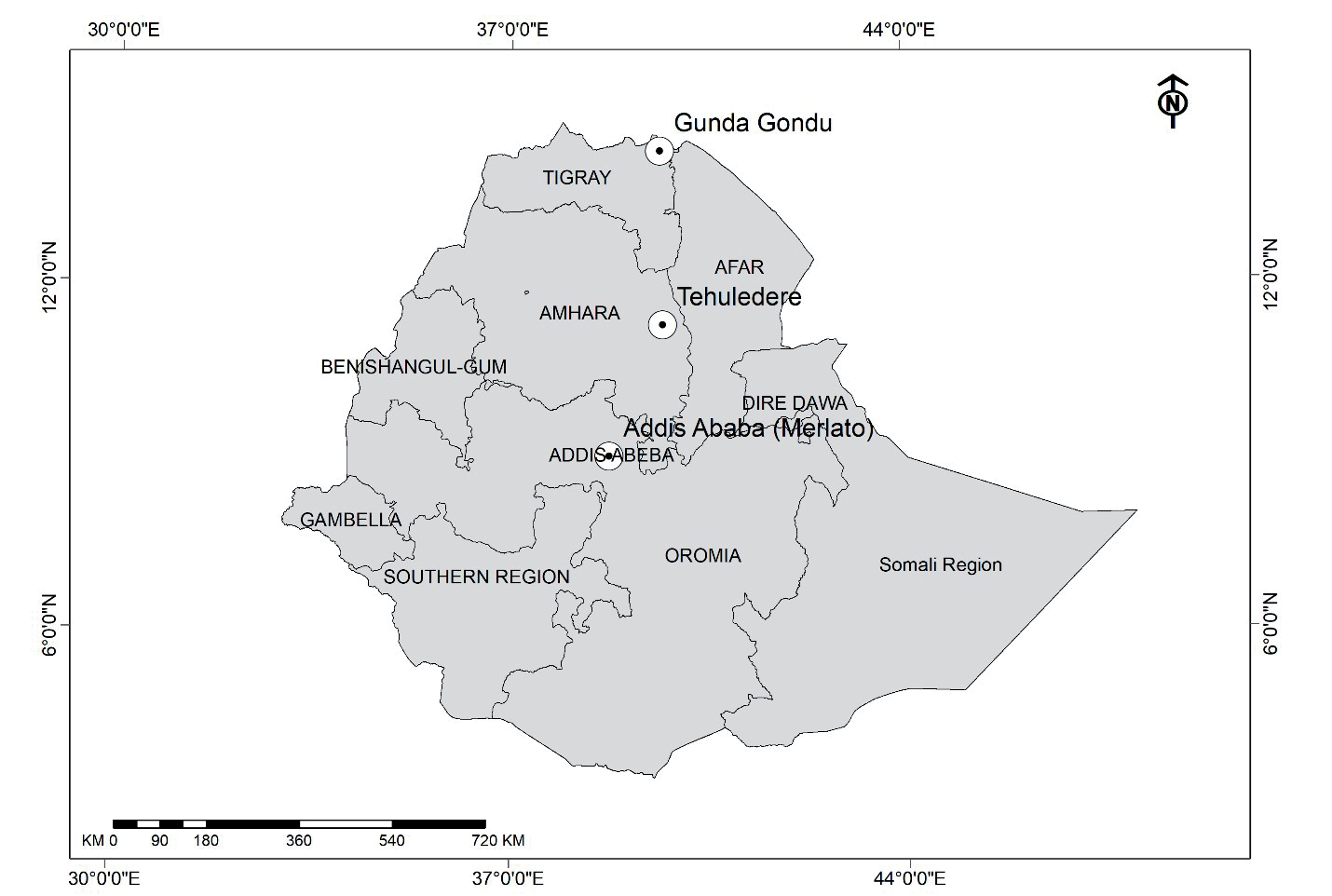
Three different orange varieties, namely Valencia, Mandarin, and Gunda Gundo, were bought from a local market in Addis Ababa, South Wollo (hayk town), and Tigray region, Ethiopia, respectively. Fig. 1 shows the map of Ethiopia, particularly the individual regions, situating the location of Addis Ababa as well as Tigray. Further, plastic net bags were used to transport 10 kilograms of each species to the Chemical Engineering Department at the Addis Ababa Science and Technology University in Ethiopia, where they were stored at room temperature until needed. Chemicals and equipment, including litmus paper, cloth filter, measuring cylinder, milling machine, pH meter, temperature sensor, shaker, beakers, oven, spoon, refrigerator, stirrer, mass balance, water bath heating, precipitator, and dryer, were purchased from a chemical shop in Addis Ababa. All chemicals and reagents used in this study were of analytical grade. Additionally, all experimental activities (extraction and various physicochemical analyses of pectin) were performed at the Chemical and Food Engineering Laboratory, Addis Ababa Science and Technology University, Ethiopia.
Sample Preparation
The orange was divided into four equal pieces, each of which was peeled and cleaned to eliminate dirt, dust, and pesticide residues. The peels were then cut into smaller pieces for straightforward drying. They were milled after being dried in the sun until the moisture level was minimal. Finally, the peel powder was stored for later use at room temperature.
Extraction Procedure
A citric acid solution was prepared with a pH of 2. In a prepared citric acid solution, 5 g of dried orange peel powder is cooked for 30 min at 70ºC with continual stirring. After the solution had cooled, it was filtered using the filter cloth. Equal parts of ethanol and alcohol were added to the filtrate solution and allowed to precipitate after being added. A cloth filter was used to filter the precipitated gel after the mixed solution was regularly precipitated. The pectin was milled after being dried for 20 min in a hot air oven at 40ºC.
Characterization of Orange Peels
Determination of Moisture Content
The moisture content of the orange peel sample was assessed using the oven drying method. Orange peel was dried to a consistent weight for three hours at 105ºC. Using the weight difference between the initial and final dried orange peel samples, the moisture content of the orange peel slice was computed and expressed as a percentage using the formula below. Triplicates of each sample were used for testing.
Determination of Ash Content
According to the procedure used by an association of official analytical chemists and reported by [11], the ash content of orange peels was described as follows: Porcelain dishes were heated to 550ºC in a muffle furnace (Nabertherm, Germany, Temp. 30-3000ºC) for 30 min prior to cooling in desiccators (with granular silica gel) and being weighed with an analytical scale (M1). Then orange peel samples weighing approximately 5 g were placed in the dish in triplicate (M2). The dishes containing the sample were put inside a muffle furnace (Nabertherm, Germany, 30-3000ºC) and heated for three hours at 550ºC until a whitish color appeared and cooled for one hour in desiccators. When cooled to room temperature, each dish with ash was reweighed (M3). The ash content was expressed as a percentage using the following formula:
Determination of Total Soluble Solid (TSS)
A refractometer was used to measure the amount of Total Soluble Solids (TSS). The thermostat setting for the refractometer (A. Kruss Optronic, Germany) was 25ºC, and the scale range was 0.00-95.00% Brix.
Determination of Reducing Sugar Content
Reducing the sugar content of orange peels was determined by using the Lane and Eynon method [11]. This required 30 g of crushed orange peels added in a 250 ml conical flask containing 5ml each of neutral lead acetate and potassium oxalate, and the total volume was made up to the mark with distilled water and allowed to seep for 5 min. The mixture thus obtained is filtered into another 250 ml conical flask using a muslin cloth. After the sample solution’s filtration, 5 mL of each Fehling solution A and B were taken in a conical flask and heated until boiling before being added to a drop of methylene blue indicator 1% w/v solution. Using the sample solution filtrate as the burette solution, this was titrated until brick-red precipitates appeared as the endpoint. Finally, the percentage of reducing sugar in the samples was determined as follows:
For invert sugar, the following calculations and standardization of Fehling solution were carried out using about 9.5 g of AR-grade sucrose dissolved in 100 ml of distilled water. After the sucrose was dissolved, 5 ml of HCl was added, and the mixture was allowed to remain for three days at room temperature in order to cause inversion. In order to calculate the Fehling solution factors, 25 ml of an inverted sugar solution was transferred into a 100ml volumetric flask, diluted to volume (1ml is equal to 2.5 mg of inverted sugar), and then transferred to a burette with an offset tip. The endpoint was identified by the complete discoloration of the methylene blue indicator, which was used to titrate against the Fehling solution. The mg of inverted sugar was calculated using the formula below:
Determination of pH Value
A digital pH meter (Model 744, Metrohm, Switzerland) was used to measure the pH of orange peel [12].
Characterization of Extracted Pectin
Determination of Yield
The extraction yields of pectin from three varieties of orange peels on a dry weight basis were determined as follows:
Determination of Viscosity
The resultant pectin was dissolved in distilled water at a concentration of 1.0 percent (weight per volume). A viscometer (Model HTD13145, Haitongda, China) was used to measure the mixture’s viscosity at 100 revolutions per minute at about 22ºC.
Determination of Equivalent Weight (EW)
The equivalent weight of pectin obtained from orange peels was determined [13]. This required 0.5 g of pectin sample with 5 ml of ethanol, then mixed against 0.1 N NaOH, one gram of sodium chloride, 100 milliliters of distilled water, and six drops of phenol red indicator. The titration point was designated by the color purple. The following equation was used to calculate the equivalent weight (EW).
Determination of Methoxyl, Degree of Esterification, and Anhydrouronic Acid
The degree of esterification (DE) is defined as the ratio of the esterified galacturonic acid group to the galacturonic acid group present. The degree of esterification was determined through titration, connecting the methoxyl content (MeO) with the equivalent weight method [13]. First, 0.50 g of orange peel pectin was dissolved in a 1:20 v/v solution of ethanol and water. Next, the mixture was titrated with 0.1 N sodium hydroxide (V1, ml) until the indicator changed, after which five drops of the phenol red indicator were added. The sample, heated briefly, was vigorously stirred after adding 25 ml of 0.25 N NaOH. Five drops of phenol red and 25 ml of 0.25 N HCl were subsequently added. After that, 0.1 N NaOH (V2, ml) was added to the mixture in titrations until the endpoint color changed from yellow to pale pink. The following equation was then used to calculate the MeO and the DE.
The anhydrouronic acid (AUA) content of pectin was also calculated as follows:
Where V1 and V2 are the volumes used for the first and second titrations, respectively, 31 is the molecular weight of methoxyl and 176 is the molecular weight of anhydrouronic acid expressed in mg/meq.
Determination of Acetyl Content
The acetyl content was measured [13] using 0.5 g of pectin mixed with 25 ml of 0.1 N NaOH, followed by rapid agitation to ensure thorough mixing, then diluted with 50 ml of diluent after being left for 1 h. The 20 ml of liquor was put into a steam distillation device together with 20 ml of a magnesium sulfate-sulfuric acid solution. The solution was steam-distilled, and a small amount of distillate (about 100ml) was collected in the distillation flask. The obtained acetic acid is titrated with 0.05 N NaOH to the endpoint of phenol red. Following a black titration on distilled water, the acetyl concentration was calculated using the equation:
Results and Discussion
Physicochemical Characteristics of Variety Orange Peels
The results of the physicochemical study of three types of orange peels (Valencia, Mandarin, and Gunda Gundo) are presented in Table 1. Specifically, the physicochemical components included moisture content, ash content, total soluble solids (Brix), reducing sugar content (%), and pH value. Orange peels of different types were employed in this investigation, and the moisture content ranged from 8.51% to 11.01%. These differences were significant (p<0.05). Orange peels from the Valencia variety obtained a higher moisture content (11.01%), but those of the Mandarin orange peels appeared lower (18.51%), which seems above those reported elsewhere for lime orange (10%) [14]. It is possible for orange peel moisture levels to vary from 2.8 to 7.2% [15], like those of the “Maltease” variety of orange peels reported at about 3% (dry basis) [16]. The genetic makeup of the cultivars, their maturity stage, and agricultural techniques, including harvesting timing and analysis, could all contribute to this disparity between varieties and researchers [6, 17]. In fact, microbial growth and unfavorable responses in food might be significantly influenced by moisture and water activity. However, low moisture and water activity values remain crucial for long-term storage, with the latter causing the least degradation of pectin. Indeed, microbial proliferation by the pectinase enzyme is detrimental to pectin’s quality.
Ash contents resembled those between the three varieties of orange peels (p>0.05) (Table 1) with 3.25% (Valencia), 3.13% (Mandarin), and 3.3% (Gunda Gundo), which seemed not too far from those reported elsewhere [14, 18]. The reasons for the ash differences across varieties could include the cultivar types, maturation, fertilizer applied during growing, and meteorological conditions [6]. The total soluble solid (TSS) content of orange peels was significantly different (p<0.05) by variety, between 13.05 and 15.78 Brix, which was likened to that of prickly pear fruit peels (13.02-14.47 Brix) [19]. Here, peels from the Mandarin variety had a low TSS content (13.05 brix) with a high pectin yield (26.3%), whereas those of the Valencia variety had a high TSS (15.78 brix) with a low pectin yield (20.4%). Feasibly, the TSS of the peel could determine the pectin yield during extraction. Despite this, reducing the sugar resembled (p>0.05) between varieties of orange peels (Table 1). Reducing sugar content of the orange peel was 2.43% for Valencia, 3.02% for Mandarin, and 2.71% for Gunda Gundo varieties.
The pH value between varieties of orange peels resembled (p>0.05) (Table 1), given by 5.81 for Valencia, 4.17 for Mandarin, and 5.19 for Gunda Gundo. Elsewhere, orange peel (OP), citrus peel (CP), lemon peel (LP), and jackfruit peel (JFP) showed pH ranges from 3 to 4 [20]. Orange peels that have a high pH (greater than 4.5) value or low acidity may produce a high yield of pectin because of the resistance to damage (loss of texture, decreases in viscosity of food products) during extractions of pectin [19]. Thus, it is inferred that orange peels of the Mandarin variety, having a low pH, might offer extracted pectin of a high yield and gel-forming ability compared to the other varieties in the current study.
Table 1.
Physiochemical properties of three varieties of orange peels.
Physicochemical Characteristics of Pectin Extracted from a Variety of Orange Peels
The pectin yields significantly differed (p<0.05) between Valencia, Mandarin, and Gunda Gundo varieties, with values of 20.4, 26.3, and 24.03%, respectively. These observed pectin yield differences might be associated with the inherent genetics of the varieties [6]. The pectin yield obtained from those three varieties of orange peels was high compared to Elephant Apple peel and Pomelo peels (2.97-10.84%) reported by [21], yet it resembled the yield of pectin extracted from grapefruit peel (23.5%) [22], and ponkan peel (25.6%) [23]. Elsewhere, the yield of pectin extracted would widely vary, with ranges from 10.9 to 24.08% in banana peels (24.08%) over apple pomace (10.91%) [10].
Moisture contents of extracted pectin significantly differed (p<0.05) across three varieties of orange peel and ranged from 8.02 to 10.64% (Table 2). These results compete favorably with extracted pectin from papaya peel, mango peel, watermelon peel, and chayote peel, where moisture content ranges from 9.44 to 15.03% [24]. The excessive moisture levels of pectins may promote the development of microorganisms and result in the production of pectinase enzymes, which may have an impact on the pectin’s quality. The ash content of pectin extracted from Valencia orange peels was higher than that of pectin derived from Mandarin and Gunda Gundo varieties of orange peels. According to different literature reports, the quality of pectin yield decreased as the ash content increased. More so, the International Pectin Producers Association (IPPA) suggested that less than 10% ash in pectin could be a useful criterion for gel formation and pectin quality. Lower levels of ash are associated with decreased levels of mineral residues, such as calcium and magnesium, which cohydrolysate with protopectines. Pectin purity was also demonstrated by ash contents, where a higher ash content corresponded to a lower pectin purity. Therefore, the ash content of the pectin extracted from all three varieties of orange peel was lower than the maximum limit indicated by IPPA. During food preparation, the ash content of pectin should reflect the quality of gel formation.
The viscosity of pectin extracted from three different varieties of orange peels is also presented in Table 2. Pectin extracted from Mandarin orange peel had the highest viscosity (0.95 Pa. s) and was clearly different (P<0.05) from the Valencia (0.71 Pa. s) and Gunda Gundo (0.69 Pa. s) varieties. The acetyl content of pectin obtained from Valencia, Mandarin, and Gunda Gundo was 1.97, 1.31, and 1.52%, respectively, which seemed close to those of white grapefruit peel (1.63%) and citrus sinensis peel (1.20-1.34%) [25]. Indeed, the acetyl content of pectin extracted from apple peels could be even lower (0.68%) [25], which could affect the gelling capacity and degree of acetylation. The pectin containing 3.5-4.0% of acetyl content should, therefore, form weak gels.
The equivalent weight in milligrams per milliliter of the pectin extracted from Valencia, Mandarin, and Gunda Gundo varieties of orange peels was 544.2, 672.6, and 603.7%, respectively. The equivalent weight of the pectin extracted from lemon, orange, and tangerine was 150.4, 116.78, and 97.15%, respectively [26]. Elsewhere, the equivalent weight of pectin extracted from papaya peel via hydrochloric and citric acids was 912.2 and 415.1, respectively [27]. Higher amounts of the equivalent weight of pectin would occur with gel-forming effects, whereas the lower equivalent weight would occur with higher pectin degradation [26]. The highest amount of equivalent weight of pectin is used in jam, jellies, and marmalade preparations as a gelling agent [28], indicating that pectin extracted from Mandarin varieties of orange peel could likely be employed in food applications relative to the other two varieties of orange peels in this current study.
Table 2.
Physiochemical properties of pectin obtained from three varieties of orange peels.
The methoxyl content of the extracted pectin significantly differed (p<0.05) across the Valencia, Mandarin, and Gunda Gundo varieties of orange peels (Table 2). Elsewhere, the methoxyl content of pectin extracted from papaya peel using HCl and citric acid was 7.5 and 6.2%, respectively [27]. Whereas some characteristics of pectin, like gel strength and susceptibility to metal ions, might help determine the functional characteristics, pectin’s gel texture would depend on its methoxyl concentration [27]. Besides, gel formation mechanisms should differ in the methoxyl content of pectin. For instance, a higher methoxyl content would form a gel with an increased sugar concentration. Methoxyl in pectin might affect how quickly it dissolves in water. More so, pectin with a higher methoxyl content should dissolve more readily. Besides, low methoxyl pectin appears widely popular in making baked goods.
The gelling nature of pectin reflects the degree of esterification (DE), which typically differs per fraction, dependent on plant species, followed by physiological changes. For instance, the DE in the pectin obtained from the various regional varieties of orange peels ranged from 62.9 to 70.2% (Table 2). Pectin from Mandarin peel showed a significantly higher (p<0.05) DE value compared to Gunda Gundo and Valencia. The high DE value of the Mandarin variety may be attributed to the degree of maturation, followed by genetic considerations. High methoxyl pectin suggested a DE value greater than 50%. However, low methoxyl pectin suggested the contrary, i.e., a DE value of less than 50% [10]. Peak methoxyl contents of pectin might gelatinize with a low pH and higher sugar content making it very useful as thickening/gelling agents during food processing. Moreover, it is believed that the DE content of pectin could vary from 60% to 90% [29]. Besides, the AUA content of pectin indicates the purity or quality of pectin, especially when considering the principle of the food chemical codex, given that its value is recommended above 65% for the purpose of food additives/pharmaceuticals [12]. In this current work, the highest value of AUA in extracted pectin came from Mandarin peel (79.40%), whereas the lowest value came from Valencia pectin (70.45%), which meets the food chemical codex requirement (minimum = 65%) (Table 2).
Conclusions
Current work indicates the orange peel of Mandarin, followed by Gunda Gundo varieties, records greater levels of reducing sugar, total soluble solids (Brix), and pH despite the low ash and moisture, which might subsequently impact pectin quality/yield. Comparatively, the Mandarin variety seems to be a richer pectin resource and, hence, a raw material potential for the Ethiopian food processing industry, which could spread to the sub-region. Moreover, future studies could seek the influence of soil contents such as organic matter on the orange peel, which might reflect on the efficacy/quality of the extracted pectin. Also, the short-to-long-term implications of pectin extracted from citrus products for the pharmaceutical industry require further exploration. Another future study could be a meta-analysis of how the pectin quality of Ethiopian citrus compares with others from different continents, providing climatic, soil, and geographical perspectives.

