

Introduction
Wedelia trilobata belongs to Asteraceae family. It is native to America, Mexico, and Caribbean. It has been introduced widely as a ground cover plant in tropical and sub-tropical areas [1]. W. trilobata was introduced in China as an ornamental plant, but its fast-clonal growth and propagation through seed division made it a top invasive plant in China [2]. Once plantation of W. trilobata were established in the ground cover, they prevented the growth of other native species [3]. W. trilobata can survive in every habitat condition due to its high tolerance [4]. W. trilobata is the terrestrial plant species, mostly found in the arid and semi-arid region, but nowadays it was found in the humid region of China [5]. It indicated that W. trilobata can also grow in resource-rich habitats.
Many environmental factors, i.e., water, nutrient, CO2, light, and temperature boost the growth of invasive plant species due to resource-rich habitats which come along with them [6]. In wetland or riparian zone, major issues are flooding and nutrient enrichment. Access amount of water creates flooding. Flooding negatively impacts aquatic ecosystems and reduces the growth of native plant species. In contrast, invasive plant species sustain their growth under flooding because they use “escape or quiescence” techniques to cope with flooding for better growth [1]. Water availability is not enough for the successful invasion of invasive plant species because water-rich habitats enhance their growth [7]. In nutrients, nitrogen is the most important nutrient for plant growth, especially for invasive plant species [8]. Nitrogen enrichment and flooding in wetland areas greatly influence the successful invasion of invasive plant species. Therefore, functional traits responses of invasive plant species under flooding and nitrogen enrichment conditions allow the management of invasive plant species in the wetland.
Invasive plant species show different types of functional traits in different environments, That was indicating that the functional traits have an important role in the growth of invasive plant under different environmental conditions [9]. Functional traits also facilitate W. trilobata to successfully invades its native congener in submergence and eutrophication due to an increase in its plant height and number of leaves [1, 10]. Under flooding and nutrient enrichment conditions, W. trilobata increased its height and leaf area to get the sunlight for photosynthesis [11]. While, Alternanthera philoxeroides increased its root length under water stress and nutrient limitation conditions to capture resources [12]. Moreover, some invasive plant species show stomatal closure between warm and drought conditions to reduce the evapotranspiration and maintain their water status [13]. Leaf area (indicating leaf photosynthesis area), leaf chlorophyll, and leaf nitrogen concentration (indicating leaf photosynthesis capacity) are essential leaf traits which play an important role in enabling plants to utilize their resources use efficiency under different environmental conditions [9]. Functional traits explain which growth traits assist W. trilobata in sustainable growth under flooding and nitrogen enrichment conditions [14]. Furthermore, growth of W. trilobata should be managed under flooding along with nitrogen enrichment by controlling those functional traits that assist W. trilobata, in its growth.
Growth parameters of invasive plant species played an important role in its successful invasion under different environmental conditions. Developing best management practices to control invasive plant species is the researchers’ main focus nowadays [5]. Many researchers developed growth prediction models with the help of different growth parameters for agricultural crops. A prediction growth model was built for okra using leaf water status and growth traits [15]. The growth model for Brassica Napus was developed by using leaf tensity and growth traits [16]. Whereas, the okra growth prediction model was developed with photosynthetic traits under salt stress condition [17]. The modeling was done with multi linear regression, stepwise regression, factor analysis, and principle component analysis (PCA) [18-20]. Researchers assumed a linear relationship between variables and crop production in all these methods. Although this assumption would decrease the number of variables, the method is neither sufficient nor comprehensive enough to show the interactions between the variables and yield [20].
Moreover, these models could not capture the highly non-linear and complex relationship between variables and yield [21]. Nowadays researchers are using non-linear models, i.e., artificial neural networks (ANN), adaptive neuro-fuzzy inference systems (ANFIS) and artificial intelligence (AI), to solve the complex relationships among variables and yields [19, 22]. Numerous studies have described that non-linear methods such as ANN explained variables relations more precisely than other methods. Moreover, the predictions about yield with this method were more accurate then the linear methods [21, 23].
Many ANN prediction models were developed with the help of different environmental factors to predict crop yield in the agriculture sector [24, 25]. However, in the invasive plants ecology sector, the modeling related research work is limited. There is a lack of knowledge on how growth parameters are related to the invasive plant species success under different environmental conditions. This non-linear prediction model is very helpful to understand the role of growth parameters for the success of invasive plant species under different environmental conditions [26]. Furthermore, also figure out which growth parameters helped these invasive plant species to boost their growth under different environmental conditions [27]. This study used flooding and nitrogen enrichment as a main treatment to describe wetland conditions. Therefore, the objective of this study was to build an ANN model that indicates which growth traits assist W. trilobata to enhance its dry weight under nitrogen enrichment and flooding conditions. We hypothesize that the constructed growth model for W. trilobata gives us more effective growth traits that enhance its dry weight under flooding and nitrogen enrichment conditions. This information could allow us to control the spread of W. trilobata under flooding and nitrogen enrichment conditions by resisting the growth of the most important traits.
Material and Method
This study was conducted in the Greenhouse of Jiangsu University (32°12′N, 119°12′E), Zhenjiang, Jiangsu, China from May to July 2019. Samples of W. trilobata, plants were collected near the Greenhouse, where they were grown for experimental studies. Ramets of W. trilobata were prepared in the seedling tray with sand as a growing medium. These seedling trays were placed inside a Greenhouse that had 25±5oC with 70% relative humidity. Ramets were watered every day, and Hoagland solution was given once a week. When these ramets have two to four fully expanded leaves, then they were transferred into the plastic pots (height 10 cm and width 13 cm), each containing one plant with sand as a growing medium. The average height and dry weight of ramets recorded at the time of transplanting were 7.10 cm and 0.35 g, respectively. W. trilobata is the terrestrial plant species, but it is also found in wetland areas. It indicated that some of its growth traits assist W. trilobata to grow in wetland conditions like plant height and leaf area [5]. In wetland conditions, flooding and nitrogen are the major environmental factors that disturb the growth of native plant species as compared with invasive plant species [10]. Developing a growth prediction model under flooding and nitrogen enrichment conditions gives us more understanding of which growth traits assist W. trilobata invasion under wetland conditions. For this purpose, prepared W. trilobata seedling were given treatment of nitrogen enrichment (0.130 g/L) and flooding water (0.9 L/week). Nitrogen enrich treatment was prepared according to [28], comprised of equal proportions of KNO3 and NH4Cl, whereas water flooding treatment was made according to the procedure outlined [29]. The flooding water treatment level was maintained in the whole experiment. There were 60 pots in total for this study.
Growth and Photosynthetic Traits Measurement
After two months of treatments, leaf nitrogen was measured with a hand-held plant nutrient meter (TYS- 3N, TOP Instrument Co., Ltd., Hangzhou, China). Whereas, leaf relative chlorophyll content (CHI) was measured with portable chlorophyll meter, SPAD; Oakoch OK-Y104, China. Leaf area was measured with ImageJ software for every individual treatment plant with 30 replicates. Stem diameter was measured with vernier caliper. Photosynthesis traits like net photosynthetic rate (PN) and stomatal conductance (gs) were recorded by using a portable photosynthesis measurement system (LI-6400XT, LI-COR, Lincoln, NE, USA). Water potential was measured with Psypro, Wescor, USA. Plant height of every individual plant with 30 replicates were measured with a measuring scale and leaves of every plant were counted. After harvesting, plants were carefully washed with water to remove sand particles. Afterwards, the biomass of plant parameters above ground (leaf and stem) and below ground (root) surface were measured with weight balance as fresh biomass and the root length was measured with a measuring scale. Finally, we put them into the oven at 72 oC for 48 hours to measure dry biomass of each plant [30].
All these measured growth parameters were used to build prediction growth model as shown in Table 1.
Method for Construction of Neural Method
For the selection of best network topology and learning method, the network ability to approximate and generalize based on the network quality and validation was taken into consideration. Satistica v7.1 software was used to build neural network model. Trial and error method was used to find the best structure of the model under automated network designer (AND) [20]. The best growth parameters were selected for determining the best network quality.
The data set were divided into three parts: training 70%, testing 15%, and validation 15% [10]. According to data selected for this study, training, testing, and validation contain 42, 9, and 9 pots, respectively.
Method for Validating of Neural Network
Model validation was done based on the information obtained from “Statistica” on mean error, standard deviation, mean absolute error, deviation quotient, error deviation and correlation [31]. Larger correlation values and smaller errors values were the criteria for selecting the best model [19]. In the next step, the predictive ability of the constructed neural model was evaluated using prediction error between measured and predicted values. Whereas, the validation of the predictive model was accomplished using root means square error (RMS), mean absolute error (MAE), mean absolute percentage error (MAPE), and relative approximate error (RAE) [10, 19] .
Table 1.
. Input variables for model construction.
Where n represents total number of samples, Yi is the observed values, and Yio is the predicted values.
Sensitivity Analysis
Sensitivity analysis was done to check which of the input variables contribute more in the growth development under neural network model. For this purpose, a specific input was deliberately removed (independent traits) from the model, and its effect on the total error of the neural network model was measured to determine the statistical significance (influence on the output variable, i.e., dry weight) of individual input variable. The error quotients and rank, these two indicators were used for this purpose. The error quotient is the ratio of total error to error obtained from all independent input variables. The higher value of the error quotient indicated the greater statistical significance of the given input variable. If error quotient value is less than 1, a variable maybe removed from the model to improve model quality. Rank showed the numerical order of the input variables by declining error, i.e., a rank of 1 indicated the greatest significance for the network [32, 33] .
Results and Discussion
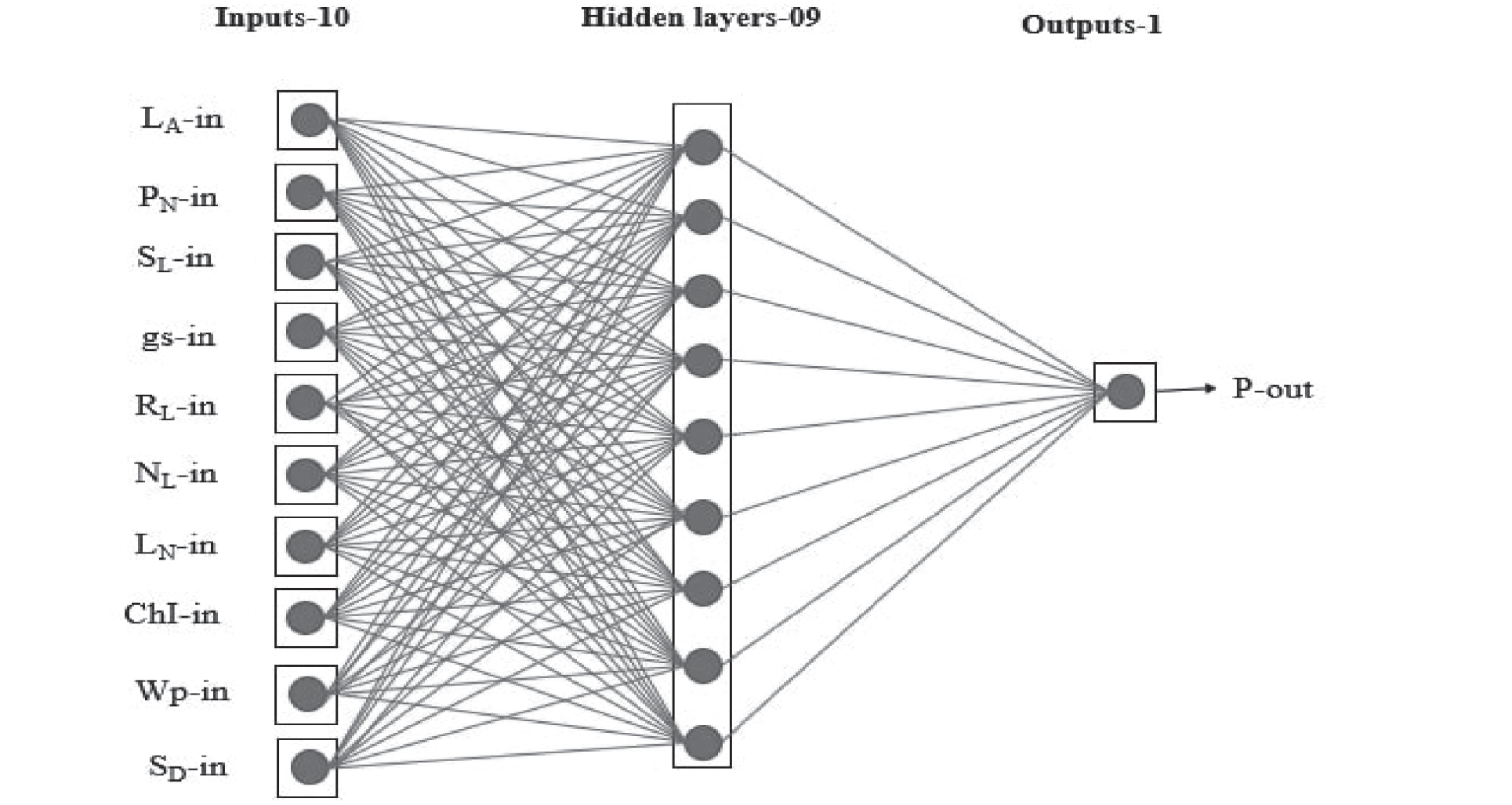
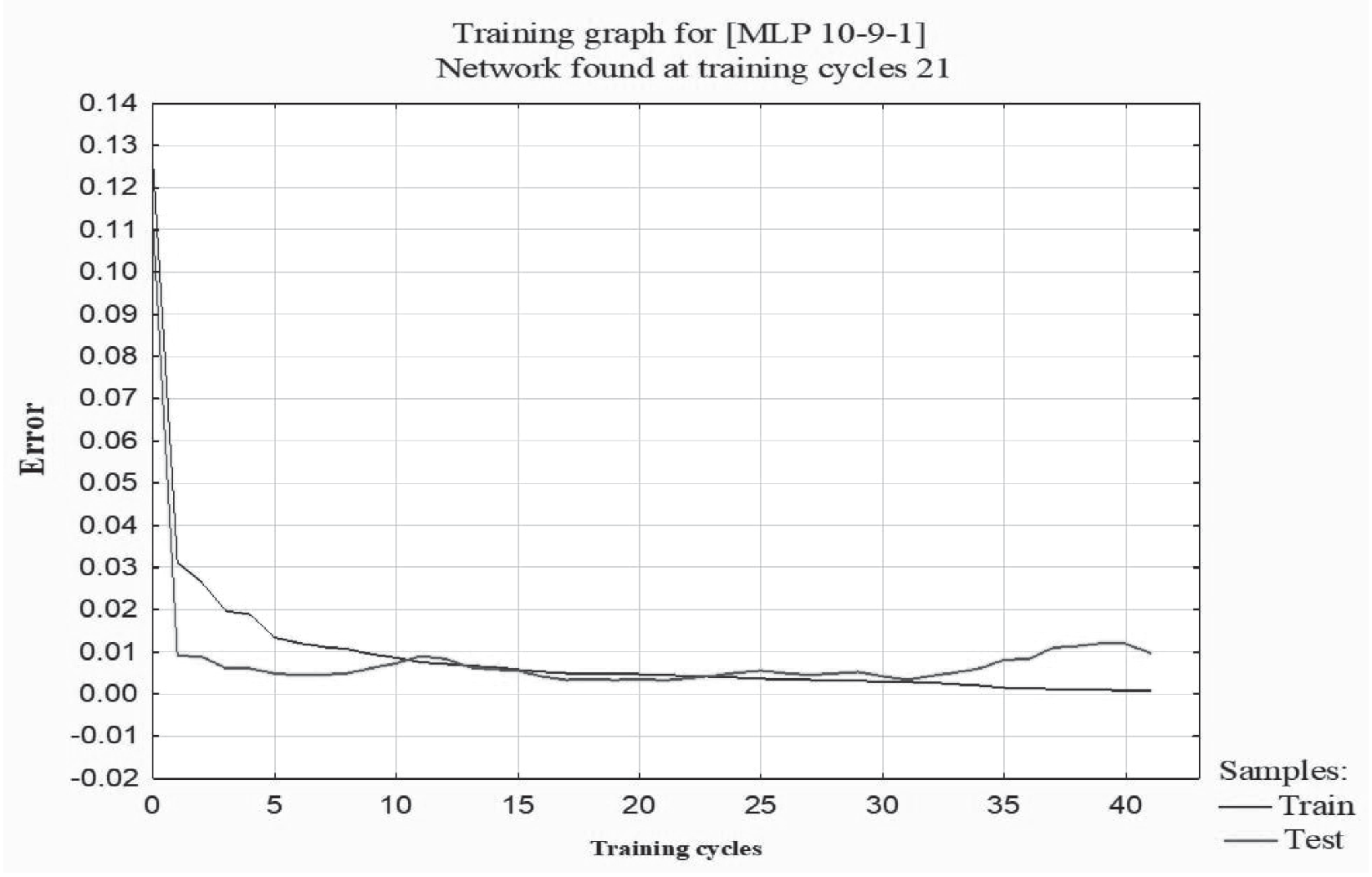
In this study prediction dry weight growth model of W. trilobata was developed under nitrogen enrichment and flooding conditions. The purpose of this model is to find out which growth parameters assist W. trilobata in its sustainable growth under nitrogen enrichment and flooding conditions. This finding can be helpful to control the spread of invasive plant species under these conditions by controlling the most important growth parameters. A neural network model based on the multilayer perceptron (MLP) was generated with 10 neurons at the input network, 9 neurons in the hidden layer, and 1 neuron in the output layer as shown in Fig. 1. The applied learning method was single stage network. Broyden-Fletcher-Goldfarb-Shanno gradient (BFGS) network was used to train the network. The optimal result was achieved in the 21th epoch Fig. 2.
BFGS method also known as metrics method belongs to quasi-Newton class. It is characterized by high constancy and low sensitivity to reduce errors and does not use the Hesse matrix [34].
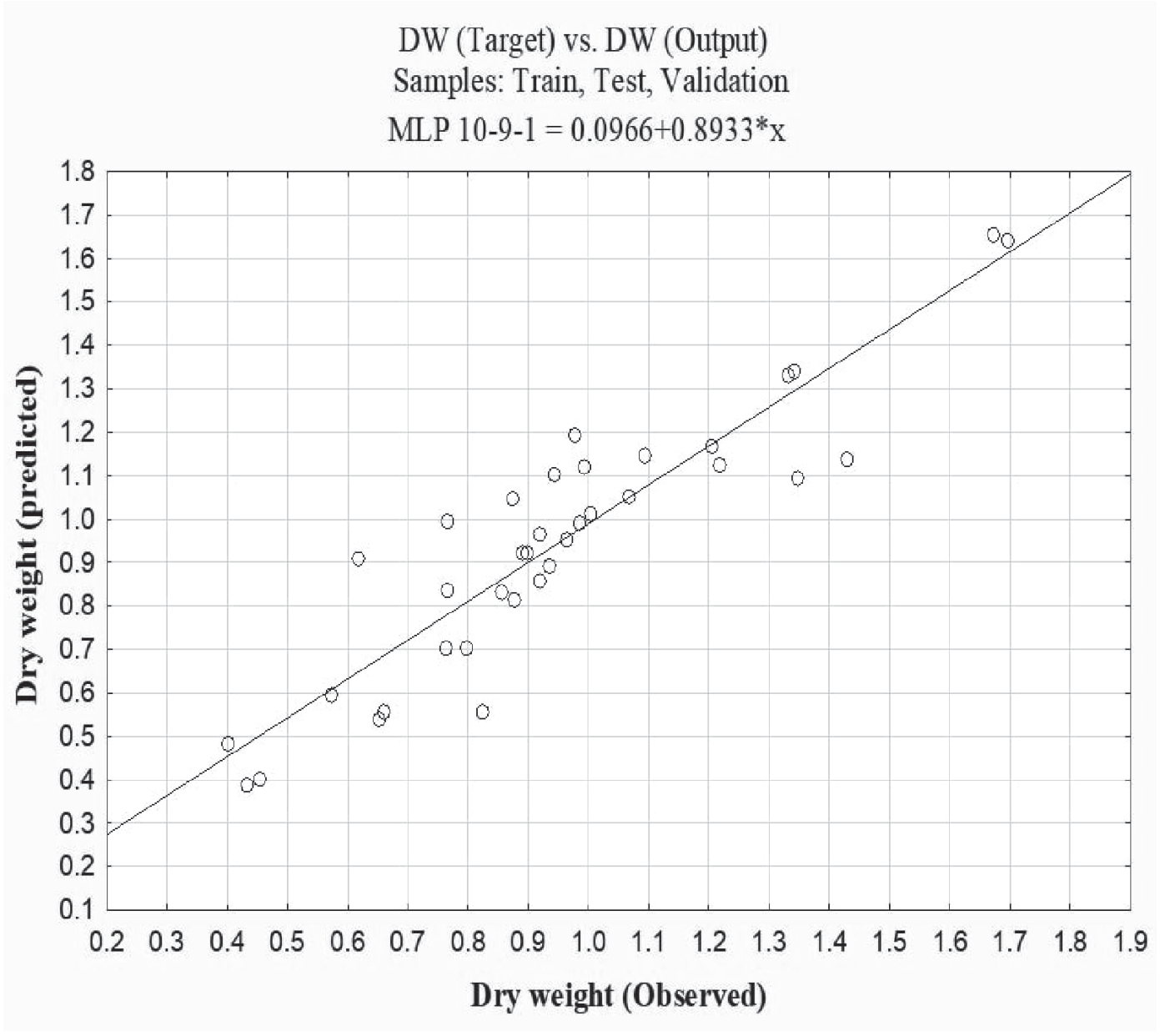
The growth parameters used as a performance indicators of the neural model were satisfying the performance of constructed model. The testing, training, and validation errors were below 0.01, and the correlation was 0.90. The other important information of the selected model is shown in Table 2. The constructed model’s validation was checked using equations (1-4), and the results are shown in Fig. 3. At the end, the sensitivity analysis of the constructed neural network was done. It showed a significant impact on all the used growth parameters to predict W. trilobata dry weight because all growth parameters had a quotient error greater than one, as shown in Table 3. The most influential parameter was leaf area with a quotient error 6.37. The water potential was ranked 2nd, while the rank of all other parameters regarding their quotient error values are shown in Table 3. The graph between the observed and predicted values were showed the significance of the constructed model in Fig. 4.
Invasive plant species are a major threat to the native biodiversity [35]. People are trying to manage its growth by using different cultivation techniques, planting methods and fertilizers [5]. In the last ten years, a trend of using modern skills and technologies have emerged in the agriculture sector in order to develop a better understanding of the relationship among many processes occurring in nature. These processes include crop yield prediction, growth response under different environments, seed germination, and growth trait parameters that boost plant growth under different environmental conditions [34, 36]. Many researchers used artificial neural network modeling to develop different models to stimulate seed germination, crop growth, and oil content by using different growth parameters [17]. However, in ecological section for invasive plant species, there is a lack of these developed models that could precisely simulate invasive plant species’ growth and its spread under different environmental factors [37, 38]. These predicted models could be very useful for managing the spread of invasive plant species under different environmental conditions [32]. They described, which growth parameters helps invasive plant species to boost their growth under these given environmental conditions [39]. In this study, a multi criteria model of W. trilobata dry weight was produced using different growth trait parameters under flooding and nitrogen enrichment to stimulate wetland conditions. Modeling was done by dividing the data into training 70%, testing 15% and validation 15%. The model (10-9-1) was produced with 10 independent growth trait parameters, used as input variables, and one hidden layer and one output variable (dry weight) as shown in Table 1.
Table 2.
Structure and quality of neural network model.
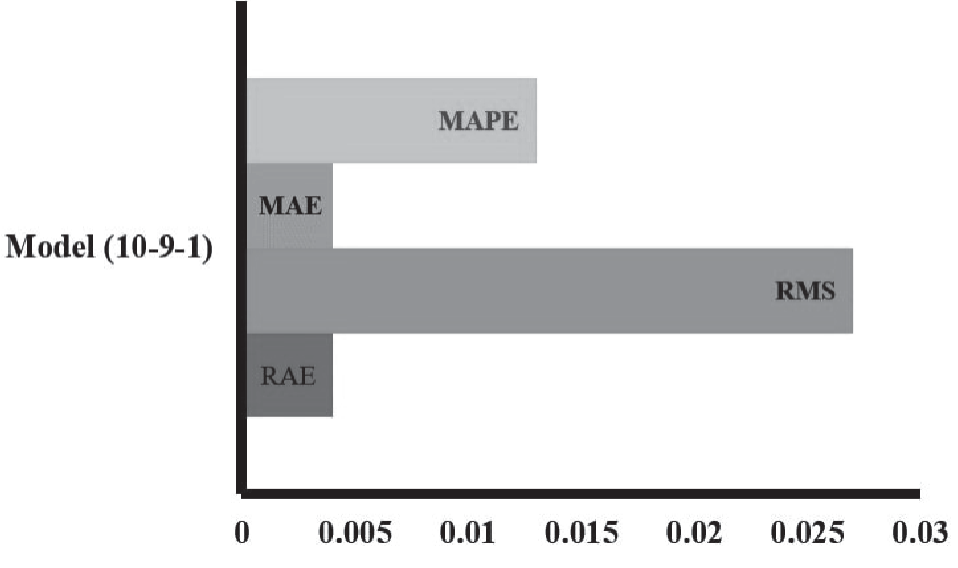
Table 3.
Sensitivity analysis of neural network.
The main issue in the prediction growth model is the selection of the best suitable network topology [1, 3]. In this study, the best network topology with multilayer perceptron (MLP) architecture was selected by trial-and-error method [20, 40]. In plant growth model, MLP architecture was used because its gave better results [34, 41]. A good model should accurately explain the dynamic behavior of the system. This indicating that under construction model should be alike to the empirical system, from which data are taken for research, calculations and analysis [42]. Relative approximation error (RAE), root mean square error (RMS), mean absolute error (MAE), and mean absolute percentage error (MAPE) were determined as shown in Fig. 3, for the selection of the best model. MAPE is the most commonly used error indicator for selecting the best model [43] and its value is very low in this constructed model (10-9-1). The degree of fit in the constructed model was determined through the error values. If the error values were below 10%, the degree of fit is considered to be perfect. Whereas, in case the values were below 20%, the degree of fit is considered to be good. Moreover, if error values were greater than 30%, the degree of fit was classified as bad. In this study, all errors values were below 10%, so degree of fit for the constructed model was perfect [21].
In the next step, sensitivity analysis was done to check the validation of the model. The highest rank 1 was obtained for leaf area as shown in Table 3. This indicated that the leaf area had the highest influence on the dry weight production of W. trilobata under flooding and nitrogen enrichment [44]. It was also interpreted that the leaf area played an important role in the successful invasion of invasive plant species in flooding and nitrogen enrichment because the leaf area controls photosynthesis, respiration and evapotranspiration [7, 45]. Water potential was ranked 2nd as it played an important role in the plant growth. The plant water status is an essential factor for invasive plant growth development because it controls the plant’s water and nutrients requirement [12]. The variations in the water status affected the opening and closing of stomata [17]. In this study, W. trilobata maintained its water status due to this, stomatal conductance is ranked 6th. Photosynthesis is a other main feature for plant growth because 90% plant growth depends on it [45, 46]. Whereas, nitrogen is the main nutrient that boosts the photosynthesis process [28], due to this photosynthesis ranked 3rd. The hypothesis of this study was strengthened with sensitivity analysis findings because it gave the most important growth trait parameters (leaf area, water potential and photosynthesis) that boost the dry weight of W. trilobata under flooding and nitrogen enrichment conditions. The predicted model provides two directions by controlling the growth of invasive plant species under these conditions including: 1) reducing the amount of nitrogen in water; and 2) controlling the growth of the most important growth traits. Flooding creates oxygen deficiency that reduce the growth of W. trilobata [47]. While, nitrogen enrichment alleviates the effect of flooding and gives strength to plant in order to sustain its growth under flooding and nitrogen enrichment [48]. Plant leaf area is correlated with amount of nitrogen in the water [49]. While decreasing the amount of nitrogen also affects the growth of leaf area that reduce the photosynthesis and plant water status, thereby adversely impacting the growth of plant. On the basis of the above findings, it should be noted that the prediction of W. trilobata dry weight with the use of artificial neural network, gives acceptable prediction results. However, in order to optimize the models, further research work should be done to obtain more data from the fields to carry out further analysis of the independent factors in the models.
Conclusions
In short, there are many different multivariate regression models to figure out most valuable associated traits that have greatly influence in plant growth production under different environmental conditions but these multivariate regression models are unable to explain complex relationship between independent variables. Furthermore these models are also unable to intercept the complex relationship between dependent and independent variables, specially when non-linear relationship prevailing. One of the best method to overcome these shortages in plants growth prediction is ANN. In this current study dry weight prediction model of W. trilobata was made with different growth traits parameters under flooding and nitrogen enrichment conditions by using ANN. For the management purpose, we can use this model to control the spread of W. trilobata under these conditions by resisting the growth of the most important growth parameters. This research will help to manage the spread of invasive plant species under different environmental conditions.

