

Introduction
Landfill leachate, as extensively studied by researchers, is a highly contaminated liquid comprising high concentrations of inorganic ions, organic compounds, and various toxic elements such as heavy metals and ammonia [1]. It is formed when excess rainwater permeates through the waste layers of landfills and subsequently infiltrates the soil, eventually finding its way into groundwater or surface water bodies [2]. Studies have identified four primary chemical compound groups in landfill leachate: dissolved organic matter, inorganic components, heavy metals, and xenobiotic organic compounds [3]. Furthermore, landfill leachate exhibits wide contamination ranges and rapid pollution propagation. Improper management of landfill leachate can lead to its downward migration, resulting in groundwater contamination. It also exacerbates heavy metal pollution in the surrounding soil, impacting the redox conditions, pH levels, oxygen content, and microbial activity of the adjacent soil [4-7]. Moreover, it facilitates the leaching of heavy metals from landfill waste and even accelerates the release of naturally occurring metal elements present in the surrounding soil. Given the increasing global population and urbanization levels, municipal solid waste generation has reached alarming levels, consequently leading to a proportional increase in landfill leachate production [8-11]. Consequently, there is an urgent need to treat the significant volume of landfill leachate. Therefore, numerous scholars have directed significant attention toward the research and development of landfill leachate treatment technologies [12-14].
Disposal of landfill leachate has attracted widespread attention among scholars, and significant progress has been made in various research aspects. However, in order to gain a comprehensive understanding of the existing knowledge domain and explore potential research directions, it is necessary to provide a comprehensive overview of this field. Bibliometric analysis is a valuable statistical method that can reveal the evolution of specific research topics and provide insights into research trends and emerging interests [15-17]. While some review papers have covered topics such as environmental impacts, treatment by membrane filtration, ozonation systems, and so on [18, 19], these reviews are limited to specific research areas and lack a comprehensive bibliometric analysis of the disposal of landfill leachate research. Therefore, the application of bibliometric analysis is imperative to provide a holistic perspective, highlight key aspects, and guide future research.
In this paper, a bibliometric approach is adopted to analyze the literature, construct a knowledge map, and quantitatively evaluate the research progress on the global disposal of landfill leachate from 1996 to 2022. By employing multiple criteria, the literature is subjected to in-depth analysis and data-driven bibliometric research is conducted, providing valuable indicators for further research in this field. The organization of the remaining sections is as follows: In Section 2, the literature data retrieved for this study, as well as the bibliometric methods and software used, are introduced. In Section 3, the results of the bibliometric analysis are presented, including publication quantity and trends, collaboration networks, research hotspots and keyword analysis, as well as knowledge mapping. Sections 4 and 5 delve into the current research hotspots, offer insights into future research directions, and summarize the findings of this paper.
Data Acquiring and Method
Literature Dataset Acquisition and Compilation
The initial and crucial step in conducting bibliometric analysis involves selecting appropriate databases and predefined search criteria. The Web of Science databases, which include the Science Citation Index Expanded (SCIE), Social Sciences Citation Index (SSCI), and Arts Humanities Citation Index (A&HCI), are widely recognized platforms extensively utilized in academic research. These databases are comprehensive, multidisciplinary, and encompass core journals, making them highly valuable for literature reviews and bibliometric analysis across various fields of study. In our study, we employed the Web of Science database, specifically the Science Citation Index (SCI), renowned for its significant international influence in the realm of science and engineering research. This database provides a user-friendly and comprehensive search interface that allows for the utilization of logical operators such as “AND,” “OR,” and “NOT” to refine the search parameters. For our study, a topic-based search was performed using the following search formula: TS = (“Landfill leachate” OR “ Garbage leachate”) AND TS = (“Disposal” OR “Treatment”). Only research articles were selected, and the document type was restricted to research articles. The search timeframe was set from January 1, 1996, to December 31, 2022. After the retrieval process, 1095 articles were retrieved. Then a manual review of the titles and abstracts of the retrieved articles was conducted to eliminate irrelevant and duplicate documents. Ultimately, a total of 959 relevant articles were obtained. To facilitate knowledge mapping analysis, the “All Records and References” and “Full Record” information of 959 article documents were exported from the database in both plain text and Excel formats. This compiled dataset, consisting of the 959 articles, serves as the sample for conducting knowledge mapping analysis.
Method for Bibliometric
In this study, CiteSpace, a software developed by Dr. Meichao Chen from Drake University in the United States, was utilized for conducting the bibliometric analysis. CiteSpace, programmed in Java (version 6.2.R4), employs co-citation analysis to visualize and analyze the imported literature dataset [20, 21]. It offers various visualization functions, including collaboration networks, literature coupling, and clustering of research hotspots. Moreover, CiteSpace calculates the strength of relationships between nodes pertaining to a specific scientific question, enabling the conceptualization and visualization of research hotspots.
To commence the analysis, the literature dataset was imported into the CiteSpace software. By adjusting the visualization parameters, knowledge maps were created to achieve the desired objectives of scientific measurement analysis. This study conducted bibliometric analysis from four perspectives: analysis of publication output characteristics, collaboration analysis, co-occurrence analysis of keywords, and clustering analysis. These analyses collectively led to the generation of a comprehensive knowledge map.
Results and Discussion
Annual Publication Numbers and Publication Trend
Tracking the number of publications in the field of disposal of landfill leachate is a key metric for assessing the advancement of research in this area. Analyzing the publication trends over time provides valuable insights into the developmental stages and enables researchers to anticipate future directions [22].
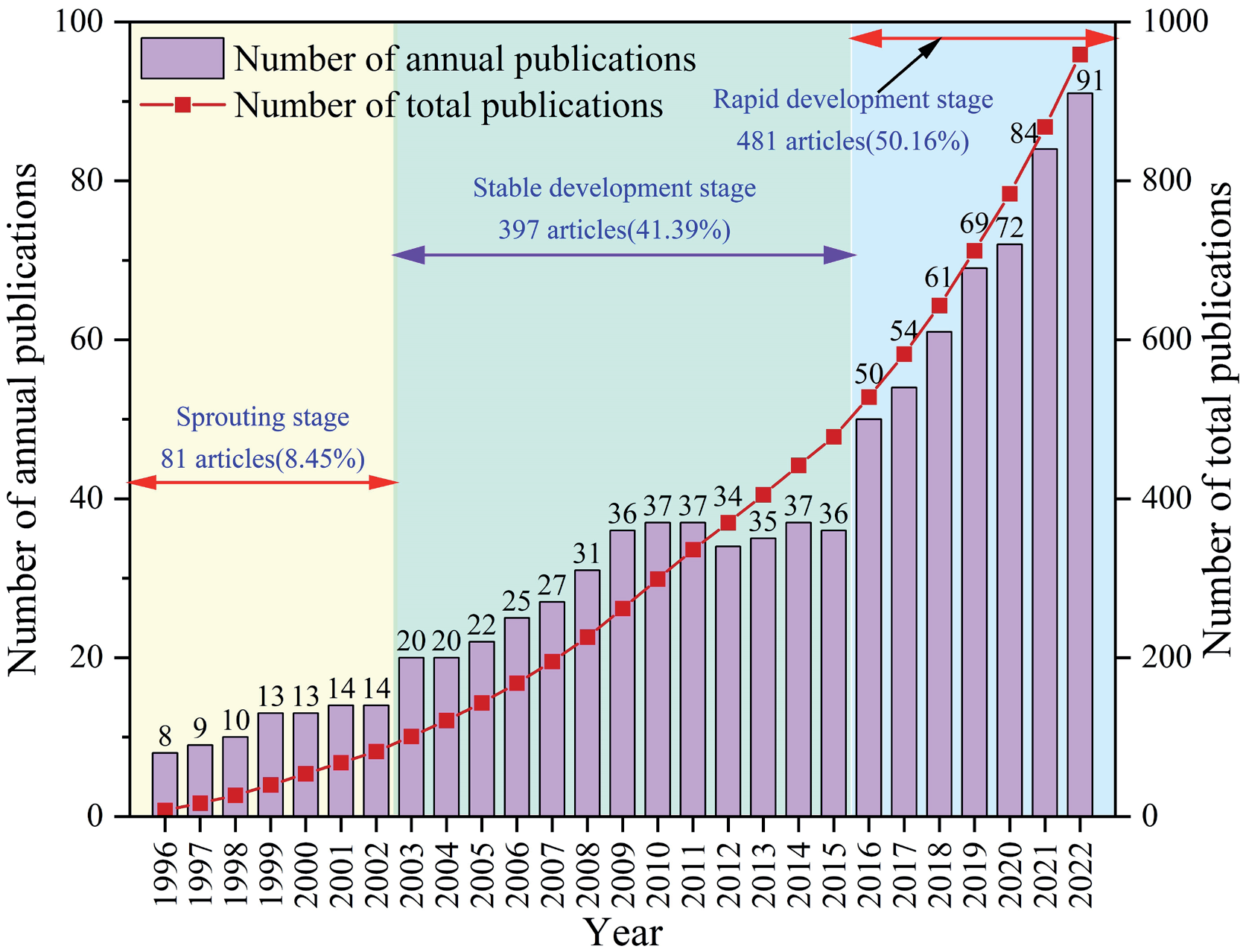
Fig. 1 shows the annual publication count and cumulative publication count derived from the retrieved dataset, illustrating the publication trends in the field of disposal of landfill leachate. The first research article in this area was published in 1996, and since then, the number of publications has exhibited a consistent upward trajectory, reflecting the growing research interest in this field. Based on the annual publication count, the research progress can be classified into three distinct stages:
Sprouting stage (1997-2002): During this stage, a total of 81 articles were published, constituting only 8.45% of the total publications. This indicates that disposal of landfill leachate was still in its nascent phase and received limited attention from scholars. However, there was a slight increase in the number of articles from 8 in 1996 to 14 in 2002 indicating a gradual growth of interest during this stage.
Stable development stage (2003-2015): In this stage, the number of articles significantly increased compared to the previous stage, with a total publication count of 397,constituting 41.39% of the total publications. This period marked a stable academic focus on disposal of landfill leachate issues during the construction and operation stages of environmental engineering projects.
Rapid development stage (2016-2022): The number of publications experienced a sharp growth trend, reaching its peak in 2022 with 91 articles, which was almost double the count in 2016 (50 articles). A total of 481 articles were published during this stage, accounting for 50.16% of the total. This indicates that disposal of landfill leachate has gained widespread attention from the academic community and entered a phase of rapid development.
International Collaborative Networks Analysis
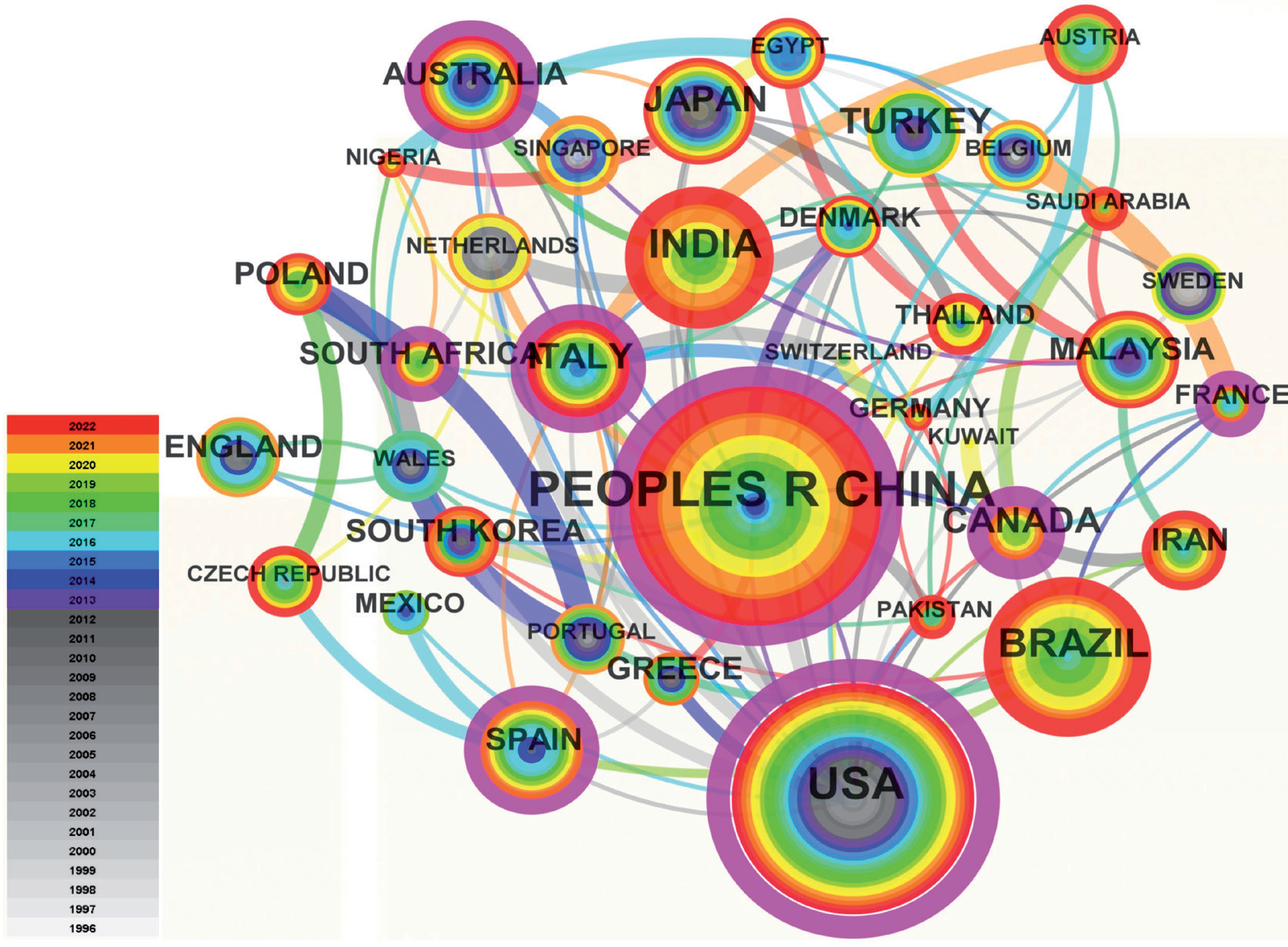
Using the CiteSpace software, an analysis and visualization of the co-occurrence network knowledge map were conducted to explore international collaboration relationships in the field of disposal of landfill leachate, as depicted in Figure 2. In the figure, each node represents a country, and the size of the node reflects the number of publications originating from that country. The colored rings correspond to different years, with the thickness of the rings indicating the number of publications in each respective year. The connections between nodes represent co-authorship relationships between countries, and the thickness and darkness of the lines represent the strength of the collaboration relationships [22, 23].
A total of 90 countries/regions have made significant contributions in the field of landfill leachate treatment. Among them, the top 10 countries in terms of total publications include China (155 articles), the USA (140 articles), India (74 articles), Brazil (73 articles), Italy (46 articles), Turkey (44 articles), Canada (38 articles), Japan (36 articles), Australia (32 articles), and Malaysia (32 articles). It is noteworthy that both China and the USA far exceed other countries in terms of publication output, with China publishing twice as many articles as the third-ranked India, thus holding an absolute core position in the global research field of landfill leachate treatment. Despite having a slightly higher publication output than the USA, an analysis of the network knowledge map reveals that China’s connections with other countries are relatively weak, indicating a lower level of international collaboration activity. On the other hand, the USA, which also occupies a central position, demonstrates strong connections with other countries, reflecting a higher level of international cooperation.
Co-citation Analysis of Literature
Through the analysis of literature citations, influential articles in the field of disposal of landfill leachate can be identified, and the citation rate of an article is considered a significant indicator of its research value [24]. Journals with higher citation frequencies are generally regarded as more authoritative and influential within the field. The Waste Management, Journal of Hazardous Materials and Water Research hold top 3 positions in the knowledge graph towards disposal of landfill leachate, suggesting strong connections with other journals. Table 1 provides detailed information on the top 5 most cited articles. It is essential to acknowledge that the citation frequency presented here is derived from CiteSpace based on a selected set of 959 articles, and thus may differ from the total citation frequency reported in the Web of Science database.
Fig. 3.
Keyword co-occurrence network knowledge map of disposal of landfill leachate from 1996 to 2022.
The analysis of the top 5 articles and a comprehensive literature review suggests that current research on landfill leachate treatment primarily focuses on two main aspects. Firstly, there is a significant emphasis on identifying the composition of pollutants in landfill leachate and assessing the corresponding biochemical pollution levels. Studies such as Przydatek et al.’s [25] analysis of groundwater physicochemical elements near a municipal solid waste landfill provide insights into the impact of leachate on groundwater quality, highlighting increased levels of certain elements like Cd, electrical conductivity (EC), and total organic carbon (TOC); as indicators of leachate’s negative effects. Secondly, researchers are dedicated to seeking efficient and practical pollution treatment processes based on the determination of pollution levels. For instance, Sohoo et al. [26] conducted experiments comparing conventional landfill conditions (CLF) and bioreactor landfill conditions (BRLF) to assess the impact of moisture and leachate recirculation on waste stabilization. The study suggests that optimal air distribution in low-moisture landfills enhances waste oxidization and stabilization. Overall, the current research direction in landfill leachate treatment focuses on understanding the composition of pollutants, assessing their impact on the environment, and developing effective treatment processes based on pollution levels. This knowledge is crucial for improving waste management practices and minimizing the adverse effects of landfill leachate on the surrounding ecosystems.
Table 1.
Top 5 cited articles towards disposal of landfill leachate from 1996 to 2022.
Keywords Co-ocurrence Analysis
Analysis of Keywords Co-Ocurrence and Citation Burst
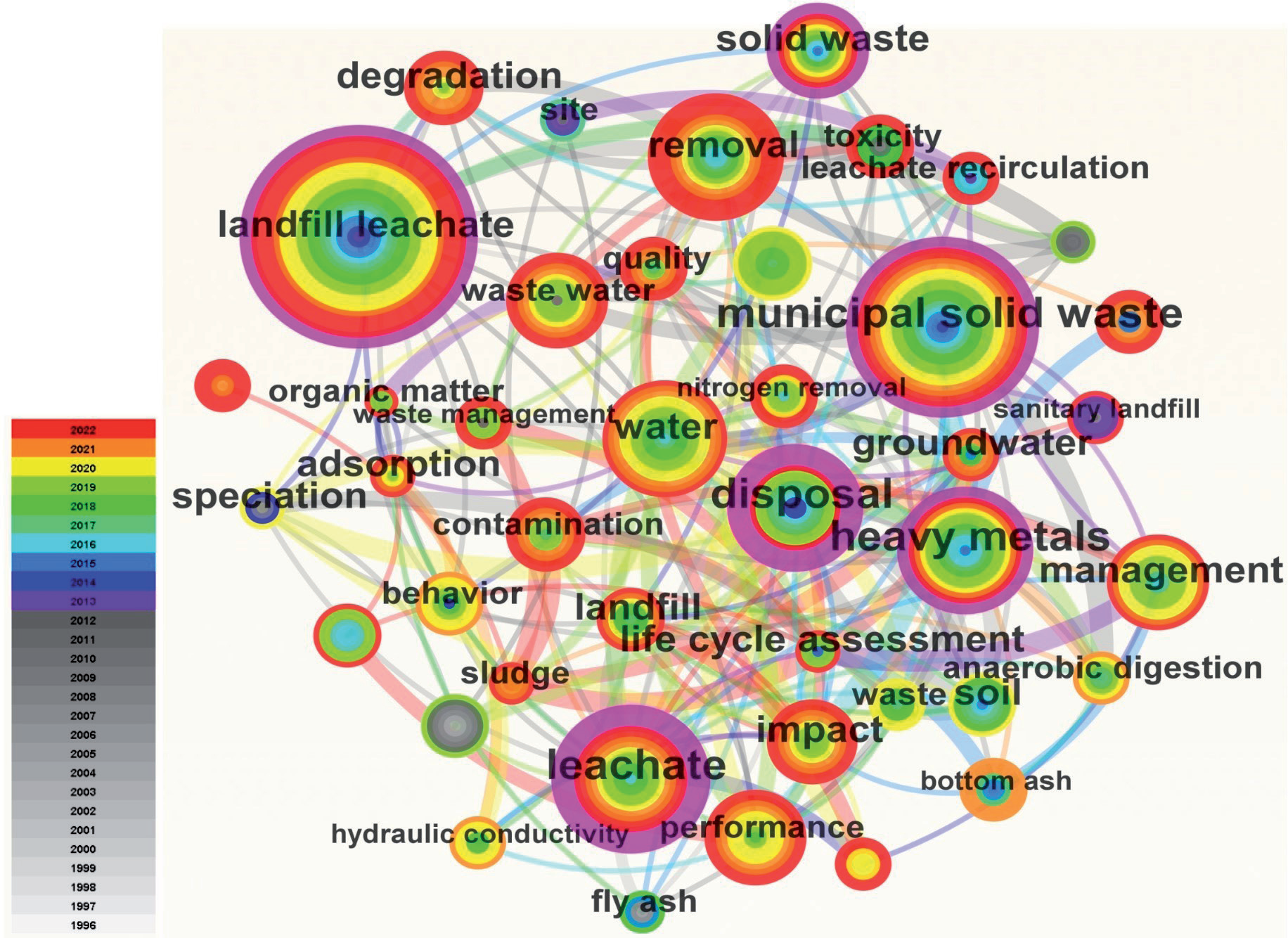
Keyword co-occurrence analysis is a valuable approach that enables a comprehensive understanding of research topics and issues in a specific field [30]. This analysis involves three methods: keyword co-occurrence network, keyword temporal network, and keyword clustering. In the first two methods, keywords are represented as nodes, with node size indicating the frequency of occurrence. Larger nodes indicate higher occurrence frequency, and the size is proportional. The color of the node represents the publication year. When keywords appear together in a document, a connection line is drawn between them. The color of the line corresponds to the year, and its thickness represents the strength of co-occurrence, while the color also indicates the time of occurrence of the keyword. The keyword co-occurrence network knowledge map in disposal of landfill leachate research is shown in Figure 3.
In this network, the size of the keywords is proportional to their frequency of occurrence. Keywords with a frequency exceeding 100 include “municipal solid waste” (frequency = 214), “heavy metals” (frequency = 188), “management” (frequency = 152), “degradation” (frequency = 124) and “adsorption” (frequency = 105). It is important to note that the keywords “landfill leachate”, “leachate” and “disposal” have been excluded as they do not describe the current research trends. There are interrelationships among keywords, with some keywords exhibiting higher research frequencies. However, the overall research trend appears to be diverse. Clearly, the keyword “municipal solid waste” has the highest frequency of occurrence in the past two decades. With the continuous development of urbanization, the increasing amount of municipal waste has raised concerns about environmental issues. Consequently, the disposal of landfill leachate has become a focal point of research, particularly focusing on its classification and the adsorption and treatment of hazardous heavy metal substances.
Keyword co-occurrence analysis can provide detailed information on the hot topics in a given field, but the results cannot be used to analyze development trends, especially the latest trends in the field. Keyword citation burst refers to a sharp increase in the usage of certain keywords during a specific period, which can partially reflect the dynamics and potential research issues in a particular field.
Table 2.
Top 10 cited articles towards disposal of landfill leachate from 1996 to 2022.
Table 2 presents the top 10 keyword burst citations from 1996 to 2022, illustrating the blasting keywords associated with the disposal of landfill leachate, including the objects, content, purposes, methods, and research scale. These keywords have been widely discussed and investigated by scholars in this field. Their appearance can be traced back to 1997, with a concentrated burst period that spans the entire research period. The blasting keywords, in chronological order, are as follows: Fly ash, Hazardous waste, Speciation, Oxidation, Toxicity, Pretreatment, Solid waste, Management, Wastewater, and Sludge. This indicates that the pollution factors, extent of contamination, pollution grading, and corresponding treatment strategies for landfill leachate have received extensive and close attention throughout the entire period.
Keyword Clustering Analysis
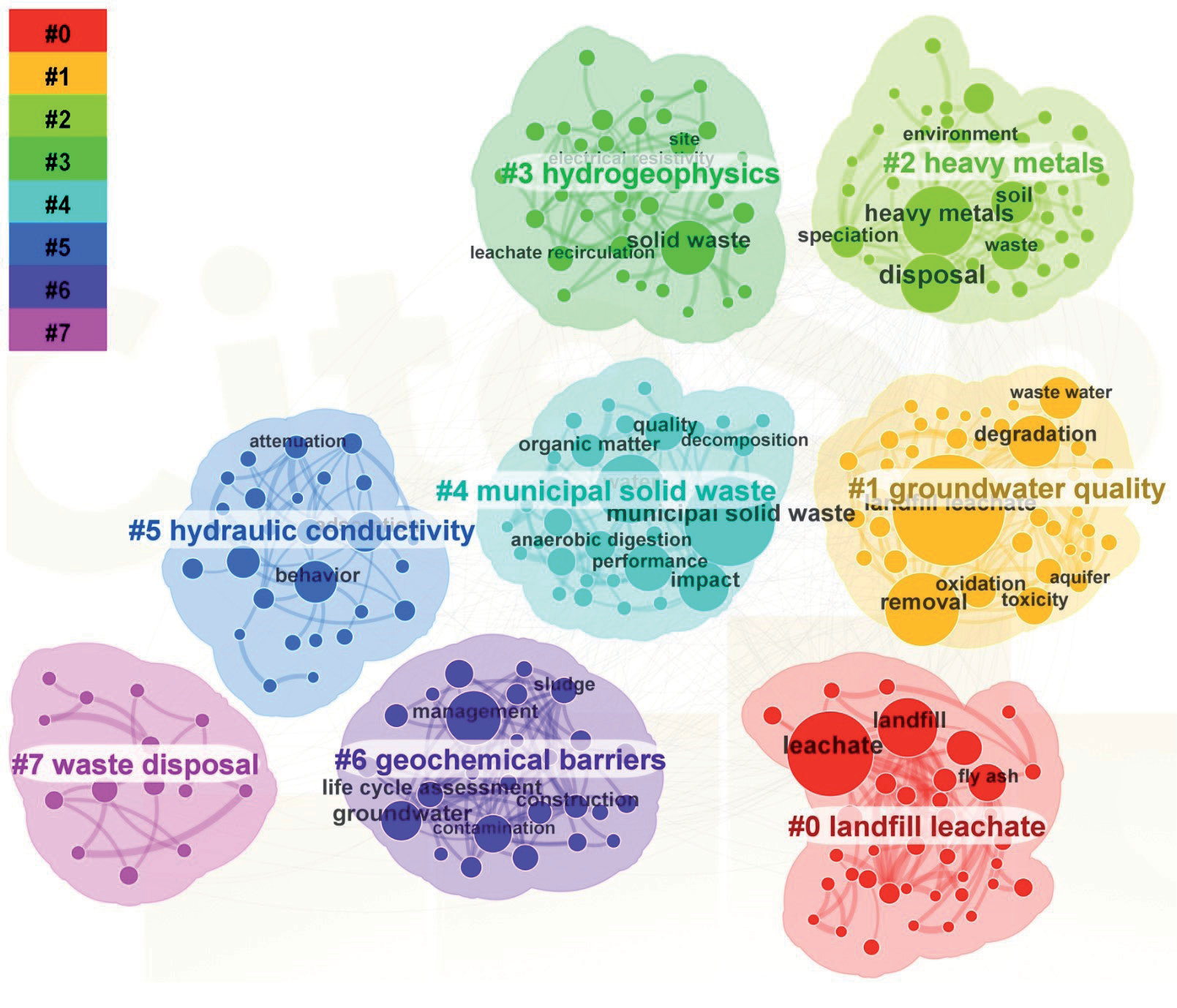
Clustering analysis is a valuable data mining technique that uncovers hidden semantic themes in textual data. CiteSpace enables users to cluster research data based on nouns or keywords found in the literature. Clustering labels can be generated using algorithms like latent semantic indexing (LSI), log-likelihood ratio (LLR), or mutual information (MI) [31]. By applying the LLR algorithm, keyword clustering was conducted in this study, grouping similar keywords into topics and dividing the research data into distinct units, as depicted in Fig. 4. Each cluster is named after the algorithm’s highest value, with clusters ranked by the number of keywords they contain. The size of each unit represents the number of articles, and the clustering module achieved a Q value of 0.6742, indicating a significant clustering structure (Q>0.3). The average silhouette value (S) of 0.7726 indicates reasonable clustering (S>0.5) and substantial clustering (S>0.7) [21, 23]. Thus, the generated knowledge map of clusters can be employed for hotspot analysis. Since the text data is centered around landfill leachate, the cluster associated with landfill leachate is labeled as #0.
Fig. 4 reveals a network comprising 7 distinct modules: Cluster #1 – groundwater quality, Cluster #2 – heavy metals, Cluster #3 -hydrogeophysics, Cluster #4 – municipal solid, Cluster #5 – hydraulic conductivity, Cluster #6 – geochemical barriers and Cluster #7 – waste disposal. These clusters cover a significant portion of the literature and represent the primary research topics in the field. Interconnections and overlaps between clusters suggest associations and interdependencies among them. It is worth noting that groundwater quality (#1) serves as a crucial indicator for assessing the criteria and effectiveness of landfill leachate disposal, making it the most prominent theme directly impacting the progress and stability of relevant environmental engineering projects. Heavy metals (#2) in landfill leachate, particularly those originating from municipal solid waste (#4), are the primary pollutants that significantly affect the quality (#1) and hydraulic conductivity (#5) of groundwater. This concern has stimulated and facilitated the establishment of geochemical barriers (#6) based on hydrogeophysics (#3) and waste treatment (#7) approaches.
Future Research Perspectives
Based on an analysis of keywords and clustering terms, along with a review of highly cited literature in disposal of landfill leachate, the following future research directions in this domain can be identified:
(1) Research on Comprehensive Treatment Technology for Leachate: With the increase in population, the quantity of waste accumulated in open dumpsites and landfills continues to grow. Consequently, the volume and pollution level of leachate have significantly escalated. Therefore, it is necessary to strengthen the research on comprehensive treatment technology for leachate to effectively manage and reduce the adverse environmental impact of leachate.
(2) Strategy for Recycling Leachate: Policymakers aim to implement strategies for energy recovery and the recycling of leachate. Future research should focus on developing feasible techniques and methods to facilitate the resource utilization of leachate, thereby reducing dependence on natural resources and enhancing the sustainability of waste management.
(3) Characteristics and Assessment of Pollutants: Currently, there is insufficient assessment of the potential binding of toxic metal ions with dissolved organic matter (DOM) in landfill leachate. This area of research holds great significance for environmental scientists, landfill managers, and officials. Future studies should concentrate on the biogeochemical cycling of pollutants, emerging contaminants (such as per- and polyfluoroalkyl substances and microplastics), as well as the evaluation of toxic trace metals like mercury. This comprehensive understanding of the impact and risks posed by pollutants to the environment is crucial.
Conclusions
In this study, a bibliometric analysis was conducted using CiteSpace software to review the research on disposal of landfill leachate from 1996 to 2022, based on a dataset of 959 literature sources, which can reduce distortion and bias caused by subjective information filtering by comprehensively mining research foundation literature. Various aspects, including publication quantity and trends, international collaborative networks, co-citation literature, keyword co-occurrence, citation burst and clustering, were analyzed providing potential prospects for future research for researchers and practitioners. The findings of this study are as follows:
(1) By analyzing the publication quantity and trends, the development of research related to disposal of landfill leachate has exhibited an upward trajectory, characterized by three stages in terms of publication volumes: the sprouting stage, the stable development stage and the rapid development.
(2) A total of 90 countries/regions have made significant contributions to the field of landfill leachate treatment. Among them, China, the USA, India, Brazil, Italy, Turkey, Canada, Japan, Australia, and Malaysia are the top 10 countries in terms of total publications. It is worth noting that both China and the USA have a significantly higher publication output compared to other countries, with China leading the field by publishing twice as many articles as the third-ranked India.
(3) The journals Waste Management, Journal of Hazardous Materials, and Water Research are ranked among the top three publications in the field of landfill leachate treatment. The analysis of the top five cited articles, keyword co-occurrence and a comprehensive literature review suggests that current research on two main aspects. Firstly, identifying the composition of pollutants in landfill leachate and assessing the corresponding biochemical pollution levels. Additionally, seeking efficient and practical pollution treatment processes based on the determination of pollution levels.
(4) Cluster analysis identified seven major clusters that represent the current research topics: #1 groundwater quality, #2 heavy metals, #3 hydrogeophysics, #4 municipal solid, #5 hydraulic conductivity, #6 geochemical barriers and #7 waste disposal.
(5) Future research directions in the field encompass the study of comprehensive treatment technologies for landfill leachate, exploration of strategies for the recycling of waste leachate, and in-depth investigations into the characteristics and assessment of pollutants. These studies will contribute to enhancing the efficiency and sustainability of waste management while minimizing the adverse environmental impacts.

