

Introduction
As a policy tool to resolve the inequality of income distribution, financial transfer has an important impact on income redistribution [1]. Financial transfer is a financial channel that causes income redistribution of participants in financial activities [2], there are three main ways that financial transfer affects farmers’ income distribution: (1) Regulate the redistribution of farmers’ income by affecting the development of rural economy [3]. Rural economic development will affect rural access to credit resources. The rural economic subjects who obtain credit funds will expand the scale of agricultural production and improve the efficiency of agricultural production, so as to obtain more income distribution [4]. (2) The effect of inflation on income and wealth redistribution in rural areas [5]. In case of inflation, the cash assets in rural areas will shrink significantly. Due to the lack of capital in rural areas, the proportion of labor income in total income will be larger, and the appreciation space of less fixed assets is limited. Rural areas tend to be more affected by the redistribution of wealth than cities and towns [6]. (3) Influence the redistribution of farmers’ income through the path of public expenditure [7]. In public expenditure, the government tends to provide more public expenditure for cities, which will affect the coordinated development of urban and rural areas [8-9].
Financial transfer in our financial system has produced financial rent and financial subsidy under the state property right, the former is obtained by the regular financial institution and the latter by the state sector [10]. There are a large number of financial transfers in urban and rural areas, which play an important role in urban development, but fail to play a role in promoting the growth of rural economy, which expands the regional economic gap and causes more unequal income distribution [11]. In our current distribution system, it is not only the economic bodies such as financial institutions and urban residents that get the financial transfer, but also the agricultural department and rural residents [12]. As a result, the innovation of this article is under the perspective of financial transfer, the introduction of bilateral stochastic frontier approach, building contains financial transfer channels of farmers’ income distribution measure model, through testing different financial transfer channel for farmers income distribution effects, to increase farmers’ income, reduce the inequality of income distribution, urban and rural development as a whole, Realizing the sustainable development of our country’s economic society has a vital significance [13].
In the area of environmental pollution affecting income distribution, Zhao et al. argue that carbon dioxide emissions in Russia and South Africa can ameliorate income inequality. Li et al. argue that environmental pollution in the source country will widen the income gap between skilled and unskilled workers, and that brain drain caused by environmental pollution will magnify this effect. In addition, improving environmental quality in recipient countries would widen the gap between skilled and unskilled income in source countries.
The text structure of this paper is as follows: the second part discusses the literature review related to income distribution; The third part introduces the bilateral stochastic frontier model, data sources and index selection; The fourth part is an empirical study on the impact of financial transfer path on Farmers’ income distribution; The fifth part is a brief section.
Literature Review
At present, domestic and foreign scholars’ research on income redistribution mainly focuses on the following two aspects:
On the one hand, it is found that the purpose of fiscal policy tools is to adjust redistribution and reduce income inequality. Wang et al. believe that although the ratio of tax to GDP is much higher, the impact of social welfare expenditure on income redistribution still exceeds that of tax [14]. Martinez-vazquez et al. used multiple linear regression method to analyze panel data of 150 countries from 1970 to 2006 and found that health expenditure in public services had a stronger effect on reducing income inequality than tax, while consumption tax, social security tax and education expenditure aggravated income inequality [15]. Higgins et al. believe that the redistribution function of fiscal policy is to reduce inequality and reduce the scope of poverty. The redistribution function of fiscal policy can be divided into direct redistribution and indirect redistribution. The former refers to the state through tax means to tax enterprises and individuals directly to adjust the redistribution; The latter redistributes directly to specific social groups through means of social welfare expenditures, such as pensions, disability benefits and unemployment benefits. As for the effects of the above two direct measures, it is generally believed that social welfare expenditure has a greater impact on redistribution [16]. By analyzing the income distribution of 17 Latin American countries in 2011, Hanni et al. found that 61% of the redistribution on average was caused by social welfare expenditures, mainly pensions, and this result was caused by generally low incomes in developing countries. Indirect redistribution plays the redistributive role of fiscal policy through public services such as health or education [17]. Arisi-nwugballa et al. believe that the government’s active poverty alleviation policy has not significantly improved the living standards of the poor [18]. Dauda et al. cite a number of reasons for the poor performance of poverty reduction policies: poor design and implementation, policy inconsistencies and discontinuities, inadequate funding and corruption [19]. Guillaud et al. believe that the combination of various taxes and public services can also achieve the effect of reducing inequality. In the 22 OECD countries analyzed, the research results prove that public services have a stronger impact on redistribution, and also find that the impact of individual fiscal instruments varies across countries. Therefore, the goal of eliminating income inequality can be achieved through a combination of different fiscal policy instruments [20]. In order to alleviate or eliminate poverty, some scholars believe that poverty reduction policies should be adopted, but the effect of poverty reduction is not ideal.
On the other hand, it is found that economic development and inflation will affect income redistribution. Doepke et al. found that when inflation occurs, the interests of rich households as the main creditors will suffer, and the middle-income households with fixed interest mortgage debts will become the main gainers. Inflation is a kind of welfare for the government, and a kind of tax for foreigners [21]. Osahon et al. found that most developing countries also adopted economic growth strategies in poverty reduction and supported economic growth through the implementation of macro and micro economic policies. The reason why economic growth is considered so important is that it creates opportunities for the poor to earn income, thereby exploiting their most abundant asset, which is their Labour. Human capital, a product of education and health, helps reduce income inequality by improving productivity, stimulating economic growth and opening up job opportunities to more people, raising living standards [22]. Zaman et al. believe that economic growth increases employment opportunities, wage levels and wealth redistribution for the poor. When resources are used for infrastructure construction and increased spending on social services such as education and health, economic growth makes the greatest contribution to poverty reduction, and income redistribution can be improved through poverty reduction [23]. Algan et al. believe that the majority of income of low-income groups comes from labor, and the increasing return of labor under the expansionary monetary policy is helpful to improve the welfare level of low-income groups [24]. Jordan et al. believe that low-income groups tend to have greater wage income elasticity, and inflation is conducive to improving employment opportunities and income inequality distribution. Low-income households have no obvious response to policy rate changes; High-income households respond less to monetary policy than middle-income households because high-income households have less debt; Monetary policy has the greatest impact on middle-income households because they are the most involved in financial markets [25].
To sum up, we find that there are few literatures that study income distribution from the perspective of financial transfer, mainly focusing on the definition of financial transfer and the channels through which financial transfer affects income distribution, and lacking empirical tests of economic data. Therefore, the innovation point of this paper is to introduce the bilateral stochastic frontier method, construct a measurement model of farmers’ income distribution including the influence channel of financial transfer, and test the effect of different financial transfer channels on farmers’ income distribution. In order to provide reference for the improvement of farmers’ income distribution in 31 provinces of China, and provide theoretical reference for China to formulate farmers’ income distribution subsidy policy from the perspective of financial transfer.
Model Setting and Data Selection
Model Setting
Firstly, the farmer income distribution measurement model is constructed on the basis of the bilateral stochastic frontier model of Kumbhakar [26]. Financial transfer is an important means for the government to adjust the income redistribution. Different financial transfer channels will have different effects on the income distribution of farmers. The final result of the income distribution of farmers is denoted by R, and the expression is as follows:
In Formula (1), R̲ represents the lowest possible level of income distribution of farmers, R̅ denotes the highest possible level of income distribution for farmers, λ(0≤λ≤1) is used to measure the ability of farmers to obtain financial transfers in the distribution of farmers’ income, λ(R̅ – R̲ ) is the financial transfer that the farmer eventually gets in the distribution. A special state θ that theoretically exists but cannot be measured is added to Equation (1). That is, the farmer income distribution level without the influence of financial transfer μ(x) = F(θ|x), that is, R̲ ≤μ(x)≤ R̅ , then, equation (1) is rewritten as the following equation:
In Equation (2), [R̅ –μ(x)] represents the financial transfer expected to be obtained in the process of income distribution for farmers, the actual financial transfers available to farmers is λ[R̅ –μ(x)]. [μ(x)–R̲ ] represents the financial transfer that other economic agents are expected to extract from the distribution of farmers’ income, (1–λ) [μ(x)–R̲ ] denotes the financial transfer actually extracted from the income distribution of farmers.
The final income distribution of farmers will be affected by the financial transfer acquisition ability λ, the ability of his economic subject to acquire financial transfers (1–λ), The surplus of financial transfers that farmers expect to receive [R̅ –μ(x)], and the surplus of financial transfers that other economic agents are expected to capture [μ(x)–R̲ ]. The above equation can be divided into three parts, namely, the distribution of farmers’ income without the influence of financial transfer μ(x), The financial transfers that farmers end up getting, and the financial transfers that other economic agents grab. Formula Net = λ[R̅ –μ(x)] – (1–λ) [μ(x)–R̲ ] is used to show the comprehensive effect of farmers and other economic entities on financial transfer, namely net transfer.
By deformation of Equation (2), we can obtain:
Where xi represents the individual characteristics of different provinces. The paper selects two characteristic factors, namely, regional characteristics and local rural financial development level. Let wi denotes the increase in income distribution when farmers get financial transfers, let ui denote the decrease in income distribution when other economic agents grab financial transfers, and let vi denote the random interference term. In the following estimation, wi, ui and Net are mainly estimated to judge the fluctuation of farmers’ income distribution under the influence of financial transfer. The advantage of this method is that the influence degree of farmers and other economic entities on financial transfer can be reflected only through the estimation results, without setting their impact on financial transfer in advance.
The Data Source
The research data were selected from the annual statistical data of 31 provinces in China from 1998 to 2019, and the data were obtained from the Compilation of Statistical Data of 60 Years of New China, China Statistical Yearbook (2010-2020) and China Financial Yearbook (2010-2020). As some provinces lacked the consumer price index of that year, use the current year’s national price level instead. Table 1 shows the variables, symbols, units and descriptive statistics used in the model.
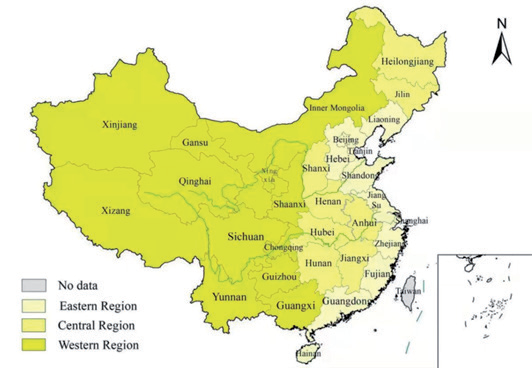
In Table 1, further explanations of regional characteristic variables are as follows: the eastern region includes 11 provinces and municipalities including Beijing, Tianjin, Hebei, Liaoning, Shanghai, Jiangsu, Zhejiang, Fujian, Shandong, Guangdong and Hainan. The central region is divided into eight provinces and autonomous regions: Shanxi, Jilin, Heilongjiang, Anhui, Jiangxi, Henan, Hubei and Hunan. The western region includes 12 provinces and municipalities directly under the central government, including Sichuan, Chongqing, Guizhou, Yunnan, Tibet, Shaanxi, Gansu, Qinghai, Ningxia, Xinjiang, Guangxi and Inner Mongolia. Fig. 1 shows the regional characteristic variables. Rural financial development level, according to the agricultural loan and the first industry in GDP ratio of annual of provincial rural financial development level sort, takes the digits as provincial rural financial development level, the last of the provinces of the rural financial development level determine the median sorted again, greater than the median provinces for the rural financial development level is high, the other provinces have a low level of rural financial development.
Variable Selection
The following contents can be determined by literature collation and analysis. Based on previous research results and combined with the actual situation of 31 provinces in China, considering the feasibility of index quantification and data availability, in order to comprehensively consider the performance of farmers’ income distribution from the perspective of financial transfer, this paper selects the following indicators for empirical research:
Farmers’ income distribution, represented by RURAL, is measured by the ratio of per capita net income of RURAL households and per capita GDP in the selection of variables, and its fluctuation is reflected by logarithmic difference treatment of farmers’ income distribution [27].
Inflation, expressed by CPI, is represented by the consumer price index of each province with the base removed to represent the inflation path of financial transfers [28].
Table 1.
Descriptive statistics of model variables.
Public expenditure, JY is respectively used to represent education expenditure in the fiscal expenditure projects of each province to represent the public expenditure path of financial transfer [29].
The rural economic growth is expressed by RGDP, and the growth rate of the gross product of the primary industry represents the rural economic growth path of financial transfer [30].
Other variables. Environmental pollution, denoted by EV, is used to express the impact of environmental pollution on the distribution of farmers’ incomes, as it may affect the health of rural residents and may also lead to a deterioration in the quality of agricultural products, using the ratio of pesticide use to the gross domestic product of the primary sector. Because economic development and financial development in China has regional characteristics, we need to consider regional factors and rural financial development level factors when analyzing the influence factors of rural income distribution [31-32]. Regional factors are expressed by AREA, literature has confirmed that the development of China’s regional development is the step of the characteristics of differences, so according to the east, central and west is divided into three regions [33]. The level of village financial development is represented by FD. According to the scale of rural financial development, there are two types: areas with low level of rural financial development and areas with high level of rural financial development. Combined with the existing literature, the ratio of the balance of agricultural loans to the gross product of primary industry is adopted to measure the level of rural financial development in China, which is more consistent with the situation of rural financial development in China [34].
Finally, the measurement model of farmers’ income distribution is set based on the following formula:
Analysis of Empirical Results
Based on the annual data of 31 provinces in China, this paper analyzes the impact of different financial transfer channels on farmers’ income distribution. Through the total variance decomposition of the model, the impact of financial transfer on farmers’ income distribution was measured. It also considers the difference of financial transfer affecting the fluctuation of farmers’ income distribution under different characteristic factors.
Analysis of the Influencing Factors of the Fluctuation of Farmer Income Distribution
Based on the bilateral stochastic frontier method, the influence degree of different financial transfer channels on farmers’ income distribution is calculated. The regression results are shown in Table 2.
In Table 2, model 1 adopts the least square estimation, and model 2 adds the constraint conditions on the basis of model 1, and uses the bilateral stochastic frontier method to perform the maximum likelihood estimation. The constraint conditions are LN σ w = ln σ u = 0. Models 3-5 are two-sided random frontier maximum likelihood estimates without constraints. Since the regression results of the financial transfer health expenditure path of model 2 are not significant at the 5% significance level, model 3 is the estimate after excluding the financial transfer inflation path, model 4 is the estimate after excluding the financial transfer public expenditure pathways, and model 5 is the estimate including the financial transfer three pathways and environmental pollution factors. Comparing all the models, model 5 has a better fit, and the estimation results show that the distribution of farmers’ income is positively proportional to the financial transfer inflation path, inversely proportional to the public expenditure path rural economic growth path, and inversely proportional to the environmental pollution factor. It can be assumed that the occurrence of inflation increases the distribution of farmers’ income, the financial expenditure education expenditure path exacerbates the gap between urban and rural human capital, the rural economic growth path are not able to become an increase in the distribution of farmers’ income to help, environmental pollution plays a negative role in the distribution of farmers’ income. The follow-up analysis is based on model 5 in Table 2 to analyze the regional factors and the characteristic factors of the regional rural financial development level.
Variance Decomposition of Farmer Income Distribution Measurement Model
The effect of financial transfer on farmers’ income distribution is shown in Table 3. The influence coefficient of the financial transfer obtained by farmers on the fluctuation of farmers’ income distribution is 4.2353. The influence coefficient of financial transfer obtained by other economic subjects on the fluctuation of farmers’ income distribution is 3.9885. The comprehensive effect of financial transfer on the fluctuation of farmers’ income distribution is positive. The combined effect of financial transfers on the volatility of farmers’ income distribution is shown in the following equation
Table 2.
Estimation results of farmers’ income distribution.
Table 3.
Analysis of financial transfer effect of farmers’ income distribution.
In Table 3, the total variance is 34.6063, is the part that cannot be explained by the explained variable, 97.8 percent of this is due to financial transfer. Among the total effects of financial transfer on the fluctuation of farmers’ income distribution, the impact of financial transfer on the fluctuation of farmers’ income distribution reaches 53%. The influence of financial transfer of other economic entities reached 47%. Farmers and other economic agents compete with each other to obtain the surplus of financial transfer, forming a net transfer to the fluctuations of farmers’ income distribution. Table 3 shows the unilateral estimation of the effect of financial transfer on farmers’ income distribution.
Estimation of Financial Transfer of Farmer Income Distribution
Full Sample Estimation
The core of this paper is to estimate the financial transfer effect that causes the fluctuation of farmers’ income distribution. Farmers and other economic entities are based on the financial transfer that they can obtain under the condition of no financial transfer.
Table 4 shows the estimation results for the sample population. The financial transfer obtained by farmers causes the income distribution of farmers to be 80.88% higher than that in the state without financial transfer, while the financial transfer obtained by other economic entities causes the income distribution of farmers to be 79.97% higher than that in the state without financial transfer. Overall, the net value of financial transfer obtained by farmers increases by 0.91% compared with the income distribution of farmers without financial transfer status. It can be concluded that the difference of financial transfer effect of various economic entities will increase the income distribution of farmers. Suppose that the income distribution of farmers is 100 yuan under normal circumstances, and the difference of financial transfer effect of various economic entities will increase the income distribution of farmers to 100.91 yuan. In Table 4, Q1 represents the 25th percentile, Q2 represents the 50th percentile, and Q3 represents the 75th percentile. The distribution characteristics of farmers and other economic entities competing with each other to obtain the surplus of financial transfer can be observed in detail. Table 4 shows that there is strong heterogeneity in the financial transfer factors that cause the fluctuation of farmers’ income distribution. In Table 4,the statistical results of the 25th percentile (Q1) show that 1/4 of farmers and other economic entities compete for the result of financial transfer, which reduces the income distribution of farmers by 29.72% compared with the state without financial transfer. The results from the 50th percentile (Q2) show that another quarter of economic agents compete with each other for financial transfers, resulting in a 1.73% increase in the income distribution of farmers relative to the baseline state. The statistical results of the 75th percentile (Q3) show that the income distribution of 1/4 farmers has increased by 30.38%, indicating that the distribution of financial transfer in rural areas is not equal, and some rural areas have obtained far more financial transfer surplus than other economic entities.
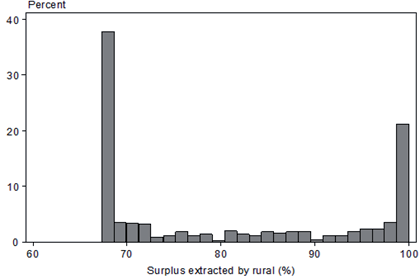
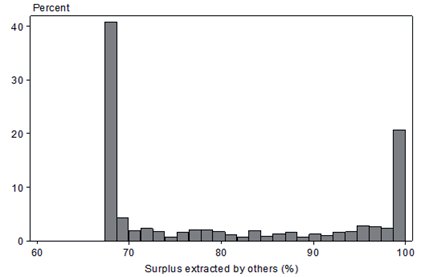
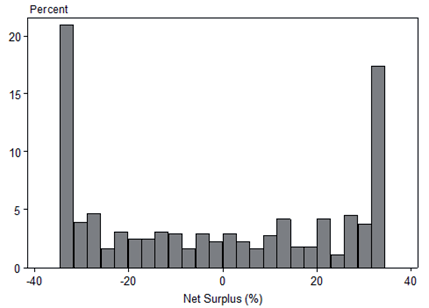
Through the distribution of the frequency of financial transfer, we can clearly observe the situation that economic entities compete with each other to obtain the surplus of financial transfer. Fig. 2 shows the distribution characteristics of farmers receiving financial transfers; no more than 40% of farmers are at an absolute disadvantage when competing for financial transfers, and about one-fifth of farmers are at an absolute advantage. Fig. 3 shows the distribution characteristics of financial transfer obtained by other economic entities. More than 40% of other economic entities are at an absolute disadvantage in the competition for financial transfer, and nearly 20% of other economic entities are at an absolute advantage. Can be seen in Fig. 1 and Fig. 2, farmers and other economic agents competing financial transfer has obtained the distribution characteristic of both ends differentiation, convergence, farmers and other economic main body inside have the characteristics of the distribution of the “dual”, wealth concentrated in the hands of a few people, not evenly distributed in the hands of most people. Fig. 4 shows the farmers and other economic agents competing financial transfer of net surplus distribution characteristics, also has the distribution characteristics of “both ends differentiation, convergence”, farmers and other economic subject about the transfer of financial competition is very fierce, just sample in general farmers receives financial transfer is slightly less than other economic subject, the final distribution result of farmers is less than that without financial transfer, and the unreasonable financial transfer has not played a role in improving income distribution.
In order to observe the changes of farmers’ income distribution caused by financial transfer in different periods, this paper conducts annual statistics on the samples because farmers have received more financial transfers than other economic entities on the whole. The net transfer distribution of farmers and other economic entities is shown in Table 5. It is found that the net transfer of farmers and other economic entities from 1999 to 2010 is almost negative, which means that the financial transfer of farmers is always in a state of transfer out during this period, and the income distribution to farmers is constantly decreasing. The reason for this phenomenon is related to the financial transfer bailouts adopted by the government in response to two financial crises: the Asian financial crisis in 1997 and the global financial crisis in 2008. Among them, the net transfers in 1999, 2007 and 2009 were positive, which may have benefited from policy on the second round of rural land contracting in 1998, the complete abolition of agricultural tax in 2006, and the Third Plenary session of the 17th CPC Central Committee in 2008, which set a goal of doubling the net income per capita of farmers by 2020 compared with 2008. It was not until 2011 that the net transfer of farmers and other economic entities was positive, and the financial transfer of farmers changed from “transfer out” to “transfer in”. Among them, the net transfer in 2017 is negative, which may be influenced by the agricultural supply-side structural reform. The agricultural structural adjustment in the early stage of the reform may cause a slight reduction in the income distribution to farmers.
Table 5.
Annual statistics of net transfer.
The Influence of Individual Characteristics on Farmer Income Distribution
The above analysis can find that the impact of financial transfer on the income distribution of farmers has obvious heterogeneity. In the following, the regional rural financial development level and regional factors will be further used to regroup the samples, so as to analyze the heterogeneity distribution characteristics of financial transfer obtained by farmers and other economic entities.
Table 6 shows the financial transfer of farmers and other economic entities under different levels of rural financial development. High level of rural financial development in the net transfer of above the low level of the rural financial development, financial transfer was transfer to other economic subject to farmers, the rural financial development level high area net transfer rate reached 1.04%, indicates that the rural financial development of the higher area, affected by the financial transfer, the greater the increase of farmers’ income distribution.
Table 6.
The influence of rural financial development level on the financial transfer.
Table 7.
Residual effect of regional factors on income distribution.
Table 7 shows that in terms of regional factors, the overall impact of financial transfer on farmers’ income distribution shows a step-like character. The average value of net surplus in eastern region, central region and western region is 1.18%, 1.18% and 0.48%, respectively. The net transfer is increasing from west to east, and the net transfer shows a gradual increasing trend, indicating that the financial transfer increases the distribution of farmers’ income, and the financial transfer improves the inequality of income distribution. The 25th percentile (Q1) also shows increasing net transfers from west to east, the 50th percentile (Q2) shows the highest net transfers in the central part of the country, followed by the eastern part of the country, and the western part of the country has the lowest and negative net transfers, while the net transfers in the 75th percentile (Q3) are the smallest in the eastern part of the country, the middle in the western part of the country, and the largest in the central part of the country.
Conclusions and Recommendations
In this paper, a measure model is constructed to analyze the income distribution of farmers, and the bilateral stochastic frontier method is used to test the impact of financial transfer on the income distribution of farmers in the annual data of each province from 1998 to 2019. Finally, the following conclusions are drawn and corresponding suggestions are put forward.
Different financial transfer paths have different effects on farmers’ income distribution. The path of public expenditure is inversely related to the path of rural economic growth and is also negatively correlated with the state of environmental pollution. It can be considered that moderate inflation helps to increase the income distribution of farmers and improve the income inequality between urban and rural areas. The path of fiscal expenditure on education exacerbates the gap between urban and rural human capital and the inequality of urban and rural income. The path of rural economic growth reduces the distribution of farmer’s income, and it can be concluded that the current state of agricultural development in China is restricting the rural labor force, which makes it difficult for farmers to increase their income. At the same time, the negative effects of environmental pollution also affect the distribution of farmers’ income.
On the whole, financial transfer increases the income distribution of farmers, and the net transfer of farmers and other economic subjects has the distribution characteristics of “differentiation at both ends and convergence in the middle”. 97.8% of the total variance of the measurement model of farmer income distribution is caused by financial transfer. The comprehensive impact of financial transfer on the fluctuation of farmer income distribution is 24.68%, and the farmer income distribution with financial transfer increases by 0.91% compared with that without financial transfer.
Comparative analysis of regional factors and rural financial development level on the income distribution of farmers. The financial transfer in the areas with high rural financial development has a better effect on improving the income distribution of farmers. The influence of financial transfer on farmers’ income distribution has the characteristics of regional stepwise distribution, showing the characteristics of net transfer from negative to positive and increasing from west to east.
Based on the empirical results, the suggestions are as follows:
(1) Optimizing the path of rural economic growth. We should improve the rural industrial system, strengthen the integration of primary, secondary and tertiary production in rural areas, improve the agricultural industrial chain, and pay attention to the deep processing of agricultural products in producing areas, so that farmers can draw more value-added benefits from the industry.
(2) Optimizing the path of rural public expenditure. We will improve the basic medical insurance system for rural residents, moderately raise government subsidies, reasonably set individual contribution rates, and improve the medical insurance system for seriously ill patients. We will accelerate poverty alleviation through education in rural areas, establish a mechanism to ensure funding for compulsory education in rural areas, encourage both the public and the private sectors, and foster a new type of professional farmers. We will help the new generation of rural migrant workers to participate in vocational agricultural education through flexible schooling.
(3) Keeping prices stable. When the central bank implements the expansionary monetary policy, it controls the influence of monetary policy tools on the money supply within a certain range. Through the comprehensive application of deposit reserve ratio and rediscount rate, it limits the growth rate of money supply and stabilizes the price level.
(4) Optimizing the supply path of rural finance. We will set up more grassroots branches of rural financial institutions, self-service bank deposit and withdrawal facilities, POS machines, etc., promote inclusive financial services in rural areas, and gradually realize the full coverage of financial services in rural areas.
(5) In response to the health and income problems caused by environmental pollution, market incentives can be used to strengthen the testing of the quality of agricultural products, and environmentally friendly and organic agricultural products will receive higher market prices, thus improving the distribution of farmers’ income.
The theoretical contribution of this paper: Most of the current research on financial transfer to the study stays at the theoretical level, lacking data support and verification of empirical results. By constructing a measurement model of farmers’ income distribution, the paper empirically examines the attributes of financial transfer in farmers’ income distribution and analyzes the effects of farmers’ income distribution in different financial transfer channels. It provides theoretical reference for scholars engaged in financial transfer-related research, and enriches the theoretical research in the field of financial transfer and farmers’ income distribution. It also provides theoretical references for policy makers to regulate the income distribution of farmers at the institutional level and the paths to choose.
The shortcomings of this paper: Although the paper found that the frequency distribution of farmers’ access to financial transfers showed a distributional characteristic of “polarization at the two ends and convergence in the middle”, it was unable to analyze the reasons for this due to space constraints.

