

Introduction
China's economy is currently shifting from a high-speed growth model to one focused on high-quality development. The traditional industrial development model of China has led to problems of high energy consumption and environmental risks [1, 2]. The green transformation of industrial development models is considered an essential solution to current energy and environmental issues [3]. In recent decades, with the development of technologies such as the internet, big data, and machine learning, artificial intelligence (AI) has made substantial progress. AI is rapidly advancing worldwide, sparking a new technological revolution and industrial transformation. AI is having a disruptive impact on various economic and social sectors and offers a significant opportunity for the green and high-quality development of China's industry [4]. In an effort to utilize AI to drive industries towards high-quality and green development, the Chinese government has given significant importance to the implication of AI and has implemented a series of policies aimed at "promoting the intelligent and green development of the manufacturing industry" and "advancing the deep integration of AI technology and the industry" [4]. As a result, AI technology has experienced rapid development and application in China. Taking industrial robots as an example, since 2013, China has been the world's largest consumer of industrial robots for eight consecutive years. In 2020, China manufactured 148,000 industrial robots, constituting 38% of the global industrial robot output, marking a 14.7% year-on-year rise [5]. The core industry market size of China's intelligent industry surpassed 150 billion yuan in 2020 and is expected to reach 400 billion yuan by 2025 [5].
Achieving carbon peaking by 2030 and carbon neutrality by 2060 is a crucial strategy for the Chinese government to address resource and environmental issues. Industry, as the pillar of China's economic and social development, is also a major source of pollutant emissions. The China Environmental Statistics Yearbook 2021 indicates that sulfur dioxide emissions from industrial production accounted for 76.31% of the total emissions across all industries. Advancements in industrial energy conservation and carbon reduction and the enhancement of the level of green development in the industry are crucial steps in achieving China's "dual carbon" goals and are also necessary paths to achieve high-quality development in China's industry. AI, as a key driving force behind the new wave of technological revolution and industrial transformation, can facilitate green improvements in industrial production processes through real-time monitoring of pollution emissions, precise governance, optimization of production modes, and the upgrading of industry structure. Therefore, promoting the development of industrial intelligence may become a viable path for China to achieve industrial green transformation.
Existing literature on AI primarily focuses on two aspects: the assessment of AI development and the impact of AI on the economy and society. There is still no consensus on the methods for evaluating the development level of AI. At present, some scholars measure the development level of AI by proxy variables of AI. Some scholars use the number of AI patents as a proxy variable to measure the development level of AI in a region [6]. Some other scholars use the number or density of industrial robots as proxy variables for AI [7]. The number of published research papers on AI [8], as well as the development level of the Internet of Things (IoT) [9], were also used by some scholars as proxy variables for measuring the level of AI development. To avoid the limitations of a single proxy variable on the level of AI development, some researchers, such as Geng et al. and Sun et al., have constructed a multidimensional indicator system to measure the level of AI in China [10, 11]. Literature on the impact of AI mainly includes its effects on economic growth, income inequality among workers, technical innovation, and so on. Aghion holds that there is a certain level of uncertainty about how AI technology impacts economic growth [12]. Shi found that AI technology is a key lever for driving the transformation and upgrading of China's economic structure [13]. The penetration of AI into the industrial sector can optimize the input of industrial elements, reduce operational costs, and improve service quality, consequently promoting economic growth [13]. AI can unleash technological spillover effects through economies of scale in the market, thus promoting high-quality development of the Chinese economy [13]. Graetz and Michaels analyzed industry panel data from 1993 to 2007 and found that AI affects economic growth by influencing total factor productivity [14]. Acemoglu and Restrepo argued that AI can effectively counteract the effects of aging and promote economic growth by increasing total factor productivity [15]. Autor and Dorn believed that due to the partial substitution of low-skilled labor by AI, wage inequality is likely to widen further. However, with the development of AI technology, high-skilled labor may also be replaced, which could, to some extent, reduce income inequality [16]. Iain et al. contended that AI contributes to the economy by restructuring the innovation process [17], and Kromann et al. also asserted that AI could profoundly influence the process of technical innovation and economic development by enhancing the efficiency of technological innovation [18].
In recent years, as AI technology has made breakthroughs in capabilities like semantic understanding, visual perception, and logical reasoning, its impact on the development of the green economy and environmental improvements has increasingly begun to attract scholarly attention. For instance, Hu and Li believed that AI technologies are facilitating the green transformation of regional economic development models [19]. Korinek and Stiglitz held that there exists a synergistic relationship between green transformation and AI technologies, as AI frees up significant labor resources to support the requirements of green transformation [20]. AI could mitigate the conflict between economic development and environmental protection by improving the efficiency of resource utilization and enhancing precise environmental management [21, 22]. Some scholars have begun to pay attention to the influence of AI on IGD. For example, Sun and Hou suggested that the effective integration of industrial intelligence and human capital could enhance the green development of industries [11]. Shi and Li posited that intelligent transformation of industry could strengthen the effect of low-carbon emissions reduction [23]. AI contributes to IGD by establishing public service platforms and developing environmental monitoring systems [24]. Sarkar believed that the implementation of AI in industries could enhance energy efficiency, consequently leading to a reduction in associated environmental pollutants [25]. The application of deep learning and big data techniques in the industrial sector has demonstrated significant advancements in energy efficiency, achieving a notable increase of 97.86% [26]. Liu et al. found that the deployment of industrial robots in industry results in a marginal carbon reduction of 5.44% [27].
A review of the literature reveals that although many scholars have paid attention to the impact of AI on the economy and society, the primary focus has been on AI's effects on economic growth, income inequality among workers, employment, and technical innovation. Some researchers have also paid attention to AI's impact on green development, but they mainly focus on topics of AI's influence on economic green development, as well as its effects on energy efficiency and pollutant emissions. However, scholars seldom focus on the specific impact mechanisms of AI on IGD, including both direct and indirect impact mechanisms. To fill this academic gap, exploring the complex relationship between AI and IGD and clarifying the specific mechanisms of AI's impact on IGD are necessary.
Our study contributes to the existing literature in three ways. First, by empirically exploring the impact of AI on IGD, it enhances our current understanding of how to improve IGD levels in the context of industrial intelligence development. Second, we combine the Intuitionistic Fuzzy Analytic Hierarchy Process (IFAHP) and dynamic Grey Relational Analysis (DGRA) methods to determine the AI and IGD indexes for 30 provinces from 2011 to 2021. Compared to other methods, IFAHP can better address the hesitations and uncertainties of experts during the indicator evaluation process, while DGRA is more effective for dynamically comparing the AI and IGD values across different years. Third, by establishing a moderated mediation model, we investigate whether industrial structure upgrading plays a mediating role in the relationship between AI and IGD and whether industrial agglomeration plays a moderating role in the link between the upgrading of industrial structure and IGD. These analyses enhance the understanding of the mechanisms through which industrial structure upgrading and industrial agglomeration impact IGD. The research results of this study could provide inspiration for governments to formulate policies for IGD and AI development and to explore how AI can be utilized to promote regional IGD.
Hypothesis Development
According to Schumpeter's innovation theory, technological innovation not only involves the introduction of new methods of production but also introduces new elements and conditions into the production system [28]. Technological innovation facilitates the emergence of new ways of organizing economic activity and drives the upgrading of industrial structure [29]. Technological innovation plays a crucial role not only in advancing the economic development of human society but also in promoting the green transformation of the economy [30]. When driving forward the development of the economy and society, technological innovation often exhibits nonlinear dynamics [31]. AI is a particular type of radical technological innovation [31]. Accordingly, we believe that it can not only change the production and organizational forms of traditional industries but also have an influence on IGD.
AI and IGD
IGD is closely related to technological innovation [32]. AI, as a typical technological innovation in the new wave of technological revolution, could help the green development of industry through its integration with the production and management processes of industries. First, AI could leverage its perception and learning capabilities to assist in production decision-making [33]. Through technologies such as image recognition and deep learning, AI can discern and predict customer demand and market trends [34]. Accurate control of production demand enables real-time management of various inventory needs, thereby reducing unnecessary inventory and waste. Additionally, with AI-assisted production decision-making grounded in data rather than solely relying on experience and intuition, decision accuracy and reliability can be enhanced, thus improving the efficiency of production decision-making and reducing erroneous production decisions [33], thereby saving resources and decreasing carbon emissions.
Second, AI facilitates the optimization of production processes, thereby improving productivity and consequently reducing carbon emissions [35]. Through the automatic perception capabilities and autonomous decision-making processes of AI, dynamic adjustments and real-time optimization of materials and personnel allocation can be achieved in the production process. This helps enhance resource utilization efficiency during production, reduce unnecessary inventory, and minimize resource waste [21, 36]. Besides, production processes assisted by real-time monitoring and data processing tools based on AI allow factories to implement real-time control over product quality and make intelligent decisions based on information obtained from real-time monitoring [37], thereby effectively reducing the rate of defective products and improving production efficiency and product quality. Furthermore, intelligent monitoring of the entire production process through AI can accurately identify high-pollution and high-energy consumption stages of production and provide proposals for improving production processes. Therefore, it is beneficial for enhancing resource utilization efficiency and reducing the level of carbon emissions in the production process [37, 38]. Enhancing resource utilization efficiency and reducing the level of carbon emissions is pivotal to IGD [39].
Third, AI could also facilitate the simplification and flattening of organizational structures [40], thereby reducing the operating costs of the organizational system and enhancing the resource management capabilities of different entities within the system. The ability to rapidly deploy and precisely control various types of resources creates favorable conditions for improving efficiency in green development [41]. Lean production facilitates optimizing resource allocation decisions, thereby enabling the reduction of energy and raw material waste, as well as decreasing pollutant emissions during the production process [42].
On the basis of these arguments, we hypothesize the following:
Hypothesis 1: AI has direct and indirect effects on IGD.
The Mediating Role of Industrial Structure Upgrading
Technological progress is a core driving force behind industrial structure upgrading, with each technological advance bringing about shifts in economic paradigms [43]. Technological advancements reshape the existing demand-supply dynamics, production resource conditions, and factor allocation within the industrial system [44]. This alignment ensures that the industrial structure effectively integrates with technological methodologies to optimize various production efficiencies [45]. The effects of industry correlation and technological diffusion will drive the transformation and upgrading of traditional industries, thus elevating the industrial structure to a higher level [46]. Industrial structural upgrading refers to the transition of industrial structure from a lower to a higher form, which is one of the essential tools for green economic growth [47]. The essence of industrial upgrading is to drive the transition of industrial development from a resource-driven mode to a technology- and innovation-driven mode [48]. AI is a general-purpose technology that contributes to achieving full automation in the production process and improving production efficiency and plays a pivotal role in transforming industries and facilitating the upgrading of industrial structures [49]. The proportion of emerging intelligent industries within the industrial system continues to rise, gradually driving an increase in the share of technology- and knowledge-intensive industries. The penetration, diffusion, and application of AI technologies within traditional industrial sectors have the potential to improve their methods of production, thereby improving their productivity performance and resource allocation efficiency [48]. Therefore, the diffusion and application of AI technologies have triggered the emergence and development of intelligent industries, as well as the intelligent transformation of traditional industries. This will ultimately drive the evolution of industrial structure towards one with higher levels of productivity [48].
Industrial structure upgrading is not only a process of reconfiguring and combining resource elements towards more efficient industries but also a drive to improve energy efficiency, reduce energy consumption and emissions, and adopt green production practices [50]. The upgrading of the industrial structure will drive production factors to flow continuously from high-energy-consumption and high-pollution sectors into high-value-added and low-energy-consumption industries [51]. Industrial structure upgrading provides the impetus for enterprises to adopt green development strategies [50]. It shifts industries toward knowledge-intensive sectors, encouraging local enterprises to adopt greener, more efficient technologies. This transition fosters sustainable industrial chains and enhances environmental efficiency [50]. Furthermore, industrial structure upgrading will enhance consumers' environmental awareness. Enterprises implementing green development strategies are more likely to gain a competitive edge [50]. Adopting green branding strategies allows enterprises to establish leadership and differentiate themselves from competitors, potentially leading to higher profits as consumers are willing to pay more for environmentally friendly products. Consequently, enterprises aiming to gain competitive advantages are more likely to implement green production technologies and processes, thereby reducing energy consumption, carbon emissions, and pollutant emissions.
Based on the above analyses, we propose the following hypotheses:
Hypothesis 2: Industrial structure upgrading plays a mediating role in the link between AI and IGD.
Hypothesis 2a: AI has a positive effect on industrial structure upgrading.
Hypothesis 2b: Industrial structure upgrading has a positive effect on IGD.
The Moderating Role of Industrial Agglomeration
Industrial agglomeration refers to the phenomenon where industrial enterprises gather in large numbers within a certain geographic area [52]. Some scholars believe that industrial agglomeration contributes to promoting IGD. For instance, Park and Behera found that during the process of industrial agglomeration, achieving optimal energy and resource utilization efficiency through symbiotic relationships among industrial enterprises can reduce environmental pollution and achieve sustainable industrial development [53]. Lanjouw and Mody observed that in industrial agglomeration, due to economies of scale in pollution control, the pollution abatement function for the entire industry demonstrates significant increasing returns to scale [54]. Industrial agglomeration facilitates intensifying the scope, depth, and frequency of interactions among enterprises within and across various industrial sectors. The interactions and exchanges among enterprises can generate spillover effects, facilitating the dissemination of knowledge and resources among the enterprises in the agglomeration [55, 56], which can reduce enterprises' costs in technological research and development, leading to higher production efficiency, greater economic returns, and lower production costs. Moreover, spillovers of knowledge and technology can promote the advancement of energy-saving and pollution control technologies among industrial enterprises, effectively improving resource utilization efficiency and driving progress in pollution treatment technologies and efficiency, thus promoting the overall green development of industries [55]. Furthermore, industrial agglomeration contributes to scale effects. Industrial enterprises within agglomerated areas, whether producing similar products or operating within the same industrial chain, often utilize similar production methods and generate similar types of pollution. By sharing pollution control equipment and management schemes, they can prevent and control pollution more efficiently, leading to economies of scale in pollution control. After upgrading the industrial structure, the proportion of knowledge and technology-intensive enterprises in industrial clusters will increase. When these types of industrial enterprises are clustered in the same geographical area, the spillover effects of knowledge and technology will be strengthened. Accordingly, we suppose that industrial agglomeration will strengthen the impact of industrial structure upgrading on IGD.
However, some scholars held that the impact of industrial agglomeration on green development exhibits complex and nonlinear characteristics [57]. When industrial agglomeration progresses beyond a certain threshold, the demand for various production factors exceeds the carrying capacity of the region [58]. As the scale of aggregation increases, the diminishing returns effect reduces the previously existing dividends of economies of scale. The expansion of scale generates a significant amount of demand, and when this demand surpasses the carrying capacity of the ecological environment, the negative effects of industrial agglomeration begin to manifest. Issues such as population congestion, traffic congestion, worsening pollution emissions, capital surplus, resource scarcity, etc., gradually become prominent, leading to a shift from economies of agglomeration to diseconomies of agglomeration [59]. When the growth effect of industrial agglomeration is outweighed by the pollution effect, and the growth dividend can no longer offset the environmental costs, the positive externalities of industrial agglomeration could then be diminished [58]. Consequently, we believe that the positive impact of industrial structure upgrading on IGD will be weakened as the level of industrial agglomeration increases.
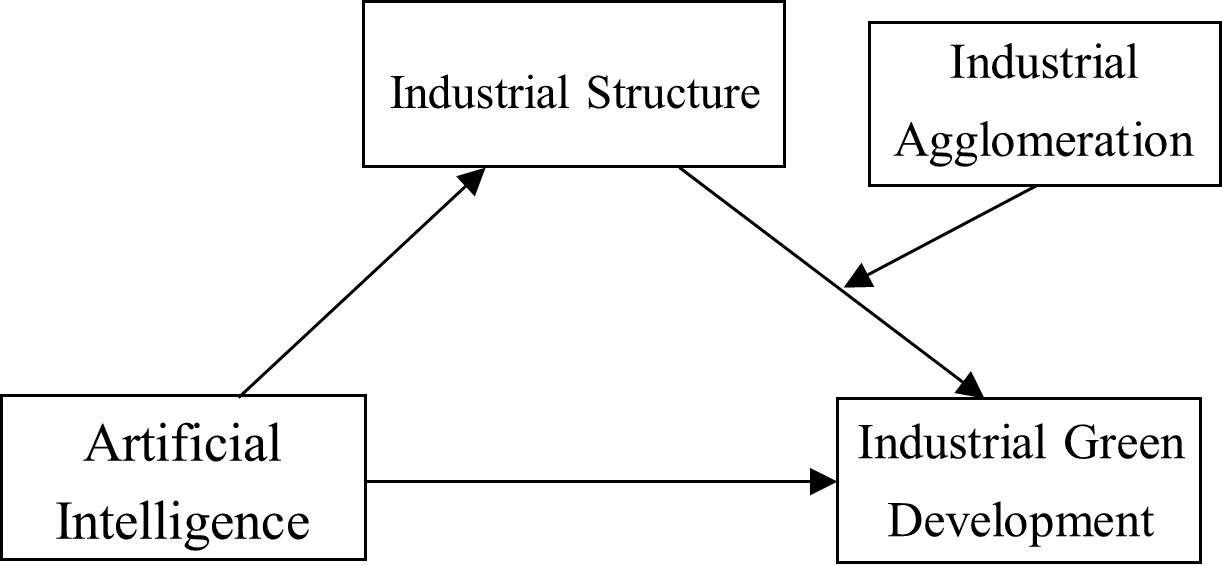
Therefore, we proposed the following hypothesis:
Hypothesis 3: Industrial agglomeration can moderate the impacts of industrial structure upgrading on IGD. At first, industrial agglomeration strengthens the positive influence of industrial structure upgrading on IGD. However, as agglomeration reaches a certain level, it weakens the impact of industrial structure upgrading on IGD.
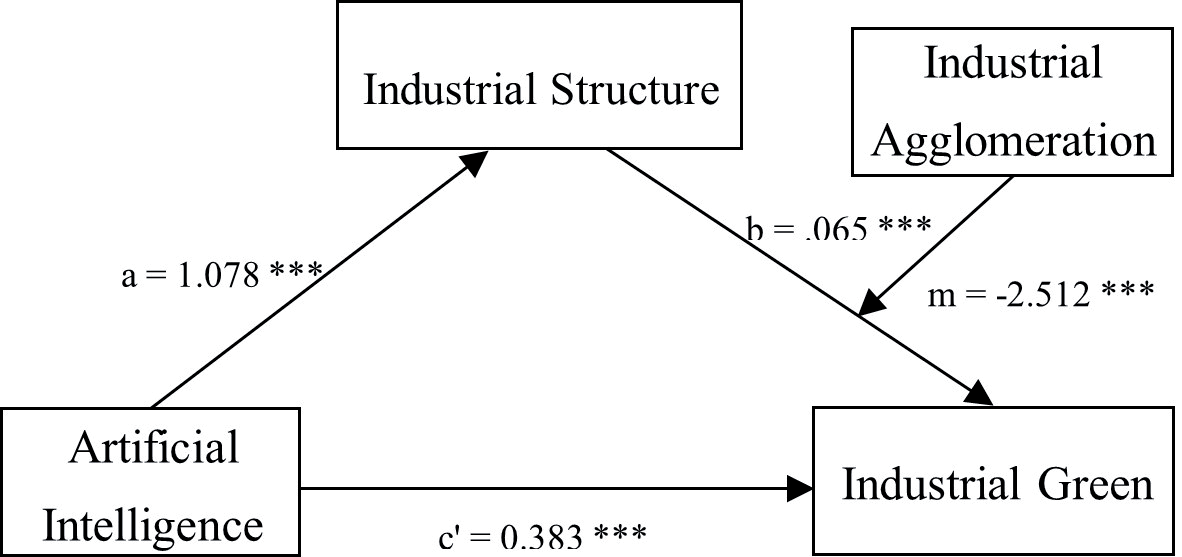
The research model of this study is depicted in Fig. 1.
Materials and Methods
Sample and Data
For empirical analysis, this study employs a balanced panel dataset covering 30 Chinese provinces from 2011 to 2021 (excluding Tibet, Hong Kong, Macao, and Taiwan due to data unavailability). Original data on industrial robots is obtained from the International Federation of Robotics (IFR). The data on the number of patent applications for AI is sourced from the National Intellectual Property Administration. The original data for industrial structure upgrading is sourced from the website of the Development Research Center of the State Council (drcnet.com.cn). Provincial-level data on resource reduction, pollution abatement, industrial green growth potential, construction of AI infrastructure, readiness for industrial applications of AI, output capacity of AI, and the three control variables are sourced from publications such as China Statistical Yearbook, China Environmental Statistics Yearbook, China Science and Technology Statistics Yearbook, China Urban and Rural Construction Database, China Industrial Statistics Yearbook, China High-Tech Industry Statistics Yearbook, and provincial statistical yearbooks. For missing data, interpolation techniques were used to fill the data gaps.
Variable Selection
Dependent Variable
As suggested in the 14th Five-Year Plan for Industrial Green Development and the Industrial Green Development Plan (2016-2020) formulated by the Ministry of Industry and Information Technology of China and other literature [60], IGD's main objective is to reduce industrial resource usage and mitigate environmental issues related to industry, while achieving sustainable economic growth in the industrial sector. Hence, we developed a comprehensive evaluation system for IGD that includes three first-level indicators: industrial resource and environmental pressure, industrial green growth potential, and industrial pollution control. By referring to the indicator systems for IGD developed by Wang, Chen et al. [61, 62], the second-level indicators have also been established. Specifically, the second-level indicator of industrial resource and environmental pressure encompasses five secondary indicators: electricity consumption per ten thousand yuan of industrial value added, water consumption per ten thousand yuan of industrial value added, SO2 emissions per ten thousand yuan of industrial value added, chemical oxygen demand per ten thousand yuan of industrial value added and the industrial particulate matter emission per ten thousand yuan of industrial value added. Industrial green growth potential includes four secondary indicators: per capita industrial added value, operating income per one hundred yuan of assets realized by designated scale enterprises, local science and technology public budget expenditure, and the ratio of local scientific research and technical services workers to the total population. Industrial pollution control includes two secondary indicators: industrial pollution treatment investments and the ratio of industrial solid wastes utilized.
Explanatory Variable
A multidimensional indicator system could overcome the limitations of relying on a single proxy variable and could provide a more comprehensive and accurate measurement of AI development in China [10]. Referencing the "2021 Artificial Intelligence Development White Paper" published by the Shenzhen Artificial Intelligence Industry Association [63] and other literature [10, 64], this study developed a multi-indicator comprehensive evaluation index system of AI in China by investigating the actual situation of AI development in China and following the principles of systematicity, representativeness, and feasibility in the selection of indicators. Given the current state of AI development in China, data availability is also an important principle for selecting indicators in this study. The first-level indicators of the evaluation index system of AI include the construction of AI infrastructure, readiness for industrial applications of AI, and output capacity of AI. Construction of AI infrastructure includes three second-level indicators: fixed asset investment in information technology and software industry, long-distance optical cable density, and internet broadband access port density. The secondary indicators for readiness for industrial applications of AI include three factors: the number of installed industrial robots, the number of software developers, and the number of enterprises related to information technology. The secondary indicators for output capacity of AI include two factors: the number of patent applications related to AI and the revenue of the software and information technology services industry.
The industrial robot data provided by the IFR is at the industry level. We first match the industry classifications provided by the IFR with the industry classifications in the China Industrial Statistical Yearbook. Then, following the method recommended by scholars such as Acemoglu, Restrepo, Lu et al. [65, 66], we multiplied the employment share of each industry in each province by the national-level installation of industrial robots. This allows us to calculate annual industrial robot installation data for each province in China. As for the data on the number of patent applications for AI, we first obtained patent classification information according to the Classification Reference Table of Strategic Emerging Industries and International Patent Classification (2021). Subsequently, using this classification information, we retrieved and compiled relevant AI patent data for each province and each year from the National Intellectual Property Administration.
Mediating Variable
Following the method proposed by Fu et al., the data on industrial structure upgrading was obtained by dividing the output value of high-end industries by the output value of middle-end industries for each province and each year [67]. Based on the classification method proposed by the Organization for Economic Cooperation and Development (OECD), Fu et al. categorize the manufacturing industry into high-end industries, mid-range industries, and low-end industries [67]. According to Fu, You, Zhang et al., high-end industries include general equipment manufacturing, specialized equipment manufacturing, transportation equipment manufacturing, electrical machinery and equipment manufacturing, communications equipment and computer and other electronic equipment manufacturing, instrumentation manufacturing, chemical industry, and pharmaceuticals. Middle-end industries include industries such as petroleum processing, coking and nuclear fuel processing, rubber and plastics, non-metallic minerals, ferrous metal smelting, non-ferrous metal smelting, and metal products [67, 68].
Moderating Variable
Agglomeration can be defined as the concentration of a specific element within a region. Following the suggestions of researchers like Shen and Ke, we determined the index of industrial agglomeration of a region by calculating the quantity of non-agricultural industry employment per unit area of land [69, 70]. The specific method involves dividing the number of non-agricultural industry employment across 30 provinces from 2011 to 2021 by the corresponding administrative area of each province. This method can show the spatial inequality of industrial location [70]. The higher the index value of a region, the greater the degree of industrial agglomeration in that region.
Control Variables
The control variables in this present work are a scale of industrial enterprises above designated size, which is denoted by the ratio of the output of industrial enterprises above designated size in each province to its GDP; government intervention, which is expressed as the ratio of general public budget expenditure of each province to its GDP; degree of opening up, which is represented by the ratio of total import and export value of goods to its GDP in each province.
The scale of industrial enterprises above a designated size may have impacts on regional green development [71]. Following Guo et al.'s approach, the scale of industrial enterprises above the designated size is characterized by the ratio of the output value of industrial enterprises above a designated scale to the regional GDP of each province [71]. According to Droste et al., government intervention may also have influences on regional green development [72]. Government intervention is calculated as a ratio of the general public budget expenditure of a region to its GDP [73]. The degree of opening up was believed to be related to the green development of regions and could be quantified using the ratio of total import and export trade to regional GDP [74, 75]. Following the suggestion of Jin et al., the total value of regional import and export trade was converted into RMB (¥) based on the current year's exchange rate [75].
Methods
Intuitionistic Fuzzy Analytic Hierarchy Process
Intuitionistic Fuzzy Analytic Hierarchy Process (IFAHP) evolves from the Fuzzy Analytic Hierarchy Process. Unlike the traditional Analytic Hierarchy Process, IFAHP can better address the hesitations and uncertainties of experts during the process of indicator evaluation [76]. The specific calculation steps are as follows:
Step 1: Establish the intuitionistic fuzzy judgment matrix: R = (rxy) = (txy,fxy,πxy), where x and y represent the rows and columns of the matrix, respectively. txy denotes the membership degree. fxy indicates the non-membership degree, and πxy represents the degree of uncertainty. The values of txy, fxy , πxy are all greater than 0 but less than 1, and their total sum equals 1.
Step 2: Perform a consistency check on the judgment matrix. To guarantee the effectiveness of the evaluation results, it is necessary to verify the consistency of the judgment matrix [77]. This paper adopts the method proposed by Szmid and Kacprzyk to test the consistency of the judgment matrix. If the judgment matrix does not pass the consistency test [78], it is necessary to modify the matrix. The modification process can refer to the method suggested by Wang and Xu [77], and then perform a consistency test on the modified matrix. If it still does not pass the consistency test, adjust the parameters for the modification equation until the matrix passes the consistency test; if it does, proceed to the third step.
Step 3: Calculate the weight vector for each intuitionistic fuzzy judgment matrix by the following formula:
Step 4: Determine the weight of each indicator utilizing the formula:
Finally, Calculate the normalized weight of each indicator. The formula is:
Dynamic Grey Relational Analysis
Grey Relational Analysis (GRA) determines the closeness of the relationship between curves by comparing their geometric shapes. The closer the curves, the stronger the correlation between the corresponding numerical sequences; conversely, the correlation decreases as the curves diverge [79]. Previous studies utilizing GRA primarily focused on the evaluations of static cross-sectional data. GRA overlooks the temporal variation of evaluation indicators, hindering the ability to track the dynamic changes occurring in the subjects over time [80]. In order to compare the assessment results of AI and IGD from different years based on the same benchmarking sequence, following suggestions from Shi et al. [81], this paper employs the Dynamic Grey Relational Analysis (DGRA) to calculate the index values of AI and IGD of China. The detailed steps for the calculation are as follows:
The first step is to nondimensionalize all indicator data. The calculation formula for positive indicators is:
In the second step, set the sequence of the optimal values of each indicator as the benchmarking sequence:
In the third step, calculate the difference between each indicator in panel data and its corresponding comparison value. The difference matrix is then constructed. The calculation formula is as follows: Δnm = | bnmk - bn+ |.
In the fourth step, calculate the grey relational coefficient by the following formula:
where p is the resolution coefficient, typically taking a value of 0.5.
Finally, by multiplying the grey relational coefficient matrix with the weight matrix obtained earlier through IFAHP, we obtain the final index values (
Hierarchical Regression Analysis
To test the hypotheses, we employed the method of hierarchical regression analysis of the PROCESS macro designed by Hayes [82]. Compared to alternative methods, the PROCESS macro simplifies the execution of bootstrapping techniques and excels at estimating mediation and conditional processes within regression-based models [83]. Bootstrapping is a resampling method and provides an alternative method for null hypotheses testing, which could be utilized for indirect effects [84]. When testing for an indirect effect with a null hypothesis, it is assumed that ab follows a normal distribution [85]. Bootstrapping does not require the assumption of normality for ab, making it preferable because we cannot accurately determine the shape of the distribution of indirect effect [85]. By bootstrapping, the confidence interval around the examined effect could be constructed [86].
In this study, we hypothesized that industrial structure upgrading mediates the relationship between AI and IGD, and industrial agglomeration moderates the link between industrial structure upgrading and IGD. By following the suggestion of Mueller et al. [87], we first conducted regression analysis using PROCESS macro model 1 in order to test the total direct effect of AI on IGD. Then a multiple regression analysis was performed on the direct and indirect effect of AI on IDG by the mediator of industrial structure upgrading without the moderator using PROCESS macro model 4. Partial mediation exists when mediation is established in the presence of a significant total direct effect, and the direct and indirect effect of AI on IGD is statistically different from zero [88]. However, if the direct effect of AI on IGD is not significant, then industrial structure upgrading is regarded as a complete mediator [88]. Finally, PROCESS macro model 14 was used to assess the complete moderated mediation model. In this process, we first examined whether the mediating variable of industrial structure upgrading can significantly influence IDG. Subsequently, we tested the interaction effect between industrial structure upgrading and industrial agglomeration on IGD.
Results
After inviting experts to conduct pairwise comparisons of the evaluation indicators for AI and IGD, we employed the method suggested by Wang and Xu to perform intuitionistic fuzzy processing on the evaluation data [77]. We obtained two intuitionistic fuzzy judgment matrices, R1,2 = (rxy) = (txy,fxy,πxy). Following the method recommended by Xu and Liao [89], when the σ value is set to 0.5 for the correction of the matrix data, the d R R values of all matrices ( , ) are less than 0.1, indicating that all corrected judgment matrices have passed the consistency test. Subsequently, by applying Formula (1) to the matrices, we computed the weight vectors for each intuitionistic fuzzy judgment matrix. Then, following the procedure outlined in step 4 of IFAHP, we obtained the weight data for each indicator. Next, according to the formula
After constructing the indicator systems and determining the weights for each secondary indicator, we collected the panel data on AI and IGD in 30 provinces of China from 2011 to 2021. Subsequently, employing steps 1-3 of the DGRA method and Formula (2) outlined before, we obtained all the grey relational coefficients of AI and IGD of all 30 provinces from 2011 to 2021. Finally, by conducting matrix multiplication between the grey relational coefficient matrix and the weight matrix obtained previously through IFAHP, we derived the final index values (
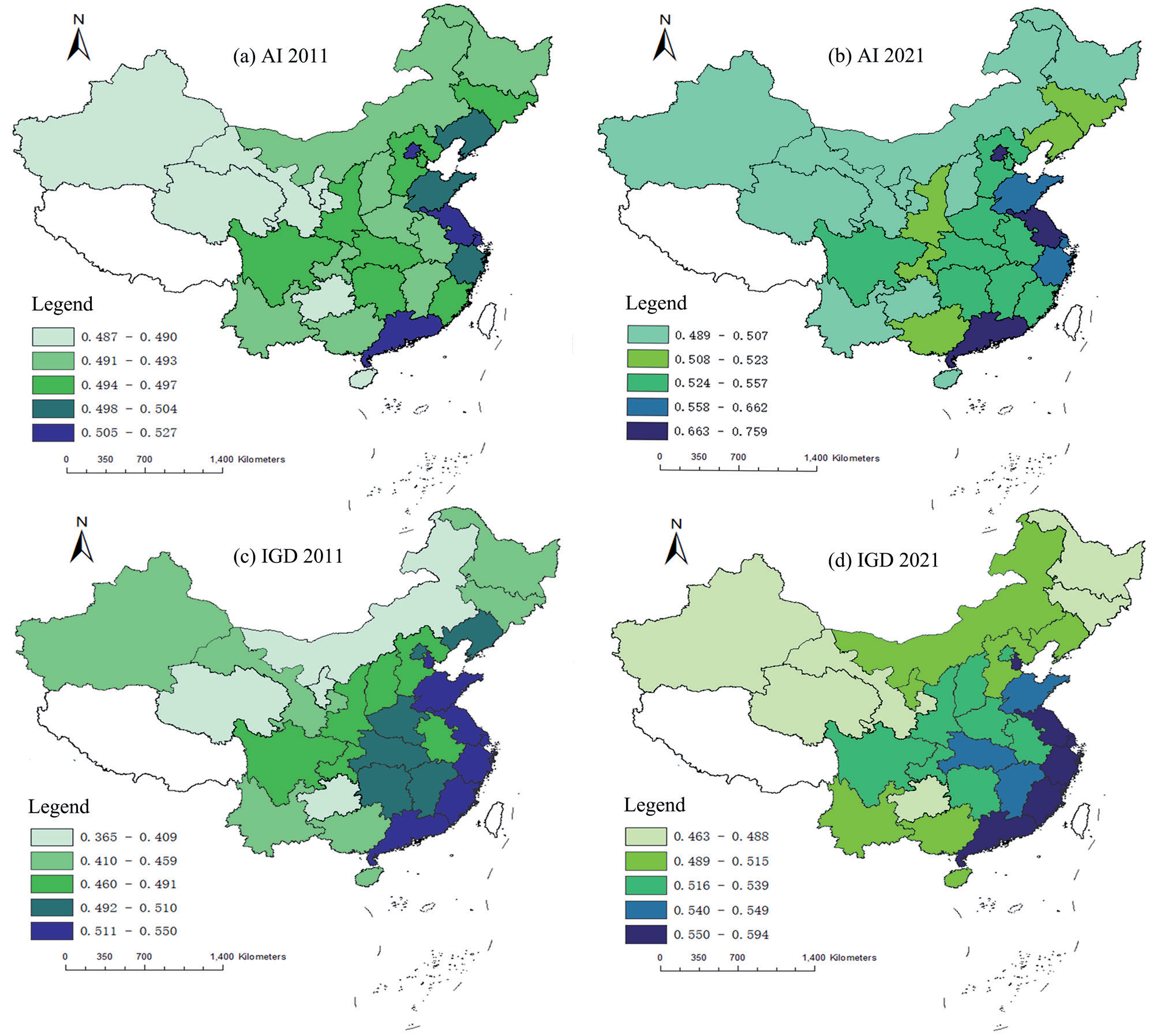
To clearly illustrate the spatiotemporal evolution of AI and IGD across various provinces in China during the research period, we created Fig. 2 using ArcGIS 10.8. As depicted in Fig. 2, from 2011 to 2021, there has been a significant improvement in the overall level Note: This map is based on the standard map with approval number GS(2020)4619, downloaded from the standard map service website of the National Bureau of Surveying, Mapping, and Geographic Information. The base map remains unchanged. of AI development in China. The average AI index in 2011 was 0.497, while in 2021, it increased to 0.552. From a spatial perspective, the AI index in eastern China surpassed that of central and western regions. Similarly, the level of IGD development across China's 30 provinces experienced significant improvement from 2011 to 2021, with the average IGD index of these 30 provinces increasing from 0.487 to 0.526. Furthermore, the eastern region exhibited the highest overall level of IGD compared to the central and western regions.
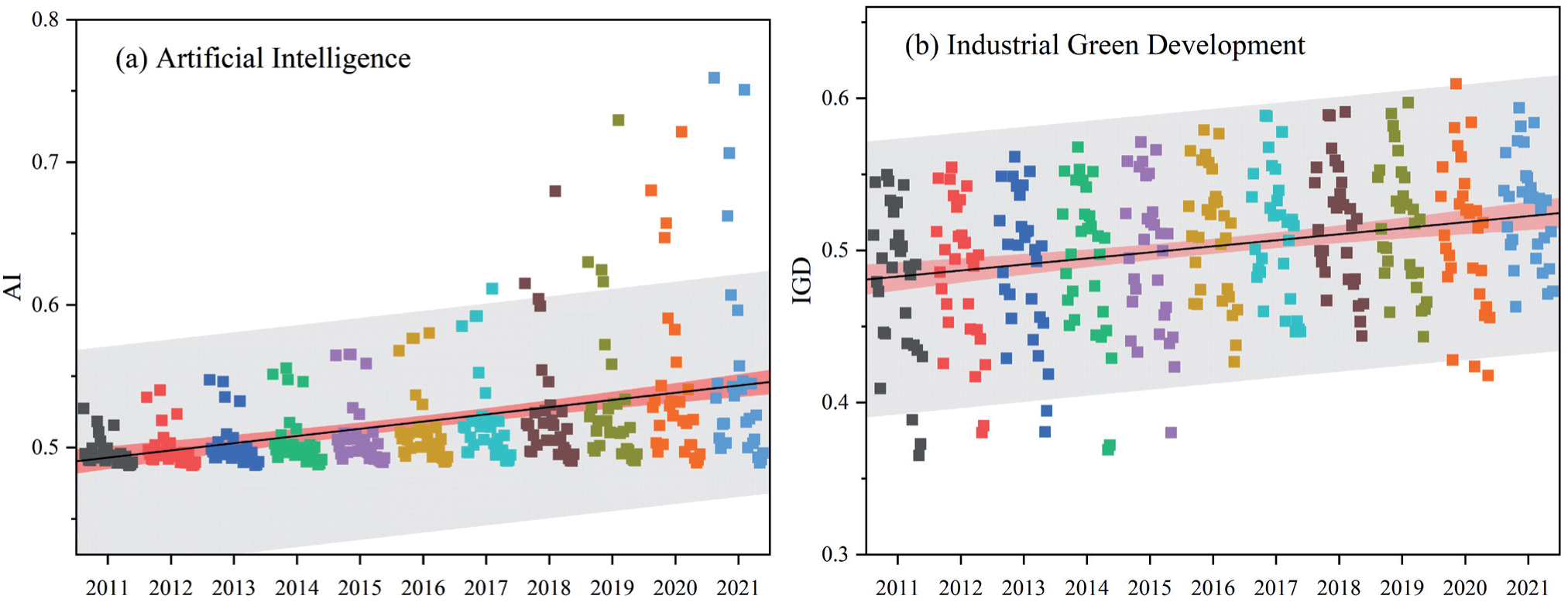
Two grouped scatter plots of the AI index (Fig. 3a) and IGD index (Fig. 3b) of China during the study period were also created to depict the annual trends and the degree of data dispersion each year. Overall, the fit line, confidence band, and prediction band of the AI index show an upward trend. Furthermore, from Fig. 3a, it can be observed that China's AI development index exhibited a trend from convergence to divergence, particularly after 2018, with the disparity in AI indices among provinces widening annually. Specifically, the standard deviation of China's AI index was 0.009 in 2011, 0.043 in 2018, 0.052 in 2019, 0.059 in 2020, and 0.073 in 2021. Similarly, the fit line, confidence band, and prediction band of the IGD index also show an upward trend. Unlike the year-by-year divergence trend in the AI development index, during the study period, the disparity in IGD indices among provinces remained relatively stable (Fig. 3b), without a clear convergence or divergence trend. Specifically, the standard deviation of China's IGD index was 0.051 in 2011, 0.041 in 2018, 0.041 in 2019, 0.047 in 2020, and 0.035 in 2021.
Table 1 presents the correlation matrix of the variables. It can be seen that AI, IGD, industrial structure upgrading, industrial agglomeration, the scale Note: The black line in the middle is the fit line, the light red shaded area is the confidence band, and the gray shaded area is the prediction band. of industrial enterprises above designated size, and degree of opening up were all significantly and positively correlated with each other, while government intervention was negatively and significantly correlated with AI, IGD, industrial structure upgrading, industrial agglomeration, the scale of large industrial enterprises, and degree of opening up.
To ensure that the PROCESS-based hierarchical regression analyses were effective, we conducted the variance inflation factor (VIF) test to uncover possible collinearity. It was found that all VIF values of the variables are between 1.45 and 2.91, which were all below the cut-off value of 5, suggesting that there are no problems related to multicollinearity [90].
Tests of Mediation
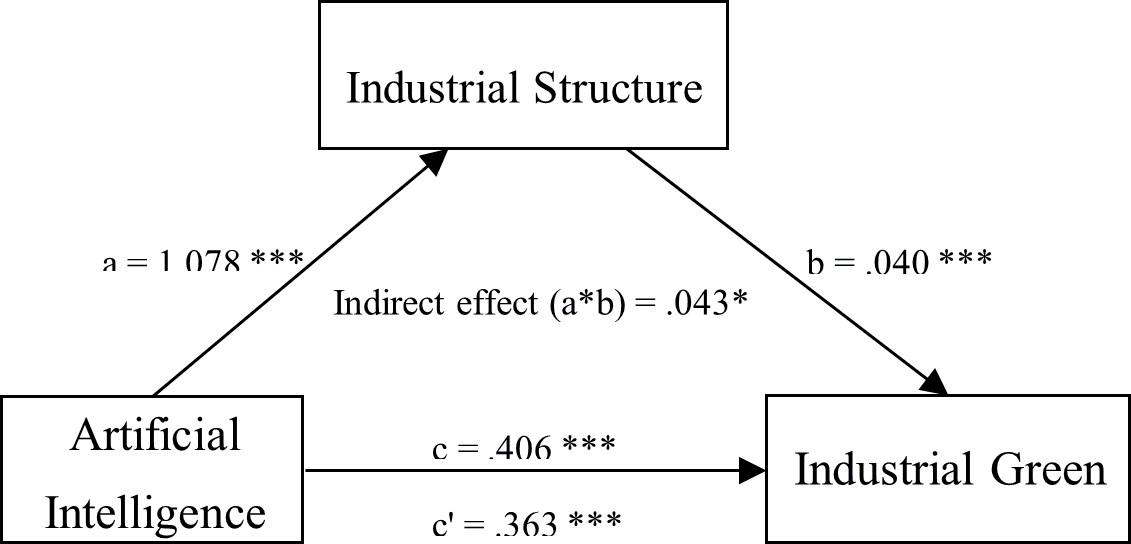
To detect whether AI has a direct effect on IGD, we conducted a linear regression analysis between AI and IGD, with the covariates being controlled. The results are shown in Table 2 (Model 1) and Fig. 4. As seen in Table 2 and Fig. 4, AI had a significant and positive direct effect on IGD (β = .406, 95% CI = [.325, .487]) and the control variables of scale of industrial enterprises above designated size (β = .015, 95% CI = [.007, .024]), degree of opening up (β = .022, 95% CI = [.010, .034]) and government intervention (β = -.228, 95% CI = [-.263, -.193]) were all found to have significant effects on IGD. The R2 of Model 1 was .718. PROCESS macro Model 4 was then employed to test the mediating effect of industrial structure upgrading. The results of the mediation model are shown in Table 2 (Model 2 and Model 3). In Model 2, AI positively predicted industrial structure upgrading (β = 1.078, 95% CI = [.677, 1.479]). The control variables of degree of opening up (β = .203, 95% CI = .145, .260]) and government intervention also (β = -.585, 95% CI = [-.758, -.413]) had significant impacts on IGD, but scale of industrial Note: * p < 0.05; ** p < 0.01; *** p < 0.001. enterprises above designated size (β = .007, 95% CI = [-.035, .049]) did not show a significant effect. The R2 of Model 2 was .528. In Model 3, AI (β = .363, 95% CI = [.281, .446]) and industrial structure upgrading (β = 0.040, 95% CI = [.018, .062]) both showed positive and significant influence on IGD. The control variables of the scale of industrial enterprises above designated size (β = .015, 95% CI = [.006, .023]), degree of opening up (β = .014, 95% CI = [.002, .026]), and government intervention (β = -.205, 95% CI = [-.241, -.168]) were all found to have significant effects on IGD. The R2 of Model 3 was .731. Furthermore, the significance of the mediating effects was assessed using the bias-corrected percentile bootstrapping method. Bootstrapping analysis revealed that the indirect effects of AI on IGD (indirect effect (a*b) = .043, 95% CI = [0.018, 0.075]) through industrial structure upgrading were significant (Fig. 4). Since the total effect and direct effect of AI on IGD were 0.406 (95% CI = [.325, .487]) and 0.363 (95% CI = [.281, .446]) respectively, indirect effects accounted for 10.591% of the total effects. That is to say, the mediating role of industrial structure upgrading was proved, and the link between AI and IGD was partially mediated by industrial structure upgrading [88]. In summary, by these results, Hypothesis 1, Hypothesis 2, Hypothesis 2a, and Hypothesis 2b have all been supported.
Tests of Moderated Mediation
PROCESS macro Model 14 was utilized to test the moderating effect of industrial agglomeration on the mediation model [85]. Table 3 and Fig. 5 present the results of the moderated mediation analysis. As shown in Table 3 (Model 4) and Fig. 5, AI was positively associated with industrial structure upgrading (β = 1.078, 95% CI = [.669, 1.487]). The control variables degree of opening up (β = .203, 95% CI = [.161, .244]) and government intervention (β = -.585, 95% CI = [-.749, -.422]) were significantly linked with industrial structure upgrading while the scale of industrial enterprises above designated size (β = .007, 95% CI = [-.035, .049]) was not. The R2 of Model 4 was .527. In Model 5, we found that AI (β = .383, 95% CI = [.261, .505]), industrial Note: * p < 0.05; ** p < 0.01; *** p < 0.001. structure upgrading (β = .065, 95% CI = [.039, .092]), and industrial agglomeration (β = 2.125, 95% CI = [1.467, 2.783]) positively and significantly influenced IDG. Furthermore, the interaction between industrial structure upgrading and industrial agglomeration (β = -2.512, 95% CI = [-3.374, -1.649]) significantly and negatively predicted IGD, which suggests that the moderating effect of industrial agglomeration on industrial structure upgrading and IGD was supported. The results of Model 14 also show that the scale of industrial enterprises above the designated size (β = .009, 95% CI = [.001, .017]) and government intervention (β = -.159, 95% CI = [-.218, -.099]) had a significant impact on IGD while degree of opening up (β = .001, 95% CI = [-.010, .012]) did not. The R2 of Model 5 was .764. Hypothesis 3 was thus supported.
Table 2.
The mediating effect of industrial structure upgrading on the relationship between AI and IGD.
[i] Note: AI, artificial intelligence; IGD, industrial green development; ISU, industrial structure upgrading; IDS, scale of industrial enterprises above designated size; OPN, degree of opening up; GVI, government intervention; SE, standard error; LL, low limit; CI, confidence interval; UL, upper limit; * p < 0.05; ** p < 0.01; *** p < 0.001.
Table 3.
Results of moderated mediation analysis.
[i] Note: AI, artificial intelligence; IGD, industrial green development; ISU, industrial structure upgrading; IAG, industrial agglomeration; IDS, scale of industrial enterprises above designated size; OPN, degree of opening up; GVI, government intervention; SE, standard error; LL, low limit; CI, confidence interval; UL, upper limit; * p < 0.05; ** p < 0.01; *** p < 0.001.
Fig. 5.
Model of the moderating role of industrial agglomeration on the direct and indirect relationship between AI and IGD.
Using bootstrapping, the conditional indirect effects of AI on IGD via industrial structure upgrading at different values of industrial agglomeration (1 SD below the mean, mean, and 1 SD above the mean) were examined. The results are shown in Table 4. The indirect effect was significant for both low industrial agglomeration (95% CI = [.038, 0.112]) and high industrial agglomeration (95% CI = [-.186, -.049]). However, the indirect effect was not significant for the middle level of industrial agglomeration (95% CI = [−.026, .024]). Thus, the indirect effect of AI on IGD via industrial structure upgrading could not be achieved under the condition of the middle level of industrial agglomeration.
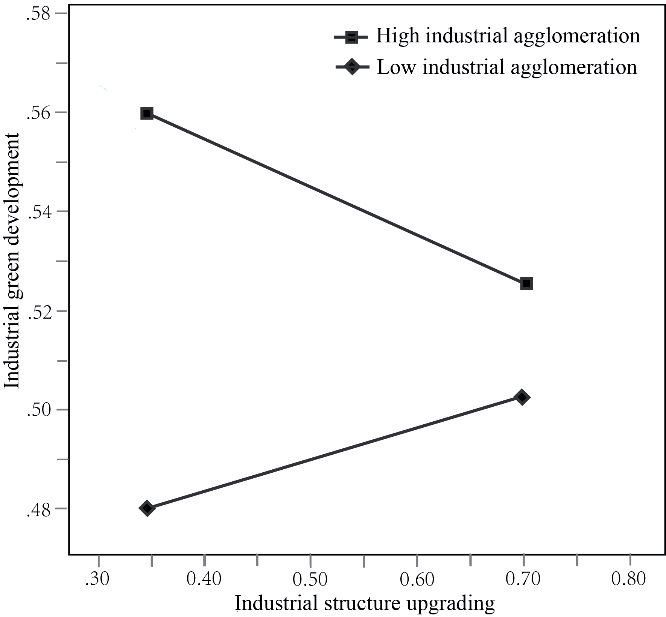
To visually elucidate the moderating influence of industrial agglomeration on the association between industrial structure upgrading and IGD, Fig. 6 was created to illustrate the relationship between industrial structure upgrading and IGD with high and low levels of industrial agglomeration. The mean of the moderating variable (industrial agglomeration) plus or minus one standard deviation was utilized as the grouping criterion, and a simple slope test was conducted to generate Fig. 6. The simple slopes indicated that industrial agglomeration acted as a trigger factor in the process of promoting IGD. With low industrial agglomeration, industrial agglomeration could positively moderate the relationship between industrial structure upgrading and IGD. However, when industrial agglomeration was high, the moderating effect of industrial agglomeration on the link between industrial structure upgrading and IGD was negative.
Table 4.
Results for conditional indirect effect analysis.
| Industrial agglomeration | Effect | BootSE | BootLLCI | BootULCI |
|---|---|---|---|---|
| Low (M − 1SD) | .069 | .019 | .038 | .112 |
| Middle (M) | -.0002 | .013 | -.026 | .024 |
| High (M + 1SD) | -.104 | .035 | -.186 | -.049 |
Fig. 6.
Conditional effect between industrial structure upgrading and IGD according to the level of industrial agglomeration.
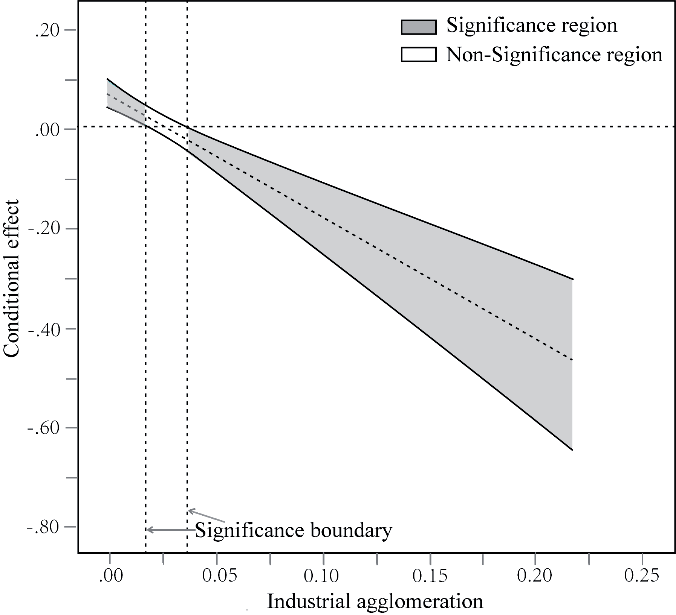
To further describe the moderation effect of industrial agglomeration clearly, we followed He and Ismail, Gorgol et al. to utilize the Johnson-Neyman technique to ascertain the significance area for the entire range of the moderating variable [91, 92]. The Johnson-Neyman technique generates two solutions within the data range in the region where the effect of X on Y is significant when "JNM1≤M≤JNM2" or, possibly, "M≤JNM1" and "M≥JNM2" [85]. A statistically significant conditional effect of X on Y occurs when M is between JNM1 and JNM2 [85]. Consequently, the Johnson-Neyman technique was employed to show where industrial agglomeration would significantly moderate the indirect effect of AI on IGD via industrial structure upgrading in this study. The Johnson–Neyman regions are provided in Fig. 7. In Fig. 7, it is evident that the influences of AI on IGD through industrial structure upgrading were significant in areas where industrial agglomeration scores were less than 0.018 and more than 0.037. In other words, industrial structure upgrading mediates the relationship between AI and IGD in areas where industrial agglomeration scores were lower than 0.018 and higher than 0.037, in which the 95% CI did not contain zero.
Conclusions and Policy Suggestions
Conclusions
AI is profoundly transforming the development model of the economy and society of China. The industrial development model is also inevitably being influenced by AI. This paper, based on Schumpeter's innovation theory, develops a moderated mediation model to explore the specific mechanisms through which AI affects IGD.
We first constructed two comprehensive evaluation index systems for assessing AI development levels and IGD levels in China. We then measured the AI index values and IGD index values in China from 2011 to 2021 using methods of intuitionistic fuzzy analytic hierarchy process and dynamic grey relational analysis. The results show that from 2011 to 2021, there has been a significant improvement in the overall level of AI development in China. The average AI index was 0.497 in 2011, increasing to 0.552 by 2021. Similarly, the level of IGD development across China's 30 provinces also saw significant improvement over this period, with the average IGD index of the provinces rising from 0.487 to 0.526.
A moderated mediation model was constructed to examine the direct and indirect effects of AI on IGD of China, the mediating effect of industrial structure upgrading, and the moderating effect of industrial agglomeration. Data from 30 provinces in China spanning from 2011 to 2021 was collected to test the model and hypotheses. Based on an analysis of data from 30 provinces in China, it is clear that AI could exert a notable and positive direct influence on IGD (β = 0.406, 95% CI = [.325, .487]). Also, we found that the indirect effect of AI on IGD is also supported by the results (β = .363, 95% CI = [.281, .446]). In recent years, there have been debates in the academic community about whether AI can promote industrial green development. Some scholars believe that AI plays a critical role in promoting the greening of production methods and reducing carbon emissions by enhancing production efficiency and resource utilization efficiency, reducing inventory levels, minimizing waste of resources, etc. [5, 93, 94]. However, some other researchers argued that the development of AI may hinder IGD because a significant amount of energy is required for data processing, data training, and model application in AI systems [95]. Based on the empirical data from 30 provinces in China, this study confirms the significant roles of AI on IGD, thereby providing new evidence for the debate on whether AI promotes IGD.
The results confirmed the mediating role of industrial structure upgrading in the relationship between AI and IGD. On the one hand, it was found that the development of AI is positively associated with industrial structure upgrading. This is in line with some previous studies. For instance, Wu and Liu believed that AI promotes industrial structure upgrading by reorganizing manufacturing modes, enhancing efficiency in resource utilization and allocation, and organizational management [96]. Xia et al. argued that AI promotes industrial structure upgrading through intelligent transformation of traditional industrial systems [97]. Wu showed that the development of AI driven by the application of industrial robots can lead to industrial structure change of regions [98]. On the other hand, it was also uncovered that industrial structure upgrading could positively and significantly affect IGD. In previous studies, industrial structure upgrading was considered crucial for decreasing dependence on carbon and advancing cleaner, technology-driven products and services [93], and has the effect of curbing pollutant emissions [99, 100] and reducing energy consumption [101]. The result of this study proved that promoting the movement of production factors towards high-end industries contributes to enhancing IGD, thus providing evidence for the significant role of industrial structure upgrading in promoting industrial greening in the context of the fourth industrial revolution.
Additionally, we discovered that the moderating effect of industrial agglomeration on the relationship between industrial structure upgrading and IGD was significant, and the level of industrial agglomeration has a noticeable impact on its moderation effect. In previous studies, some researchers have investigated the influence of industrial agglomeration on IGD, but there is currently no consensus on it. Some scholars held that the spatial spillover effect of industrial agglomeration due to external economies of scale is beneficial for the recycling of resources and minimizing pollution emissions [55]. However, some other scholars argue that the impact of industrial agglomeration on green development is a dynamic evolutionary process. Although initially, industrial agglomeration has a positive effect on industrial greening, when it progresses beyond a certain threshold, industrial agglomeration can have negative environmental impacts [58]. Through the analysis of panel data from 30 provinces in China, we found that when industrial agglomeration is at a low level, it positively moderates the relationship between industrial structure upgrading and IGD. Conversely, when industrial agglomeration is at a high level, it exerts a negative moderating effect on the association between industrial structure upgrading and IGD. The result of this study lends strength to the previous scholars' view on the nonlinear moderating effect of industrial agglomeration in promoting IGD, which may arise from the dynamic balance between the negative externalities of scale and Jacobs' positive externalities [55]. We also found that when the levels of industrial agglomeration were less than 0.018 and more than 0.037, industrial agglomeration would significantly moderate the indirect effect of AI on IGD via industrial structure upgrading. By confirming the complex nonlinear effects of industrial agglomeration, this study contributes to a deeper understanding of the mechanisms by which industrial agglomeration affects IGD.
Policy Suggestions
Based on the research findings presented above, several potential policy observations can be made:
Firstly, the results of this study reveal that, despite the yearly increase in China's AI development, the overall level of AI in China still has significant room for improvement. Hence, local governments should introduce AI-related policies to support and guide the high-quality development of AI. In particular, tax incentives and other policies could be made to attract more investment in AI. One key area of investment is the construction of AI infrastructure. The widespread adoption and application of AI necessitate more software and hardware infrastructure. For instance, more big data centers and intelligent computing centers should be created, and more long-distance optical cables and internet broadband access ports should be built. Also, policies should be formulated to encourage enterprises and research institutions to increase their investment in the research and development of fundamental AI technologies, particularly those related to green production, green sales, and green logistics in the industrial sector.
Secondly, local governments should enact relevant industrial policies to accelerate the integration of AI with industrial systems, enhancing the embedding depth of AI technology within industrial systems. The traditional industrial production model, which relies heavily on high input of resources and energy consumption, hinders the green transformation of China’s industries. The results of this study indicate that transforming enterprise production, management, and sales systems through AI can significantly improve industrial production efficiency, reduce resource waste, and lower emissions of pollutants in industrial production. Upgrading traditional industrial production models through AI technology can effectively transform the industry's long-standing extensive development approach, making it greener and more efficient. The integration of AI with the Chinese industry is still in its early stages, with enormous potential for future growth. Therefore, accelerating the intelligent transformation of traditional industries and progressively implementing AI-based systems for production, sales, and management is imperative for enhancing IGD levels.
Thirdly, it is of significance to promote industrial structure upgrading. The results of this study suggested that industrial structure upgrading can positively and significantly impact IGD. Consequently, policies such as tax incentives should be introduced to guide and promote the process of upgrading local industrial structures. It is advisable to develop high-end manufacturing industries such as new energy, new materials, environmental protection industries, biotechnology, etc. It is highly necessary to implement an energy-saving assessment system for fixed asset investment projects and rigorously control the capacity levels of newly added high-energy-consuming industries. In the process of promoting industrial structural upgrading, making use of the positive momentum provided by AI technology is essential. By utilizing AI technology to intelligently upgrade and transform the production equipment and production processes of traditional industries, particularly those high-energy consumption and high-pollution industries, it is possible to create favorable conditions for their green development.
Finally, local governments should conduct dynamic assessments of the concentration levels in industrial clusters and implement corresponding management measures based on the results of these assessments. For industrial agglomeration zones with low levels of clustering, policies should be developed to guide industrial enterprises to cluster at an appropriate level. This aims to fully utilize the spillover effects of industrial agglomeration to promote the exchange and sharing of knowledge, technology, and experience among industrial enterprises. Then, the moderating effect of industrial agglomeration on the relationship between industrial structure upgrading and IGD will be reinforced, and the positive impact of the interaction between industrial structure upgrading and industrial agglomeration on IGD will also be enhanced. For industrial clusters whose level of industrial agglomeration is higher than the threshold value, it is vital to raise the entry threshold and rigorously manage the aggregation level to avoid surpassing the critical point, which could bring about pressures on the environment and resources, produce negative externalities, and weaken the positive influence of industrial structure upgrading on IGD.
Implications for Future Research
Firstly, in the comprehensive evaluation index system of AI in China constructed in this study, we used some indirect indicators due to limitations in data availability. For instance, in the secondary indicators for the construction of AI infrastructure, using fixed asset investment in AI to replace the current indicator of fixed asset investment in information technology and software industry would more directly reflect the level of AI infrastructure construction. However, under current conditions, data on fixed asset investment in AI for each province is not readily accessible. Additionally, there is also no readily available statistical data on industrial robots for each province. The data in this study is derived using the method developed by scholars such as Acemoglu, Restrepo, Lu et al. [65, 66], which involves extrapolating from industry-level industrial robot data. Although the methods of using indirect indicators and derived data are widely adopted and relatively scientific compared with other available methods, future research may use more direct indicators and data as AI continues to advance and more data across various dimensions becomes readily accessible. Secondly, the empirical data used in this paper is from national-level sources. Future research could investigate the topic further by analyzing data at a micro level. For instance, future researchers could improve data granularity by examining municipal or county-level sources, enabling a more detailed and nuanced investigation into how AI influences IGD. Thirdly, Future researchers could explore other mediating or moderating variables, such as environmental regulations and the green innovation effect. Finally, since industrial enterprises are the direct users of AI technology and are most familiar with the impact of AI on industrial processes and management, future studies could investigate the impact of AI on IGD from the perspective of industrial enterprises.

