

Introduction
A good ecological environment is an important guarantee for promoting green and low-carbon economic development [1]. With the continuous advancement of the global low-carbon energy transition, environmental issues have become the focus of extensive attention in various countries and regions of the world. China has formed an economic development model that is highly dependent on energy consumption in the process of industrialization, and the economy has deteriorated the ecological environment while developing at a high speed. According to the report “Fossil Fuel Consumption 2022” issued by the U.S. Department of Energy, China’s sulfur dioxide emissions in 2022 will be the highest globally. The phenomena of “border pollution” and “polluted paradise” have emerged. Serious environmental pollution will, in turn, hinder economic development [2]. Therefore, as China’s economy enters a period of high-quality development, strengthening environmental protection, realizing green and low-carbon economic transformation, and actively promoting global ecological governance have become urgent issues.
Facing the pressure of low-carbon environmental protection, the Chinese government often seeks solutions at the policy level. Currently, the Chinese government has effectively reduced environmental pollution through the implementation of environmental regulations [3], low-carbon pilot programs [4], and the river-long system [5], etc. The common point of these policies is that most are direct and mandatory policies enacted for environmental pollution. However, the impact of these direct and mandatory policies on economic effects is not always positive. Porter [6] pointed out that environmental policies can promote sustained economic growth by enhancing enterprises’ green technological innovation, and some studies have also shown that environmental regulations do not necessarily enhance industrial competitiveness [7]. Digitalization and IP protection, as a comprehensive policy that combines “emission reduction” and “efficiency enhancement”, have received more and more attention in urban governance and environmental improvement. The construction of digital infrastructure and the digital transformation of enterprises can promote industrial restructuring and technological innovation to improve environmental quality [8-11]. The role of IP rights (IPR) protection in global environmental pollution management is becoming more and more prominent, especially under the framework of the optimal IPR protection theory. The appropriate IPR protection system can optimize the regional business environment, promote the green technological innovation of enterprises [12], and play a crucial role in managing environmental pollution with the help of technological advances [13, 14]. The IPDC policy was initially created in 2012, and after achieving results, it was gradually promoted to other cities. This process not only optimizes the regional business environment but also promotes the leap of green technology innovation. Moreover, relying on a good business environment and a high level of green technological innovation has also attracted the inflow of high-quality foreign investment, optimized the structure of utilized foreign investment, and promoted the upgrading of regional industrial structure. Green technology innovation can promote the development of clean energy and emission reduction technology. The application of high-quality foreign investment in environmental protection technology and clean energy technology can have a demonstration effect on the place where it is introduced, which will superimpose on the upgrading of the industrial structure to promote the improvement of energy efficiency and the reduction of pollutant emissions, and thus improve the quality of the environment. Thus, compared with other policy tools, the IPDC policy has a natural advantage in terms of system construction, which takes into account the dual objectives of “emission reduction” and “efficiency enhancement”. Therefore, in the context of green and low-carbon transformation goals, whether the IPDC policy can become a breakthrough in environmental governance has become a question worth exploring.
Existing literature on the effect of the IP protection system on economic development has been fully explored, including the promotion of IP protection in foreign direct investment, industrial structure upgrading, and enterprise innovation [15- 17]. Although the important role of IPR protection in global environmental pollution management has been confirmed from international experience [13], the research focusing on China’s environmental pollution management from the perspective of IPR protection is not yet sufficient. Whether there is an environmental improvement effect of IPR protection needs to be further explored. Due to the lack of city-level FDI data, existing studies on IPR protection and environmental quality improvement have mostly focused on exploring the mechanism analysis of technological innovation and green technological innovation [12, 18, 19], and there is little literature to test the mechanism impact of foreign investment structure optimization and industrial structure upgrading. Therefore, based on exploring the mechanism effect of traditional industrial structure upgrading, this paper further tests the mechanism effect of foreign investment structure optimization and industrial structure upgrading by utilizing the index of foreign investment in the service industry. Based on the above analysis, this paper adopts the panel data of 243 prefecture-level cities. It considers the IPDC policy as a quasi-natural experiment to empirically test the environmental improvement effect of the IPDC policy and the mechanism behind it, as well as to improve the construction of the IPDC further and stimulate the enterprises’ green technological innovation and industrial structure upgrading.
The contributions are as follows: (1) In terms of research perspectives, this paper integrates the IP protection system and the improvement of environmental quality into a unified analytical framework, which enriches the policy toolbox of environmental governance.
(2) In terms of research content, on the one hand, most existing studies focus on exploring the economic impact of IP protection at the national macro level [20], and there is still a lack of exploration of the city-level dimension. Based on this, this paper divides cities based on geographic location and economic strength to explore the regional and city-level heterogeneity of IPR protection on environmental quality improvement. On the other hand, this paper examines the important mechanism of foreign investment structure optimization and industrial structure upgrading of IP protection affecting environmental quality, which enriches the theoretical basis of such research.
The rest of the paper is organized as follows: The second part provides the literature review and theoretical analysis; the third part provides the policy background and research design, which explains the models and variables; the fourth part draws on and discusses the empirical results and heterogeneity tests; and the fifth part summarizes the main conclusions and provides policy recommendations.
Literature Review
There are two types of literature closely related to this paper; the first is the literature on IP protection. The mainstream view in academia is that IP protection can promote foreign direct investment, industrial structure optimization and upgrading, as well as green innovation capacity. Awokuse and Yin [20] verified that IP protection could promote FDI on a national level. Klein [21] considered the impact of factors such as imitation risk and transaction costs and concluded that the higher the IP in the host country, the more attractive it will be to foreign investment. The level of IP protection also largely affects the country’s industrial structure [15] and improves the optimization of industrial structure [16], which is especially crucial for capital and technology-intensive industries [17]. As an important institutional innovation of IP protection, the IPDC policy can improve the IP management system and enhance the development level of the urban IP service industry. Xu [22] found that the IPDC policy promotes industrial structural adjustment by accelerating human capital flow and encouraging innovative enterprise development. In terms of innovation, strengthening IP protection can stimulate the innovation vitality of enterprises by creating a favorable innovation environment [23-25]. Enhancing enterprises’ open innovation capability can improve green technology innovation [26]. Meanwhile, the strengthened IP protection gives inventors monopoly rights to protect the power of patent owners and incentivizes firms to expand the scale of innovation [27]. Some scholars have also argued that high-intensity IP protection hinders knowledge spillovers and technology diffusion and dampens innovation [28, 29]. For example, Cho et al. [30] found that IP protection raises the threshold for firms to imitate and innovate and that countries with weaker innovation capabilities, such as Vietnam and Indonesia, will see a decline in firms’ willingness to innovate.
Another category is the literature on the factors affecting environmental pollution. Since environmental pollution problems can cause serious harm and economic losses to society, they have now become the focus of extensive attention worldwide. A large amount of existing literature focuses on the analysis of various types of factors affecting environmental pollution. Shen and Lin [1] argued that technological innovation can improve energy saving and emission reduction and then promote low-carbon development. Liu [31] found that reducing environmental pollution mainly relies on the technological progress of labor production. The impact of technological progress on environmental pollution will, in turn, be affected by environmental regulation. Liu et al. [32] found a nonlinear dynamic environmental regulation threshold effect of technological progress and environmental pollution, but Guo et al. [33] found that environmental regulation strengthens the inhibitory effect. FDI inflows can similarly promote the application of green technology and reduce air pollution [34, 35]. In addition, industrial structure and fiscal decentralization are also important factors that influence environmental pollution. The irrationality of industrial structures can cause ecological pollution, and Hammond et al. [36] revealed that the manufacturing industry improved environmental quality through industrial structure upgrading. Scott [37] argued that optimizing industrial structure improves productivity and energy efficiency and reduces environmental pollution. Silva and Caplan [38] believed that fiscal decentralization reduces the intensity of environmental governance and is not conducive to environmental improvement. More scholars support the conclusion that fiscal decentralization can improve environmental quality [39-41].
After a comprehensive analysis of the existing literature, it was found that current research on the influence factors of IP protection and environmental pollution has been quite perfect. Existing literature focuses on IP protection’s impact on FDI, industrial structure upgrading, technological innovation, green innovation, environmental regulation, industrial structure, fiscal decentralization, and other factors on environmental pollution, answering the question of how much these factors will affect environmental pollution, but little research on how to manage environmental pollution to improve environmental quality. Although the important role of IP protection in global environmental pollution governance has been confirmed from international experience [13], the research focusing on China’s environmental pollution governance from the perspective of IP protection has not been sufficient. Based on the existing research, this paper brings IP protection and environmental pollution into a unified framework, analyzes the impact of IP protection on China's environmental improvement, and discusses in depth the mechanism of the impact, which is of great practical significance.
Theoretical Analysis
IP Protection and Environmental Pollution
The IPR model city policy aims to stimulate urban innovation and creativity and promote high-quality regional development. This not only encourages local governments to take various measures to promote green scientific and technological innovation [26] and industrial restructuring [12], reduces the environmental pollution index of the “leading” demonstration cities [36], but also realizes the “striving for excellence” effect among local governments. The effect of “striving for excellence” has been realized among local governments.
At the same time, the policy optimizes the local business environment by increasing the supply of IP systems, reducing the uncertainty cost of technology transfer and the cost of defending the rights of foreign enterprises, and attracting regional agglomeration and development of high-quality foreign investment [42]. High-quality foreign investment has a spillover effect and demonstration effect when changing the structure of regional energy consumption, improving the energy utilization efficiency of enterprises, and reducing the proportion of polluting industries to improve the regional environmental quality.
Therefore, IP protection can effectively promote environmental pollution control and environmental quality improvement.
Mechanisms through which IP Protection Improves the Environment
In view of the key role played by the industrial structure of foreign investment in the optimization of China’s overall industrial structure [43], this paper will explore how IPR protection policies can promote environmental improvement through these paths from the dimensions of green technological innovation, optimization of foreign investment structure, and industrial structure upgrading.
(1) Green Technology Innovation
IP demonstration city policy has an incentive and guarantee effect on green technological innovation of enterprises. On the one hand, the formulation of the policy standardizes the rules of cooperation between upstream and downstream enterprises, strengthens the exclusivity of enterprises’ green technological innovation achievements, raises the cost of innovation imitation [44], enables the innovators to obtain the corresponding innovation excess returns [45], and stimulates the enthusiasm of enterprises to carry out green innovation [46]. The policy increases the protection of green patents by cracking down on the infringement of IP patents related to green products and pollution control technologies, safeguards the legitimate rights and interests of the main body of green technological innovation, and enhances the willingness of enterprises to carry out green technological innovation. On the other hand, the IPR model city policy promotes establishing an efficient IPR judicial system to provide efficient judicial protection for resolving IPR disputes. Improving the case processing efficiency to safeguard the legitimate rights and interests of innovation subjects and reducing the cost and time of green technological innovation results in the defense of rights [47]. Therefore, the IP model city policy helps improve enterprises’ ability to innovate in green technology. Further, green technology innovation can improve factor resource input, enhance product cleanliness and energy-saving and emission-reduction efficiency, reduce environmental pollution, and promote low-carbon development.
(2) Optimization of foreign investment structure and industrial structure upgrading
As a knowledge-intensive industry, the service industry outputs wisdom, innovation, and advanced concepts of intangible elements, such as the lack of perfect IP protection, which is easy to imitate and plagiarize. Therefore, the more perfect the IP system, the more attractive the region is to foreign investment in the service industry. The IPR model city policy strengthens regional IPR protection and significantly promotes the increase of foreign investment flows [20], especially the inflow of foreign investment in the service industry, and optimizes the structure of foreign investment.
High-quality foreign investment has an important impact on local enterprises through the competition effect and spillover effect [48, 49] and promotes upgrading industrial structure. On the one hand, the strengthening of IP protection will force domestic enterprises to maintain the comparative advantage of the home country, independently improve the efficiency of resource allocation, constantly adjust production and operation, change production and operation, use factors of production in other industries and sectors through the effect of the correlation between the front and back of the industry, and realize the upgrading of the structure of each industry [50]. On the other hand, improving the IP protection level will strengthen the spillover effect of high-quality foreign investment. The process of introducing advanced production technology and management mechanisms improves the financing situation of high-tech enterprises and enterprises in advantageous industries [51] and rationally allocates capital distribution among industries. The alleviation of financing constraints in optimizing resource allocation in enterprise “dry middle school” will enhance the productivity of local enterprises [52], promote the development of emerging industries and advantaged industries, and realize the upgrading of industrial structure. The optimization of foreign investment structure and industrial structure upgrading can guide local enterprises to transform in a cleaner and greener direction and improve regional environmental quality [53].
Combined with the above theoretical analysis, this paper proposes the following two research hypotheses to be tested:
Hypothesis 1: IP model city policy helps to improve environmental quality.
Hypothesis 2: Green technological innovation, optimization of foreign investment structure, and upgrading of industrial structure are the main mechanisms to exert the environmental improvement effect of IP protection.
Materials and Methods
Policy Background
The development of the IPDC policy is a key measure taken by China to strengthen IP protection and promote economic innovation and growth. The policy aims to develop a replicable IP management and application model through policy pilots in selected cities to improve IP work nationwide. As China enters the stage of high-quality development, the demand for innovation-driven development increases, and IP becomes a key strategic resource. In order to realize the goal of becoming a “strong IP country”, the Chinese government has emphasized the importance of building an IP system as part of its national strategy in a number of important documents.
In 2011, the State IP Office of China (SIPO) formulated and released the evaluation methods for national pilot and demonstration cities of IP rights, detailing the basic conditions, application procedures, and responsibilities and capabilities required for the cities to apply for the program. In terms of specific conditions for policy implementation, cities or regions applying for the demonstration are required to achieve a certain level of IP protection and management, including efficient administrative and judicial protection mechanisms and a mature IP dispute resolution system. In addition, local governments are also required to attach great importance to IP protection and coordinate the promotion of IP. Regarding creating a model city, the relevant city needs to submit a detailed construction plan, which will be reviewed by the provincial government and submitted to the State IP Office (SIPO). The SIPO, together with the relevant departments, will carry out the selection, management, and acceptance and will select qualified cities to carry out demonstration construction for two years. Those cities that have passed the acceptance will be awarded the title of “Demonstration Zone”, which is valid for a period of time. The city that passes the acceptance will be awarded the title of “Demonstration Zone”, which is valid for three years and can be renewed after the expiration of the period. In terms of specific work, detailed provisions have been made for the duties of the executive unit, work support, financial service innovation, pilot demonstration of strong county projects, improvement of the public service system, strengthening of the work assessment, business training, increased guidance and support, and policy favoritism in a variety of aspects, forming a comprehensive system for IP rights.
The IPDC policy is an important measure taken by the Chinese government to enhance its IP governance capacity and realize its strategy of becoming a strong IP country. Since 2012, China has gradually established a number of IPDCs in batches, as shown in Table 1. 23 cities were established in 2012, 18 cities were approved in 2013, and a total of 6 batches containing 77 cities have been established as of 2019. The expanding scope of the IPDC policy provides a solid foundation for China’s IP-enhanced strategy and high-quality development, as well as a good policy impact for exploring the impact of IP protection on environmental quality.
Econometric Model Specification
The environmental impact of constructing national IP demonstration cities can be regarded as a policy experiment. The policy effect can be identified by the double difference model (DID) method in econometrics, which is unfolded mainly by comparing the research samples that have not been affected by the policy as well as those that have been affected by the policy before and after implementation to confirm the impact brought about by the policy. If the construction of IPR model cities can effectively promote the improvement of China’s environment, it indicates that IPR protection has a significant environmental improvement effect. In this paper, the 77 national IPR model cities established in batches are taken as the experimental group, and the rest are taken as the control group. The environmental improvement effect of IPR protection is assessed by calculating the double difference between the experimental group and the control group before and after implementing the IPR model city policy several times. Adopting the double difference model as the empirical method has the following advantages: (1) Policy shocks are exogenous variables, so they can be regarded as a “quasi-natural experiment”, avoiding causality reversal and thus reducing endogeneity problems. (2) By setting up dummy variables for regression analysis, the double-difference method can more accurately reflect the relationship between the occurrence and non-occurrence of policies and better predict the trend of the impact of IP protection on environmental improvement. (3) Compared with traditional empirical methods, the double difference model can effectively reduce the omission of variables, and the model form is simpler and easier to understand the inner principle. The double difference is a causal effect analysis method, which needs to consider four elements: shock event, treatment group, control group, and time and the classical construction is in the following form:
Table 1.
Pilot List of IPDCs.
Where Yct denotes the explanatory variable, Dc denotes the policy grouping dummy, Tc denotes the policy time dummy, Dc*Tc represents the interaction term between the two, γ, δ, and β denote the coefficients of each, and εct is the random error term. The general double differencing method will cover two different sets of samples and two periods, with the first set of samples receiving no treatment in the first period, a specific treatment in the second period, and the second set of samples receiving no treatment in either period. Therefore, the case where individual c receives the treatment in period t is defined as the experimental group, i.e., Dct=1, and the case where it does not receive the treatment is defined as the control group, i.e., Dct=0. The period before the experimental group receives the treatment is defined as the baseline period, i.e., t=0, and the period after the treatment is notated as t=1. where for the experimental group of individuals, there is Dct=1, for the control individuals, there is Dct=0, and for all the individuals, c, there is Dc0=0. Constructing a double difference model makes it possible to identify the average treatment effect of a policy shock on the affected sample and thus assess the status of the change in the treatment outcome, Yct, when the policy impact occurs versus when it does not occur.
Accordingly, this paper constructs a fixed effects model for double difference estimation, which is set as follows:
Where the subscript c denotes the city, and t denotes the year. Pollutionct is an explanatory variable representing the sulfur dioxide emissions of city c in year t, representing the environmental pollution of city c. IPct is a policy variable for the construction of IP demonstration cities, which is equal to the product of the policy dummy variable Dc and the time dummy variable Tc, and it takes the value of 1 if city c is a model city for IP rights in year t. Otherwise, it takes the value of 0. Otherwise, it takes the value of 0; Xct represents a series of control variables at the city level; μc and μt represent city-fixed effects and time-fixed effects, respectively; and εct is a random error term.
Variable Selection
Explained Variable
Degree of urban environmental load (pollutionct). The explained variable is the degree of urban environmental load; because enterprises are the main body of economic activities, sulfur dioxide is the main pollutant emitted by industrial activities, and the work draws on the practice of Niu et al. [54], using industrial sulfur dioxide emissions as a proxy variable for the degree of urban environmental load. In addition, the research also uses the value of urban PM2.5 concentration for robustness testing.
Core Explanatory Variables: IP Demonstration Cities Policy IPct
IP demonstration cities policy (IPct). This work takes the pilot construction of a national IP demonstration city starting from 2012 as a quasi-natural experiment and constructs a dummy variable of IP demonstration city construction to indicate whether the level of regional IP protection has improved. For example, city c assigns a value of 1 to IPct in the year of becoming an IP demonstration city, and in the year after that, it assigns a value of 0 otherwise.
Control Variables
Referring to existing research and integrating the relevant factors affecting the location choice of foreign investment, the control variables are selected as follows: Urban scale (pop), represented by the logarithm of the total population at the end of the year; Economic development level (pergdp), represented by the logarithm of the annual per capita GDP; Government intervention (gov), measured by the ratio of municipal government expenditure to the GDP of the year; Urban livability (green), specifically represented by the area of urban green space per capita; Urban industrial structure (thirdgdp), represented by the proportion of the value added of the tertiary industry in the GDP; Level of urban openness (open), represented by the ratio of the city’s annual import value to the total GDP; Information technology development level (internet), represented by the logarithm of the number of urban internet broadband access; Urban public service level (hospital), represented by the average number of hospital beds per ten thousand people.
Table 2.
Descriptive statistics of variables.
Sample Selection and Data Sources
The city-related data mainly come from the Urban Statistical Yearbook and the hand-arranged statistical yearbook and statistical bulletin of each city. Based on the research needs, the study has screened the samples as follows: Firstly, the samples of four municipalities directly under the central government are excluded. Considering the differences in administrative levels and government behavior patterns between municipalities and other cities and the fact that some of the IPDCs are only part of the municipalities (e.g., Chaoyang and Haidian districts in Beijing), the inclusion of municipalities may affect the reliability of the results of this paper, so we exclude the samples of Beijing, Tianjin, Shanghai, and Chongqing. Secondly, we exclude the samples of prefecture-level cities that contain IP demonstration county-level city pilots; for example, Yiwu City, Zhejiang Province, was selected as the fourth batch of pilots in 2016, but Jinhua City, which is in charge of Yiwu City, was also selected in the list of the sixth batch of IPDCs in 2018. The same situation occurs in Qingdao, Suzhou, and Nantong, and so on. In order to avoid the influence of such city samples on the regression results, we have excluded such samples. Finally, this study also refers to the study of Nie et al. [55] to exclude the sample of prefecture-level cities that were selected in the sixth batch of the list in 2019 to avoid its impact on the policy evaluation results.
After screening, the research obtains the sample data of 243 prefecture-level cities, among which 49 cities have been successively selected as national IP demonstration cities, constituting the sample of the experimental group of this paper, and the remaining 194 cities constitute the sample of the control group of this paper. This study is based on macro-city-level data provided by the China City Statistical Yearbook and micro-firm-level data from the Foreign Direct Investment Approval Database aggregated to the city level, which provide valuable information for exploring the impact of IPR protection policies on environmental improvement and the intrinsic mechanism of impact. The first batch of national IPR demonstration cities was announced in 2012, and the data in the FDI Approval Database was last updated in 2017. In order to ensure that there are reasonable observation intervals before and after the implementation of this policy, this paper chooses 2007 as the starting period of the study so that the earliest batch of cities that have become IPR pilots will have a five-year observation period before treatment and a five-year observation period in the same year of the treatment as well as after the treatment. In addition, because the FDI approval database has not been updated in recent years, and the China Urban Statistical Yearbook does not have sufficiently complete statistics for some cities in remote areas, there are certain limitations in the availability and timeliness of data, which may limit our observation and analysis of longer-term trends, and our study is unable to fully capture the impact of recent policy changes on the environment. Despite certain shortcomings, we believe that the data over the time period analyzed can still provide valuable insights into understanding the drivers and pathways of environmental improvements from IP protection. Table 2 gives the results of the descriptive statistics.
Results and Discussions
Baseline Model Test
The study adopts a double difference model to test the net effect of the IPDC policy on the degree of urban environmental load; specific regression results are Table 3, Column (1) and Column (2) results show that, in the uncontrolled time fixed effects and city fixed effects, gradually adding control variables after the establishment of IPDCs suppressed the urban sulfur dioxide emissions at the 1% level of significance. Columns (3) and (4) gradually add year-fixed effects and city-fixed effects on the basis of the previous two columns, which shows that the IPDC policy still significantly negatively affects urban sulfur dioxide emissions and reduces urban environmental pollution. This verifies hypothesis 1.
Table 3.
Benchmark regression.
Parallel Trend Test
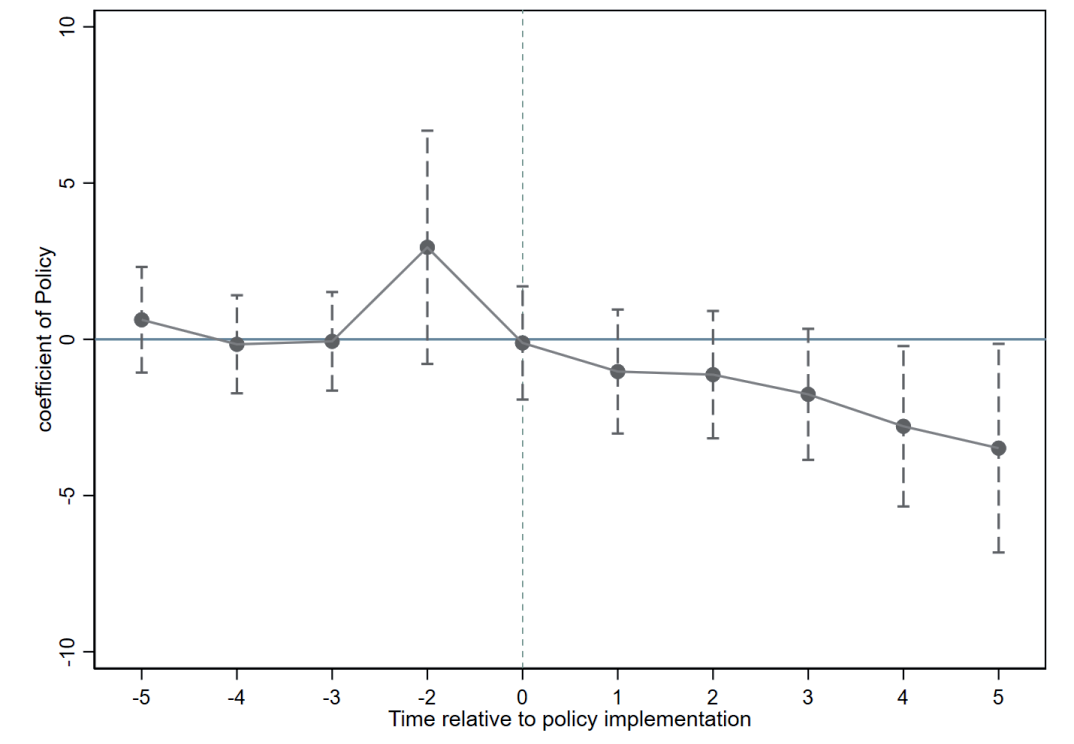
The premise of using the double difference model is to require that the experimental group and the control group have a similar trend before the implementation of the policy, meet the common trend assumption, and have a significant increase or decrease after the implementation of the policy. This paper refers to the event study method, sets IPDCs as the experimental group and other cities as the control group, takes the year before the city is listed as IPDCs as the base period, and sets the 0 and 1 dummy variables before and after the implementation of the policy as the first 5 periods, the first 4 periods, the first 3 periods, the first 2 periods, the current period, the second 1 period, the second 2 periods, the second 3 periods, the third 4 periods, and the fifth 5 periods of the implementation of the policy, respectively. In Fig. 1, the regression coefficients of the first 5 periods of policy implementation contain 0 values in the 95% confidence interval; the confidence interval of the regression coefficients of the fourth period and after the implementation of the policy no longer contain 0 values, and the size of the coefficients increases with the incremental increase in time, indicating that IPDCs passed the test of the parallel trend, and at the same time the effect of the implementation of the policy effect on the improvement of the quality of the urban environment, there is a three-year lag, and there is some continuity. There is a certain degree of continuity with the passage of time to promote the effect and gradually enhance it.
Robustness Tests
To enhance the robustness of the benchmark regression, the study performs a series of robustness tests, such as replacing the explanatory variables, sample shrinkage treatment, propensity score matching method, and changing the sample range.
Replacement of Explanatory Variables
Sulfur dioxide emissions are used in the benchmark regression to represent the degree of urban environmental improvement. The study further adopts urban PM2.5 emissions as a proxy variable for the degree of urban environmental load for robustness testing. The results are shown in Column (1) in Table 4. The results show that after replacing the explanatory variables, the regression coefficient is -0.968, which further verifies the robustness of the results.
Trimming the Sample
Some outliers may exist in the data; this paper performs regression after shrinking the upper and lower 1% of continuous variables. The results in Column (2) show that the coefficient is -1.854 and significant at the 1% level after the upper and lower 1% shrinkage treatment, indicating that the benchmark regression is not disturbed by obvious outliers.
Changing the Sample
Five batches of IPDCs were set up during the sample period, and a sixth batch was set up in 2019. In order to avoid the sixth batch of cities from impacting the results of this paper, the study excludes the IPDCs set up in 2019 after regression. The estimated coefficient of Column (3) of Table 4 is -1.966 and is significant at the 5% level, proving that the results are robust.
Provincial capital cities and sub-provincial cities have some special characteristics compared with other prefecture-level cities in terms of administrative level, economy, resources, and policies, which may impact the results. Therefore, the study conducts a robustness test again after excluding sub-provincial cities and excluding sub-provincial cities and provincial capital cities, respectively, based on the original sample. The results are shown in Columns (4) and (5) of Table 4, with the regression coefficients of -1.622 and -1.913, respectively, proving that the results are robust.
Estimation Based on the PSM-DID Method
The work adopts the proximity matching method to match year by year with a ratio of 1:2 and re-regresses the matched samples. The results are shown in column (6) of Table 4, and the regression coefficient is -1.804, further proving the robustness of the results.
Table 4.
Robustness test.
Placebo Test
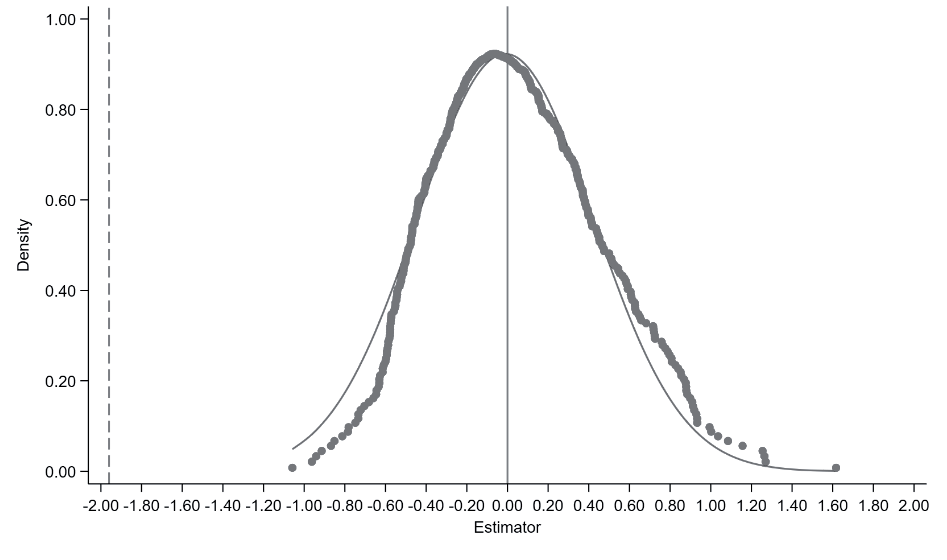
The relevant factors that may affect the urban environment have been controlled in the benchmark regression, but there may still be other policies or external shocks that affect the improvement of the urban environment. This study conducts 500 random samples of the list of pilot cities and pilot years. Suppose the improvement effect of the IP model city policy on the urban environment is real and effective. In that case, the coefficients of the random samples should converge to 0, and the density plot should be consistent with a normal distribution. Fig. 2 shows the kernel density distribution of the regression coefficients after random sampling of the treatment group; most of the coefficient estimates are concentrated around 0 and, as a whole, obey normal distribution consistent with the expectations, indicating that the conclusions of this paper through the placebo test, the negative impact of the IPDC policy on sulfur dioxide emissions is real and effective, and the IPDC policy has a contributing role in the enhancement of the quality of the urban environment.
Mechanism Analysis
In the above analysis, the study believes that the IPDC policy will affect environmental quality through technological innovation, foreign investment, and industrial structure upgrading; therefore, the study will empirically test the above two mechanisms.
(1) Green Technological Innovation
IP model city policies can promote green technological innovation by enterprises. Improvements in factor resource inputs, product cleanliness, and energy-saving and emission-reduction efficiency can help reduce environmental pollution. This paper uses green patent applications and authorizations to measure the level of green technological innovation in cities. Table 5 shows that the estimated coefficients of IP demonstration cities are all significantly positive, indicating that the IP demonstration city policy promotes urban green technological innovation, proving that implementing the IP demonstration cities policy provides support and incentives for urban green technological innovation. Previous studies have found that technological development is significantly biased toward low carbon, which helps to improve product cleanliness, energy saving, and emission reduction efficiency and helps to change China’s energy-dependent economic development model. Therefore, innovation in green technology is important in reducing urban environmental pollution. In addition, the test of calculating the urban innovation environment was done by referring to Kou’s method [56].
(2) Foreign investment structure and industrial structure upgrading
The study uses the FDI enterprise registration database of the Foreign Enterprise Information Query Platform of the Ministry of Commerce of China to construct indicators for optimizing the structure of foreign investment. This database contains more than 2 million records of FDI registrations. Based on this database, we can know the investment time, registration amount, and investment source of each foreign investment in China. On this basis, this paper matches the FDI enterprise registration database with the list of enterprises captured on the platform of “Tianyiha” through the enterprise name. Then, it obtains the province and city where the enterprise is located and the industry category to which the enterprise belongs. Referring to the methods of Gan [57] and Yuan [58] to construct the foreign investment structure optimization index, the construction method is shown in Equation (3) and Equation (4):
Where yct,m=3 indicates the number of new FDIs in the tertiary industry in region c in period t, and yct,m=2 indicates the number of new FDIs in the secondary industry in region c in period t, which reflects the size of the proportion of the service industry in FDI and the degree of upgrading of the city’s foreign investment structure.
Among them, ycmt indicates the proportion of the new number of FDIs in industry m in region c in period t to the regional total, reflecting the evolutionary relationship of the three major industries of FDI from the dominant position of the primary industry to the dominant position of the secondary and tertiary industries gradually.
In this paper, we refer to Gan [57] and construct the industrial structure upgrading index by utilizing the ratio of the tertiary industry’s added value to the secondary industry’s added value. The above indicators are added in Equation (2) for regression.
The coefficients of Columns (1) to (2) in Table 6 are significantly positive, indicating that the IPR model city policy can promote the optimization of foreign investment structure. The number of foreign investment introductions in the use of services shows similar results. In addition, the results in Columns (3) and (4) of Table 6 have significantly positive coefficients, indicating that the IPR model city policy can promote the overall industrial structure upgrading. Studies have shown that the optimization of foreign investment structure and industrial structure upgrading can force local enterprises to improve the efficiency of resource allocation, continuously adjust their production and operation, and shift from high-energy-consuming and high-polluting industries to high-tech direction, effectively reducing the pollution intensity [49]. Combining the regression results and previous studies, it can be concluded that the optimization of foreign investment structure and upgrading industrial structure are still important factors influencing China’s low-carbon development. The IPR model city policy effectively promotes the inflow of foreign investment in the service industry, the transformation of industrial structure in the direction of low-energy modernization, and the rapid development of clean and green industries. This verifies hypothesis 2.
Table 5.
Green technological innovation mechanisms.
Table 6.
Mechanisms for upgrading the industrial structure.
Heterogeneity Tests
Urban Location Heterogeneity
Considering that cities in different geographic locations are subject to certain differences in policy support and historical factors, the IPDC policy may have a heterogeneous effect on improving urban environments in different locations. According to the city’s geographic location on the coast, in the hinterland, or in the remote area, and the strength of the city’s economic development, the city is divided into the Eastern Economic Belt, the Central Economic Belt, and the Western Economic Belt. Cities in the western part of the country, where regional development is weaker, are more affected by the IPDC policy and will receive more obvious promotion when improving the environment. Based on this, this paper conducts regressions based on the geographic location of the cities into East, Central, and West, respectively. The regression results in Columns (1) to (3) of Table 7 show that the estimated coefficients of the core explanatory variable IP for the eastern city sample are significantly negative, the estimated coefficients for the central city sample are significantly negative, the estimated coefficients for the central region sample are -2.507, and the estimated coefficients for the western region sample are -2.099 and significant.
It is a fact that the establishment of IPDCs has a more obvious effect on the improvement of the local environment in the central and western regions. Possible reasons for the markedly different effects of policies are differences in market conditions and opportunities for economic development. On the one hand, China’s economic center of gravity has shifted to the eastern region, and this historical development has resulted in the relative backwardness of the central and western regions in terms of economic development. The regional unbalanced economic development strategy implemented by the state since the reform and opening up has objectively exacerbated development imbalances. The lower level of IP protection and the poorer environment for innovation and development in the central and western regions have led to a lower level of green technological innovation, giving the central and western regions a larger space for policy implementation. The IPR model city policy, supported by the Western development strategy, can effectively enhance the green technological innovation level of cities in central and western China by strengthening the synergistic utilization of patents and cultivating innovation subjects, thus improving the local environmental quality.
On the other hand, the business environment is very important to the regional utilization of foreign investment structure and industrial structure upgrading. Implementing the policy of national-level demonstration zones for undertaking industrial transfer has shifted industries from the east to the central and western regions. Various kinds of subsidies and industrial synergy protection measures obtained by the central and western regions provide strong support for implementing the policy. Based on the law of marginal diminution of the impact of policy shocks on the regional business environment, strengthening the IPR protection of the model cities in the central and western regions can optimize the local business environment and attract high-quality foreign investment inflows. These foreign investments not only optimize the local foreign investment structure but also drive the upgrading of the industrial structure. Advanced technology and the management experience of foreign-funded enterprises have a good demonstration effect on local enterprises, prompting them to pay more attention to environmental protection and green development, thus effectively reducing pollution emissions.
Table 7.
Heterogeneity test for location and city class.
City Hierarchy Heterogeneity
The theory of urban hierarchy points out that there are certain differences in the functions and the degree of resource environmental protection of cities of different hierarchical levels within the urban system. According to the latest circular on the adjustment of the standard of city size classification issued by China, the cities are categorized into megacities and non-megacities. Higher-ranking cities in the region provide various kinds of high-quality services for lower-ranking cities, so the IPDC policy’s effect on improving the urban environment varies greatly among cities of different ranks. The results in Columns (4) and (5) of Table 7 show that the establishment of IPDCs in the sample of megacities has no significant effect on the improvement of the urban environment, while the estimated coefficients for non-mega cities are significantly negative, indicating that the IPDC policy has a more significant effect on the improvement of the environment in non-mega cities. There are two main reasons for this difference: First, non-mega cities are more inclined to adopt a small-scale, incremental development pattern in the urban renewal process. Non-mega cities face relatively less administrative resistance in policy implementation than megacities. The IPR model city policy can effectively promote patent transformation and enhance the quality of urban human capital. By optimizing the allocation of resources, it enhances the city’s green innovation capacity, thus promoting the city’s low-carbon development. Secondly, non-mega cities mainly take the initiative to undertake industrial transfer by giving full play to their comparative advantages and building an industrial structure with advanced manufacturing as the mainstay. The ability of non-mega cities to adjust their economic structure in a timely and flexible manner is conducive to the IPR model city policy to more effectively promote the optimal allocation of public service resources, such as education and medical care, and improve the business environment. A good business environment can help optimize the structure of foreign investment, promote upgrading the city’s industrial structure, and reduce environmental pollution.
Conclusions
Green development has become one of the important goals of economic transformation; the public’s awareness of ecological and environmental protection has gradually increased, and environmental protection issues are increasingly being paid attention to. Improving environmental quality is an urgent requirement for realizing green development and actively promoting global ecological governance. As an institutional innovation, IP protection has played a significant role in improving environmental quality. However, research focusing on China’s environmental pollution management from the perspective of IP protection is still insufficient. Most existing studies focus on the macro level, and there is still insufficient exploration of the city-level dimension. In addition, there is little literature on how IP protection can improve environmental quality by optimizing the structure of foreign investment and promoting the upgrading of industrial structure.
This work establishes a multi-period double-difference model, empirically examines the impact of the IPDC policy on improving environmental quality, and conducts an in-depth analysis of the impact mechanisms and heterogeneity involved. The study’s conclusions are as follows: (1) The IPDC policy improves regional environmental quality, and the results pass the parallel trend and placebo tests. The conclusions of this paper still hold even after a series of robustness tests, such as replacing PM2.5 emissions as a proxy variable for environmental pollution variables, shrinking the upper and lower 1% of continuous variables, excluding IPDCs set up in 2019, excluding sub-provincial and capital city change samples, as well as estimation based on the PSM-DID method. (2) The IPDC policy mainly improves environmental pollution problems through two mechanisms: improving enterprises’ technological innovation and green innovation capacity and promoting foreign investment and industrial structure upgrading.
(3) Regional heterogeneity and city-level heterogeneity are involved in the environmental improvement effect of the IPDC policy, which is more obvious in central and western cities with weaker economic development and non-mega cities. This may be due to the fact that the economic development of the central and western regions is weaker than that of the eastern regions. The awareness of environmental protection and environmental quality is not as good as that of the eastern regions, so the IPDC policy optimizes the business environment of the central and western regions and has a more obvious effect on the improvement of the local environment. The megacities themselves have a more mature industrial structure and innovation system, better environmental protection awareness and regulation, and a higher level of IP protection, and the marginal environmental improvement effect of the IPDC policy is smaller. On the other hand, strengthening IP protection in non-mega cities has a more obvious improvement effect on urban innovation and the macro environment, thus providing sufficient motivation and conditions for improving local environmental quality. The improvement effect is also more obvious than that of megacities.
Recommendations
These findings provide the following policy insights for China to utilize the IP model city policy to achieve low-carbon development goals:
First, the government expanded the list of pilot cities by optimizing the city screening criteria and strengthened the assessment and incentive mechanisms for IPR legislation and enforcement personnel to enhance the intensity of legislation and enforcement. It emphasizes the importance of IP protection when formulating environmental governance policies such as pollutant emission standards.
Second, emphasize the role of green technology innovation capacity in low-carbon development. At the level of policymakers, set up special funds and innovation platforms to support enterprises, universities, and scientific research institutions to carry out green technology research and development. At the level of industrial policies, prioritize the development of energy, chemical, and other industries that apply renewable energy and clean production technologies and promote the upgrading of green technologies to achieve low-carbon transformation.
Third, promote the introduction of high-quality foreign investment to help upgrade the industrial structure. At the level of policymakers, improve the investment environment, optimize the structure of foreign investment, and guide foreign investment in high-tech, modern service industries, and other green industries. Encourage the transformation and upgrading of strategic emerging industries such as information technology, high-end equipment manufacturing, and traditional industries. At the level of local industries, high-tech enterprises and service enterprises should actively cooperate with foreign investment, introduce advanced technology and management experience, and realize the green transformation of industries.
Fourth, the policy of model cities for IP rights should be implemented according to regional conditions. Developed regions continue to strengthen IP protection and set up domestic low-carbon demonstration benchmarks through sustainable technology development and industrial evangelization. Less developed regions focus on strengthening the awareness of IP protection in leading industries such as agriculture and equipment manufacturing and promoting the research and development of green technologies and their application. Local governments will support foreign-funded enterprises in countries with more stringent environmental standards to attract high-quality foreign investment inflows. Encourage high-quality foreign-funded enterprises to establish clean energy R&D centers in China, strengthen the spillover effect of foreign investment, promote industrial structure upgrading, and realize low-carbon economic transformation.
This paper still has some limitations. First, this paper is based on the FDI approval database, which is limited in its availability and timeliness of the data, and the study cannot fully capture the environmental impact of the recent changes in IPR protection policies. Future research can further validate the findings of this study by expanding the timeframe and sources of data and exploring possible changes over different time periods. Second, this paper is based on China’s “Model IPR City” policy. When similar studies are generalized to other countries in the future, the differences in policies and institutions of different countries should be taken into account.

