

Introduction
The rough economic growth is not coordinated with environmental protection, which will inevitably cause environmental pollution and ecological deterioration. As China enters a critical period of transformation, a green and ecological development model has become an important goal [1]. With the deep adjustment of the global industrial competition pattern, industrial transfer has become an inevitable choice to accelerate economic transformation due to the weakening of the traditional comparative advantages and the strategic importance of regional economic development [2]. In January 2010, the Chinese government announced the official establishment of the first national-level demonstration zone for industrial transfer, the Wanjiang City Belt Demonstration Zone. The same year, the Chinese government stated that it would strengthen environmental protection, conserve and intensively utilize resources, and promote sustainable development. The promulgation of a series of policies has accelerated the pace of interregional industrial transfer. Reasonable industrial transfer, vacating cages, and exchanging birds can improve the long-term docking mechanism for the economic development of the East, Central, and West, realizing the effective gradient transfer and industrial chain reshaping between regions. Chinese-style industrial transfer is not only to adjust industrial structure and promote economic growth but also an important strategy for realizing green development [3].
The transfer of industries will lead to the transfer of environmental pollution through changes in regional division of labor and production structure [4]. For example, if factor costs rise, the eastern coastal region will transfer energy-intensive industries to the central and western regions, accelerating urbanization. Under the pattern of research and development in the east and manufacturing in the central and western regions, pollution-intensive production links will be concentrated in the central and western regions, where environmental regulations are weaker. At the same time, environmental pollution will also be transferred to the central and western regions. However, this conclusion has not been uniformly recognized in the academic community. So, can industrial transfer actually play a role in improving the environment of the receiving place? Through what mechanism does industrial transfer affect environmental pollution? Is there regional and urban heterogeneity? Based on this, this paper considers the creation of national-level industrial transfer demonstration zones in China as a quasi-natural experiment, adopting the panel data of 285 prefecture-level cities from 2007-2022, among which 28 prefecture-level cities have been successively selected as the pilot cities during the sample period (the prefecture-level cities included in the experimental group sample in this paper are: Hefei, Wuhu, Ma’anshan, Tongling, Anqing, Chizhou, Chuzhou, Lu’an, Xuancheng, Wuzhou, Guigang, Hezhou, Yulin, Hengyang, Chenzhou, Yongzhou, Jingzhou, Jingmen, Yuncheng, Weinan, Sanmenxia, Linfen, Guang’an, Ganzhou, Lanzhou, Baiyin, Yinchuan, and Shizuishan), constituting the experimental sample, and other 257 prefecture-level cities constitute the control sample of this paper, and we test empirically that the environmental improvement effect of industrial transfer system construction.
Literature Review and Theoretical Analysis
Literature Review: Pollution
The literature related to environmental improvement can be traced back to Grossman and Krueger’s [5] pioneering analysis of the relationship between economic growth and the environment. With the continuous development of the global economy, environmental problems have become increasingly prominent, among which industrial pollution is the center of attention [6]. The informal regulation of industrial pollution is regarded as a means of solving water pollution problems [7]. It has been found that factors such as technological progress, policy environment, and resource agglomeration can influence regional environmental pollution. Improvements at the technological level, such as green technology innovation and labor production technology upgrading [8], can effectively reduce urban pollution. At the policy environment level, improving laws and regulations has strengthened the inhibition of environmental pollution [9]. Meanwhile, Radelyuk et al. [10] assessed the oil refinery industry’s impact on global water resources, and foreign direct investment somewhat promoted green innovations, thereby reducing industrial pollution [11-12]. In addition, the implementation of national-level policies also has an obvious promotion effect on regional water environment improvement. Xiao et al. [13] explored a cross-sectoral dynamic model of water pollution to address developing countries’ water pollution control problems. Relying on the practice of national eco-industrial demonstration parks, Hua and Ye [14] found that national eco-industrial demonstration parks effectively reduce carbon emissions by utilizing the double-difference method.
Industrial transfer is undoubtedly an important path to break the shackles of regional economic development and promote national industrial transformation and upgrading [15]. With environmental problems becoming more and more prominent, national environmental protection awareness is increasing; however, there is no unified conclusion about industrial transfer’s impact on environmental pollution at present. Lu et al. [16] explored the impact mechanism of Beijing enterprises’ investment in Hebei, which significantly affects green TFP through rationalizing industrial structure with a certain degree of regional heterogeneity. Then, some scholars began to study the impact of demonstration zone policies on the environment. It is found that the policies can reduce carbon emissions and regional pollution emissions [17- 19] and affect the regional ecological environment [20]. After the city was selected as a demonstration zone for undertaking industrial transfer, industrial sulfur dioxide emissions were significantly reduced [21, 22]. A few scholars hold the opposite view, believing that industrial transfer will negatively impact the region and exacerbate urban environmental pollution. Zhang and Lin [23] found that regional industrial transfer in China exacerbated carbon emissions. Zhang et al. [24] found that economic growth can increase industrial wastewater emissions and industrial sulfur dioxide emissions. In summary, there is no consistent conclusion on the relationship.
By combing the existing literature, it can be found that the current study on regional environmental improvement is mostly about economic growth, green technology innovation, resource agglomeration, and business environment impact on regional environmental quality. Literature on industrial transfer focuses on the factors that influence industrial structure, in which industrial transfer’s impact on environmental quality focuses more on carbon emissions and other air pollution and less on water pollution phenomena. The policy of national-level demonstration zones for industrial transfer provides new perspectives for the study, but most scholars focus on a single demonstration zone as the object of study, which lacks universal conclusions. Based on this, this paper incorporates multiple national-level demonstration zones for undertaking industrial transfer and urban wastewater management into a unified framework, analyzes demonstration zone policy impact on environmental quality, and explores its intrinsic mechanism, which is of great practical significance.
Theoretical Analysis
Industrial Transfer and Environmental Quality
Industrial transfer, maybe with a large influx of relocated industries into the receiving place [25], will impact and influence the development of the receiving place. However, there may be a phenomenon that transfers high energy-consuming industries into receiving places while easing the environmental pressure of the transferring region [26, 27]. Suppose the central and western regions actively exert their own comparative advantages and resource endowments to undertake transferring industries by adopting strict environmental regulations and reasonable local policies. In that case, they are also able to realize environmental improvement [28].
National-level demonstration zones for industrial transfer have strict environmental requirements for undertaking industries, and local governments are strictly prohibited from undertaking highly polluting industries. The Wanjiang City Belt attaches importance to strengthening ecological construction and building green ecological barriers in industrial transfer. The South and West Hunan Demonstration Zone for Industrial Transfer puts forward strict industrial access standards and emphasizes that the basic principle of industrial transfer is to prioritize ecology and green development. These environmental policies can affect the industrialization and urbanization process in the central and western regions and increase clean energy use. Policies such as access standards and green investment have optimized the business environment and attracted more foreign investment to green and high-end industries. They can improve industry upgrading in the receiving site, reduce the emission of pollutants by influencing the behavior of enterprises, and ultimately improve regional environmental quality [29].
In summary, the policy of national-level demonstration zones for undertaking industrial transfer aims to help local governments promote industrial transfer through the requirements of green development, promote industrial structure upgrading in the receiving places, and provide an important institutional guarantee for pollution control and environmental improvement. Accordingly, the following hypotheses are proposed:
Hypothesis 1: National-level demonstration zones for undertaking industrial transfer policy help improve the receiving place’s environmental quality.
The Role of the Mechanism of Industrial Transfer in Improving the Environment
(1) Agglomeration effect
The movement of labor can affect a region’s economic structure [30]. Population agglomeration improves economic structure from the supply and demand sides [31] and promotes the urbanization and industrialization process in these regions, thus indirectly affecting regional environmental quality.
From the supply side, industrial transfer can promote the re-agglomeration and integration of population and industrial factors [32]. To increase the attractiveness of labor migration, industrial receiving sites in the demonstration zone will accumulate more efficient individuals and enterprises through a series of supportive policies, accelerate the accumulation of human capital, optimize the allocation of innovative equipment, innovative manpower, and innovative resources, and create a foundation for improving technological innovation efficiency. Enterprises, under the guidance of clear policies of the demonstration zone, focus on green development, strengthen green R&D investment and production, form low-carbon production methods, promote the service-oriented transformation of the manufacturing industry, and reduce the energy consumption of the industry transferring place and the receiving place [33], then improving the environmental quality.
From the demand side, industrial transfer improves population agglomeration in the receiving place of the demonstration area, which can increase disposable income to stimulate regional consumption capacity. At the same time, the consumption behavior of the new labor force will change the regional consumption structure, and enterprises will adjust their products according to changes in demand under the regulation of supply and demand in the market, thus attracting higher-quality foreign investment and upgrading the local manufacturing industry, which will indirectly improve the regional environment. Accordingly, point out the following hypothesis:
Hypothesis 2: China’s national-level demonstration zones for undertaking industrial transfer policy improve the environmental quality of the receiving place through the agglomeration effect.
(2) Optimization of foreign investment structure and upgrading of industrial structure
Foreign investment is important for developing countries to realize technological upgrading and promote economic transformation [34, 35]. The increasing cost of labor and other factors, coupled with the complex environmental changes, means that the traditional Chinese international competitive advantage in attracting foreign investment is shifting to the advantages of technology, knowledge, and systems. The target of foreign investment has shifted from low-end manufacturing to technology-intensive high-end manufacturing and service industries. Since high-quality foreign-funded enterprises tend to implement higher environmental and emission standards than local enterprises in host countries, strengthening regional environmental regulations to improve the business environment is an important guarantee of attracting high-quality foreign investment inflows.
China’s national-level demonstration zones for undertaking industrial transfer are a typical example of institutional innovation. The demonstration zone cities, as leaders, optimize the regional business environment by setting strict environmental standards and rules, strengthening supervision to ensure that enterprises in the zones meet higher environmental requirements, and increasing the inflow of capital to low-carbon industries, as well as many policies to enhance the environmental awareness of local enterprises. Improving the business environment can reduce the uncertainty and institutional transaction costs of technology transfer for foreign enterprises and improve the regional innovation performance [36], thus attracting the inflow of higher-quality foreign investment. With the continuous improvement of China’s industrial transfer policy, the structure of foreign investment has shown an obvious optimization trend.
The inflow of high-quality foreign capital impacts the enterprises in the receiving area through the competition effect and spillover effect and promotes industrial structure upgrading in the receiving area. Specifically, high-quality foreign investment, mainly in technology-intensive high-end manufacturing and knowledge-intensive services, can produce competitive effects, forcing enterprises in the receiving area to improve the efficiency of resource allocation, enhance the green innovation capacity, and promote upgrading the industrial structure of the receiving area. In addition, high-quality foreign-funded enterprises follow a higher standard of environmental protection and emphasize the environmental effects of the unity of the production concept, which is a good demonstration effect on the local enterprises in the receiving area. Under the background of tightening environmental regulations in the demonstration zone, local enterprises are motivated by the demonstration effect of foreign investment to learn and imitate the advanced management concepts established by high-quality foreign-funded enterprises and learn from their cleaner-biased technologies and efficient environmental management systems in order to improve their own green development capabilities [37] and realize cleaner production. The management concepts and innovative green technologies gradually formed by the enterprises in the demonstration zone will radiate to the upstream and downstream industries by transmitting the industrial chain.
The industrial structure effect is an important contributing factor to environmental pollution sources [38, 39]. The inflow of foreign capital into high-tech manufacturing and service industries with better environmental performance will enhance green technological innovation and promote local industrial structure upgrading through the influence on enterprises in the host country. It has been shown that industrial structure upgrading can improve enterprises’ energy efficiency and regional environmental quality [40].
Accordingly, point out the following hypotheses:
Hypothesis 3: China’s national-level demonstration zones for undertaking industrial transfer policy improve the environmental quality of the host site by optimizing foreign investment structure and promoting industrial structure upgrading.
(3) Policy environment
It has been shown that a good ecological policy environment can improve regional environmental quality by influencing corporate behavior. In order to prevent the economy of national-level demonstration zones for industrial transfer from taking the traditional development path and to achieve the goal of industrial transfer, the Chinese central government has clearly put forward the optimization of the business environment and low-carbon development as the focus of the demonstration zones in the Measures for the Administration of Demonstration Zones for Industrial Transfer. Strict environmental requirements have been put forward for the industries to be undertaken in the demonstration zones and for reviewing energy-saving assessments. With regard to the undertaking industry, the environmental capacity of the demonstration zone should be taken as undertaking industrial transfer. Transfer projects must comply with the resource conservation and national environmental protection access thresholds and prohibit highly polluting industries and backward industries to avoid wasting resources and the proliferation of pollution. In terms of energy-saving assessment and review, it is necessary to strictly implement the national standards of volume ratio and investment intensity of industrial construction land and to strengthen the access system review of the project site. The environmental review of key industries, such as chemicals and metallurgy, will be intensified, and the clean production capacity of key industries will be improved.
As the implementer of the policy, the local government of the demonstration area implements the central government’s guiding ideology, which determines the regional ecological policy environment and directly affects the environmental quality of the receiving area [41]. As China’s high ground for domestic industrial transfer, it is difficult for national-level demonstration zones to apply for, set up, build, and improve. Therefore, local governments will inevitably strengthen the implementation of environmental protection policies and recognition of environmental governance. Firstly, they strictly implement environmental protection standards and reduce environmental pollution. Secondly, through local financial subsidies, credit tilt, and land policies, the demonstration zone government guides the transfer of industries to green and clean industry development. Helping to improve the environment of the receiving place. Thirdly, the government of the demonstration zone encourages enterprises to increase the learning and imitation of foreign investment while improving the investment in green R&D, enhancing green technology innovation, and improving regional environmental quality. At the government level, a series of policies in the demonstration zone strengthen regional environmental governance and improve environmental quality. Accordingly, the following hypotheses are proposed:
Hypothesis 4: China’s national-level demonstration zones for undertaking industrial transfer policies improve the environmental quality of the host sites by improving the policy environment and strengthening local government environmental governance.
Method
Measurement Modeling
In this paper, the construction of a state-level undertaking industrial transfer demonstration area is regarded as an exogenous policy shock, and the impacts of industrial transfer on regional environmental quality are identified by using the Doubling of Difference (DID) method, with the Doubling of Difference (DID) method modeling set up as follows:
where subscript c is the city and t is the year, waterct is an explanatory variable indicating the level of wastewater treatment rate of city c in year t; UITDct is a national-level demonstration zone for undertaking industrial transfer, which takes the value of 1 if city c is a city within the scope of the national-level demonstration zone for undertaking industrial transfer in year t, and 0 otherwise; Xct denotes control variables; μc and μt denote city fixed effects and time fixed effects; and εct is a random error term. This paper focuses on the coefficient β1. If β1>0, the demonstration zone for industrial transfer will improve environmental quality (increase the sewage treatment rate); otherwise, it will deteriorate environmental quality.
Selection of Variables
Explained Variable
The explanatory variable is urban environmental quality. As enterprises are the main body of economic activities, the centralized industrial wastewater treatment plant is a centralized facility or independently operated unit specialized in treating industrial wastewater for industrial parks, contiguous industrial enterprises, or peripheral enterprises. Compared with the characteristics of air pollution, which is more diffuse and difficult to detect, water pollution will be reflected differently within the city, and the local water pollution in the city is more reflective of the environmental quality situation. The sewage treatment rate can reflect the fulfillment of water ecological and environmental management efficiency and effectiveness objectives [42]. The higher centralized treatment rate of wastewater treatment plants represents the greater intensity of environmental regulation [43] and the relatively stronger environmental improvement effect [28]. Therefore, this paper adopts the centralized treatment rate of sewage treatment plants as a measure of urban environmental quality. In addition, this paper also uses urban coal energy consumption and urban industrial chemical oxygen demand (ICOD) for robustness testing.
Core Explanatory Variables
Exploring the policies for national-level demonstration zones for undertaking industrial transfer (UITDct). This paper takes the pilot construction of national-level demonstration zones for undertaking industrial transfer starting from 2010 as a quasi-natural experiment and constructs the dummy variable of national-level demonstration zones for undertaking industrial transfer to indicate whether the ability of the region to undertake industrial transfer is improved, i.e., city C is assigned the value of 1 in the year of becoming a national-level demonstration zone for undertaking industrial transfer and in the year after that, and the year of UITDct is assigned the value of 0 otherwise.
Control Variables
Referring to York et al. [44], Feng et al. [45], and Bing et al. [46], combined with the construction of demonstration zones for undertaking industrial transfer and the relevant influencing factors of environmental quality, the control variables are as follows: city size (pop), expressed by the logarithm of the city’s total year-end population; urban livability (green), expressed by the logarithm of area of park green space per capita in the city; Information technology development (internet), expressed as the logarithm of the city’s internet access; the level of talent pool (university), expressed as the logarithm of the number of higher education schools in the city; government intervention (gov), measured as the ratio of government expenditure to the current year’s GDP in prefecture-level cities; the level of economic development (gdp), expressed as the logarithm of the city’s annual GDP; and the level of urban air quality (pm10), expressed as the logarithm of the average concentration of PM10 in the city for the current year. The descriptive statistics results are shown in Table 1.
Table 1.
Descriptive statistics of variables.
Results
Benchmark Model Test
This paper uses a double difference model to test the net effect of the national industrial transfer demonstration zones policy on the environmental quality of the host sites, with the results shown in Table 2. The results in columns (1) and (2) show that, without controlling for the city fixed effect and year fixed effect, the gradual addition of the control variables increases the municipal sewage treatment rate of the national industrial transfer demonstration zones policy at the 1% significance level. Columns (3) and (4) gradually add city-fixed effects and year-fixed effects based on the previous two columns. It can be seen that the policy of national-level industrial transfer demonstration zones still significantly increases the urban sewage treatment rate, which indicates that the policy of national-level industrial transfer demonstration zones has a significant positive impact on the environmental improvement of the host sites. The above conclusion is consistent with the expectation, thus verifying hypothesis 1 of this paper.
Parallel Trend Test
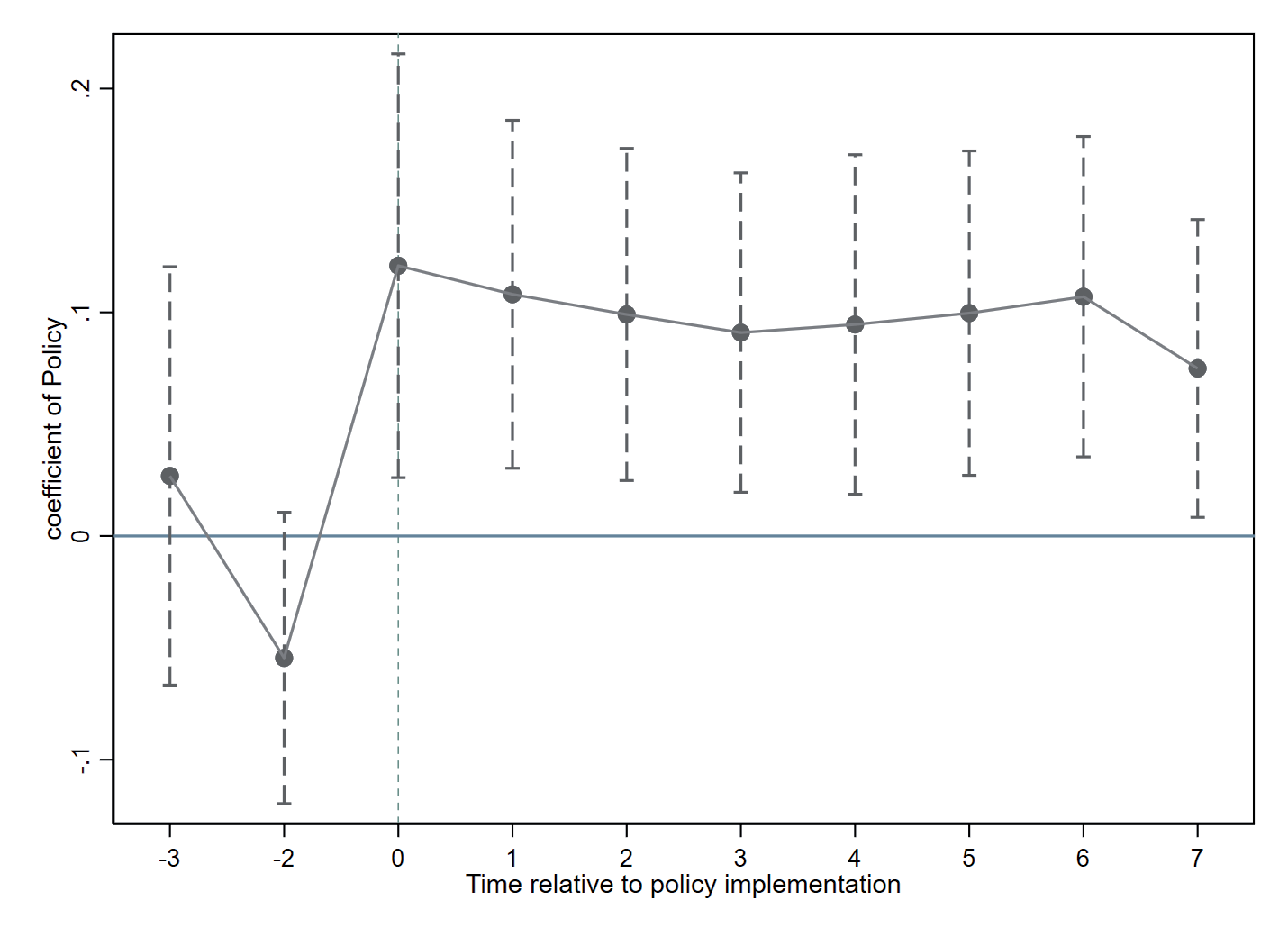
With reference to the event study method, we set the city of national-level demonstration zone for undertaking industrial transfer as the experimental group and other cities as the control group and take the year before the city is listed as the city of national-level demonstration zone for undertaking industrial transfer as the base period, and set it as the 0 and 1 dummy in the first 3 periods, the first 2 periods, the current period, the second 1 period, the second 2 periods, the third 3 periods, the fourth 4 periods, the fifth 5 periods, the sixth 6 periods, and the seventh 7 periods of the implementation of the policy, respectively, before the implementation of the policy, and after the implementation of the policy. In Fig. 1, the regression coefficients of the first 3 periods of policy implementation contain 0 value in the 95% confidence interval; the confidence interval of the regression coefficients of the current period and after the implementation of the policy no longer contain 0 value; and with the increment of time, there is a certain degree of continuity in the promotion of the policy implementation effect on the urban environment, indicating that the policy of the national-level demonstration city for undertaking industrial transfer has passed the parallel trend test.
Robustness Test
The work conducts a series of robustness tests to enhance the benchmark regression’s robustness, such as replacing the explanatory variables, sample shrinkage treatment, propensity score matching method, changing the sample range, and eliminating policy interference.
Replacement of Explanatory Variables
In the benchmark regression, the sewage treatment rate is used to represent the urban environmental quality. To enhance the results’ robustness, the research further adopts the urban coal energy consumption as a proxy variable for the degree of urban environmental load to conduct the robustness test. After replacing the explanatory variables, the results in column (1) of Table 3 show that the coefficient is -0.024 and significant at the 10% level. In addition, ICOD was used to replace the explanatory variables for the robustness test, and the results are shown in column (2) of Table 3, where the regression coefficient is -0.23 and significant at the 1% level after replacing the explanatory variables. It shows that the policy of national-level demonstration zones for undertaking industrial transfer reduces the host cities’ coal energy consumption and ICOD and improves the regional environment, further verifying its robustness.
In addition, to exclude the interference of the carbon emissions trading pilot city policy in 2013, the cities included in the pilot are assigned a value of 1 in 2013 and the years after that; otherwise, they are assigned a value of 0. Cross-multiplying the DID to conduct the regression results in Column (3) of Table 3 shows that the coefficient is 0.1 and significant. It shows that the national-level demonstration zones policy for undertaking industrial transfer still improves the sewage treatment rate of the hosting area and improves the regional environment, and the results are robust.
Table 2.
Benchmark regression.
Trimming
To exclude the interference of possible outliers in the data, the study carries out regression after shrinking the upper and lower 1% of continuous variables. The results in column (4) show that the coefficient is 0.098 and significant after the upper and lower 1% shrinkage, indicating that the benchmark regression is not disturbed by obvious outliers. To exclude the interference of possible outliers in the data, the study carries out regression after shrinking the upper and lower 1% of continuous variables.
Changing the Sample
The outbreak of the global epidemic in 2020 will have a greater impact on the domestic and international industrial chain supply chain, affecting industrial transfer. To avoid the interference of the new crown epidemic in 2020 on the results, the study excludes all samples after 2020. Results in column (5) show that the coefficient is 0.093 and significant, proving the results are robust.
Table 3.
Robustness test.
The provincial capital and sub-provincial cities have some special characteristics compared with other prefecture-level cities in terms of administrative level, economy, resources, policies, etc., which may affect the results to some extent. Therefore, the study conducts the robustness test again after excluding sub-provincial cities and provincial capital cities, respectively, on the basis of the original sample and results in columns (6) to (7) and coefficients of 0.106 and 0.108, proving that the results are robust.
Estimation Based on the PSM-DID Method
Since the selection of cities in national-level demonstration zones for undertaking industrial transfer is not random, it will be affected by its own factors, such as urban development and undertaking capacity, which may cause systematic bias to results. For this reason, this work adopts the proximity matching method to match year by year with a ratio of 1:2 and re-regresses the matched samples. The results are in column (8), and the t coefficient is 0.084, further proving the robustness.
Placebo Test
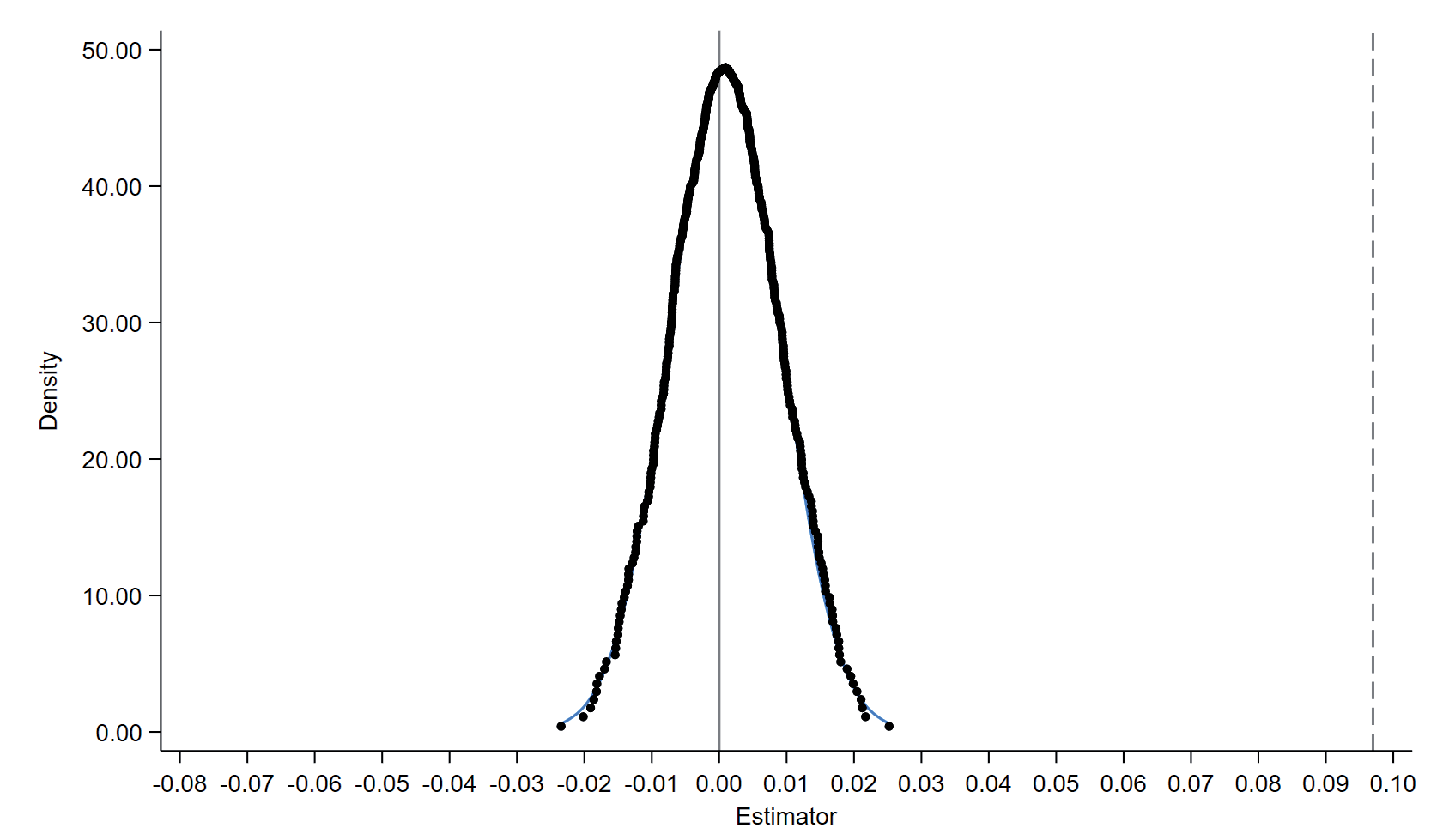
The relevant factors that may affect environmental improvement have been controlled in the benchmark regression, but there may still be other policies or external shocks that affect urban environmental improvement. Based on this, this paper carries out 500 times of random sampling on the list of pilot cities and pilot years. Suppose the promotion effect of urban policies on urban environmental improvement in the national-level demonstration zones for undertaking industrial transfer is real and effective. In that case, the coefficients of the random sampling should converge to 0, and the density plot should conform to a normal distribution. Fig. 2 below shows the kernel density distribution of the regression coefficients after random sampling of the treatment group. Most of the coefficient estimates are concentrated around 0 and, as a whole, obey the normal distribution, which is consistent with the expectation, indicating that it passes the placebo test and that the national-level demonstration zones policy for receiving industries is real and effective in improving the environment of the receiving places.
Heterogeneity Analysis
Regional Heterogeneity
Previous analysis shows that national-level demonstration zone policies for undertaking industrial transfer generally improve regional environmental quality. However, due to the vastness of China, the local policy support and historical factors in different regions have great variability, and the different locations of the demonstration zones may have heterogeneous effects on the improvement of the environment. Based on this, this paper conducts separate regressions based on the regions to which the demonstration zones belong, which are categorized into central and western China, the Yangtze River Economic Belt, and the non-Yangtze River Economic Belt. Table 4 shows that in the data for the central cities, the regression coefficient for the core explanatory variables is positive at the 5 percent significance level. In contrast, the data for the western cities show that the coefficient is negative at the 5 percent significance level. Further looking at the sample of cities within the Yangtze River Economic Belt, the regression coefficient of the core explanatory variable is significantly positive at the 1 percent significance level, whereas in the sample of cities outside the Yangtze River Economic Belt, the coefficient is not significant.
Table 4.
Heterogeneity test for industrial host location and city class.
Table 5.
A test of locational heterogeneity in places receiving industrial transfers.
There may be heterogeneity in the impact of whether the demonstration area specifies the host region and the difference in the host region on its environmental improvement. Therefore, the corresponding dummy variables are re-regressed and analyzed after interacting with the variable DID, taking into account the cases of explicit and unambiguous hosting regions and the hosting regions specified explicitly as the Yangtze River Delta, Guangdong, Hong Kong, Macao, and the Pearl River Delta. The results in columns (1) and (2) of Table 5 show that for the samples that specify the relevant industry receiving region, the policy can promote the improvement of environmental quality in the receiving place, but the effect of environmental improvement in cities with unspecified receiving regions is not obvious. Compared to the cities that take over industries from the Yangtze River Delta region, the environmental improvement effect is more obvious for the cities that explicitly indicate that they take over industries from Guangdong, Hong Kong, Macao, and the Pearl River Delta region.
Heterogeneity of City Types
The theory of urban hierarchy points out that there are certain differences in the functions and degree of resource environmental protection of cities of different grades within the urban system. Therefore, the environmental quality of cities of different types and grades is affected by the industrial transfer policy in a more varied manner. The results in columns (5) and (6) of Table 4 show that, for the sample of production-oriented cities, the construction of national-level demonstration zones for industrial transfer can promote the environmental improvement of the receiving place, but the environmental improvement of service-oriented cities is not significant.
Heterogeneity of Industry Types
Due to the different characteristics of the industrial layout of different industrial transfer cities, there are differences in handling and managing the transfer of the industries undertaken during the process of industry transfer. Therefore, the different industries undertaken by the demonstration zone may have different impacts on the environmental quality of where they are undertaken. Based on this, this paper is divided into four categories: agriculture, the high-tech industry, the service industry, and the traditional manufacturing industry, according to the different industries undertaken by the demonstration zone for regression, respectively. The regression results in columns (1) and (4) of Table 6 show that the core explanatory variables for the demonstration zones hosting agricultural and traditional manufacturing industries are estimated to be insignificant. The regression results in columns (2) and (3) show that the estimated coefficients of the core explanatory variables of the demonstration zones hosting high technology and service industries are significantly positive at the 10% level. This indicates that environmental improvement is more obvious in demonstration zones hosting high-tech and service industries.
Analysis of Mechanisms
In the theoretical analysis, this paper believes that the establishment of national-level demonstration cities for undertaking industrial transfer will affect the urban environment through the channels of agglomeration effect, upgrading of foreign investment and industrial structure, and policy environment; therefore, this paper carries out an empirical test on the above three mechanisms.
Table 6.
Tests of heterogeneity in the host industry.
Agglomeration Effect
Core cities implementing industrial transfer policies will directly lead to the reagglomeration of labor factors and accelerate the accumulation of human capital [47]. At the same time, the implementation of the policy will indirectly affect the degree of matching between the city’s greening construction and the population size [48], thus affecting labor agglomeration, promoting the transformation and upgrading of regional industrial structure, and improving the environmental quality of the host site. Based on this, referring to the practice of Cao [49], this paper uses the logarithm of the city’s calendar year-end population to measure the direct labor force agglomeration effect. Referring to the practice of Zhu and Chu [50], it uses the ratio of the city’s calendar year-end population to the current year’s greening area to measure the indirect labor force agglomeration effect.
Columns (1) and (2) of Table 7 report the agglomeration effect mechanism and show that the estimated coefficients of the environmental improvement of the policies of the national-level demonstration zones for industrial transfer are both significantly positive, indicating that demonstration zone policies improve the environmental quality of the host sites through the agglomeration effect. Hypothesis 2 was verified.
Optimization of Foreign Investment Structure and Upgrading of Industrial Structure
State-level demonstration zones for industrial transfer have optimized the business environment and attracted high-quality foreign investment by setting strict environmental standards and rules, strengthening supervision to ensure that enterprises in the region meet higher environmental protection requirements, and increasing the inflow of capital to low-carbon industries. The optimization of foreign investment structure through the impact on the receiving enterprises to promote industrial structure upgrading, enhance green technological innovation, and then change the structure of regional energy consumption, improve energy efficiency, reduce the proportion of polluting industries, and improve the regional environmental quality.
This paper adopts the volume of foreign investment in the secondary industry and the proportion of foreign investment in the secondary industry to measure the level of foreign investment structure. The main database used is the foreign direct investment enterprise registration database from the Foreign Enterprise Information Query Platform of the Ministry of Commerce. This database contains more than 2 million records of FDI registration, covering all the foreign investment registration data in China from 1983-2018. Based on this information, we can know the investment time, registration amount, and investment source of each foreign investment in China. On this basis, this paper matches the FDI enterprise registration database with the enterprise registration database and the list of enterprises captured on the “Tianyecha” platform by enterprise name. It obtains the province and city where the enterprise is located and the industry category to which it belongs.
The amount of FDI in secondary industries is measured by the number of new FDI in secondary industries per year in China’s FDI database, and the proportion of FDI in secondary industries is measured by the proportion of the amount of new FDI in secondary industries per year to the total amount of new FDI per year in China’s FDI database, which reflects the evolution of the structure of the secondary industries in the city.
The industrial structure optimization index is calculated according to Kou et al. [51] for the city’s industry and industry innovation index, combined with China’s State Council department’s classification standard for high-technology industries, which divides industries into whether they belong to high-technology innovation industries and assigns a value of 1 to those that belong to high-technology innovation industries, otherwise 0, and is included in the regression as a cross-multiplier term.
Table 7.
Agglomeration effect, foreign investment, industrial structure upgrading, and policy environment mechanism.
Columns (3), (4), and (5) show the regression results of the optimization mechanism of foreign investment and industrial structure, all of which are significant. This indicates that the policies of the demonstration zone improve the environmental quality of the receiving place by optimizing the structure of foreign investment and promoting industrial structure upgrading. This verified hypothesis 3.
Policy Environment
This paper refers to Yang and Wei [52] and uses the policy environment index in the business environment index to measure policy environment excellence. Column (6) reports the regression results for the policy environment mechanism, and the estimated coefficient is 0.121. It indicates that demonstration zone policies improve the environmental quality of the receiving place by strengthening environmental regulation through the local government and implementing the environmental protection requirements for undertaking industrial transfer. This verified hypothesis 4.
Conclusions and Policy Implications
Conclusions
As China’s economy enters a period of high-quality development, improving environmental quality is urgently required to realize global ecological governance and promote green economic development. The policy of national-level industrial transfer demonstration zones, as an institutional innovation, provides new ideas for environmental improvement in the receiving places.
The study takes China’s national-level industrial transfer demonstration zones as a quasi-natural experiment. It utilizes the panel data from 2007 to 2022 to establish a multi-period double-difference model to empirically test the effect of the industrial transfer system on environmental improvement and deeply analyze the influence mechanism and heterogeneity therein. The conclusions are as follows:
(1) Overall, China’s national-level demonstration zones for industrial transfer policy significantly improved the environmental quality of the receiving areas.
(2) Mechanism analysis shows that the demonstration zone policy can increase urban population concentration, optimize the structure of foreign investment, boost industrial structure upgrading, and improve the regional policy environment, improving environmental quality.
(3) The environmental improvement effect of the demonstration zone policy is heterogeneous in terms of different regions, city types, clarity of the receiving area, and characteristics of the receiving industry. The environmental improvement effect of the industrial transfer policy is more obvious for the demonstration zones in central China and the Yangtze River Economic Belt, production-oriented cities, and cities with clearly defined areas for the relevant industries. This may be because the level of economic development in the western region is weaker than that in the central region, the industrial structure is not optimized enough, the awareness of environmental protection and green development is not as good as that in the central region, and the capacity of industrial acceptance is weaker. In order to develop the local economy, the government should introduce a more fixed-asset investment scale and more polluting industries, resulting in a stronger effect of environmental pollution on the local area. The cities in the demonstration zones of the Yangtze River Economic Belt have stronger synergistic development and independent innovation capabilities, and the implementation of environmental protection policies is in place so that they can well undertake the transfer of low-carbon industries and exert their environmental improvement effects. The original intention of the model zone policy is to promote the transfer of manufacturing industry better, and the environmental protection and green industry development of service-oriented cities are better in themselves, so they can smoothly undertake the transfer of industry and realize the integrated development of productive service industry and advanced manufacturing industry. Therefore, the demonstration zone policy affects the environmental improvement of production-oriented cities. In addition, the environmental improvement effect of the demonstration zone policy is stronger in cities hosting high-technology and service industries than in agriculture and traditional manufacturing industries. This may be because, unlike traditional manufacturing industries with high pollution emission intensity, such as coal mining, metal ore mining, and the textile industry, high technology and service industries have low pollution emission intensity, which will have a more obvious environmental improvement effect on the host cities in the process of industrial transfer.
Policy Implications
(1) Industrial transfer is important in green transformation. Recognize the importance of national-level demonstration zones for undertaking industrial transfer policies for economic development, summarize the experience, and continuously promote the policies of the demonstration zones. Include more non-bearing cities with the capacity and conditions to undertake industrial transfer to the list of national-level demonstration zones for undertaking industrial transfer to fully release the effect of environmental improvement and help China’s high-quality economic development.
(2) The central government should support the demonstration zones with more endowment resources through a series of supportive policies. Demonstration zones should pay attention to the attraction of talents in industrial transfer, give full play to the agglomeration effect, and help improve the efficiency of regional manufacturing technological innovation; create a good innovation atmosphere, guide enterprises to strengthen green R&D investment and production, improve green technological innovation capability, attract higher-quality foreign capital inflow, promote the service-oriented transformation of the manufacturing industry, and optimize low-carbon development to provide a good ecological and environmental policy guarantee for industrial transfers. Emphasize the comprehensive effects of the agglomeration effect, optimization of foreign investment and industrial structure, and improvement of the policy environment to improve the environmental quality of the receiving place.
(3) In the process of undertaking industrial transfer, the demonstration zones should take into account the differences in different locations, types of cities, and industrial characteristics and accurately implement policies tailored to the local conditions in light of the corresponding characteristics of the places where the transfer is to take place. Clearly define the industrial transfer areas of each demonstration zone, especially for the transfer of industries from specific regions such as the Yangtze River Delta, Guangdong, Hong Kong, Macao, and the Pearl River Delta, and formulate and implement environmental improvement policies in a more targeted manner to improve the effectiveness of the policies. The receiving areas should, based on their own green development advantages, take more feasible measures to adjust the structure of local industries and identify the receiving industries that are in line with the direction of local industrial development. Incentives such as tax concessions and financial subsidies should be provided to attract the relocation of high-tech and service enterprises, and more stringent environmental standards and regulatory measures should be formulated to reduce the environmental burden that may result from the relocation of agricultural and traditional manufacturing industries.

