

Introduction
Global warming has had a profound impact on the natural environment, economic systems, and societal development [1-3]. In particular, the incidence of heatwave events (HWE) has escalated significantly over the past decades, posing unprecedented challenges to public health systems across various nations. It is estimated that approximately 0.9% of the total annual global deaths can be attributed to HWE [4], with this figure being even more alarming in certain years and specific regions, such as Chicago in 1995 [5], southeast Australia in 2009 [6] and southern China in 2013 [7]. Numerous epidemiological studies have provided solid evidence that HWE are a major contributor to illness and mortality within populations [8-10]. The extreme heat can put a great strain on the human body, especially on the cardiovascular and respiratory systems. Illnesses caused by heat often require advanced medical technologies and services for diagnosis, treatment, and recovery [11]. This drives up medical resource demand
Introduction
Global warming has had a profound impact on the natural environment, economic systems, and societal development [1-3]. In particular, the incidence of heatwave events (HWE) has escalated significantly over the past decades, posing unprecedented challenges to public health systems across various nations. It is estimated that approximately 0.9% of the total annual global deaths can be attributed to HWE [4], with this figure being even more alarming in certain years and specific regions, such as Chicago in 1995 [5], southeast Australia in 2009 [6] and southern China in 2013 [7]. Numerous epidemiological studies have provided solid evidence that HWE are a major contributor to illness and mortality within populations [8-10]. The extreme heat can put a great strain on the human body, especially on the cardiovascular and respiratory systems. Illnesses caused by heat often require advanced medical technologies and services for diagnosis, treatment, and recovery [11]. This drives up medical resource demand and costs while requiring significant government resources for emergency responses, such as deploying medical teams and opening cooling shelters to combat HWE. Preventative measures, like public awareness campaigns about heat-related health risks, also require financial support. Numerous studies have confirmed that HWE significantly affect healthcare service demand. Specifically, during HWE, the number of ambulance calls, outpatient visits, emergency department admissions, and hospitalizations all tend to increase [12- 14].
The evaluation report published by IPCC indicates that, by the end of this century, the global surface temperature is projected to rise by at least 2.1°C in the absence of effective environmental policies [15]. Amidst climate change, the anticipated increase in the frequency, intensity, and duration of HWE is likely to result in a higher prevalence of adverse health outcomes. Consequently, this will further burden healthcare systems that are already strained and operating under limited budgets [16], particularly in most developing countries. Research has shown that the rate of climate warming in China is notably higher than the global average [17]. As a result, in recent years, numerous studies in China have explored the impact of HWE on the health of urban residents and the utilization of medical resources [18-20]. Some studies have focused on the short-term effects of heatwaves on emergency department visits, while others have investigated the long-term impact on chronic diseases. At the same time, although research on the impact of HWE on public health has been increasing, only a few studies have specifically examined the impact on personal hygiene spending [21- 23], while the impact on public health expenditures (PHE) remained understudied. Furthermore, few studies account for regional heterogeneity in climate adaptation capacity or socioeconomic disparities, limiting the generalizability of findings to diverse urban contexts, and the mechanisms that mitigate the growth of PHE caused by HWE need to be clarified as well.
PHE directly reflect the emphasis placed by local governments on healthcare and social development [24]. Especially in developing countries like China, where public healthcare systems serve as the primary safety net for vulnerable populations, PHE directly reflect governmental priorities and capacity to address climate-induced health crises. Developing countries often exhibit heightened vulnerability due to inadequate healthcare infrastructure, limited adaptive technologies, and socioeconomic inequities [25]. Unlike personal expenditures, which are often constrained by individual financial limitations, PHE represents a centralized mechanism for equitable resource allocation, emergency preparedness, and long-term infrastructure investments. When population health is affected by HWE, PHE will inevitably increase to mitigate the negative impacts. Based on existing research, scholars mainly discuss the influencing factors of PHE from two aspects: external socio-economic factors and internal health system factors [26-30], such as economic development level, environmental quality, urbanization rate, and the number of doctors. However, research on PHE driven by HWE in China still needs to be further supplemented and enriched. Given that China is one of the world's largest developing countries, with a high urban population density and in some areas, inadequate infrastructure, its sensitivity and vulnerability to HWE are particularly evident [31]. By analyzing the impact of HWE on PHE in Chinese cities, this research can provide a scientific basis for China and other developing countries to formulate effective strategies to cope with HWE.
Therefore, using panel data of 238 Chinese cities from 2011 to 2020, a panel regression model with two-way fixed effects was constructed to analyze the impact of HWE on PHE. To ensure the reliability of the empirical results, this paper employed various robustness checks and endogeneity handling methods. Additionally, the paper conducted group regressions on the sample data from city size and employment status to investigate whether there is heterogeneity in the impact of HWE on PHE in Chinese cities. Finally, two potential moderating variables are selected, and the paper explores whether they can significantly mitigate the increase in PHE caused by HWE. By integrating climate science with health economics, the findings provide actionable insights for policymakers to build climate-resilient health systems.
Materials and Methods
Variable Measurement
Drawing on extensive research outcomes and considering the available data, this paper selects healthcare expenditures within the general budget allocations of local governments as the dependent variable [29]. To eliminate the possible influence of regional population scale differences among different cities on the results, per capita PHE is used as the explained variable in this paper.
In defining HWE, scholars typically need to establish a threshold in advance. HWE are recognized as occurring when temperature data exceeds the threshold and persists for a certain duration [32, 33]. Given China's vast territory and diverse geographical characteristics, there are significant differences in climatic conditions across regions. Therefore, the number of heatwave days occurring in each city is measured by combining the relative threshold and duration. The detailed procedure is as follows: First, the daily average temperatures of each city over the past 40 years are arranged in ascending order. Subsequently, the temperature corresponding to the 90th percentile is designated as the threshold. Finally, the number of days where the daily average temperature surpasses this threshold and persists for three days or longer is tallied. To efficiently facilitate these computations, the Python programming language was employed to devise the necessary code. Notably, this study excludes higher percentile thresholds and extended durations, as these combinations resulted in a low number of heatwave days, making it impossible to assess their impact on PHE accurately. The 90th percentile threshold captures the most severe 10% of historical temperature events, balancing sensitivity to extreme heat while avoiding oversaturation from less impactful warm days. The three-day duration criterion is grounded in evidence that prolonged heat exposure exacerbates health risks, while shorter durations may not induce sufficient cumulative physiological stress to elevate morbidity or mortality rates significantly.
Based on previous research and data availability, control variables are selected from both external socioeconomic factors and internal health system factors [26-30]. The external factors mainly include per capita GDP (GDP), industrial wastewater discharge (IWD), population density (PD), and urbanization rate (UR). GDP, as an important indicator of economic development level, is highly correlated with the purchasing power of medical and health services. IWD, as an indicator reflecting environmental quality, may have a direct or indirect impact on public health needs. Densely populated areas and highly urbanized cities may have different patterns of medical resource allocation and health care needs. The internal factors primarily encompass the number of hospital beds (HB) and doctors (HD). To avoid the influence of regional population size, further calculations are made to obtain relevant data per 10,000 people. These indicators can directly reflect the supply of medical and health resources and the adequacy of health human resources in each region.
According to relevant research findings, urban park green spaces have multiple positive effects on the urban environment and human health [34]. They can effectively reduce surface temperatures, acting as natural coolants in cities. At the same time, they provide leisure spots for residents, which is beneficial for people's mental and physical well-being. Therefore, this paper selects the area of park green spaces (PGS) as a moderating variable to explore whether it can reduce the amount of PHE caused by HWE. In addition, studies have shown that the frequent occurrence of HWE is largely due to the large amount of greenhouse gases emitted by human activities [35]. The development of green technologies can effectively reduce greenhouse gas emissions, thereby minimizing the occurrence of human-caused heatwaves [36]. Thus, this paper also selects the number of green technology innovations (GTI) as another moderating variable to examine its role in mitigating the impact of HWE on PHE.
Model Construction
In the process of econometric analysis, unmeasured individual characteristics and time-varying factors may affect the accuracy of the estimates. The two-way fixed effects model can effectively overcome the potential bias caused by differences in individual-specificity and time-specificity [37]. The model is as follows:
Where PHEit is the public health expenditures for the city i in year t. HWEit represents the number of heatwave days. Xit is a vector of 6 control variables described above. γi and δt represent the time trend and regional effect, respectively. εit represents the random disturbance term. If the HWE leads to an increase in PHE, the parameter α1 should be statistically significant and positive.
In addition, a moderating effect model was constructed to explore whether some variables could weaken the impact of HWE on PHE. The moderating model is as follows:
Among them, Mit is a moderating variable, including the GTI and PGS. Interactionit denotes the cross-product between HWEit and Mit. When the regression coefficient α3 is statistically significant and negative, indicating that the moderating variable can mitigate the increase in PHE caused by HWE.
Data Sources
In the process of data collection, due to the need for data availability and completeness, samples with severe missing key data were carefully excluded from this analysis. After a series of strict data screening procedures, the final panel dataset includes 238 prefecture-level and above cities from 2011 to 2020, which is representative of the majority of urban areas in China. On the one hand, these cities account for over 70% of all prefecture-level and higher administrative units in China, including 93 cities in the east, 77 cities in the central region, and 68 cities in the west. On the other hand, the sample includes cities of varying sizes, from megacities like Beijing and Shanghai to smaller prefectures, ensuring diversity in heatwave exposure and public health infrastructure. A wide range of indicator data were sourced from authoritative annual publications, such as the “China Statistical Yearbook”, “China Urban Statistical Yearbook”, “China Health Statistics Yearbook”, and various municipal statistical yearbooks. For a minor portion of missing data, linear interpolation was used for estimation. The temperature data were obtained from materials available on the China National Meteorological Science Data Sharing Service Platform. This platform provides high-quality and reliable meteorological data, ensuring the accuracy of heatwave measurement.
Results
Trend Features
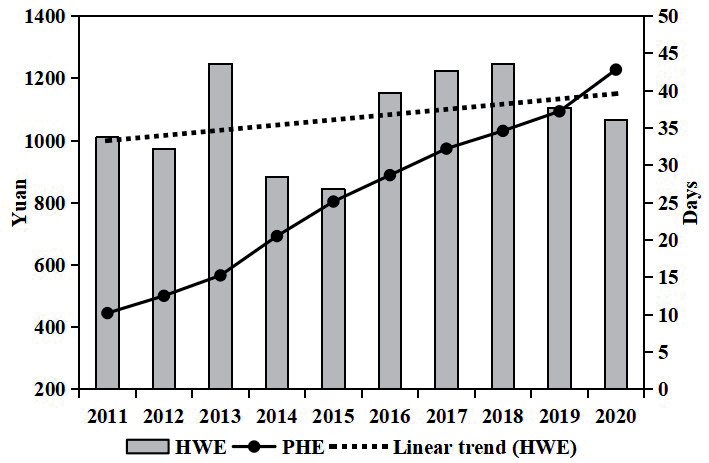
The algorithm for calculating linear trends typically involves fitting a straight line to a dataset using the least squares method, and when the regression coefficient is greater than 0, it indicates an overall upward trend in the data. Fig. 1 provides a simple visualization of the trends in HWE and PHE. It can be seen that both HWE and PHE show an overall upward trend, indicating a potential positive correlation between the two in the long-term development. Specifically, although the raw data of HWE show some volatility, the slope of the linear trend line equation is positive. The result may imply a long-term trend of global warming, but the annual fluctuations may be disturbed by regional meteorological conditions, data collection methods, and other factors. This result is also in line with the reality of the situation, in terms of the change in the data, with the highest values in 2013, which caused a super-heat wave to hit southern China [7]. PHE similarly shows an overall increasing trend, which may be closely related to the intensification of public health policies as well as rising economic levels. Although the annual data fluctuations of HWE and PHE are not perfectly synchronized, the long-term trend lines of both point in an upward direction, suggesting a potential correlation. The analysis provides a basis for subsequent empirical studies, which need to further explore the impact of HWE on PHE in depth.
Baseline Regression
Table 1 presents the estimation results of the baseline regression. Column (1) excludes control variables, providing a simple view of the relationship between HWE and PHE. Column (2) includes control variables, which can better isolate the impact of HWE on PHE while controlling for other influencing factors. The results of both columns indicate that the regression coefficient of HWE is significantly positive (p<0.01). Moreover, if personal health expenditures are taken into account along with social health expenditures, the overall health costs caused by HWE are even greater. This finding highlights the importance of understanding the economic impact of HWE on public health and the need for appropriate policy responses.
Table 2.
Results of the robustness test.
Robustness Check
To substantiate the reliability of the aforementioned results, this paper employed a variety of robustness checks. One approach was to replace the independent variable. In the original measurement of HWE, a certain threshold and duration were used. To mitigate the misestimation caused by potential errors in the measurement of the variables, the 90th percentile threshold number was kept unchanged, but the number of duration above the threshold was changed to a duration of 4 days and above. This alternative measurement of HWE allows for a more comprehensive examination of the relationship between HWE and PHE. Another robustness test used in this paper was to adjust the sample size. On the one hand, the samples of municipalities and provincial capitals were deleted, due to the fact that they differ significantly from the remaining cities in terms of city size and level of development, which may have a misleading effect on the results. On the other hand, this study also removed the sample data for 2020 because the COVID-19 pandemic severely impacted China's public health system, thus potentially rendering the estimates of the impact of HWE on PHE inaccurate. In addition, considering the shortcomings of traditional linear regression models, this paper used a double machine learning approach for robustness testing. Specifically, this paper adopted the random forest algorithm based on the 1:4 sample split ratio to solve the model [38]. The regression results of the above robustness tests are sequentially displayed in Columns (1) to (4) of Table 2, all of which show significantly positive coefficients for HWE (p<0.05), and thus the regression results can be considered to be highly stable, suggesting that the high frequency of HWE significantly drives up PHE.
The possibility of bidirectional causality between HWE and PHE is relatively small, but to further mitigate the possible endogeneity problem, this paper adopted the two-stage least squares method for estimation. The selection of instrumental variables is crucial in this method. The instrumental variable should be highly correlated with the independent variables but not with the dependent variables. Therefore, regional river density was selected as an instrumental variable in this paper. On the one hand, river density may be related to local environmental factors such as air humidity, land use, and vegetation cover. These environmental factors can affect the frequency or intensity of HWE. For example, areas with higher river density may have more humid air, which can influence the formation of heatwaves [39]. On the other hand, river density, as a natural geographic feature, usually does not directly affect PHE. The regression results are shown in Column (5) of Table 2, which further validates the previous conclusions, strengthening the credibility of the research findings.
Heterogeneity Analysis
To delve deeper into whether there are regional disparities in the impact of HWE on PHE, this paper conducted a heterogeneity analysis from two aspects: city size and employment status.
Firstly, differences in the scale of urban development can lead to variations in infrastructure, resource allocation, and healthcare services among cities. Larger cities generally have more advanced infrastructure, better-equipped medical facilities, and a more diverse range of healthcare services. However, they also tend to have higher population densities, which can exacerbate the impact of HWE on public health. Smaller cities, on the other hand, may have more limited resources but a lower population density, potentially resulting in a different relationship between HWE and PHE. Therefore, this paper divided the overall sample into two subsamples of large cities and medium-small cities for group regression. The results, presented in Columns (1) and (2) of Table 3, reveal that based on the regression coefficients, the effect of HWE on PHE is more significant in large cities. In large cities, the complex urban environment, high population density, and greater demand for healthcare during heatwaves contribute to a more substantial increase in PHE. The high-rise buildings and extensive concrete surfaces in large cities can enhance the urban heat island effect, making the impact of HWE more severe.
Table 3.
Results of the heterogeneity analysis.
Secondly, studies suggest that certain outdoor occupations face heightened safety risks during extreme hot weather. Workers in sectors such as construction are directly exposed to high temperatures for extended periods. This can have a detrimental impact on their health and safety, leading to an increased risk of heat-related illnesses and injuries. Considering the availability of data, this paper characterized the data of outdoor workers in terms of the proportion of employment in the secondary industry. The secondary industry, which includes manufacturing and construction, typically involves a significant number of outdoor or physically demanding jobs. The data was divided into two subsamples for regression based on the mean value. The results in Columns (3) and (4) of Table 3 indicate that the impact of HWE on PHE is greater in cities with a higher proportion of secondary employment. In these cities, a larger number of workers are at risk of heat-related health problems during HWE, resulting in increased medical consultations, hospital admissions, and thus higher PHE.
Moderating Effect
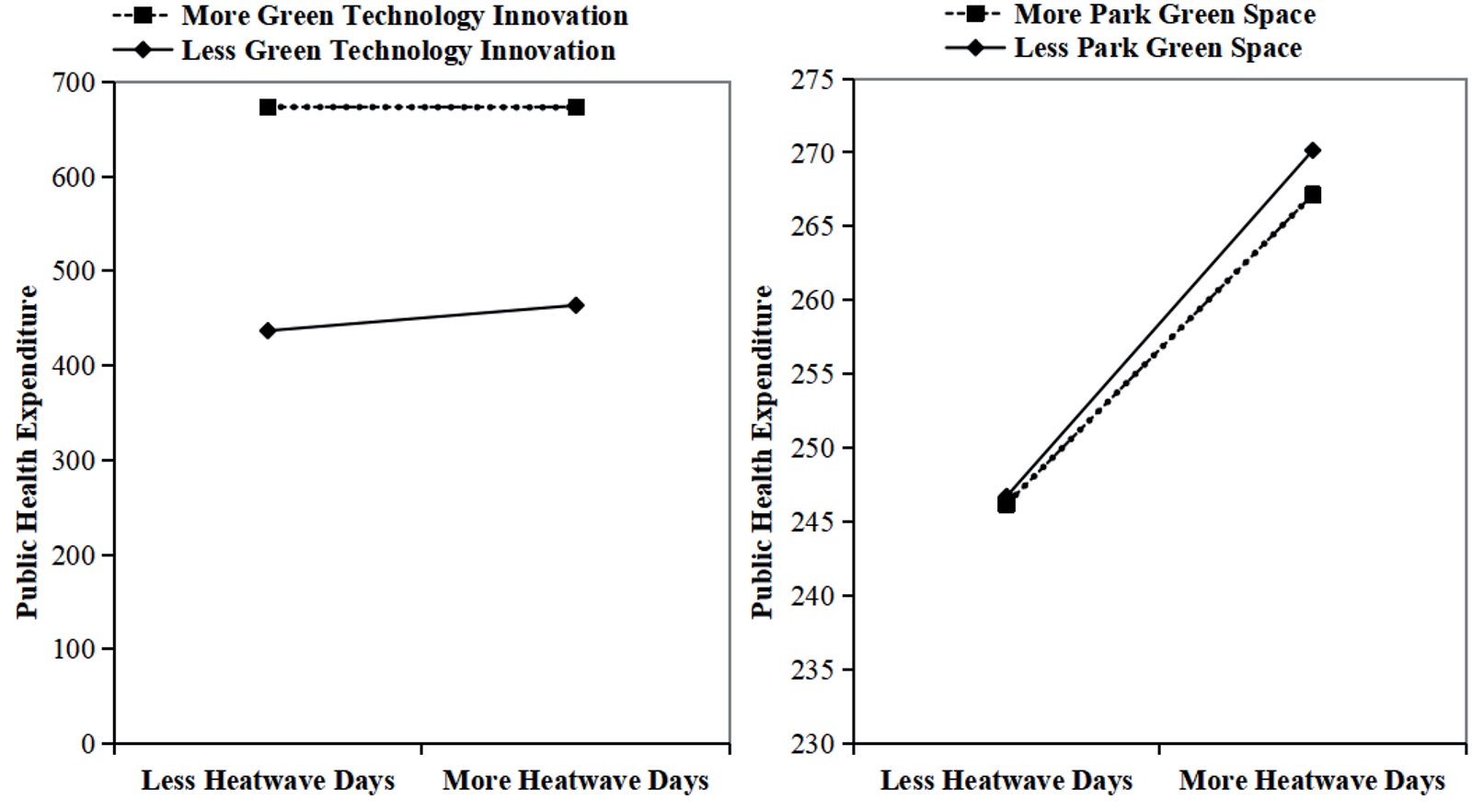
To simplify and visually represent the moderating effect, the results are presented in Fig. 2. By analyzing the trend of the curves, one can effectively assess whether the two moderating variables mitigate the increase in PHE caused by HWE.
On the one hand, as the number of heatwave days increases, in cities with higher green technological innovation capabilities, the rise in PHE is not significant, and it even experiences a slight decline. This indicates that green technological innovation can effectively reduce the negative impact of HWE on PHE. Technologies such as energy-efficient building materials, smart cooling systems, and clean energy sources can help mitigate the urban heat island effect and reduce the occurrence of heat-related illnesses, thereby lowering PHE.
On the other hand, although the curve for cities with larger areas of park green spaces does not decline with increasing heatwave days, its magnitude of change is significantly weaker than that of the other curve. This implies that a larger area of park green spaces can also mitigate the increase in PHE caused by HWE. Urban park green spaces can lower surface temperatures, improve air quality, and provide residents with places for relaxation and exercise, which are beneficial for maintaining good health and reducing the need for medical services during heatwaves.
Discussion
The findings of this study indicate that the frequent occurrence of HWE has contributed to an increase in the number of PHE. China, being a sensitive and significantly impacted region in the context of global climate change, experiences more pronounced adverse effects of the increasing number of heatwave days due to its vast territory and large population [40]. For instance, the severe HWE in southern China during the summer of 2013 led to a substantial increase in the number of cases and deaths related to heatstroke, cardiovascular diseases, and respiratory diseases [7]. National health is the foundation and hallmark of a country's prosperity, related to the accumulation of human capital and economic and social development [25, 29]. When population health is adversely affected by HWE, PHE are bound to increase. Therefore, government departments should broaden the scope of decision-making basis when formulating fiscal budgets. Especially when determining the budget for health expenditures in the current year, climate factors should be taken into consideration. This requires strengthening communication and cooperation among climate monitoring departments, health departments, and financial departments. By sharing information and coordinating efforts, these departments can better predict the impact of HWE on public health and allocate resources more effectively.
Large cities usually have a higher population density than small and medium-sized cities, making public health issues more likely to break out when facing HWE [41]. During heatwaves, the high concentration of people in a limited space can facilitate the spread of heat-related illnesses. In addition, large cities generally have a relatively complete public health system. During high HWE, medical institutions need to increase emergency and inpatient beds, emergency response systems need to enhance emergency response capabilities, and disease prevention and control institutions need to strengthen monitoring and early warning [42]. All these require substantial PHE as support. Therefore, government departments in large cities can step up publicity and education campaigns on the prevention of heatwave-related diseases. By raising public awareness of heat-related health risks, people can take proactive measures to protect themselves, such as staying hydrated, avoiding outdoor activities, and using cooling devices properly. At the same time, relevant emergency response plans should be formulated. These plans should include details on resource allocation, medical team dispatch, and public communication. By preparing resources and mobilizing medical teams in advance, large cities can better respond to health emergencies caused by HWE and reduce the burden on the medical system.
Research has shown that the increase in morbidity and mortality among vulnerable urban populations and outdoor workers due to extremely high temperatures has become one of the main negative impacts of climate change [43]. This, in turn, leads to a greater amount of additional PHE due to HWE in cities with a high proportion of secondary sector employment. Outdoor workers (such as construction laborers) are disproportionately exposed to extreme heat due to prolonged physical activity in open environments, which elevates risks of heatstroke, dehydration, and exacerbation of pre-existing conditions, leading to surges in emergency department visits and hospitalizations [44]. Such acute healthcare demands strain public health resources, necessitating additional expenditures on emergency medical services, temporary cooling facilities, and workforce mobilization. Therefore, the government should focus on the impact of HWE on vulnerable groups. Early warning systems can effectively reduce the number of deaths caused by HWE. By providing timely and accurate high-temperature warnings, vulnerable groups can be urged to avoid outdoor activities during extremely high temperatures. Furthermore, various measures should be taken to ensure basic livelihood healthcare. This includes optimizing the allocation of public medical resources to ensure that vulnerable areas and populations have access to necessary medical services. Expanding the coverage of medical insurance can also help reduce the financial burden on vulnerable groups when they seek medical treatment due to heat-related illnesses, thereby alleviating the adverse impacts of extremely high temperatures on them and maintaining social justice.
Urban park green spaces have multiple roles in improving residents' health levels. Firstly, urban greening can effectively reduce the urban heat island effect [45]. The vegetation in park green spaces can absorb heat, evaporate water, and lower the surrounding temperature. This reduces the morbidity rate of health problems caused by HWE, such as heatstroke and heat-related cardiovascular diseases, and alleviates the pressure on PHE. Secondly, it helps reduce the content of pollutants in the air. Green plants can absorb harmful gases and particulate matter, improving air quality and reducing the incidence of respiratory diseases [46]. Therefore, the government should increase investment in urban park greening. This can be achieved through financial support for park construction and maintenance, as well as the implementation of policies to encourage private-sector participation in urban greening projects. Residents should also be encouraged to participate in greening initiatives, such as tree-planting and park clean-up activities. By formulating corresponding policies, such as land-use regulations that prioritize green space preservation, the government can create a healthier and more livable urban environment.
Green technological innovation can also reduce the increase in PHE caused by HWE. Green technological innovations, such as carbon capture and utilization technologies, help reduce greenhouse gas emissions [36]. Therefore, green technological innovation can reduce the risk of HWE from the source. At the same time, through green technological innovations, such as smart building technologies and green transportation technologies, the urban heat island effect mitigation capacity can be enhanced [47]. Therefore, the government should encourage and support green technological innovation projects with significant potential through tax incentives, financing support, and policy subsidies. By providing financial incentives and a favorable policy environment, more enterprises and researchers will be motivated to engage in green technology development. The government should also actively promote the application of green technologies in urban construction and public service areas. Only when green technological achievements are smoothly transformed into practical applications can the environmental quality be truly improved, and the negative impact of HWE on PHE be effectively mitigated.
Conclusions
This study comprehensively explored the impact of heatwave events (HWE) on public health expenditures (PHE) in China using panel data of 238 cities from 2011 to 2020. Through a series of empirical analyses, several important conclusions have been drawn. Firstly, the baseline regression coefficient of HWE is significantly positive, indicating that as the number of heatwave days increases, PHE also rises. Secondly, there are obvious heterogeneities in the impact of HWE on PHE. In terms of city size, HWE have a more significant impact on PHE in large cities. Regarding employment status, cities with a higher proportion of secondary-industry employment, which typically involves more outdoor workers, also experience a greater impact of HWE on PHE. Thirdly, green technological innovation and park green spaces play a positive role in mitigating the increase in PHE caused by HWE. Green technologies such as energy-efficient building materials, smart cooling systems, and clean energy sources help mitigate the urban heat island effect. Similarly, park green spaces can lower surface temperatures, improve air quality, and provide residents with places for relaxation and exercise, which is beneficial for maintaining good health during heatwaves. These findings underscore the urgency of integrating climate resilience into public health budgeting and urban planning frameworks. From the perspective of climate change mitigation, governments need to adopt comprehensive measures to reduce the frequency of HWE, such as promoting the application of green technologies and urban ecological planning, which will fundamentally weaken the negative impacts of HWE on population health.
There is still much room for further research in this study. First, utilizing county-level data would allow for finer-grained analysis of localized impacts, capturing intra-city disparities in vulnerability and resource allocation. Second, addressing social inequities in heat vulnerability must be prioritized. Future studies should investigate how HWE disproportionately affect low-income households, informal workers, and marginalized communities. Policies targeting these groups could reduce health disparities and enhance social justice. Third, the public health expenditures in this article are summed up between urban and rural areas, which may blur the differentiated impact of heatwave events on urban and rural populations. Research on rural-urban disparities can be deepened by searching for more refined data (such as special surveys and financial breakdown data), and the paper calls on statistical authorities to improve the classification of public health expenditures.

