

Introduction
China’s rapid economic development has exacerbated serious air pollution issues, leading to numerous cities surpassing the PM2.5 standard [1, 2]. In response, the Chinese government has implemented various policies aimed at incentivizing both enterprises and individuals to participate in environmental conservation efforts [3]. Certain major corporations are proactively involved in environmental public welfare initiatives as part of their commitment to fulfilling social responsibility [4]. Such endeavors serve to showcase their proactive stance on social responsibility and environmental stewardship, thereby enhancing public perception and fostering goodwill towards the enterprise.
Ant Forest is a public welfare game launched by Alipay in 2016. As a new form of application emerging in recent years, the green behavior mobile application aims to guide users to actively participate in low-carbon emission reduction activities and promote sustainable development by promoting environmental protection concepts and behaviors [5]. Ant Forest, as a typical green behavior mobile application, has attracted the attention and participation of a large number of users with its innovative mode and rich functions [6]. However, how to further enhance the stickiness of users to green behavior mobile applications such as Ant Forest, so that it can retain users for a long time and continue to play its environmental value, has become a problem worth studying. User stickiness refers to the user’s willingness and dependence on continuous use of a particular application, which is one of the important indicators for measuring the success of an application [7]. For green behavior mobile applications, enhancing user stickiness not only helps increase user activity and improve the usage rate of the application but also better promotes environmental concepts and facilitates the popularization of green behaviors.
Gamification has garnered significant attention in numerous research endeavors across diverse fields, including healthcare [8, 9], marketing [10, 11], organizational behavior [12-14] and education [15-17]. Gamification is the process of applying game designs in non-game activities in order to attract users [18]. The basic presentation forms of game design include leaderboards, points, achievements, status changes, rewards, badges, and goals [19]. Gamification employs game elements to increase a user’s gratification; specifically, these elements enhance a user’s sense of playfulness, mastery, and immersion [20]. Many companies use gamification mobile applications to attract and retain users [21]. Previous research efforts have generally concentrated on how gamification affects customer engagement [22, 23] and satisfaction [24]. However, there is limited understanding regarding how gamification contributes to user stickiness.
The purpose of the present study is to address two pivotal questions: (1) How do perceived gamification interactions affect user stickiness? (2) Do flow experience and user satisfaction mediate the relationship between gamification interactions and user stickiness? The stimulus-organism-response (S-O-R) model was applied to explore the impacts of gamification on user stickiness. User interactions with the mobile application were categorized as human-computer or interpersonal interaction to clearly distinguish the effect of each type of interaction on user stickiness.
The main contributions of this work are as follows: Firstly, this study broadens our understanding of user stickiness within green behavior mobile applications. While past research predominantly focused on user adoption of green behavior mobile applications, few studies have delved into the factors shaping user stickiness towards such applications [4, 25, 26]. Moreover, the findings highlight the role of gamification interactions in promoting user stickiness. Previous studies exploring gamification’s impact have typically concentrated on some variables [23, 24, 27], with limited attention to its effect on user stickiness. Finally, the results confirm that the flow experience and user satisfaction mediate the relationship between perceived playfulness and user stickiness. To the best of our knowledge, this is the first empirical investigation to probe into these relationships, specifically regarding the roles of flow experience and user satisfaction in bolstering user stickiness.
Theoretical Framework and Development of Hypotheses
The S-O-R Model
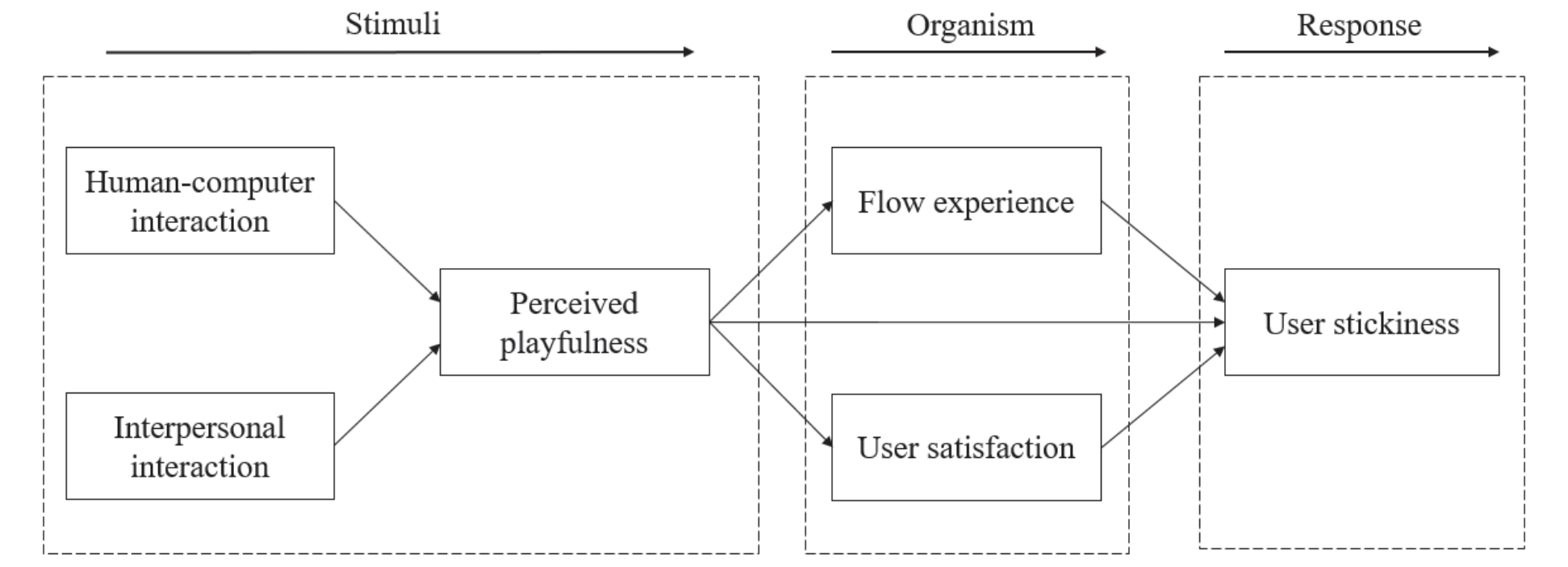
Mehrabian and Russell [28] developed the S-O-R theory to elucidate the mechanism whereby external environmental factors influence individual behavior. This theory has wide-ranging applications spanning various domains such as e-commerce, marketing, tourism, and hospitality [29]. The previous research applied S-O-R theory to the study of mobile application user behaviors [30-34]. The present study used the S-O-R theory as the framework, with gamification interactions and perceived playfulness as stimulus factors, to evaluate a series of cognitive and emotional reactions of consumers. Satisfaction and flow experience were considered organic reactions, and user stickiness was the variable reflecting approach behavior. The theoretical model is depicted in Fig. 1.
Development of Hypotheses
Gamification Interactions and Perceived Playfulness
Gamification is defined as the implementation of game design elements to establish a persuasion system that encourages users to participate in activities [18]. Interaction is essential to gamification in mobile applications [35]. Within the user interaction dimension, the interactions involving gamification mobile applications can be divided into interpersonal and human-computer interaction [2]. In a gamification mobile application, human-computer interactions occur between users and virtual entities [36], whereas interpersonal interactions in a gamification mobile application occur between users [37]. The latter type of interaction mainly occurs on the mobile internet, although it may also occur offline in real life (e.g., via face-to-face communications).
Perceived playfulness is the degree to which the activity using a particular system is perceived as enjoyable, while also taking into account the performance consequences arising from using the system [38]. The key to implementing a successful gamification mobile application is to bring users the “game feeling,” which is related to the perceived playfulness of the game. Ant Forest offers a captivating game where users can immerse themselves in the interactive experience it provides. Consequently, the human-computer interaction within Ant Forest enhances users’ perception of perceived playfulness. Zhou et al. [2] found that human-computer interaction affected users’ perceived playfulness in Alipay. Thus, human-computer interaction may impact perceived playfulness. Accordingly, the following research hypothesis is proposed:
H1: Human-computer interaction influences perceived playfulness.
Socialization has recently emerged as a key element of mobile applications [2]. In terms of user motivation, interpersonal interactions represent users’ internal motivations to interact with gamification mobile applications. Social platforms can provide users with more social interaction, and users can experience more fun on social platforms. Ant Forest is a social platform that allows users to communicate with each other [39]. Therefore, it can be inferred that the interpersonal interaction in Ant Forest can promote the user’s perceived playfulness. Zhou et al. [2] found that interpersonal interaction in apps increased the users’ perceived playfulness. Thus, interpersonal interaction may similarly affect the perceived playfulness of mobile applications. Accordingly, the following research hypothesis is proposed:
H2: Interpersonal interaction influences the perceived playfulness.
Perceived Playfulness, Flow Experience, User Satisfaction, and User Stickiness
Novak et al. [40] defined flow experience as the positive experience of completely immersing oneself or focusing on online shopping activities. Engaging and interesting information products have a positive impact on the user’s flow experience because interesting content enriches the user’s experience and leads to a high level of attention [41]. It can be inferred that Ant Forest’s user perception of perceived playfulness can improve users’ flow experience. Novak et al. [40] found that perceived playfulness affects users’ flow experience in online environments. Zhao and Khan [42] also observed that the perceived enjoyment of an online English platform influences the flow experience. Thus, it is reasonable to infer that the perceived playfulness of Ant Forest can influence flow experience. Accordingly, the following research hypothesis is proposed:
H3: The perceived playfulness of Ant Forest influences flow experience.
Lu et al. [43] defined user satisfaction as the level to which the user is comfortable using technological products. Users could enhance their satisfaction because they feel happy during the utilization of the information system [44]. Ant Forest, as an information system, provides users with games, and the playfulness users get in the games can enhance user satisfaction. Kang [45] revealed a direct impact of perceived playfulness on user satisfaction, while Liu et al. [44] demonstrated its influence on user satisfaction specifically within E-book apps. Previous studies have consistently affirmed that the User Generated Content (UGC) element of playfulness significantly contributes to user satisfaction [46]. Therefore, it is reasonable to expect that the perceived playfulness of Ant Forest can influence user satisfaction, as expressed in the following research hypothesis:
H4: The perceived playfulness influences user satisfaction.
Shim et al. [7] defined user stickiness as retention of consumption and the ability to attract users to return. The stickiness tendency reflects users’ willingness to return to a specific website or extend their stay on a particular website [47]. Users play the game in Ant Forest and can feel the fun of the game, so they are willing to spend more time in Ant Forest. Nandi et al. [48] discovered a positive correlation between perceived hedonic value and mobile app stickiness. Additionally, Liu et al. [44] observed that perceived playfulness significantly impacts a user’s inclination to engage with a particular website. Moreover, Ma [49] identified that hedonic gratifications contribute positively to user stickiness. Thus, it can be inferred that perceived playfulness can affect user stickiness in Ant Forest. Accordingly, the following research hypothesis is proposed:
H5: Perceived playfulness positively influences user stickiness.
Flow Experience, User Satisfaction, and User Stickiness
Previous research has indicated that flow experience positively affects user stickiness in tourism apps [50]. Another study showed that flow experience directly affected user stickiness in the context of augmented reality games [51]. Bao and Zhu [52] also found that flow experience positively affects user stickiness.
According to the S-O-R theory [28], gamification design serves as an external stimulus (S) to improve users’ flow experience (O), thereby increasing user stickiness in Ant Forest. Previous research has demonstrated that flow experience may play various mediating roles in governing consumers’ positive responses. Liu et al. [53] showed that flow experience modulates the relationship between e-commerce livestreaming features and purchase intentions. One study illustrated that interactivity affected trust in AR apps through flow experience [54].
The discussions above indicate that flow experience likely has an influence on user stickiness in Ant Forest, and moreover, that it mediates the relationship between perceived playfulness and user stickiness. Therefore, the following research hypotheses are proposed:
H6a: Flow experience positively influences user stickiness.
H6b: Flow experience mediates the relationship between perceived playfulness and user stickiness.
Shao et al. [55] observed a positive relationship between user satisfaction and stickiness in the context of social networking services. Similarly, Maqableh et al. [56] found that user satisfaction was linked to stickiness in Facebook. Bao and Zhu [52] suggested that user satisfaction could improve user stickiness in livestreaming commerce platforms.
Based on the S-O-R theory [28], where gamification design is regarded as the external stimulus, user satisfaction is the emotional response based on actual user perceptions, while user stickiness is the behavioral response. Liu et al. [44] suggested that perceived playfulness influences users’ intentions to continue using e-book apps based on their level of satisfaction. The concept of these continuance intentions is similar to that of user stickiness, such that user stickiness can somewhat replace continuance intentions. Therefore, the following research hypotheses are proposed:
H7a: User satisfaction positively increases user stickiness.
H7b: User satisfaction mediates the relationship between perceived playfulness and user stickiness.
Experimental Procedures
Research Approach
This study applied a questionnaire survey method, and the research design included four stages: questionnaire production, questionnaire revision, questionnaire distribution and collection, and data analysis. The questionnaire production process was based on a thorough literature review, and items were created on this basis. Then, two experts were invited from relevant fields to test the accuracy of the questionnaire and revise the questionnaire items. Next, the survey site was selected, and the investigators distributed and collected completed questionnaires. Finally, the collected data were processed and analyzed using statistical software.
To analyze the data in this study, a partial least squares structural equation modeling (PLS-SEM) method was used, which has several important characteristics. First, it requires less data volume and does not emphasize that the data or residuals must conform to a normal distribution. Second, it can handle complex measurement models and structural models involving multiple causes and effects, as well as latent variables containing formative or reflective indicators. Finally, missing values and disturbing data can be processed effectively, and the dependent variables can be interpreted and predicted with high accuracy. PLS-SEM is more applicable and practical than the general linear analysis method and covariance-based SEM, so scholars gradually favor it.
Measurements
All constructs in the questionnaire were adapted from previous studies and modified to reflect the gamification scenario. All items were scored on a five-point Likert scale, ranging from 1 = strongly disagree to 5 = strongly agree. Human-computer interaction was measured with three items [2]; interpersonal interaction was measured with three items [2]; perceived playfulness was measured with three items [2]; flow experience was measured with three items [50]; user satisfaction was measured with three items [50]; and user stickiness was measured with four items [50]. The English scale was translated into Chinese by professionals who were proficient in English, followed by a back-translation.
Data Collection and Profile of the Respondents
Ant Forest was launched by Alipay and designed to create game-like experiences. There were two main reasons for choosing Ant Forest for this case study. First, Ant Forest is one of China’s most well-known mobile applications. Second, gamification interactions are widely used in Ant Forest. The survey was conducted offline at Hangzhou Railway Station. Before completing the questionnaire, the respondents obtained the consent of the investigation and were asked whether they had ever used the Ant Forest. In total, 371 questionnaires were distributed, and 318 were recovered (recovery rate = 85.7%). A sample of the formal investigation is shown in Table 1. The gender ratio was well balanced, with 49.1% male respondents. Most users (52.8%) were 35-44 years old, and most (58.8%) had an educational background of a college/bachelor’s degree. The monthly income of respondents was mostly concentrated in the range of 3001-5000 yuan (accounting for 44.7%), which reflects the current income level in the region. In summary, the sample set who completed the questionnaire exhibited good representativeness and statistical validity.
Data Analysis
Data analysis was performed using the SPSS20.0 and SmartPLS3.0 programs. First, the demographic characteristics of the samples were analyzed, and then the reliability and validity of the measurement model were tested. Finally, the PLS algorithm and bootstrapping tools were used to test the research hypotheses and evaluate the mediating effects.
Results
Common Method Bias Test
This study used the Harman single factor method to test for a common method bias. An exploratory factor analysis was performed on all items as the common factors using SPSS20.0 software. The largest common factor variation was less than 40%, indicating that the homologous variance of the sample data had no significant impact on the results.
Measurement Model
The measurement model statistics are presented in Table 2. The Cronbach α coefficients for the latent variables were all larger than 0.7, which indicates good reliability [57]. The composite reliability (CR) exceeded the threshold value of 0.7, which indicates good reliability [58]. Table 1 shows that the Cronbach α coefficient of each variable is within the range of 0.813-0.882, and their composite reliabilities are within the range of 0.888-0.918; these values all exceeded the threshold of 0.7, indicating that the measurement model is reliable.
The convergent validity requirements are satisfied when the standardized factor loading exceeds 0.5 and the average variance extracted (AVE) value is greater than 0.5 [59]. As shown in Table 2, the standardized factor loading of each measurement item was between 0.833-0.893, and the AVE was between 0.725-0.773, indicating sufficient convergent validity.
According to the standards established by Fornell and Larcker [59], when the square root of the AVE is greater than the correlation coefficient between the variables, the discriminant validity meets the necessary requirements. Table 3 shows that the square root of the mean AVE of each variable was greater than the correlation coefficient between each variable, indicating sufficient discriminant validity.
Structural Model
The coefficient of determination (R2) was computed to evaluate the explanatory power of the predictor constructs; the value of this parameter should be ≥0.1 [60]. The values of R2 in this study all exceeded this value (0.67, 0.33, and 0.19), representing substantial, moderate, and weak explanatory capacities [61]. The R2 value for perceived playfulness was 0.221, for flow experience, it was 0.209, for user satisfaction, it was 0.273, and for user stickiness, it was 0.428; therefore, the model’s overall explanatory capacity can be considered moderate.
Table 1.
Sample population description.
Table 2.
Results of the measurement model.
The path analysis of the structural model is presented in Table 4 and Fig. 2. Both the human-computer interaction (β = 0.325, P<0.001) and interpersonal interaction (β = 0.284, P<0.001) had a significant positive impact on perceived playfulness, indicating that the data supports H1 and H2. Moreover, perceived playfulness had a significant positive effect on the flow experience (β = 0.457, P<0.001), user satisfaction (β = 0.523, P<0.001), and user stickiness (β = 0.264, P<0.001), indicating that the data supports H3, H4, and H5. Flow experience had a significant positive impact on user stickiness (β = 0.195 P<0.001), indicating that the data supports H6a. Finally, the influence of user satisfaction on user stickiness also passed the significance test (β = 0.346, P<0.001); therefore, it was assumed that this data supports H7a.
Mediating Effects
Bootstrap analysis was adopted to test H6b and H7b. The number of bootstrap samples was set to 5000, with a confidence level of 95%. The mediating effect is presented in Table 5. The flow experience had a significant mediating effect on the relationship between perceived playfulness and user stickiness. Therefore, the data support H6b. Moreover, the results suggest that user satisfaction significantly mediates the relationship between perceived playfulness and user stickiness. Therefore, the data also support H7b.
Discussion
This study adopted the perspective of interactivity to evaluate the impacts of gamification on user stickiness in Ant Forest. The following conclusions were drawn from the analytical results:
Table 3.
Discriminant validity.
| HCI | II | PP | FE | US | RS | |
|---|---|---|---|---|---|---|
| HCI | 0.869 | |||||
| II | 0.186 | 0.851 | ||||
| PP | 0.378 | 0.344 | 0.873 | |||
| FE | 0.327 | 0.395 | 0.457 | 0.879 | ||
| US | 0.433 | 0.448 | 0.523 | 0.426 | 0.877 | |
| RS | 0.401 | 0.443 | 0.534 | 0.464 | 0.567 | 0.859 |
Table 4.
Results of hypotheses tests.
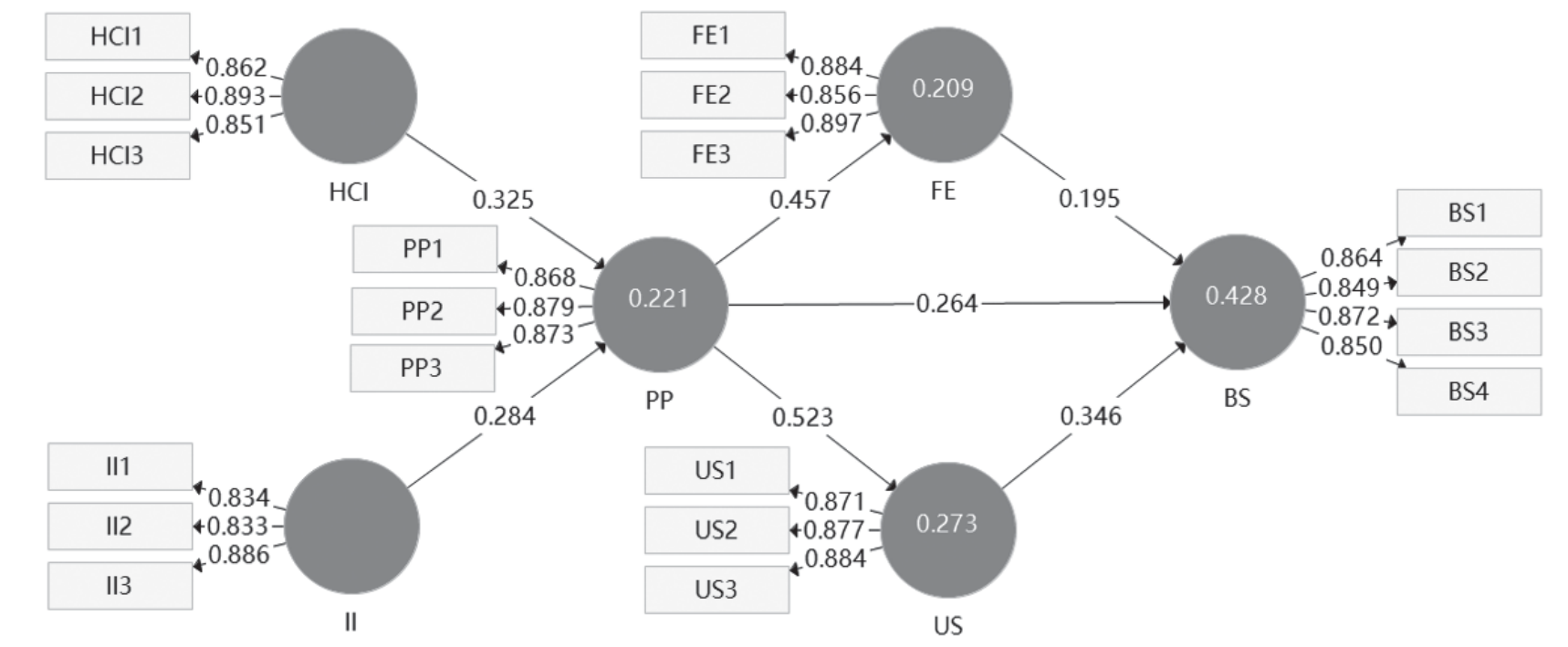
Table 5.
Mediation effects.
| Hypotheses | Path | Indirect |
|---|---|---|
| H6b | Perceived playfulness → Flow experience → User stickiness | 0.143*** |
| H7b | Perceived playfulness → User satisfaction → User stickiness | 0.284*** |
First, the findings of this study indicated that interpersonal and human-computer interaction are two major antecedents of perceived playfulness. These observations are consistent with Zhou et al. [2], who demonstrated that such interactions affected perceived playfulness. Second, these findings indicated that perceived playfulness significantly impacted user flow experience, satisfaction, and stickiness. Previous studies have described similar impacts of perceived playfulness on flow experience [40, 62] and user satisfaction with e-book apps [44]. However, to our knowledge, no studies have examined the relationship between perceived playfulness and user stickiness. Ma [49] found that hedonic gratifications positively affected user stickiness. The present study indicated that perceived playfulness can also positively impact user stickiness. Third, the impact of flow experience on user stickiness was significant, which is consistent with previous reports [51, 52]. Fourth, the results showed that user satisfaction has a significant positive impact on user stickiness, which is in line with the literature [49, 52, 55]. Finally, the mediating effects of flow experience and user satisfaction on the perceived playfulness-user stickiness relationship were explored. Previous studies have demonstrated the mediating effect of streaming experience and satisfaction in promoting positive responses [44, 53, 54]. The results presented herein showed that perceived playfulness influences user stickiness via the mediating effects of flow experience and user satisfaction. Overall, the results showed that S-O-R theory can explain the promotion of user stickiness in mini-programs.
Theoretical Implications
First, this study enhances the breadth of knowledge regarding user stickiness in green behavior mobile applications. Previous studies mainly focused on the user’s adoption of green behavior mobile applications [4, 25, 26]. However, few studies have examined the factors influencing user stickiness to green behavior mobile applications. User stickiness reflects users’ dependence on and recognition of the services provided by the platform, as well as their willingness to maintain a long-term trust relationship with the platform. Thus, the results of this study reveal the elements governing user stickiness in green behavior mobile applications.
Additionally, the findings highlight the role of gamification interactions in promoting user stickiness. Previous studies about the impact of gamification have generally focused on customer engagement [22, 23] and satisfaction [24], whereas few studies have explored the impact of gamification on user stickiness. This study divided gamification interactivity into two dimensions (i.e., human-computer and interpersonal interaction) to evaluate their effects on user stickiness.
Finally, the results of this study indicated that the indirect relationship between perceived playfulness and user stickiness is influenced by flow experience and user satisfaction. To our knowledge, this is the first empirical research to explore these relationships, specifically the roles of perceived playfulness, flow experience, and user satisfaction in promoting user stickiness. The results revealed that perceived playfulness indirectly influences user stickiness via flow experience and user satisfaction, which serve as mediators in the relationship between perceived playfulness and user stickiness.
Practical Implications
With further developments of the mobile internet, gamification marketing strategies focusing on interactivity will become an important business objective. Human-computer interaction is essential for increasing perceived playfulness. The game content of Ant Forest should be updated to be more attractive to users. For example, the enterprise can organize regular updates to enhance the human-computer interaction experienced by users. Interpersonal interaction also plays a vital role in driving perceived playfulness. Many users like to make friends with interesting people, and therefore, activity planning that considers various social needs can satisfy users’ individual needs for social communication. Meanwhile, it can increase users’ attention and sharing mechanisms to form a positive social atmosphere.
Limitations and Future Work
The present study had several limitations. First, only Ant Forest was examined as a case study, with few cases. To increase the validity of the study, future research endeavors will consider different types of mini-programs. Second, perceived ease of use and perceived usefulness may also affect user stickiness, and thus, additional control variables should be included in future studies. Finally, it is worthwhile to consider the influence of other moderating variables, such as gender, age, and personality traits.
Conclusions
The study concludes that Ant Forest, a mobile app promoting environmental conservation in China, faces limited research on user stickiness despite its widespread usage. Through analysis of questionnaire responses from 318 participants using partial least squares estimation, it was found that interpersonal and human-computer interactions contribute to users’ perceived playfulness, subsequently enhancing their flow experience and satisfaction. Perceived playfulness, flow experience, and satisfaction were identified as pivotal factors affecting user stickiness. Particularly, flow experience and satisfaction serve as mediators in the relationship between perceived playfulness and user stickiness.

