

Introduction
In recent years, ERs have gained increasing significance in the agri-food business sector. The agri-food industry, given its extensive supply chain operations and environmental impact, faces mounting pressure to adopt sustainable practices. Within the agri-food supply chain context, this shift has demanded a greater focus on implementing GSCM practices through CSR [1]. Effective GSCM practices not only allow enterprises to realize economic benefits but also provide them with competitive advantages, contributing to the sustainable development of the social economy [2]. Similarly, CSR entails integrating social and environmental concerns into business operations, often extending beyond legal obligations [3]. This concept has become especially vital in the agri-food sector due to its significant environmental and social impacts [4]. Therefore, there is an urgent need to examine the relationships between ERs, GSCM, and CSR in this context.
Similarly, ERs play an essential role in shaping corporate business [5]. ERs, which encompass both CCT and MBT approaches, serve as essential structures for ensuring corporate accountability and promoting sustainable practice [6, 7]. CCT regulations involve the imposition of mandatory standards, emissions limits, and specific practices that organizations must adhere to. Various global ERs, encompassing administrative rules, pollution penalties, and charges, have been implemented. While these initiatives have somewhat encouraged enterprises towards GSCM [8, 9]. Consequently, it is essential to investigate the precise mechanisms through which ERs influence GSCM.
In response to dwindling natural resources and escalating environmental challenges, countries worldwide perceive ERs as a necessary facet of economic progress [2]. Similarly, adept implementation of GSCM practices can fortify both social and economic sustainability [10]. Ongoing research, both in theory and practice, continually refines and establishes comprehensive frameworks and robust management systems for GSCM. This innovative approach underscores the infusion of CSR initiatives and environmental considerations into diverse supply chain processes[11]. Moreover, it emphasizes the comprehensive “greening” of the supply chain involving various stakeholders, such as producers, suppliers, logistics operators, purchasers, users, and recyclers. This collective effort aims to attain economic, social, and environmental advantages [2].
CSR plays a very important role in encompassing sustainable agribusiness including environmental sustainability, social responsibility, food quality and safety, and economic sustainability [12]. With this, the demand for sustainable and responsible practices increases, and stakeholders in the agriculture sector are recognizing the importance of integrating CSR into their operations [13]. We contended that these perspectives are important to be explored. Therefore, we investigated CSR as a mediated variable.
Literature shows a limited understanding of the three-way connection between ERs, CSR and GSCM [14]. The existing literature often focuses on these elements individually, failing to provide a comprehensive understanding of how they interact and influence each other within the context of the agri-food business. It exhibits insufficient evidence of the mediating role of CSR. Additionally, its specific mediating effects within the context of the agri-food business remained unexplored. Understanding how CSR mediates the relationship between ERs and GSCM can reveal important insights into the mechanisms of agribusiness. Literature also shows that there is limited empirical research within the context of agri-food business in China.
Despite the significance of the agri-food business in the Chinese socio-economic system and its impact on both local and global markets, there is a relative scarcity of empirical studies focusing on environmental regulation, CSR and GSCM within the Chinese agri-food business.
Most of the existing research predominantly stems from Western contexts, highlighting the need for studies that are tailored to the unique cultural, economic, and regulatory landscape of China. Therefore, this study explores the three-way connection between ERs, CSR and GSCM within the Chinese agri-food business. The following research questions were formulated for the study: Research Question 1: How do ERs influence GSCM in the agri-food business? Research Question 2: How do ERs influence CSR? Research Question 3: How does CSR mediate the relationship between ERs and GSCM?
Literature Review
Conceptual Framework
The current study explores the connections between ERs and GSCM through CSR. Most of the previous research explored the direct connection between ERs and GSCM practices[2, 15]. We used Institutional Theory to develop the synthesized research framework. Institutional Theory suggests that organizations are influenced by the wider societal norms, values, and regulatory frameworks within which they operate. In the context of the agri-food business, this theory proposes that ERs play a pivotal role in shaping GSCM practices. These regulations act as external institutional pressures that compel agri-food businesses to adopt environmentally sustainable practices in their supply chains. The level of stringency and enforcement of these regulations will determine the extent to which organizations are motivated to integrate green practices into their supply chain operations.
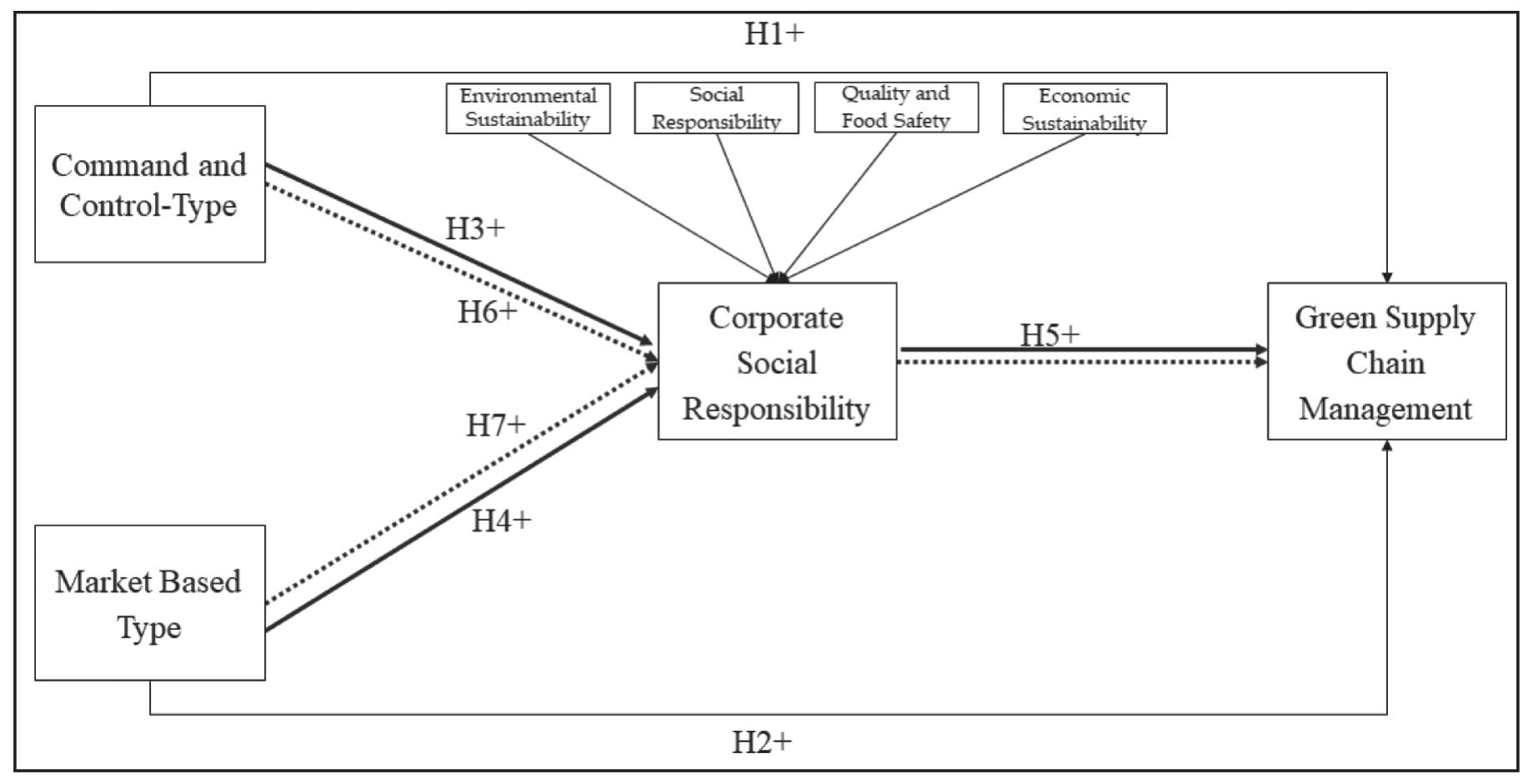
CSR is considered an internal institutional factor that complements and reinforces the effects of ERs on GSCM in the agri-food sector. Within the framework of Institutional Theory, CSR functions as an internalized normative element that aligns with and amplifies external regulatory pressures. Agri-food businesses that proactively engage in CSR are more likely to view compliance with ERs as a minimum threshold to sustain their supply chains. Institutional Theory suggests a dynamic interplay between ERs and GSCM in the presence of CSR in the agri-food industry. The following research framework elaborates on the connections between these variables (see Figure 1):
Command-and-Control Type Environmental Regulation
Command-and-control (CCT) type environmental regulation represents a traditional approach to environmental protection policy, where specific standards are defined and enforced by governmental agencies. This approach often involves specific restrictions on emissions or mandates for specific technologies, thus compelling the corporate world to follow these fixed regulations [11, 16]. CCT regulation is characterized by its prescriptive nature, wherein government agencies set specific pollution limits, establish best practices, or mandate the use of specific technologies. It leaves little to no room for flexibility in compliance, which can result in high compliance costs or inefficiencies[17]. In many cases, CCT regulation has proven effective in reducing emissions and improving environmental quality. However, CCT regulation is frequently criticized for its rigidity and inefficiency. Due to the ‘one size fits all’ nature of the standards, businesses that could achieve the same environmental outcomes at lower costs are unable to do so, leading to economic inefficiency [18]. Moreover, such regulations can stifle innovation since they typically prescribe specific methods or technologies for reducing pollution [17]. MBT such as emissions trading systems and carbon taxes have emerged as alternatives to CCT regulations. CCT regulations aim to achieve environmental goals in a more cost-effective and flexible way by allowing corporate firms to choose how to reduce their emissions [19]. However, the effectiveness of these regulations often depends on the precise design and implementation context [20]. Therefore, this study explores CCT regulations with CSR and GSCM in agri-food business.
Fig. 1.
The Research Model Illustrating Direct and Indirect Relationships among Command-and-Control Type, Market-Based Type, Corporate Social Responsibility, and Green Supply Chain Management. The Command-and-Control Type Serves as a Mediator. Note: Solid arrows denote direct effects between command-and-control type, market-based type, corporate social responsibility, and green supply chain management. Dotted arrows represent the indirect effects linking command-and-control type, market-based type, and green supply chain management through corporate social responsibility. ‚H’ signifies hypotheses, and ‚H1+’ to ‚H7+’ indicate the positive direction of relationships between variables.
Market-Based Type Environmental Regulation
Environmental protection is a burning issue in the current world, particularly as economic development continues to outpace environmental sustainability [21]. The conflicts between environmental protection and economic development have become more apparent as industrialization and globalization have increased [22]. Most of the countries have faced the challenge of balancing economic development with environmental protection [23]. One approach that has gained attention and been implemented in various countries is market-based type environmental regulation [24]. Market-based type environmental regulations are an approach to environmental protection that leverages market forces and economic incentives to promote sustainable practices by corporate sectors [25]. Various studies have explained that there are several key areas of focus when examining market-based environmental regulation [26]. These include the economic impacts of environmental regulation, the effectiveness of market-based types approaches in achieving environmental goals, and the role of technology innovation in supporting sustainable development and environmental regulations [27]. The impact of environmental regulation on total factor productivity has been extensively studied in the literature [28]. However, there is a lack of research on the relationship between ERs, CSR, and GSCM [29]. Further research is needed to explore these factors with MBT environmental regulation [30, 31]. Therefore, this study explores MBT regulations with CSR and GSCM in agri-food business.
Corporate Social Responsibility
CSR is a topic widely explored in business and management literature. The concept refers to the efforts made by companies to positively contribute to society and the environment beyond their legal obligations and economic interests [32]. [19] analyzed CSR activities with some other factors, such as corporate performance. However, the strength and direction of this relationship can vary depending on the context and the specific CSR activities [17]. According to [33], companies that engage with stakeholders through CSR activities can achieve better financial performance, improved reputation, and enhanced customer satisfaction. CSR is a multifaceted concept with significant implications for businesses, stakeholders, and society at large [34]. While there is broad consensus on the positive impacts of CSR, its mediated effects in relation to GSCM require further exploration. For this study, we included four indicators of CSR: environmental sustainability, social responsibility, quality and food safety, and economic sustainability. Therefore, the present research paper examined the mediating role of CSR in the relationship between ERs and GSCM in agri-food business.
Green Supply Chain Management
In recent years, scholars have paid increasing attention to explore GSCM in various context [35]. Much of the research has explored and analyzed the key concepts, trends, and challenges associated with GSCM [8]. These perspectives have provided valuable insights into the current state of research, identifying various topical issues and highlighting areas for further investigation. Such as [36] focused on exploration of GSCM with carbon trading and ERs. These studies have examined the various models of GSCM with potential benefits and challenges of implementing environmental sourcing practices. From these perspectives, it has been found that such practices can lead to reductions in greenhouse gas emissions and other environmental impacts. However, GSCM is a complex phenomenon and has yet to be thoroughly explored in the context of ERs and CSR [36, 37]. Therefore, this research explores the GSCM with CSR and ERs in agri-food business.
Hypothesis Formulation
CCT VS. GSCM
Most studies indicated that CCT environmental regulation affects corporate GSCM [38]. CCT environmental regulation focuses on the execution of GSCM practices in enterprises. These practices can be categorized as the goal setting, policy design, execution, and supervision of CCT environmental regulations that need to be set by laws and intervened by government agencies [2]. In case of failure to comply with the CCT environmental regulations by enterprises, government agencies must intervene and impose some fines, production restrictions, and temporary production bans and exit that enterprise from the market [39]. Thus, command and control regulation enhance corporate GSCM certainty, vital for urgent environmental issues. Such perspectives need to be explored; therefore, this research investigates the relationship between CCT environmental regulation and GSCM. The following hypothesis was formulated in this regard: H1: CCT has a positive and significant effect on GSCM.
MBT VS. GSCM
The study explored that MBT environmental regulation influences corporate GSCM positively, significantly, and directly [2]. Similarly, MBT environmental regulation employs market incentives rather than specific environmental standards, offering a cost-effective approach. By setting tax rates aligned with pollution’s marginal cost, the environmental regulation department enhances GSCM efficiently [40]. MBT environmental regulation allows enterprises flexibility, balancing emission reduction with progress. This accommodates varying capacities to reduce emissions, and with cost-based payments, it enables discretion in GSCM implementation [41]. MBT environmental regulation continuity, even amid leadership changes, fosters robust GSCM optimization [42]. This shows the connection between MBT environmental regulation and GSCM and needs to be explored in the agri-food business. Therefore, current research investigates this relationship. The following hypothesis was formulated for this purpose: H2: MBT has a positive and significant effect on GSCM.
CCT VS. CSR
Similarly, various studies focused on exploring the connection between CCT environmental regulation and CSR practices within corporate organizations [43, 44]. Few other studies discussed that this alignment strengthens the effectiveness of command-and-control regulations by ensuring their execution and compliance during the supply chain [2]. With this, the CSR initiatives focus on compliance, including legal obligations, and encourage companies to proactively address environmental concerns including sustainable sourcing and waste reduction [45]. This perspective, such as the connection between command-and-control regulations and CSR, needs to be explored in agri-business [2]. Therefore, the present study measured the connection between these variables and the following hypothesis was formulated: H3: Command-and-control has a positive and significant effect on CSR.
MBT VS. CSR
Research was focused on exploring MBT and CSR practices and their impact on market perceptions, customer loyalty, and brand reputation [46]. MBT environmental regulation generated by consumer demand may be a result of the outcomes of CSR initiatives, such as sustainable sourcing, organic farming, and fair trade practices [46]. This alignment between market-based type environmental regulation and CSR can lead to competitive advantages, enhanced market positioning, and increased market share within the agri-food business [47]. Another study suggests to explore relationships between MBT and CSR [2]. Therefore, the current study explored the connection between MBT and CSR, and the following hypothesis was formulated: H4: MBT has a positive and significant effect on CSR.
CSR VS. GSCM
Various studies have focused on exploring such variables as CSR and supply chain management practices [48]. Several studies have indicated a positive connection between CSR and GSCM capability, as well as an environmental management system, market competitiveness, and possible decisional and policy initiatives [49]. Likewise, [50] also explored the connection between CSR and green supply-chain management in sustainable organizations. [2] also suggested exploring the connection between CSR and GSCM. Therefore, the current study investigated this connection, and the following hypothesis was formulated: H5: CSR has a positive and significant effect on GSCM.
Mediating Role of CSR
Most of the studies explore the direct connection between CCT environmental regulation and GSCM [2, 38]. Less focus is given to exploring the mediating role of CSR in the relationship between CCT environmental regulation and GSCM. However, [2] suggested exploring the mediating role of CSR in the relation of CCT environmental regulation and GSCM. Thus, the current study investigated the mediating role of CSR in the connection between CCT and GSCM in the agri-food business. The following hypothesis was formulated: H6: CSR has a positive and significant mediating effect in the relationship between CCT and GSCM.
Mediating Role of CSR
Various studies indicated that MBT environmental regulation has a direct effect on GSCM [42]. However, as per the knowledge of the authors, the mediating role of CSR has yet to be explored. Likewise, [2] recommend exploring the mediating role of CSR in the relation of MBT environmental regulation and GSCM. The present research explored the mediating role of CSR in the connection between MBT and GSCM. We made the following hypothesis for this purpose: H7: CSR has a positive and significant mediating effect in the relationship between MBT and GSCM.
Methodology
Research Design
The present research was performed within the agri-food industry in an emerging economy, specifically in China. While prior studies have predominantly originated in Western countries, limited research has been conducted in the Chinese context concerning variables such as ERs, CSR and GSCM. The agri-food product supply chain management has been subject to influence from both global and local legislations. This motivated the researchers to conduct this study to contribute a broader array of viewpoints to the existing knowledge. This study had a quantitative nature and used a questionnaire survey to investigate the relationship between ERs, CSR and GSCM. The data was collected using a convenient sampling technique from employees within the agri-food business supply chain who were selected as participants for the study. The demographics of the participants are outlined in Table 1. Further details about the instrument are provided in the following section.
Table 1.
Analysis of Demographic Characteristics for Participants, Including Company Scale, Enterprise Age, and Ownership, Presented in Frequencies and Percentages.
Table 2.
Reliability and Convergent Validity of Scales (environmental sustainability, social responsibility, quality and food safety, economic sustainability, Command and Control-Type, market-based type, corporate social responsibility and green supply chain management). Reliability indicators; Factor Loading, Cronbach’s Alpha, Composite reliability (rho_a) Composite reliability (rho_c), Convergent Validity; Average variance extracted (AVE).
Instruments Development
In the current study, ERs were the independent variable GSCM, was the dependent variable, and CSR was investigated as a mediator in the relationship between these variables. An online survey questionnaire having 35 items was adopted by the researchers. The questionnaire has five main parts. The questionnaire items were adapted from previous reliable and valid constructs. We took the opinions of five experts related to this field on survey questionnaire items. They suggested some contextual changes for content and face validity. We adapted the questionnaire items according to the experts’ feedback. Part one of the questionnaire presented the aims of the study, privacy, and anonymity, along with guidance for the participants. Part two had information related to the demographic profile of the participants, such as company size and location. The third part collected the data from the participants related to the latent variable, including environmental regulation (10 items in total, 5 items command and control-type, and 5 items MBT). Part four collected the data related to CSR (20 items) including (environmental sustainability, 5 items), (social responsibility, 5 items), (quality and food safety, 5 items) and (economic sustainability 5 items). Part five collected data related to GSCM (5 items). Before the final data collection, we ensured the reliability and validity of the instrument through pilot testing with 50 participants. The participants of the pilot study had similar demographics as the final sample participants. The participants of the pilot study gave their feedback on the questionnaire. We amended the items as per their feedback. We used a revised version of the questionnaire for final data collection.
Measures
The items used to measure command and control-type ERs were adapted from the work of [51] and [52]. Examples of the items are “Our organization strictly adheres to specific environmental standards set by regulatory authorities,” and “Command and control regulations play a crucial role in influencing our environmental management practices”. The reliability of the scale was validated with a Cronbach’s alpha coefficient of 0.896, as indicated in Table 2. This outcome confirms the reliability and validity of the measurement scale.
The scale of market-based type- Type-environmental regulations with 5 items was adapted from the work of [51] and [53]. Example items are “Our organization actively participates in emissions trading programs and other market-based mechanisms,” and “Our organization sees market-based mechanisms as a means to achieve both economic and environmental benefits.” The reliability of the scale was established with a Cronbach’s alpha coefficient of 0.906, as mentioned in Table 2. This result confirms the reliability and validity of the measurement scale.
The items used to measure environmental sustainability were adapted from the work of [54]. This section encompasses a total of 5 items. The examples of these items encompass statements such as “Our organization actively invests in initiatives to reduce its environmental footprint in the agri-food sector,” and “Environmental conservation is considered a fundamental aspect of our business operations in the agri-food industry.” The reliability of the scale was established with a Cronbach’s alpha coefficient of 0.901, as indicated in Table 2. This outcome affirms the reliability and validity of the measurement scale.
The items used to assess social responsibility were adapted from the work of [55]. This section is comprised of a total of 5 items. The examples of these items encompass statements such as “Our organization supports community development and social well-being in the agri-food sector,” and “Social responsibility is ingrained in our organizational culture and values within the agri-food industry” The company ensures fair wages and working conditions for farmers” and “ The company promotes ethical practices throughout the supply chain.” The reliability of the scale was established with a Cronbach’s alpha coefficient of 0.896, as seen in Table 2. These results affirm the reliability and validity of the measurement scale.
The items used to evaluate quality and food safety were adapted from the work of [56] and [55]. This section consists of 5 items. The examples of these items encompass statements such as “Our organization places a high emphasis on maintaining strict quality and safety standards in the agri-food industry,” and “Our organization regularly conducts audits and assessments to ensure compliance with food safety regulations.” We checked reliability with a Cronbach’s alpha coefficient of 0.895 (see Table 2). This result confirmed the reliability and validity of the quality and food safety scale.
Economic sustainability measurement scale items were adapted from the work of [56] and [55], and this section 5 items. Examples of these items include statements such as “Our organization actively supports local economies and communities in the agri-food sector,” and “Our organization seeks partnerships and collaborations that promote economic growth and stability.” Moreover, we measured reliability of the scale through applying Cronbach’s alpha and coefficient of it was 0.898 (see Table 2). These results confirmed the reliability and validity of this measurement scale.
The items used to measure GSCM were adapted from the work of [57]. Examples of the items are “Our organization actively seeks suppliers who demonstrate a commitment to environmentally sustainable practices in the agri-food sector”, and “Our organization regularly assesses and improves packaging materials to minimize environmental waste in the agri-food supply chain”. The reliability of the scale was established with a Cronbach’s alpha coefficient of .897, as indicated in Table 2. This result affirms the reliability and validity of the measurement scale.
Sampling and Data Collection
We used a convenient sampling approach to collect the data. Before data collection, we got signed advance consent from the participants. We provided them with a cover letter having information regarding the study aims, as well as the privacy and confidentiality of their responses. We sent an online questionnaire through the WeChat QR code. We received 300 valid questionnaires.
Data Analysis Procedure
This study applied SmartPLS (version 4) and SPSS (version 22) for data analysis. The specific analysis process includes three steps. First, we performed the demographic analysis of frequencies and percentages through SPSS. Second, we performed reliability and validity to test the measurement model through SmartPLS. Last, we conducted a structural equation modelling analysis through SmartPLS to test the research hypotheses.
Participants
Our research objects are employees’ perceptions about ERs (including CCT and MBT), CSR (including subscales such as environmental sustainability, social responsibility, quality and food safety and economic sustainability) and GSCM in the agri-food business in China. We used a convenience sampling approach and selected six organizations that carried out agricultural product supply chains in China. Data collection was performed from May 13 to May 25, 2023. An online questionnaire with introduction and purpose of the research through WeChat the link was sent to the participants and invited them to participate anonymously and voluntarily. A total of 315 responses were collected, of which 300 were valid (an effective rate of 95.23%). The demographic information of the respondents is shown in Table 1. The demographic characteristics and corresponding percentages of a sample have been as follows: The first section examined company size distribution, with a small scale at 67.33% of the sample, and a large scale at 32.67%. The second section focuses on the enterprise age among the sample group; 5-year-olds and younger comprised 10.00%, 5 to 15-year-olds comprised 7.70%, 15- to 30-year-olds comprised 28.01, and 54.32% of participants were above 30 years of age. The third section explains the ownership of the enterprises of the participants, including as State-Owned Enterprises (25.56%), and private enterprises (74.44%). Overall, the table provides an overview of the demographic composition of the sample of 300 stakeholders.
Results and Discussion
Table 2 presents the reliability and validity measures for multiple constructs and their individual items or scales such as ERs (including command and control-type and MBT), CSR (including subscales as environmental sustainability, social responsibility, quality and food safety and economic sustainability) and GSCM in the agri-food business. For instance, the factor loading threshold value is 0.60. All constructs were above the standard values. Reliability was evaluated through Cronbach’s alpha and Composite reliability (rho_a and rho_c). All constructs used in the research model show strong internal consistency, with Cronbach’s alphas and composite reliability above the acceptable threshold of 0.7. The AVE is above 0.5 for all constructs, suggesting that each construct is adequately measuring the concept it purports to measure. Overall, the high values of reliability and validity measures suggest good measurement properties of the scales used in this research.
Table 3 presents the discriminant validity of constructs used in the research model: CCT and MBT, CSR, and GSCM. Discriminant validity measures the degree to which one construct is different from others. The threshold value for discriminant validity is less than 0.90. The values in Table 3 represent the HTMT ratio between pairs of constructs, with values less than 0.90 indicating good discriminant validity. Based on Table 3, all the HTMT ratios indicate that the constructs have good discriminant validity, meaning they measure distinct aspects of the phenomenon being studied.
Table 4 explains the collinearity analysis among three constructs: CCT, CSR, and MBT. The values in the table represent the variance inflation factor (VIF), which measures the degree of multicollinearity between predictors. A VIF value greater than 5 suggests the presence of collinearity. From Table 4, we observe that there is no degree of collinearity among dimensions.
Table 3.
Discriminant Validity (heterotrait-monotrait ratio) Analysis of the Constructs including CCT, CSR, GSCM and MBT.
| Discriminant Validity Constructs | CCT | CSR | GSCM | MBT |
|---|---|---|---|---|
| CCT | ||||
| CSR | 0.872 | |||
| GSCM | 0.861 | 0.851 | ||
| MBT | 0.827 | 0.834 | 0.732 |
Table 4.
Collinearity Among Constructs including CCT, CSR, GSCM and MBT.
| Constructs | CSR | GSCM |
|---|---|---|
| CCT | 1.403 | 2.021 |
| CSR | 2.875 | |
| GSCM | ||
| MBT | 1.000 | 3.483 |
Table 5.
Model fit Comparison between Saturated and Estimated Models. The fit indices are SRMR, d_ULS, d_G and NFI.
| Model Fits | Saturated model | Estimated model |
|---|---|---|
| SRMR | 0.035 | 0.035 |
| d_ULS | 0.228 | 0.237 |
| d_G | 0.402 | 0.412 |
| Chi-square | 569.051 | 577.884 |
| NFI | 0.919 | 0.918 |
Table 6.
Coefficient of Determination (R-Square, R-square adjusted) for CSR and GSCM Constructs.
| Constructs | R-square | R-square adjusted |
|---|---|---|
| CSR | 0.395 | 0.394 |
| GSCM | 0.463 | 0.462 |
Table 7.
Effect Size (F Square) for Constructs including CCT to GSCM, CSR to GSCM and MBT to GSCM.
| Constructs | CSR | GSCM |
|---|---|---|
| CCT | 0.018 | |
| CSR | 8.484 | 0.19 |
| MBT | 0.045 |
Table 5 compares the fit of the saturated model to the estimated model using several indices. The Standardized Root Mean Square Residual (SRMR) is identical for both models at 0.035, indicating a good fit, as it’s below the recommended threshold of 0.08. Discrepancy (d_ULS and d_G) values show slight increases in the estimated model, but are generally considered acceptable. The Chi-square test is significant for both models, suggesting a discrepancy between the observed and predicted covariance matrices; however, this test is sensitive to sample size and not the sole determinant of the fit. The Normed Fit Index (NFI) shows a marginal decrease in the estimated model (0.918) compared to the saturated model (0.919), but is still close to the preferred value of >0.90. Overall, the estimated model seems to fit the data reasonably well, indicating it is a good representation of the data.
Table 6 provides the R-square and adjusted R-square values for two constructs: CSR and GSCM. The R-square value represents the proportion of variance in the dependent variable that can be predicted from the independent variable(s). For instance, in the case of CSR, 46.3% of the variance can be explained by the predictor(s). The adjusted R-square considers the number of predictors in the model and adjusts the R-square accordingly to prevent overfitting. Here, the adjusted R-square values are slightly lower than the corresponding R-square values, but the differences are minimal. These values suggest moderate explanatory power of the models for each construct, indicating that the model is somewhat effective in predicting these constructs but there is still substantial variance left unexplained.
Table 7 presents three constructs: CCT, GSCM, and MBT. The CCT has a value of 0.018, which suggests that within this context, the influence of CCT regulations on the constructs (CSR and GSCM) is relatively low. CSR under CCT: The high value of 8.484 indicates a strong relationship between CCT regulations and CSR. This implies that organizations are significantly influenced by CCT regulations in their CSR practices. The value of 0.19 indicates a moderate relationship between CCT regulations and GSCM. This suggests that CCT regulations also have a notable, albeit somewhat lesser, influence on GSCM practices. MBT: the value of 0.045 indicates that within this context, the influence of MBT regulations on the constructs (CSR and GSCM) is moderate.
Measurement Modeling
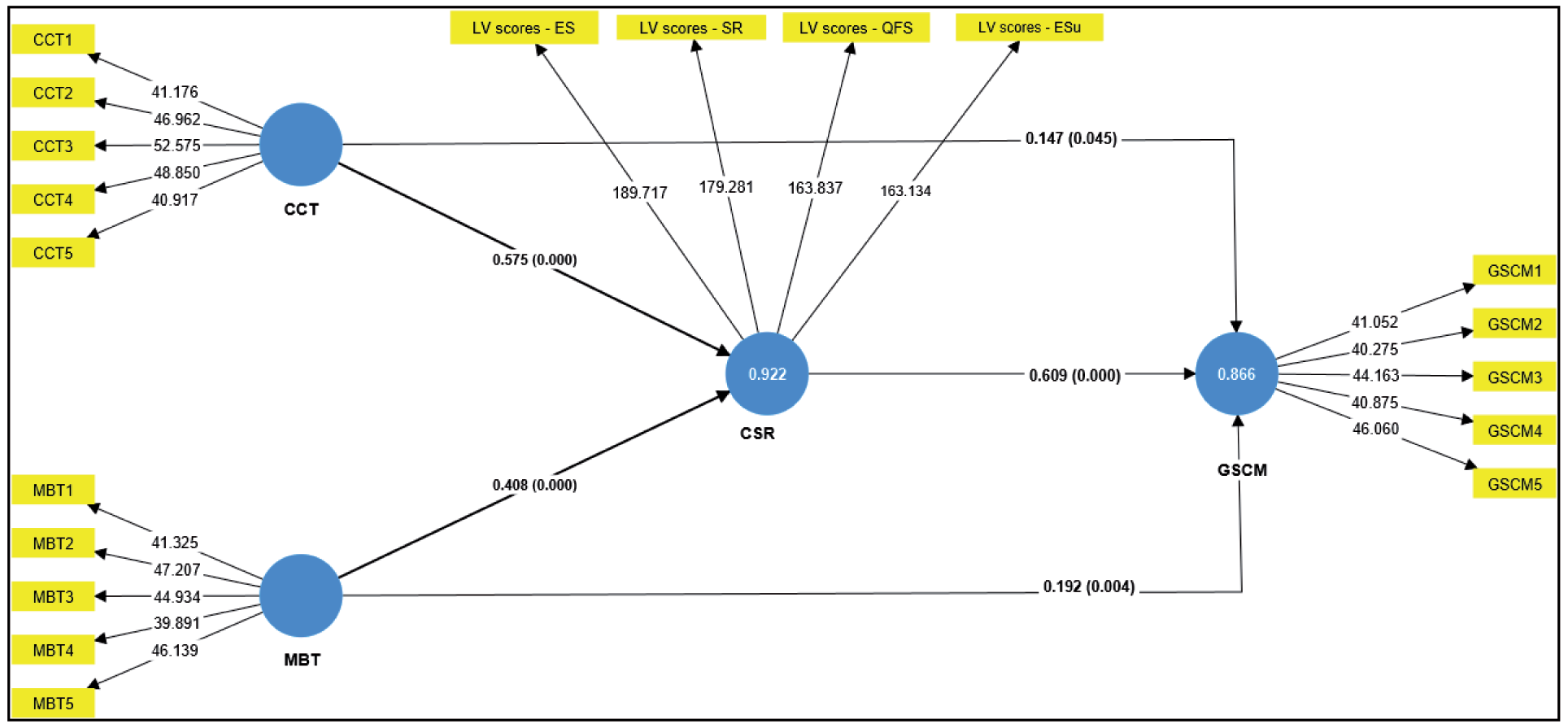
Table 8 demonstrates the direct relationship between different constructs in terms of path coefficients, standard deviations, T-statistics, and P-values. The CCT has a positive and significant direct effect on GSCM (β = 0.147, p < 0.05) which approved H1. Similarly, MBT also has a positive and significant direct connection with GSCM (β = 0.192, p < 0.05), which confirmed H2. The results also indicated that CCT has a positive and significant direct relationship with CSR (β = 0.575, p < 0.05), which approved H3. Likewise, MBT has a positive and significant direct connection with CSR (β = 0.408, p < 0.05), which supported H4. Furthermore, CSR has a positive and significant direct relationship with GSCM (β = 0.609, p < 0.05), which approved H5. We also measured the indirect connection between CCT and GSCM through CSR. The results indicated that CCT has a positive and significant indirect connection with GSCM through CSR (β = 0.350, p < 0.05), which confirmed H6. Similarly, the results indicated that MBT also has a positive and significant indirect connection with GSCM through CSR (β = 0.350, p < 0.05), which confirmed H7. The detailed results are presented in Table 8 and Figure 2.
Table 8.
Analysis of Direct and Indirect Relationships between Variables CCT, MBT, CSR, and GSCM, Including Coefficients, Mean, Standard Deviation (SD), T Statistics, P Value, and Hypotheses Decisions.
Fig. 2.
The Structural Model Illustrates Direct Relationships Among CCT (command and control type), MBT (market-based type), CSR (corporate social responsibility), and GSCM (green supply chain management). Arrows Represent Direct Effects, and Values Display Coefficients Alongside Hypotheses. Note: The model includes Environmental Sustainability (ES), Social Responsibility (SR), Quality and Food Safety (QFR), and Economic Sustainability (ESu) as indicators of CSR for second-order analysis.
This study provides a comprehensive analysis of the direct and indirect relationships between ERs, CSR, and GSCM in agri-business. The findings highlighted the substantial direct influence of ERs on GSCM. Moreover, both effective CCT and MBT exhibited positive and significant direct effects on GSCM. Intriguingly, our analysis reveals the positive and significant indirect role played by CSR in mediating the relationship between CCT and GSCM. Similarly, our analysis reveals the positive and significant indirect role played by CSR in mediating the relationship between MBT and GSCM. This study contributes to the body of knowledge by elucidating the complex interplay of, environmental regulation, CSR and GSCM, emphasizing the strategic necessity of integrating these aspects into corporate operations and decision-making.
CCT VS GSCM
First, the results of our study revealed that CCT environmental regulation has a positive and significant direct effect on GSCM, which approved H1. The outcomes of the present study are consistent with the results of previous research that environmental regulation primarily takes the form of command and control environmental regulation, which has a meaningful impact on corporate GSCM [38]. Similarly, CCT environmental regulation enforces rigorous GSCM through legally mandated goals, policies, and penalties, overseen by government agencies, ensuring environmental compliance [39]. Additionally, CCT environmental regulation limits enterprise autonomy while providing predictable GSCM outcomes, proving effective in tackling sudden, severe environmental challenges with direct, forceful policies [2]. Similarly, the study highlights a significant positive correlation between command-and-control environmental regulation and the effectiveness of green Supply Chain Management [6]. In expanding the discussion, [58] contribute valuable insights, suggesting that command-and-control environmental policy tools positively influence innovations related to end-of-pipe solutions, further supporting the positive impact of regulatory frameworks on environmental practices within supply chains. Thus, it was deduced that the positive and significant impact of command-and-control environmental regulation on GSCM stems from its enforcement of legally mandated goals and policies overseen by government agencies, ensuring environmental compliance and predictability in outcomes. In conclusion, the synthesis of these research findings supports the notion that command-and-control environmental regulations positively influence GSCM, providing a robust foundation for further discussions and analyses in academic discourse.
MBT VS GSCM
Second, the results of current research indicated that MBT environmental regulation has a positive and significant direct influence on GSCM, which approved H2. The results of the contemporary research are consistent with the outcomes of the previous study that MBT environmental regulation also affects GSCM [2]. Similarly, [42] explored market-based environmental regulation employing cost-effective market incentives, granting flexibility in emission reduction. Market-based environmental regulation fee system allows discretion and flexible GSCM, while its continuity ensures robust optimization. However, to enhance the depth of the discussion, additional insights from relevant research are essential. [58] contribute valuable findings, supporting the positive effect of command-and-control environmental regulation on GSCM and its economic benefits, competitive advantages, and realization potential. The research further explores the influence of MBER on GSCM, revealing positive correlations and emphasizing the role of environmental dynamism in regulating these relationships [59]. Additionally, [60] explored into the nuanced analysis of the influence of MBER on GSCM, providing a comprehensive understanding of their positive impact. The plausible reason for the results is that market-based environmental regulation has a strong impact on GSCM results from its utilization of cost-effective market incentives, providing flexibility in emission reduction and ensuring robust optimization in the system.
CCT VS CSR
Third, the outcomes of the present study indicated that CCT environmental regulation has a positive and significant direct effect on CSR, which accepted H3. The results were consistent with previous findings that CCT environmental regulation has a positive connection with CSR practices within corporate organizations [43, 44]. This alignment strengthens the effectiveness of command-and-control regulations by ensuring their implementation and compliance throughout the supply chain. CSR initiatives go beyond legal obligations and encourage companies to proactively address environmental concerns, such as sustainable sourcing and waste reduction [61]. In the research conducted by [62], the study focuses on the influence of government environmental regulation on enterprise green innovation, emphasizing the regulatory role in shaping environmentally responsible practices within organizations. Furthermore, [63] contribute insights by examining the connection between environmental regulation and innovation performance, highlighting the positive role of firm transparency in reinforcing the beneficial impact of CSR. This integration of command-and-control regulations and CSR practices may happen due to the sustainability efforts made in agribusiness.
MBT VS CSR
Fourth, the findings of the current study indicated that MBT environmental regulation has a positive and significant direct impact on CSR, which accepted H4. The results align with findings from previous studies, indicating that companies demonstrate their commitment to ethical and sustainable business practices. This voluntary adoption of CSR practices can have a positive impact on market perceptions, customer loyalty, and brand reputation [46]. MBT environmental regulations generated by consumer demand are the outcomes of CSR initiatives, such as sustainable sourcing, organic farming, and fair trade practices [46]. This alignment between market-based type environmental regulation and CSR can lead to competitive advantages, enhanced market positioning, and increased market share within the agri-food business [2]. Additionally, [62] explored the link between government environmental regulation and enterprise green innovation, highlighting the regulatory role in shaping environmentally CSR practices within organizations. These studies collectively offer compelling evidence that market-based environmental regulations serve as a powerful driver of positive CSR behavior in businesses.
CSR VS GSCM
Fifth, the results of contemporary research indicated that CSR has a positive and significant direct influence on GSCM, which acknowledged H5. The outcomes of the current study are aligned with the previous study’s results, showing that CSR has a positive effect on supply chain management [48]. Similarly, a positive connection was found between CSR and GSCM capability, such as environmental management system and market competitiveness opens the floor for further debates through possible decisional and policy initiatives [49]. Likewise, [50] also explored the nexus between CSR and green supply-chain management in sustainable organizations. Similarly, [64] emphasizes how firms implementing CSR strategies experience reduced pressure from stakeholders, ultimately leading to the adoption of GSCM practices. Additionally, a recent study on the mediating role of green supply chain management [65] found that GSCM mediates the relationship between CSR and Sustainable Competitive Project Performance (SCPP), suggesting that GSCM acts as a key mechanism through which CSR drives sustainability outcomes. This growing body of evidence highlights the crucial role of CSR in promoting GSCM and achieving sustainable supply chain practices.
Mediating Role of CSR
Sixth, the results of our study revealed that CCT environmental regulation has a positive and significant indirect effect on GSCM through CSR, which approved H6. The previous research outcomes indicated that CCT environmental regulation has a direct effect on GSCM [2, 38]. Furthermore, it was found that CSR mediates the relationship between political connections and corporate green innovation, highlighting the potential of CSR as a mechanism for translating external pressures into positive environmental actions [2]. This finding aligns with prior research by [66] and [67] who demonstrated the mediating role of GSCM in the link between environmental regulations and sustainability outcomes. Consistent with these findings, our research suggests that CCT regulations encourage firms to adopt CSR practices, which, in turn, motivate the implementation of GSCM initiatives. This mediating role of CSR highlighted its crucial importance in driving sustainable supply chain practices within organizations. Thus, the current study explored the facilitating role of CSR in strengthening the association between CCT environmental regulation and GSCM in the agri-food business.
Mediating Role of CSR
Seventh, the results of current research indicated that MBT-environmental regulation has a positive and significant indirect influence on GSCM through CSR, which accepted H7. The previous research outcomes indicated that MBT environmental regulation has a direct effect on GSCM [42]. Furthermore, [2] suggested exploring the mediating role of CSR in the relation of MBT environmental regulation and GSCM. This aligns with existing research highlighting the mediating role of CSR in the relationship between environmental regulations and sustainable supply chain practices [68, 69]. MBERs, such as emissions trading schemes and green taxes, incentivize firms to reduce their environmental impact, often leading to the adoption of CSR initiatives as a means of compliance and stakeholder management[6]. These CSR practices, in turn, foster a culture of environmental responsibility within organizations, ultimately motivating the implementation of GSCM practices [50]. This indirect effect of MBER on GSCM through CSR highlights the importance of considering both regulatory pressures and internal organizational factors in promoting sustainable supply chain management in agri-food business. The current study explored this phenomenon in the Agri-food business. Market-based ERs drive companies to invest in CSR, creating a positive ripple effect on GSCM. This may align with stakeholder expectations, ensure long-term viability, and grant a competitive edge in sustainability-driven markets.
Practical Implications
With growing social awareness of environmental issues, enterprises that solely focus on adhering to government policies and social environmental mandates will find themselves inadequately responsive in the commercial world. It is essential for enterprises to proactively adapt their GSCM and CSR approaches in a timely manner. This involves giving due attention not only to governmental environmental policies, but also to the environmental concerns voiced by market players. Moreover, enterprises must vigilantly monitor external environmental shifts. When these shifts are minor, relying on ERs can effectively drive GSCM implementation. However, facing substantial changes, ERs alone may have a limited impact on GSCM. In such cases, enterprises should establish standardized internal management processes and execute GSCM in accordance with established standards and requisites to ensure uninterrupted operations. Furthermore, in the process of crafting environmental policies, pertinent government bodies should also take into account the prevailing market dynamics. Aligning policy direction with the collective demands of all market stakeholders such as CSR will further fortify enterprises’ adherence to GSCM practices.
Theoretical Contributions
Our study provides a few new perspectives, such as how CCT and MBTs of ERs affect GSCM practices and consider CSR as a mediator construct. Our study also provides a synthesized theoretical framework that explains the connection between command and control and MBTs of ERs and CSR collectively influence the GSCM in the agri-food business. Previous studies demonstrated a lack of focus on CSR as a mediator variable between these variables, therefore, our study added a new perspective to the existing literature.
Conclusions
This research used a model based on prior literature and institutional theory to investigate the connection between ERs and GSCM. The findings affirmed both the direct and indirect correlation between ERs (CCT and MBT) and GSCM in the agri-food business in China. Similarly, the current study further explored those ERs (CCT and MBT) that had a positive influence on CSR. Additionally, we assessed the direct association between CSR and GSCM. The results indicated that CSR had a positive and significant direct link with GSCM. Moreover, we measured the mediating role of CSR in the relationship between ERs (CCT and MBT) and GSCM. Results indicated that CSR had a positive and significant mediating role in the relationship between ERs (CCT and MBT) and GSCM in the agri-food business.
The following conclusions were thus made from the study: First, both CCT and MBT ERs enhanced GSCM practices. Second, it forces corporate organizations to legally mandate goals and policies overseen by government agencies, ensuring environmental compliance and predictability in outcomes. Third, both CCT and MBT ERs positively influence CSR. Fourth, CSR also played a vital role in leading the GSCM practices. Lastly, CSR facilitates the strengthening role of both CCT and MBT ERs to implement GSCM practices in agri-food businesses.
Limitations and Future Directions
Our sample size included a diverse range of industries. However, future studies could include specific industries for data collection or add them as control variables to enhance the generalization of the outcomes. Furthermore, this study explored the mediating role of CSR, and future investigations may consider additional mediating variables such as stakeholder engagement and stakeholder satisfaction as internal factors could be explored. Additionally, variables like environmental uncertainty and institutional location influence enterprises and may be used as external factors. Likewise, this study delves into the direct impact of command and control and MBTs of ERs on corporate GSCM. Upcoming research endeavors could explore the relationship between these factors and their combined influence on GSCM.

