

Introduction
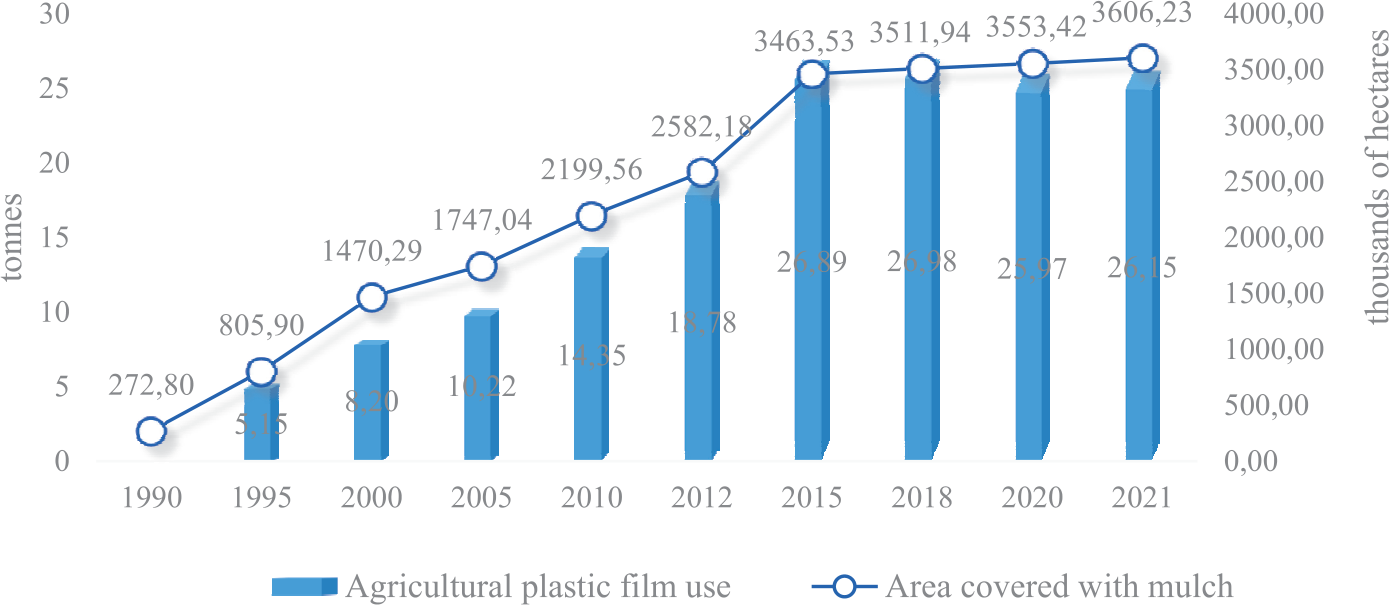
Agricultural plastic mulch is an indispensable and important material in agricultural production. Agricultural mulch film has obvious drought prevention, temperature increase, moisture retention, and salt control effects [1] and plays a significant role in improving the yield and quality of agricultural products, ensuring food security, as well as increasing farmers’ income. Over time, China’s agricultural dependence on plastic films has increased significantly. The use of film in Xinjiang showed a trend of increasing first and then decreasing, from 51,500 tonnes in 1995, covering a land area of 805.9 thousand hectares, to 269,800 tonnes in 2018, covering an area of 3,511.94 thousand hectares. The use of film after 2018 all showed a downward trend, decreasing to 2,615 tonnes in 2021, but the area of film coverage still showed a growth trend, Xinjiang has become the province with the largest amount of ground film use and the most serious residual film pollution in China (specific data are shown in Fig. 1). Agricultural film is the main source of residual film pollution. The film will be broken in the late maturity of the crop and remain in the arable land. Due to its own difficulty to degrade, residual film in the soil after a long period of time accumulation causes damage to the soil structure, reduced soil fertility, and damage to the growth and development of the crop, resulting in a reduction in crop yields and lower quality [2]. According to estimates, the average annual new 18 kg of residual film per hectare of farmland in Xinjiang, more than 80% of farmland film residue is higher than 225 kg/hm2, the average residue is as high as 255 kg/hm2, which is 5 times of the national average level. The problem of “white pollution” has become a major hazard to the local ecological environment, posing a non-negligible threat to the sustainable development of agriculture, and has received great attention from all sectors of society.
In recent years, the transformation of China’s agricultural green production has reached a critical moment. The Ministry of Agriculture and Rural Development in 2015 put forward the “one control, two reductions and three basic” goal, issued in 2017 on “the innovation of institutional mechanisms to promote the green development of agriculture,” put forward by 2020 to achieve the recovery rate of agricultural film to reach 80%. The “Soil Pollution Prevention and Control Law” adopted in 2018, will strengthen the control of agricultural film use as one of the important means of soil pollution prevention and control. The Soil Pollution Prevention and Control Law, adopted in 2018, emphasizes strengthening the management of agricultural film usage as a key measure to prevent and control soil pollution. In 2021, the “14th Five-Year Plan” for National Green Development in Agriculture was introduced, setting a target for the recycling rate of used agricultural films to reach 85% by 2025.
Building on this, in 2022, the Ministry of Agriculture and Rural Affairs, together with the Ministry of Finance, issued the Notice on the Pilot Program for the Scientific Use and Recycling of Ground Film. This initiative promotes the adoption of thickened, high-strength ground films and fully biodegradable ground films as alternatives to traditional films, aiming to reduce their use at the source. The program seeks to systematically address the challenges associated with ground film recycling.
Pilot work on film recycling in the Xinjiang region began in 2014, and a comprehensive management target system and evaluation mechanism for film pollution, led by the autonomous region, prefectures, and counties, have been preliminarily explored and established. However, due to factors such as wind and sun exposure, agricultural films are prone to breakage, and during field plowing, they are turned into the 0-30 cm plowing layer in fragmented form, making film recycling challenging and costly, and farmers lack the motivation to recycle waste films. As micro-agents of agricultural production and operation, farmers are the producers of film pollution, direct participants in its management, and beneficiaries. Enhancing farmers’ participation in waste film recycling is of great significance in winning the battle against “film pollution.”
New Institutional Theory posits that the institutional environment is a prerequisite for the survival of organizations and individuals, necessitating broad social acceptance. This suggests that individual behaviors and practices are inevitably constrained by societal legitimacy and follow certain logical patterns, namely, legitimacy mechanisms [3]. According to new institutional economics, institutions include both formal and informal aspects, and informal institutions go hand in hand with formal institutions; formal constraints only work if they are socially accepted, i.e., compatible with informal constraints, thus dividing institutions into formal (formal constraints) and informal (informal constraints). In the field of agriculture, the shaping of farmers’ behavior by formal (environmental regulation) and informal institutions is particularly significant. From the point of view of formal institutions, environmental regulation, as an important means for our government to supervise and incentivize the development of green production in the countryside, gives more intervention and control over farmers’ production behavior, especially in the case of the typical externality of agricultural surface pollution, which can be effectively internalized through the policies and regulations of environmental regulation to solve the problem. As for the informal system, it is the root of the formal system, deeply rooted in the daily life of farmers’ communication and production process, silently shaping their production mode. Under the soft constraints of the informal system, farmers will adjust the willingness of agricultural green production and decision-making and revise the expected benefits and expected output.
There is a rich body of scholarly work on how social support, social norms, and social identity – elements of informal institutions – alongside formal environmental regulations, influence farmer behavior. Formal environmental regulations have been widely shown to positively influence green behaviors among farmers [4-6], with varying effects across different types of regulations [7-9]. Regarding informal institutions, some scholars consider them an important endogenous force influencing farmer behavior choices [10]. Regulating and constraining farmers’ behavior through group-recognized and tacitly accepted norms [11,12], while others have empirically explored the impact of informal institutions on the adoption of green behaviors by farmers [13-15]. A number of scholars have also explored the mechanism of informal institutions such as social trust, social networks and social norms on the behavior of farmers [16-18].
Despite the wealth of existing research providing significant insights for this study, there is still room for in-depth research: much of the literature examines the impact of informal or formal institutions on farmer behavior from a singular perspective, rarely integrating both within the same framework. Rural areas are rich in informal institutions, while formal institutions are relatively lacking. Relying solely on formal institutional analysis of the impact on green production behaviors without considering the informal institutional context can lead to certain deficiencies and shortcomings; formal regulations cannot be effectively implemented or produce effective outcomes in rural management without the broad recognition and general support of internal perception. Conversely, without formal regulations providing basic guidelines and requirements, those internal perceptions compatible with and accepted by formal settings would lose public support, authority, and justification. Only by finding an optimal synergy between the two can their regulatory effects be fully utilized. Farmer waste mulch recycling behaviors are primarily regulated by both formal and informal rules, and to achieve ideal management outcomes, it is essential to fully leverage the synergistic effects between them. Based on this, the paper uses survey data from 697 farmers in Xinjiang to construct a probit model to investigate the influence of informal systems and environmental regulations on farmers’ waste film recycling behavior and tries to examine the multidimensional relationship between informal systems and environmental regulations in farmers’ waste film recycling behavior from a multidimensional perspective (informal systems are classified into value orientation, disciplinary supervision, and transmission internalization according to the mechanism of their action, and environmental regulations are classified into guiding, incentive and constraining regulations according to the nature of the measures), with a view to enriching related studies of new institutional economics and land film pollution prevention. We attempted to examine the multidimensional interaction between informal institutions and environmental regulations in the recycling behavior of farmers from a multidimensional perspective (informal institutions are classified into value orientation, disciplinary supervision, and transmission internalization according to the mechanism of action, and environmental regulations are classified into guidance regulation, incentive regulation, and constraint regulation according to the nature of measures), with a view to enriching the research on new institutional economics and the prevention and control of landfilm pollution, expanding the theoretical content and empirical evidence of intrinsic patterns between institutions and farm household behavior, and to provide policy suggestions to further promote the participation of farmers in recycling of used and scrap films as well as to offer useful references to the current policy of managing the pollution of farmland films.
Materials and Methods
Environmental Regulation and Farmer Behavior in Agricultural Film Recycling
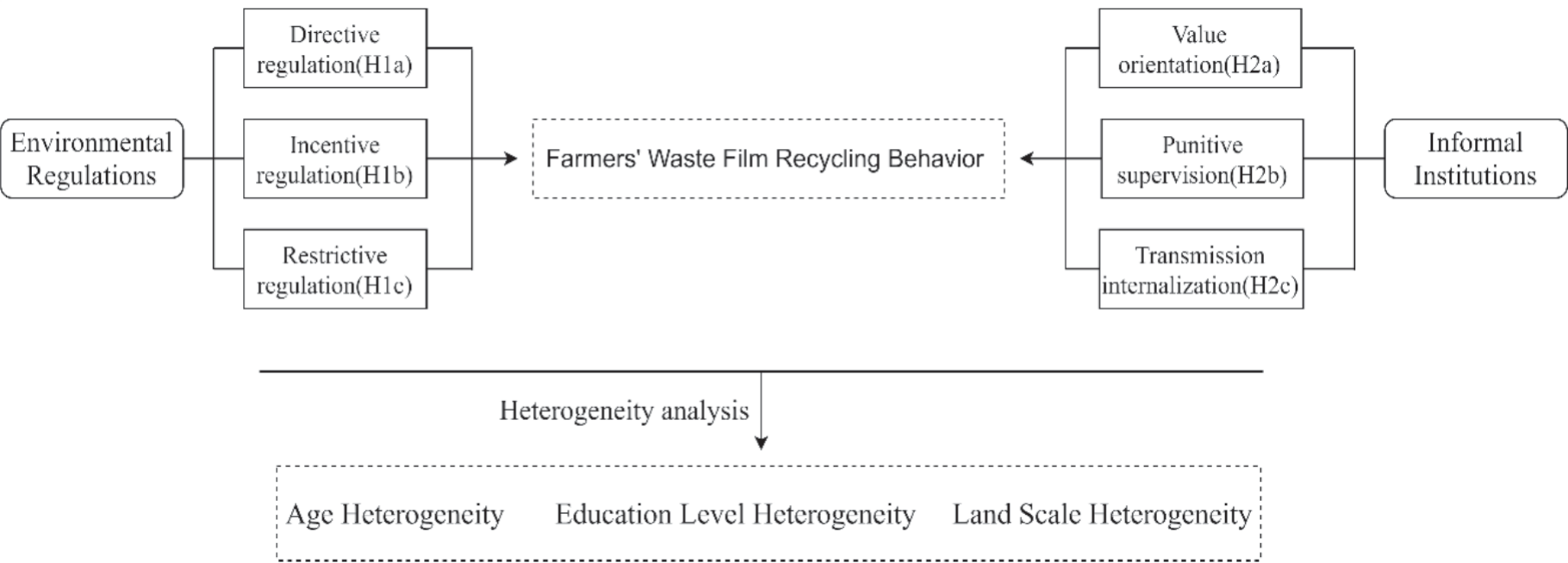
In exploring solutions to the problem of agro-environmental pollution, the theory of externalities is particularly important, as it not only provides a solid theoretical basis for the design of formal institutions, but also indicates two main ways of internalization. Because agricultural residual film pollution is a typical problem of negative externalities, it can be dealt with through internalization, the most common of which is government regulation advocated by Picus and market mechanisms advocated by Coase. Picou believed that direct regulation should be carried out by the government, and he suggested the use of taxes and subsidies to internalize negative external impacts, which also provided direct support for a formal system on agri-environmental pollution management. Environmental regulation refers to the government’s use of policy tools to adjust farmers’ economic activities, aiming to balance environmental protection and development [19]. Drawing from existing literature [20-22], these formal institutions can generally be categorized into three types: directive regulation, incentive regulation, and restrictive regulation. Environmental regulation balances individual, social, and ecological interests through publicity and education, direct benefit compensation and reward, and regulatory constraints in order to achieve policy objectives.
The impact of policy implementation on farmers’ behavior is abstract and must be revealed through the specific behavior of farmers, from the basic logic of environmental regulations affecting the recycling behavior of farmers’ residual film, under the stimulating effect of various guiding, incentive, and constraint policies, the internal recycling willingness of farmers has been stimulated, which triggered the external recycling choices of farmers as well as changes in the degree of recycling, and the process of ultimately realizing the desired goal is the process of environmental regulations affecting the recycling behavior of farmers’ used film. The process of achieving the desired goal is the process of environmental regulation influencing the recycling behavior of farmers.
Directive Regulation
Directive Regulation: The government employs information-led measures such as agricultural film recycling demonstrations, technological consultancy services, media, and internet promotions, as well as the distribution of promotional materials to help farmers understand the ecological and economic benefits of film recycling. These efforts strengthen farmers’ awareness of the hazards associated with film pollution and the advantages of participating in recycling initiatives, thereby increasing their likelihood of engaging in such activities.
Incentive Regulation
Incentive Regulation: Recycling agricultural film is an activity that protects the farm environment. Farmers who choose to recycle must bear significant costs associated with recycling machinery, transportation of residual films, and the time involved. Under incentive-based environmental regulations, the government provides financial subsidies to cover some of these recycling costs, effectively alleviating the economic burden on farmers and enhancing their willingness to participate in film recycling.
Restrictive Regulation
Restrictive Regulation: Restrictive regulation emphasizes the use of penalties to suppress and constrain individual behaviors that pollute the environment, thereby serving the purpose of environmental protection. Farmers’ decision-making behaviors are often limited by bounded rationality. The government enforces agricultural activities through regulatory policies, and if farmers contravene these regulations, they face legal accountability and penalties. Under such circumstances, considering the economic costs associated with rule violations or potential reputational damage, farmers, motivated by self-protection, usually adjust their behavior to comply with regulations and proactively recycle waste agricultural films [23-25].
In summary, directive, incentive, and restrictive regulations within environmental regulation significantly impact farmers’ production behaviors. Based on this, the study proposes the following research hypotheses:
H1: Environmental regulations can promote farmers’ agricultural film recycling behavior.
H1a: Directive regulation can promote farmers’ agricultural film recycling behavior.
H1b: Incentive regulation can promote farmers’ agricultural film recycling behavior.
H1c: Restrictive regulation can promote farmers’ agricultural film recycling behavior.
New institutional economics posits that internal perception, when functioning, requires supplementation and coordination from informal institutions [26]. Particularly in the field of agricultural pollution management, due to imperfect market transactions and value orientation, the transmission internalization of internal perception alone is insufficient to eliminate free-riding behaviors. It is necessary, beyond formal institutions, to delve into and utilize internal perception resources, such as social norms, social identity, and social support [27, 28], to construct a new governance model that integrates “top-down” and “inside-out” approaches. Rooted in rural traditional culture and deep social ties, informal institutions form a unique social network that not only facilitates the sharing of economic resources and circulation of production tools [29] but also plays a crucial role in shaping values, fostering emotional connections, and affirming social identities [30, 31]. Social embeddedness theory suggests that any individual’s economic behavior and decision-making cannot be separated from the social context in which it is located and that farmers, as members of rural society, are deeply embedded in the social structure of their waste film recycling behavior, which has the attribute of a “social person”. Under the constraint of limited rationality, their waste film recycling behavior tends to “follow” the choice of the majority of the group. Compared to formal institutions, this informal social structure plays a more profound and binding role in farmers’ production and everyday life [32]. It effectively guides farmers towards engaging in green production practices through mechanisms such as cultural value leadership and internalization of education [33]. This study measures informal institutions in two aspects: value orientation and transmission internalization.
Value Orientation
Value Orientation: Value orientation leverages the influence of exemplary figures, such as rural leaders or model families, to promote the adoption of green agricultural practices among farmers. First, informal regulations establish titles like “Green Production Model Households”, which serve to set clear production action targets for farmers, thereby exerting a guiding influence on their behavior. Second, awards such as “Green Production Model Household” also fulfill farmers’ desires for recognition and honor, which can motivate their initiative and enthusiasm in recycling waste agricultural film.
Punitive Supervision
Transmission Internalization: Transmission internalization utilizes communication among farmers to advance the process of voluntarily recycling waste agricultural film. Social learning theory suggests that when people are observing the behavior of others or modeling behavior, it has an impact on their behavioral decisions. Driven by the psychology of conformity, farmers’ behaviors are easily influenced by the assimilation of their peers, leading them to unconsciously mimic the actions of those around them [34-36]. This informal mechanism of mutual influence gradually permeates through daily interactions, transmitting and reinforcing various values and guiding farmers to develop norms in their production activities. Over time, these informal institutions become an inseparable part of the farmers’ consciousness.
Overall, the elements of informal institutions – value orientation, punitive supervision, and transmission internalization –directly impact farmers’ behaviors concerning the recycling of waste agricultural film. Based on this understanding, the study proposes the following hypotheses:
H2: Informal institutions can facilitate farmers’ choices in agricultural film recycling behavior.
H2a: Value orientation can promote farmers’ agricultural film recycling behavior.
H2b: Punitive supervision can promote farmers’ agricultural film recycling behavior.
H2c: Transmission internalization can promote farmers’ agricultural film recycling behavior.
Based on the relevant theories and literature, the logical framework of the influence of environmental regulation and informal systems on the recycling behavior of farmers’ used mulch is constructed, as shown in Fig. 2.
Data Source, Variable Selection, and Model Specification
Data Collection
The microdata used in this study were obtained from field surveys conducted between June and September 2023. The research focused on the Northern Xinjiang region, selecting eight counties and cities for the survey, including Hutubi County and Manas County in Changji Prefecture, Shawan County in Tacheng Area, Qapqal Xibe Autonomous County in Ili Kazakh Autonomous Prefecture, Yiwu County in Hami City, Shanshan County in Turpan City, Hu Yanghe City in the Seventh Division of Xinjiang Production and Construction Corps, and Shihezi City in the Eighth Division. These areas were chosen to carry out a field survey concerning farmers’ green production behaviors and their perception of related policies. A total of 730 questionnaires were distributed in this research, and after eliminating invalid questionnaires, 697 valid questionnaires were finally obtained, with an effective rate of 95.48%. The questionnaires included the basic characteristics of farmers’ personal, family, and production, the use of mulch film and the behavior of recycling used mulch film by farmers, and the situation related to the recycling system of used mulch film.
Sample Characteristics
Table 1 shows the basic characteristics of the sample farmers. The sample consists of a slight majority of Han ethnicity over ethnic minorities, with Han Chinese representing 53.08% and minorities accounting for 46.92%. Gender distribution among the surveyed households shows a slight male predominance, with males making up 55.09% and females 44.91% of the sample. The majority of the sample households are older, particularly those between the ages of 41 and 50, who dominate the sample with 218 households, accounting for 31.28%. In terms of educational background, the majority of the sample households are concentrated at two levels: junior high school and college or higher. The health status of the sample households is generally good, with 92.25% of them considering their health to be average or above. Financially, over one-third of the families (38.16%) had an annual income ranging between one to five million yuan in 2022, indicating significant economic disparities among different households. Regarding land area, the farming land size of households is generally small, with most owning 40 acres or less. A substantial majority of the households (85.37%) have not joined any cooperatives or leading enterprises. Among the 102 households that are part of cooperatives or leading enterprises, 78 households (76.47%) reported that their cooperatives (enterprises, bases) have set requirements for the recycling of waste agricultural film, of which 75 households (96.15%) strictly adhere to the related regulations.
Variable Selection
The variables involved in this study are categorized into four groups:
1. Dependent Variable: The dependent variable selected is the recycling behavior of agricultural film among farmers, which is measured by whether the interviewed farmers choose to engage in recycling activities. In the questionnaire, a question was asked in the form of “Do you recycle residual film?” The question was asked in the form of “Do you recycle residual film?”, and farmers were assigned a value of 1 and 0 for “yes” and “no” responses, respectively.
2. Core Explanatory Variables: This includes environmental regulations. Drawing on research by scholars such as Guo [8, 37], environmental regulations are represented by three indices: incentive regulation, restrictive regulation, and directive regulation.
3. Intermediary Variable: Drawing on the study of Hao et al. [21, 33], Internal Perception is measured through two indices: value orientation and transmission internalization. Value orientation was measured by asking farmers how much they agreed with the question “The village committee will guide you to adopt green production methods”, and transmission was internalized by asking farmers how much they agreed with the question “All farmers around them recycle used mulch”. Both sets of core variables are measured using a Likert five-point scale to capture the extent of agreement or disagreement.
4. Control Variables: To eliminate confounding influences, following existing research [38-41], variables such as the individual’s age, educational level, family’s agricultural income, the scale of land management, and the availability of technical training related to the use and recycling of agricultural film are included. These control variables help to account for additional variability in the dependent variable that might be influenced by factors other than the core explanatory variables. The specific definitions and value assignments of the variables are shown in Table 2.
Table 1.
Descriptive Statistics of Production and Management Characteristics of Sample Farmers.
Model Specification
Since the dependent variable, whether farmers are willing to recycle plastic film (y), is a binary categorical variable, the outcome of plastic film recycling behavior manifests as either ‘recycle’ or ‘do not recycle’, that is, a 0-1 variable. Typically, discrete choice models such as Probit and Logit are chosen to study such problems. Compared to the Logit model, the Probit model is more suitable for analyzing micro-level behaviors of subjects and predicting problems [42, 43]. Therefore, a Probit model is used for estimation. The basic form of the model is as follows:
In the model, y is a binary outcome vector (0 or 1), X is the matrix of explanatory variables, β represents the coefficients to be estimated, and Ɛ represents the random error term. The specific functional form is:
Table 2.
Variable selection and definitions.
In the formula y is the dependent variable indicating whether a farmer chooses to recycle agricultural film (1 = yes, 0 = no); represents the standard cumulative normal distribution function; is a constant; are the coefficients to be estimated for the explanatory variables. X refers to the specific explanatory variables.
This paper applies the mediation effect model to further test the mediation mechanism of intrinsic cognition in the influence of environmental regulation on the recycling behavior of farmers’ discarded mulch film, to verify the correctness of the mediation effect model’s influence path, and to construct the following mediation effect model:
Where X is environmental regulation, Y is farmers’ discarded film recycling behavior, Z is intrinsic cognition, Control is a control variable, β1 is the total effect of environmental regulation on farmers’ discarded film recycling behavior; β’1 is the degree of influence of environmental regulation on the mediating variable; β’’1 is the direct effect of environmental regulation on farmers’ discarded film recycling behavior, and the mediating effect of intrinsic cognition is β’1β3.
Robustness Tests
Considering that older individuals may lack the physical capability to engage in agricultural production activities, this study excludes samples of individuals aged 60 and over and re-runs the Probit regression. The results are presented in Table 3. It is evident that the regression outcomes for the restricted sample are consistent with those of the full sample, indicating that the model’s estimated results are robust.
Table 3.
Robustness Test for Restricted Sample.
Endogeneity Tests
The binary Probit model described above may suffer from endogeneity bias due to reverse causation and omitted variables. On the one hand, there are many influencing factors affecting the recycling of waste mulch by farmers, and the problem of omitted variables arises due to the fact that the selected data, as well as the control variables, tend to be limited; on the other hand, the level of environmental regulation and informal institutions may be higher among farmers who are willing to recycle waste mulch, which may lead to biased estimation results.
The study addresses potential endogeneity issues due to reverse causality or omitted variables using the Conditional Mixed Process (CMP) model.
In this paper, we refer to the study of He et al. [44] and introduce the mean values of environmental regulation and informal system of other samples living in the same area except for the farmers themselves as instrumental variables to deal with the endogeneity of the model, on the one hand, environmental regulation and informal system have certain geographical characteristics, the stronger the social and cultural atmosphere of the village, the more frequent the neighbors help each other and the stronger the support for the policy, the higher the level of environmental regulation and informal system will be. On the one hand, environmental regulations and informal systems have certain geographical characteristics: the stronger the social and cultural atmosphere of the village, the more frequent the mutual help of neighbors, and the stronger the policy support, the higher the level of environmental regulations and informal systems, so the level of environmental regulations and informal systems of other farmers in the same region has a significant effect on the level of environmental regulations and informal systems of the focal farmer, which meets the requirement of relevance. The results, after instrumental variable tests with p-values less than 0.1, reject the null hypothesis of exogeneity, confirming the appropriateness of the instruments. The corrected results still indicate a positive and robust influence of both environmental regulations and informal institutions on farmers’ recycling behaviors. Notably, the CMP model suggests that the influence of environmental regulations might have been underestimated and the impact of informal institutions potentially overstated in previous models. For complete results, see Table 4.
Heterogeneity Analysis
In order to further analyze the impact of environmental regulations on the waste film recycling behavior of different types of farmers, this paper divides farmers into different groups from the three dimensions of the age of the head of the household, level of education, and planting size, in order to test the heterogeneity of the impact of environmental regulations on the waste film recycling behavior of farmers.
Age Heterogeneity
In this paper, we first sorted all the sample households according to the age of the head of household, and divided them into below-median and above-median groups according to the median (43 years old), and then tested the effects of environmental regulations on the waste film recycling behaviors of the two groups of farmers, and the results are shown in Table 5. From the regression results, it can be seen that the positive influence of environmental regulation on farmers’ waste mulch recycling is greater in the higher age group. The possible reasons for this are that older farmers mainly learn agricultural production technology through government technology extension and social networks, and social network relationships are mostly concentrated within villages, which are more likely to be influenced by local social norms, and the disposal methods and perceptions of other farmers around them on waste mulch are more likely to change the waste mulch recycling behavior of older farmers. Younger farmers, on the other hand, have a wider distribution of social relations, and they can search for diversified information on agricultural production technologies in a wider range of areas outside the village and make decisions on waste film recycling based on comprehensive comparisons and analyses, so environmental regulations have relatively little impact on them.
Education Level Heterogeneity
Based on the sample characteristics of education level, this subsection divides the farmers into two samples of low education level group (junior high school level and below) and high education level group (junior high school level and above), and conducts regressions separately, and the results are shown in Table 6. As can be seen in Table 6, the positive impacts of environmental regulation and informal systems on waste mulch recycling of farmers are greater in the ground education level group, and for the farmers in the low education level group, the greater the strength of environmental regulation and informal system, the greater the possibility of recycling of their waste mulch. The greater the intensity of the institutions, the greater their waste mulch recycling is likely to be. Possible explanations for this are that farmers in the low-education group have fewer non-farm employment opportunities than farmers in the high-education group, pay more attention to their farmland, have limited knowledge and awareness of waste mulch, and have a clear “other-orientation”, so they are more likely to be affected by environmental regulations and informal systems.
Land Scale Heterogeneity
In order to analyze the scale heterogeneity of the impact of environmental regulations on farmers’ waste mulch recycling behavior, this paper sorts all sample farmers according to the size of planting scale and divides them into a below-median group (small-scale) and above-median group (large-scale) according to the median (50 acres), and then examines the impact of environmental regulations on the recycling behavior of waste mulch for the two groups of farmers respectively. The results are shown in Table 7. From the regression results, it can be seen that the positive effect of environmental regulations on the recycling behavior of farmers is more significant in large-scale growers, probably because the cost of recycling used film is higher, and the capital constraints on large-scale growers are relatively small. According to the field research, most of the subsidies for the recycling of used film are based on the area of cultivation and the amount of recycling, and the detection of residual film is mostly based on the area of cultivation. As a result, large-scale growers are more likely to be incentivized and constrained by environmental regulations and are more likely to recycle used film than small-scale farmers.
Further Discussion: Mechanism Testing
Results an as can be seen from Model 1 in Table 8, the effects of guided regulation on waste film recycling behavior are all significant, at least at the 10% level. Hypothesis H2a is verified, and there is also a positive and significant effect of guided regulation on the value orientation of farmers, which further indicates that hypothesis H2 is verified. This suggests that there is a direct effect of the guiding regulation on farmers’ waste film recycling behavior and an indirect effect on farmers’ waste film recycling behavior driven by value orientation, which also verifies the previous conclusion that the “total effect” of the guiding regulation is significant.
From Model 1 in Table 8, we can also see that the effect of incentive regulation on farmers’ waste film recycling behavior is positive, and the results of Model 2 show that the effects of incentive regulation and value orientation on farmers’ waste film recycling behavior are both positive effects. This shows that incentive regulation not only can directly promote the waste film recycling behavior of farmers, but also there exists the influence path of incentive regulation→value orientation→waste film recycling, and Hypothesis H2a and Hypothesis H2 are further verified.
Finally, from the results of Model 1 and Model 3 in Table 8, we can also see that the effect of constraint regulation on value orientation and transfer internalization is positive, and significant at the 1% statistical level, and the results of Models 1-4 show that the effects of constraint regulation, value orientation, and transfer internalization on the waste film recycling behaviors of farmers are positive, which indicates that constraint regulation not only promotes the behaviors of farmers on waste film recycling, but also has two influence paths, hypothesis H2b and H2 are all verified. The hypotheses H2b and H2 have been tested, and there are two influence paths of constraint regulation→value orientation→waste film recycling and constraint regulation→transfer internalisation→waste film recycling.
Table 8.
Results of the interaction between environmental regulations and informal institutions.
Results and Discussion
To ensure the accuracy of the model’s estimation results, it is necessary to diagnose potential multicollinearity among variables before examining the impact of each variable on the dependent variable. Using Stata 16.0 software for analysis, the Variance Inflation Factor (VIF) for all variables used in the model was found to be less than 3, indicating that there is no multicollinearity among the variables. When examining the impact of informal institutions and environmental regulations on farmers’ participation in agricultural film recycling, the study employs three models for analysis. Firstly, variables representing environmental regulations and informal institutions are incorporated into Models 1 and 2 based on controlled variables. Subsequently, all indicator variables are included in Model 3 for regression estimation. The Probit regression results are presented in Table 9.
According to Model 1 from Table 9, restrictive regulations significantly positively affect farmers’ behaviors in recycling waste agricultural film, and this effect is significant at the 1% confidence level, which verifies the research hypothesis H1a. The likely reason is that restrictive regulations primarily involve economic penalties and educational criticism for environmental pollution behaviors. Therefore, the greater the intensity of restrictive regulations, the more likely farmers are to increase their recycling activities to avoid economic penalties and criticism.
According to Model 2 from Table 9, directive regulations did not pass the significance test, and research hypothesis H1b was not passed, which may be due to the current reliance on promotional slogans and mottos for film recycling awareness, a rather uniform approach. Additionally, the variability of regional characteristics and the complexity of rural issues can cause a lag in the implementation of directive policies, diminishing their immediate effectiveness in promoting recycling behaviors among farmers.
Table 9.
Regression results of environmental regulations and informal institutions on farmers’ recycling behavior of waste agricultural film.
According to Model 3 from Table 9, incentive regulations also failed to pass the significance test, and research hypothesis H1c was not passed. This may be because the subsidies provided by the government for recycling waste agricultural film do not compensate for the costs incurred by farmers in the recycling process. The subsidies do not increase expected profits or reduce production costs significantly, hence the limited effect of incentive regulations on enhancing farmers’ recycling behaviors.
According to Model 4 from Table 9, age was found to negatively affect farmers’ recycling behaviors significantly, likely because younger farmers are more receptive and better informed about film pollution, while older farmers may not be as aware of its hazards. The educational level also negatively impacts recycling decisions; better-educated farmers may prioritize short-term financial returns and thus calculate the cost-benefit ratio of recycling more stringently, reducing their recycling enthusiasm. Conversely, technical training significantly encourages recycling, as it increases farmers’ knowledge about the scientific use of agricultural film and its recycling importance. Additionally, geographical differences play a role, with farmers in the Production and Construction Corps showing a higher likelihood of recycling than local farmers, possibly due to regional policies or better access to recycling facilities. Directive regulations did not pass the significance test, and research hypothesis H1b was not passed, which may be due to the current reliance on promotional slogans and mottos for film recycling awareness, a rather uniform approach. Additionally, the variability of regional characteristics and the complexity of rural issues can cause a lag in the implementation of directive policies, diminishing their immediate effectiveness in promoting recycling behaviors among farmers.
Conclusions
Based on a sample of 697 farmers from the Xinjiang region and using the Probit model, this study examined farmers’ agricultural film recycling behavior from the perspectives of informal institutions and environmental regulations. The conclusions are as follows: Both environmental regulation and informal systems have a facilitating effect on farmers’ film recycling behavior, and there is a certain degree of complementary relationship, which requires the two to cooperate and synergistic governance. Informal systems are stronger than environmental regulations in promoting farmers’ participation in film recycling. In the current stage of environmental regulation, the policy effect is weakened, and the informal system needs to play a role in farmers’ film recycling behavior to promote the role of the informal system. The informal system can partially complement the role of environmental regulation, and environmental regulation can provide a certain degree of protection for the informal system, and the two together promote the participation of farmers in film recycling.
Based on these conclusions, to increase farmers’ participation in film recycling and promote green agricultural development while alleviating rural resource and environmental pressures, the following recommendations are proposed:
The role of environmental regulations in farmers’ mulch recycling should be further strengthened. Increase diversified publicity on the harms of farmland residual film pollution and residual film recycling subsidy policy, through a combination of “online+offline” methods, such as village loudspeakers, village committees’ publicity windows, mobile publicity trucks, distribution of film knowledge brochures, centralized technical training, organization of professional households to give lectures on their experiences, and technicians’ visits to households to provide guidance and training. Offline publicity methods, such as guidance training, combined with WeChat public number and radio and television network media publicity methods, widely publicized the harmfulness of waste film residues and the urgency of white pollution control on farmland; at the same time, expand the coverage and strength of subsidy policy, continue to optimize the residual film recycling subsidy policy, set up a residual film recycling subsidy project to attract more enterprises and cooperatives to join, and improve the support for the existing recycling outlets of residual film. For recycling outlets that are not affiliated with residual film processing enterprises, appropriate financial subsidies will be given to farmers for the settlement of used residual film sold by them in accordance with the purchasing price of residual film from residual film processing enterprises to guide farmers to participate in film recycling. It has continued to fulfill the role of binding environmental regulations, strengthened the main responsibility of county-level governments, and strictly implemented environmental regulatory policies.
Utilize Internal Perception: In the current stage where managing agricultural film pollution is costly and less effective, maximize the complementary role of internal perception alongside environmental regulations. Grassroots governments should actively enhance the guiding and binding power of village culture to create an atmosphere of green agricultural production. Targeted guidance to farmers to establish the values of green agricultural production, to lead the village farmers to form the binding supervision of waste film recycling; focus on the environmentally friendly orientation of the village rules and regulations, community bulletin boards, radio, and other carriers to publicize the importance of recycling residual film.
Make full use of the unique culture and resources of villages to motivate all sectors of society to participate in the supervision and guidance of waste film recycling and reuse so as to build a long-term and effective model, so that farmers can learn from each other and supervise each other, thus motivating them to take the initiative to use their own power to monitor other people, and attracting authoritative and respected village leaders to join in waste film recycling, so that the combination of the “top-down” and “inside-out” models of governance will form a pattern in which society as a whole participates in the management of landfilm pollution.
This study examines the factors influencing farmers’ behavior in recycling agricultural film from the perspectives of environmental regulations and internal perception. It finds that both have a significant promotional effect on recycling behaviors and that they complement each other, which is consistent with existing research [45, 46]. The study highlights those analyzing farmers’ behaviors in terms of the dimensions of environmental regulations and informal institutions, and examining the interaction between environmental regulations and informal institutions in the recycling of used mulch by farmers is relatively rare in the existing literature. In terms of the study area, the study was conducted using survey data from Xinjiang, which has the advantage of regional characteristics and fieldwork.
However, this study has potential limitations. First, the long-term nature of the research data could be improved. The analysis relies on cross-sectional microdata, while the process of recycling agricultural film is dynamic and requires continuous investment and maintenance by farmers. Second, the objectivity of the research indicators needs enhancement. Due to the constraints of survey timing and content, the study constructs key variables for “environmental regulations” and “internal perception” based on farmers’ subjective judgments, which may compromise the objectivity of the findings. Finally, the data for this study come from a sample survey in the Xinjiang Uygur Autonomous Region, and the study has some regional limitations.
Future research should aim to conduct longitudinal studies on farmers’ recycling behaviors in order to obtain dynamic panel data to explore the dynamic pattern of farmers’ participation in waste film recycling and focus on the design of objective questions in the questionnaire content, as far as possible from the government or a third party to obtain external indicators to measure the environmental regulation, and consider consulting with experts in the relevant fields to build an objective indicator system for the effect of recycling of waste film by farmers, in order to enhance the objectivity of the content of this study. In future research, it is also expected that the effectiveness of environmental regulations and informal institutions in different regions can be compared to provide more generalized insights. In conclusion, to effectively manage agricultural film pollution, it is crucial to continue leveraging the restraining influence of environmental regulations on farmer behavior and place greater emphasis on enhancing the role of internal perception to complement the limitations of environmental regulations, thereby reducing the social costs of managing film pollution.

