

Introduction
Global warming poses an existential threat to humanity and the sustainable development of our planet, necessitating an urgent and coordinated international response. Urbanization, a pivotal driver of modernization, has triggered a profound demographic shift from rural to urban landscapes, signifying a transformative transition from agrarian societies to those predominantly characterized by industry and services [1-3]. This metamorphosis represents more than a mere alteration in population distribution; it serves as a catalyst for economic and social progress. Despite the remarkable benefits of urbanization, such as enhanced living conditions and access to superior infrastructure, education, and healthcare, urban areas have become epicenters of concentrated human activity, contributing significantly to carbon dioxide emissions [4].
China’s economic reforms and opening up have spurred over four decades of swift growth, accompanied by a notable upsurge in urban scale [5]. The National Bureau of Statistics reports that the country’s urbanization rate has dramatically increased from 17.9% in 1978 to 65.2% in 2022, an achievement that serves as a model for urbanization initiatives in numerous developing nations. However, the traditional model of urbanization, while beneficial, has exerted considerable pressure on the environment. The aggregation of economic activities in urban centers has intensified energy consumption and pollutant emissions, resulting in a marked increase in urban carbon emissions that imperil the delicate ecological balance [6, 7]. This reality poses a formidable challenge to the sustainable development of China’s economy and society.
In this context, promoting urban pollution reduction and carbon emission cuts while advancing urbanization, enhancing the quality of the urban living environment, and bolstering the sustainable development capabilities of cities have become pressing issues for the Chinese government. To address the environmental challenges brought about by extensive urban development, the Chinese government has set forth the goal of building a new-type urbanization. In 2014, the “National New-Type Urbanization Plan (2014-2020)” was issued, emphasizing the importance of enhancing sustainable urban development capabilities and constructing green cities as key objectives. This new model of urbanization differs from the traditional approach by focusing not only on the expansion of urban scale but more critically on the improvement of urbanization quality, underscoring the harmony between urban construction and ecological civilization [8-10].
So, has the new-type urbanization initiated in China since 2014 fostered low-carbon urban development? How does the construction of new-type urbanization impact carbon emissions? What are the pathways through which new-type urbanization achieves carbon reduction? Are the carbon-cutting effects of new-type urbanization influenced by other factors? To elucidate the intrinsic relationship between new-type urbanization and urban carbon emissions, this study examines a sample of 280 cities in China and systematically investigates the impact and mechanism of new-type urbanization on urban carbon emissions using a difference-in-differences model. Compared with previous studies, the main marginal contributions of this paper are as follows: First, this paper takes the new-type urbanization pilot policy implemented in China from 2014 to 2016 as a quasi-natural experiment to systematically explore the emission reduction effect of new-type urbanization from a micro level. Second, previous studies have lacked a systematic analysis and demonstration of the impact mechanism of new-type urbanization on carbon emissions. However, this paper elucidates the impact mechanism of new-type urbanization on urban carbon emissions, thereby addressing this research gap. The findings highlight that upgrading industrial structure, enhancing green technology innovation capabilities, and improving energy efficiency serve as crucial pathways through which the pilot policy for new-type urbanization promotes low-carbon development in cities. These insights make valuable contributions to the existing body of research. Thirdly, this paper conducts robustness tests from multiple perspectives, such as employing replacement models and variables, including PSM-DID, SDID, Bacon decomposition, and other methods. These additional analyses further enhance the robustness and reliability of the conclusions drawn in this study. The research findings presented in this paper not only contribute to exploring practical pathways for urban low-carbon governance but also provide valuable insights into China’s expedited achievement of its dual-carbon goal. Moreover, these findings can offer valuable experiences and inspiration for other developing countries seeking to reduce emissions.
The remaining sections of this paper are organized as follows: Section 2 provides a comprehensive literature review, followed by Section 3, which presents theoretical analysis and research hypotheses. Section 4 outlines the research design employed in this study, while Section 5 focuses on empirical analysis. Finally, Section 6 concludes with policy recommendations.
Literature Review
Factors Affecting Carbon Emissions
The driving factors of carbon emissions have long been a crucial area of investigation in the field of environmental economics. Previous scholars have extensively examined these factors at both micro and macro levels. In terms of macro-level influences, numerous studies have demonstrated that an increase in population size corresponds to higher energy demand and consumption, consequently leading to elevated carbon dioxide emissions [11]. However, Liu et al. [2] revealed that the expansion of urban populations has a restraining effect on per capita carbon emissions within cities. Unlike population size, several researchers have found a significant reduction in carbon emissions associated with increased population density [12]. This can be primarily attributed to the agglomeration effect resulting from heightened population density [13]. The relationship between international trade and carbon emissions is also a focal point for scholars’ investigations. For instance, Wu et al. [14] discovered that if foreign trade were not considered, China’s carbon dioxide emissions would be 2.43% to 14.67% lower than their actual value – indicating that international trade has contributed to an increase in China’s CO2 emissions. Further analysis reveals that this rise in China’s carbon dioxide emissions due to international trade mainly stems from increased export activities. Drawing upon research data from China, Liang and Hao [15] analyzed the impact of service trade development on China’s carbon dioxide emissions from a trade structure perspective; their findings indicate that ultimately, the development of service trade will help reduce carbon dioxide emissions. Furthermore, many scholars have extensively examined the influence of environmental policies and regulations on carbon dioxide emissions. For instance, Liu et al.’s [16] study investigated the impact of environmental regulation on manufacturing carbon emissions within the context of local government competition. The empirical findings indicate that environmental regulation effectively mitigates manufacturing carbon emissions, while local government competition exacerbates them. Subsequently, Xu et al. [17] conducted a comparative analysis to explore the emission reduction effects of two environmental policies: carbon tax and carbon emissions trading. The results reveal that although the economic cost associated with the carbon emissions trading policy is lower, the emission reduction performance achieved by implementing a carbon tax policy surpasses that of employing a carbon emissions trading policy.
Among the micro-level variables influencing carbon emissions, scholars have focused on the impact of consumers’ green consumption behavior and preferences on emission reduction. Lami et al. [18] present findings from a choice experiment conducted with Spanish consumers, demonstrating that environmental considerations play a significant role in food purchasing decisions, particularly regarding low-carbon footprint food production. Yang et al. [19], using big data from Chinese restaurant consumption, evaluate greenhouse gas emissions associated with different dishes in China and find that Qinghai cuisine exhibits the highest single-item greenhouse gas emissions. As global warming awareness deepens, researchers are increasingly interested in exploring how enhanced public environmental awareness contributes to emission reduction efforts. Shen et al. [20] identify public participation as a crucial aspect of informal environmental regulation and observe that it significantly reduces regional carbon emissions. Wang et al. [21] theoretically analyze and empirically verify that public concern for the environment can effectively reduce regional carbon dioxide emissions by strengthening government environmental supervision. Furthermore, some scholars investigate the influence of smart home usage on household electricity-related carbon dioxide emissions and find that advancements in energy-saving technology within smart homes ultimately lead to reduced carbon dioxide emissions [22].
The Relationship Between Urbanization and Carbon Emissions
Currently, despite the endeavors of numerous scholars to investigate the impact of urbanization on carbon emissions, a definitive relationship between the two remains elusive. This can be attributed to variations in research objectives, methodologies, and measurement techniques employed by scholars studying urbanization [1]. In general, research on the influence of urbanization on carbon emissions has yielded three primary conclusions: Firstly, urbanization tends to escalate carbon dioxide emissions. For instance, Kasman and Duman [23] examined European countries as their research subject and observed that an increase in urbanization levels leads to a greater concentration of people in cities and surrounding areas, consequently resulting in elevated urban carbon emissions. Similarly, Zhao et al. [24], utilizing the STIRPAT model, found that population-based urbanization significantly contributes to increased carbon emissions. Secondly, there is evidence suggesting that urbanization exerts a negative impact on carbon dioxide emissions. Wang et al. [25], based on OECD country data and employing the ARDL model for regression analysis, demonstrated significant inhibitory effects of urbanization on total carbon dioxide emissions as well as per capita emission levels and emission intensity. Furthermore, Fan et al. [26] presented empirical findings from 30 provinces in China indicating a direct negative correlation between China’s carbon dioxide emissions and its level of urban development. Thirdly, the relationship between urbanization and carbon emissions is nonlinear with an inverted U-shaped pattern, implying that after reaching a certain stage of development, urbanization may suppress further increases in carbon emissions. This conclusion finds support in numerous scholarly studies [27-29].
Based on the extensive literature review, there have been extensive explorations on the relationship between traditional urbanization and carbon dioxide emissions in cities, and considerable research findings have been achieved. However, the association between new-type urbanization and urban carbon emissions remains unclear, lacking systematic analysis and argumentation. In contrast to the crude and extensive growth model of traditional urbanization that solely focuses on economic growth and scale expansion, China’s implementation of the new-type urbanization strategy exhibits distinctive characteristics of intensive, green, and ecological development [30]. It places greater emphasis on coordinating economic development with the ecological environment while embracing sustainable development principles centered around people-oriented progress [31]. Therefore, further in-depth exploration is warranted to understand the specific relationship between new-type urbanization construction and urban carbon emissions. This presents an opportunity for this paper to make a marginal contribution.
Theoretical Analysis and Research Hypothesis
The Direct Impact of New-Type Urbanization Development on CO2 Emissions
For a considerable duration, China’s urbanization process has been accompanied by challenges such as suboptimal land utilization, traffic congestion, and environmental pollution. Particularly, the expansion of high-polluting and energy-intensive industries has inflicted harm upon the ecological environment. Consequently, to achieve harmonious integration between urban development and living surroundings, the Chinese government formulated the “National New-Type Urbanization Plan (2014-2020)” in 2014 and subsequently disclosed the roster of initial national pilot regions for new-type urbanization, encompassing 62 provinces, including Jiangsu and Anhui.
The proposal of the New-Type Urbanization Strategy represents a significant shift in China’s urban development model, moving from previous emphasis on scale expansion to prioritizing the quality of urbanization [32]. Guided by this strategy, green city construction has been given unprecedented importance as it integrates ecological civilization concepts into every aspect of urban planning, construction, and management. Green city is not just a description of urban form but rather an approach that places environmental protection and sustainable development at the core of urban development with the aim to provide citizens with healthier and more livable environments through scientific methods and effective policies. Moreover, green city construction emphasizes strict control over high-energy consumption and high-emission industries by setting stricter environmental standards and emission limits while encouraging these industries to adopt clean energy sources, advanced technologies, reduce energy consumption levels, and promptly phase out outdated capacity, thereby driving economic structure optimization towards greener industrial transformation ultimately leading to reduced carbon emissions [33]. Furthermore, new-type urbanization construction advocates for regional joint prevention and control cooperation models that break administrative divisions’ limitations by coordinating across regions to address regional environmental problems jointly. By sharing information technology resources, synergistic effects are achieved in carbon emissions governance. With the advancement of new urbanization, the urban traffic layout will be optimized, and the public transportation system will progressively improve. Residents will show a greater inclination towards adopting low-carbon modes of transportation. In the pilot areas of new urbanization, governmental efforts will also focus on promoting environmental awareness through education and publicity campaigns, encouraging active citizen participation in energy conservation and emission reduction endeavors to collectively construct a more sustainable and environmentally friendly urban environment [34]. Based on this, the article proposes the hypothesis H1:
H1: New-type urbanization can reduce urban carbon emissions.
The Indirect Impact of New-Type Urbanization Development on CO2 Emissions
The innovation of green technology is widely acknowledged by many countries as a crucial approach to achieving industrial greening, urban pollution reduction, and carbon emission reduction [35]. On the one hand, the development of new-type urbanization provides cities with a more livable ecological environment, cultural environment, and business environment, which in turn attracts high-end talent and capital for research and development purposes [36], thereby accelerating the progress of green technology innovation [37]. Simultaneously, the enhancement of urban informationization level and infrastructure offers strong impetus and ample space for technological innovation and diffusion. On the other hand, new-type urbanization also emphasizes environmental protection and sustainable development by providing substantial financial support and incentives for green technology innovation within cities and enterprises [37]. With government policy incentives in place, clean energy development along with energy-saving technologies will eventually be applied across various industries to achieve low-carbon city development. Based on these points, this article proposes the following research hypothesis:
H2a: New-type urbanization can reduce urban carbon emissions by promoting green technology innovation.
The construction of new-type urbanization has injected fresh vitality into the transformation and upgrading of the industrial structure. Firstly, from the perspective of factor mobility, the construction of new-type urbanization gradually dismantles barriers to factor mobility, effectively harnesses market mechanisms for allocating factors [3], ensures efficient utilization of production factors across all three industries, and facilitates a high-level transformation of factor resources and industrial structure. Secondly, the construction of new-type urbanization drives incremental improvements in infrastructure, creating opportunities for interregional industrial transfers. Different regions leverage their respective endowments to exploit comparative advantages and achieve a rational regional industry layout. Through continuous adjustment and optimization of both industrial structure and regional layout, industries progressively transition from low-level to high-level operations while expanding and extending their industrial chains and supply chains [30]. Finally, from a human capital perspective, new-type urbanization exerts significant talent attraction effects by aggregating skilled individuals who provide robust support for upgrading the industrial structure [38]. The enhancement in urban human capital not only propels traditional industries’ upgrade, but also fosters emerging sectors along with novel business models and forms – ultimately manifesting as an overall elevation in the industrial structure level. Numerous studies have confirmed that such structural upgrades exert substantial inhibitory effects on urban carbon emissions; henceforth, we propose the following research hypothesis:
H2b: New-type urbanization can promote the upgrading of urban industrial structures and thereby reduce urban carbon emissions.
With the advancement of new urbanization, cities have witnessed a substantial enhancement in their green innovation capacity, thereby establishing a robust foundation for the widespread implementation of clean technologies. The utilization of these technologies ultimately leads to comprehensive improvements in energy efficiency. Moreover, guided by the “National New-Type Urbanization Plan (2014-2020)”, smart city construction has become an integral aspect of new urbanization. The proliferation and application of Internet-based technologies have provided crucial technical support for smart city development. Through leveraging the Internet of Things, big data analytics, and cloud computing, among others, companies can accurately monitor and manage energy usage while optimizing its allocation to improve overall efficiency. These technological applications not only contribute to reduced energy consumption and waste but also effectively mitigate carbon emissions through meticulous management. Based on this, the article proposes the research hypothesis H2c:
H2c: New-type urbanization can reduce urban carbon emissions by improving energy efficiency.
Research Design
Sample Selection and Data Description
This study considers the comprehensive pilot policies of the new-type urbanization implemented in China from 2014 to 2016 as a quasi-natural experiment and employs a multi-period difference-in-differences model to investigate the impact of new-type urbanization construction on urban carbon emissions. Specifically, following Li et al.’s [39] research approach, if the new-type urbanization pilot policy covers an entire prefecture-level city, that city is treated as the treatment group sample; otherwise, if the pilot is only conducted in districts (counties, towns) under the prefecture-level city, it is not included in the treatment group sample. Regarding the selection of the treatment and control periods, we have designated 2014, 2015, and 2016 as the policy implementation years for the three batches of new-type urbanization comprehensive pilot policies. If a city is chosen as a new-type urbanization comprehensive pilot city during any of these years, it is considered to have been affected by the policy shock in that year and subsequent years. Taking into account data availability and reliability, this empirical analysis utilizes panel data from 280 cities in China spanning from 2006 to 2021. Unless otherwise specified, all data used in this study are sourced from the CNRDS database, the China City Statistical Yearbook, and the National Bureau of Statistics of China. In cases where certain variables have missing data, we supplement them with statistical yearbooks from various provinces and cities.
Econometric Model
Based on theoretical analysis and research hypotheses, we employ a multi-period double-difference model to investigate the carbon emission reduction impact of the pilot policy for new-type urbanization. The econometric model is presented as follows:
Where i and t stand for city and year, respectively; lnCO2it represents the carbon emissions for each city; NTUit is the dummy variable of the new-type urbanization pilot policy (NTUPP); Controlsit denotes the set of control variables; μi and δt represent the fixed effects of control city and time, respectively; εit represents the random error term; standard errors are clustered at the city level.
Definition of Variables
Dependent Variable
Carbon emissions (lnCO2). Referring to the calculation method of Qian et al. [40] and Huo et al. [41], we compute the total carbon dioxide emissions for each city based on their respective electricity consumption, artificial gas, and natural gas consumption, as well as liquefied petroleum gas consumption. Subsequently, we take the logarithm of the total carbon emissions for each city during each period. The specific formula used for calculating carbon dioxide emissions is as follows:
Where EC, NG, and LPG represent electricity consumption, total consumption of artificial gas and natural gas, and total consumption of LPG, respectively; δec, δng, and δlpg denote the discounted standard coal coefficients for electricity, natural gas, and liquefied petroleum gas correspondingly. The carbon emission coefficient of 0.67 is recommended by the Energy Research Institute of the National Development and Reform Commission of China as the standard coal emissions factor, while 44/12 represents the carbon dioxide oxidation factor.
Core Explanatory Variable
New-type urbanization pilot policy (NTU). Following the practices of previous scholars, if a city is designated as a pilot city for new-type urbanization in year t, then the NTU value for that city in year t and subsequent years is set to 1, otherwise, it is set to 0 [31].
Mediating Variables
Industrial Structure Upgrade (ISU). Referring to the research of Cui and Cao [31], we use the proportion of the added value of the secondary industry and the tertiary industry in GDP to measure the upgrading of the industrial structure of each city.
Green Technology Innovation (GI). Consistent with the prevailing research convention, we utilize the natural logarithm of green patent application numbers as a measure to quantify the level of green innovation in each city [42].
Energy Utilization Efficiency (EE). This indicator is expressed in terms of GDP per unit of electricity consumption, and the larger the indicator, the higher the energy efficiency of the city.
Control Variables
To mitigate the potential bias arising from omitted variables in the regression analysis, we incorporated control variables based on relevant literature. These included economic development level (PGDP), measured by the average per capita GDP of each city [43]; financial development level (FIN), represented by the ratio of financial institutions’ end-of-year deposits and loans to GDP [34]; degree of openness (OPEN), indicated by the ratio of import and export trade to GDP for each city [44]; population size (POP), captured through the natural logarithm of the total population for each city [45]; fiscal burden (FB), denoted by the ratio of fiscal expenditure to fiscal revenue; urbanization level (CITY), reflected by the proportion of the urban population to the total population [3]. The descriptive statistics of each variable are presented in Table 1.
Empirical Analysis
Benchmark Regression Analysis
The benchmark regression results are presented in Table 2. To ensure robustness, we employ stepwise regression to sequentially include control variables in columns (1) to (7). The regression outcomes consistently demonstrate that the core explanatory variable NTU exhibits a statistically significant negative effect of at least 10%. In column (7), after incorporating all control variables and accounting for time and city fixed effects, the coefficient of NTU is estimated as -0.148, which is statistically significant at the 1% level. This finding provides evidence supporting Hypothesis H1 by indicating that China’s implementation of the new-type urbanization pilot policy has a substantial low-carbon governance impact, leading to an average reduction of carbon emissions by 14.8% in the pilot areas.
The regression coefficients of the control variables reveal that the economic development level (PGDP) has a significantly positive impact on carbon emissions, indicating that an increase in economic growth leads to higher carbon emissions in the city. Similarly, the coefficient of urbanization level (CITY) also shows a significant positive relationship with carbon emissions, suggesting that as urbanization expands, so does the city’s carbon footprint. This finding aligns with previous research conducted by Ding and Li [46]. Additionally, the coefficient of openness (OPEN) indicates a significantly negative impact (-0.059 at 5% significance level) on carbon emissions during the study period, aligning with conclusions drawn by He et al. [47].
Table 1.
Descriptive statistics.
Table 2.
Baseline regression results.
Robustness Test
Parallel Trend Test
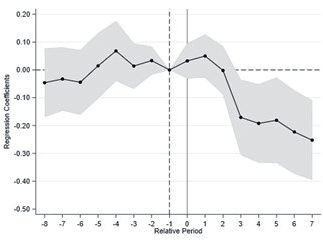
The fundamental assumption underlying the utilization of the Difference-in-Differences (DID) model is that the dependent variable (lnCO2) for both the treatment and control groups should exhibit a common trend prior to policy implementation. In order to test this, we employ the event study methodology proposed by Jacobson et al. [48] to assess pre-policy parallel trends and subsequent dynamic effects following the introduction of the new-type urbanization pilot policy (NTUPP). Fig. 1 presents the results of our parallel trend analysis, with relative time from policy implementation depicted on the horizontal axis, estimated coefficients of the NTUPP on urban carbon emissions on the vertical axis, and shaded regions representing corresponding 95% confidence intervals. The results of the parallel trend test indicate that there is no statistically significant difference in carbon emissions between the treatment group and the control group prior to the implementation of the NTUPP, suggesting that both groups adhere to the common trend hypothesis. From a dynamic perspective, starting from the third year after implementing the NTUPP, there is a consistently significant negative coefficient estimate for NTU on carbon emissions, with its absolute value gradually increasing over time. This finding demonstrates an escalating inhibitory effect of the NTUPP on urban carbon emissions.
Placebo Test
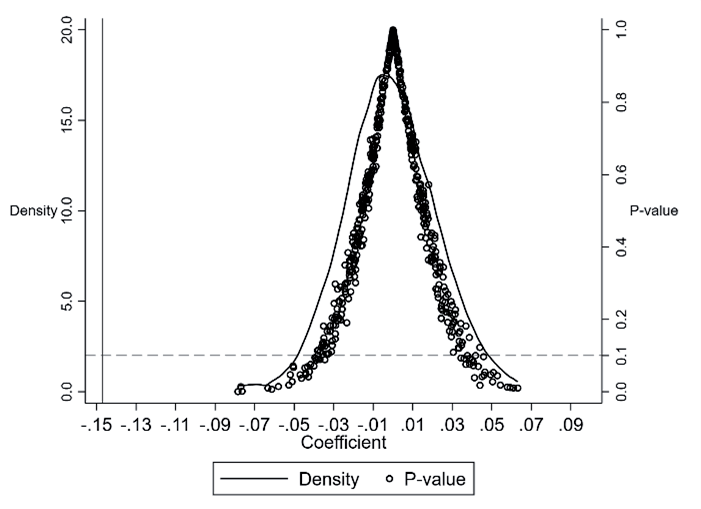
To mitigate the potential influence of unobserved confounding factors on the estimation outcomes in the benchmark regression, we conducted a placebo test by randomly selecting policy interaction terms (NTU). Specifically, we iteratively selected the core explanatory variable NTU and re-estimated its coefficients and P-values using model (1). This process was repeated 1,000 times, resulting in kernel density plots and scatter plots for P-values as depicted in Fig. 2. The findings from Fig. 2 indicate that the estimated coefficient of randomly sampled NTU is around 0 and approximately conforms to a normal distribution. Additionally, these coefficients significantly deviate from the coefficient estimate of -0.148 obtained in model (1). Furthermore, analysis of the P-value distribution reveals that most of the randomly sampled NTU coefficients are greater than 0.01, suggesting insignificance for a majority of estimates. Consequently, this robustly excludes any potential influence stemming from other unobserved factors or confounding policies while affirming the reliability of our regression results.
Bacon Decomposition
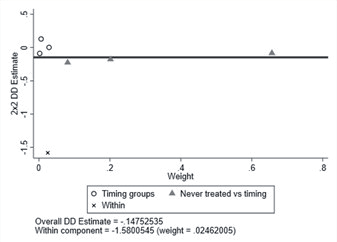
Due to the heterogeneity that often exists between different treatment groups or at different treatment times in a two-way fixed effects model, there may arise “bad treatment groups” or “negative weights”, which can introduce bias into the estimation of multi-period double differences in a two-way fixed effects model [49]. Therefore, this study adopts the approach proposed by Goodman-Bacon [50] and decomposes the average treatment effect of multi-period Difference-in-Differences (DID) analysis to assess the dynamic impacts of the pilot policy on new urbanization. Based on the Bacon decomposition results presented in Table 3, it is observed that the treatment times (Timing_ groups) contribute only 3.5% to the total effect, while within-group differences (Within) account for a mere 2.5%. Moreover, Fig. 3 shows that the weighted sum of DID estimation coefficients across various classification groups is -0.148, which aligns with the regression findings reported in column (7) of Table 2. These outcomes affirm the robustness of our benchmark regression estimates obtained in this study.
PSM-DID
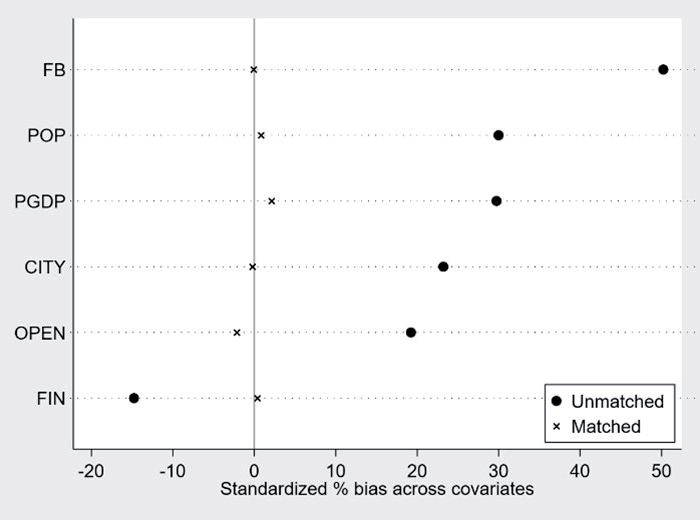
A potential critique of this study could be that the regions selected for the new-type urbanization pilot policy (NTUPP) are often those with higher levels of economic development and infrastructure, which may introduce individual differences between the treatment and control groups. In other words, the central government’s selection of pilot areas for the NTUPP may not have been entirely random. To address this concern regarding the sample self-selection problem in the baseline regression and enhance the comparability of the samples, this paper further integrates the Difference-in-Differences (DID) method with Propensity Score Matching (PSM). This methodological fusion serves to validate the reliability of our conclusions. First, this paper treats all control variables in the benchmark regression as covariates representing individual characteristics of cities and uses the Probit model to conduct regression and calculate propensity score values. Then, it pairs the treatment group and control group based on the propensity score values and conducts a balance test. As shown in Fig. 4, after propensity score matching, the standardized deviations of all covariates are less than 10%, indicating that the matching effect is good and the balance assumption is met. Finally, the DID estimation is employed to re-estimate the successfully matched samples, and the regression results listed in Column (1) of Table 4 show that the estimated coefficient of the core explanatory variable NTU is still significantly negative, further confirming the effectiveness of the new-type urbanization pilot policy in promoting urban low-carbon development.
SDID
In order to further reduce the policy evaluation bias caused by the subjectivity and randomness of the control group selection of the traditional Difference-in-Differences model in practice, we adopted the Synthetic Difference-in-Differences (SDID) method for regression analysis [51]. The SDID method synthesizes weights from periods before and after policy implementation to create a control group that shares the same pre-intervention trends as the treatment group. This approach reduces reliance on the parallel trends assumption and yields a more reliable assessment of the policy’s impact. As shown in Column (2) of Table 4, the estimated coefficient for NTU is -0.195, which is significantly negative at the 1% level. This result indicates that the estimates obtained from our baseline regression model remain robust.
Other Robustness Tests
To fully validate the robustness of our study’s conclusions, we also conducted the following robustness tests:
Firstly, the dependent variable is replaced. In the benchmark regression model, the dependent variable lnCO2 represents the logarithm of total carbon dioxide emissions in each city. To enhance robustness, we substitute the dependent variable with two measures of carbon dioxide emission intensity: carbon dioxide emissions per unit of GDP (CO2int) and carbon dioxide emissions per capita (PCO2). The regression results are presented in Columns (3) and (4), respectively, revealing that the estimated coefficient for the impact of the NTUPP on urban carbon dioxide emission intensity is -0.177, significant at a 1% level of statistical significance. Similarly, the estimated coefficient for the effect of NTUPP on urban per capita carbon dioxide emissions is -0.238, which is statistically significant at a 10% level.
Table 4.
Robustness test results.
Secondly, to control the potential impact of certain factors that may vary across provinces and over time on the estimation results, we incorporate province-year fixed effects into the benchmark regression model. As evidenced in column (5) of Table 4, the introduction of these fixed effects has not substantially altered the estimated coefficient or its significance for the dummy variable NTU, which represents the new-type urbanization pilot policy. This consistency further substantiates the robustness of our baseline regression findings.
Mechanism Analysis
According to the previous analysis and hypothesis, the new-type urbanization is expected to mitigate urban carbon emissions through the optimization of urban industrial structure, promotion of green innovation, and enhancement of energy efficiency. To circumvent the interference of endogeneity issues, this study adopts Jiang’s [52] operational suggestions on the mediating effect model and further examines the impact of NTUPP on industrial structure upgrading, green technology innovation, and energy efficiency improvement based on prior evidence confirming a negative association between NTUPP and urban carbon emissions. According to the regression results in Table 5, the influence coefficients of new-type urbanization construction on industrial structure upgrading (ISU), green technology innovation (GI), and energy utilization efficiency (EE) are 0.265, 0.208, and 0.422, respectively, and the estimated coefficients are all significant at least at the statistical level of 5%. The results show that under the effect of the NTUPP, the new-type urbanization construction has significantly reduced urban carbon emissions. During this process, optimizing and upgrading the urban industrial structure, enhancing green technology innovation capabilities, and improving urban energy utilization efficiency are important channels for promoting low-carbon development in new-type urbanization construction. Therefore, hypotheses H2a-H2c have been confirmed.
Further Analysis
The Synergistic Effect of Informatization Level and Environmental Regulation
Currently, the flourishing new generation of information technology revolution, exemplified by the Internet, is accompanied by rapid advancements in digital technology. The significance of energy conservation and emission reduction brought about by the digital economy cannot be underestimated. In this context, urban information construction plays a pivotal role in fostering the development of the digital economy. Enhancing the level of urban informatization not only empowers regional innovation capacity but also provides essential technical support for new-type urbanization initiatives while driving optimization and upgrading of industrial structure. Consequently, within the framework of new-type urbanization construction, improving the level of urban informatization may potentially reinforce emission reduction effects.
Additionally, with the central government’s increasing attention to ecological environment protection in recent years, local governments at all levels have strengthened environmental regulations and implemented corresponding pollution control measures to guide polluters towards better environmental governance. The new-type urbanization precisely emphasizes the people-centered construction concept. As the process of new-type urbanization advances, pilot cities will also enhance regional environmental governance and improve the living environment. Ultimately, this will achieve low-carbon development in cities and reduce carbon emissions in the region. Therefore, the pilot policy of new-type urbanization may generate a synergistic effect with environmental regulation, whereby environmental regulation will further enhance the emission reduction impact of new-type urbanization construction.
Based on the aforementioned analysis, this paper constructs a moderating effect model to examine whether the level of urban informatization and intensity of environmental regulation have synergistically contributed to mitigating carbon emissions in the process of new-type urbanization construction:
Table 5.
Mechanism test results.
In models (3) and (4), INF represents the level of urban informatization, which we estimate using the internet penetration rate of each city, as suggested by Huo and Wang [53]. ER represents the intensity of environmental regulation, which we estimate using the ratio of a city’s GDP to its industrial sulfur dioxide emissions, as suggested by Ma and Wang [54]. The definitions of other variables remain consistent with model (1). We primarily focus on the estimated coefficients of interaction terms NUPPit×INFit and NUPPit×ERit. If the coefficient of the interaction terms is less than 0, it indicates that the level of informatization and environmental regulations have strengthened the emission reduction effect of new-type urbanization construction.
The results presented in Table 6 demonstrate that the estimated coefficients of the interaction terms NUPPit×INFit and NUPPit×ERit, which are of particular interest to us, exhibit negative values and achieve statistical significance at a minimum level of 5%. This suggests that as the city’s level of informatization improves and environmental regulation intensity increases, the emission reduction effect resulting from new-type urbanization construction will be further amplified.
Heterogeneity Analysis
The preceding discussion has addressed the average treatment effect of NTUPP on carbon emissions in pilot cities. However, given China’s vast territory and its status as the largest developing country, it is inevitable that different cities within China exhibit significant variations in attributes such as geographical characteristics, economic development levels, and resource endowments. Consequently, one may wonder whether the performance of carbon emission reduction resulting from NTUPP differs across regions due to these disparities in resources and residents’ environmental concerns. To further analyze the heterogeneity of emission reduction effects of NTUPP, the study samples were categorized into three regions based on city location: eastern region, central region, and western region. Moreover, the sample cities were divided into resource-based cities and non-resource-based cities in accordance with the Notice of the State Council on Issuing the National Sustainable Development Plan for Resource-Based Cities (2013- 2020). To gauge residents’ environmental concern (EC), we utilized search data from Baidu, China’s largest search engine, by calculating the ratio of annual searches for the keyword “carbon dioxide” per city resident to the total regional population. Based on median levels of residents’ environmental awareness, we classified the entire sample into two groups: cities with high residents’ environmental concerns and those with low residents’ environmental concerns.
The results of the heterogeneous grouping regression in Table 7 reveal regional variations in the inhibitory effect of new-type urbanization on urban carbon emissions. Specifically, we find that this effect is highest in the western region, followed by the central region, and finally the eastern region. Notably, our analysis indicates that the estimation coefficient for new-type urbanization did not achieve statistical significance at the 10% level in the eastern samples. This disparity can be attributed to variations in regional economic development stages and industrial structures, which consequently result in diverse responses toward new-type urbanization policies. On the one hand, the eastern region has already undergone an early stage of industrialization, leading to optimized industrial conditions and structures. Conversely, the central and western regions are still undergoing this process. The implementation of new-type urbanization policies presents these regions with opportunities to adjust their industrial structure and reduce energy intensity, thereby exhibiting greater potential for emission reduction. On the other hand, the difference in the level of infrastructure and informatization also affects the policy effect. The eastern region has the perfect infrastructure and a high informatization level, and the marginal effect of new-type urbanization policies on carbon emissions may not be as obvious as that in the central and western regions. Through the promotion of NTUPP, the central and western regions have accelerated the process of infrastructure construction and informatization, thus achieving remarkable results in improving energy utilization efficiency promoting low-carbon technologies, and producing stronger carbon emission reduction effects. On the other hand, through the implementation of NTUPP, the central and western regions have accelerated infrastructure development and informatization processes. This has resulted in significant progress in enhancing energy utilization efficiency and promoting low-carbon technologies, leading to more noticeable reductions in carbon emissions.
Table 6.
Regression results of the moderating effect model.
Table 7.
Results of the heterogeneity test.
In terms of urban resource characteristics, the results in columns (3) and (4) of Table 7 indicate that NTUPP has a more pronounced inhibitory effect on carbon emissions in non-resource-based cities compared to resource-based cities. The reason for this can be attributed to the fact that while resource-based cities have a unique advantage in resource endowment, which provides a solid foundation for their economic development, their industrial structures tend to be singular and lack deep processing capabilities. This industrial rigidity makes transformation and upgrading extremely challenging, and the economic development model has long been dominated by heavy industry focused on resource exploitation. Such an industrial layout not only restricts the diversified development of the economy but also exacerbates the emission of environmental pollutants to some extent, weakening the carbon reduction benefits of the new-type urbanization policy in resource-based cities.
The regression results from column (6) to column (7) also indicate that the impact of NTUPP on emission reduction varies depending on residents’ environmental awareness. Specifically, in cities with high levels of environmental concerns among residents, the estimated coefficient of NTU is -0.184, which is statistically significant at the 1% level. However, in cities with low levels of environmental concerns among residents, the estimated coefficient of NTU is only -0.092 and lacks statistical significance. These findings highlight the importance for local governments to consider the pressure arising from residents’ environmental concerns during new-type urbanization construction. On one hand, the disparity of environmental consciousness and societal engagement can significantly influence policy outcomes. In cities where residents exhibit a high level of concern for the environment, there exists robust public awareness regarding environmental protection. This not only compels the government to prioritize environmental preservation during policy formulation and implementation but also fosters active citizen participation and oversight in policy execution. Consequently, this symbiotic relationship between the government and residents cultivates a positive synergy that collectively advances the achievement of carbon emission reduction targets. On the other hand, the combination of market demand and technological innovation provides impetus for the low-carbon transition. Residents in these cities are more environmentally conscious and inclined to choose green products and services, driving market demand for environmentally friendly technologies and solutions. Simultaneously, enterprises and research institutions are incentivized by this market to invest more actively in researching and developing clean energy and environmental protection technologies, accelerating the innovation and application of green technologies, thus promoting the low-carbon transformation of the economic structure.
Conclusions and Policy Recommendations
The new-type urbanization strategy proposed by China is an important lever for promoting regional economic growth and facilitating urban green transformation. This study analyzes the theoretical mechanisms of reducing urban carbon emissions through the dual effects of direct and indirect impacts of new-type urbanization. It selects panel data from 280 cities in China between 2006 and 2021 to empirically verify the carbon reduction effects of the new-type urbanization pilot policy (NTUPP) using a DID model. The findings demonstrate that: (1) The implementation of the new-type urbanization pilot policy (NTUPP) significantly reduces urban carbon emissions, and this conclusion remains robust after conducting various tests such as parallel trend tests, placebo tests, PSM-DID, SDID, and alternative variable analysis. (2) Mechanism analysis and empirical results indicate that upgrading industrial structure, enhancing green innovation capacity, and improving energy efficiency are crucial mechanisms through which NTUPP reduces urban CO2 emissions.
(3) The advancement of urban informatization level and the reinforcement of environmental regulations further amplify the emission reduction impact of NTUPP.
(4) Heterogeneity analysis reveals that in central and western regions, non-resource-based cities, and cities with strong environmental awareness, the NTUPP exhibits a more pronounced inhibitory effect on carbon emissions.
Based on the research findings, this paper presents the following targeted policy recommendations:
Firstly, considering the substantial potential of new-type urbanization in reducing CO2 emissions, it is recommended that China progressively expand the implementation of pilot policies in this domain. This expansion should aim at guiding cities of all types to adopt green and low-carbon urban development concepts, thereby transitioning from previous extensive urbanization practices towards sustainable and intelligent urbanization. To effectively construct new-type urbanization, it is particularly crucial to account for the heterogeneity among cities in terms of population size, resource endowment, and developmental stage. Consequently, each pilot region should formulate tailored green development strategies that align with its unique characteristics and local conditions. The successful experiences accumulated by pioneering pilot cities should be actively promoted after being verified through theory and practice in order to achieve the policy effect of “pioneering and experimenting first, leading by example, and spreading outward”.
Secondly, talent plays a pivotal role in enhancing the quality of green urbanization. On one hand, pilot areas should coordinate the implementation of corresponding measures to attract and retain talented individuals, enhance infrastructure development, and foster innovative factors. By elevating the human capital level within regions, we can effectively stimulate carbon emission reduction through industrial structure upgrading and innovation in green technologies during the process of new urbanization. On the other hand, it is imperative to adopt fiscal incentives and innovative mechanisms that encourage enterprises and researchers to develop and utilize eco-friendly technologies and products, thereby improving energy efficiency utilization while promoting an overall transformation towards a greener and low-carbon industry.
Thirdly, the study results show that the enhancement of environmental regulation and the level of information technology can play a synergistic effect with the construction of new urbanization, thereby strengthening the emission reduction effect of the NTUPP. Consequently, pilot cities should gradually adopt a smart city development concept and continuously enhance digital infrastructure construction to facilitate urban informatization. Furthermore, pilot cities should tailor their environmental supervision and enforcement measures according to local conditions, promote the adoption of green technologies, and progressively phase out high-energy-consuming and polluting enterprises. Simultaneously, public environmental awareness serves as an informal regulatory mechanism that exerts external pressure on enterprises for pollution control purposes. The government ought to intensify environmental publicity efforts while guiding residents in enhancing their environmental consciousness, expanding avenues for reporting environmental pollution incidents among residents, and actively addressing pollution complaints raised by them to foster a greener city.

