

Introduction
Soil provides support and crucial ecological services for sustainable agriculture on the planet. Agricultural intensification, poor crop management practices, and the effects of changing climate result in the deterioration of soil health and fertility status [1]. Organic amendments are being applied to agricultural lands as alternatives to inorganic fertilizers [2]. Fermentation of organic matter is used globally for agricultural waste management and to improve soil’s physical and chemical properties [3]. Organic amendments can increase the soil organic matter content, water-holding capacity, porosity, and biological yield of food and fiber crops [4]. In recent decades, the application of organic matter in the form of compost, manure, slurry, and animal waste has gained attention and has emerged as a sustainable and cost-effective approach for the reuse of these products as a soil amendment and to protect the soil ecosystem [5].
Cotton is a semi-xerophytic annual agricultural crop and a major source of natural fiber that contributes to 35% of the global textile needs [6]. The stunted growth and yield of cotton can be influenced by several factors, including shifting climate change, poor water management, improper seed-sowing methods, and the non-judicial use of synthetic chemical fertilizers [7]. Arid to semi-arid regions are the major cotton-growing areas where low soil moisture content and low nutrient and organic matter availability, are the major factors for reducing cotton productivity [8].
Livestock dung and other waste products emit methane, a dangerous greenhouse gas (GHG) that significantly contributes to climate change. The livestock sector contributes approximately 14.5% of all global greenhouse gas emissions, with methane being the most significant contributor [9]. The application of farmyard manure, which is not completely fermented, raises health risks because plants can take up pathogenic bacteria [10]. Unfermented animal manure can also lead to an imbalance in the nutrient content of manure, mainly nitrogen and phosphorus, which can pollute water sources through leaching and runoff [11]. The biodigestibility of animal waste and its application to enhance soil fertility is a viable way to reduce carbon and methane gas emissions into the environment and also helps to replenish soil organic carbon essential for soil microbial activity [12]. However, the unjudicial use of organic amendments derived from organic waste in soil may increase the concentration of a variety of contaminants. Therefore, anaerobic decomposition or fermentation is a promising approach to effectively mitigate the levels of contaminants present in natural amendments [13].
Bio-digestible manure or a fermenter can be applied in both liquid and solid forms, but liquid manure is more easily absorbed in the soil and can easily be taken up by the plant roots [14]. Previous studies have reported that liquid fermenter application can significantly increase soil nitrogen, phosphorus, and potassium contents in a limited time compared to solid fermented material application [15]. Moreover, liquid fermenters contain a significant number of microorganisms that can help increase soil microbial activity compared with solid manure [16].
Different water availability levels and fertilizer application significantly impact cotton crop growth and soil health. Most research in this domain is focused on the application of solid manures to improve soil health and crop productivity, but very few studies have reported on the use of different durations of fermented manure application to improve soil health and cotton seedling growth under current climate change conditions. To the best of our knowledge, this is the first study to investigate the effects of liquid fermenters on soil health and cotton seedling growth under the semi-arid climatic conditions of Multan, Pakistan.
Materials and Methods
Preparation of Bio-Digestible Fermenter
The current project was performed in Multan, Pakistan (29.35 °N, 71.69 °E, average annual temperature 27.5 ºC, and annual rainfall 143 mm). Three underground chambers (diameter of 6 m × 3 m) with an iron lid and inlet- and outlet-controlled water flow pipes were used to prepare fermented manure. The collected cow dung used as a source of nutrients in this study was placed at the base of the chambers, and the constructed chambers were closed. The expected biodigestibility was carried out, and the inlet flow pipe of water was opened to allow good-quality irrigation water to enter the chamber and mix with the bio-digestible cow dung manure. The experiment was performed using a completely randomized design with a factorial arrangement and four replications. The experiment was comprised of the following treatments: Soil with a dose of chemical fertilizer recommended for cotton crops (T1), cow dung bio-digestible fermenter placed in the controlled chamber for 7 days + good quality irrigation water (T2), cow dung bio-digestible fermenter placed in the controlled chamber for 14 days + good quality irrigation water (T3), cow dung bio-digestible fermenter placed in the controlled chamber for 21 days + good quality irrigation water (T4). The subsequent water was then applied to the treated cotton plots (5 × 2.5 ft), and the physicochemical characteristics of the soil, along with the biochemical and growth attributes of cotton, were calculated.
Plant Growth and Physiological Attributes
Cotton plants were harvested at the seedling stage, and plant shoot and root lengths were measured using a measurement scale and root area meter (WinRhizo, 2022A, Netherlands), while fresh and dry biomass was measured using an analytical weighing balance. Relative water content (RWC) was calculated for cotton plant leaves according to the method adopted by [17] by selecting 2 cm of fresh upper leaves (mid-rib-free leaves). Fresh mass (FM) and dry mass (DM) of leaf discs were weighed, and the fresh samples were placed overnight in stoppered vials containing ion-free distilled water for 24 hours of turgid mass (TM). The following equation was applied to calculate RWC:
RWC % = (FM-DM) / (TM-DM) × 100
Fresh upper fourth leaf samples (0.2 g) were boiled in deionized distilled water (10 mL) in a water bath for a half-hour at 40 ◦C (C1) and 100 ºC for ten minutes (C2) [18]. The following equation was applied to calculate RWC:
MSI % = (1- EC1/EC2) x 100
The SPAD (soil plant analysis development) content in cotton seedling leaves was measured using a SPAD chlorophyll meter, following the method described by [19].
Estimation of Antioxidant Enzyme Activity
Fresh leaf tissues (0.5 g) were ground using a leaf grinder, homogenized with 10 mL of 50 mM phosphate buffer solution (pH 7.8), and cooled to 0-4 ºC. The homogenate was centrifuged at 15,000 rpm for 20 min, and the supernatant was used for enzyme activity estimation. Superoxide dismutase (SOD) activity was measured at 560 nm following the protocol of [20]. Peroxidase (POD) activity was determined at 470 nm using a previously described method [21]. Catalase (CAT) activity was measured at 240 nm, according to the procedure described in [22].
Soil pH, Saturation Percentage, and Organic Matter Content
For soil pH, soil samples were taken from each treatment, and paste was made by following a 50:50 ratio of soil and water paste [23], and soil pH was determined using a pH meter (TL 300-A, China). The soil saturation percentage was measured as described by [24] by weighing 10 g of 2 mm sieved air-dry soil in an oven at 105 °C for 24 h. The moisture factor was determined by subtracting the wet soil from the dry soil. Soil organic matter content was determined by oven drying the soil samples and passing these soil samples through a 2 mm sieve by applying the potassium dichromate oxidation method using the method described in [25].
Determination of Soil Fertility Status
Soil samples from each treatment plot were collected and digested using concentrated H2SO4 (4 mL) and H2O2 [26] to a colorless transparent solution. To estimate the potassium (K) and phosphorus (P) contents, the digestion of soil samples using 4 mL of HNO3 was carried out up to the colorless solution, and ultrapure water was added to the digestion tubes to make a volume of 50 mL. Potassium (K) contents were recorded by a flame photometer (Sherwood 420 Cs, USA), while P contents were measured using the spectrophotometry technique [27].
Statistical Analysis
All values reported in this study were analyzed using the statistical software Statistics 8.1 (USA). The graphs’ bars depict the values of four replicates, and the error bars are the standard deviations. The bars not showing the same lower-case letters are significantly different from one another at P < 0.5 [28].
Results
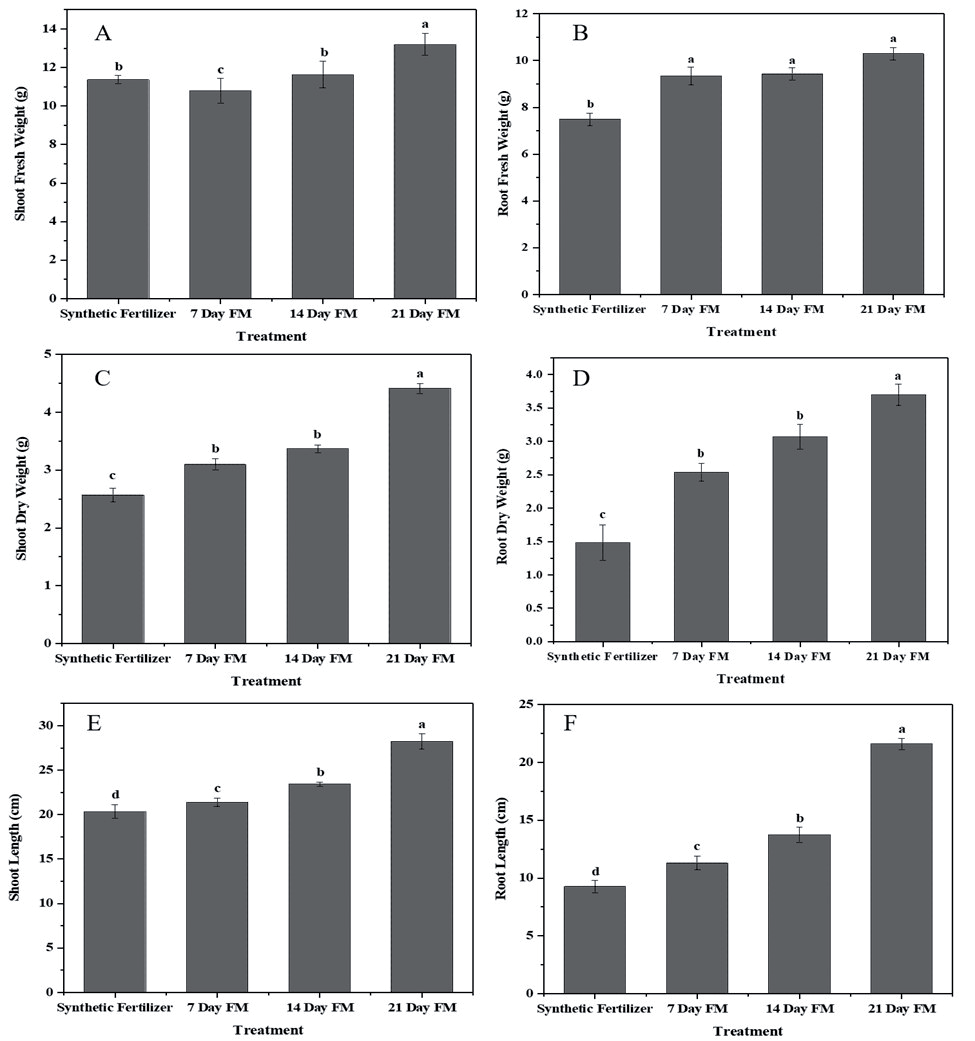
The sustainable production of cotton crops is facing serious threats due to land degradation as a result of climate change and poor soil health. These include poor cotton plant growth due to factors like cotton plants’ nutrient-exhaustive nature, which depletes soil nutrients and affects fertility status, as well as impacts from conventional farming practices adopted by a large number of farmers. In the current experiment, growth responses of cotton seedlings in terms of fresh and dry biomass under conventional fertilization and with the application of fermented manure (fermented for 7 days, 14 days, and 21 days) were investigated (Fig. 1). From the results, it was evident that as compared to the control treatment (conventional recommended fertilizer application), the irrigation water applied with 7 days of fermented manure showed no notable effect on cotton plant fresh and dry biomass. However, the 14 days of fermented manure slightly increased cotton growth, i.e., 9, 10, and 12% increases were noted in terms of root length and root fresh and dry biomass, while manure fermented for 21 days showed a significant increase of 18, 20, and 21% increases in root length and fresh and dry biomass of cotton seedlings. Cotton plants showed a similar trend in terms of shoot growth, and 9, 18, and 13% increases were noted in shoot length and fresh and dry weight under 14 days of fermented manure, and 19, 23, and 21% increases were observed in shoot length and fresh and dry weight when cotton plants were provided nutrients by 21 days of fermented manure.
Fig. 1.
The impact of synthetic chemical fertilization and fermented manure application (7, 14, and 21 days) on cotton seedlings fresh and dry biomass. The reported bar values present the mean of four replications, and the bars not sharing the same lowercase letters differ from one another (LSD) at the P <5 level.
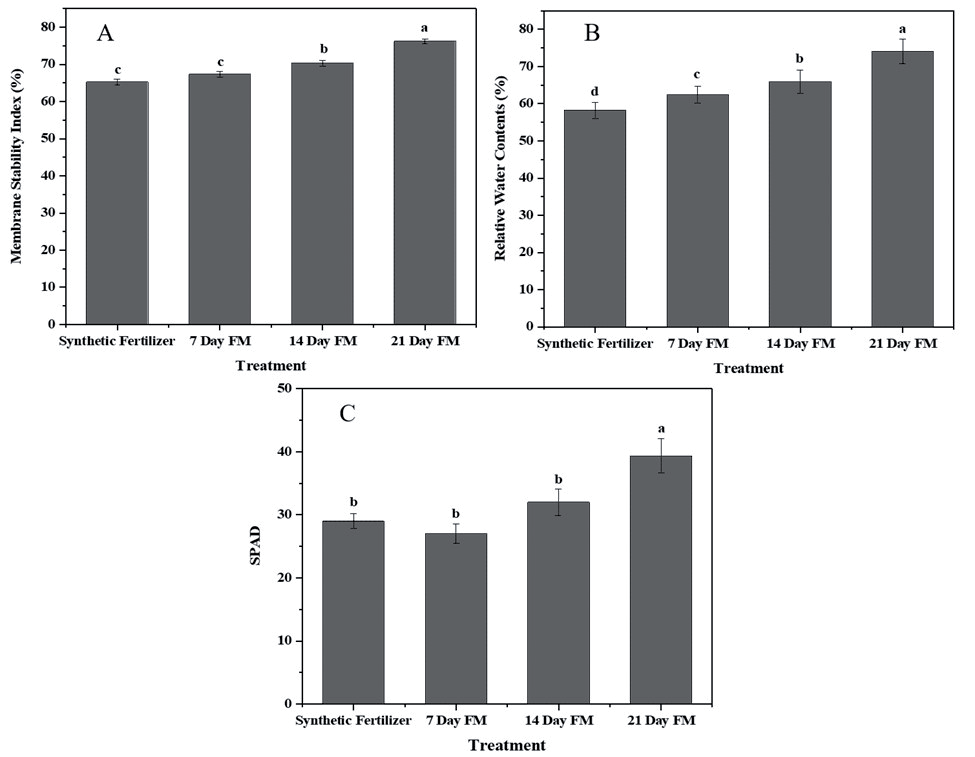
The current experiment evaluated the effect of conventional synthetic fertilization and fermented manure application on membrane stability (MSI), RWC, and SPAD contents in cotton seedlings (Fig. 2). Compared with the control treatment (conventional fertilization), the provision of fermented manure improved these plant physiological traits. Specifically, the analyzed data revealed that under 7 days of fermented manure, there was a very small increase (3, 7, and 6%) in cotton seedlings MSI, RWC, and SPAD values, while the increase under 14 days of fermented manure plants was 8, 13, and 10%. It was noted that when the cotton seedlings were treated with 21 days of fermented manure, a significant (P <0.05) increase in plant physiological traits was observed. The cotton seedlings showed a 16% increase in MSI, while the increase in RWC and SPAD content was 24% and 27%, respectively.
In the present study, the activities of various antioxidant compounds (SOD, POD, CAT, and APX), which are plant responses to better growth and yield, were also measured under conventional and fermented manure fertilization. The data analysis of the examined cotton seedlings revealed that, compared to the control treatment, where no fermented manure was applied, 7 days of fermented manure application resulted in 0, 4, 6, and 7% increases in SOD, POD, CAT, and APX enzyme activities, while 12, 20, 16, and 18% increases were observed when the cotton seedlings were treated with 14 days of fermentation. When compared to the control treatment, maximum values of SOD, POD, CAT, and APX (30, 40, 36%, and 33%) were observed in cotton seedlings after 21 days of fermented manure application (Fig. 3).
Fig. 2.
The impact of synthetic chemical fertilization and fermented manure application (7, 14, and 21 days) on cotton seedlings MSI, RWC, and SPAD contents. The reported bar values present the mean of four replications, and the bars not sharing the same lowercase letters differ from one another (LSD) at the P <5 level.
The current study investigated the effects of conventional fertilization and fermented manure application on soil properties (Table 1). Compared to the control treatment, soil properties showed variations after 7, 14, and 21 days of fermented manure application. The soil reaction (pH) was the highest (8.2) in soil samples taken from the soil in which conventional fertilization was applied. However, fermented manure lowered the soil pH and improved soil nutrient retention. It was observed that 7 and 14 days of fermented manure application had no significant effect on soil pH; however, 21 days significantly lowered soil pH (8.0). Similarly, the effect of fermented manure fertilization also showed that 7 and 14 days of fermented manure applications showed no significant impact on soil-available phosphorus and available potassium content; however, as compared to the control treatment, 21 days of fermented application significantly improved the soil-available phosphorus (17%) and available potassium (21%). A similar trend was noted for soil organic matter and soil saturation percentage.
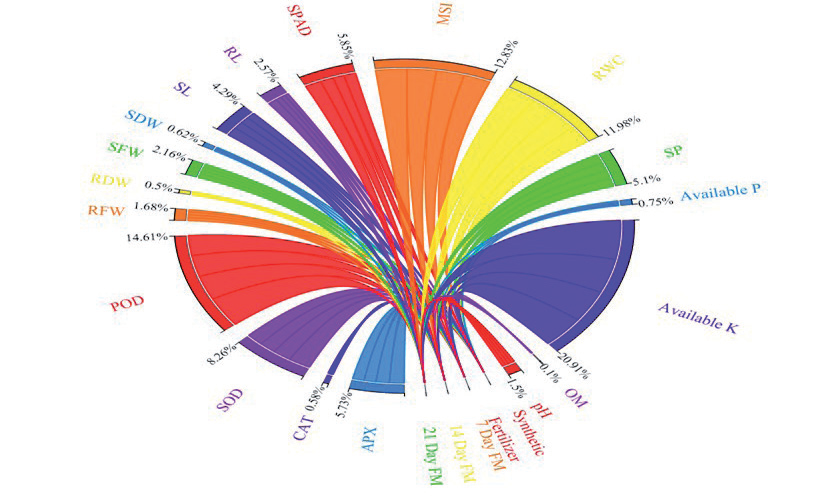
Correlation analysis (P < 0.05) and principal component analysis between different measured parameters of cotton plant seedlings and soil properties under the application of chemical fertilizers and fermented manure are shown in Fig. 4. A negative relationship was observed between the soil pH and growth attributes, physiology, and antioxidant enzyme activity, while a chord diagram representing a comprehensive analysis of alterations in cotton seedling growth and soil health parameters is given in Fig. 5.
Fig. 3.
The impact of synthetic chemical fertilization and fermented manure application (7, 14, and 21 days) on cotton seedlings antioxidant enzymes. The reported bar values present the mean of four replications, and the bars not sharing the same lowercase letters differ from one another (LSD) at the P <5 level.
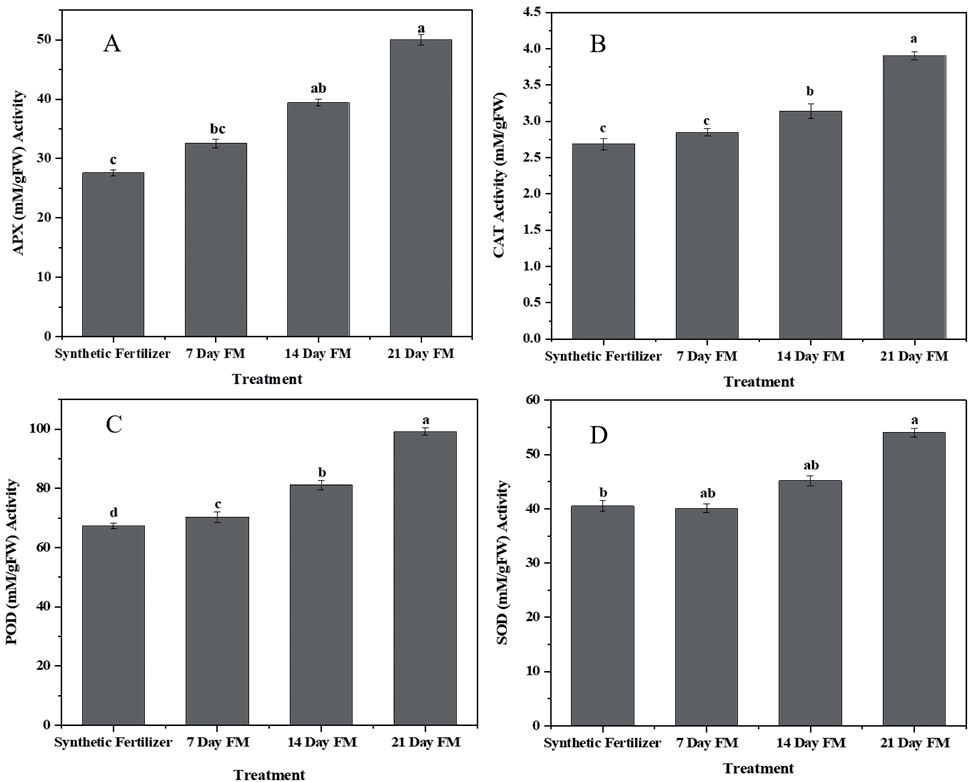
Table 1.
The impact of synthetic chemical fertilization and fermented manure application (7, 14, and 21 days) on soil properties of the experimental area. The reported values present the mean of four replications, and the values not sharing the same lowercase letters differ from one another (LSD) at the P <5 level.
Discussion
Under the current climate change scenario, soil health management is vital for preserving biodiversity and ensuring food security in rapidly growing populations [29]. Modern sustainable agriculture largely depends on chemical fertilizers; however, their detrimental effects on soil and water cannot be ignored. The supplementary application of chemical fertilizers not only poses a toxicity threat to crop plants but also alters soil physicochemical and biological properties along with a decline in soil organic matter content [30]. Furthermore, the overuse of synthetic chemical fertilizers causes ionic imbalances in soil and plants and poses environmental hazards. This study evaluated the combined effects of chemical fertilizer and fermented manure application on the physio-biochemical properties of cotton and soil health.
Fig. 4.
Correlation analysis (P < 0.05) and principal component analysis between different measured parameters of cotton plant seedlings and soil properties under the chemical fertilizers and fermented manure application. The abbreviations are as follows: SFW (shoot fresh weight), SDW (shoot dry weight), RFW (root fresh weight), RDW (root dry weight), SL (shoot length), RL (root length), SPAD (SPAD chlorophyll content), MSI (membrane stability index), RWC (relative water content), Available P (available phosphorus), Available K (available potassium), OM (organic matter), SOD (superoxide dismutase), POD (peroxidase), APX (ascorbate peroxidase), and CAT (catalase).
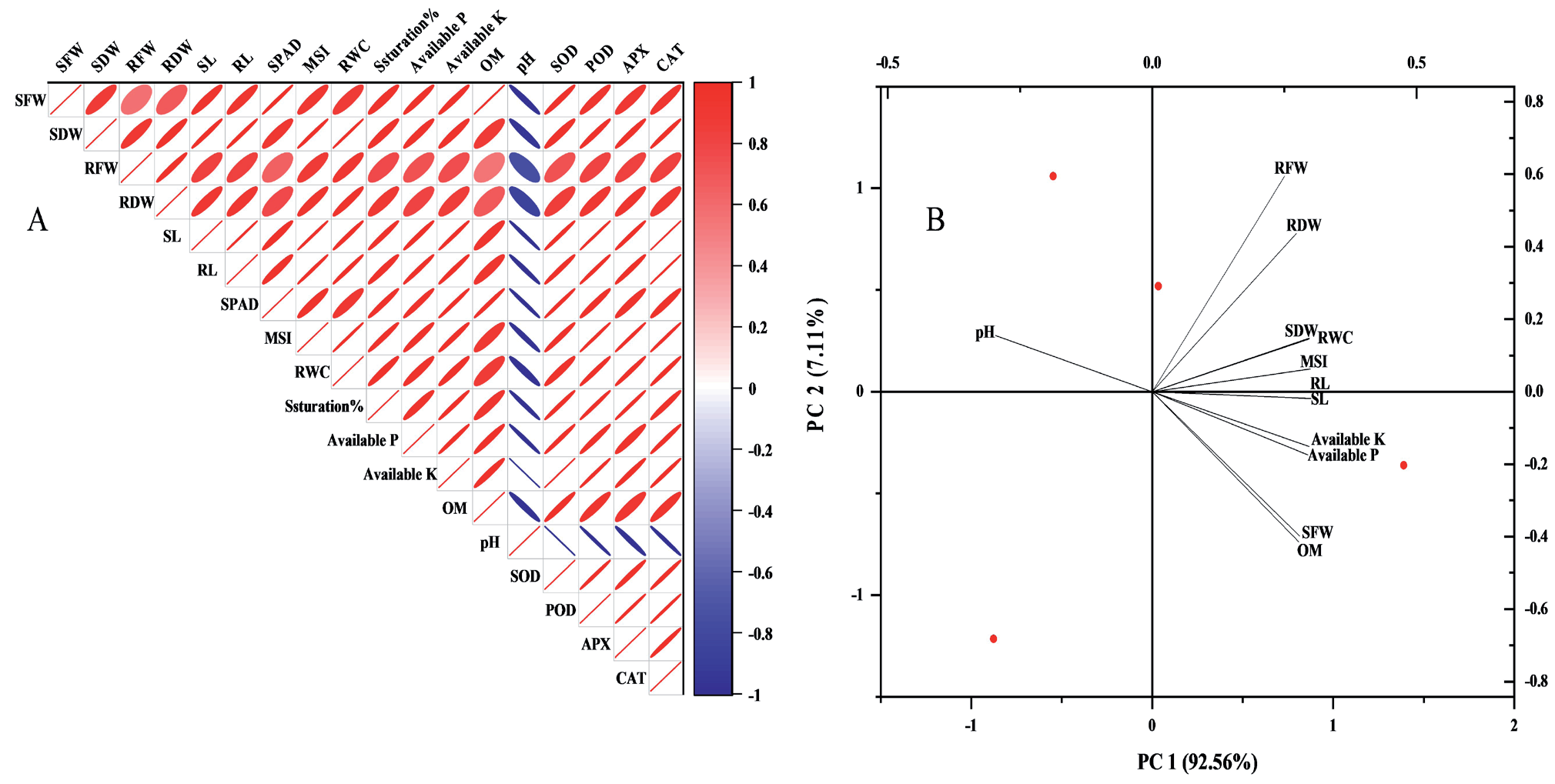
Fig. 5.
Comprehensive analysis of alterations in cotton seedling growth and soil health parameters under synthetic fertilizers and fermented manure application. The chord diagram visualizes the relationship and interaction of various soil health parameters, cotton plant growth, physiology, and antioxidant attributes subjected to synthetic and 7, 14, and 21 days fermented manure.
In this study, it was observed that the application of fermented manure significantly improved soil chemical properties, and cotton plant growth was significantly improved after 21 days of fermented manure application compared with the application of chemical fertilization. The increase in root growth might result from maintained soil nutrient balance in the rhizosphere and availability of soil moisture, which is found to be increased in the rhizosphere when organic manure is applied [31]. The relatively higher uptake of nutrients and their transfer to the upper ground results in improved growth of shoots and a greater number of leaves in plants treated with organic manure than in plants provided with chemical fertilizers [32]. Increased plant vigor and an increase in uptake of essential plant nutrients, especially nitrogen and magnesium, along with increased leaf area, improve plant metabolism and allow plants to perform more life-sustaining processes such as photosynthesis [15, 33]. This increase in root-shoot growth resulted in increased fresh and dry biomass. Our findings further confirm those of [34], who reported improved maize plant growth and biomass under manure application.
Leaf chlorophyll content, plasma membrane stability, plant water relations, and moisture content are important physio-biochemical markers that maintain and enhance plant growth. In this study, the physiological traits of cotton seedlings were measured. A significant increase in these traits was observed in cotton plants when they were provided with fermented manure (Fig. 2). The increase in organic matter content and provision of certain essential nutrients, especially phosphorus and potassium, increases the membrane stability of root and shoot cells and enhances the capability of plants to protect against chlorophyll degradation [35]. The increased nitrogen content in the soil by applying organic manures is another reason for the increase in chlorophyll content, as nitrogen availability increases the rubisco enzyme essential for chlorophyll synthesis [36]. Moreover, improvements in soil saturation and moisture content contributed to a greater relative water content in plants [37]. As previously reported, this improvement in moisture content and cell membrane stability improves plant growth and physiology in maize [38].
Crop production and dry land farming in arid to semi-arid regions are highly threatened by high temperatures and low moisture availability, which are essential for seed germination and proper plant growth and development [39]. Several studies have investigated the tolerance mechanisms to drought and nutrient stress in various plant species. Several antioxidant enzymes (SOD, POD, CAT, and APX) have been reported to improve plant root growth and help reduce stress conditions in the rhizosphere [40]. Moreover, they also help plants survive in conditions of low moisture content by scavenging reactive oxygen species (ROS) [41]. Our results showed that the activities of antioxidant enzymes increased under fermented manure compared to chemical fertilizer application. These results are previously supported by [42], who reported an increase in the activities of antioxidant enzymes under fermented manure application. An increase in enzyme activities was related to lower lipid peroxidation, lower H2O2 contents, higher soluble sugar contents, and maintained osmotic balance in the rhizosphere. Similar results were previously reported in date palms by [43].
The soil properties under chemical fertilizer and fermented manure application were also measured in the current experiment. It was observed that the application of chemical fertilizer results in increased soil pH and a decrease in soil organic matter contents that might be due to the addition of certain chemical compounds in soil solution that make the soil acidic and the binding of these certain chemical compounds with other essential nutrients that make them not available to the plant roots for uptake [44]. The addition of manure to the soil also increases soil porosity, carbon, and organic matter contents in the soil that leads to retaining more moisture contents in the rhizosphere, lowers soil pH due to improved soil structure, and makes certain essential plants’ macro and micro-nutrients available to the plant roots through soil solution [45]. These findings are in line with [46], who reported improvement in cotton plant growth and soil properties under the application of organic manures.
Conclusion
The present study indicated the comparison and beneficial role of fermented manure on cotton plant growth and soil properties. Three levels of fermented manure (7, 14, and 21 days) were applied to the cotton crop field with irrigation water. The results indicate that compared to the chemical fertilizers, the manure amendments successfully improved the morpho-physiological growth of cotton, and eminent results were noted under 21 days of fermented manure application. The fermented manure also significantly improved plant chlorophyll and leaf antioxidant enzymes, lowered soil pH, and improved soil organic matter contents, saturation percentage, and fertility status. The results of the current study highlight the beneficial role of fermented manure application in improving cotton plant growth and soil properties and propose great potential in fermented manure for use as an alternative to various expensive chemical fertilizers that lead to good soil health and environmental conservation. The current study’s findings will help sustain the soil fertility essential for the sustainable growth of crop plants under the current scenario of changing climate in semi-arid regions.

