

Introduction
The global population is continuously increasing, which demands a substantial increase in crop productivity. Food security is a critical challenge, with nearly 10% of the world’s population facing malnutrition and hunger [1]. The global population is continuously soaring, and it is projected to reach 9.7 billion by the end of 2050; this demands a substantial increase in crop production to meet food needs [2]. Traditional agriculture practices involve the intensive use of resources, causing land degradation and the challenges of climate change, deforestation, and loss of agricultural lands and crop productivity [3]. Therefore, in the context of these challenges, it is mandatory to adopt sustainable measures to ensure better food productivity and global food security.
Maize is an imperative crop grown around the globe for various purposes. However, lower soil fertility is a major reason for lower maize productivity [4-6]. The intensive agricultural practices cause the loss of organic matter, soil compaction, water holding capacity, and nutrient availability, resulting in substantial yield losses [7]. Therefore, to fulfill crop nutrient needs, farmers apply heavy doses of nutrients. The use of chemical fertilizers is an important source to fulfill crop needs. However, they cause many negative impacts on soil and environmental health [7]. Chemical fertilizers negatively impact soil micro-flora, organisms, soil, and environmental quality [8]. Besides this, chemical fertilizers also cause soil eutrophication acidification, increase greenhouse gas emissions, and depletion of the ozone layer [9]. Additionally, chemical fertilizers also alter soil microbial composition, and they are also a potential source of heavy metals entry into the environment [9]. On the other hand, manures such as composted poultry manure (CPM) can provide nutrients to the next growing season, sustaining maize production [10-12]. The application of CPM not only helps increase the productivity of maize but also improves soil fertility by increasing OM in the soil [13-15], soil biological health, water retention, and nutrient use efficiency [16]. Thus, co-applied organic manures and inorganic fertilizers are a sustainable alternative to using solely chemical fertilizers to increase maize yield [17-18].
Composted manure has an appreciable potential to improve productivity as it provides a significant amount of macro and micronutrients and improves soil cation exchange [19]. Nitrogen and other soil nutrients released from CPM are found in more available forms in the soils. Poultry manures also improve soil carbon and nutrient concentration, bulk density, nutrient use efficiency, and water holding capacity, which ensures better plant growth [6]. The study findings of [20] showed the integrated use of CPM and chemical fertilizers improved plant root and shoot growth, and nutrient uptake and led to appreciable growth and productivity. The use of organic manures also slowly releases nutrients for a long period they also improve soil fertility and crop production [21].
Nowadays, due to rapid economic development, farmers have switched to mineral fertilizers, which proved quickly responsive and easily affordable. However, their intensive use results in land degradation, poor soil fertility, and nutrient losses, which pose risks to the environment, humans, and the ecosystem. So, it is essential to find to obtain the maximum crop yield without compromising soil health. To ensure food security, environmentally responsible use of fertilizers is the key. One promising approach is to use integrated nutrient/ soil fertility management while increasing crop yield [22]. An additional benefit of using integrated soil fertility management is profitability. The poultry manure + biofertilizers, compared to farmyard manure and vermin compost, improved productivity and economic returns [23, 24]. The individual effects of poultry manure and NPK fertilizers on maize are well-documented, but there is limited research on the long-term combined application and their impact on soil health and maize productivity in a continuous cropping system. We hypothesized that the use of CPM along with NPK for four consecutive seasons would boost soil fertility, which will ultimately cut down the NPK requirement up to 40 to 50%. This study was conducted with the following objectives: i) to assess the effects of NPK and CPM on maize productivity, and ii) to assess the residual effects of combined CPM and NPK fertilizers on soil properties.
Materials and Methods
Experimental Site, Soil, and Climate
This four-season study was conducted in a field at the University of Agriculture, Faisalabad, Pakistan. The soil samples were taken before sowing to determine different soil properties (Table 1). The experiment soil has a semi-arid climate with a hot and humid summer and dry winter (Table 2).
Experimental Treatments
The study was comprised of diverse NPK levels: T0, 0:0:0), T1: 50:25:25, T2: 100:50:50, T3: 150:75:75, T4: 200:100:100 and T5: 250:125:125 and composted poultry manure (CPM) application; control and CPM. The poultry manure was applied at the rate of 3 ton ha-1 and it was mixed with soil at the time of sowing. The CPM was collected from the compost (Pvt.) Ltd. Lahore, Pakistan, and 2.27% N, 1.73% P, 1.14% K, 11:1 C: N ratio and 7.2 pH. The sowing of maize crops was done in the last week of July (Fall season) and the last of February (Spring season). The study was executed in a randomized complete block design (RCBD) in a split-plot arrangement with three replications and a net plot size of 5 m × 3 m.
Crop Husbandry
The seedbed for the sowing of the maize crop was prepared by plowing the soil twice. The maize hybrid Pioneer 30Y87 was sowed in the fall season, while the maize hybrid P 1574 was sown in the spring season. Maize crop was planted with planting and row spacing of 25 and 75 cm. Moreover, 25 kg ha-1 seed was used to sow the crop, and NPK fertilizers were applied according to treatments. The urea (46%), single super phosphate (SSP: 21%P), and sulfate of potash (SOP: 50%K) were used to fulfill NPK needs. The complete amount of P and K and 50% N was applied at sowing, while the other 50% N was applied with first irrigation. All the listed crop management practices were the same for all four seasons, with one exception. During the fall season, the first irrigation was 25 days after sowing (DAS), and this was 20 DAS for the spring season. The remaining irrigations were biweekly (15 days) until the flowering stage. Thereafter, irrigation was applied every seven days until the maturity stage.
Data Collection
The cobs (ten) were randomly taken from each treatment unit to determine grains/pod. The complete pots were hand-harvested and weighed to determine biomass and grain yield. Later, a sub-sample of threshed grains was taken and weighed to determine 1000 grain weight. The agronomic efficiency was assessed with the following formula:
We considered Agronomic N efficiency as an important parameter in terms of maize yield and measured its change with the addition of different application levels of CPM and NPK rates. Organic matter and organic carbon were determined by the concentration H2SO4 potassium dichromate heating technique [25]. On the other hand, soil N was determined by the Kjeldhal method, P was determined by the Olsen method [26], and K was determined with a flame photometer [27]. The grain N contents were determined with the Kjeldhal method, while grain P and K were determined by spectrophotometer and flame photometer.
Statistical Analysis
The collected data were statistically analyzed via analysis of variance (ANOVA), and the least-significant difference (LSD) test was employed to determine significance among means p≤0.05 [28] for all experiments.
Table 2.
Weather data for both growing seasons.
| Months | Maximum mean temperature (ºC) | Monthly total rainfall (mm) | ||
|---|---|---|---|---|
| 2016 | 2017 | 2016 | 2017 | |
| July | 32.2 | 33.5 | 193.4 | 160.9 |
| August | 31.1 | 33.2 | 47.9 | 66.3 |
| September | 31.0 | 30.5 | 12.0 | 35.6 |
| October | 26.7 | 27.1 | 22.2 | 0.0 |
| November | 20.1 | 18.0 | 0.0 | 1.5 |
Table 3.
Effect of composted poultry manure and different NPK rates on yield and related traits of fall- and spring-sown corn.
Results
Yield and Yield Traits
Different levels of NPK fertilizers and CPM and their interactive effect significantly (p≤0.05) improved the grain weight, grains/cob, and grain productivity (Table 3). The application of CPM and higher levels of NPK fertilizers appreciably improved grain production and other tested traits (Table 4). The highest values of grains per cob (>400) were obtained with the application of 100% NPK with CPM in the fall of 2016 (Table 3). However, during spring 2017, biological yield was statistically (p≤0.05) similar with 80% NPK, while during fall 2017 and spring 2018 (last season), biological yield produced by 100% dose was statistically (p≤0.05) not different as of 80% and 60% NPK. Similarly, the highest grains/cob (414) were obtained from plots where CPM was incorporated along with 80% NPK during Spring 2017, while CPM along with 60% of NPK during fall 2017 and spring 2018 (Fig. 1a, b, and c).
In addition, the highest grain weight (380 g) was obtained with CPM incorporated along with 100% NPK during the first season of study (fall 2016), while during spring 2017, maximum values were observed when CPM was applied along with 80% NPK. However, during fall 2017, a maximum of 1000-grains weight was obtained with the application of CPM and 60% NPK (Fig. 2a, b, and c). In the last season, a maximum of 1000-grains weight was obtained with 100% NPK (Table 3). Moreover, the application of CPM and 100% NPK gave maximum yield during fall 2016, while CPM along with 80% NPK during Spring 2017 (Fig. 3a and b). On the other hand, the maximum yield in fall 2017 and spring 2018 was obtained with CPM and 60% NPK application (Fig. 3c and d).
Soil Properties
The application of CPM showed a significant (p≤0.05) impact on soil properties, while NPK showed a non-significant impact on soil organic matter (SOM). Likewise, the interaction between CPM and NPK rates was also significant for total N contents and total available P (Table 4). The maximum SOM (0.78-1.19%) and soil N (0.095%), P (7.47-8.25 mg kg-1), and K (193.78-221.83 mg kg-1) were observed with CPM applied, and also their minimum values were observed by no CPM during all the seasons of study (Table 4). Likewise, a maximum total N (0.083%) was observed where CPM was applied along with 100% during all four seasons except fall 2016. However, it was statistically (p≤0.05) equal to 80% NPK during fall 2017 and spring 2018 (Fig. 4a, b, and c). Similarly, maximum values of available P were noted with 100% NPK during fall 2016 and spring 2017. During fall 2017 and spring 2018, maximum soil P concentration was recorded from plots fed with 100% NPK and CPM, and it was the same with 80% NPK (Fig. 5a and b). Likewise, maximum values of available K (222.67 mg kg-1) were recorded where 100% NPK was applied during all four seasons; however, it was statistically equal to 80% during the last season, i.e., spring 2018 (Table 4).
Grain Nutritional Contents and Agronomic Use Efficiency
In all the seasons, maximum grain N, P, K contents, and agronomic efficiency were obtained with CPM compared to those with no CPM application (Table 5). Maximum AUE was obtained with CPM and 60% NPK during fall 2017 and spring 2018 (Fig. 5c and d). Likewise, maximum grain N concentration was observed with 100% NPK in all the seasons, while this was the case for P, K, and agronomic efficiency during the first two seasons (Table 5). Maximum grain K (during fall 2017 and spring 2018) and P (fall 2017) contents were obtained with the combined application of CPM and NPK at 80% (Fig. 6a and b). Similarly, during spring 2018, maximum grain P (2.66 mg kg-1) contents were observed with CPM along with 60% NPK application (Fig. 6b).
Table 4.
Effect of CPM and different NPK rates on soil properties of fall and spring sown corn.
Table 5.
Effect of CPM and different NPK rates on grain nutritional contents and agronomic efficiency of fall- and spring-sown corn.
[i] Within a column, the values indicate means of three replications and different letters show significant difference (p ≤ 0.05). NS = non-significant; * = Significant at p≤0.05, ** = Significant at p≤0.01, GN: grain nitrgon, GP: grain phosphorus, GK: grain potassium and AUE: agronomic use efficiency
Discussion
Co-applied CPM and NPK fertilizers improved maize productivity and soil quality. The maximum grain was noted with the application of NPK and CPM, which could be ascribed to an increase in soil organic and nutrient availability [29]. Composted poultry manure can be considered an effective supportive source of nutrients, including N, P, K, and micronutrients. The addition of CPM significantly improves soil nutrient availability throughout the growing season, owing to a substantial increase in soil organic carbon. This results in a substantial increase in growth, biomass, and grain productivity [11]. The continuous application of CPM substantially improved the 1000-grain weight by improving the SOM and soil nutrient pool [11]. The increase in nutrient availability increases photosynthetic efficiency and subsequently assimilates production, leading to the production of bold grains. The integrated use of NPK and CPM fertilizers balanced the nutrient supply during the growing season, which helped the crop show uniform stand, leading to an improved yield and related traits [30]. The mineralization of poultry manure increases soil nutrient pool and nutrient availability, leading to the production of taller cobs with more grains per cob [31]. The application of organic amendments improves soil fertility nutrient supply in early and late growth stages, which ensures better silking and leads to a substantial increase in final productivity [32].
The continuous addition of CMP and its decomposition over time improves soil nutrient status (N, P, and K), leading to better grain yield and yield quality. CPM contains a significant amount of N, P, and K, which became available for plant uptake and enhanced the synthesis of photo-assimilates and their translocation toward grain [32]. The addition of CPM in our long-term study enhanced the OM content and improved soil fertility status allowing plants to establish roots to greater depths. This had a positive effect in a uniform stand, improved photosynthesis, and assimilated production. Continuous application of CPM markedly increased SOM content, which improved aeration, microbial activities, WHC, CEC, and soil structure, resulting in a significant increase in grain productivity [33]. The application of organic manures increases the soil microbial and enzymatic activities which increases the nutrient release from organic matter, thereby leading to better availability of nutrients.
Fig. 1.
The interactive impact of CPM and different rates of NPK fertilizers on grains per cob Fall 2017 a), Spring 2017 b), and Spring 2018 c). T0 = 0:0:0 kg ha-1 N, P, and K, respectively: T1 = 50:25:25 kg ha-1 N, P, and K, respectively: T2 = 100:50:50 kg ha-1 N, P, and K, respectively: T3 = 150:75:75 kg ha-1 N, P, and K, respectively: T4 = 200:100:100 kg ha-1 N, P, and K, respectively: T5 = 250:125:125 kg ha-1 N, P, and K, respectively.
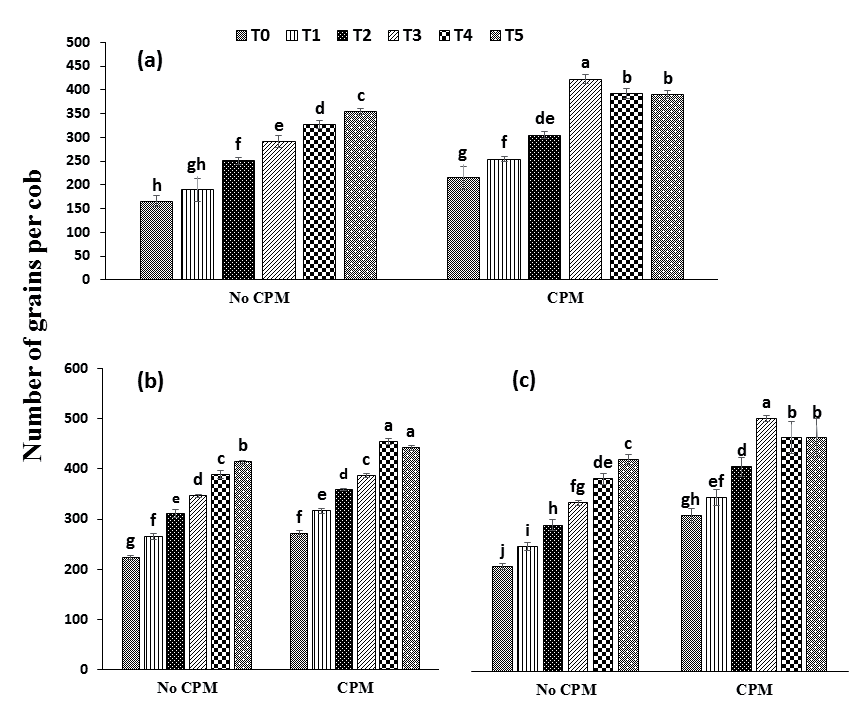
Fig. 2.
The interactive impact of CPM and different rates of NPK fertilizers on 1000-grain weight in Spring 2017 a) Fall 2016 b) and Fall 2017 c). T0 = 0:0:0 kg ha-1 N, P, and K, respectively: T1 = 50:25:25 kg ha-1 N, P, and K, respectively: T2 = 100:50:50 kg ha-1 N, P, and K, respectively: T3 = 150:75:75 kg ha-1 N, P, and K, respectively: T4 = 200:100:100 kg ha-1 N, P, and K, respectively: T5 = 250:125:125 kg ha-1 N, P, and K, respectively.
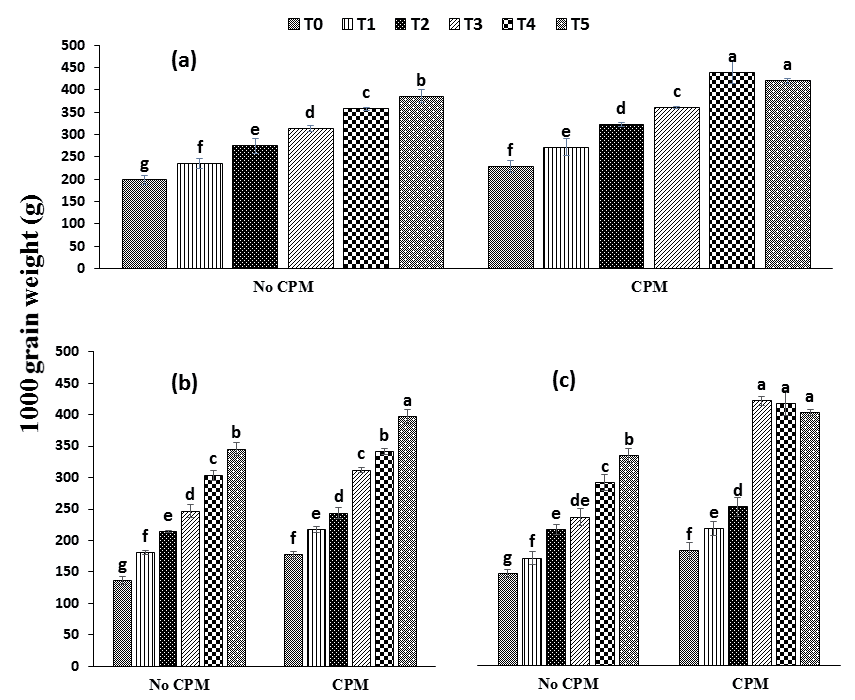
Fig. 3.
The interactive impact of CPM and different rates of NPK fertilizers on grain yield (t ha-1) in Fall 2016 a), Fall 2017 b), Spring 2017 c), and Spring 2018 (d). T0 = 0:0:0 kg ha-1 N, P, and K, respectively: T1 = 50:25:25 kg ha-1 N, P, and K, respectively: T2 = 100:50:50 kg ha-1 N, P, and K, respectively: T3 = 150:75:75 kg ha-1 N, P, and K, respectively: T4 = 200:100:100 kg ha-1 N, P, and K, respectively: T5 = 250:125:125 kg ha-1 N, P, and K, respectively.
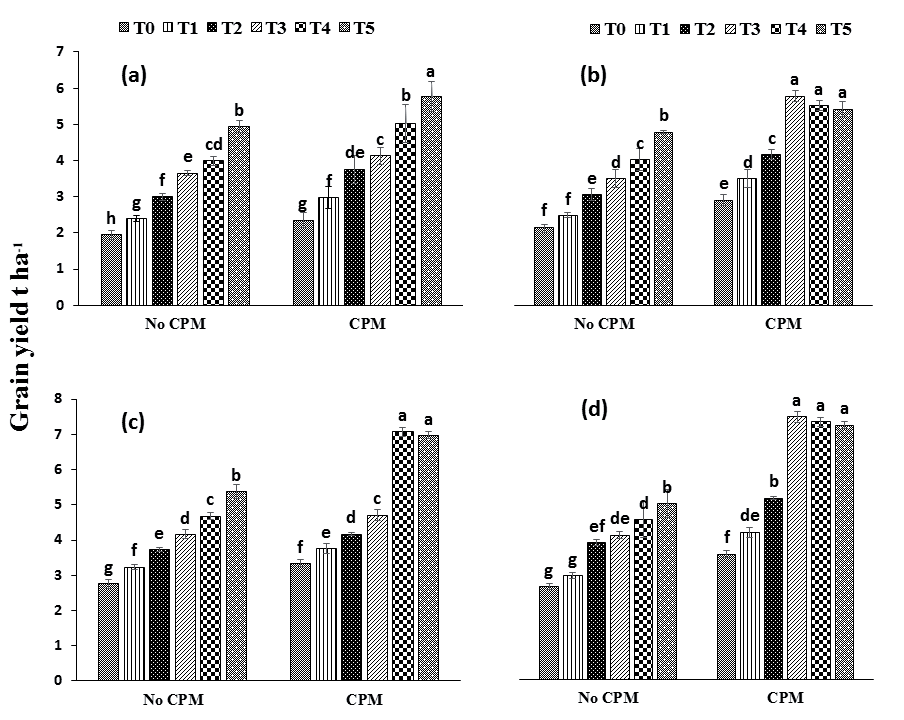
Fig. 4.
The interactive impact of CPM and different rates of NPK fertilizers on total soil nitrogen contents (%) in Fall 2017 a), Spring 2017 b), and Spring 2018 c). T0 = 0:0:0 kg ha-1 N, P, and K, respectively: T1 = 50:25:25 kg ha-1 N, P, and K, respectively: T2 = 100:50:50 kg ha-1 N, P, and K, respectively: T3 = 150:75:75 kg ha-1 N, P, and K, respectively: T4 = 200:100:100 kg ha-1 N, P, and K respectively: T5 = 250:125:125 kg ha-1 N, P, and K, respectively.
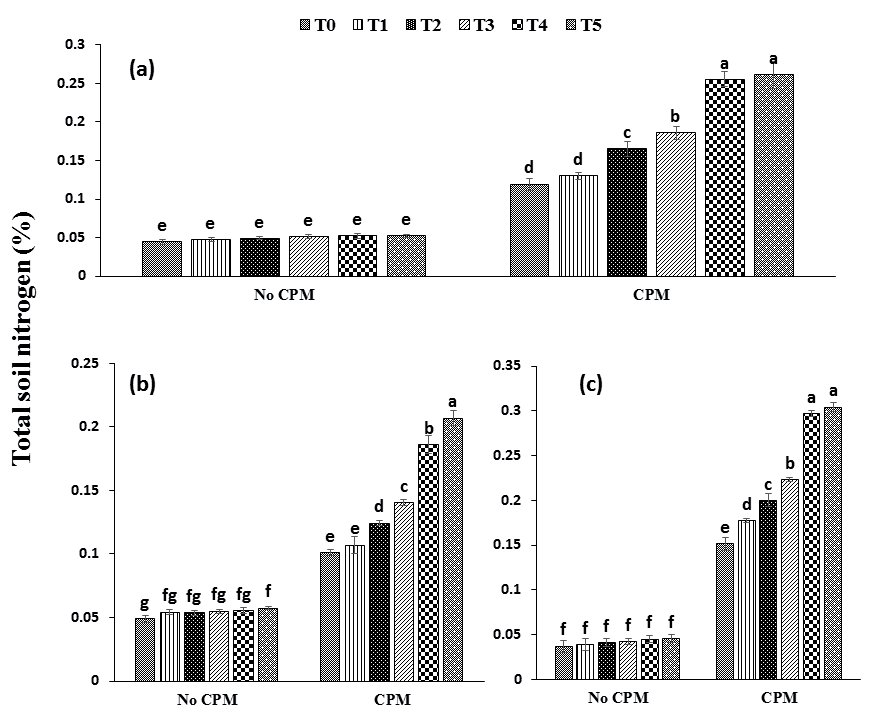
Fig. 5.
The interactive impact of CPM and different rates of NPK fertilizers on available phosphorus (ppm) in Fall 2017 a) and Spring 2018 b) and agronomic efficiency kg kg-1 in Fall 2017 c) and Spring 2018 d). T0 = 0:0:0 kg ha-1 N, P, and K, respectively: T1 = 50:25:25 kg ha-1 N, P, and K, respectively: T2 = 100:50:50 kg ha-1 N, P, and K, respectively: T3 = 150:75:75 kg ha-1 N, P, and K, respectively: T4 = 200:100:100 kg ha-1 N, P, and K, respectively: T5 = 250:125:125 kg ha-1 N, P, and K, respectively.
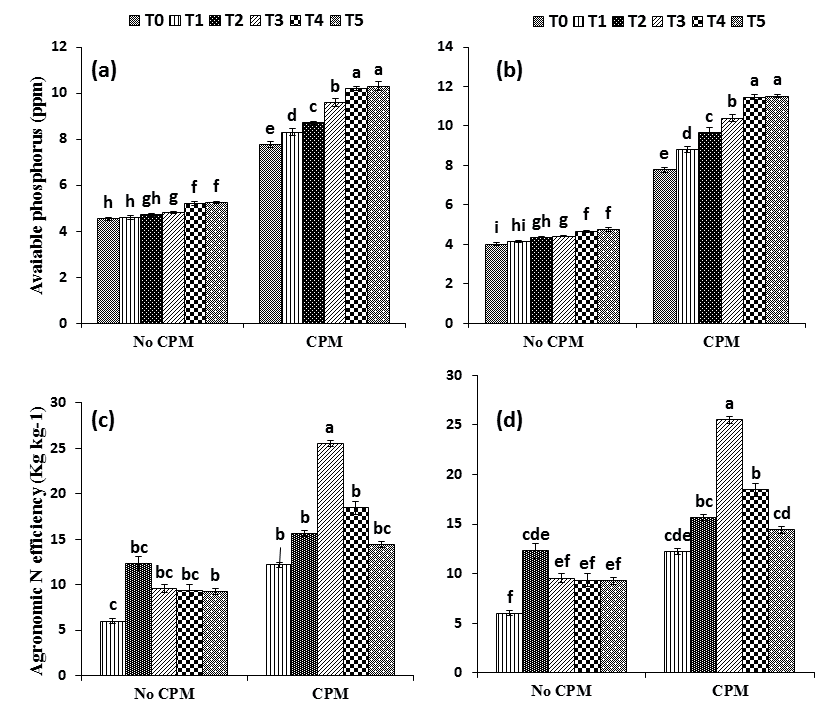
Fig. 6.
The interactive impact of CPM and different rates of NPK fertilizers on grain phosphorus contents (mg kg-1) in Fall 2017 a) and Spring 2018 b) and grain potassium contents (mg kg-1) in Fall 2017 c) and Spring 2018 d). T0 = 0:0:0 kg ha-1 N, P, and K, respectively: T1 = 50:25:25 kg ha-1 N, P, and K, respectively: T2 = 100:50:50 kg ha-1 N, P, and K, respectively: T3 = 150:75:75 kg ha-1 N, P and K respectively: T4 = 200:100:100 kg ha-1 N, P, and K, respectively: T5 = 250:125:125 kg ha-1 N, P, and K, respectively.
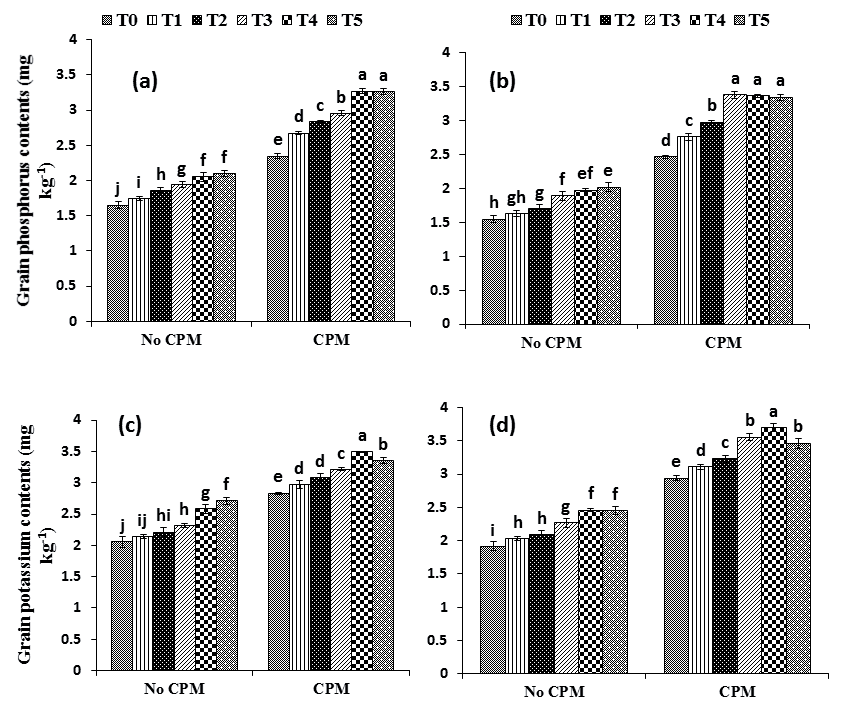
The application of NPK and CPM also appreciably increased the grain NPK concentrations. Mineralization of CPM continuously released nutrients into the soil solution, and this enhanced the duration of grain and source and sink capacity. These had a positive effect on plants, leading to better nutrient uptake and their translocation toward grains [34]. The incorporation of CPM improves soil properties and nutrient uptake which enhances assimilates production and thus ensures better root and plant growth [35]. With the addition of CPM, the agronomic efficiency of applied NPK enhanced during the last two seasons of experimentation. This was because co-applied organic and chemical fertilizers improved soil fertility and nutrient availability, thereby leading to an increase in nutrient utilization efficiency [36, 37].
Conclusions
The application of CPM with 60% NPK significantly enhanced maize productivity owing to an increase in soil organic matter and nutrient availability. Besides, this addition of CPM enhanced soil properties, maize nutritional contents, and crop productivity, and also reduced the NPK needs of crops by more than 40%. In conclusion, a combination of CPM (3 t ha-1) and NPK (150:75:75 kg ha-1) could be an effective approach to improving maize productivity and soil fertility. This was a short-term study conducted in semi-arid conditions. Therefore, long-term studies are needed in different soil and climate conditions prior to making its recommendation. Further, the impact of combined poultry manure and NPK fertilizers on soil microbial activities, soil carbon sequestration, and soil enzymatic studies must be explored in future studies. The effect of CMP and N applied in splits on soil fertilizers and crop productivity must also be explored. Additionally, the effect of CMP and NPK fertilizers on nutrient loss by leaching must also be studied.

