


Introduction
Indonesia is the largest archipelagic country in the world, with approximately 17.508 islands, a water area of about 6.315,222 km2, and a coastline of 81.000 km2 [1]. In addition, Indonesia has 3,735,250 ha of mangrove forest or about 22.6% of the world’s mangrove forest, and it is spread over almost all coasts of the islands [2-4].
Mangroves are plants that can only be found in the tropics and live and develop in the intertidal zone. Many terrestrial and aquatic organisms use mangroves as their habitat, and most estuarine fish spend their entire life cycle in this area [5-7]. Globally, mangroves support about 30% of commercial fisheries that contribute to economic development [8]. Indeed, in Indonesia, 80% of the commercial fish seen are correlated with the mangrove food chain [9].
Lombok, part of the Lesser Sunda archipelago, has a mangrove area of 3.426.78 ha. However, it is estimated that the current area is around 2.514.4 ha, with East Lombok Regency covering 1.886.50 ha, West Lombok 510.4 ha, Central Lombok 110.8 ha, and North Lombok 6.7 ha [10]. Studies on the diversity and richness of fish species in mangrove areas have also been widely discussed in Indonesia [11-14]. The fish diversity of mangrove waters on Lombok Island is not yet fully recorded, with limited studies covering the estuaries of the Cemare River, Rasu Bay, Sepi Bay in West Lombok, and Tanjung Aan in Central Lombok, excluding mangrove areas [15].
Due to the numerous changes and conversions of mangrove areas for other activities and the damage caused by anthropogenic activities, this condition may affect the survival range of biota [16, 17]. Additionally, several new records of potential fish were found within the mangrove area [12, 18]. Therefore, it is important to conduct up-to-date data collection on fish biodiversity and their IUCN status in North and East Lombok to conserve and prevent species loss. Thus, this study aims to ascertain the biodiversity and status of mangrove fish species in North and East Lombok, along with identifying the dominant fish species in these waters. The results indicate that fish research in the mangrove areas of Lombok has yet to be well published. Thus, this study aims to provide information on the richness of fish species and their status in mangrove forest areas on Lombok Island, West Nusa Tenggara. This information will help determine policy strategies for sustainable management and use in this area.
Materials and Methods
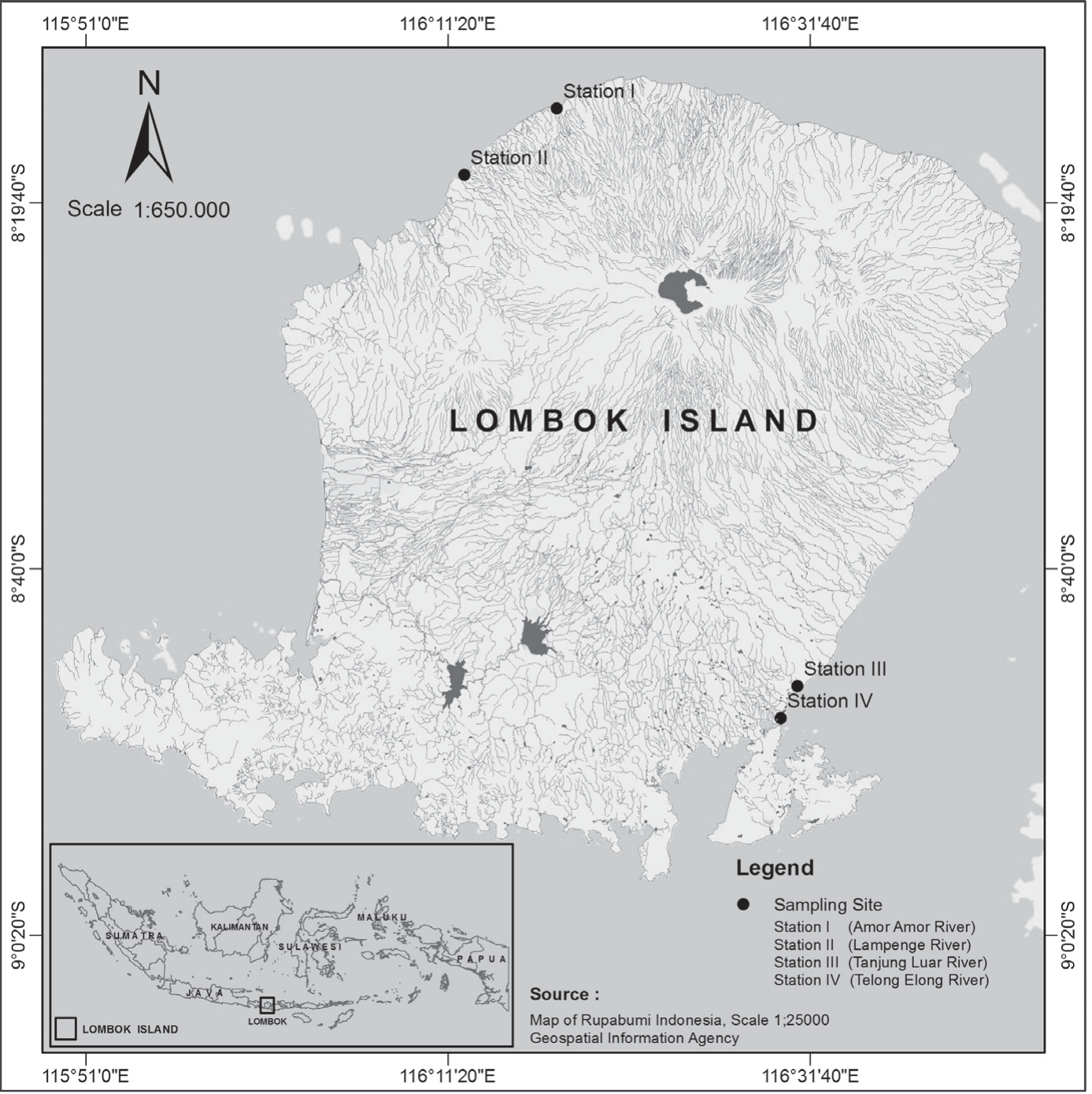
The study took place from April to May 2014. The location of fish sampling in the mangrove waters of the Amor-Amor River (-8.240683, 116.29101) was recorded as station I, and in the Lampenge River (-8.302267, 116.2042) as station II, both located in North Lombok. Meanwhile in East Lombok, namely the Tanjung Luar River (-8.775417, 116.5155) station III and the Telong-Elong River (-8.805043, 116.50027) station IV (Fig. 1).
Fish samples were taken using fishing gear, namely throwing nets with 1.5 cm and 2 cm of diameter mesh and gillnets with 1, 1.5, and 2 inches of diameter mesh. The fish were fixed by being soaked in a 10% formalin solution, then put in a plastic bag and labeled with information on the location, time, fishing gear, collector, and number of individual fish, as well as other necessary information. Furthermore, the fish samples were brought back to the Ichthyology Laboratory in the Museum Zoologicum Bogoriense, Research Center for Biosystematic and Evolution-BRIN in Cibinong, West Java.
Before transfer to the 70% alcohol, the specimen was washed with running water and then sorted based on the shape of the fish. Identification of fish species follows [19-21]. Data analysis for spatial distribution, species diversity, species richness, and species evenness was processed using the following formula: – Interpreted Distribution:
Distribution = n.St/N.St x 100
i.e: n.St = number of stations found type i
N.St = total number of stations
As for knowing the dominant type, that is, if the relative abundance is ≥10%, where is the relative abundance formula [22]:
i.e: KRi = relative Abundance
ni = number of types i
N = number of all species – Biodiversity index [22] with the formula:
H = - ∑ pi ln pi
i.e: H = biodiversity index
Pi = ni/N
ni = number of individuals of type to i
N = total number of individuals – Species richness index [22] with the formula:
d = S-1/in N
i.e: d = species richness index
S = number of types
N = total number of individuals – Evenness index [23]with the formula:
E = H/ln S
i.e: E = Evennes index
H = Biodiversity Index
S = Number of types
The similarity of habitat types between stations was determined based on the similarity of species using the Sorensen similarity index, which is calculated as Is = 2W/ (A+B), where W represents the number of shared species between two stations, A and B represent the total number of species at each station, respectively.
The fish biodiversity that inhabits the region was determined by analyzing the data with the program PAST 2.1.4 (developed by Øyvind Hammer) [24]. The IUCN status of each fish species was determined by utilizing the IUCN Red List page [25].
Results and Discussion
Research Sites
At the research site, various kinds of mangroves, including Rhizophora spp., Bruguiera sp., Avicennia sp., Sonneratia alba, and Aegiceras sp., were found to inhabit the region. The condition of each mangrove density was different at each observed station. For example, the estuary of the Lempenge River into Lempenge Village, Bayan sub-district, North Lombok, had mangroves with a closed mangrove canopy and a river face width of ±25 m with a soft and dense mud substrate. The mouth of the Amor-Amor river, Selengan Village, Kayangan sub-district, North Lombok, had mangroves with an open mangrove canopy, a river face width of ±20 m, and a dense mud and sand substrate. The mouth of the Tanjung Luar River, Keruak sub-district, East Lombok, has mangroves that tend to be open, and a lot of young mangroves are planted. The expanse of the substrate is soft mud. The mouth of the Telong-Elong River, Jerowaru Village, Jerowaru sub-district, East Lombok, had an open mangrove canopy and relatively high muddy conditions.
The water temperature range in all research sites was between 29ºC and 31ºC, with a pH of 7 to 8 and an average salinity ranging from 1 to 1.5 ppt. The watercolor was brown, except for the Amor-Amor and Telong-Elong rivers, which appeared oily, suspected to be a result of residue from the disposal of fishing motor boats. Additionally, a considerable amount of garbage was caught around the mangrove roots in the Telong-Elong River.
Biodiversity and Status of Fish Species
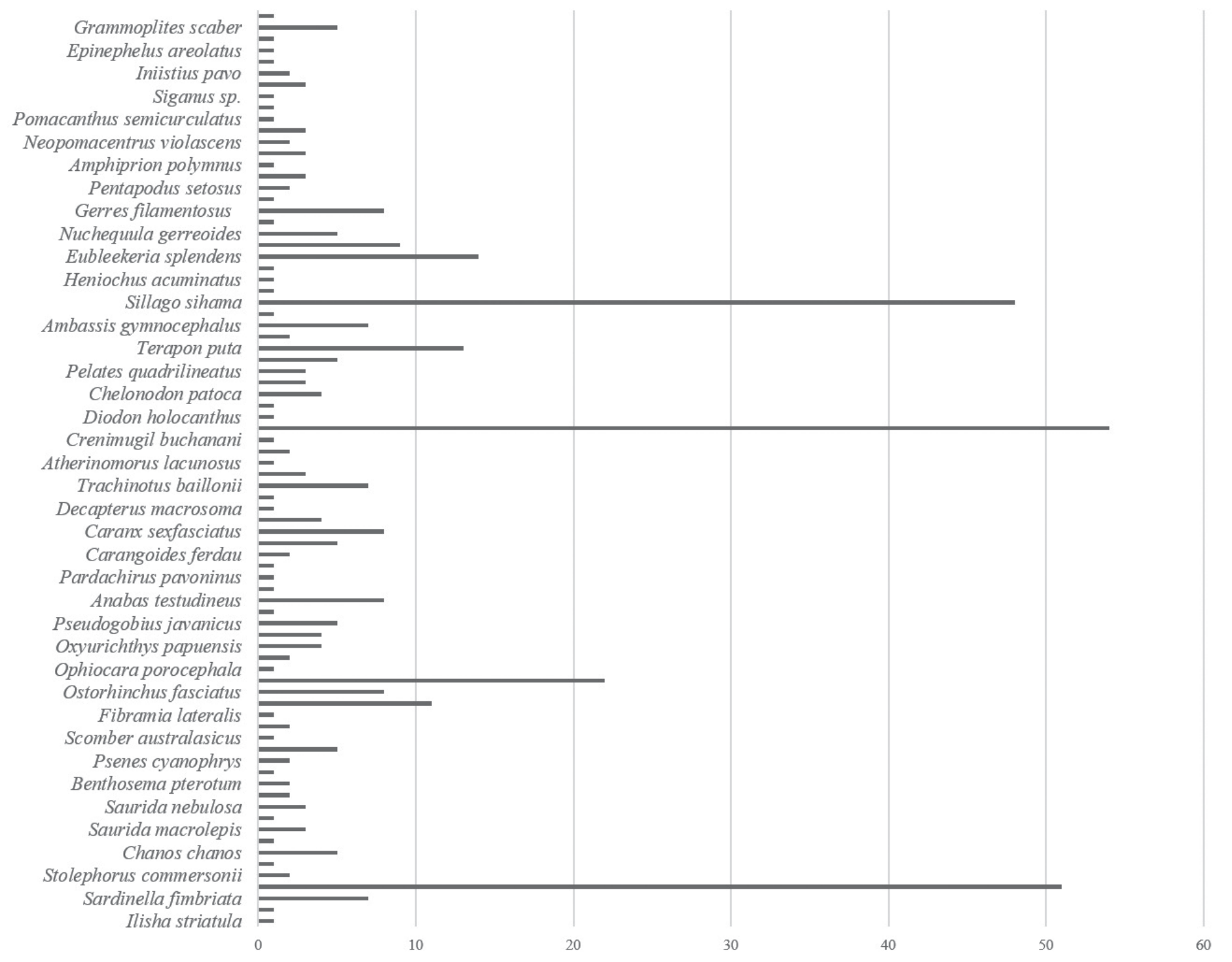
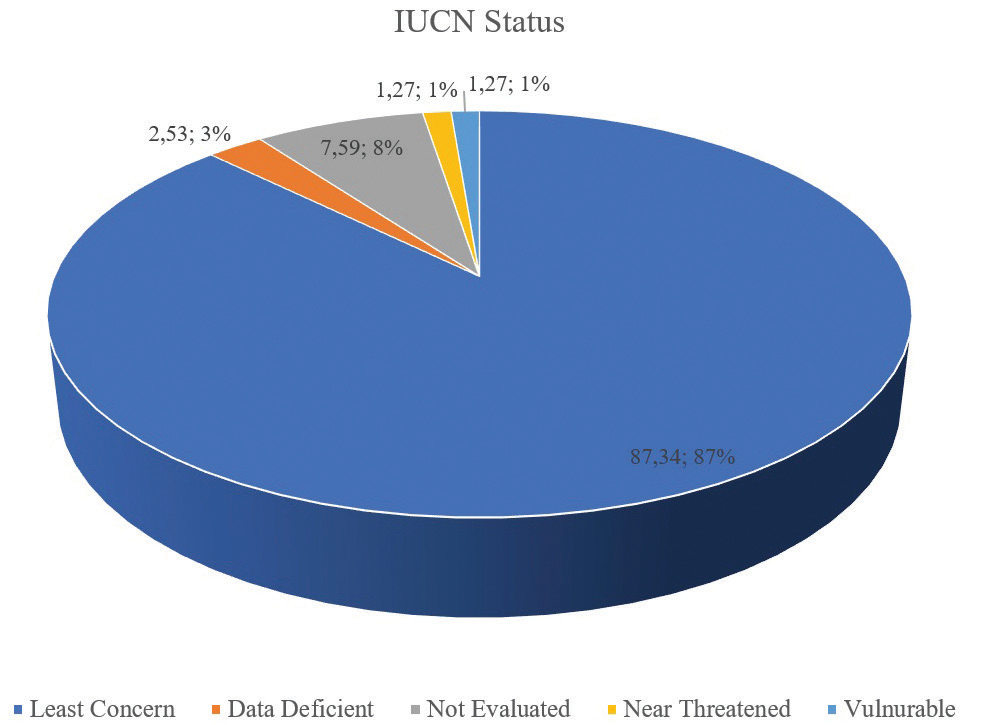
The results obtained 79 species of fish belonging to 41 tribes and 69 genera, for a total of 410 individuals. The species with the highest spatial distribution (100%) in the research are Sardinella lemuru, Planiliza subviridis, and Sillago sihama, as they were found in all of the research stations (Table 1). The family with the most species representation was Carangidae, with eight species. Followed by Synodontidae and Gobiidae, with five species each. The family with the least species representation were Pristigasteridae, Chanidae, Myctophidae, Mullidae, Butidae, Anabantidae, Sphyraenidae, Cichlidae, Ambassidae, Pomacanthidae, Ephippidae, Chaetodontidae, Acanthuridae, Diodontidae, Kuhliidae, Sillaginidae, Lutjanidae, and Gerreidae, each represented by only one species. The results of the calculation of the relative abundance of fish species showed that the dominant species was Planiliza subviridis with 54 individuals (13.17%), followed by Sardinella lemuru with 51 individuals (12.44%) and Sillago sihama with 48 individuals (11.70%) (Fig. 2). Furthermore, the IUCN status recorded 69 species as least concern (LC), 2 as data deficient (DD), 6 as not evaluated (NE), 1 as near threatened (NT), and 1 as vulnerable (VU) (Fig. 3).
In general, the result showed that the fish obtained during the study have a high species diversity, with 79 species of fish; it is suspected that the aquatic habitat is still very good. High yields were also reported by [7], where there were 63 species of fish from 26 families in the mangrove and muddy ecosystems in the Paria Bay of Trinidad. Meanwhile, in the waters of West Lombok and Central Lombok, 38 species of fish were collected from 20 families [15]. Similar research related to mangrove fish species in Indonesia has also been conducted in various locations, including Lubuk Kertang-North Sumatera, Banyuasin Regency-South Sumatra, Pagatan Village-Kalimantan, Banyuurip-East Java, the mangrove ecosystem in Basule Village-North Konawe, Maro River-Merauke, and mangrove belawan of Sicanang Island. However, the number of fish collections is much smaller [12, 14, 26, 27]. Differences in the number of species may occur due to several factors, for example, habitat conditions, deforestation, overfishing, anthropogenic activities, and the suspected presence of natural enemies that cause fish species to be displaced.
Table 1.
Fish collected in the mangrove waters of Lombok.
The record in the present study also shows that there are three species thought to have high adaptability, all of which are found in all research stations with a high number of individuals. Planiliza subviridis mullet is one of many fish commonly found in mangrove waters. The presence of mullets is suspected to be looking for food and a nursery area. This is because mullets are often found swimming in groups of juvenile size. [31] stated that mullets use mangrove areas as niches for their food sources. The species of lemuru fish (Sardinella lemuru) and kembung (Rastrelliger faughni) are listed as examples of fisheries commodities in Indonesia. These groups of fish species are known to be commonly found in several mangrove areas and are thought to be used as fish food [12, 14, 26, 27]. The research location, which tends to be a mangrove area that borders directly on sea waters, is suspected to be a factor in the presence of these fish. On the other hand, this species is categorized as near-threatened and, therefore, needs to be preserved so that the population remains stable. Then, rejung fish, S. sihama, is a type of consumption fish that currently mostly relies on catches from nature. Rejung entering the mangrove waters is suspected of using the ecosystem to find food and is thought to be carrying out the spawning process. Research by [28] in Bombana Waters, South East Sulawesi, reported that many rejungs were caught in September and November 2018 with gonad maturity level IV either during the spawning or post-spawning period. In addition, Lombok is included in the rejung distribution area along with other economic fish [29].
In addition, the three species mentioned above had the highest number of individuals, namely lemuru (51 fish), mullet (54 fish), and rejung (48 fish). By looking at the relative density of ≥10%, the three species can be said to be predominant [30]. When viewed morphologically, lemuru has an elongated body shape that tends to be cylindrical and narrows towards the tail, a small mouth opening, a relatively large eye size, a blue-green body color with golden lines on its sides, and black spots on the back of the gill cover [21]. The mullet has an elongated body and is relatively conical to the front; the head shape is slightly depressed, the mouth from the front resembles the letter V, and the body color is silvery green [20, 21]. Rejung has an elongated body that tends to be dense and tapering towards the mouth, a relatively flat abdominal profile, and a light brown to silvery yellow body with a silvery diameter [21].
The high number of individuals collected in this study is most likely related to Lombok’s location as the distribution center of these three species. The results suggest that the population of this species may be larger than that of other species. Previous research conducted in mangrove waters in other locations has identified similar dominant fish species [9, 11, 15].
Most of the fish are still in IUCN status, which is the least concern, which means that the diversity of fish in these waters is still good. Even so, monitoring is still needed to maintain these fish species. If monitoring is not carried out on an ongoing basis, the species may decline in population and automatically change its status to threatened.
Carangidae is the family with the highest representation, followed by Synodontidae and Gobiidae. It is suspected that members of this species utilize the mangrove area because of the function of the mangrove. In the interior of Ambon Bay, in the mangrove ecosystem, 11 species of Carangidae are found in various sizes [31]. [32] added that most of the Carangidae in the mangrove ecosystem are at the juvenile stage. Then, members of the Synodontidae species are thought to be associated with mangrove forests in caring for young fish and looking for food [33, 34]. As for Gobiidae, its existence in the mangrove ecosystem is no doubt; even in some locations, it contributes to the dominant species members and is recorded to be associated with the size of juveniles to adults [15, 34]. [35] stated that Gobiidae can function as environmental bioindicators and take place in the food chain in mangroves.
Comparison of Fish Species at each Station
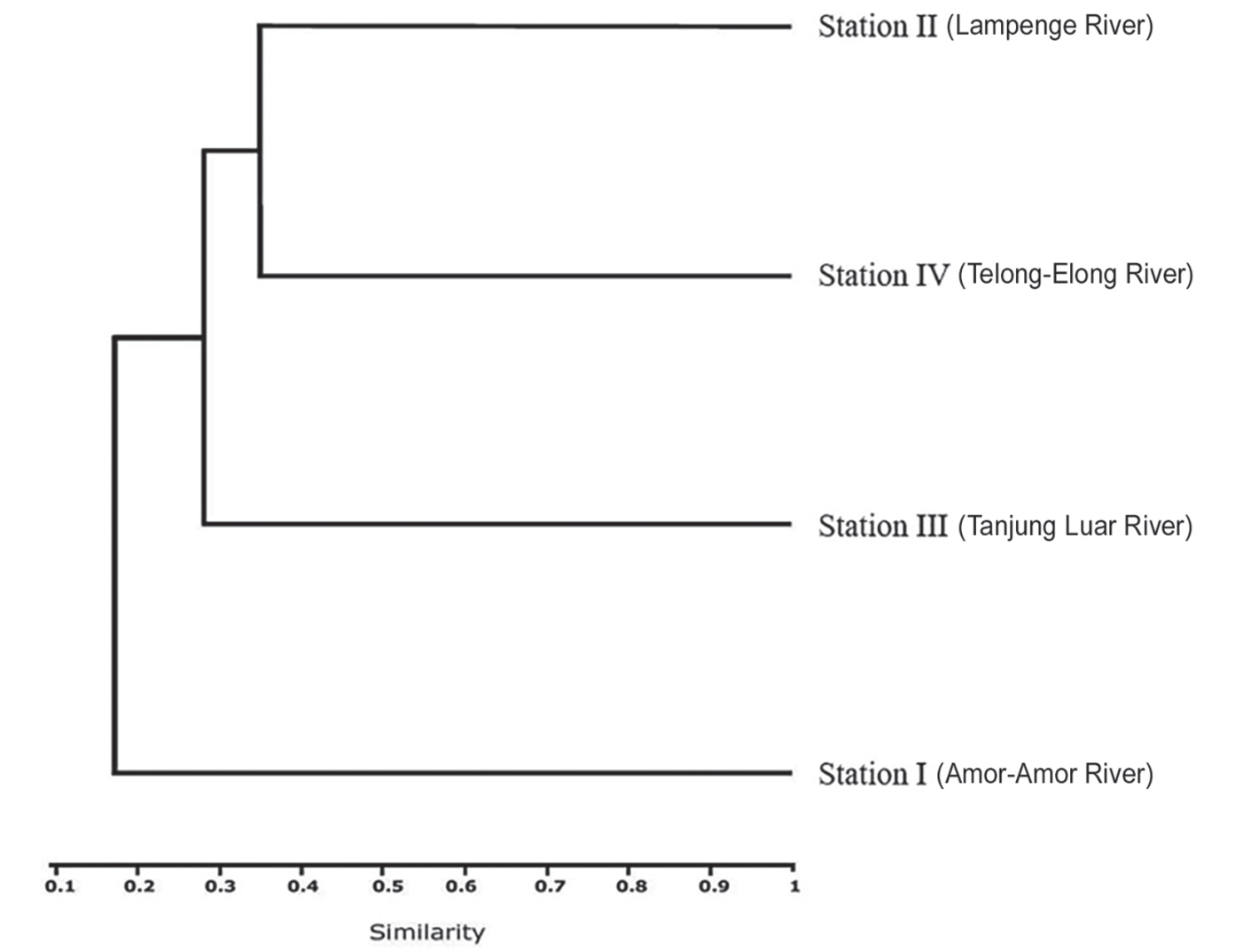
The species diversity index (H) ranged from 2,542 to 3,356, where station I had the highest index value and station IV had the lowest index value. The species richness index (d) ranged from 3.531 to 8.582, with station I haing the highest index value and station IV haaving the lowest index value. The species evenness index (E) ranged from 0.832-0.917, where station IV had the highest index value, while stations II and III had the lowest index value with the same value (Table 2). The results of cluster analysis showed that the types of fish found in stations II and IV had a similarity level of 0.33, followed by station III with a similarity level of 0.29 with stations II and IV. Station I looked different from the previous three stations, which only had 0.17 similarities (Fig. 4).
A comparison among the stations observed found that the Lampenge River estuary with 44 species (station I) has the highest diversity index (H) and fish species richness (d) compared to the Amor River estuary with 22 species (station II), Tanjung Luar Village estuary with 23 species (station III), and 16 species of Telong-Elong river estuary (station IV). Thus, it can be concluded that the mangrove conditions in station I were better than others [9], and [36] mentioned that the high and low values of diversity and species richness depend on the availability of food to support growth and fish breeding and to reduce competition between species. In general, mangrove ecosystems provide much food for various organisms, including the species of fish that live and associate with them [13, 35], and provide shelter as protection from predators [33].
Table 2.
Index of species diversity (H), evenness (E), and species richness (d) in each research location.
| Location Index | Station 1 | Station 2 | Station 3 | Station 4 |
|---|---|---|---|---|
| Biodiversity species (H) | 3,356 | 2,573 | 2,608 | 2,542 |
| Evennes (E) | 0,887 | 0,832 | 0,832 | 0,917 |
| Species richness (d) | 8,582 | 4,611 | 4,831 | 3,531 |
The value of the evenness index indicated that the Telong-Elong River estuary (Station IV) was slightly higher than the other three stations. The high evenness index is due to the absence of concentrations of individuals from certain species [22]. Therefore, the evenness index value showed that the water conditions at each station are still relatively stable. According to [36], the more evenly distributed the individuals in a species are, the more balanced the ecosystem in that area will be.
According to the similarity index, the estuary of the Amor River and the estuary of the Telong-Elong River have similar types of fish compared to the estuary of the Lampenge River and the estuary of Tanjung Luar Village. The estuary of the Lampenge River has different species of fish compared to the other three stations. The similarity between stations suggests that the ecosystem and water conditions at the two stations are not very different; where mangrove plants are relatively open, the water is brownish and oily. Meanwhile, the mangroves around the estuary of the Lampenge River are still good with closed plant cover. The location is far from residential areas, so it is suspected that the anthropogenic influence is relatively small, and the watercolor is cloudy brown. The presence of fish in the mangrove ecosystem, both permanent and temporary, plus physical conditions, are thought to affect the similarity of fish species. As a general note, the survival of fish in a certain habitat depends on the habitat conditions around them [7, 37].
Conclusions
Lombok’s mangrove waters are still in good shape, with 79 species of fish inhabiting them, most of which have a low-risk IUCN status. Sardinella lemuru and Rastrelliger faughni are consumable fish with high economic value, but they have a risk of being threatened. Its conservation deserves attention to ensure the population remains sustainable.

