

Introduction
Tea is the first of the world’s three major beverages and plays a very important role in people’s daily lives. In recent years, China’s tea plantation area has been expanding, and tea production has been increasing year by year. Currently, China ranks first in the world in terms of tea plantation area and tea production [1]. Guizhou Province, located in southwestern China, is one of the main tea-producing areas in China, and the 2021 data survey showed that the area of tea plantations in Guizhou Province ranked second in the country [2]. The content level of micronutrients directly affects the quality of tea, while the growth and development of the tea tree and the formation of tea quality require a variety of micronutrients, which are directly or indirectly involved in the composition of the plant’s organic matter, most of which are the tea quality components [3].
In addition to the need for nitrogen, phosphorus, potassium, and other macronutrients, micronutrients are also necessary for the normal growth and development of plants; they participate in a series of important material metabolisms in the plant organism and have a very key physiological and biochemical role. Trace elements are mainly involved in a series of physiological and biochemical reactions in the body in the form of essential components or activators of various enzymes, vitamins, and growth factors, which are of great significance to the growth and development of plants and animals [4, 5]. Many previous studies have demonstrated the effects of trace elements on tea growth and tea quality [6-8]. Tea is known to have many important physiological properties and health benefits. Drinking tea reduces the risk of many diseases, such as cancer and cardiovascular disease, because tea has a variety of bioactivities, including antitumor, antioxidant, and anti-obesity [9-11]. Some studies have shown that amino acids, polyphenols, and purine alkaloids are important nutritional and active components of green tea [12]. The antioxidant and free radical scavenging capacity of polyphenols in green tea may play an important role in the prevention of cardiovascular disease, chronic gastritis, and certain cancers [13]. However, purine alkaloids (e.g., caffeine, theobromine, and theophylline), which are additional key components of tea and coffee, may negatively affect our health when intake is high [14]. Currently, extensive academic attention has been paid to trace elements in tea, with the main focus on characterization, health risk assessment, enrichment patterns, and leaching patterns. However, studies on the interrelationships between biochemical components and trace elements in tea are relatively limited.
In order to grasp the status of tea quality and micronutrient content in the major tea production areas in Guizhou Province, the purpose of high quality, high efficiency, high yield, and sustainable development of tea production was achieved. In this study, 34 tea samples were collected from the main tea production areas in Guizhou Province (Guiding County, Duyun City, and Meitan County). The contents of tea polyphenols, caffeine, free amino acids, water leachate, and trace elements (effective iron, effective manganese, effective copper, effective zinc, and effective molybdenum) were determined in order to investigate (1), the characteristics of differences in the quality of tea and the content of trace elements in the major tea production areas of Guizhou Province and (2), the influencing factors of the quality and the content of trace elements of tea in Guizhou Province, with a view to providing a better solution for the quality of tea and the sustainable development of production in Guizhou Province. This includes trace element content in Guizhou Province in order to provide basic data for the improvement of tea quality in Guizhou Province.
Materials and Methods
Overview of the Study Area
Guizhou Province is located in southwestern China (103°36′~109°35′E, 24°37′~29°13′N), which is one of the main tea-producing areas in China. The 2021 number of surveys showed that the area of tea plantations in Guizhou Province ranked second in the country (472.2 thousand hectares), of which Duyun Maojian tea, Meitan Cuiye tea, and Guiding Yunwu tea are the main brands of tea in Guizhou Province, so this study was carried out in Guiding County, Duyun City, and Meitan County in Guizhou Province. Guiding County is located in the south-central part of Guizhou Province, which is situated in longitude 107°08′ to 107°15′ East and latitude 26°40′ to 26°47′ North, with an altitude of 1,000 to 1,300 meters above sea level, and belongs to the humid climate of a central subtropical monsoon, with an average annual temperature of 15.5°C, an average annual rainfall of 1084.8 millimeters, and a yellow loam-dominant soil texture. Duyun City is located in the south-central Guizhou Province, adjacent to Guiding County. It is located in the east longitude 107°7′ to 107°46′, north latitude 25°51′ to 26°26′ between the average elevation of 938 meters, has a subtropical monsoon humid climate, an average annual temperature of 16.1 ℃, an average annual rainfall of 1431.1 millimeters, and the soil texture of the yellowish loam is dominant. Meitan County in the north-central Guizhou Province, located in longitude 107°15’ to 107°41’, latitude 20°12’ to 27°20’, altitude 631 ~ 1556 meters, has a subtropical monsoon humid climate, an average annual temperature of 15.1 ℃, an average annual precipitation of 1137 mm, and the soil type is yellowish loam and calcareous soil is dominant. Soil chemical indicators (pH, soil active trace element content, and soil nutrients) at the sampling sites are detailed in Appendix 1.
Sample Collection and Processing
Sampling points were set up in June 2020 in three places: Duyun City, Guiding County, and Meitan County, Guizhou Province, with a total of 34 sampling sites (10 in Guiding County, 14 in Duyun City, and 10 in Meitan County) corresponded to the collection of 34 tea samples (about 50 g of tea for each sample), of which 17 were old leaves and 17 were young leaves. The collected tea leaves were dried to a constant amount at 70℃ in a constant temperature drying oven, and the dried samples were pulverized with a high-speed pulverizer for 1 min, and passed through a 40-60 mesh sieve for spare. The trace element content in tea was determined by inductively coupled plasma-mass spectrometry: l g of the sample was weighed in a high-pressure sealed jar, 5 mL of nitric acid and 2 mL of hydrogen peroxide were added, and the sample was digested at 250 ℃ for 6 min, at 400 ℃ for 5 min, and at 450 ℃ for 5 min. When the jar was cooled down, the solution was transferred to a 50 mL volumetric flask, and the sample solution was rinsed with two times of deionized water and then fixed to obtain the sample solution to be measured. The samples were determined by an inductively coupled plasma mass spectrometer (ICP-MS, Agilent 7500 a). The free amino acid content of tea was determined according to the modified ninhydrin colorimetric method reported by Chen et al. [15]. The tea polyphenol content was determined according to the Folin-Ciocalteu method reported by Singleton et al. [16]. The content was determined spectrophotometrically. Caffeine content was measured according to the HPLC equipment reported by Gong et al. [17]. Water leachate was measured according to the Chinese national standard (GB/T 8305- 2013) [18] using the boiling water bath heating method.
Data Statistics and Analysis
The experimental data were preprocessed using the statistical software Excel 2016, correlation and difference analysis were performed using SPSS 19.0 software, multiple comparisons of difference analysis were performed using the LSD method with a significant level of P<0.05, and plots were made using Origin 2022 and RStudio 2021.
Results
Trace Element Contents of Tea Leaves from Different Origins
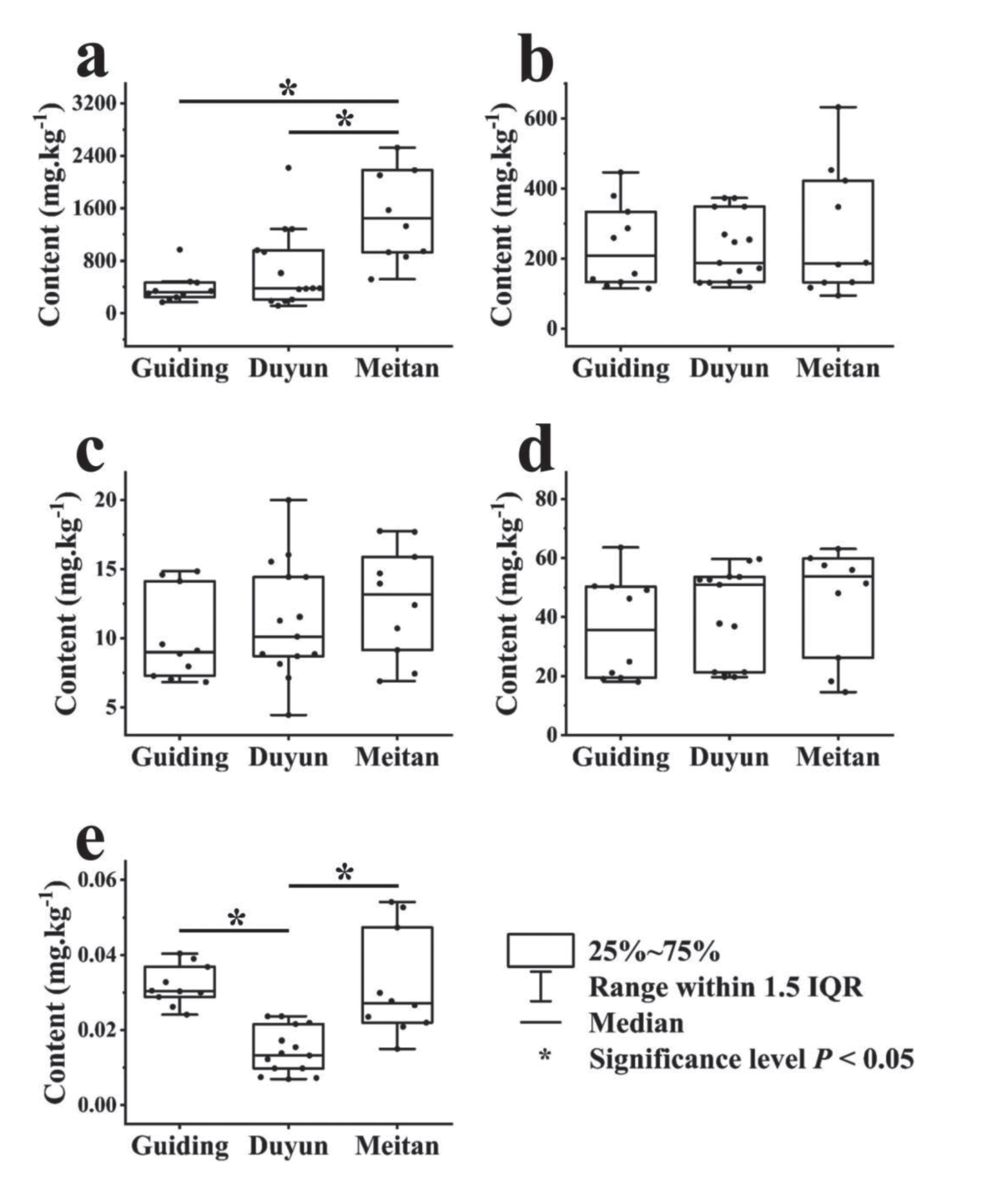
As shown in Figure 1: Mn, Cu, and Zn contents were Meitan County > Duyun City > Guiding County. Among them, Mn content was significantly higher in Meitan County than in Duyun City and Guiding County (P<0.05). Mo content was Meitan County>Guiding County>Duyun City, among which Guiding County was significantly higher than Duyun City (P<0.05); Meitan County was significantly higher than Duyun City (P<0.05). There was little difference in Fe content among Meitan County, Guiding County, and Duyun City.
Content of Tea Polyphenols, Caffeine, Free Amino Acids, and Water Leachate in Tea Leaves of Different Origins
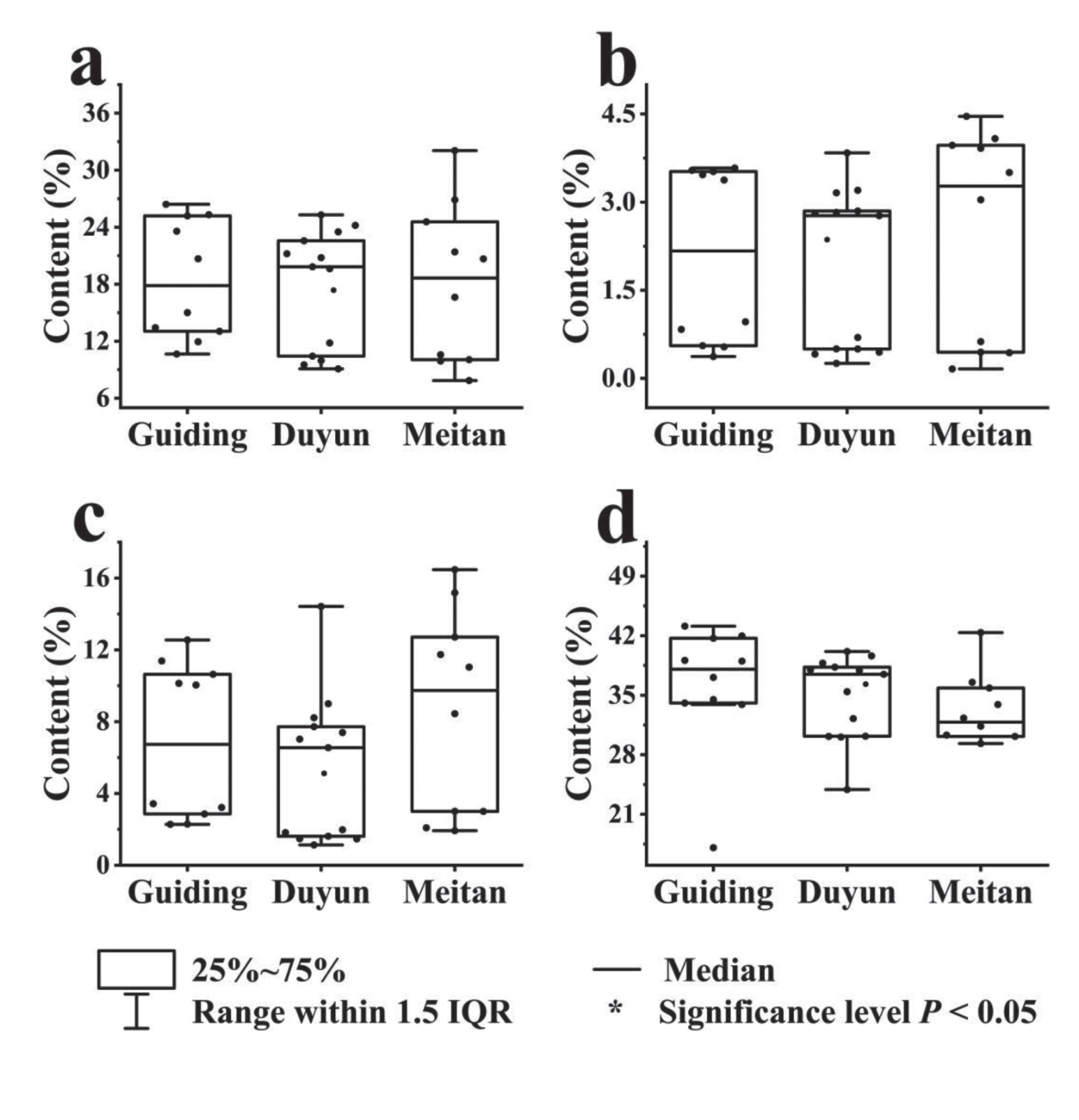
As can be seen from Figure 2, there was little difference in the content of tea polyphenols in Meitan County, Guiding County, and Duyun City. Caffeine and free amino acid contents showed that Meitan County > Guiding County > Duyun City. The water leachate content was Guiding County > Duyun City > Meitan County. Among them, there were no significant differences in the contents of tea polyphenols, caffeine, free amino acids, and water leachate in tea leaves of different origins.
Trace Element Contents of Old and Young Leaves
As can be seen from Fig. 3, Mn and Fe contents showed that old leaves were significantly higher than young leaves (P<0.05). The contents of Cu, Zn, and Mo all showed that young leaves>old leaves, among which Cu contents showed that young leaves were significantly higher than old leaves (P<0.05). Overall, the tea leaves had the highest Mn content and the lowest Mo content.
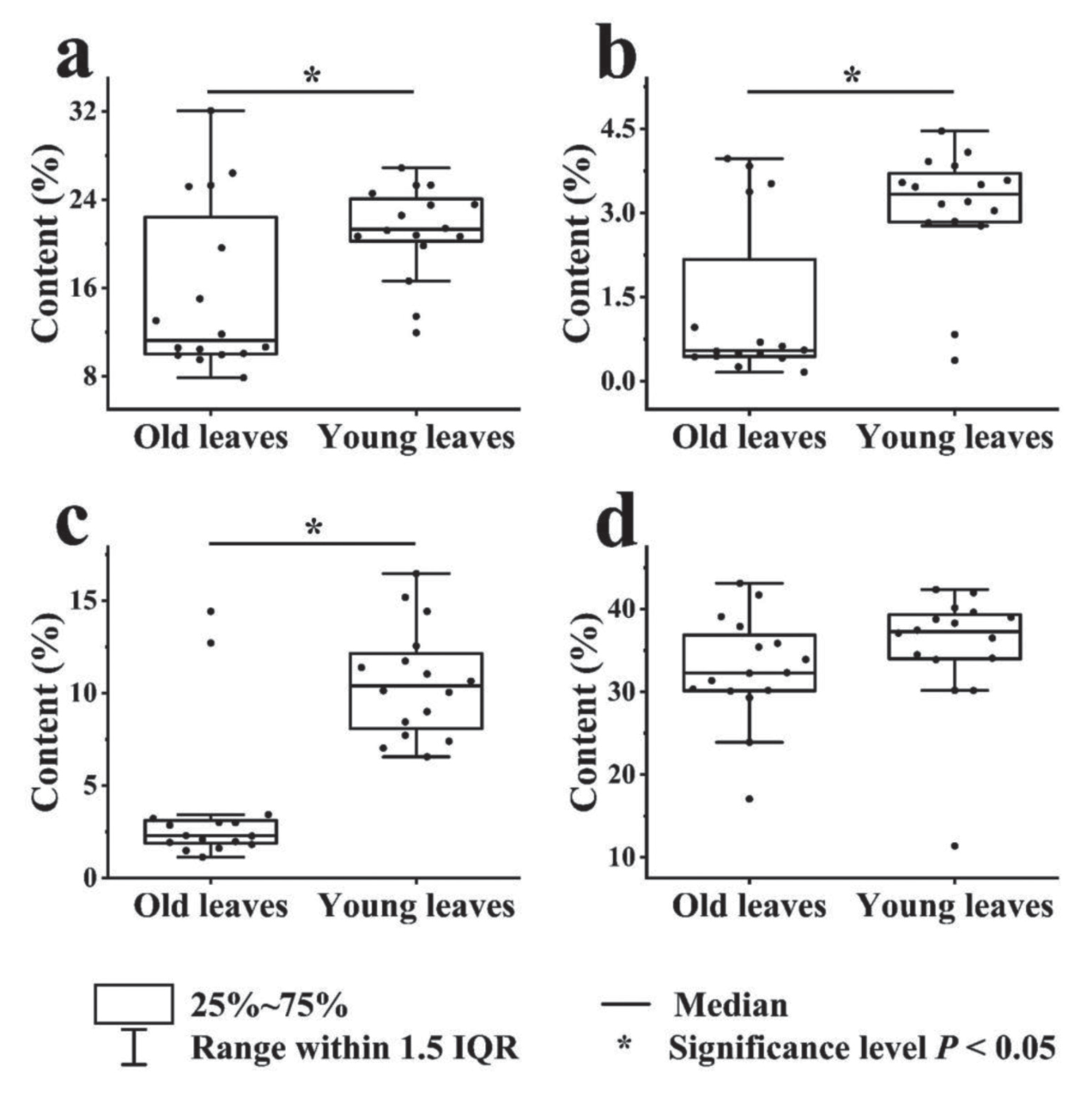
As can be seen from Figure 4, the contents of tea polyphenols, caffeine, free amino acids, and water leachate showed that young leaves > old leaves, in which tea polyphenols, caffeine, and free amino acids showed that the young leaves were significantly higher than the old leaves (P<0.05). Overall, the contents of the components in tea leaves showed that water leachate > tea polyphenols > free amino acids > caffeine.
Correlation Analysis of Trace Elements in Tea with Tea Polyphenols, Caffeine, Free Amino Acids, and Water Leachate.
From Figure 5(a), it can be seen that in Guiding County, there is a significant negative correlation between Cu and Fe (P<0.05), a highly significant negative correlation between Zn and Fe (P<0.01), and a highly significant positive correlation between Zn and Cu (P<0.05); there is a highly significant correlation between free amino acids and Fe, Zn, and Cu (P<0.01), and a significant correlation between free amino acids and Mo (P< 0.01). As shown in Figure 5(b), there were highly significant negative correlations (P<0.001) between Zn and Fe, significant positive correlations (P<0.05) between Zn and Cu, significant negative correlations (P<0.05) between Mo and Fe, significant positive correlations (P<0.05) between Mo and Zn in Duyun City; there were highly significant negative correlations (P<0.001) between tea polyphenols and Fe and Zn, between caffeine and Fe and Zn, between free amino acids and Fe and Zn, and water leachate and Mn had highly significant correlations (P<0.01); tea polyphenols and Mn, caffeine and Mo, free amino acids and Cu and Mo, water leachate and Zn had significant correlations (P<0.05). From Figure 5(c), it can be seen that there were significant negative correlations (P<0.05) between Cu and Mn, Cu and Fe, Mo and Fe in Meitan County; highly significant correlations (P<0.01) between tea polyphenols and Fe and Mo, and free amino acids and Mn, Fe, Cu, and Zn; and significant correlations (P<0.05) between tea polyphenols and Cu, and caffeine and Zn.
Fig. 2.
Content of tea polyphenols, caffeine, free amino acids, and water leachate in tea leaves of different origins Note: a is tea polyphenols, b is caffeine, c is free amino acids, d is water leachate.
From Figure 6(a), it can be seen that there was no significant correlation between trace elements in old leaves; there was a correlation between tea polyphenols, caffeine, free amino acids, water leachate, and Mn, Fe, Cu, Zn, and Mo. As shown in Figure 6(b), there was a significant positive correlation (P<0.05) between Cu and Mn, and a significant negative correlation (P<0.05) between Mo and Mn in the young leaves; there was a highly significant correlation (P<0.01) between free amino acids and Mo; and there was a significant correlation (P<0.05) between tea polyphenols and Zn, caffeine and Zn, and free amino acids and Fe.
Fig. 3.
Trace element contents of old and young leaves Note: a is Mn, b is Fe, c is Cu, d is Zn, e is Mo. Content of Tea Polyphenols, Caffeine, Free Amino Acids, and Water Leachate in Old and Young Leaves
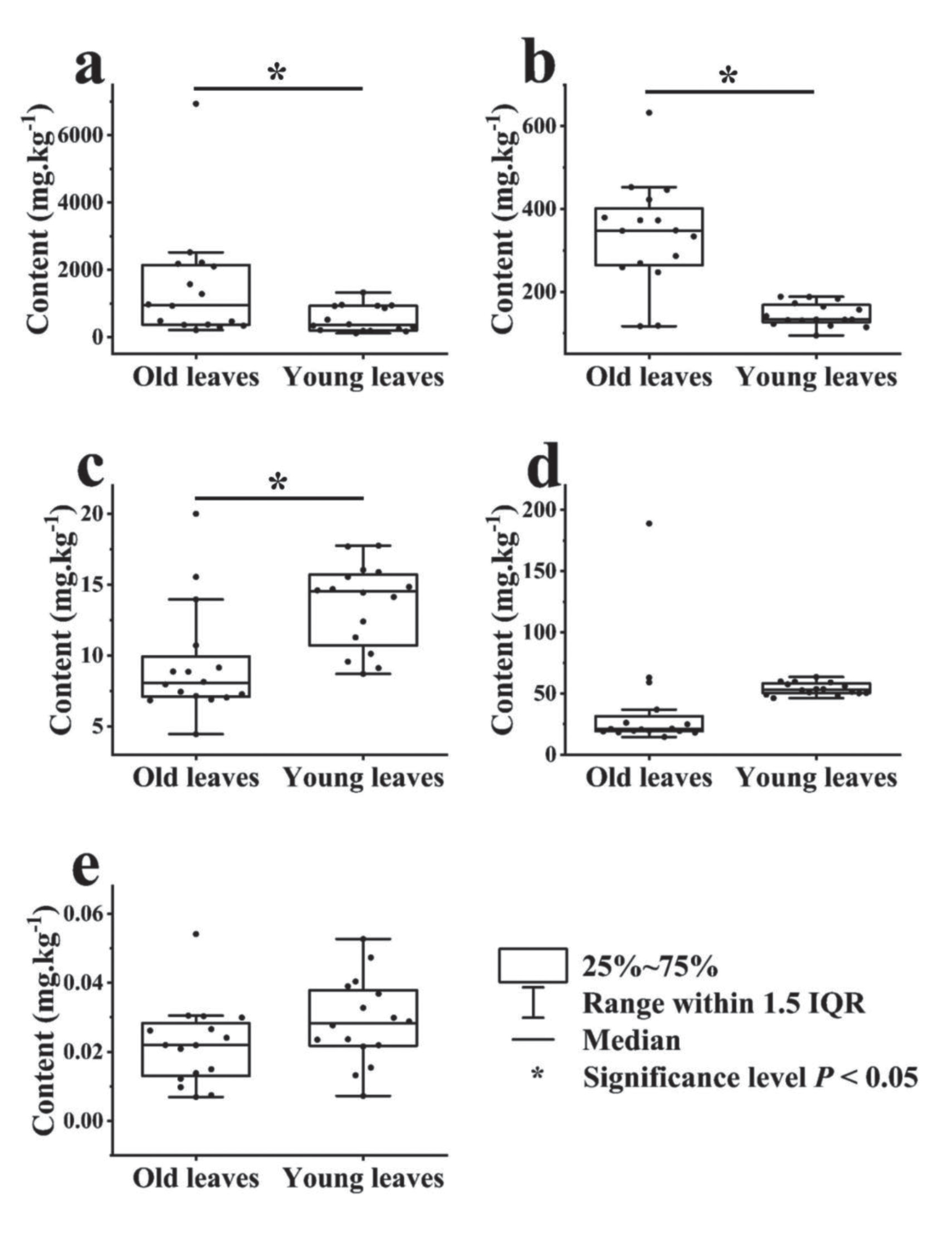
Fig. 4.
Content of tea polyphenols, caffeine, free amino acids, and water leachate in old and young leaves. Note: a is tea polyphenols, b is caffeine, c is free amino acids, d is water leachate.
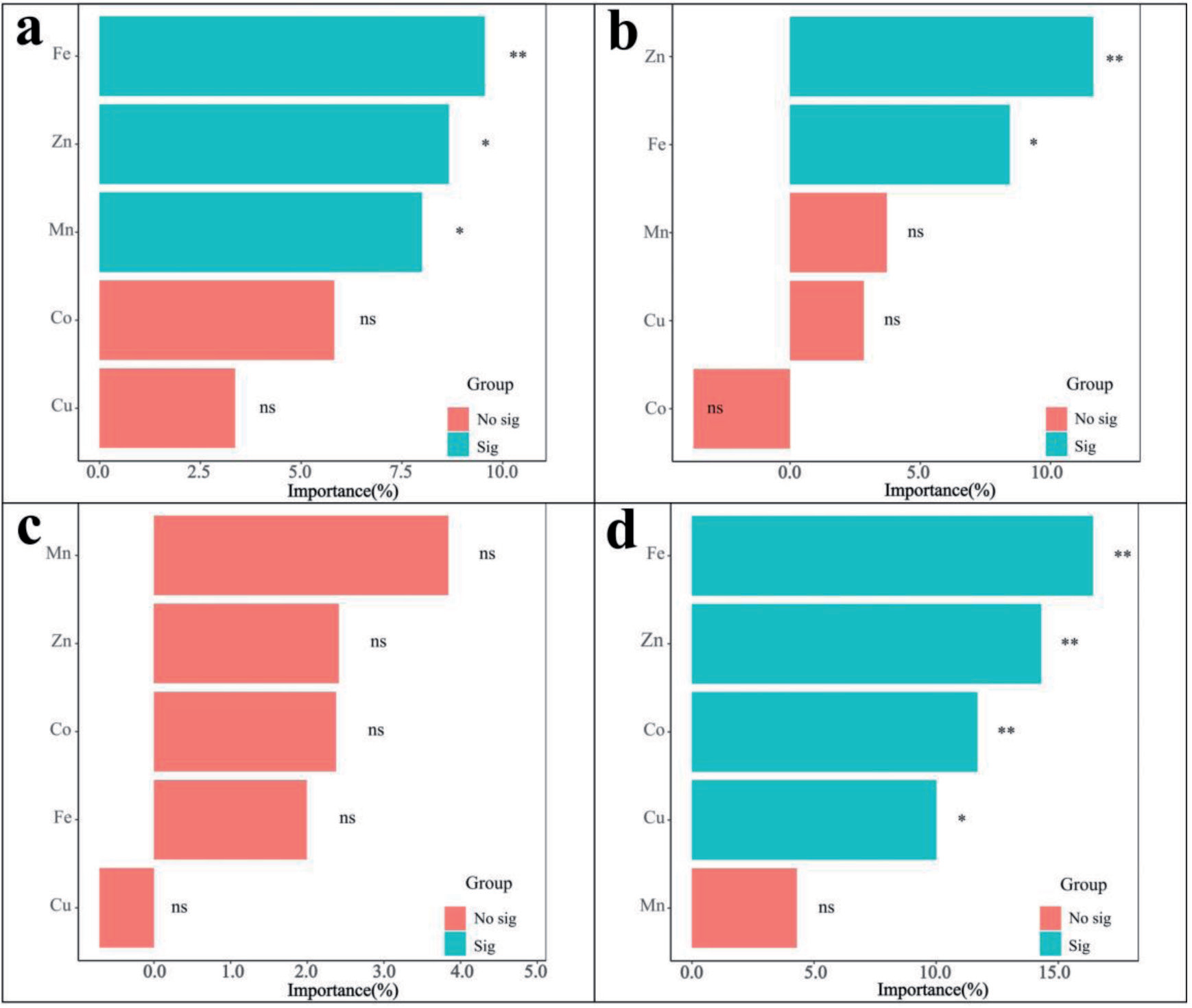
From Fig. 7(a), it can be seen that Fe had highly significant importance (P<0.01), Zn and Mn had significant importance (P<0.05), and Mo and Cu had insignificant importance for tea polyphenols. From Fig. 7(b), Zn was of highly significant importance (P<0.01) for caffeine, Fe was of significant importance (P<0.05) for caffeine, and Mn, Cu and Mo were not significant for caffeine. From Fig. 7(c), Fe, Zn and Mo were found to be of highly significant importance (P<0.01), Cu was found to be of significant importance (P<0.05), and Mn was found to be of insignificant importance for free amino acids. From Fig. 7(d), Mn, Fe, Cu, Zn, and Mo were not significantly important for water leachate.
Comprehensively analyzing the above, we found that trace elements Fe and Zn in tea have significant importance to tea polyphenols, caffeine, and free amino acids, so the content of tea polyphenols, caffeine, and free amino acids can be increased indirectly by increasing the content of trace elements Fe and Zn in tea, so as to improve the quality of tea. The application of micronutrient fertilizers in tea plantations is one of the most effective ways to increase the content of the micronutrients Fe and Zn in tea leaves.
Discussion
The trace element contents of tea leaves from different origins in Guizhou Province were higher compared to those measured by RF Milani et al. [19], who measured trace elements in herbal tea in Brazil (Mn: 111 mg.kg-1, Fe: 139 mg.kg-1, Cu: 3.1 mg.kg-1, Zn: 15 mg.kg-1). The reason for the higher trace element content of tea leaves from different origins in Guizhou Province may be related to the higher level of soil trace elements in Guizhou Province, and the higher trace element content in soil leads to the higher enrichment of trace elements in tea leaves. The studies conducted by Wen Ximei et al. [20] and Han Wei et al. [21] on the characteristics and causes of soil and crop trace elements in Guizhou and southern Sichuan found that soil trace element levels in Guizhou and southern Sichuan were higher than those in most of the provinces in the country, and that the soil trace element levels in tea plantations in Guizhou were higher than those in the southern Sichuan provinces. A study by Zhang Qinghai [22] investigated the enrichment of trace elements in tea leaves from three well-known tea-producing regions (Yunwu, Duyun, and Meitan) in Guizhou province. The enrichment factors of Cu and Pb in tea in Guizhou province ranged from 5.57% to 27.7% compared to other provinces in China. He Xue [23] found the most significant enrichment effect of Zn in agricultural regional crops in Guizhou Province, which was mainly attributed to the generally high background values of soil trace elements in Guizhou Province. The trace element contents of tea from different origins in Guizhou Province were similar to those found by Pang Xu et al. [24] in Wuyi Mountain Liugui tea. The contents of tea polyphenols, caffeine, and free amino acids (tea polyphenols: 166.44-203.08 mg.g-1, caffeine: 23.14- 24.99 mg.g-1, and free amino acids: 25.26-25.89 mg.g-1) were slightly higher compared to those of Pang Xu.
Fig. 5.
Correlation analysis of trace elements with tea polyphenols, caffeine, free amino acids, and water leachate in tea from different origins. Note: a is Guiding County, b is Duyun City, and c is Meitan County.
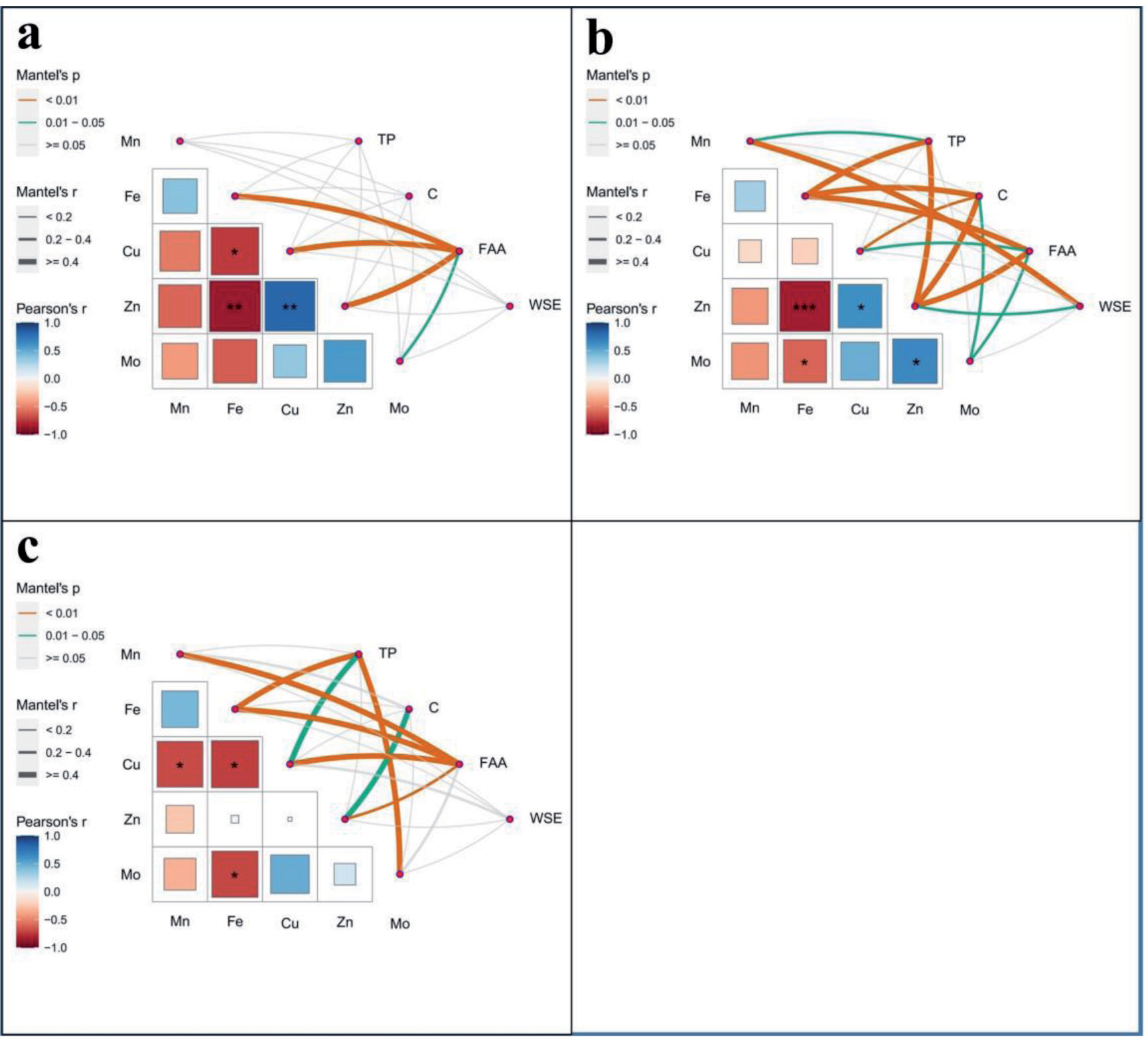
Fig. 6.
Correlation analysis of trace elements with tea polyphenols, caffeine, free amino acids, and water leachate in old and young leaves. Note: a is old leaves, b is young leaves. Random Forest Analysis of Trace Elements in Tea With Tea Polyphenols, Caffeine, Free Amino Acids, and Water Leachate
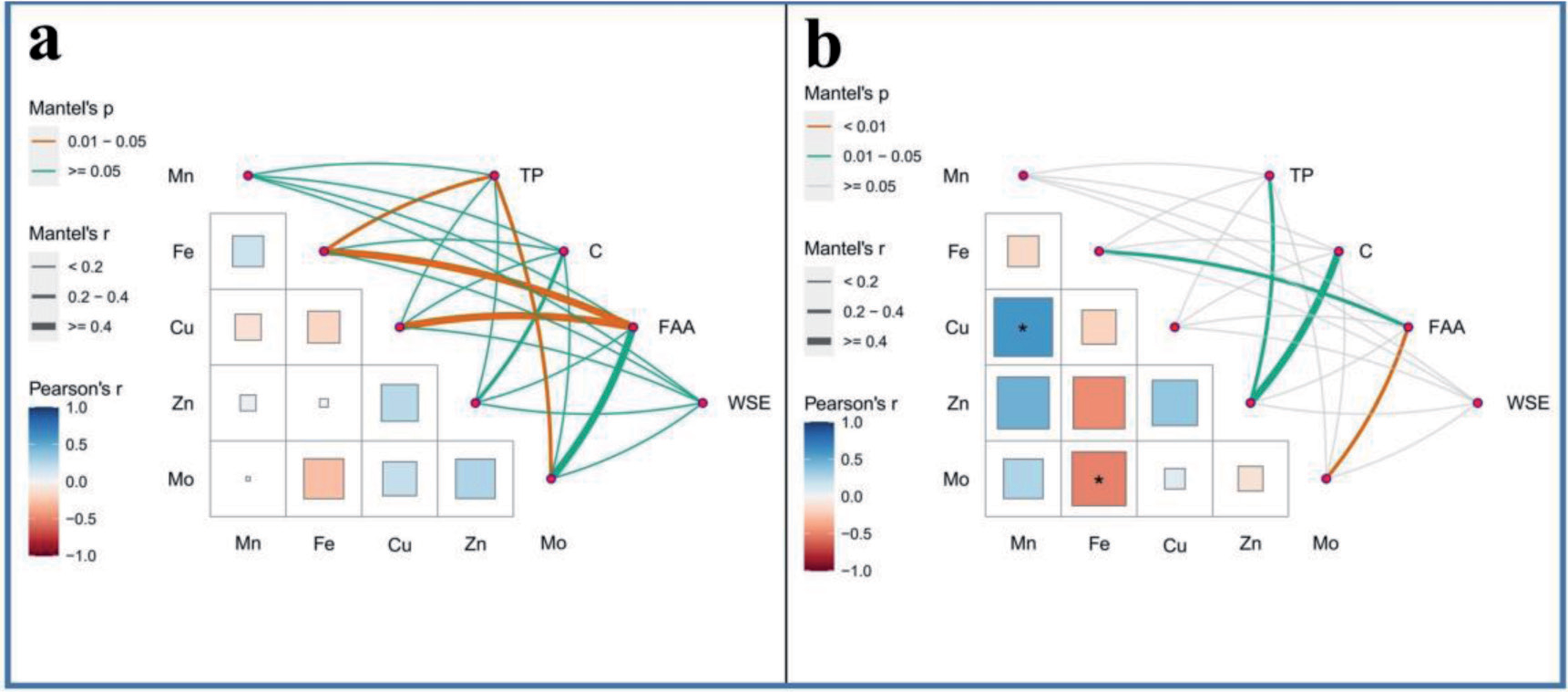
Fig. 7.
Random Forest Analysis of Trace Elements and Tea Polyphenols, Caffeine, Free Amino Acids, and Water Leachate in Tea Leaves. Note: a is tea polyphenols, b is caffeine, c is free amino acids, d is water leachate.
The content of trace elements, tea polyphenols, caffeine, free amino acids, and water leachate all have important effects on tea quality. But so far, there has been no specific study to explore the relationship between them. Some studies have shown the presence of Mn in complexes with organic acids (oxalic, malic, citric, and succinic) and Mn in tea leaves bound to polyphenols [25]. In addition, it has been shown that elevated levels of Hg and Pb allow for greater binding of catechins [26], while increased Mn concentrations reduce the antioxidant activity of EGCG and catechin [27]. In addition, the presence of a lower trace element pH contributes to the acidification of EGCG and reduces the catechin content in tea [28]. Therefore, elevated levels of trace elements have a detrimental effect on the accumulation of catechins in tea [29]. In this study, correlation analysis and random forest analysis showed that Mn, Fe, Cu, Zn, and Mo exhibited significant correlation and importance for tea polyphenols, caffeine, free amino acids, and water leachate. This result indicated that trace elements are extremely importantly linked to tea polyphenols, caffeine, free amino acids, and water leachate, but how exactly they interact with each other needs to be further explored, and this will also be our next research direction.
Conclusions
Overall, the trace element content of tea leaves from different origins was the highest in Meitan County; there was no obvious difference in the content of tea polyphenols, caffeine, free amino acids, and water leachate in tea leaves from different origins. The trace element contents of old and young leaves were significantly different, except for Zn and Mo. The contents of Mn and Fe were significantly higher in old leaves than in young leaves (P<0.05), and this result may indicate that the demand for Mn and Fe in young leaves is significantly lower than that in old leaves. The contents of tea polyphenols, caffeine, free amino acids, and water leachate in tea leaves showed that young leaves > old leaves, and this result indicates that the content of effective components in tea leaves is higher in young leaves, therefore, emphasis is placed on the collection of young leaves when picking tea leaves.
The correlation analysis between trace elements and tea polyphenols, caffeine, free amino acids, and water leachate showed that trace elements in tea showed certain antagonistic and synergistic effects; at the same time, there was a certain correlation between tea polyphenols, caffeine, free amino acids, water leachate, and trace elements, which indicated that the content of trace elements in tea would affect the content of tea polyphenols, caffeine, free amino acids, and water leachate. This result indicates that the content of trace elements in tea will affect the content of tea polyphenols, caffeine, free amino acids, and water leachate. The random forest analysis of the trace elements in tea leaves with the tea polyphenols, caffeine, free amino acids, and water leachate showed that the importance of some trace elements in tea leaves to the tea polyphenols, caffeine, and free amino acids was significant, and the results further proved the correctness of the correlation analysis results.

