

Introduction
Since the reform and opening up, China’s economic aggregate has experienced sustained and rapid growth. Concurrently, due to shifts in development models, excessive resource consumption, and low production efficiency, China’s ecological environment has suffered severe damage, with the rapid increase in agricultural carbon emissions drawing widespread societal attention. Agriculture, as an open industrial ecosystem, not only contributes to climate change but is also a source of greenhouse gas emissions. In China, agriculture contributes approximately 17% to the nation’s total carbon emissions, a figure significantly above the global average for agricultural emissions. China has committed to addressing climate change by setting ambitious targets of reaching carbon peaking by 2030 and attaining carbon neutrality by 2060, as stated in its Nationally Determined Contributions [1]. The introduction of the “dual carbon” goals signifies the Chinese government’s determination to address climate change [2]. Furthermore, the Chinese government’s “Opinions on Fully and Accurately Implementing the New Development Concept to Achieve Carbon Peak and Carbon Neutrality” explicitly sets a long-term goal of “accelerating the promotion of green agricultural development and enhancing agricultural carbon sequestration efficiency.” Thus, cutting down on agricultural carbon emissions is fundamental for reaching the “dual carbon” targets and is a necessary condition for promoting green and high-quality growth in agriculture.
The reduction of overall agricultural carbon emissions is a pressing issue. Researchers have identified that urbanization [3], population size [4], investments in ICT infrastructure [5], advancements in artificial intelligence [6], and the implementation of national agricultural policies [7, 8] all play roles in influencing agricultural carbon emissions. In recent years, with the rapid development and widespread adoption of communication technology, the digital economy has been experiencing significant growth. By leveraging network information technology, cloud computing, and artificial intelligence, socio-economic transformations can be made [9]. Industries are becoming increasingly digitalized, and digital technologies are becoming more industrialized. This progression has led researchers to investigate the environmental effects of the digital economy. Wan and Shi (2022) utilized ordinary least squares to explore how the digital economy affects sulfur dioxide pollution intensity. Their findings showed a negative effect, indicating that the digital economy can effectively reduce pollutant emissions and support environmental governance [10]. According to Li et al. (2021), the digital economy is trending towards environmentally friendly development, which has effectively boosted green economic efficiency in various regions [11]. The “Outline of the Digital Rural Development Strategy,” released in 2019, called for the thorough development of digital villages, the promotion of technological and intelligent farming, and the application of precise agricultural practices to achieve modernization in agriculture and rural regions. The 20th National Congress of the Communist Party of China called for accelerating the construction of a “Digital China” and a “Beautiful China” to achieve green development. In 2022, the State Council’s “14th Five-Year Plan for Digital Economy Development” made it clear that the digital economy is to be a fundamental pillar in China’s pursuit of carbon neutrality. The digital economy integrates data elements deeply with agricultural production, promoting green agricultural development through digital pathways, enabling intelligent management of carbon emissions, facilitating the transformation towards green agriculture, and enhancing agricultural carbon sequestration efficiency, making realizing agricultural “dual carbon” goals possible. However, can the digital economy promote agricultural carbon sequestration efficiency and effectively curb agricultural carbon emissions? What are the mechanisms supporting this effect, and does this effect exhibit nonlinear characteristics? The results of this research have significant practical implications for achieving green and high-quality agricultural development in China.
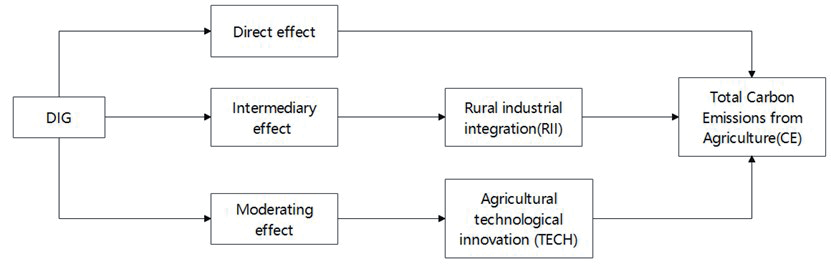
This paper’s marginal contributions are as follows: First, under the new requirements for green development, it examines the effects of the digital economy on agricultural sustainability, furnishing novel empirical data to comprehend the connection between the digital economy and agricultural carbon emissions and to delve into their nonlinear interactions. Secondly, it examines the mechanisms through which the digital economy impacts agricultural carbon emissions from the viewpoint of rural industry integration, shedding light on the principles and pathways involved. Thirdly, it investigates the role of agricultural technological innovation as a moderating factor in the relationship between the digital economy and agricultural carbon emissions, demonstrating that this innovation can amplify the carbon reduction benefits of the digital economy within agriculture. This enhances the current body of literature and supplies new theoretical and empirical insights to bolster the carbon reduction effects of the digital economy within agriculture.
The opening section provides an introduction, offering a brief overview of the paper’s background and significance. The second section encompasses a review of the literature and discusses the study’s limitations. The third section presents the theoretical analysis and hypotheses. The fourth section describes the research design. The fifth section showcases the empirical findings and their interpretation. The sixth section delivers conclusions and policy recommendations.
Literature Review
Research on Agricultural Carbon Emissions
Studies on agricultural carbon emissions are typically grouped into two main categories. One category centers on calculating the carbon emissions produced by agricultural activities. For instance, West and Marland (2002) proposed a calculation method based on fertilizer, pesticide, irrigation, and seed planting [12]. Based on the established carbon emission calculation framework of the IPCC, Liu Yang et al. estimated the agricultural carbon emissions for Shandong Province between 2000 and 2020, factoring in inputs such as agricultural materials, livestock farming, and agricultural soil utilization [13]. Moreover, Tian et al. (2014) estimated China’s agricultural carbon emissions by analyzing energy use, rice production, livestock breeding, and unconventional waste treatment while exploring the underlying mechanisms [14]. The second research direction investigates how various factors influence agricultural carbon emissions. Zhao et al. (2018) used the LMDI model to analyze the impact of water and soil resource development on agricultural carbon emissions, finding that increased resource input generally leads to higher emissions [15]. Similarly, Wang et al. (2022) indicated that land use intensification in agriculture positively promotes carbon emissions [16]. Through these studies, we gain a deep understanding of the sources and drivers of agricultural carbon emissions, thereby aiding in the creation of effective mitigation measures.
Research on the Digital Economy
The research on the digital economy primarily focuses on several important areas. First, the concept of the digital economy has been extensively explored. Tapscott (1996) introduced the concept [17], while Mesenbourg (2001) defined it as encompassing three aspects: supporting infrastructure, e-business processes, and e-commerce transactions [18]. Additionally, Ahmad and Ribarsky (2018) defined the digital economy from a transaction perspective, where any transaction characterized by “digital ordering (e-commerce)” or “digital delivery” falls under the digital economy [19]. The second major area of interest is the measurement of the digital economy. Ahmad et al. (2017) utilized advanced official statistical methods from OECD countries to measure the total volume and structure of the digital economy [20]. Moreover, using relevant indices to measure the digital economy has demonstrated that the digital economy is interdisciplinary [21]. Compared to singular accounting methods, the indicator system provides a more detailed perspective. It not only measures the development of the digital economy but also reflects its impact on socio-economic activities. Examples include the European Union’s Digital Economy and Society Index (DESI) and the International Telecommunication Union’s ICT Development Index (IDI) [22, 23]. Researchers have also developed indicator systems to measure digital economy development. For example, Li and Liu (2021) used the entropy method to construct measures based on digital industry, digital applications, and infrastructure [24]. As stated by Ma and Zhu (2022), urban digital economy development can be measured across four dimensions, including industrial digitalization, digital infrastructure, digital sustainability, and digital industry integration [25]. Finally, the impact of the digital economy has been a significant area of research. According to Meltzer (2019), the use of digital technology can improve trade efficiency, indicating that digital trade will be the direction of future development [26]. Further studies suggest that digital economy development positively influences regional economic growth, innovation efficiency, and total factor productivity [27-29]. Mo et. al. (2023) also pointed out that by optimizing agricultural industrial structures and promoting agricultural technology, green finance helps achieve the goal of agricultural carbon reduction[30]. Chang’s (2022) research indicates that by strengthening farmers’ entrepreneurial abilities and promoting innovation in agricultural technology, digital finance can play a significant role in reducing agricultural carbon emissions [31].
In conclusion, although existing literature extensively explores the digital economy and agricultural carbon emissions as separate topics, there is a lack of studies focusing specifically on their interrelationship. Only a few scholars have indirectly explored the interaction between the two. This study attempts to address this research deficiency by evaluating the development level of the digital economy and analyzing panel data from 31 provinces in China from 2011 to 2021, aiming to verify the impact of the digital economy on agricultural carbon emissions and its mechanisms. However, this study has several limitations. Primarily, the empirical analysis is limited to provincial-level data due to the unavailability of data at the prefectural level. Second, while the study considers six factors – pesticides, plastic film, irrigation, diesel, fertilizers, and tillage – in measuring agricultural carbon emissions, other factors, such as farming practices and crop types, also affect emissions and require further investigation. Lastly, the study selects a series of macro-level variables that may influence agricultural carbon emissions without delving into micro-level factors like residents’ environmental awareness. Future research could involve field surveys to obtain more detailed data for an in-depth analysis.
Theoretical Analysis and Hypotheses
1. The direct effects of the digital economy on agricultural carbon emissions
Based on data and internet technology, the digital economy has emerged as a new economic form during technological innovation and industrial upgrading. It plays an important role in promoting green, low-carbon development and achieving the “dual carbon” goals. While research shows that the internet helps improve environmental quality, it is also important to acknowledge that the digital economy has negative environmental impacts. Some scholars have pointed out that the relationship between the development of the digital economy and carbon emissions is not linear but shows an inverted U-shaped trend [32, 33]. In the agricultural sector, with the improvement of digital rural infrastructure, the integration of the digital economy with the agricultural economy has notably enhanced production efficiency and resource utilization, effectively reducing carbon emissions in the agricultural sector [34]. Farmers can use information technology to implement scientific management methods in agricultural production, accurately manage the production and processing of agricultural products, and optimize the input of agricultural materials. This reduction in the use of production materials, coupled with improved production efficiency, leads to lower carbon emissions from agricultural production.
Therefore, Hypothesis 1 is proposed:
H1: The digital economy exhibits a nonlinear impact on agricultural carbon emissions.
2. The intermediary effect of rural industrial integration
Rural industrial integration development means mutual penetration and combination within agriculture and between agriculture and rural secondary and tertiary industries, thereby forming an innovative agricultural development model. By cross-integrating industries, new business models are generated, extending the agricultural industrial chain and ultimately forming agricultural industrial complexes and consortia, achieving agricultural modernization [35]. During the agricultural modernization process, rural industrial integration leverages new technologies and models to optimize industrial structures, enhance agricultural production levels, and effectively reduce agricultural carbon emissions [36, 37]. On the one hand, the mutual penetration and cross-fusion within rural areas continuously optimize the agricultural industrial structure, establishing new breeding models based on agricultural resource endowments that coordinate the development of food, production materials, and economic crops. Examples include “fish-rice symbiosis,” “shrimp-rice symbiosis,” and “fish-vegetable symbiosis.” These new breeding models not only expand agricultural ecological cycles but also integrate economic and ecological benefits, thereby reducing agricultural carbon emissions. From another perspective, by relying on agricultural ecological resources, these models fully explore and expand the multifunctionality of agriculture, vigorously developing new agricultural industry systems that integrate production, living, and ecological functions, such as rural tourism, leisure agriculture, and popular science education. These new agricultural industry systems blend the core of traditional agriculture with modern agricultural technology, ensuring the efficient use of agricultural resources while also focusing on the sustainable development of agricultural resources and ecosystems, thus further reducing agricultural carbon emissions. To summarize, through the integration of rural industries, not only is the agricultural industrial structure improved and production efficiency enhanced, but it also promotes the harmonious development of agricultural ecology and economic benefits, effectively reducing agricultural carbon emissions. This provides solid support for achieving agricultural modernization and green, low-carbon development. Therefore, Hypothesis 2 is proposed:
H2: Rural industry integration reduces agricultural carbon emissions by enhancing the level of digital economy development.
3. The moderating effect of agricultural technological innovation
Digital platforms provide farmers with an efficient space for information exchange, significantly lowering the costs of information acquisition and sharing. Through networks and mobile devices, farmers can easily access and disseminate necessary agricultural production technology information [38]. The learning, application, and transformation of agricultural technologies often depend on government financial support [39]. The development of digital inclusive finance lowers barriers to financial services and expands coverage, offering broader financial support to farmers, reducing credit constraints, and promoting the implementation and application of agricultural technologies.
Advanced agricultural technology also plays a positive role in the reduction of agricultural carbon emissions [40]. With the development of smart agriculture, resource utilization efficiency in agricultural production has significantly improved, reducing unnecessary energy consumption and greenhouse gas emissions. Agricultural technological innovation is prominently seen in the application of biotechnology, such as the development of genetically modified crops and the use of microbial fertilizers. These technologies not only enhance crop resistance to pests and diseases but also reduce the use of chemical pesticides, thereby decreasing the carbon footprint of agricultural production. Additionally, the resource-based treatment of agricultural waste, such as bioenergy development, offers new solutions for reducing agricultural carbon emissions. Based on this, we propose Hypothesis 3:
H3: Agricultural technological innovation moderates the impact of the digital economy on agricultural carbon emissions.
Experimental
Variable Selection
Dependent Variable: Total Carbon Emissions from Agriculture (CE). This research begins by estimating the carbon emissions from each input factor in agriculture. According to the IPCC calculating method, the main sources of agricultural carbon emissions include pesticides, agricultural plastic film, irrigation water, diesel fuel, fertilizers, and farming activities [41]. The calculation formula is as follows:
In Equation (1), CE denotes the total carbon emissions, while Sijt and Fijt represent the carbon emissions and input quantities from the j-th carbon source in the i-th province (city) in year t. Qj indicates the corresponding carbon emission coefficients for these sources. Specific details are provided in Table 1.
Independent variable: Level of digital economy development (DIG). Taking into account data availability and scientific rigor, we have established an index system to gauge the level of digital economy development (see Table 2). The level is calculated using the entropy method, with specific indicators detailed in Table 2.
Mediating variable: Rural Industrial Integration (RII). A rural industrial integration index system, including 5 primary indicators and 6 secondary indicators (see Table 3), has been established. The entropy method is used to determine the level of rural industrial integration.
Moderating variable: Agricultural Technological Innovation (TECH): Measured by the number of agricultural technology patents (thousand pieces).
Control variables: (1) Rural Human Capital Level (Edu): Calculated as [(Number of illiterate individuals * 0) + (Number of elementary school attendees * 6) + (Number of middle school attendees * 9) + (Number of high school attendees * 12) + (Number of individuals with associate, bachelor, or graduate degrees * 16) / Population aged six and above. (2) Traffic Infrastructure Level (Traffic): Represented by road length per rural population. (3) Degree of Mechanization (Machine): Measured by the ratio of total agricultural machinery power to the workforce in the primary sector. (4) Scale of Agricultural Land Operation (Lscale): Determined by the ratio of the total sown area of crops to the number of workers in the primary sector. (5) Planting Structure (Stru): Expressed as the proportion of grain sown area to the total crop sown area, illustrating a shift towards grain-centric agriculture.
Table 1.
Sources of agricultural carbon emissions and coefficients.
Table 2.
Indicator system for the level of development of the digital economy.
Table 3.
Rural Industrial Integration Indicator System.
Model Specification
Baseline Regression Model
The study establishes a model aimed at analyzing the direct impact of the digital economy on agricultural carbon emissions. Hypothesis 1 is validated using a two-way fixed effects panel model, as described in Equation (2):
Equation (2) shows the direct impact of the digital economy on agricultural carbon emissions, where i represents the province/city and t represents time. CE stands for agricultural carbon emissions, DIG represents the digital economy, and DIG² is the quadratic term of the digital economy. Control stands for a series of potential control variables. β0 is the intercept term, β1-β3 are the regression coefficients for the respective variables, μi represents the province/city fixed effects, γt represents the year-fixed effects, and εit is the random error term.
Mediation Models
To delve deeper into the mechanism through which the digital economy impacts agricultural carbon emissions, a mediation variable is introduced, and stepwise regression analysis is performed. The mediation model is established as follows:
RIIit represents the mediation variable: rural industrial integration. α, β, and δ denote coefficients. μi and γt represent province and year fixed effects, respectively. εit is the random error term.
Moderation Effects Model
To study the moderating role of agricultural technological innovation (TECH) in the impact of the digital economy on agricultural carbon emissions, this research establishes the following moderated effect model.
This study verifies the inverted U-shaped moderating effect by multiplying the moderating variable with both the linear and quadratic terms of the independent variable (DIG). The interaction with the linear term assesses the moderation of the inflection point, while the interaction with the quadratic term evaluates the moderation of the curve’s steepness, flatness, or orientation.
Variable Selection
Given data availability and scientific rigor, this study uses panel data from 31 provinces (excluding Hong Kong, Macau, and Taiwan) in China for the period of 2011-2021. Data sources include the “China Rural Statistical Yearbook,” “China Agricultural Yearbook,” “China Statistical Yearbook,” provincial statistical yearbooks, the EPS database, and the GuoYian Web. Missing data for specific indicators in certain regions and years were addressed using linear interpolation. Descriptive statistics of the data used in this paper are in Table 4. Table 5 shows the full variable annotation table.
Table 4.
Descriptive Statistics.
Table 5.
Variable comment table.
Results and Discussion
Benchmark Regression
The baseline regression results of this study are shown in Table 6, clarifying the impact of the digital economy on agricultural carbon emissions. The Hausman test results strongly reject the null hypothesis, indicating that a fixed effects model should be applied. The study results demonstrate that the coefficients of the digital economy’s linear term are positive and significant, whereas the coefficients of the quadratic term are negative and significant. The U test analysis reveals that the curve’s inflection point is 0.1013, which falls within the digital economy range of [0.0333, 0.2127]. When the digital economy is at its lowest value of 0.0333, the slope of the curve is positive, but when the digital economy reaches its highest value of 0.2127, the slope turns negative. The results indicate that when the digital economy is at its minimum value, the slope is positive. When it is at its maximum value, the slope is negative, validating the inverted U-shaped curve characteristics [42]. The study results support Hypothesis 1 and confirm the Environmental Kuznets Curve (EKC) hypothesis, which posits that environmental pollution increases in the early stages of economic development but decreases after reaching a certain level due to technological advancements and industrial structure optimization. In the beginning, the digital economy drives an increase in agricultural carbon emissions. As the digital economy continues to develop, its effect on increasing agricultural carbon emissions diminishes, ultimately showing a notable carbon reduction effect. The reason might be that in the initial phase of the digital economy, the preliminary adjustment of technology application and resource allocation could cause a short-term rise in agricultural carbon emissions. The adaptation period required for the introduction and promotion of new technologies may temporarily increase energy consumption and reduce production efficiency. As the digital economy continues to advance, the ongoing maturation and optimization of technology will improve resource utilization efficiency and decrease energy consumption, gradually reducing agricultural carbon emissions and showing a significant carbon reduction effect.
Table 6.
Benchmark Regression Result.
Even with the introduction of control variables, the significant positive effect of the linear term and the significant negative effect of the quadratic term of the digital economy on agricultural carbon emissions remain unchanged, confirming the reliability of the inverted U-shaped relationship between the digital economy and agricultural carbon emissions. In the baseline regression analysis, the enhancement of rural human capital and transportation infrastructure has a significantly negative effect on agricultural carbon emissions, which may imply that these improvements increase agricultural efficiency and decrease carbon emissions. The significant positive effect of mechanization level and farm-scale management on carbon emissions may be due to the higher energy consumption and carbon emissions associated with mechanization and large-scale agricultural operations in the short term. The effect of cropping structure on agricultural carbon emissions is not pronounced.
Heterogeneity Analysis
The results of the heterogeneity analysis, shown in Table 7, indicate significant differences in the impact of the digital economy on agricultural carbon emissions across different regions and agricultural zones. Particularly in the northern region, the development of the digital economy exhibits a significant inverted U-shaped effect on agricultural carbon emissions. Initial technological upgrades and equipment updates increase emissions, but as digital technologies develop and management measures are optimized, emissions gradually decrease. In contrast, in the southern region, the impact of the digital economy on agricultural carbon emissions is not significant, and the inverted U-shaped relationship is weaker, possibly because agricultural production in the south is more dispersed.
The development of the digital economy shows a significant inverted U-shaped effect on agricultural carbon emissions in major grain-producing areas and regions with balanced production and consumption. This reflects that initial improvements in production efficiency increase emissions, but as technology matures and management practices are optimized, emissions begin to decrease. In major grain-consuming areas, the impact of the digital economy on agricultural carbon emissions is not noticeable, possibly because these areas depend more on external supply and market distribution, resulting in fewer agricultural activities.
Influence Mechanism Test
The regression analysis results of the mediation effect show in Table 8 Column (1) that there is a distinct inverted U-shaped relationship between the digital economy and agricultural carbon emissions, indicating that with the growth of the digital economy, agricultural carbon emissions initially increase and then decrease. According to the data in Column (2) of Table 8, the digital economy’s impact on rural industry integration includes a negative first-order coefficient and a positive second-order coefficient, implying a nonlinear dynamic characteristic in the relationship. In the early phases, introducing the digital economy may require considerable investments involving technology, equipment, training, and adapting to new operational models. These investments may increase operational costs in the short term, leading to poor initial performance in industrial integration. As the scale of the digital economy expands, network effects begin to emerge. More farmers and enterprises join the digital economy ecosystem, making information, technology, and market resources more concentrated and efficiently utilized, further promoting rural industrial integration.
Table 7.
Heterogeneity Test.
Table 8.
Mediation Analysis.
In Column (3) of Table 8, when rural industrial integration is used as a mediating variable, the effect of the digital economy on agricultural carbon emissions remains significant, but the coefficient is reduced. This means that rural industrial integration plays a partial mediating role in the relationship between the digital economy and agricultural carbon emissions. The digital economy, through rural industrial integration, optimizes industrial structure and improves production efficiency, thereby reducing carbon emissions in the agricultural production process.
Moderation Effect Test
During the initial phase of digital economy development, agricultural carbon emissions rise, but as the digital economy matures to a certain point, these emissions start to decline. Agricultural technological innovation acts as a significant moderating variable in this relationship. During the initial phase of digital economy development, the negative moderating effect of agricultural technological innovation (interaction term coefficient = -0.3751) indicates that it helps mitigate the initial increase in agricultural carbon emissions. This is because technological innovation leads to more efficient agricultural production methods and resource utilization.
Table 9.
Moderating Effects Estimation.
As the digital economy continues to develop, the positive moderating effect of agricultural technological innovation (interaction term coefficient = 1.8128) facilitates the application and dissemination of low-carbon technologies, further reducing agricultural carbon emissions (see Table 9). This demonstrates that at higher levels of digital economy development, agricultural technological innovation can more fully realize its potential, driving agricultural production towards low-carbon and green practices. Thus, agricultural technological innovation plays a stage-specific moderating role in the inverted U-shaped relationship between the digital economy and agricultural carbon emissions. In the initial stages, it helps to alleviate the rise in carbon emissions due to the digital economy, and in the more mature stages, it effectively promotes the decrease in carbon emissions.
Sensibility Analysis
Adding Control Variables
To reduce bias from omitted variables, additional control variables such as financial support for agriculture were introduced, verifying the robustness of the baseline regression results. As shown in Column (1) of Table 10, the coefficient for the linear term of the digital economy is significantly positive at 1.3795, and the coefficient for the quadratic term is significantly negative at -6.7953, once again proving the robustness of the baseline results.
Excluding Directly Governed Municipalities
Due to significant differences in the development levels of the digital economy and agricultural carbon emissions between municipalities and other regions, we excluded samples from Beijing, Tianjin, Shanghai, and Chongqing to ensure the accuracy of the regression results. As shown in the regression results in Column (2) of Table 10, the coefficient for the linear term of the digital economy is significantly positive at 0.9126, and the coefficient for the quadratic term is significantly negative at -4.1018, further validating the robustness of the baseline results.
Excluding Extreme Values
To handle outliers, the study truncated 1% of the tail from all variables in the baseline regression. After truncation, the regression results in Column (3) of Table 10 show that the coefficient for the linear term of the digital economy is significantly positive at 1.6799, and the coefficient for the quadratic term is significantly negative at -7.8963, further confirming the robustness of the baseline results. Overall, these robustness tests validate Hypothesis 1 and strengthen the argument for the baseline regression results.
Lagged Terms
To consider the potential lagged effects of the digital economy on agricultural carbon emissions, we included one-period lagged variables of the digital economy and its squared term in the regressions. The regression results in Columns (4) of Table 10 show that the coefficients for the one-period lagged variables and its squared term are 1.1552 and -6.2064, respectively, both significant and supporting Hypothesis 1.
Table 10.
Robustness test results.
Endogeneity Test
Given the potential inertia in agricultural carbon emissions, where historical levels may affect current outcomes, we introduced the lagged dependent variable of agricultural carbon emissions into a dynamic panel model. This approach helps mitigate potential omitted variable bias and reduces model specification errors. To address the endogeneity of the lagged term, we employed a two-step system GMM strategy. The AR(1) and AR(2) tests for the system GMM are 0.020 and 0.857, respectively, indicating no autocorrelation of the disturbance term. The Hansen test confirms the validity of all instrumental variables, demonstrating the appropriateness of our model and analysis methods. The significant coefficients for the linear and quadratic terms of the digital economy align with the baseline regression results, with a positive linear term and a negative quadratic term, indicating that the baseline model is robust to endogeneity issues. Table 10 presents the estimates from the endogeneity test.
Conclusions
Existing research indicates that the digital economy significantly effects economic growth, poverty alleviation, and reducing urban carbon emissions. This paper empirically examines the impact and mechanisms of the digital economy on agricultural carbon emissions from the perspective of agricultural carbon emissions, using panel data from 31 provinces in China (excluding Hong Kong, Macau, and Taiwan) from 2011 to 2021. The main conclusions include: (1) In terms of regional differences, the digital economy’s impact on agricultural carbon emissions shows a more significant inverted U-shaped trend in northern regions compared to southern regions. Regarding differences in grain production areas, the inverted U-shaped impact of the digital economy on agricultural carbon emissions is more evident in major grain-producing areas and balanced production-consumption areas. (2) The digital economy can impact agricultural carbon emissions through the mediating effect of rural industry integration. (3) The impact of the digital economy on agricultural carbon emissions is moderated by agricultural technological innovation.
(4) Through a series of robustness tests, the existence of a significant inverted U-shaped relationship between the digital economy and agricultural carbon emissions was confirmed.
Based on the above conclusions, the following recommendations are proposed. Firstly, vigorously develop the digital economy to improve the effectiveness of agricultural carbon reduction. Each region should, according to its own circumstances, fully utilize digital technologies, strengthen data empowerment, and maximize the role of data resources in promoting green agricultural development through the digital economy. Specific measures include strengthening the construction of digital infrastructure like household broadband and rural networks, promoting knowledge related to the digital economy, and providing policy guidance. Secondly, take advantage of the opportunities brought by the technological revolution to drive the rapid integration of the digital economy with the agricultural economy. This includes developing smart agriculture, technological agriculture, and digital agriculture, promoting the integration of technology with industry to foster green development and modernization in agriculture and rural areas, thereby establishing a new framework for digital rural development. Thirdly, enhance the role of rural industry integration in promoting agricultural carbon reduction by promoting high-quality development in rural agriculture and optimizing rural industrial structure and resource allocation to effectively curb agricultural carbon emissions. For example, establishing rural cooperatives to integrate resources and promote the integration and synergistic development of the industrial chain, creating economies of scale, and reducing production costs while simultaneously improving resource utilization efficiency and reducing carbon emissions. Lastly, drive the coordinated regional development of the digital economy, especially focusing on the development levels in northern regions and major grain-producing areas. Promote the widespread application of digital technologies in agriculture to enhance their role in carbon reduction efforts. By promoting technological innovation, low-carbon and energy-efficient agricultural production techniques can be adopted, such as precision agriculture, smart irrigation, and biodiversity planting, to reduce energy consumption and carbon emissions in the production process.

