

Introduction
The resourceful utilization of kitchen waste (KW) has emerged as an important research topic due to increasing urbanization and the growing need for sustainable waste management solutions [1-3]. Composting KW is considered an economical and efficient approach to recycling such materials [4]. However, the feedstock inherently contains high levels of salts, which current technological methods struggle to eliminate [5] in order to facilitate its safe application in dryland agricultural production [6]. Current reports in the literature suggest that combining kitchen waste compost (KWC) with other materials to formulate vegetable seedling substrates (SS) provides a rational secondary use of the resource while simultaneously avoiding significant secondary salinization of the soil due to its high salt content [7, 8].
Traditional SS primarily consists of peat as the main component [9]. However, peat, being a non-renewable resource, is no longer suitable for contemporary agricultural production processes that emphasize sustainability [10]. Numerous researchers have conducted extensive experiments on developing novel, renewable SS, particularly focusing on the use of agricultural waste to formulate SS [11, 12]. Currently, the academic community widely acknowledges that plant-derived waste such as straw is suitable for formulating SS [13, 14], with cow manure compost being the only type of livestock manure to have shown promising results in this application [15, 16].
Compared to agricultural waste, KW has a higher nutrient content [17]; accordingly, composting the latter feedstock through rigorous processes can partially replace peat, meeting both nutrient supply and environmental protection requirements [6]. Our previous research found that when KWC partially replaces peat in SS, several growth indicators of cucumber seedlings improve to varying degrees compared to peat-based substrates [4]. However, simply using KWC to replace peat does not meet the agricultural industry standards for vegetable SS in several aspects. Firstly, the physical structure of KWC can be too dense, compromising root aeration and water infiltration, which are essential for seedling substrate requirements [6]. Secondly, the pH of KWC tends to be unstable, often fluctuating outside the ideal range, which can negatively impact seedling growth [18]. Additionally, the nutrient content of KWC can vary significantly depending on the feedstock, leading to imbalances that may hinder healthy seedling development [19]. Lastly, if KWC is not fully composted or sterilized, it may contain pathogens and weed seeds, increasing the risk of disease and weed infestation. Therefore, simply replacing peat with KWC does not fully comply with the standards required for vegetable SS.
Although previous studies have explored the use of KWC in seedling substrates, there is limited research on the specific ratios of KW compost and agricultural waste that optimize cucumber seedling growth. Furthermore, prior studies have not adequately addressed the challenges posed by high salinity and unstable pH levels in KW compost. Given these challenges, it remains unclear what the optimal ratio of KWC to other agricultural waste – such as straw, rice husk, and peat – would be for the growth of sensitive crops like cucumber, which is highly vulnerable to salt stress. The current study aims to address this gap by exploring how different mixtures of KW compost and agricultural waste affect cucumber seedling growth. The hypothesis driving this research is that an optimal balance of KW compost with other organic components can enhance seedling growth while minimizing the negative effects of salinity and pH fluctuations. At the same time, higher proportions of KW compost are expected to elevate salinity levels, which could detract from root length and overall seedling vigor. By combining KW compost with other materials like rice husks and straw, this study seeks to mitigate those negative effects and establish a substrate formulation that can promote robust seedling growth.
This research differs from previous studies by not only focusing on the nutrient content of KWC but also rigorously examining the physical and chemical properties of the substrates and their impact on cucumber seedling morphology. Through this approach, the study will provide practical insights into how KW compost can be optimized for sustainable agricultural use, offering both environmental benefits and viable solutions for reducing reliance on non-renewable peat resources.
This report is about preliminary screening investigations on the feasibility of KWC replacing peat in the production of cucumber seedlings. The experiments involve formulating SS by mixing KWC at 15% and 30% levels with agricultural organic waste and evaluating the effects of the mixtures on cucumber seedling development. The goal of the investigations is to determine an optimal substrate formulation, providing technical support and a theoretical basis for cucumber transplantation and the resourceful utilization of organic waste.
Experimental
Test Materials
The test crop used in this study is cucumber (Cucumis sativus L.), variety Shenqing No.1. Kitchen waste compost (KWC) was obtained from the Taihu Lake region and fully decomposed through aerobic fermentation at the Taihu Lake Organic Waste Treatment and Utilization Demonstration Center. The main components of the compost are detailed in Table 1. The peat used in the study was purchased from Lvyuan Meijia Agricultural Technology Co., Ltd. The rice straw and rice husks were collected from an ecological farm in the Taihu Lake region and naturally fermented to produce the straw and husk fermentation products. Fresh raw materials were used to prepare the substrates, and their main physical and chemical properties are detailed in Table 2.
Table 1.
Main components of kitchen waste for testing.
| Composition | Rice | Vegetable | Meat | Soybeans | Oil | Salt | Other waste |
|---|---|---|---|---|---|---|---|
| Mass share (%) | 40.11 | 25.73 | 15.82 | 6.16 | 1.94 | 0.57 | 9.67 |
Table 2.
Main physical and chemical properties of raw materials for test substrates.
Experimental Design
A total of seven treatments were set up in the experiment, including the commercial seedling substrate (SS) (CK), T1~T6, and each treatment was replicated three times. The volume-specific gravity of substrate materials corresponding to each treatment is detailed in Table 3.
Seedling Substrate Preparation
According to the design of each treatment described in Table 3, the SS raw materials were proportionally filled into 60 cm x 48 cm x 20 cm plastic pots, mixed well, and 500 g of samples were collected from each treatment for testing.
Sowing and Management
The SS of each treatment was seeded in 50-hole seedling hole trays, with 1 seed per hole, and sown at 0.5 cm from the surface of the substrate. Each treatment was watered uniformly, with 800 mL of water per seedling hole tray and 400 mL of water replenished every 2 d during the test period. It was then placed in an artificial climate chamber at 25ºC with 80% humidity for 15 d.
Measurement Items and Methods
Seedling Growth
Ten days after sowing, the number of emerged cucumber seedlings was counted to calculate the seedling emergence rate and cotyledon emergence rate. Additionally, the leaf area of cucumber seedlings was determined using the leaf area coefficient method [20]. Fifteen days after sowing, fifteen healthy cucumber seedlings per tray were selected for morphological measurements. The height of seedlings was measured using a ruler, while stem diameter was measured using a vernier caliper. Chlorophyll content was determined using a chlorophyll meter, expressed as SPAD values, on fully expanded leaves. The leaf area of cucumber seedlings was also measured. Furthermore, the substrate adhered to the roots of the selected cucumber seedlings was collected using a brush, sealed, and stored at 4ºC for subsequent analysis.
The root length and root surface area of cucumber seedlings were determined using a root scanner. The fresh weight of both aboveground and belowground parts of cucumber seedlings was measured using an electronic balance. Subsequently, samples were dried at 60ºC to a constant weight, and dry weights were recorded to calculate the seedling vigor index. The growth performance of cucumber seedlings under different substrate compositions was evaluated using the membership function method [21]. Higher membership values indicate better growth of cucumber seedlings under the respective substrate composition. The membership values and seedling strong index were calculated using the following formulas:
Table 3.
Volumetric weight of raw materials in seedling substrate for each treatment.
| Treatment | Kitchen waste | Peat | Fermented straw | Fermented rice husk |
|---|---|---|---|---|
| T1 | 15 | 45 | 40 | 0 |
| T2 | 15 | 45 | 0 | 40 |
| T3 | 15 | 45 | 20 | 20 |
| T4 | 30 | 30 | 40 | 0 |
| T5 | 30 | 30 | 0 | 40 |
| T6 | 30 | 30 | 20 | 20 |
Where i denotes the treatment and j denotes the seedling growth indicator; Xij denotes the measured value of the j indicator under treatment i; Xjmax denotes the maximum value of the j indicator in each treatment; and Xjmin denotes the minimum value of the j indicator in each treatment.
Chemical Property
The substrate adhering to cucumber seedlings was air-dried, ground, and sieved through a 2 mm mesh, following the methods specified in the agricultural industry standard “NY/T 2118-2012 Vegetable Seedling Substrate” [4]. The chemical properties of the substrate were then determined, including pH value, EC value, and contents of alkali-hydrolyzable nitrogen, available phosphorus, quick-acting potassium, and organic matter, in accordance with the aforementioned standard.
Physical Property
According to the agricultural industry standard NY/T 2118-2012, we measured the bulk density, relative water content, total porosity, air-filled porosity, and water-holding porosity of the substrate samples. Select a 200 mL ring cutter with a bottom cover and weigh the empty ring cutter to record its mass as M0. Uniformly fill the fresh substrate sample into the ring cutter and weigh the ring cutter with the substrate to record its mass as M1. Dry the ring cutter with the substrate at 105ºC for 4 h. After naturally cooling in a desiccator for 4 h, weigh the ring cutter with the dried substrate and record the mass as M2. Pack the air-dried substrate sample into the ring cutter to the same compactness as during seedling cultivation and cover it with a perforated top cover. Weigh this setup and record the mass as M3. Place the ring cutter in clean water and soak it for 24 h, then weigh it again and record the mass as M4. Set the ring cutter on a funnel lined with filter paper to drain naturally for 3 h, then weigh it and record the mass as M5. The specific calculation methods for the measured indices are as follows:
Quantitative Fluorescence Analysis of Fusarium spp.
Cucumber seedlings attached to nursery substrates were utilized as analysis samples. The genomic DNA of the samples was extracted using the CTAB method and served as the template for qPCR. The extracted DNA was eluted in 40 μL of Tris-HCl buffer (pH 8.0) and stored at -20ºC for subsequent analysis. Real-time qPCR analysis was performed using specific primers ITS-Fu-f and ITS-Fu-r targeting the fungus Fusarium oxysporum. The amplification protocol was adapted from Meng et al. [22].
Data Statistics and Analysis
Using DPS 18.1 software [23], the trial’s raw data were submitted to a one-way ANOVA after being tallied using Excel 2019.
Results
Physical Property
Based on the data presented in Table 4, a detailed analysis of the physical properties of seedling substrates (SS) under different treatments was conducted, covering bulk density, relative water content, total porosity, air porosity, and water-holding porosity. The results indicate that T3 had the lowest bulk density at 0.36±0.02 g·cm-3, significantly lower than other treatments, while CK exhibited the highest bulk density at 0.44±0.04 g·cm-3. In terms of relative water content, T4 demonstrated the highest value at 37.08±1.51%, significantly higher than CK and T6, with T6 showing the lowest relative water content at 31.26±3.01%. For total porosity, T1 had the highest value at 0.85±0.01%, significantly exceeding T2 and T3, while T5 had the lowest total porosity at 0.70±0.02%. Additionally, air porosity analysis revealed that T5 had the highest air porosity at 0.24±0.02%, whereas T2 had the lowest at 0.18±0.02%. The water-holding porosity was highest in T1 at 0.66±0.06%, significantly higher than in T6, which had the lowest value at 0.53±0.01%. Overall, these data indicate that the different treatments had a significant impact on the physical properties of the SS, with notable differences across the various parameters, potentially influencing the growth environment and performance of the seedlings.
Table 4.
Physical properties of seedling substrates of different treatments.
Chemical Property
Previous studies have indicated that a pH range of 5.5-7.5 and an EC (electrical conductivity) below 2.5 mS·cm-1 are optimal for crop seedling growth. As shown in Table 5, the pH and EC values for both CK and T2 treatments fall within the ideal range for seedling growth. The CK treatment exhibits significantly lower pH and EC values compared to the T2 treatment (P<0.05), with the pH decreasing by 25.48% and the EC by 271.43% relative to the T2 treatment. In terms of chloride ion content, previous research has shown that cucumber seedling growth is significantly inhibited when the chloride ion content in the soil exceeds 0.06%. In this experiment, the chloride ion content was lowest in both CK and T2 treatments, with T2 showing a significantly higher value than CK (P<0.05). This increase in chloride ion content in the T2 treatment is attributed to the higher salt content in the kitchen waste compost (KWC), which raises the chloride levels in the seedling substrate (SS). Humic acid plays a crucial role in promoting cucumber seed germination and nutrient uptake, making its content a key indicator of SS quality. In this study, the CK treatment had the lowest humic acid content, while there were no significant differences in humic acid content among the T1-T3 treatments. The highest humic acid content was observed in the T4-T6 treatments, which is likely due to the higher addition rates of KWC in these treatments, as KWC inherently contains a substantial amount of humic acid.
Nutrient Contents
Based on the data presented in Table 6, an analysis of the nutrient contents in seedling substrates under different treatments was conducted, focusing on available nitrogen (Ava.N), available phosphorus (Ava.P), available potassium (Ava.K), and organic matter content. The results indicate that different treatments significantly influenced the nutrient content of the seedling substrates. For Ava.N, the T5 treatment had the highest content at 1705.37±12.10 mg·kg-1, which was significantly higher than that of the other treatments. In contrast, the CK treatment had the lowest Ava.N content at 497.70±17.23 mg·kg-1. In terms of Ava.P, T5 also showed the highest content at 268.00±13.87 mg·kg-1, markedly higher than CK, which had only 97.20±3.85 mg·kg-1. Similarly, the Ava.K content was highest in the T5 treatment at 3186.14±206.13 mg·kg-1, while CK had the lowest Ava.K content at 596.25±41.83 mg·kg-1. Regarding organic matter content, T5 again demonstrated the highest value at 34.55±3.08%, slightly lower than CK, which had 35.21±1.02%. Although CK showed a relatively high organic matter content, the significantly higher nutrient contents in T5 suggest that it may offer greater potential to support plant growth by providing more abundant nutrients.
Table 5.
Chemical properties of seedling substrates of different treatments.
Table 6.
Nutrient contents of seedling substrates of different treatments.
Seedling Growth
As shown in Table 7, different seedling substrates (SS) had a significant impact on the growth of cucumber seedlings. According to the agricultural industry standard “NY/T 2118-2012”, the germination rate of vegetable SS should not be less than 90%, and all treatments meet this industry standard. When the same proportions of rice husk and straw were added, except for chlorophyll content, the growth indicators of cucumber seedlings in the substrate with 25% KWC were significantly higher than those in the substrate with 50% KWC. Specifically, leaf area, total root length, total root area, aboveground fresh weight, aboveground dry weight, and seedling vigor index all reached significant levels of difference (P<0.05). This indicates that a 25% addition of KWC to the substrate promotes the growth of cucumber seedlings, though the proportions of rice husk and straw still have a considerable impact. For the T1 treatment, plant height and chlorophyll content were higher than those in the T2 and T3 treatments, but the differences were not statistically significant. In the T2 treatment, leaf area, total root length, total root area, aboveground fresh weight, aboveground dry weight, belowground fresh weight, and belowground dry weight were all higher than those in the T1 and T3 treatments, with total root length, total root area, aboveground dry weight, belowground fresh weight, and belowground dry weight showing significant differences (P<0.05). The T3 treatment had a higher stem diameter compared to the T1 and T2 treatments, but this difference was not significant.
Table 7.
Growth of cucumber seedlings in different treatments of nursery substrates.
In summary, and based on the seedling vigor index, the T2 treatment resulted in the optimal growth state for cucumber seedlings among all the treatments. Comparing the T2 treatment with the CK (control) treatment, it was found that except for plant height, chlorophyll content, and aboveground dry weight, the CK treatment had higher values in the other growth indicators and the seedling vigor index compared to the T2 treatment, but these differences were not statistically significant.
Comprehensive Evaluation of Seedling Growth
By applying the membership function method to the growth index data of cucumber seedlings in different treatments of seedling substrates (SS) in Table 7, the membership values for various growth indicators under each treatment were obtained, as shown in Table 8. The average membership value for the CK treatment was 10.61, which was the highest among all treatments, indicating that cucumber seedlings grew best in the CK treatment seedling substrate. The second highest was the T2 treatment, with an average membership value of 9.33, surpassing the other experimental treatments. The treatment with the lowest average membership value was T4, with a value of 2.00. The comprehensive ranking of average membership values for the SS in each treatment was as follows: CK>T2>T3>T1>T5>T6>T4.
When the same proportions of rice husk and straw were added, the average membership values of the SS with 25% KWC addition were higher than those with 50% KWC addition. This indicates that SS with 25% KWC addition had better seedling effects compared to those with 50% KWC addition. Among the seedling substrates with 25% KWC addition, the T2 treatment had a higher average membership value than the T1 and T3 treatments, indicating that a 40% addition of rice husk was most suitable for the growth of cucumber seedlings.
Microbiological Content of Fusarium spp.
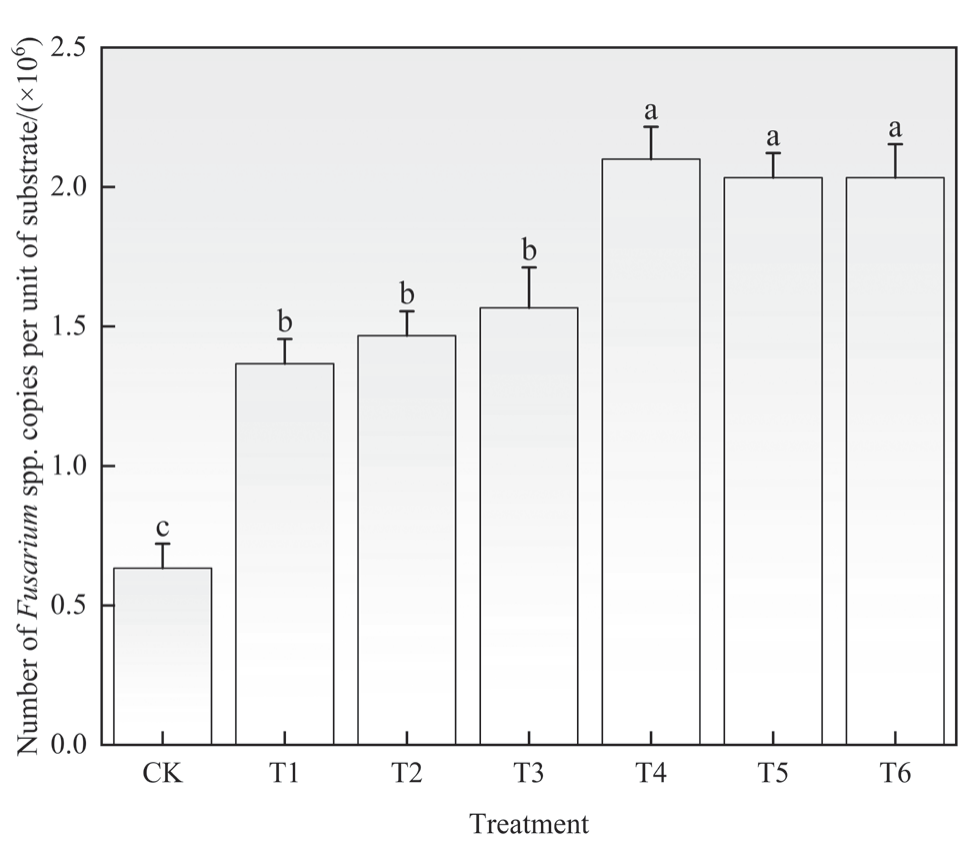
The microorganisms of the Fusarium genus are significant contributors to various soilborne diseases, including wilt disease, in cucumbers. From Fig. 1, it can be observed that the Fusarium genus content in the CK treatment is the lowest, likely due to the sterilization process added during the commercial seedling substrate’s production. Meanwhile, the Fusarium genus content in T1, T2, and T3 treatments, although higher than in the CK treatment, is significantly lower than in T4, T5, and T6 treatments (P<0.05).
Discussion
Beneficial utilization of organic waste resources has recently been receiving intense research attention, especially in contexts of resource sustainability, energy security, and climate change [24-26]. Transforming organic waste into resources usable by humans has become an urgent issue to address. Various organic wastes derived from plants or animal sources are increasingly being used in agricultural production through their direct field applications to soil or their use as composts [27]. Kitchen waste (KW) is a waste stream that has arguably received most of the current attention for beneficial utilization, largely because of its contents of plant nutrient elements. However, incorporating KW into agricultural production is relatively challenging due to its complex physicochemical properties and composition, which vary significantly depending on region, culture, and economy. This makes it difficult to standardize large-scale resource treatment for agricultural use.
Table 8.
Comprehensive evaluation of growth indexes of cucumber seedlings.
Fig. 1.
The microbial content of Fusarium in post-sedimentation substrates. Note: Different lowercase letters represent significant differences (P<0.05).
One recommendation for rendering KW utilizable in agricultural production involves composting to produce KWC. However, current composting processes of KW still result in composts with high salt content, which is detrimental to crop growth and soil properties, particularly for dryland and its crops [28]. In our experiment, when the addition of KWC reached 15%, the chloride ion concentration in the seedling substrate was already 0.06%, which showed a certain inhibitory effect on cucumber seedling growth. As a result of such detrimental effects, relatively few reports exist in the literature on the application of KWC in vegetable production. The limited number of such reports focus on rice because the aquatic environment of rice can significantly dilute the salts in KWC, thus not significantly inhibiting rice growth [29].
To avoid the inhibitory effects on crop growth when high-salt KWC is applied directly to soil, some investigators have successfully combined KWC with other organic wastes for applications in the field [30]. Besides direct application as fertilizer, using organic waste to prepare seedling substrates (SS) is also an ideal utilization method. In the context of increasingly scarce peat resources, high-quality and efficient vegetable SS are urgently needed in agricultural production [31]. Organic waste itself contains a large amount of nutrients, which can provide sufficient nutrition for crops during the seedling stage. The nutrient content of the SS in this experiment was sufficient but did not fully meet the requirements of the agricultural industry standard “NY/T 2118-2012”. However, based on local characteristics and cost-saving principles, the SS in this experiment met the requirements of three local standards, including “DB65/T 3376-2012”, regarding vegetable SS. Similarly, studies on preparing vegetable SS using compost from livestock manure have also found nutrient contents exceeding industry standards. Although the nutrient content of the SS in this experiment exceeded industry standards, no seedling burn occurred due to excessive nutrients during the experiment, ensuring the safety of the SS for cucumber seedlings.
The germination and growth of cucumber seeds are the most direct indicators of the quality of SS [32]. In this experiment, the emergence rate of cucumber seedlings in all treatments exceeded 90%, meeting industry standards. Based on various growth indicators of seedlings and comprehensive evaluation using the membership function method, the T2 treatment was the most suitable for cucumber seedling growth. This treatment had lower pH, EC value, and chloride ion content compared to other treatments but remained higher than the control treatment. Previous studies have shown that pH, EC value, and chloride ion content of SS are crucial factors affecting cucumber seedling growth. Higher pH can be adjusted by adding agricultural amino acids; a higher EC value can be regulated by adding zeolite minerals with high cation exchange capacity. Currently, there is no low-cost and efficient method to completely remove the high chloride ion content in KW. The chloride ions in SS with KWC mainly threaten cucumber seedling growth but have less impact on soil compared to the direct application of KWC. Therefore, adding exogenous substances to SS can alleviate or even eliminate the stress of chloride ions on cucumber seedling growth [6]. Ideal exogenous substances include brassinolide compounds and organosilicon, which can not only enhance the stress resistance of cucumber seedlings but also significantly promote their growth.
Conclusions
In summary, the seedling substrate composed of 15% kitchen waste compost (KWC), 45% peat, and 40% fermented rice husk proved to be the most suitable for the growth of cucumber seedlings. However, the high salinity and alkalinity of the KWC remain critical challenges affecting cucumber seedling growth. It is recommended that future research integrate findings from studies on cucumber salt tolerance to optimize the seedling substrate further, including KWC. Beyond its agricultural applications, the reuse of kitchen waste in seedling substrates presents significant opportunities for several sectors. The agriculture sector can directly benefit by reducing its reliance on non-renewable resources like peat, which contributes to environmental degradation. Waste management companies could capitalize on converting organic waste into valuable compost products, promoting a circular economy. Additionally, the horticulture and landscaping industries could adopt these substrates for sustainable plant cultivation, further expanding the market for organic waste-derived products. To support these developments, investment in waste treatment facilities that specialize in producing high-quality compost from kitchen waste is essential. This includes funding for research and development to improve composting technologies that reduce salinity and enhance the nutrient balance of the resulting products. Governments and private sectors should also consider investments in infrastructure for the collection and processing of kitchen waste, as well as promoting public-private partnerships to foster innovation in sustainable agricultural practices. By addressing these challenges and investing in the necessary infrastructure, the reuse of kitchen waste has the potential to transform waste management systems and support sustainable agriculture, benefiting both the environment and the economy.

