

Introduction
The circular economy is a current European and global phenomenon that is gaining increasing attention, especially after the adoption of the new European Commission Action Plan in 2015. This Action Plan is also largely focused on municipal waste and sets specific and ambitious long-term targets for municipal waste management. These targets will become legally binding for Czech municipalities, whose current practice in the field of circular management is very limited, both in terms of volume and structure of municipal waste. Waste management is a specific area of the national economy which has not been subject to standard market mechanisms for many years as it is typical of many other publicly or privately provided services. The waste management system is, by the very nature of the activity, very rigid in some respects, which is reflected in the activities of all public and private stakeholders, not only in waste management, but also in other environmental segments. This area is heavily regulated by various legislative, financial, technical, and other constraints. The actors of the waste management system and the actors of the circular economy include: waste producers, municipalities, producers, sellers, distributors, waste prevention, and other service providers, waste management entities, and entities indirectly involved in waste management [1]. The perception of the functions of the individual actors of the integrated waste management system (circular economy) is crucial regarding the subsequent evaluation of the expenditure on waste management and municipal waste management of the municipalities of the Czech Republic and their efficiency, as well as with regard to the transition to the circular economy.
In accordance with the priorities of the European Union in the field of waste management, in the last ten years there has been an increasing discussion on how to implement and subsequently enforce the principles and mechanisms that will make it possible to prevent the generation of large amounts of waste in the Czech Republic. It is necessary to realize that the implementation of any fundamental changes will have an indisputable impact on the national economy as a whole, but also on the waste management sector itself in the area of supplier-customer relations.
Kadam and Sarawade [2] also addressed the process of solid waste management and disposal in Indian villages in relation to treatment options.
While the authors Gupta, Yadav, and Kumar [3] studied Indian cities and monitored waste management using the MSW flowchart, only 6-7 % of MSW is converted into compost and the rest is disposed of in landfills.
It is important to note that waste creates a public health problem in India [4]. The composting process or energy recovery is becoming a suitable alternative to waste final treatment [5].
The way waste is selected and managed can be linked to various demographic factors, such as education level, house size, or individual age [6]. In developing countries [7] the reuse of objects is seen as a fundamental aspect of sustainable development before reducing consumption or recycling itself. This is mainly because waste is perceived as valuable and can therefore be a source of income [8].
Approximately 50% of manufactured plastic items are for single use and only 20% to 25% for long-term use [9]. As the use of plastic materials has increased, so has the amount of waste produced [10].
Alzubi [11] studied the natural processes of disposal of rubber waste, which has a negative impact on the environment. One possible solution was to recycle rubber as an aggregate in concrete mixtures.
While Ovedele [12] was trying to outline suitable sites for landfills in the Ado-Ekiti basement complex in southwestern Nigeria. The study was based on the maximum likelihood algorithm in ArcGIS 10.2.2.
Budijati’s study [13] examined the determinants of the intention of informal actors to cooperate with formal ones in the management of used mobile phones. Data were collected using questionnaires distributed to used market participants in five districts in a special area of Yogyakarta province. By using regression analysis and structural equation modeling at the provincial level, it was found that government support and finance play an important role in the cooperation of the actors concerned.
The aim is not to compare approaches to waste management in different countries, but to offer representatives of municipalities a functional system that will respect local conditions, and will be clearly graspable and applicable in the given target group of municipalities.
Activities in waste management can be classified into two categories. The first category is the prevention phase. This category is preferred by both Czech and European waste law. With the accession of the Czech Republic to the EU, the need to harmonize the Czech waste management legislation with the requirements of European waste legislation arose, Act No. 185/2001 Coll., on waste and amending certain other acts, was adopted. In 2013, the Waste Act was amended by Amendment No. 169/2013 Coll. (hereinafter referred to as the “Amendment”). The main aim of the amendment was to eliminate legislative-technical deficiencies. These modifications had a major impact on the orientation in the legal provisions, especially for the addressees themselves, while the second category focused on the cooperation of the operator with the public administration.
Municipalities and cities play a key role in managing the waste produced by households in their area. Each municipality must determine at least how mixed and hazardous waste will be disposed of in the municipality, how paper, plastics, glass, metals will be sorted, and whether vegetable bio-waste will be sorted or composted. Since the municipality has the right to charge people money for these services, it is in the interest of the municipal representatives and the population that the whole system is functional and efficient.
The main problem of municipal waste management in the Czech Republic is the high production of mixed waste. The Czech Republic currently produces about 100 kg more of this waste per capita per year than, for example, countries like Austria or Germany.
There are several reasons for the higher production of mixed waste. In particular, a lot of European countries started to reduce the production of mixed waste as early as the beginning of the 1990s. Another reason is that households in the Czech Republic burn more coal than in Western European countries.
As a result of the high production of mixed waste, we are not complying with the requirements of the Landfill Directive to reduce the disposal of biodegradable waste in landfills (in 2023 we should only landfill about 80 kg of mixed waste per capita per year). In response to this situation (non-compliance with the Directive), the Czech Parliament has adopted a ban on landfilling of this waste starting from 2024. To implement this ban, a significant increase in the landfill tax is being prepared. Only biologically stable waste with low calorific value will be landfilled.
Current research and literature sources do not address what specific practices and actions to implement in the field of municipal waste management in the municipalities in accordance with the environment.
Municipalities and towns are obliged to take over all municipal waste generated in their territory during the activities of non-entrepreneurial natural persons and must designate places for separate concentration of municipal waste. Separately concentrated components of municipal waste include hazardous waste, paper, plastics, glass, metals, bio-waste and edible oils and fats. From the 1st of January 2025, also textiles. Separate concentration of municipal waste components can be ensured by the municipality not only through collection containers for sorted waste, but also, for example, by a bag method of collection or by specifying a place for the disposal of individual components of municipal waste within the collection yard. The effectiveness of public service provision is currently still a burning issue, both in terms of theory and practice [14]. Notwithstanding this broad discussion, there is no general consensus as to whether local governments should prefer to provide their services as producers or providers.
Municipal waste management therefore requires a more complex system, including an efficient system of collection, sorting, and proper monitoring of waste flows, while active involvement of citizens and adaptation of infrastructure to the specific composition of this waste is also important. Equally important is a sophisticated financing system for the management of MWM. Countries that have effective municipal waste management systems tend to have better overall waste management results, including high recycling rates.
The research evaluates the current state of waste management production in the selected municipality and, based on the analysis, a proposal can be made for the future optimization of the network of municipal waste management facilities for locally operating public entities. Most often, these are municipal companies established to manage the municipality’s assets, including (or only) waste management. The most typical example is the so-called “technical services of the municipality”.
A systemic waste management solution requires the concentration of fragmented markets into larger units. For these reasons, waste flows need to be addressed at a higher territorial level. Within micro-regions or voluntary associations of municipalities (hereinafter the Czech abbreviation DSOs will be used), there may already be sufficient individual waste streams for treatment technology. Currently, there is no unified waste management system in the Czech Republic in the concerned municipalities.
The research study analyzes specific waste management data of a selected municipality as a decision support tool to allocate potential waste production and meet EU targets. There is no indication in the existing research, how municipalities should approach the reduction of MWM production and waste prevention using economic and legislative information and incentive tools.
The village of Radkovy counts 159 inhabitants and is part of the Moštěnka microregion and occupies a cadastral area of 253 ha. The municipality is obliged to annually prepare a generally binding municipal decree on the establishment of a system of collection, collection, transport, sorting, recovery and disposal of municipal waste (hereinafter referred to as OZV).
Materials and Methods
Triple Exponential Smoothing Methodology
To predict the future development of the amount of waste, we will use the Holt–Winters’ seasonal triple extermination method for given time series. We will use forecasting functions such as FORECAST. ETS [15] was implemented in Microsoft Excel. These functions are based on the ETS algorithm, namely in the AAA version; it is therefore a Holt–Winters’ additive model, which we will explain below.
Forecasts made using exponential smoothing methods are weighted averages of past observations, with weights decreasing exponentially as the observations get older. In other words, the more recent the observation, the higher its weight. The simplest method of exponential smoothing is simple exponential smoothing, where there is a smoothing parameter (base value) assigning weights to individual observations. For older observations, the weights fall faster the higher the coefficient α. However, this method is only suitable for time series that do not show any trend or seasonality, which is a significant limitation. A more advanced method is double exponential smoothing, where, in addition to parameter α, there is also a smoothing parameter for trend β (trend value). Double exponential smoothing is suitable for time series with a linear trend, but still without seasonal influences. This deficiency was eliminated by further extending the method to triple exponential smoothing, where we already have a total of three smoothing parameters α, β, and γ. Here, it is the smoothing parameter for seasonality and is called seasonality value.
The basic equations for calculating the Holt–Winters additive model of exponential smoothing [16] are:
overall smoothing,
trend smoothing,
seasonal smoothing,
forecast.
Where:
The quality of the forecast is evaluated using the forecast error [17], which is the difference between the observed value and its forecast, i.e.
These errors
The first group of errors is composed of scale-dependent errors, which are at the same scale as the data. Mean squared error (MSE), root mean squared error (RMSE) and mean absolute error (MAE) are used here.
If we want to compare the quality of forecasts between time series with different units, it is not possible to use the previous scale-dependent errors. In this case, we can use another type of errors, namely percentage errors that do not contain units. This group of errors includes, for example, symmetric mean absolute percentage error (SMAPE).
An alternative to percentage errors for comparing forecast accuracy across time series with different units is scaled errors, which include mean absolute scaled error (MASE).
where L is the length of the season and in the case of a non-seasonal time series we put L = 1.
The above errors (RMSE, MAE, SMAPE, MASE) are contained in the Excel function FORECAST. ETS. STAT, which we will use to determine the accuracy of the prediction.
The key task in triple exponential smoothing is to find the appropriate values of the weighting coefficients, and so that the prediction error is as low as possible. The usual goal is to minimize the MSE or RMSE error, which is the same task. It is a non-linear optimization problem, the solution of which is usually part of software packages for forecasting. The algorithms first choose the initial value of the search parameters α, β and γ, and then iteratively optimize their values so that their combination shows as little prediction error as possible [18].
Example: The following dataset represents 24 observations of quarterly store sales over 6 years (see Table 1).
Using triple exponential smoothing, let us predict sales in the next two years. To do this, we use the Holt– Winters additive model, realized by functions such as FORECAST. ETS (see Fig. 1).
From the graph in Fig. 1 we can see that a given quarterly time series has a linearly increasing trend and an obvious annual seasonality (L = 4). The sales forecast from period 25 (first quarter 2022) to period 32 (fourth quarter 2023) maintains both the current trend and seasonality. Furthermore, the optimal values of the smoothing parameters α = 0,9, β = 0 and γ = 0,1. For these values, the forecast errors MASE, SMAPE, MAE, and RMSE sizes are also calculated here.
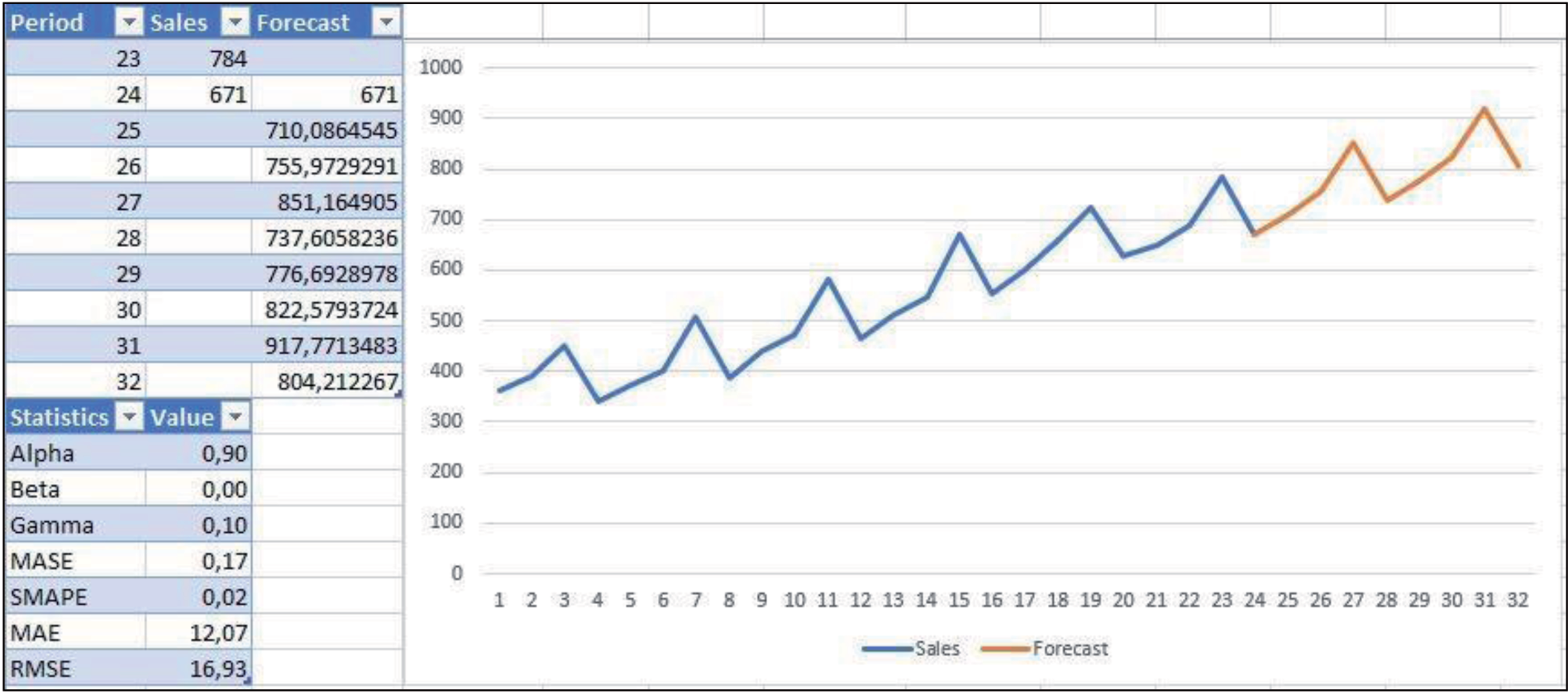
Table 1.
Accounting for quarterly sales of the store for 6 years.
Table 2.
Annual amount of waste collected to the Bystřice landfill in total and from the village of Radkovy.
Forecast
The following table shows the total annual quantities of waste in bins from all municipalities collecting waste to the Bystřice landfill, and also the annual amount of waste in a particular municipality of Radkovy. These data were recorded from 1996 to 2020 (see Table 2).
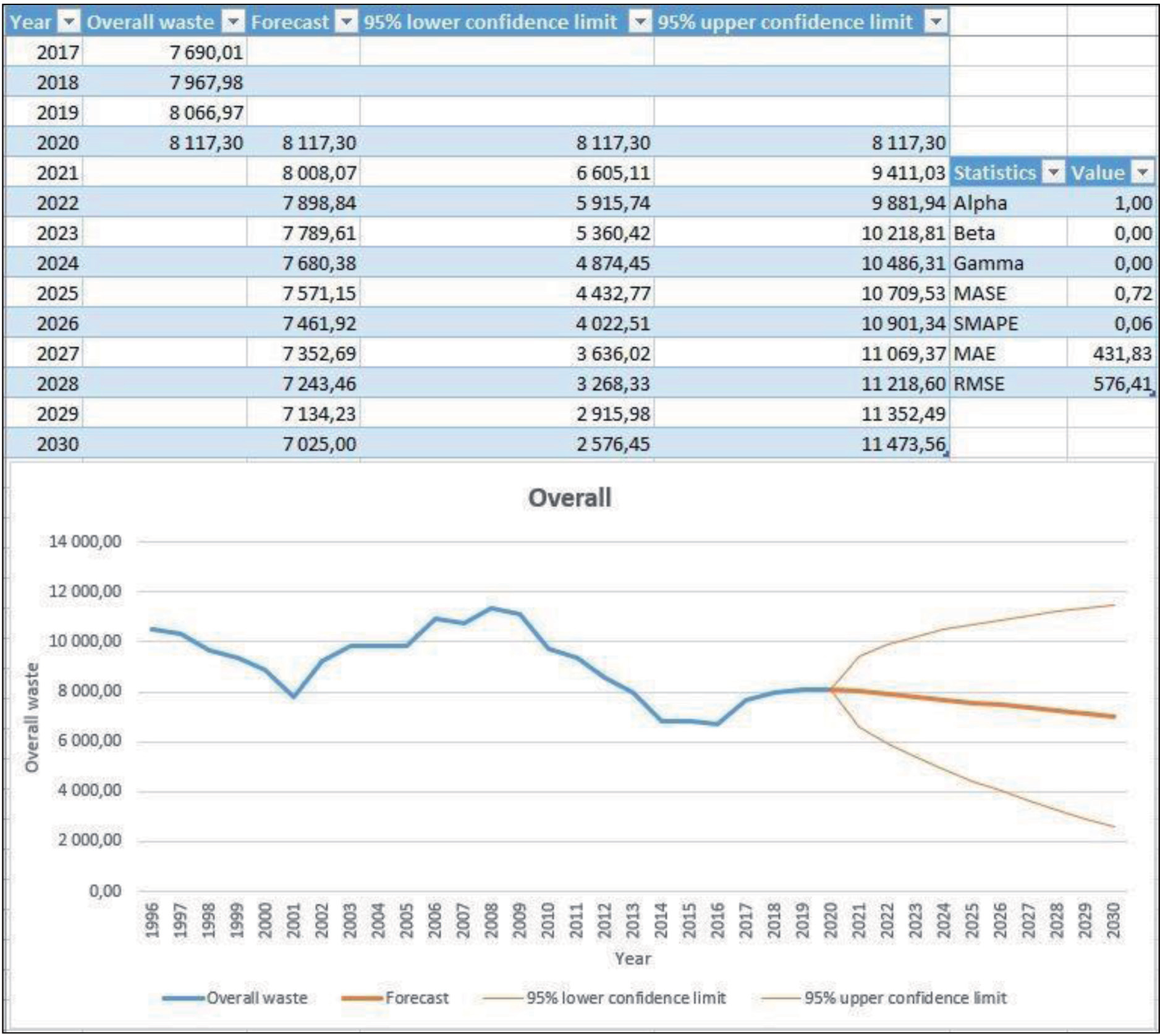
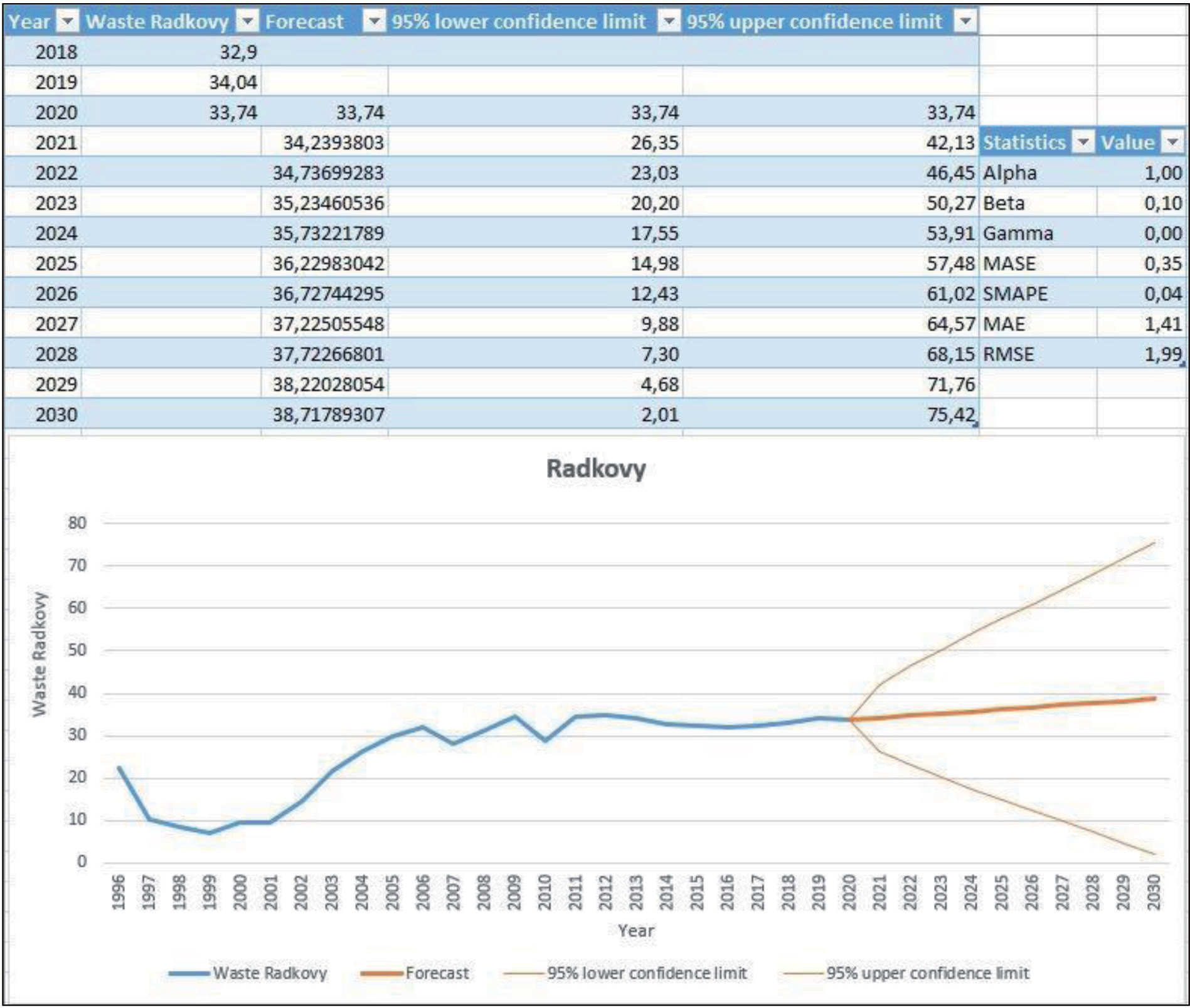
Using triple exponential extermination, we predict the amount of waste (total and in the village of Radkovy) until 2030. The results for the total amount of waste from all relevant municipalities are shown in Fig. 2.
From the graph in Fig. 2 we conclude that the given annual time series is not seasonal. Also, the overall trend cannot be considered linear. This also corresponds to the calculated zero values of the parameters β and γ. For this time frame, it would be enough to use simple exponential smoothing, since due to the absence of a trend it makes no sense to change the zero parameter β and also the parameter γ cannot be non-zero due to the non-seasonality of this time series. In addition, 95% confidence intervals for forecasts in individual years are shown. With a 95% probability, the predicted values will lie between the lower confidence limit and the upper confidence limit. The predicted trend between 2020 and 2030 is slightly downward.
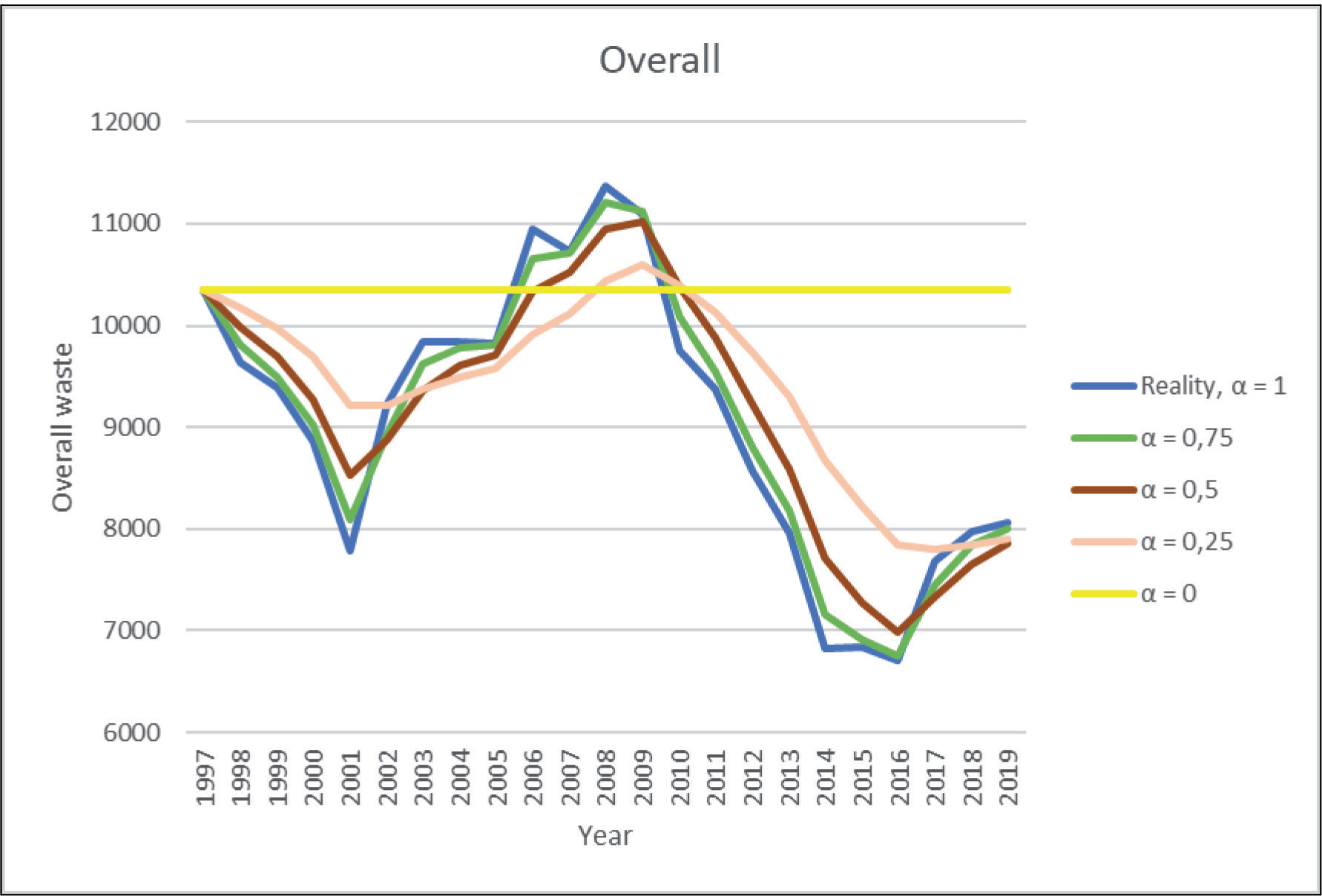
As mentioned in the previous paragraph, it is only meaningful to change the parameter α for this time series. In Fig. 2, we see that the FORECAST.ETS.STAT function has found the optimal value of this parameter α=1 at which (in combination with the choice of β=0 and γ=0) the forecast error is the smallest possible. Thus, one would expect that by changing the parameter α, we achieve more erroneous predictions compared to the choice α=1. This is illustrated in Fig. 3, in which we compared the predictions with reality for different values of the parameter α. The calculated values for these graphs are shown in Table 3.
Table 3.
Total annual amount of waste taken to Bystřice landfill – factual value and forecasts with their errors for different values of parameter α
Results and Discussion
In this article, we evaluated the amount of registered mixed municipal waste in the years 1996–2020, namely in the Bystřice landfill, and also in the specific municipality of Radkovy, which delivers the waste to this landfill. With the help of exponential extermination, the expected development of the amount of waste up to 2030 was also outlined. This prediction could be refined for the coming years if we include more recent data from 2021 and 2022. In this case, our prediction for these two years could be compared with the actual situation.
Another possibility of analysis would be a comparison of our two-time series for the Bystřice landfill and the municipality of Radkovy. For each of these time series, its descriptive characteristics would first be calculated. These would be position characteristics (arithmetic mean, median), characteristics of variability (variance, standard deviation) or measures of dynamics (absolute increments, average absolute increments, relative increments, average relative increments, growth coefficients, average growth coefficients). Subsequently, our two-time series could be compared in terms of variability using a coefficient of variation. To compare these series from the point of view of ska dynamics, the respective growth coefficients, or chain indices, can be converted into basic indices (indices with the same basis), which already allow comparison of different time series. Furthermore, a correlation could be calculated that would characterize the relative degree of dependence in the mutual development of the two series.
Another possible extension of this article could be to focus on sorted waste. Here again, data from the Bystřice landfill would be used, and possibly again for specific municipalities of Radkovy. This would compile a time series for each type of sorted waste, and all these series could again be predicted in the future using the exponential smoothing used in this article. Subsequently, it would be possible to compare the trends of time series for individual types of sorted and mixed municipal waste (both for the municipality of Radkovy and for the entire Bystřice landfill) using the methodology mentioned in the previous paragraph.
Conclusions
The paper presents waste management in a selected municipality in the Czech Republic. It is crucial to carry out further research in the field of municipal waste management and to improve the prevention and recycling of more resources.
Every municipality or city is a waste producer. Each producer must manage its waste in an appropriate manner, in accordance with the legislation in force, and hand it over to an authorized waste management company. A large number of small municipalities produce only small volumes of waste. These individual small quantities must be transported to treatment facilities. Each waste producer usually has its own contractual relationship with an authorized waste manager. There are cases where several producers are linked under one contract. This fragmentation creates space in the market environment for smaller processors. At the same time, fragmentation is a barrier to the conceptual design of a given waste flow. Due to the specific situation and the fragmented market, a large capacity end-of-line facility is only suitable in locations where a certain amount of input waste is provided. A systemic waste management solution requires the concentration of the fragmented market into larger units. For these reasons, waste flows need to be addressed at a higher territorial level. Within micro-regions or voluntary associations of municipalities (hereinafter DSOs), sufficient quantities of individual waste flows may already be generated for treatment technology. In this case, coordinated action by the members of the micro-region or DSO is essential.
It is essential for municipalities to find ways to reduce costs so that their budgets are burdened as little as possible. However, streamlining the functioning of the waste and circular economy, creating and implementing their own strategy for the transition to a circular economy, which would help municipalities meet the goals set by the Waste Act, are proving to be inevitable for municipalities.
The study presents scenarios for the likely development of waste quantities in the coming years. It provides a concrete idea of the likely trend in waste quantities and enables in advance to adjust the number of containers in the localities, the logistics of waste collection, etc.

