

Introduction
With the increasing emphasis on global environmental change research, the distinctive ecology of karst landscapes has received significant attention from academics, government agencies, and various sectors [1]. Karst regions are extensively distributed, comprising approximately 10-15% of the total global land area. Notably, China possesses the largest karst area in the world, contributing to one of the three most significant karst topography concentrations globally [2]. The area of the KNC region encompasses approximately 14% of the total land area of China, which is located primarily in the dolomitic mountainous regions of the Yanshan-Taihang Mountains, with a central focus on Hebei and Shanxi Provinces [3]. The distinctive topography and associated ecosystems developed on carbonate rocks render the karst topography one of the most remarkable landscapes worldwide. It possesses outstanding aesthetic qualities, fulfills an important role in biodiversity conservation efforts, and exhibits various other valuable natural features [4, 5]. These attributes render human intervention crucial to ensure the protection of this unique and vulnerable landscape. Concurrently, karst regions are among the most ecologically fragile and sensitive regions globally, exhibiting characteristics such as fragility, sensitivity, heterogeneity, and a limited natural rehabilitative capacity. The combination of distinctive ecological and geological contexts with irrational human socioeconomic activities constitutes a significant risk factor for soil erosion, the reversal of vegetation succession, biodiversity loss, and other factors that impede the sustainable development of the regional economy and society [6, 7]. Karst ecosystems provide a range of eco-products that are valuable to humans. The realization of this value represents an effective measure to consolidate the achievements of ecological restoration and protection measures, improve the quality of the production-life-ecology triad, and promote rural revitalization [8, 9]. Furthermore, it constitutes an effective interface with sustainable development.
In terms of the interconnections between ecological, social, and economic development and human well-being, the concept of ecosystem services is widely applied on an international scale. In China, a similar concept is that of eco-products. The Chinese government was the first to introduce the concept of eco-products in the 2010 National Plan for Major Functional Areas, defining them as the final products or services resulting from the interaction between the natural production of ecosystems and human activities [10]. Its value is the total value of all types of eco-products and services. Realizing the value of eco-products is an important way to promote sustainable development, including the EPVRM and EPVRP. The process for realizing the value of eco-products encompasses policy, market, and technology mechanisms. It is a mechanism for intervening in the use of various policy tools to establish a means for adapting to the new productivity of the ecological environment [11]. The EPVRP encompasses the realization of the value of eco-products via various mechanisms and pathways, with the objective of achieving economic value. The United Nations Decade of Ecosystem Restoration initiative serves to accelerate the restoration of degraded ecosystems on a global scale. Furthermore, the realization of the value of eco-products can facilitate the process of combating ecosystem degradation, biodiversity loss, and climate disruption and degradation.
The KNC is mainly distributed in the relatively dry and cold climate of Hebei-Shanxi, as the center of the Yanshan-Taihangshan dolomitic mountainous areas. The lithology is carbonate (with mud and silica) with more impurities, often interbedded with clastic rocks, with more seasonal springs and rich underground karst development. Although dry farming (wheat, maize), the loess area is cultivated under better conditions than the southern karst area and can provide more tangible ecological products than the southern karst area, it is still a region with a fragile ecological environment, poor habitats, poor terrain conditions and a relatively backward region in terms of economic and social development. The deterioration in ecosystems, the significant decline in biodiversity, the gradual intensification of soil erosion, and the severity of rocky desertification due to anthropogenic impacts have become pivotal ecological concerns that impede the economic and social advancement of the region. Ecological restoration plays a very important role in ecological development [12]. China has implemented karst forest ecosystem restoration projects via the Three-North Shelter Forestation Project. These ecosystems fulfill pivotal roles in maintaining water resources, soil conservation, and biodiversity. They are the primary providers of eco-products, which are directly linked to the ecological security of the North China Plain [13]. Notably, ecosystem protection and restoration in the KNC region could facilitate the production of superior-quality eco-products, while the realization of the value of karst eco-products is important for the sustainable development of this fragile ecological region. As a consequence, in this study, a literature analysis method was employed to study the realization of the value of eco-products. The aims of this paper are threefold: first, to clarify the development stage of research; second, to explore popular research trends with landmark achievements; and third, to reveal future directions with the key scientific issues to be addressed. This study is important for global research, particularly within the context of North China, regarding the subject of karst ecosystem services.
Methods
In this study, the main databases of the WOS (https://webofscience.clarivate.cn) and the CNKI (https://www.cnki.net, accessed in December 2023) were employed. Given the global universality of the English language and its wide audience, we chose the WOS, which is an authoritative English-language database with high credibility. However, since eco-product value realization occurs mainly in China and since karst ecological management efforts are unique to China, we also included articles from the CNKI, which is the largest literature database of China, in our literature review. The combination of these two databases could provide a more comprehensive picture of the research content.
The following criteria were used to determine the study scope: (1) the research was published in the CNKI and WOS databases; (2) the articles matched the search terms; (3) the articles were published up to December 2023; and (4) the research types included research papers, review papers, master’s theses, doctoral dissertations, and conference papers. The exclusion criteria were as follows: (1) duplicate studies; (2) literature inconsistent with subject matter knowledge; and (3) literature with low relevance to the study object. The specific screening process is shown in the figure below (Fig. 1):
Results and Discussion
Distribution of Literature
By statistically analyzing the number of publications in different years and understanding their temporal distribution, the research trends in this field were determined. The study period was divided into three phases (Fig. 2a): during the first phase (2003-2012), only a small portion of the literature focused on the relevant research areas, with some years without relevant research results. During the second phase (2012-2017), the number of publications increased, but the total number was small. During the third phase (2017-present), the number of studies increased exponentially. This shows that the research potential in this field is considerable and exhibits broad research prospects.
After review and analysis of the retrieved domestic and international studies, they were classified into five categories according to the content (Fig. 2b): EPVA, EPVCRA, EPVRM, EPVRP, and others. The mechanism of eco-product value realization accounted for 34.3% of the total studies, followed by the path of eco-product value realization, accounting for 25.2% of the total studies. Moreover, the evaluation of the conversion rate of the value of eco-products accounted for 17% of the total studies, while the proportions of studies involving the assessment of the value of eco-products and other studies were relatively low, accounting for 12.2% and 11.3%, respectively, of the total studies. Existing research on the mechanism of realizing the value of eco-products and increasing the conversion rate remains at the theoretical stage.
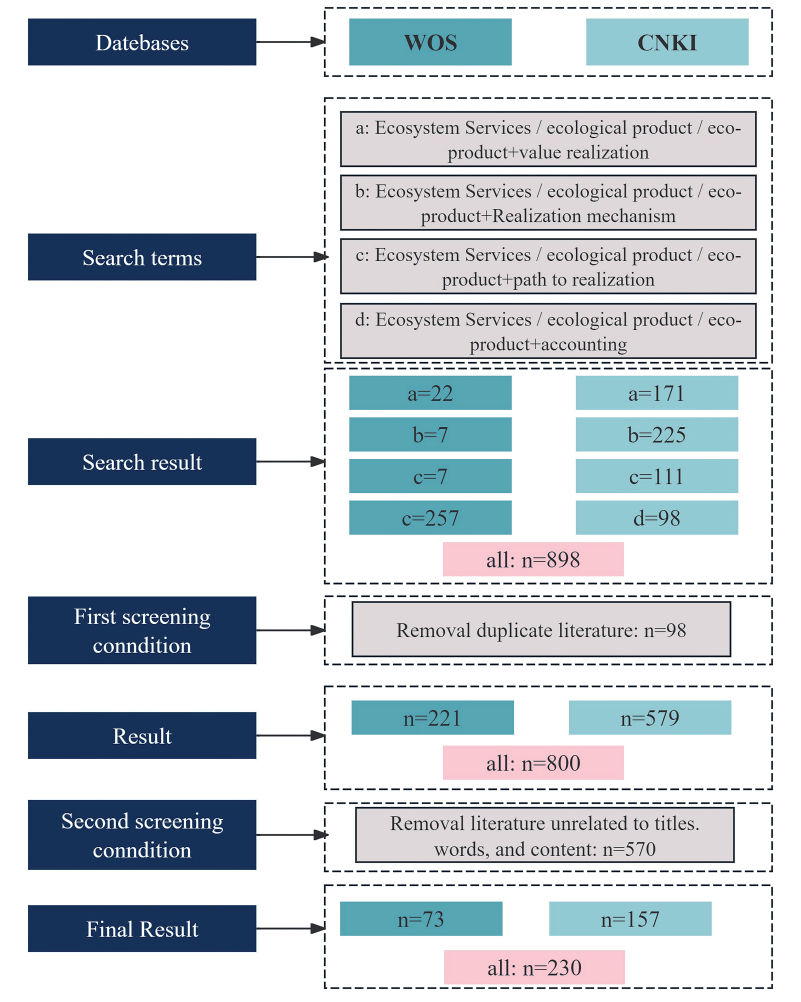
Fig. 2.
Distribution of Literature. a) publication year b) content division c) regional distribution.
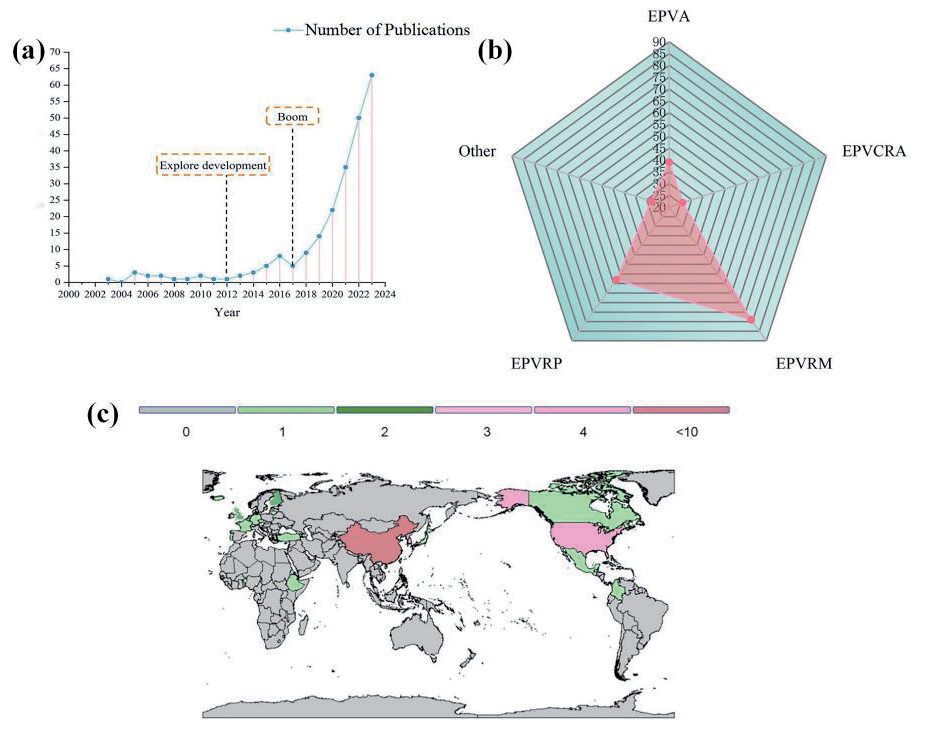
Among the 230 documents reviewed, most studies focused on China, with a minimal number of studies from other countries (Fig. 2c). In China, national-scale studies dominate at present. At the provincial scale, the research on the mechanism of realizing the value of eco-products and increasing the conversion efficiency focused mainly on Beijing, Guizhou, Northeast China, Fujian, Guangxi, the Yangtze River Economic Belt, Zhejiang, and other areas. In terms of the geographical distribution in China, the research areas exhibited two characteristics: a cluster of studies from higher education institutions and research institutes, and a national province-scale pilot for eco-products. A review of the English-language literature revealed that China exhibited the largest number of publications, followed by the United States, whereas other countries, such as Switzerland and Japan, exhibited approximately the same number of publications.
Research Progress
Eco-Product Value Accounting
By exploring the value of eco-products in different regions, the dynamics of eco-products and the differences in value realization across the different regions can be elucidated. In recent years, research interest in the quantitative analysis of the value of eco-products has increased. The Intergovernmental Science-Policy Platform on Biodiversity and Ecosystem Services (IPBES) has conducted a comprehensive assessment of the value and various valuation methods associated with nature, including the presentation of case studies from a range of geographical regions [14]. Sun Chongyang et al. evaluated the value realization of eco-products in 11 cities in Zhejiang Province [15]; Wu Shangyun constructed an evaluation index system for eco-product value realization and conducted an empirical study in Chishui city [16]; Wang Xiaoxin et al. assessed the effectiveness of typical cases of eco-product value realization released by the Ministry of Natural Resources [17]. Given the distinct territoriality of eco-products and the realization of their value as a systematic project involving various aspects and fields, the realization of value varies.
The ecosystems in the KNC region were formed under arid–semiarid conditions, with lower precipitation levels and lower temperatures than those in southern karst ecosystems. Thus, their eco-products are geographically different. The diversification and localization of the EPVA represent significant advancements in the development of a green economy, with a multitude of accounting methodologies serving as the foundation for more regionalized value accounting. An accounting system suitable for the value of eco-products in karst regions can be constructed by drawing on existing results and analyzing them on the basis of the localization parameters of ecosystems, value coefficients, and equivalent substitution methods for nonmarket currencies.
Eco-Product Value Conversion Rate Assessment
Most studies of the value of eco-products primarily focus on theoretical aspects. At present, the primary focus of eco-product research is conceptualization, the establishment of the EPVRM, the assessment of the value of eco-products via the Integrated Valuation of Ecosystem Services and Trade-offs (InVEST) model [18-19], and the exploration of methods for realizing their value. Nevertheless, few quantitative studies have focused on evaluating the effects of transforming the value of eco-products. Zeng Xiangang et al. proposed the concept and classification of eco-products and their market-oriented supply mechanism. They concluded that eco-products can be categorized into four types: national eco-products, regional or watershed-based eco-products, community-based public eco-products, and private eco-products [20]. Gao et al. reported that the realization of the value of eco-products entailed interventions in the behavior of the supplier via policy tools to incentivize decisions that are in the private and public interest [21]. Liu Bern examined the connotation, classification, and institutional framework of the EPVRM [22]. Zeng Xiangang proposed that the EPVRM essentially involves establishing production relationships compatible with the ecological force of the ecological environment and that different types of eco-products exhibit distinct mechanisms and paths for realizing their value [23]. Himes-Cornell et al. [24] performed a valuation of salt marshes and mangrove forests, while Richter et al. [25] evaluated grasslands. Costanza et al. [26] assessed the value of coastal wetlands for storm protection, and Shen et al. [27] conducted a valuation of forest carbon mechanisms.
Carbonate rocks are widely distributed in the ecosystems of the KNC region, and karst development is extensive but incomplete and discontinuous [28]. Although there are eco-products provided by natural resources such as forests, shrub forests, gardens, and grasslands, these eco-products are not only scattered but also suffer problems such as difficulty in pricing, value accounting, and market-oriented trading [29], which restricts the effect of transforming the value of eco-products. The mechanism for realizing the value of eco-products requires an in-depth exploration of the conversion of the value of these products.
By starting from an ecological civilization construction perspective, various eco-product value realization systems have been proposed. Ecological economic theory aims to solve ecological environmental issues and other problems in the ecological economic system, balance, revenue, and other definition aspects. Realizing the value of eco-products necessitates coordination with ecology, the environment, resources, the economy, and society as a whole. This can not only satisfy basic human developmental needs [30] but also ensure the reasonable development, utilization, and protection of ecosystems. The concept of sustainable development primarily emphasizes the effective and measured use of nonrenewable resources, thereby maintaining a virtuous cycle of renewable resources and safeguarding the sole living environment of humans. It places sustainability at its core and development as its goal, emphasizing the importance of rational and coordinated management of the human–Earth relationship. Thus, the ecological environment and natural resources can be matched with the process and rate of human development. Although few studies on the effects of transforming the value of eco-products are available, they are not unrelated. Liu Jie, on the basis of the theory of the ecological economy, researched and analyzed the connotations of the type, value, and value transformation of eco-products in Beijing and constructed an evaluation index system for the effect of the conversion of the value of eco-products from the three perspectives of the evaluation index of the value transformation volume, the value volume index and the value transformation rate index [29].
The ecosystems in the KNC region encompass loose soil and exhibit a low soil moisture content, the rocks are susceptible to weathering and fragmentation, and the population pressure is high [31]. The process of realizing the value of eco-products is complicated by the dual constraints of fragile natural and social factors. We should establish a system of evaluation indices belonging to the transformation effect of the value of karst eco-products and employ the transformation rate of the value of the eco-products of different types of ecosystems to evaluate the transformation effect for the eco-product value. The spatial distribution of the transformation level of the value of eco-products across different karst areas should be analyzed. Moreover, the factors that constrain the realization of the value of eco-products should be explored in a more targeted way to formulate a practicable mechanism for value realization.
Eco-Product Value Realization Mechanism
Exploring government- and market-led mechanisms to promote the participation of society as a whole in realising the value of eco-products. Currently, the economic value of eco-products recognized by the market, i.e., the ecological value, has been fully revealed, and the social value has steadily increased, and joint efforts of the government and market have become commonplace [32]. Natural resources are the natural background and the main body of supply of eco-products, and the natural resources sector has become the system provider and important manager of the realization of the value of eco-products [33]. Policies fulfill an indirect role in supplying eco-products and correcting market failures, and policies can provide funding for or compensate for externalities. The main factors influencing the existence of externalities are high transaction costs, poorly defined property rights, information asymmetry, and small market sizes [34, 35]. One or more of these factors may simultaneously lead to an inadequate supply of eco-products [36]. The main difference in policy instruments lies in the use of market-based instruments [37, 38]. Government-led mechanisms face problems such as large gaps in financial resources and inefficient utilization of financial resources. Market-based instruments are increasingly regarded as options for achieving the environmental and economic outcomes demanded by society [39, 40]. However, market-led mechanisms exhibit problems such as the absence of laws and regulations or mandatory policies, insufficient endogenous market dynamics, unclear rules for market establishment and trading, or malfunctioning market regulations [41]. In practical exploration, the realization of the value of eco-products faces institutional and other obstacles, which require us to constantly explore, seek evidence, practice, and summarize. During the development and utilization of natural resources, humans should adhere to natural laws, particularly in fragile ecosystems such as karst areas, thereby emphasizing the harmony between humanity and nature.
From the perspective of realizing the value of eco-products, various eco-product value realization mechanisms have been proposed. Sun Bowen considered that the establishment of a sound EPVRM, as well as accelerating the increase in the participation of government-led, enterprise, and social sectors in market-oriented operations and a sustainable EPVRP, is necessary to improve the system of ecological compensation, property rights trading, and green finance. For example, emissions trading, water rights trading, carbon sink trading, and forest rights systems provide effective ways to address the realization of the value of public eco-products and the externalities of ecological construction [42]. Lv Jiehua et al. analyzed the necessity of value compensation for forest eco-products and examined value compensation standards, eventually proposing a model for measuring the value compensation standard of forest eco-products [43]. Sun Zhi proposed improving the power structure of mineral resources, enhancing the ecological value market system, and increasing ecological restoration for ecological value realization [44]; Zhang Wei noted the need to pay attention to the role of green finance in the process of realizing the value of eco-products [45].
There are contradictions in the coordinated development of the resource-environment-population-economy nexus in the KNC region, and the full value of eco-products has not been released. We must study the eco-product value realization system and examine aspects such as ecological compensation, property rights trading, green finance, and other related factors. This could enable us to better understand and analyze the intrinsic connection between ecological compensation, property rights trading, and the EPVRM, thus promoting improvements in the eco-product value realization system.
Eco-product Value Realization Path
Based on exclusivity and competitiveness, they are classified into eco-products with the characteristics of pure public products, with the characteristics of public resources, with the characteristics of club products and with the characteristics of general private products, and the ways of realizing the value of each type of eco-product are discussed [46, 47]. Alternatively, on the basis of their production and consumption characteristics, they can be divided into two categories: public and operational eco-products [10]. On this basis, public eco-products correspond to the government-led value realization path, operational eco-products correspond to the market mechanism, and quasipublic eco-products correspond to the hybrid government– market path. The government pathway is the main way in which the value of public eco-products is realized, mostly in the form of unidirectional financial subsidies within a policy framework. In addition, the flow of resource property rights, ecological carrier premiums, and ecological capital gains cannot be separated from the leading behavior of the government. Quasipublic eco-products exhibit relatively clear property rights or ownership relationships, the beneficiary group or enterprise institutions are clearly involved, and the eco-product can be employed as a material carrier of value realization to facilitate direct transactions between the property owner and the beneficiary via market-oriented mechanisms. Eco-industry development is the mode of realizing the exchange value of operational eco-products via the market mechanism, and it is the most market-oriented way of realizing the value of eco-products. In essence, it entails the process of transforming operational eco-products from products with use value into commodities. The environment and poverty status of the ecosystem in the KNC region are mutually causal, so it is necessary to understand and analyze the intrinsic connections among the ecological environment of karst areas, the advantageous types of eco-products, and the eco-industry, and to choose an appropriate EPVRP according to the characteristics of the connections.
Discussion
In view of the diverse types of eco-products and their complex structure, a targeted, standardized, and localized EPVA system and standards should be constructed from a practical perspective.
China has performed GEP accounting at the provincial, municipal, county, district and village levels; GEP accounting has been completed for 31 provinces (autonomous regions and municipalities directly under the Central Government) for the 2015-2019 period; and the GEP accounting methodology and system have been continuously improved in accordance with the specific conditions of the ecosystems in each region [48]. However, the types of eco-products are diverse and structurally complex, and the indicators and methods for calculating the value of eco-products are not uniform in different regions of China. Thus, it is necessary to select characteristic accounting indicators according to different patterns and on the basis of the representativeness of the indicator system in accordance with local conditions. This facilitates accounting for the value of eco-products and clarifies the value of different types of eco-products.
Severe soil erosion, high population pressure, drought, and water scarcity in the KNC region have severely exceeded ecological thresholds, exerting enormous pressure on the ecological environment and restricting the economic development of mountainous regions [31, 49]. Screening the types of eco-products constitutes the basis for value assessment, and eco-product value assessment provides the basis for value realization. Today, human-land conflicts are prominent in karst areas, and economic development is limited. Local people do not have a good understanding of the ‘ecological value’ of ecological products, and there is a lack of scientific valuation techniques and value accounting systems. The eco-products in karst regions exhibit notable regional characteristics, and value assessment should be conducted for the eco-products with dominant functions.
The relationship between eco-products and ecosystem services should be clarified in response to the lack of harmonization of the concept of eco-products, which affects the accounting content.
As a term with Chinese characteristics, the concept of eco-products is less common in foreign studies and practices and is usually used in terms of ecosystem design, environmental services, ecosystem services, etc. Currently, at the exploratory stage of realizing the value of eco-products, scholars and the public worldwide have not yet obtained a unified understanding of the connotations and classification of eco-products [11]. Ecosystem services are defined as “the conditions and utility of the natural environment shaped by ecosystems and ecological processes to sustain human existence” [50]. Costanza et al. [51] collectively referred to the products and services provided by ecosystems as ecosystem services. Stammel et al. [52] posit that the concept of ecosystem services was developed to underscore the significance of biodiversity and facilitate systematic monitoring of these services. There are relatively few domestic studies on eco-products. In studies on eco-products, the understanding of eco-products includes 3 aspects: (1) eco-products are considered ecosystem services; (2) eco-products include, among other things, agricultural and forestry products;
(3) eco-products also include eco-labeled products, including organic food, green agricultural products, and other material products produced via cleaner production, recycling, and other means that reduce the consumption of ecological resources [10].
Inconsistent definitions of the concept of eco-products may lead to enormous difficulties in accounting for the value and distribution of products in karst regions and other geographical areas, and the intertwined relationship between the production and marketing of eco-products is likely to collapse in the event of varying uncertainties and asymmetries of information in the distribution process (misleading information for consumers, problems of authentication, problems of distribution, etc.) [53]. This restricts the smooth progress of realizing the value of regional eco-products. We should clarify the concept of eco-products and refine and improve the accounting methods and data sources of regional eco-product values across all levels so that interregional eco-product values can be effectively compared for determining karst eco-product values.
In response to the question of how to increase the market conversion rate of eco-product values, it is necessary to elucidate the specific ecosystem conversion rate by exploring the important factors influencing the conversion rate.
At present, domestic and international studies on the market transformation of ecosystem service value have focused mainly on investigating the mechanism and strategy of market transformation [54-59]. However, there is a lack of systematic quantitative research on which service values can be transformed into real market values and which cannot. Chen Yuanquan et al. proposed the concept of the market transformation (rate) of the value of ecosystem services, which enables certain ecosystem services to enter market circulation, such as ordinary commodities, and their transformation into products with direct economic value [60]. Zhai adopted Inner Mongolia as the study area and proposed a dual assessment mechanism for the gross domestic product (GDP) and the GEP, with the GEP growth rate and the GEP conversion rate as important assessment indicators [61]. Cheng Wenjie et al. used Lishui city as the study area to analyze the conversion rate of forest-regulating eco-product values from 2011 to 2019 and concluded that the efficiency of technological progress most notably influenced the conversion efficiency of forest-regulating eco-product values, and that forestry investment negatively impacted the comprehensive conversion rate of forest-regulating eco-product values [62].

The vegetation in the ecosystems of the KNC region is characterized by relatively sparse stony, calcareous, drought-tolerant plants [28] (Fig. 3). Eco-products are highly territorial, and the development of the market scale and circulation methods is inconsistent across the region, which results in inconsistent market conversion rates of the eco-product value. We should research the market factors influencing the conversion rate of eco-products in the KNC region in depth and promote the green and benign development of ecological and economic benefits. In the future, a new industry based on the transformation of the value of eco-products could emerge, making the value of eco-products a part of the current economic performance.
In view of the imperfections in the property rights system of eco-products, the trading mechanism, the safeguard mechanism, and the compensation mechanism for ecological protection, the trading EPVRM should be improved, and the horizontal ecological protection compensation method should be expanded.
In accordance with the different attributes and classifications of eco-products, various types of EPVRMs exist. Differentiated EPVRMs should be adopted for different themes, objects, and eco-products. Innovative research should be strengthened to ensure that mechanisms are adapted to local environmental and economic conditions. The realization of the value of eco-products is a gradual process. In the realization of the value of eco-products, the property rights of eco-products must first be clarified, and the basic characteristics, types, and value composition of eco-products must be determined, which differ from each other. Therefore, it is necessary to establish a property rights system, supply system, and value system for eco-products. Wang Jinnan suggested that to improve China’s vertical ecological diversity protection and compensation policies and systems and to protect the diversity of important regional strategic ecosystems, national ecological functions and important industrial areas of ecology and security, it is necessary to establish a national horizontal compensation constraint mechanism for the protection of ecological resources to promote cross-regional cooperation and construction of a suitable ecological environment as well as the sharing of the benefits of the green cycle of development [63].
The vulnerability of the ecosystem in the KNC region generates economic vulnerability, which in turn generates market vulnerability. We must establish a rights database and platform to enable unified and systematic rights registration of eco-products and subsequently analyze the suitable forms and mechanisms for realizing different types of eco-products and improve the investigation and monitoring, value evaluation, operation and development, ecological compensation, implementation guarantee, and promotion mechanism involved in realizing the value of eco-products in the KNC region to facilitate further improvement in the system of realizing the value of eco-products [45].
Quantitative research on the transformation of eco-products is still limited to GEP accounting, and systematic research on the transformation rate of the value of eco-products is lacking, which should be conducted by accounting for the value of eco-products and their economic transformation rate to explore the important factors influencing the transformation rate and increase the maturity of the EPVRP.
The realization of the value of eco-products is a gradual process. Ecosystem services and their products link nature and society, constituting core ecological capital. They contribute to revitalising the countryside and promoting high-quality rural development. Therefore, we should account for the value of the eco-products of the ecosystem regulation category and their economic conversion rates, and explore the important factors influencing the conversion rate and its influence mechanism. At present, research on the ecological value conversion rate remains in its infancy, while research on the ecological value realization mechanism is limited to qualitative descriptions, general policy interpretations, and case studies [62]. Quantitative research is limited to GEP accounting, and there is a lack of studies on the ecological value conversion rate and the ecological value realization mechanism based on the value conversion rate.
The ecosystems in the KNC region exhibit rain-heat nonsimultaneity and mismatch, which makes ecological restoration more difficult than that in southern karst ecosystems, and there are fewer quantitative studies on the realization of the value of their eco-products and conversion rates. We should strengthen the awareness of eco-products, enhance the recognition of their ecological value, improve the supply, utilization rate, and value conversion rate, explore the factors and mechanisms influencing conversion, improve the trading platform, and enrich the EPVRP.
In response to the problem of the scarcity of means for realizing the value of regional eco-products, it is necessary to analyze the socialist market economic system to reveal the way in which the value of domestic eco-products has gradually evolved from administrative to market-oriented and diversified mechanisms
At this stage, the shift from government-led value realization to market-oriented and diversified value realization has been explored, the complementary relationship between the government and the market has been clarified, the authoritative and credible features of the government have been fully exploited, as supplemented by market dynamics, and the whole society has been mobilized to achieve multidimensional and wide-ranging participation, which is a necessary path for realizing the value of the eco-products of the karst restoration area [64]. Second, China has now developed mechanisms for realizing the value of eco-products, such as the capitalization of ecological resources, ecological compensation, financial transfers, public-private partnership models, establishment of ecological restoration, green financial support, and other mechanisms to promote the improvement in the EPVRP.
The mountains in the KNC region are characterized by low precipitation levels and infertile soils and are both ecologically fragile and sensitive to regional ecological responses to climate change [65]. The region exhibits limited material and energy circulation, low environmental ecological capacity, high sensitivity, and poor stability [29]. We must investigate the changing karst ecosystems, policies, and markets; increase the understanding of eco-products; increase the utilization rate of eco-products; and expand the channels of eco-product value realization to achieve ecological protection and economic development.
Conclusions
Characteristics
In this paper, by analyzing 230 studies, we found an upward trend in the number of annual studies. Relevant research started in 2002 and began to rapidly develop in 2017, and the research period can be divided into three stages: germination (2002-2012), exploratory development (2012-2017), and rapid development (2017-present). Secondly, Asia exhibits the largest number of publications, with China accounting for the majority, whereas other countries have fewer studies.
Enlightenment
The paper synthesizes four main aspects: EPVA, EPVCRA, EPVRM, and EPVRP. The diverse types of eco-products and their complex structure were analyzed, which made accounting difficult. The paucity of systematic research on EPVCRA was explored. An overview of the imperfect EPVRM, as well as an analysis of the unsound EPVRP, was also performed. The following four areas need to be strengthened in the future: (1) Based on the native ecological background of the northern karst, construct an indicator system, unify the accounting content, and carry out the assessment of the value of the eco-products of the KNC.
(2) The factors influencing the conversion rate of eco-products in the KNC region should be studied in depth, and the extent of their influence on the conversion of eco-products should be analyzed. (3) Enhance the awareness of the realization of the value of eco-products. The basic conditions for the realization of the value of eco-products should be improved, and the property rights system of eco-products, trading mechanisms, guarantee mechanisms, and ecological protection compensation mechanisms should be continuously improved. (4) Strengthen systematic research on the rate of conversion of the value of eco-products, give full play to the role of policies, the market, society, and other participating bodies, and enrich the EPVRP.
Research Limitations
Although this study contributes to the field, it still has the following limitations: Although a multi-engine screening mechanism is adopted for literature retrieval, it is still affected by the inherent complexity of databases, methodological limitations, and subjective judgment, which may lead to the omission of literature. However, it should be emphasized that the above limitations did not significantly affect the overall conclusions of the study. Future research will optimize the methodology and screening mechanism to provide a more comprehensive basis for realizing the value of karst eco-products.

