

Introduction
Air transportation is a vital means of international transportation that has significantly bolstered the advancement of the global economy by facilitating the movement of passengers and goods. Despite its role in enhancing convenience and creating significant economic benefits, the negative externalities associated with aviation expansion have attracted increasing attention [1]. Airline gas emissions globally constitute approximately 12% of the overall annual transportation emissions and 4% of the presently observed anthropogenic global warming [2, 3]. Although the aviation sector presently represents a relatively minor contributor to global greenhouse gas (GHG) emissions, its long-term carbon footprint should not be underestimated. As early as 1999, a report commissioned by the International Civil Aviation Organization (ICAO) from the Intergovernmental Panel on Climate Change (IPCC) projected a potential surge in carbon dioxide emissions from civil aviation, ranging from 60% to over 1,000% between 1992 and 2050. As one of the fastest-growing contributors to carbon emissions, aviation will gradually become a significant source of greenhouse gases, notably CO2, in the future.
In the context of the global shift toward a low-carbon economy, the challenge of carbon emissions from the aviation sector has emerged as a prominent issue for governments and airlines worldwide. The ability of the aviation industry to satisfy increasing demands while concurrently mitigating emissions has progressively been a central focus for stakeholders, policy-makers, and international organizations and has also given rise to a large number of academic research outputs in the areas of carbon emission determinants, emission quantification methodologies [4], environmental impacts [5, 6], and emission abatement strategies [7-9]. Consequently, a comprehensive review of this domain is imperative for subsequent researchers to swiftly grasp the current landscape of scholarship and chart novel avenues of exploration. Recent research has assessed the trajectory of research within the domain of low-carbon aviation and prognosticated future developmental trajectories by leveraging text mining and cluster analysis techniques on low-carbon aviation literature spanning the years 1990 to 2018 [10]. This study delves further into carbon reduction technologies and policies within the air transportation sector, employing quantitative analyses such as bibliometrics to delineate the thematic distribution and research trends within the realm of aviation carbon emissions research. It scrutinizes the synergy and interplay between the evolution of pertinent industrial policies and technologies alongside academic investigations in this field, furnishing scholarly insights for researchers in the field and offering guidance to policy-makers and implementers.
The remainder of this paper is structured as follows: Section 2 introduces the research methodology, the data sources and processing; Section 3 conducts a bibliometric analysis to reveal the research lineage and distribution of literature within the research domain, combining the keywords of mutation and the changing trend of carbon reduction patents, undertaking a qualitative analysis of the interactions between academic research and technological advancements; and Section 4 concludes the key findings of this paper, deliberates on the significance of the research conducted in this paper, and proposes directions for future research endeavors.
Materials and Methods
In the 1950s, scholars began to pay attention to the utility of bibliometric methods in interpreting and analyzing extensive scientific data, aiding in elucidating and mapping the nuances of accumulated scientific knowledge and its evolution within specific fields [11]. As scientific research methodologies continue to advance across various disciplines, utilizing bibliometric analysis software has become increasingly prevalent in addressing the challenges associated with traditional manual analyses [12], facilitating a more practical and effective avenue for quantitative analysis among scholars [11]. Therefore, to systematically review the realm of carbon emissions research in the aviation industry, this paper utilizes Vosviewer and Citespace bibliometric software to conduct an in-depth bibliometric analysis of the characteristics and developmental patterns prevalent in this academic domain. In this paper, first, the scope of the literature search is determined to obtain the target literature. Second, bibliometric analysis software and text mining of aviation carbon emission research are used to reveal the research picture of previous studies. Finally, extensive data collection is conducted, and qualitative analysis is carried out in conjunction with the quantitative results.
The data for this study were sourced from the Web of Science and EBSCO databases. In the search method, the literature was collected by combining subject keywords. Literature acquisition was facilitated through a combination of subject keywords, which reflect the main research content of the literature. Literature collection and processing are illustrated in Fig. 1. (1) Keywords such as “carbon emission,” “CO2 emission,” and “greenhouse emission” are utilized to signify carbon emission, and “civil aviation,” “airline,” and “airport” to denote civil aviation industry. (2) The literature type is restricted to articles or review papers written in English. Following a comprehensive search, 2016 documents were gathered from the Web of Science database, and 163 target documents were obtained from the EBSCO database (as of December 18, 2023). (3) Focusing on criteria related to quality and authority, articles published in journals ranking above Journal Citation Reports (JCR) region II were selected, and those incongruent with the research topic were manually excluded after reviewing titles and abstracts. A total of 560 pieces of literature were retained from the two databases. (4) After importing the literature into Endnote for management and deduplication, 548 pieces of literature from 1998–2023 were ultimately utilized as research samples. Building upon sample data acquisition, this study employs high-productive journal analysis, high co-citation analysis, and cluster analysis within the realm of bibliometrics to present and expound on the research characteristics and current status of aviation carbon emissions research. The detailed outcomes of this analysis are delineated in the next section.
Results and Discussion
Most Productive Journals
The literature in the domain of carbon emissions originating from the aviation sector has been disseminated across a total of 132 journals, with eight journals notably featuring 15 or more articles each. These prominent journals include Transport Research Part D: Transport and Environment, Journal of Air Transport Management, Atmospheric Environment, Transport Policy, Energy Policy, Energy, Environment Science & Technology, and Fuel (as detailed in Table 1), collectively encompassing 40.1% of the overall article count. This distribution underscores the substantial productivity exhibited by these journals in the realm of aviation carbon emission research, highlighting their pivotal role and scholarly contributions within this field. Based on the disciplinary coverage of these journals, carbon emissions from air transportation have emerged as an interdisciplinary research focus, predominantly encompassing environmental science and transportation science, while integrating various fields such as economics and energy science. Transport Research Part D: Transport and Environment, with 61 articles, and the Journal of Air Transport Management, with 43 articles, are central in this domain, exerting a crucial influence in promoting research advancements. Journals such as Energy Policy and Transport Policy have enriched aviation carbon emission research with abundant theoretical frameworks from an economic standpoint. In summary, these journals are centered on aviation carbon emissions in terms of economic policy implementation [13] and impact [14], and monitoring technologies and methods for carbon emissions [15] have contributed significantly to advancing academic research and practical applications in this domain.
Most Co-Cited Articles
Co-cited literature refers to references that are jointly cited by different articles in the same field, reflecting the field’s research hotspots and development trends. High co-citation can be regarded as a sign of the development history of the research field to a certain extent. Due to the database limitations of the co-citation function of Vosviewer software, it was not possible to conduct a comprehensive analysis of the literature from both databases. Therefore, this paper only examines the highly co-cited literature from the Web of Science. To gain a deeper understanding of the intrinsic relationship and commonality of these highly co-cited studies, we counted and organized the information of the top 20 ranked studies in terms of co-citation frequency in Table 2.
Several key findings emerge from the analysis:
First, in terms of the publication timeline, 9 out of the 20 highly co-cited works were published between 2009 and 2011, with 6 additional articles appearing between 2016 and 2018. This temporal distribution implies that research advancements in this domain are influenced by regulatory frameworks such as the EU Emissions Trading System (ETS) and CORSIA on an international scale.
Second, a significant portion of the highly co-cited literature from the 2009–2011 period concentrates on implementing carbon reduction policies and evaluating their real-world performance. For instance, Anger and Köhler (2010) explored the environmental and economic consequences of an aviation ETS [16], while Hofer et al. (2010) studied the U.S. transportation market and found that approximately one-third of carbon emissions savings from air travel due to a carbon tax would be offset by increased emissions from cars [17]. On the other hand, Sgouridi et al. (2011) conducted a comprehensive evaluation of five overarching policies aimed at curbing CO2 emissions within the transportation sector [18]. They concluded that implementing a single policy in isolation is inefficient. Only a combination of measures and policies can bring the aviation industry closer to operating points that are environmentally and logistically sustainable. Their work laid a broad foundation for subsequent research on improving and assessing the efficiency of carbon emission reduction policies.
Table 1.
Top 8 most productive journals.
Table 2.
Top 20 co-cited articles.
Third, the academic domain of aviation carbon emissions has gradually developed a knowledge network centered on the contributions of Lee et al. [19-21], underscoring the impact of Lee and his research team. Building upon the IPCC’s Fourth Assessment Report, Lee et al. (2009) furnished insights into the aviation sector’s relative greenhouse gas (GHG) contributions, offering scenario analyses and projections of aviation emissions, radiative forcing, fuel utilization, and overall aviation radiative forcing by 2050 [19]. Furthermore, Lee et al. (2010) extensively evaluated the repercussions of climate change and ozone depletion, particularly in terms of climate-forcing GHGs and particulate matter emitted from aviation [20]. Scholars associated with Lee have focused on the core issue of climate implications arising from aviation emissions, paving the way for the expansion of the knowledge network in this realm. Additionally, Zhou et al. (2016) projected China’s aviation carbon emissions for 2030 via a ‘top-down’ and fuel-based methodology, analyzing the factors influencing historical variations in carbon emissions from the civil aviation sector and the potential evolution of these factors under diverse scenarios [22].
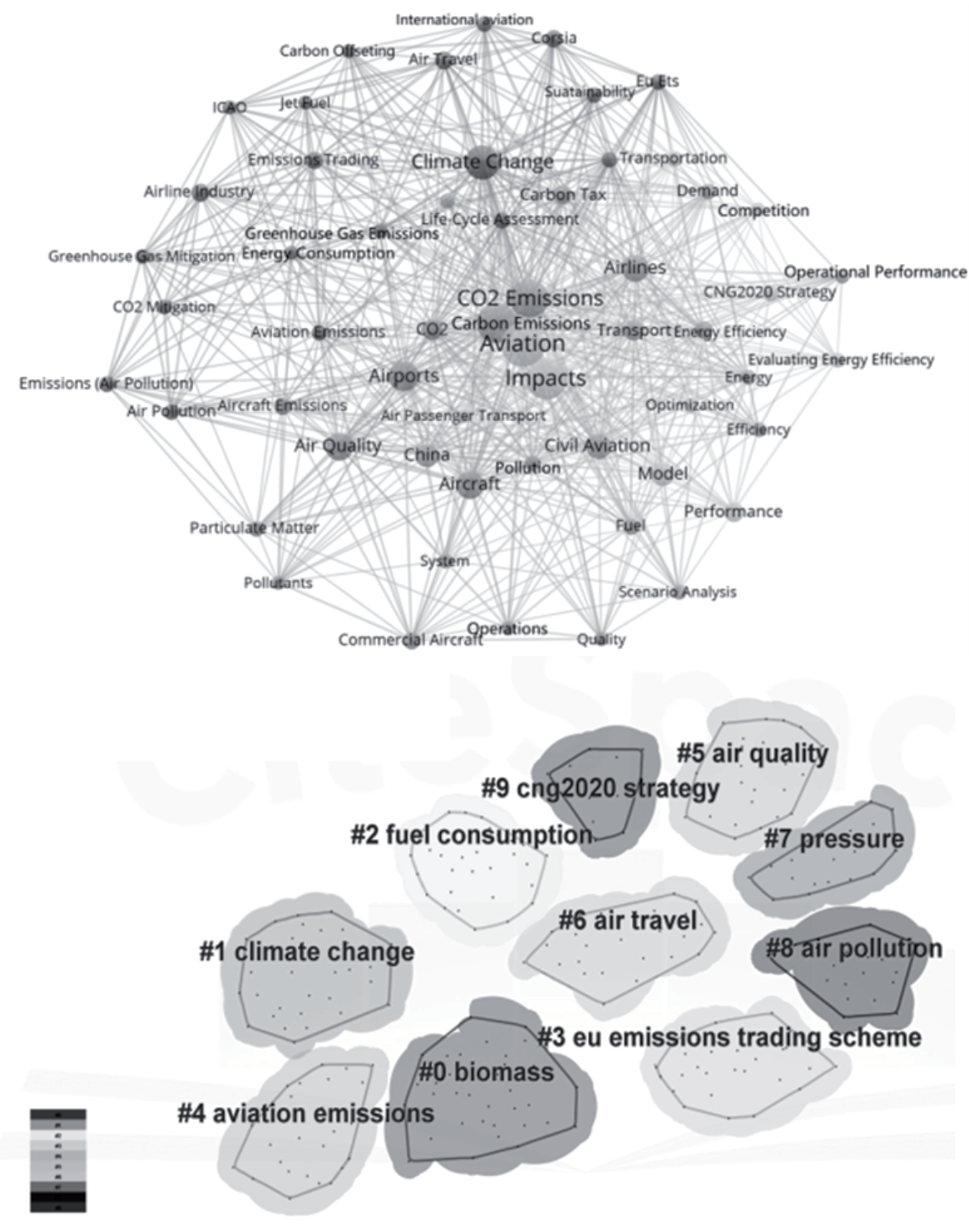
In conclusion, the foundational literature within this field centers on the climate impacts of aviation emissions, serving as the basis for two primary research trajectories: the reduction of aviation carbon emissions and the implementation of mitigation strategies. Mitigation efforts concentrate on the efficacy of technological solutions and carbon reduction policies. These studies not only foster academic progress within this domain but also furnish crucial scientific underpinnings for practical endeavors aimed at reducing aviation carbon emissions.
Research Topic Distribution
Cluster analysis can be applied to research topics with close relationships and evolving trends. By employing CiteSpace software to analyze 511 literature articles on aviation carbon emissions from the Web of Science database, the clustering results reveal the top 10 clusters with a threshold exceeding 0.85, revealing the most significant clusters and their associated keywords (refer to Table 3). Seven representative clusters are chosen for thematic classiffcation to facilitate a comprehensive analysis, as shown in Figure 2. First, Clusters 1, 5, and 8, which focus on climate change, air quality, and air pollution, respectively, are grouped under the research theme of “climate impact of aviation emissions” due to their shared environmental climate focus. Second, Cluster 2, encompassing keywords such as “scenario analysis” and “decomposition analysis” related to fuel consumption, is categorized under the theme of “Aviation Carbon Emission Accounting,” as these are common methods in carbon emission accounting and prediction research [22, 23]. Clusters 3 and 9, highlighting the EU Emissions Trading and CNG 2020 initiatives aimed at reducing aviation carbon emissions, are classified under “International Policies on Aviation Carbon Emissions.” Finally, Cluster 0, centered on biomass, pertains to sustainable aviation fuels and fuel substitution through technological advancements, leading to its categorization under “sustainable aviation alternative fuels.” This classification sets the stage for a comprehensive review of research content across the thematic categories of climate impact, accounting, market policies, and sustainable aviation alternative fuels.
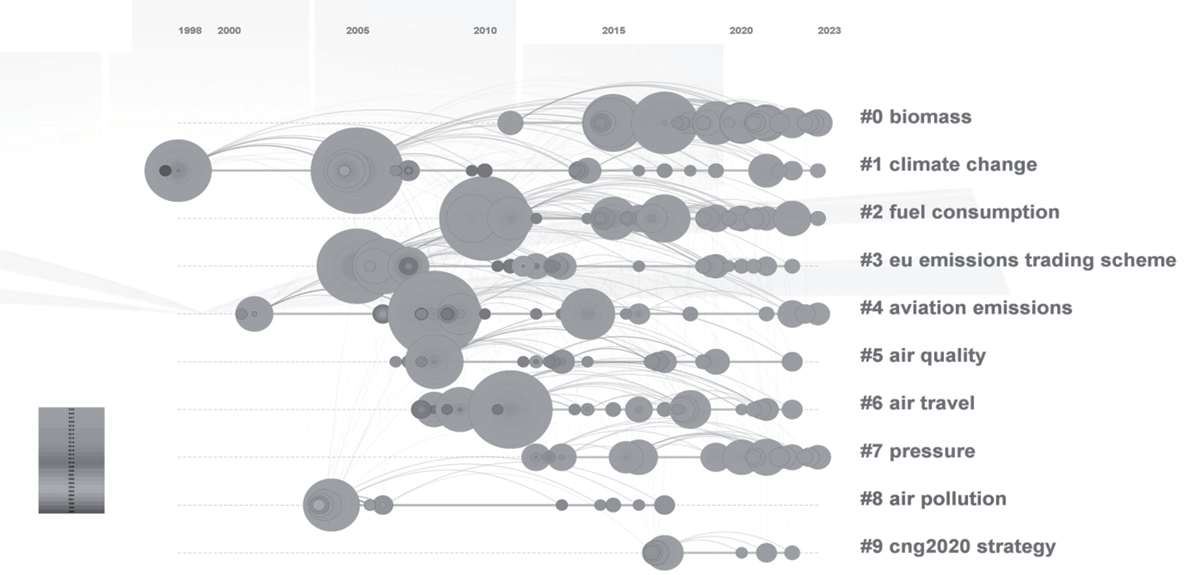
(1) The climate impact of aviation emissions was one of the first studies in the field. Lee et al.’s 2021 study suggested that aviation emissions account for 3.5% of the total anthropogenic contributors to climate change. Exploring climate impacts stemming from aviation emissions persisted after the seminal IPCC report in 1999 [19]. In the 21st century, several studies have assessed the climate impact of aviation emissions through metrics such as radiative forcing (RF) or effective radiative forcing (ERF) of both CO2 and non-CO2 emissions [20, 24]. The compact Earth System Model (ESM) has emerged as a prevalent assessment tool in this regard [24, 25]. Another area of the research topic entails life cycle assessment (LCA) , which integrates fuel production, distribution and combustion at all stages to explore the environmental and health impacts of the aviation sector [6]. Numerous studies have shown that the long-term effects of aviation CO2 emissions and the short-term effects of non-CO2 emissions combine to drive climate impacts (Lee et al., 2010). Most CO2 is emitted at high altitudes; as the most important greenhouse gas , it is important for climate impacts not only because of its long atmospheric lifetime (50–100 years) but also because of its potential to dominate other greenhouse gases [18]. Therefore, the main mitigation strategy against climate change is the reduction of CO2 emissions [6], triggering discussions among scholars on other topics.
(2) Studies on aviation carbon emission accounting can be categorized into two main areas: those focusing on carbon emission tracking and forecasting medium-to long-term emission trends, providing crucial foundational insights into the evolution of aviation carbon emissions through detailed analyses of historical data and related factors; and those concentrating on the determinants of carbon emissions, helping identify key areas for emission reduction.
Carbon emission accounting studies typically employ scenario analyses, considering current and anticipated technological advancements [26]. Among these analyses, enhancing fuel efficiency stands out as a pivotal technological factor in most studies [26, 27]. For example, Macintosh and Wallace developed a carbon emissions algorithm, projecting aviation demand in revenue ton-kilometers and global aviation emissions intensity. Building upon these projections and with 2005 as the base year, they formulated four scenarios for 2025 based on transport demand projections and technological advancements aimed at emission reduction [27]. The findings of Zhou et al. (2016) also support the conclusions of Macintosh and Wallace (2009), who suggest that disruptive technological breakthroughs are unlikely. Instead, achieving the industry’s emission reduction targets will require a combination of support for R&D and market-based measures such as carbon offsetting schemes. The adoption of biomass fuel and improvements in fuel intensity alone are insufficient [22].
Table 3.
Cluster name and corresponding keywords.
In terms of accounting methodologies, global emission control schemes in international aviation follow a fuel consumption-based approach to calculate emission levels [28]. Studies have demonstrated that CO2 emissions from aircraft engines are directly proportional to fuel consumption, with a proportionality factor of approximately 3.15 [19]. An increasing number of studies employ fuel consumption-based ‘bottom-up’ approaches [29, 30] or ‘top-down’ approaches [22, 31] to estimate carbon emissions.
Many scholars have further explored aviation carbon emissions by combining impact factor analysis and scenario analysis. Decomposition analysis has been widely adopted to determine the contributions of different factors to emissions, particularly through structural decomposition analysis (SDA), index decomposition analysis (IDA), and production decomposition analysis (PDA). These three theoretical tools have been successfully applied in existing studies [32-34]. For instance, Kito et al. (2020) employed the IDA method to analyze the drivers of carbon emissions for two major Japanese airlines, revealing that changes in aircraft type and the total number of flights have the most significant impact on carbon emissions within the aviation industry. They emphasized the crucial role of biojet fuels in reducing aviation emissions [32]. Similarly, Liu et al. (2017) utilized the PDA method to dissect the influencing factors of carbon emissions in aviation, highlighting that changes in revenue ton kilometers are the greatest factor contributing to the increase in CO2 emissions from civil aviation [33]. They also underscored the importance of enhancing energy intensity to mitigate CO2 emissions, suggesting that policy-makers should encourage demand shifts, while aviation stakeholders should prioritize the modernization of aircraft and engine technologies.
With the gradual development of research, the extended log-mean Dee’s index model (LMDI) approach has emerged as another valuable tool for identifying the factors that drive changes in CO2 emissions [31, 34]. Despite variations in analytical methods across the literature, the general conclusion is that aviation demand is the most important factor driving carbon emissions [22, 31] and is closely associated with global economic growth. Decomposition analyses suggest that breakthrough technologies are necessary to achieve carbon reductions [23]. Hence, policies geared toward fostering technological advancements, enhancing fuel quality and efficiency, and implementing measures to reduce or shift demand should be prioritized.
(3) International organizations such as ICAO and IATA generally support market measures to reduce aviation emissions. As the first international policy measure with binding targets aimed at reducing aviation carbon emissions, including aviation in the EU, ETS triggered an exploration of the possible impacts of an ETS as soon as the plan was proposed.
From the earliest proposals of the EC scheme, scholars have assessed the impacts of different methods for allocating emission permits to passengers based on different preconceptions [35], the impact of the scheme design on airlines’ operating costs and transport demand [36], and so on. These studies were carried out under assumptions different from the final legislation, using models that were often oversimplified and with limited consideration of scenarios for the impact of the ETS system [37]. After the final enactment of the legislation, the use of EU ETS impact scenarios and models gradually increased, with a focus on the impact of introducing the EU ETS on airline demand [38], on airline performance [39], and on competition between different airlines [40, 41]. Cui et al. (2016) simulated the impact of EU ETS emission restrictions on airline performance by building a new dynamic environmental DEA model with a study sample of 18 full-service airlines [39]. The study revealed that large airlines have sufficient capacity to adapt to the EU ETS. The EU ETS has the potential to induce behavioral changes in the short to medium term and technological changes in the long term without reducing the competitiveness of firms and regions [16], but it is still argued that the EU ETS is not an effective measure [38, 42]. Vespermann and Wald (2011) reported that the annual growth rate of CO2 emissions from aviation under a carbon emissions trading system is expected to decrease by only approximately 1% and that substantial reductions in emissions will still need to be achieved through more stringent system design [37].
In 2010, the 37th ICAO Assembly set a goal of zero growth in net carbon emissions from international aviation starting in 2020 (hereafter referred to as “CNG 2020”), and the implementation of CORSIA is intended to support the CNG 2020 strategy [43]. CORSIA is a necessary step toward carbon neutrality in the aviation industry, stimulating the demand and production of sustainable aviation fuels while also reducing air travel growth by increasing airfares [44]. As offset programs, CORSIA and the EU ETS are fundamentally different [43]. Once an airline exceeds the emission targets set by CORSIA, it must purchase emission reductions achieved by other sectors to offset the excess emissions. Through the carbon trading market, CORSIA can offset CO2 emissions that cannot be reduced through technological improvements [45]. While the EU ETS focuses on airlines’ emissions in Europe, CORSIA focuses on airlines’ international aviation emissions [46], with a greater scope of emission control. In addition, the EU does not have the power to regulate and supervise non-EU airlines [47], and the ICAO’s status of implementing emission reductions is more appropriate, as evidenced by its emphasis on member states to ensure that their compliance with the consistency of the Standards and Recommended Practices (SARPs) in their national aviation policies and domestic aviation policies [28], guaranteeing effective global regulation of COSIA.
In 2030, it is estimated that 12% of aviation emissions will be offset due to CORSIA (Scheelhaase et al., 2018). As the first global international aviation policy, the introduction of CORSIA is highly likely to affect the future dynamics of the EU-ETS [47], with some scholars arguing that the EU will have no need for international aviation to be included in the EU ETS when CORSIA is fully implemented by the ICAO in 2030 [47]. It has also been argued that CORSIA will not achieve absolute emission reductions [48] and will expose airlines in the EU to dual policy issues. These questions of rationality also provide ideas for enhancing the effects of CORSIA.
(4) Sustainable aviation fuels are included in EU ETS monitoring, reporting, and verification from 2025 onward. To accelerate the commercialization and scaling up of sustainable fuels, one part of the research analyses the production chain of sustainable fuels from a technological point of view, while the other part analyses the environmental and economic impacts of sustainable fuel strategies for aviation and interactions with existing fuel policies.
By replacing conventional fossil fuels, a potential GHG reduction of 63% could be achieved by 2050 [49]. Sustainable aviation fuels are considered to be the most promising alternative because they can achieve significant emission reductions in the short to medium term [13]. The established literature has widely confirmed the need for sustainable aviation fuel use with life-cycle CO2 reduction potential [50, 51]. Capaz et al. (2020) suggested that this alternative could reduce CO2 lifecycle emissions by 80% by 2050, using 2005 as the base year [52]. In addition, the use of sustainable aviation fuels will also contribute to more sustainable aviation services for all large commercial aircraft in the medium term before the technological and commercial realization of hydrogen and electric aircraft [53]. International organizations are also actively steering the use of sustainable aviation fuels: the European Union Emissions Trading System (EU ETS) requires emission allowances for aviation CO2 emissions without considering the carbon produced by the combustion of sustainable aviation fuels, and in 2022, the International Air Transport Association (IATA) called on governments to urgently put in place large-scale emission reduction measures to rapidly expand the use of sustainable aviation fuels.
In a broad sense, sustainable aviation fuels include energy from bioresources or from the conversion of non-bioresources with sustainable characteristics [53], and academic research usually discusses sustainable biofuels. With significantly lower life cycle carbon emissions than conventional fossil fuels and advantages in terms of compatibility with conventional engines and fuel systems [54], as well as the potential to reduce the aviation sector’s dependence on fossil resources, biofuels have a promising future in the aviation market but still face challenges in scaling up sustainable production and distribution of feedstock options, developing cost-effective challenges in terms of biojet fuel production technologies. Conversion and production technologies for feedstocks [55-57] are being explored with increasing levels of research.
There are three main types of biofuels: the first generation is based on edible oilseed crops, but energy crops as a source of production should not pose a challenge to food production and are currently not widely accepted; the second generation is based on industrial and agricultural wastes, which have been successfully used for the production of biojet fuels, with lignocellulosics considered the most suitable long-term alternative; and the third generation of sustainable aviation fuels, based on algae, is considered the most promising fuel technology today. Compared with lignocellulosic biomass, algae have greater growth rates and carbon sequestration efficiencies [58] and are economically valuable because of their high oil content and low land occupation [59]. However, the current chemical process of converting microalgae oil to biojet fuel is very expensive, which is not conducive to its promotion in the aviation market. Lim et al.’s (2021) review of microalgae oil hydrotreatments to biojet fuel concluded that gasification, the Fischer-Tropsch method, and sugar jets could be alternative processes for converting microalgae to biojet fuel in the future, with biomass Fischer-Tropsch synthesis being the most energy efficient and having the lowest greenhouse gas emissions, which is one of the best methods for replacing natural aviation fuels [60]. The limitations of algal oil fuels in terms of strain selection, nutrient costs, production platforms, and harvesting and optimization of oil production were presented in the study of Sharma et al. (2023), and possible pathways to overcome these challenges are suggested [61]. It is foreseen that the production and technological optimization of algal fuels will continue to be valuable research topics.
The transition of aviation to biologically sustainable aviation fuels (SAFs) is expensive because their production costs are not economically efficient in the short term, and the learning curve effects and economies of scale in the initial phase have not yet been realized [62]. Renewable fuel incentives and feedstock prices are key factors affecting SAF production costs and strategic deployment [63], and many studies have demonstrated the need for appropriate government policies such as subsidies, taxes, etc. [64-66]; moreover, only prices or policies must significantly incentivize the production of bioenergy and waste feedstocks, as well as incentivize airlines to choose to use sustainable aviation fuels over fossil fuels, for this pathway to reduce emissions to have the desired effect. With better biofuel production technologies, lower production costs, and more incentives and research, sustainable aviation fuels will become more economically competitive.
The analysis above underscores a primary focus on mitigating aviation carbon dioxide emissions. Research concerning the climate impact of aviation emissions predominantly revolves around keywords such as “climate change” and “carbon footprint,” showcasing the environmental harm caused by aviation carbon emissions and emphasizing the pressing need to reduce carbon dioxide emissions. Studies on carbon emission accounting and prediction employ methodologies such as scenario analysis and decomposition analysis to uncover the current and future carbon emissions of aviation sectors in various countries, identify the factors influencing aviation carbon dioxide emissions, and offer practitioners vital references for emission reduction. The remaining research themes on international policies and sustainable aviation alternative fuels correspond to market measures and technological advancements as two pivotal avenues for emission reduction, aiming to lower aviation carbon emissions through practical solutions. These four research themes are interconnected and mutually influential, collectively shaping a comprehensive research framework on aviation decarbonization.
Discussion on the Relationship between Aviation Carbon Reduction Technology, Carbon Reduction Policy, and Research Progress
To explore the relationships among carbon reduction technology, carbon reduction policy, and research development, this paper combines patent changes, trends in the number of publications, and mutated keywords to interpret the research changes, technological development, and commonalities between the three from 1998 to 2023 (as shown in Fig. 3), in which the carbon reduction technology data come from the Lens database. The keywords “low carbon”, “CO2”, “greenhouse”, and “aviation” were used to search the database for 4716 global aviation low carbon-related patents published between 1998 and 2023, which measured the degree of development of aviation low carbon technology.
Fig. 3 shows the evolution of aviation carbon emission research, which is divided into three phases, based on the duration of keyword mutation and the timing of two international policies (EU ETS; CORSIA), with a focus on the second and third phases. The three phases show different characteristics: (1) In the first phase, academic research and technological progress of aviation carbon emissions grow slowly, and there is no mutation of keywords. (2) In the second phase, academic research and technological progress enter into a fluctuating upward phase, with the emergence of research hotspots such as carbon dioxide, atmosphere, emissions trading, climate change, and other research hotspots, of which carbon dioxide and atmosphere are two keywords that began the earliest and lasted the longest time, which is an important issue in this stage.
(3) In the third stage, patent changes and changes in the issuance of papers first show a decline and then a rise in the trend, both after 2020 and into the high-speed growth stage. In this period, hot topics such as model, energy efficiency, DEA, commercial aircraft, willingness to pay, engine, China, etc., the number of mutated keywords is obviously increased, the duration is shortened, and the research hotspots are constantly changing. Several meaningful findings are obtained from these characteristics and further analyses.
First, international policies have driven research and practice. Before 2006, carbon emissions from aviation did not attract much attention from academics and practitioners, and the number of publications and patents was relatively small. After 2007, carbon emissions entered a phase of rapid growth, with the emergence of the mutation keywords, which overlaps with the introduction of the EU’s plan to include aviation in the EU ETS, suggesting that the EU ETS opened a gap in the theoretical and practical worlds to address carbon emissions from aviation and that the practice community must squarely address aviation carbon emissions.
Second, the aviation carbon reduction pathway is a core topic in the field, and technology carbon reduction has good research momentum. As shown in Fig. 3, the 18 mutated keywords for aviation carbon emissions from 1998 to 2023 included three keywords related to carbon reduction policy attributes—emissions trading, willingness to pay, and the EU ETS; and four keywords related to carbon reduction technology attributes— engine, sustainable aviation fuel, hydrogen, and biofuels—indicating that emission reduction pathways have always been a research hotspot in this field. In addition, policy category keywords appeared earlier and have evolved throughout the research on aviation carbon emissions, reflecting the importance of the policy framework in emission reduction practices. In contrast, sustainable aviation fuel, hydrogen, biofuels, and related keywords have only become research hotspots in recent years. Moreover, a study conducted by Nakano et al. (2022) has confirmed the long-term effects of technological innovations such as SAF and hydrogen energy on aviation carbon emission reduction [67]. It is obvious that with the deepening understanding of the complexity of climate change and aviation’s need for more efficient and sustainable solutions to carbon emissions, the value of technological innovations and practical applications has become more prominent;
Fig. 3.
The trends in publication volume, patent technology changes, and keywords related to abrupt changes from 1998 to 2023.
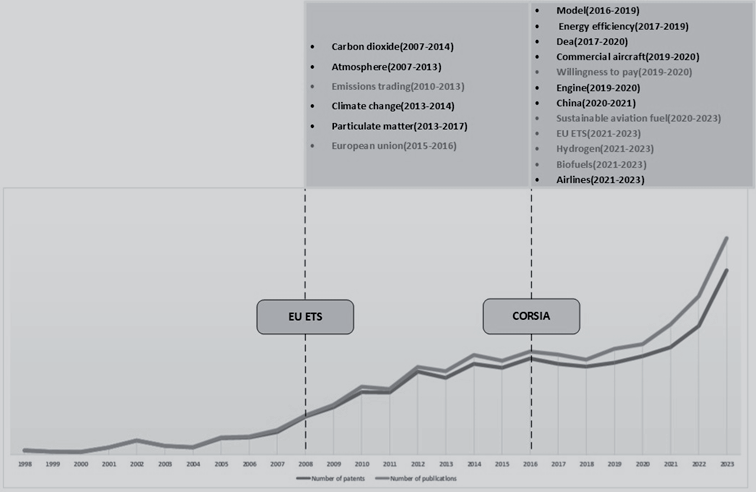
Third, there is a similar trend between the number of publications and technological changes in general. Fig. 3 shows that the number of publications and the number of patents have similar growth trends in the three phases, and from 2020 to the present, both the number of patent applications and the number of academic publications have experienced unprecedented growth. Terms such as “hydrogen” and “biofuels” frequently appear in various types of research and show remarkable research continuity, reflecting a deep understanding of the role of technological advances in combating climate change in both academia and practice.
Conclusion
Based on the bibliometric analysis method, this paper portrays the overall situation of 548 documents in the field of aviation carbon emissions during the 1998- 2023 period, reveals the core content and development trend of the field, further analyzes the synchronicity between academics and practitioners on the issue of aviation carbon emissions, and obtains the following research conclusions:
First, aviation carbon emissions are a comprehensive issue involving multiple disciplines, such as environment, transport, and economics. Lee et al.’s research team constitutes the field’s core knowledge network and lays the foundation for later expansion of research by demonstrating the climate impacts of aviation emissions. Second, the focus of research in the field of aviation carbon emissions has evolved continuously around the reduction of carbon emissions. Early research focused on the implementation of market policies, while in recent years, it has focused more on how to achieve technological improvements. Third, there are four main themes in aviation carbon emissions research: climate impacts, emissions accounting, international policies, and sustainable alternative fuels, which cover many aspects of the aviation carbon emissions problem and together build a theoretical system of aviation carbon emissions, with emissions reduction technologies and market policies always running through academic research. Fourth, there is a benign and mutually reinforcing relationship between academic research and technical practice, and the mutual influence of the two has injected vitality into the realization of the goal of low-carbon sustainable development in aviation and the enrichment of academic research perspectives.
This paper makes several theoretical contributions. First, this paper presents a more comprehensive knowledge map in the field of aviation carbon emissions, which helps scholars quickly grasp the focus of the research. Second, this paper explores the coupling of technology, policy, and academic research and expands the single bibliometric perspective by examining the information behind the data, providing new perspectives for a comprehensive understanding of the issue of aviation carbon emissions. This study provides a new perspective for a comprehensive understanding of aviation carbon emissions, and this approach is also of reference significance for other emission reduction research fields. In addition, this paper has certain practical significance. First, this study provides theoretical support and evidence for the aviation industry to reduce carbon emissions, which can guide the practical community to promote the low-carbon transformation of the aviation industry by strengthening academic research and technological innovation. Second, this study provides useful references to policy-makers for formulating scientific and effective emission reduction policies, such as incentives for technological innovation and promoting the sustainable development of the aviation industry.
Aviation carbon emissions reduction is an ongoing and pressing issue that requires collaborative efforts from industry, regions, and the global community. Achieving carbon reduction goals requires adopting advanced efficiency technologies and market interventions [18]. While existing research has generated valuable insights into market measures for emission reduction, there is a lack of discourse on efficiency enhancements. Therefore, this paper proposes that future research should concentrate on the following areas to better inform emission reduction strategies. First, future research should focus on emerging aircraft and hydrogen technologies. Advancements in engine and aircraft technology, along with the utilization of sustainable aviation fuels, offer promising avenues to achieve carbon neutrality by 2020 and a 50% reduction in carbon dioxide emissions compared to 2005 levels by 2050. While studies predominantly focus on the emission reduction potential and applications of sustainable aviation fuels, there is limited exploration of hydrogen energy technologies and electric aircraft [68-70]. This discrepancy may stem from the challenges posed by current engine compatibility with hydrogen fuel, the extended timeline required for aircraft improvements or engine design implementation, and the approximately 30-year fleet replacement cycle [61], which surpasses the carbon reduction target date of 2050. As a result, there is less emphasis on liquid hydrogen and aircraft enhancements. However, over the long term, clean fuels such as liquid hydrogen could significantly reduce carbon emissions [71] and serve as future energy sources for the aviation industry [72]. Subsequent research can delve into systematic analyses of hydrogen production mechanisms and strategies to facilitate the widespread adoption of hydrogen energy in aviation, thereby fostering sustainable aviation development. Second, research on policies to incentivize biofuel production and substitution is expanding. Policy-makers have two key avenues for mitigating the environmental impact of aviation growth: implementing measures to limit aviation demand and enhancing aircraft energy efficiency through technological innovation. While biofuel substitution for aviation represents a viable solution for emission reduction [50], it still encounters challenges such as high production costs and scalability issues. Therefore, future research should focus on devising market policies that stimulate the production and adoption of aviation biofuels, contributing to achieving net-zero carbon emissions in aviation.

