

Introduction
In response to the severe challenge of global climate change, green transformation has become an international consensus [1], aiming to reduce greenhouse gas emissions and achieve sustainable economic and social development. As a major country in global energy consumption and carbon emissions, China’s total energy consumption is huge, and its energy structure has been centered on coal for a long time, which not only establishes China’s important position in the global energy landscape, but also makes it a key force to promote green transformation. According to statistics, China’s total energy consumption climbed to a high of 5.72 billion tons of standard coal in 2023, while the total carbon emissions reached 12.6 billion tons. The 20th National Congress of the Communist Party of China emphasized China’s commitment to a green, low-carbon, and sustainable development model. The congress set the strategic goals of Carbon Peaking and Carbon Neutrality, providing clear direction for the upcoming transformation of China’s energy system. Driven by Carbon Peaking and Carbon Neutrality goals, the green electricity market and carbon trading market, as key mechanisms for achieving carbon emission reduction targets, are showing a trend of coupled development [2].
The green electricity market and carbon trading market are two engines of energy transformation. Green electricity products refer to all electricity generated by established renewable energy projects, such as wind power, solar power, and conventional hydropower [3]. Transactions in which the above electricity varieties are traded are known as green electricity trading. The carbon trading market refers to the trading of carbon emission rights as assets, thereby achieving the internalization of external environmental costs [4]. The green electricity market and carbon trading market complement each other and jointly promote the development of a low-carbon economy. The green electricity market mechanism promotes the low-carbon transformation of the energy structure by encouraging the development and efficient application of clean electricity resources [5]. The carbon trading market provides a platform for trading emission allowances through a market-oriented mechanism, encouraging enterprises to reduce carbon emissions. As the largest carbon emission industry, the electricity industry was among the first to be included in the carbon emissions trading system, which helps to control the carbon emissions of electricity generation enterprises guided by the carbon market.
Currently, China is in a critical period of coupling development between the green electricity market and the carbon market. The deep integration of these two market systems not only improves resource utilization efficiency but also accelerates the pace of energy transformation [6]. This has far-reaching strategic significance and practical value for addressing climate change and achieving synergy between environmental protection and economic growth [7]. Although China has made significant progress in constructing the green electricity and carbon markets, many challenges remain in their coupling development, such as imperfect market mechanisms, lack of policy coordination, and limited international integration, which need further study and resolution [8].
Some scholars have begun studying the integration of green electricity with carbon markets, with a primary focus on analyzing the interplay between green certificates and carbon markets, as well as their synergistic effects. These studies generally find that the development of green electricity significantly contributes to reducing carbon emissions [9]. Yu et al. propose that implementing tradable green certificates and carbon emissions trading mechanisms can help control carbon emissions in the electricity sector and promote China’s national goals for carbon reduction [9]. Feng et al. used the system dynamics model to analyze and simulate the dual impacts of carbon trading and GEC trading on the electricity market [10]. Li et al. found that the interaction effect between the electricity market and the carbon market focused on low-carbon investment decisions, electricity structure optimization, and carbon emission reduction [11]. Generally speaking, research on the coupling effect between the green electricity market and the carbon market is still lacking.
Existing reviews primarily address methodologies for calculating carbon emissions within the electricity sector [12], low-carbon electricity systems [13], and the impacts of integrating specific types of green electricity into the grid [14]. Reviews that analyze the coupling between the electricity and carbon markets primarily concentrate on the relationship between the thermal electricity market and the carbon market [15], paying less attention to the coupling between the green electricity market and the carbon market. Currently, most scholars refer to the relationship between the green electricity market and the carbon market predominantly in empirical analyses, whereas few conduct systematic studies on their coupling relationship.
This paper focuses on the coupling between the green electricity market and the carbon market, further categorizing green electricity into the green electricity market and the green certificate market, and discusses their respective couplings with the carbon market. It analyzes existing mechanisms from a policy perspective and evaluates coupling performance at the application level, providing a multi-dimensional analysis from both theoretical and practical viewpoints to address gaps in the current research. Furthermore, this study delves into the primary challenges faced by the coupling of green electricity and the carbon market and proposes concrete development strategies and policy recommendations.
Materials and Methods
Materials and data were gathered from relevant institutions, government regulations and documents, the authors’ experiences, and literature reviews. The analyses and discussions focused on the coupling effects of green electricity-carbon market integration, institutional frameworks, policies, regulations, and societal aspects. The findings aim to provide an overview and understanding of the current state of green electricity-carbon market coupling.
Regarding the study of the coupling of the green electricity-carbon market, this study divided the green electricity market into the green electricity market and the green certificate market, and conducted case studies focusing on the coupling effects, coupling policies, current status, and challenges faced by these two types of markets in relation to the carbon market. The case studies not only summarize the practical experiences of green electricity-carbon market coupling worldwide but also track the cutting-edge research on green electricity-carbon market coupling in China. Based on these case studies, this paper proposes policy recommendations to address the challenges and promote the development of green electricity-carbon market coupling.
Results and Discussion
Coupling Effect of Green Electricity-Carbon Market
Coupling Effect of Electricity Market and Carbon Market
During the 14th Five-Year Plan period, the pace of China’s green energy and low-carbon transformation will accelerate, new energy will be further developed on a large scale, and the energy structure and electricity supply and demand situation will face profound changes. China has introduced a number of policies to reform the electricity market, and the national green electricity trading pilot was officially launched in September 2021. As independent trading varieties in the electricity market, green electricity and GEC will be used to discover the environmental value of green electricity in a market-based manner. In addition, the construction of the national unified electricity market system is underway and being advanced in an orderly manner, which will help improve the structure of the electricity market system, promote the construction of a new type of electricity system, and deepen the reform of the electricity system [16].
China’s carbon market is an important market for achieving carbon emission reduction and promoting the achievement of the “Dual-Carbon” goal. Since 2013, China has first established pilot carbon markets in seven provinces and cities, covering the electricity, iron and steel, chemical, and other industries, and including nearly 3,000 key emission units. On the basis of the smooth development of the pilot carbon market, China opened a unified national carbon market in 2021. The carbon market includes the voluntary emission reduction market and the mandatory emission reduction market. The voluntary emission reduction market encourages all kinds of market participants to voluntarily participate in carbon emission reduction actions and carbon emission reduction projects with additionality, and the emission reductions generated can be traded in the market after quantitative verification [17]. The mandatory emission reduction market, also known as the China Emission Allowance (CEA) market, is divided into a primary market and a secondary market, in which the government allocates quotas to key emission units based on the total amount of carbon emissions set, and enterprises trade carbon quotas in the secondary market [18].
Although the electricity market and the carbon market are different in nature, they are interrelated. At present, it is generally believed that the coupling relationship between the electricity and carbon markets can be manifested in many aspects. Kim et al. found that the electricity market and the carbon market share the same emission reduction goal, that is, jointly promote the low-carbon transformation of the electricity system and promote the development of renewable energy [19-21]. Deng et al. found that the electricity market and the carbon market have the same market subject, and thermal electricity enterprises participate in both the carbon market and the electricity market at the same time and connect the two markets through their electricity generation behavior and trading decisions [22]. Yu et al. found that there is a price transmission effect in the two markets. On the one hand, the carbon price will be superimposed on the quotation of thermal electricity enterprises in the electricity market, which will affect the electricity transaction price; on the other hand, the supply and demand of electricity market and price changes will affect the thermal electricity generation, and then affect the supply and demand of carbon quotas [23, 24].
Coupling Effect of Green Electricity Market and Carbon Market
Green electricity refers to electricity produced with zero or near-zero carbon dioxide emissions. It primarily originates from renewable sources like solar, wind, biomass, and geothermal energy, characterized by the integration of “certification and electricity” [25]. Unlike the carbon market, the green electricity market is overseen by the National Development and Reform Commission, the Ministry of Finance, and the National Energy Administration. Its goal is to promote the development of green energy.
Zero-carbon electricity refers to the electricity that does not produce greenhouse gases, such as carbon dioxide, in the process of production, transmission, and use [26]. Due to the zero-carbon nature of green electricity, using zero-carbon fuel is an important way to decarbonize the electricity industry [27], the purchase of green electricity means that the carbon emissions brought by the electricity consumption of enterprises are zero under the conditions approved by relevant carbon footprint standards or initiatives, so there is a strong coupling effect between the two markets.
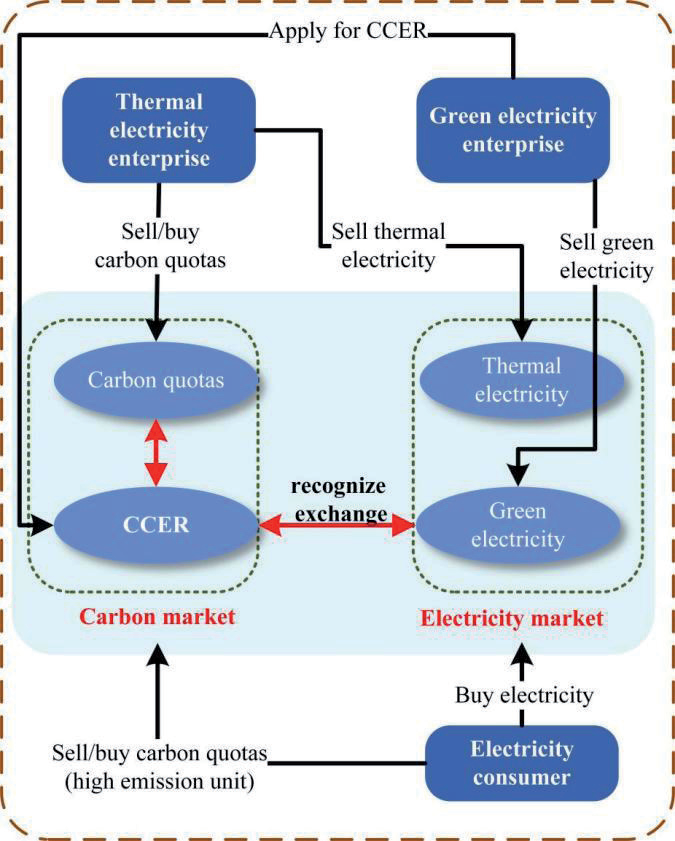
Currently, the academic community generally recognizes that the coupling effect between the green electricity market and the carbon market manifests in two primary ways. The first approach involves establishing mutual recognition and exchange mechanisms between CCERs and green electricity based on emission reduction effects. The second approach involves setting the carbon emission coefficient of green electricity to zero [28]. Fig. 1 illustrates the coupling effect of the green electricity and carbon markets. As shown, relevant green electricity enterprises can independently apply for CCERs. Once green electricity projects are registered as CCER projects, they can obtain CCER emission reductions that can be traded in the carbon market. The carbon market provides a 1:1 ratio of CCERs substituting for carbon emission allowances; thus, one CCER is equivalent to one allowance and can offset one ton of CO2 equivalent emissions.
Coupling Effect of GEC Market and Carbon Market
GEC is an electronic certificate with a unique identification code issued for renewable energy projects. They are governed by the National Energy Administration and are distinct from the carbon market [29]. Both GEC and carbon emission trading aim to promote green, low-carbon development through market mechanisms. Chinese Government calls for the study and promotion of coordination between GEC mechanism, the national carbon emission trading mechanism, and the voluntary greenhouse gas emission reduction trading mechanism [30].
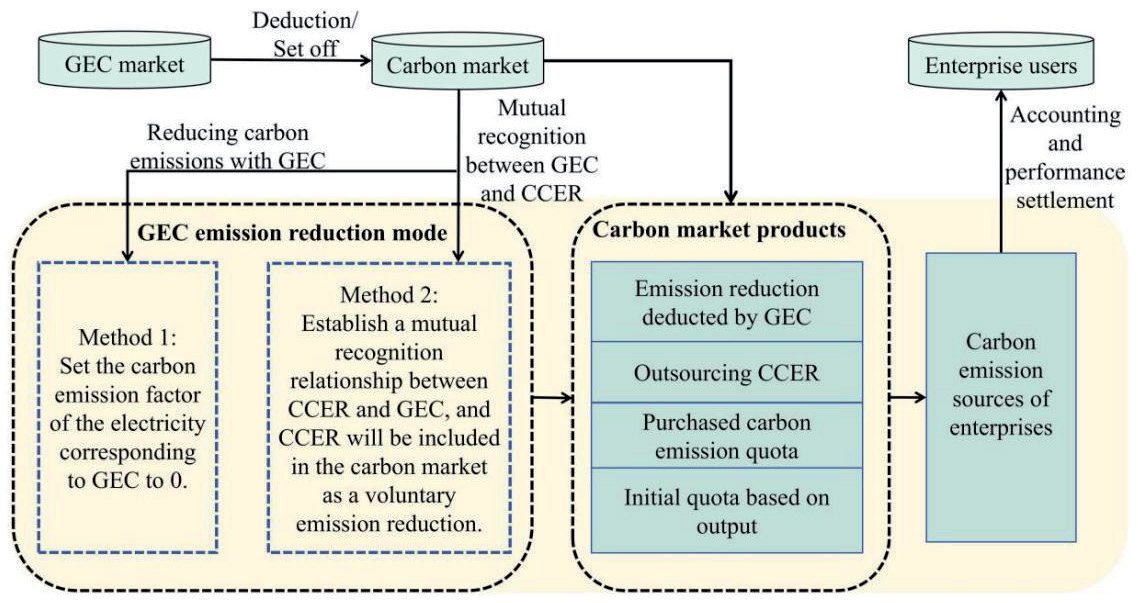
At present, the coupling effect of GEC and the carbon market is mainly manifested in the reduction of carbon emissions caused by GEC. One approach is to establish a mutual identification and exchange mechanism between GEC and CCER, which enables the identification of verified emission reductions by exchanging GEC for CCER [31]. Another approach is to set the electricity carbon emission factor corresponding to GEC to zero when calculating net purchased electricity in key emission units or during the compliance phase [28]. The coupling effect between GEC and the carbon market is shown in Fig. 2.
Current Policies of Coupling Green Electricity-GEC-Carbon Market
Current Policies on the Coupling of Green Electricity Market and Carbon Market
At the local level, some provinces have introduced and piloted green electricity consumption certification policies aimed at using green electricity consumption to offset the carbon emissions of enterprises in scope 1 or scope 21. Establish the relationship between the green electricity market and the carbon market by strengthening the linkage and coordination between carbon emissions trading and green electricity trading. At the same time, it improves the incentive for local enterprises to purchase green electricity, thus promoting the development of green electricity. The green electricity-carbon market coupling policies in each pilot province are shown in Table 1.
As can be seen from the specific provisions of the pilot policy, all pilots support green electricity consumption and promote the coupling of green electricity and carbon markets, but there are differences in the way green electricity and carbon markets are coupled.
In terms of coupling, there are two main ways of coupling green electricity and carbon in the pilot regions. The first way is to set the corresponding carbon emission of green electricity to 0, when accounting for the carbon emission of scope 2. In specific operation, Shanghai and Beijing make the carbon emission of green electricity accounted for as 0 by adjusting the carbon emission factor of green electricity to 0 and stipulating it directly; and Tianjin makes the carbon emission of green electricity accounted for as 0 by directly deducting the amount of green electricity purchased into the grid in the actual accounting. The second way is to offset the corresponding carbon emission reduction of green electricity against the actual carbon emission, when accounting for the carbon emission of scope 1 and scope 2. The second way is to offset the carbon emission reduction corresponding to green electricity against the actual carbon emission when accounting for the carbon emission of scope 1 and scope 2. In practice, Hubei Province allows enterprises with shortfalls in quotas to offset carbon emissions from green electricity against the corresponding emission reductions for carbon market quota compliance.
Current Policies on the Coupling of GEC Market and Carbon Market
As shown in Table 2, both national and local governments are actively promoting the coupling and linkage of the green certificate market and the carbon market, but the relevant regulations currently proposed differ in the way they are coupled.
At the national level, the policy stipulates that offshore wind and solar thermal electricity projects can apply for China-certified voluntary emission reductions (CCERs), which can be used to offset carbon emissions in carbon market compliance. At the same time, both types of electricity generation projects can apply for the issuance of green certificates in the green certificate market and participate in regular market-based transactions in the form of grid parity. The coupling between the green certificates and the carbon market is achieved through renewable energy generation projects.
At the local level, none of the eight pilot carbon markets currently include green certificates as an accounting basis for reducing carbon emissions from purchased electricity, as is the case with green electricity. In December 2022, the Shenzhen government suggested that the carbon emission reductions corresponding to green electricity transactions can be directly incorporated into the Shenzhen carbon market in a supplementary compliance manner, thus enabling the coupling of the green certificates to the carbon market. The specific practical operation method of this provision has not yet been announced, but it is stipulated that the corresponding electricity shall not be double certified with CCERs. As can be seen from the policy of the Shenzhen pilot, the future policy trend may be that the same renewable energy generation capacity is not certified with both CCERs and green certificates.
Table 1.
Green electricity-carbon market coupling policies in pilot carbon market provinces.
Table 2.
Coupling policies of the GEC market and the carbon market of China.
Practice of Coupling Green Electricity - GEC - Carbon Market
International Practice of Green Electricity and Carbon Market Coupling
International coupling of the green electricity-carbon market primarily includes two types: coupling of green electricity with voluntary carbon markets and with compliance carbon markets [32]. In the coupling of green electricity with voluntary carbon markets, green electricity projects (such as solar, wind, and small hydroelectricity) can apply to become voluntary carbon reduction projects through designated mechanisms [33]. These projects must typically comply with certain standards and undergo rigorous third-party verification to ensure that their emission reductions are genuine and additional and conform to internationally recognized standards. Internationally recognized voluntary carbon reduction standards include the Verified Carbon Standard, Gold Standard, and Clean Development Mechanism. In the coupling of green electricity with compliance markets, international recognition allows the use of green electricity to be considered as not generating carbon emissions for the portion of product electricity consumption. Purchasing green electricity via electricity Purchase Agreements is particularly more likely to gain recognition in the carbon market [34].
Moreover, in the coupling of green certificates with carbon markets, unlike some pilot carbon markets in China where purchasing green certificates can be used for carbon offsetting, foreign scholars generally believe that green certificates do not satisfy the additionality requirement of carbon offset projects, and current technology cannot guarantee the traceability of green certificates. Consequently, purchasing green certificates is primarily viewed as an act of supporting the development of renewable energy by companies. Thus, international coupling of the electricity-carbon market generally refers to the coupling of green electricity with the carbon market.
Additionally, the coupling of international electricity-carbon markets is also reflected in the coupling of policy implementation effects. For instance, the European Union has included both carbon market policies and renewable energy directive policies in its Green Deal policy package. Green electricity-related policies support investment in electricity generation and mandate a compulsory proportion of green electricity consumption on the demand side to promote the development of green electricity. Carbon markets limit coal-fired electricity generation and increase the prices of coal-fired electricity, reducing the price differential between renewable energy and coal-fired electricity, thus forcing a decrease in coal-fired electricity generation and carbon emissions and driving an increase in the demand for green electricity in the market [35-38].
China’s Practice of Green Electricity and Carbon Market Coupling
Pilot carbon markets in Beijing, Tianjin, Shanghai, Hubei, and other places have begun to explore the zero-carbon attribute of green electricity, and the zero-carbon attribute of green electricity in pilot areas is mainly reflected in the carbon emission offset of purchased electricity in scope 2. The green electricity deduction mechanism of Beijing-Tianjin-Shanghai carbon market is to subtract the total carbon emissions in the stages of Monitoring, Reporting and Verification (referred to as MRV), and there are subtle differences in the carbon emission accounting stage among the three regions: at present, there are differences in the practice of electricity-carbon coupling in the pilot carbon markets.
Beijing’s carbon market only allows green electricity to offset, and the carbon emissions of green electricity purchased through marketization are accounted as 0 in carbon emission accounting; Shanghai’s carbon market only allows inter-provincial trading of green electricity to offset, allowing carbon trading enterprises to separately account for the carbon emissions generated by outsourcing green electricity, and adjust the carbon emission factor of outsourcing green electricity to 0, while the other outsourcing electricity emission factors are still calculated according to 0.42 tCO2/MWh, that is to say, the carbon emissions of outsourcing green electricity are accounted as 0; Tianjin carbon market allows enterprises to apply for deducting the purchase of green electricity in the electricity grid when calculating the net purchase electricity consumption; Hubei’s carbon market rules are different from those of Beijing, Tianjin and Shanghai, which allow green electricity consumption to offset actual carbon emissions in the form of emission reduction in the stage of contract settlement.
On the whole, green electricity’s zero carbon attribute policy in the pilot areas shows a large regional character. For example, the green electricity deduction mechanism in Beijing, Tianjin, and Shanghai is to reduce the total carbon emissions at the MRV stage; that is, the part using green electricity is not included in the scope of carbon emissions. The rule of Hubei carbon market is that green electricity consumption offsets the actual carbon emissions in the form of emission reductions at the performance and payment stage, rather than at the MRV calculation stage, which may also lead to a certain lag in determining the total amount of quota allocation and market regulation factors in Hubei. On the whole, at present, the relevant policies on green electricity’s zero carbon attribute are only pilot projects and have not been popularized on a large scale. The effect of green electricity and GEC on carbon emissions deduction is still unknown.
China’s Practice of GEC and Carbon Market Coupling
Currently, there are differences in the practice of GEC market and carbon market coupling among the pilots. The Tianjin carbon market allows enterprises to use GEC to apply for the deduction of green electricity purchased from the grid when accounting for net purchases of electricity used. The Hubei carbon market allows companies to use GEC to offset actual carbon emissions in the form of emission reductions at the compliance and payment stage. However, the “green certificates” used by enterprises need to be jointly certified by the Hubei Electricity Trading Center and the Hubei Carbon Emission Trading Center.
Overall, there are some differences in the timing of the policy of coupling GEC with the carbon market in each pilot. Tianjin’s GEC offset mechanism is a reduction of total carbon emissions at the MRV stage, i.e., the portion of green electricity corresponding to the GEC is not counted as scope 2 emissions. In contrast, the rule in the Hubei carbon market is that GEC, jointly certified by the Hubei Electricity Trading Center and the Hubei Carbon Emission Rights Trading Center, can offset actual carbon emissions in the form of emission reductions rather than being underwritten at the MRV calculation stage. Although the National Development and Reform Commission (NDRC), the National Bureau of Statistics (NBS), and the National Energy Administration (NEA) have explicitly proposed to strengthen the connection and coordination between GEC and energy conservation and carbon reduction management, carbon emission accounting, and product carbon footprints in the jointly issued Circular on Strengthening the Connection of GEC with Energy Conservation and Carbon Reduction Policies and Vigorously Promoting the Consumption of Nonfossil Energy, the policy practice on GEC-carbon coupling has only been carried out in a small portion of the pilots, and has not been However, the policy practice of GEC-carbon coupling has only been carried out in a small number of pilot projects and has not been popularized on a large scale.
Challenges in the Integration of Green Electricity Market and Carbon Market
Inefficiencies in Price Transmission Mechanisms
At present, the low price of green electricity weakens its ability to attract investment in electricity generation. Due to the different certification standards for green electricity’s zero carbon attribute in different provinces, as well as the fact that the green electricity market is still in its infancy and the price mechanism is not perfect [39], the environmental protection value and zero carbon characteristics of green electricity have not been fully reflected and compensated in the market pricing. Therefore, the price of green electricity fails to truly reflect its environmental value and social benefits. In addition, the price transmission between green electricity market and carbon market is not smooth, and the generation process of electricity generation enterprises and the process of electricity consumption by electricity users will produce carbon emissions, while the carbon price will also largely affect the cost of non-renewable energy electricity generation enterprises, increase the on grid price of non-renewable energy, affect the demand of electricity users for different types of electricity, and thus affect the green electricity price [40, 41]. At present, due to the problems in the price transmission mechanism of carbon and electricity, the price signal of the carbon market is difficult to be effectively transmitted to the electricity market, especially the price difference between thermal electricity and green electricity has not been fully reduced, which weakens the market demand for green electricity.
Ineffective Integration of Environmental Rights Products
China has implemented a series of regulations and mechanisms to promote the convergence of the electricity and carbon markets and to achieve the goal of carbon neutrality [42]. However, at present, the environmental equity products in the electricity and carbon markets have not yet effectively achieved convergence and mutual recognition, and there are still problems of non-recognition and non-traceability among the environmental equity products. At present, in green electricity trading, the price paid by enterprises for green electricity includes the environmental premium of green electricity, but because the electricity-carbon market has not yet been effectively connected, green electricity is still treated as ordinary electricity and is counted as indirect emissions in the calculation of carbon emissions, resulting in the loss of the environmental value of green electricity. In addition, although the strengthening of the environmental rights and interest’s product convergence has basically become a consensus for the future development of the electricity-carbon market, the scope, scale, and quantification of the specific product convergence have not yet formed fixed rules and mechanisms.
Low Acceptance of Green Electricity and GEC Consumption
In recent years, under the support of various policies, green electricity trading has been vigorously developed, but influenced by factors such as lagging consumption concepts, higher purchasing costs, and the lack of market trading mechanisms, the society as a whole’s willingness to consume and acceptance of green electricity is still not high. Relevant data show that in 2023, the national green electricity intra-provincial trading volume was 53.77 billion kWh, accounting for about 0.95 percent of the national market trading volume, and the proportion of green electricity consumption to the whole society’s electricity consumption is still low [43]. At the same time, the current green certificates in the transaction of market price fluctuations, the problem of low trading volume [44]. With the increase of renewable energy electricity generation, green certificates are in oversupply, and the sale of green certificates faces challenges. In addition, the current policy stipulates that domestic projects can only apply for domestic green certificates, and the mutual recognition mechanism between China’s green certificates and international green certificates has not yet been implemented, so domestic green certificates have weaker market competitiveness compared with international green certificates. Moreover, international green certificate certification bodies and green electricity consumer organizations do not have a high degree of recognition of domestic green certificates, and enterprises do not have a strong willingness to consume green certificates.
Policy Recommendations
Improving the Efficiency of Price Transmission Mechanisms
Strengthen the certification of the zero-carbon attributes of green electricity and the attribution of green rights and interests [45], so that the green environmental price based on the carbon price plays a role. It is necessary to expand the coverage of green electricity environmental rights and interests attribute certification, create a green electricity-carbon emission offset green consumption certification system, improve the authority of green electricity zero-carbon attribute, pilot the green electricity carbon emission reduction in carbon emission accounting offset, and enhance the competitiveness of green electricity price. Form and strengthen the price transmission mechanism with market-based trading, and reduce the government’s direct regulation of electricity prices and carbon prices. Under the current carbon trading mechanism, when the coal price fluctuates reasonably within the medium- and long-term trading scale, the electricity generation enterprises in the coal-fired industry can fully transmit the coal cost changes through the market-based approach, and realize the coal and electricity price transmission by flexibly setting the relevant clauses in the electric electricity medium- and long-term trading contract to reflect the linkage between the medium- and long-term trading price of coal and the feed-in tariffs. Visible carbon pricing signals in the price of electricity can be reflected, thus highlighting the price of green electricity and carbon emission reduction benefit advantage, complete the transmission of carbon price to the price of electricity, realize the cost of carbon costs in the whole society at all levels of cost-sharing, and promote the whole society common low-carbon emission reduction [46].
Enhancing the Integration of Environmental Rights Products
Although GEC, green electricity, excess green electricity consumption, CEA, and CCER belong to different markets, they are all environmental rights products that have the value of carbon emission reduction [47]. So, strengthening the connection of all these environmental rights products will have a good effect on promoting the convergence between electricity and carbon market, promoting the application and liquidity of environmental rights products, and stimulating the willingness the public to use green energy, so as to realize synergistic development of different markets. On the one hand, in the improvement of carbon market policy, it is necessary to quantify the use of green electricity and GEC into the emission reduction of key pollutant discharge units, as an alternative to surrender CEA in the carbon market, such as CCER proposed by some scholars as an intermediate product to realize mutual recognition of environmental rights in the electricity and carbon market. By strengthening the traceability technology of green electricity and CCER, collaborative settlement technology and blockchain technology among multiple markets can be applied, avoiding the double counting of environmental rights [48]. On the other hand, it is necessary to strengthen China’s carbon accounting of electricity consumption as soon as possible and to align with international standards. The government should improve the electricity carbon calculation method, increase CEMS devices (Continuous Emission Monitoring System) and smart electricity-carbon meter equipment, and gradually build a national emission factor database and electricity-carbon accounting platform. Taking green electricity trading into consideration is the key step of electricity-carbon accounting from both the electricity generation side and the electricity consumption side. Timely, accurate, and credible data is the basis for the carbon accounting [49-52].
Promoting International Mutual Recognition of Green Electricity Consumption
The government should improve the international recognition of China’s carbon accounting data of electricity consumption and green electricity consumption by strengthening cooperation with international organizations to ensure that the efforts made by China in the field of emission reduction and environmental protection are treated fairly. On the one hand, it is necessary to understand the rules made by organizations represented by RE100 and to communicate with the international rule makers in depth to understand each other’s demands, purposes, and backgrounds and take the initiative to cooperate with each other. On the other hand, the government should actively engage in negotiations and dialogues to address climate change, take the initiative to strengthen cooperation with the United Nations, unofficial international third-party organizations, and governments of other countries in renewable energy, voluntary emission reduction mechanisms. Multilateral cooperation is the best way to combat climate change and an opportunity to reclaim the voice in carbon reduction responsibility issue that should be equal to all.
Conclusions
The article offers a comprehensive analysis of the coupling effects, policies, and practical applications among China’s green electricity market, GEC market, and carbon market. It identifies market coupling deficiencies and challenges, such as inefficient price transmission from flawed design, lack of mutual recognition of environmental rights products, and low acceptance of green electricity and GEC due to various factors. With the ongoing advancement of “carbon peaking” and “carbon neutrality” goals, the importance of integrating low-carbon markets is undeniable. The article recommends focusing future efforts on strengthening zero-carbon certification for green electricity and GEC, improving price transmission, establishing mutual recognition among GEC, green electricity, excess consumption, carbon quotas, and CCER, and increasing acceptance of GEC and green electricity. These measures aim to enhance the coupling of green electricity and carbon markets, drive energy structure transformation, and support the electricity industry’s green and low-carbon transition.

