

Introduction
With the growing concern of the international community about environmental pollution, and in order to respond to climate change and achieve sustainable and healthy development, countries need to accelerate low-carbon transformation and promote the development of green technology innovation. However, at present, green technology innovation is difficult, the cycle is long, the investment benefit is low, and the cost of green technology innovation for individual organizations is too high. In the current development of technological innovation, government, finance, and enterprises play an increasingly important role. The government is the guide of green technology innovation policy; finance, as a series of financial instruments, systems, policies, and services, is a systematic arrangement to promote green science and technology development, achievement transformation, and high-tech industry development; and enterprises are the main force of scientific and technological innovation, with strong innovative capacity. How to achieve the integration and development of government, finance, and green science and technology innovation and to promote synergistic innovation among all the main actors is crucial to optimizing the national resources, environment, and science and technology innovation structures, promoting the coordinated development of scientific research, production, and market, and improving the overall competitiveness of green industry development.
In recent years, technological innovation and improvements in environmental benefits in the energy industry have had significant beneficial effects on the sustainable and healthy development of EU countries [1]. For enterprises, Yuan and Dai found through the action mechanism of green technology innovation in industrial upgrading that green technology innovation is conducive to improving the quality of Chinese manufacturing products and the position of Chinese enterprises in the global manufacturing value chain [2]. According to Ghisetti and Rennings, green technology innovation can greatly reduce the use of energy and materials, which has a positive impact on the competitiveness of enterprises [3]. Wu et al. found that green technology innovation improved the total factor productivity of green technology [4]. However, carrying out green technology innovation has a long cycle, high-risk costs, and requires the continuous investment of a large number of funds and factors. In this regard, Song et al. found that a green innovation alliance can improve the efficiency of green technology innovation, promote the transfer and transformation of green technology achievements, and reduce the cost and risk of green innovation by complementing resources and capabilities [5, 6]. Lee found that entrepreneurs, governments, and financial institutions are participants in the fintech ecosystem [7]. Wang et al. found that the cooperation of government, industry, university, research, and the utilization of funds can lead to the innovation and development of green technology with multi-subject cooperation [8]. Irfan et al. believe that a collaborative approach between government and finance can contribute to green co-innovation [9]. However, Cao and Yu found that the duration of about 50% of collaborative innovation was about 3 years, and the phenomenon of short-termism was obvious [10].
In order to promote the long-term, stable development of green innovation ecosystems, many scholars have studied their innovation systems and stability. Xiao et al. found that the complementarity of multi-agents in resources and capabilities is the key to the stability of green technology collaborative innovation [11]. Horbach et al. found that government regulation and enterprise cost-saving play an important role in ecological innovation [12]. Yin et al. used game analysis to find that the proportion of green technology transformation, market drivers, and regulatory incentives are the most important influencing factors [13]. Yang et al. believe that high default costs and the distribution ratio between R&D costs and green innovation benefits are key factors affecting the stability of the green innovation ecosystem [14]. Fan et al. found that green innovation incentives, environmental taxes, and innovation subsidies play an important role in promoting the diffusion of green innovation and are effective policy tools for enterprises to choose green technology innovation [15-18]. Yang and Nie found that enterprises without innovation benefit from the technology spillover effect, and subsidies promote the innovation of enterprises [19]. Yang et al. found out through the evolutionary game that exit default penalty, synergistic knowledge absorption benefit, and risk and benefit allocation affect the stability of the green innovation alliance [20]. Yang et al. found that the government should strengthen guidance and promote sci-tech finance business to become a new profit growth point for the banking industry in the future, so as to attract more financial institutions to join the sci-tech finance cooperation alliance [21]. Yang et al. built an evolutionary game model and found that the atmosphere of collaborative innovation and multi-agent cooperation in the scientific and technological financial system requires a platform of trust, learning, fairness, transparency, and flexibility to ensure the realization of the optimal dynamic game equilibrium [22].
The above research shows that green technology innovation has a driving effect on national industrial upgrading, environmental improvement, and enterprise development, while green technology innovation has certain difficulties and risks and needs to be guided and incentivized. The collaborative innovation of the government, financial institutions, and enterprises is one of the most effective ways to realize green technology, and the stability of its collaborative innovation is affected by a variety of factors. It can be seen that the current research on collaborative innovation of green technology innovation has achieved a lot of results, but there are still some limitations, mainly including: (1) lack of more in-depth research on the relationship between the flow of factors within the green technology innovation of the government, financial institutions, and enterprises; (2) lack of research on the way and effect of the government to incentivize. The collaborative innovation of green technology; (3) lack of research on the stability of the collaborative innovation among the three research, unable to explore the degree of influence of each factor and the relationship between the factors. Based on this, this paper intends to conduct a comprehensive study on the synergistic relationship between the government, financial institutions, and enterprises, construct a three-party evolutionary game model from the perspective of incentive theory, and explore the effective strategies for the three parties to carry out green technology co-innovation in order to promote the innovation and development of green technology.
Material and Methods
Theory Analysis
There is a close relationship between finance and green technology innovation, which usually requires a large amount of capital investment for research and development, production, and promotion. Financial institutions can help green technology innovation enterprises obtain the necessary funds to promote their development and application by providing financial support, such as loans and venture capital [23, 24]. In addition, financial institutions can cooperate with the government and regulatory agencies to formulate and promote policies and regulations for green technology innovation. Through the establishment of relevant financial policies and incentives, such as tax preferences and subsidies, more funds can be attracted to flow into the field of green technological innovation [25, 26], and at the same time, they can help innovative subjects obtain bank loans through the construction of a financial service system, the establishment of a platform for communication between banks and enterprises, and the innovation of credit products [27]. Therefore, finance has a core role in enterprise green technology innovation, but how finance, enterprise, and government can play a synergistic effect in the process of cultivating technological innovation has yet to be thoroughly studied and explored.
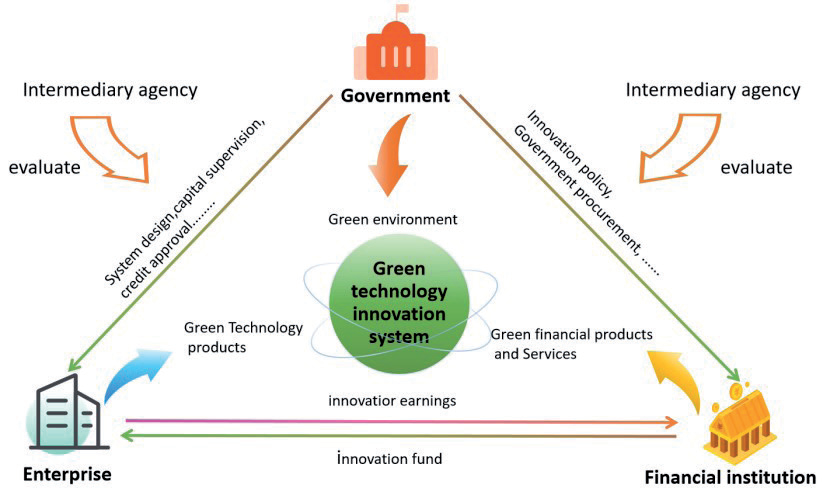
From the perspective of incentive, the green science and technology financial innovation ecology is an ecosystem with the government as the general regulator, science and technology innovation enterprises as the leading players, and financial institutions as the support. As the regulator of the innovation system of science and technology finance, government departments mainly play a regulatory role in the following two ways: First, directly formulate relevant policies to guide and supervise various entities in the system [28]; second, indirectly affect innovation entities by influencing the environment of science and technology innovation [29, 30]. The enterprise community is the main demand for science and technology innovation funds, as well as the initiator, organizer, and executor of collaborative innovation. It is a technological innovation chain composed of science and technology enterprises and supporting enterprises [31, 32]. The community of financial institutions includes heterogeneous financing institutions such as banks, fund companies, venture capital companies, and securities companies, which provide financial support for technological innovation and achievement transformation for the community of enterprises through continuous innovation of financial products [33, 34]. The social intermediary innovation community provides enterprises and financial institutions with platform services in scientific and technological consultation, intellectual property transactions, credit guarantees, etc. System collaborative innovation is a cooperative game process involving multiple populations, and various groups provide heterogeneous elements for the collaborative innovation process, as shown in Fig. 1.
Underlying Assumptions of the Model
In government-financial institution-enterprise green technological collaborative innovation there is instability, and the withdrawal of any party will cause overall system disintegration. In order to ensure the stable development of government-financial institutions-enterprises, this paper adopts the method of the evolutionary game to construct the government-financial institutions-enterprise three-party evolutionary game model and then on the stability of collaborative innovation to carry out research. It is assumed that each member’s innovation strategy is collaborative and non-collaborative, and as a limited rational subject, it will constantly change its strategy to seek the maximization of its own interests. Based on this, this paper makes the following assumptions.
Fig. 1.
Flow chart of the government-financial institution-enterprise green S&T co-innovation system under an incentive perspective.
Hypothesis 1: Participating subjects. The government (G) can encourage other subjects to carry out technological innovation by formulating relevant policies and regulations, giving policy support, providing input subsidies, and so on. Financial institutions (F) have more financial products and financing ability and can formulate financial policies; enterprises (E) have strong technical innovation ability, and the ability to gain insight into the future technology market, which belongs to the whole system of benefit output parties.
Hypothesis 2: Co-operation strategy. Each subject can choose different strategies according to their own needs as well as the benefit relationship, the government strategy and the probability of choosing (x participation, 1-x nonparticipation), the financial institution’s strategy choice for (y investment, 1-y non-investment), and the enterprise strategy choice for (z cooperative innovation, 1-z independent innovation).
Hypothesis 3: Initial innovation cost-profit coefficient: Assume that the financial institutions invest in other projects to obtain the benefits of L1; enterprises alone carry out technological innovation to obtain the benefits of L2.
Hypothesis 4: Green revenue coefficient: Assume that the high-end and greenness coefficients of collaborative innovation green technology are k, 0<k<1; The external spillover risk coefficient of green technology is d, 0<d<1; Since the spillover of green technology is negatively correlated with the degree of high-end technology, that is, the higher the degree of high-end green technology, the smaller the benefit loss caused by green technology spillover. Therefore, the benefit reduction coefficient caused by green technology spillover is assumed to be (1 – k)d. In addition, assume that N is the green finance benefits obtained by financial institutions under the collaborative green technology innovation between enterprises and financial institutions. Suppose bN is the green finance benefits obtained by the financial institutions without cooperation between the two parties. Since the non-cooperation will lead to a decline in green technology innovation ability, the achieved green revenue will be reduced, then 0<b<1.
Hypothesis 5: Cooperative cost sharing coefficient: Although the government will not directly participate in the collaborative innovation process, it will give corresponding supervision fees and subsidy incentive policies to both parties. Suppose that the government’s supervision cost to both parties in the collaborative innovation process is T, and its subsidy to both parties is [k + (1 – k)d]S, Among them k + (1 – k)d represents the sum of high-end and spillover of green technology. Then the preferential policies given by the government reduce the total cost of collaborative innovation by [k + (1 – k)d]S. Assume that the cost incurred in the collaborative innovation process between enterprises and financial institutions is C, then the cost to enterprises and financial institutions participating in innovation is C – [k + (1 – k)d]S, and the costs borne by both parties shall be β distribution, the cost borne by enterprise is β{C – [k + (1 – k)d]S}, the cost borne by financial institutions is (1 – β){C – [k + (1 – k)d]S}.
Hypothesis 6: Coefficient of profit sharing from cooperation: It is assumed that co-innovation will result in synergistic benefits for enterprises as well as financial institutions as [k – (1 – k)d]R, this portion of the proceeds is distributed according to enterprise innovation inputs as well as the inputs of financial institutions, with a sharing coefficient of 0<α<1, then the financial institution receives a return of α[1 – (1 – k)d]R, the revenue received by the business is (1 – α)[k – (1 – k)d]R. In addition, it is assumed that under the cooperation between the two parties, the financial institution, in order to encourage enterprises to actively innovate, gives innovation subsidies to enterprises to help them solve the problem of insufficient funds in the process of innovation. In addition, assume that W is the benefit gained by government participation, and m represents the proportion of the revenue obtained by the government without the participation of the government, then the revenue obtained by government non-participation is mW. If the financial institution and the enterprises perceive the benefits of green technological innovation under the synergy to be low and withdraw from the innovation during the period of cooperation, Q1 denotes the additional benefit received if the financial institution exits. Q2 denotes the additional benefits received by the enterprise if it exits.
Hypothesis 7: Penalties, financial institutions, and enterprises in the process of collaborative innovation, either subject to obtaining more innovation benefits or the existence of negative cooperation and free-riding behavior, the subject must bear the breach of contract faced by the reputation, the amount of money, and other aspects of the penalty, assuming that P represents the cost of the penalty faced.
Evolutionary Game Modeling
To simplify the arithmetic, this paper sets e = k – (1 – k)d, h = k + (1 – k)d, Then, from Tables 1 and 2, the expected returns and average returns to government participation and non-participation can be found to be, respectively,
At this point, the replication dynamic equation for government decision-making can be obtained by evolving the game replication dynamic formula.
Table 1.
Under the government participation innovation game matrix.
Table 2.
Under the government non-participation innovation game matrix.
(4)
The expected and average rate of return on investment and non-investment of financial institutions.
(6)
At this point, the replication dynamic equation of the financial institution’s decision can be obtained by evolving the game replication dynamic equation.
The expected and average returns of companies that innovate independently and cooperatively, respectively.
(11)
At this point, the replication dynamic equation of the enterprise decision can be obtained by evolving the game replication dynamic equation.
Join Equations (5), (10), and (15), substitute e = 1 – (1 – k)d, h = k + (1 – k)d, the replication dynamics system for governments, financial institutions, and enterprise can be known as:
(16)
The partial derivatives of x, y, and z through the three differential equations of Eq. (16) lead to the system Jacobi matrix J.
Equilibrium Point Stability Analysis
In Eq. (16), let F(x) = 0, F(y) = 0, F(z) = 0, Equilibrium can be obtained E1(0,0,0), E2(0,0,1), E3(0,1,0), E4(0,1,1), E5(1,0,0), E6(1,0,1), E7(1,1,0), E8(1,1,1). From the evolutionary game theory, if all the eigenvalues of the Jacobi matrix J are non-positive, the equilibrium point is the stable point of system evolution (ESS).
In the following, we first analyze where the equilibrium point is and where the Jacobi matrix is:
Table 3.
Eigenvalues at each equilibrium.
It follows that the eigenvalues of the Jacobi matrix at this point are λ1 = – [(k – m)W – T – hS]; λ2 = – [βhS + αeR + (k – b)N – I – Q1 – βC]; λ3 = – [(1 – β)(hS – C) + (1 – α)eR + I – Q2 + P]. By analogy, each of the eight equilibrium points is substituted into the Jacobi matrix (17), from which the eigenvalues of the Jacobi matrix corresponding to the equilibrium points can be obtained separately, as shown in Table 3.
In order to promote the participation of collaborative innovation among subjects, according to the equilibrium point determination method proposed by Friedman, if both are less than 0, the innovation strategy stability point of each party will converge to E(1,1,1); At this time, the influencing factors of collaborative innovation strategy among subjects should satisfy the following situation:
As can be seen from equation (19), at this time, the benefits obtained by the government from maintaining green technological co-innovation are greater than the cost of supervision and collaboration in the process of co-innovation and the subsidies to enterprises and financial institutions for technological innovation; and the difference between the sum of the government subsidies, co-innovation benefits, technological benefits, and exit penalties received by the financial institutions and the costs of co-innovation is greater than the sum of innovation grants given to the enterprises and spillover benefits; and the difference between the sum of government subsidies, co-benefits, subsidies, and exit penalties received by enterprises, and the cost of collaborative innovation is greater than the internal spillover benefits of green technologies.
Table 4.
Local stability analysis of each equilibrium point.
In order to facilitate the study of whether the other seven equilibrium points meet the evolutionary stable state, without loss of generality, the correlation coefficient is assumed.
That is, in the case of government participation, the benefits of synergistic innovation between financial institutions and enterprises are greater than those with no synergy. Based on the above analysis method, the sign of the eigenvalues corresponding to the other seven equilibrium points is obtained, as shown in Table 4.
Results and Discussion
In order to fully explore the influence of factors such as the high-end of green technology, the benefits of green technology, the benefits of green innovation subsidies, and technology spillovers on stability, this paper assigns the relevant variables that affect the stability of the system based on the relevant literature and actual situation (assuming that the unified unit is a million yuan), sets the government regional benefits W = 70, not synergistic benefits accounted for the proportion of m = 0.5, the supervision and participation costs T = 3, innovation subsidies S = 15; financial institutions and enterprises synergy benefit is R = 130, the initial benefit allocation ratio is a = 0.5, synergy cost C = 40, the initial cost allocation ratio β = 0.5, the amount of default penalty P = 5; financial institutions give enterprises innovation subsidies I = 4,green finance benefits N = 10, the share of benefits without synergies b = 0.5, financial institutions do not synergize with additional gains Q1 = 30; enterprises do not synergize with additional gains Q2 = 25; technological high-endness k = 0.8, and the external spillover risk coefficient of green technology d = 0.3. Through the above analysis and the setting of the initial value, Matlab software is used to simulate and analyze the dynamic evolution processes of governments, financial institutions, and enterprises.
The Effect of Initial Willingness on the Evolution of Collaborative Innovation Relationships
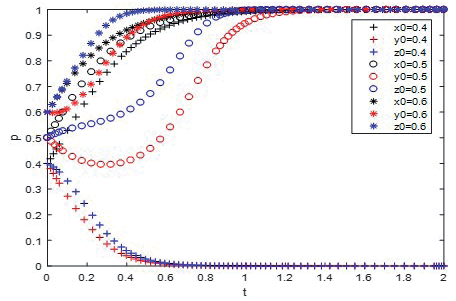
In the case of other parameters remaining unchanged, so that x = y = z = 0.4, 0.5, 0.6, the stability of the consortium under different initial willingnesses to undergo simulation analysis is shown in Fig. 2. Financial institutions and enterprises’ initial willingness to meet the critical value is between 0.4~0.5, and the government’s initial willingness is above 0.4. It can be seen that when the initial willingness of all parties is less than 0.4, the equilibrium point tends to E (1,0,0), and at this time, by the degree of benefit affected by the greatest degree of financial institutions, there is more reluctance to collaborate. When the initial willingness of all parties x, y, z is greater than 0.4, the equilibrium point will tend to E (1,1,1), where the parties are willing to collaborate.
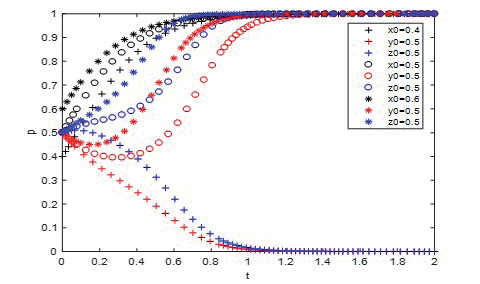
In the case of other parameters remaining unchanged, so that x = y = 0.5, z = 0.4, 0.5, 0.6, the stability of the system under different initial willingness to carry out simulation analysis, as the results show in Fig. 3., the government’s willingness to participate. In the case of a continuous rise in the willingness to participate in financial institutions and enterprises, it is also rising slowly. The simulation results in Fig. 2 and Fig. 3 show that in the process of collaborative innovation, the government has a strong guiding effect on the willingness of financial institutions and enterprises to collaborate.
The Effect of Innovation Factors on the Evolution of Collaborative Innovation Relationships
(1) The impact of government innovation subsidies and technological high-end and greenness on the evolution of collaborative innovation relationships.
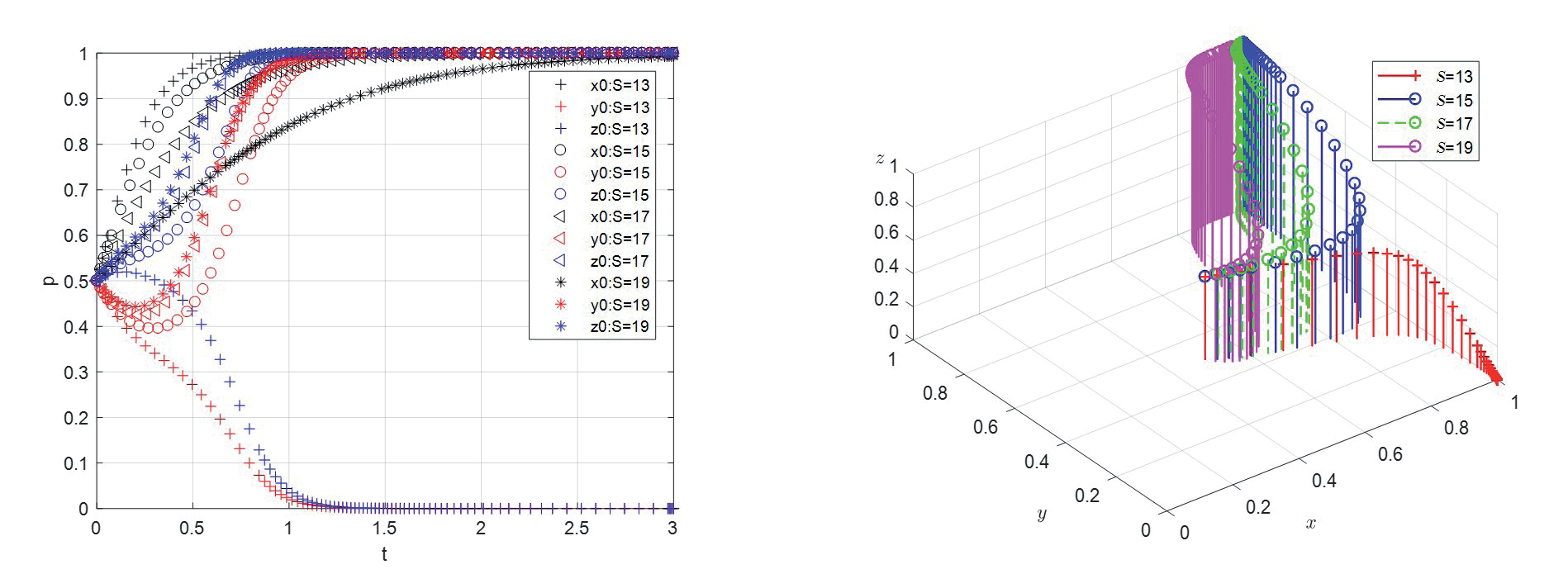
In order to promote cooperation between financial institutions and enterprises, as well as to promote the technology to achieve breakthroughs and enhance the high-end of the technology, the government gives both sides of the subsidy S. In this paper, in the case of the other parameters remaining unchanged, so that S = 13, 15, 17, 19, to get the results as shown in Fig. 4, the critical value of the government’s financial subsidy S is between 13 and 15, when S is less than 13, the equilibrium point will converge to E(1,0,0), namely financial institutions and enterprises will not choose to cooperate, and by the influence of subsidies, at this time, enterprises are more reluctant to cooperate; when S is greater than 15, the equilibrium point will tend to E(1,1,1), all parties are willing to collaborate. The simulation results show that the change in financial subsidy S affects the choice of the final strategies of financial institutions and enterprises. This is due to the fact that the financial subsidy will reduce the cost of collaborative innovation and more benefits can be obtained, so both financial institutions and enterprises will choose collaborative innovation.
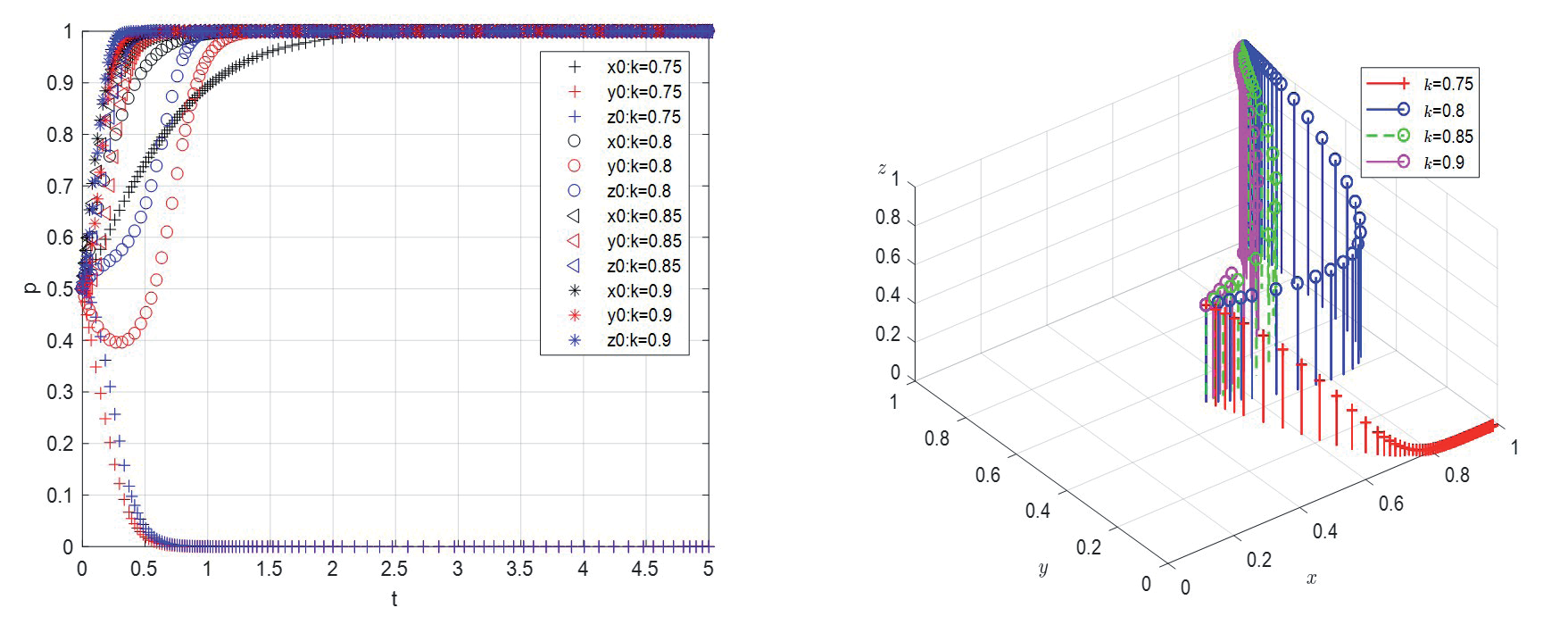
The greenness and high-end of green technology directly affect the benefits of collaborative innovation and the amount of government subsidies and have a greater impact on the stability of the collaboration. In this paper, in the case of other parameters remaining unchanged, so that k = 0.75, 0.8, 0.9, 0.95, to get the results as shown in Figure 5, the high-end nature of the technology should be no less than 0.75, when k is less than 0.75, the equilibrium point will converge to E (1,0,0), that is, the financial institutions and the enterprises will not choose to cooperate. The simulation results show that the high-end change in technology created by synergy affects the choices of financial institutions and enterprises. This is because the benefits of green synergy, green finance benefits of financial institutions, and government subsidies will be reduced significantly as the high level of technology decreases, and the reduction of these benefits will in turn reduce the willingness of enterprises and financial institutions to innovate.
(2) The impact of financial institutions’ funding of enterprise and green technological benefits on the evolution of co-innovation relationships.
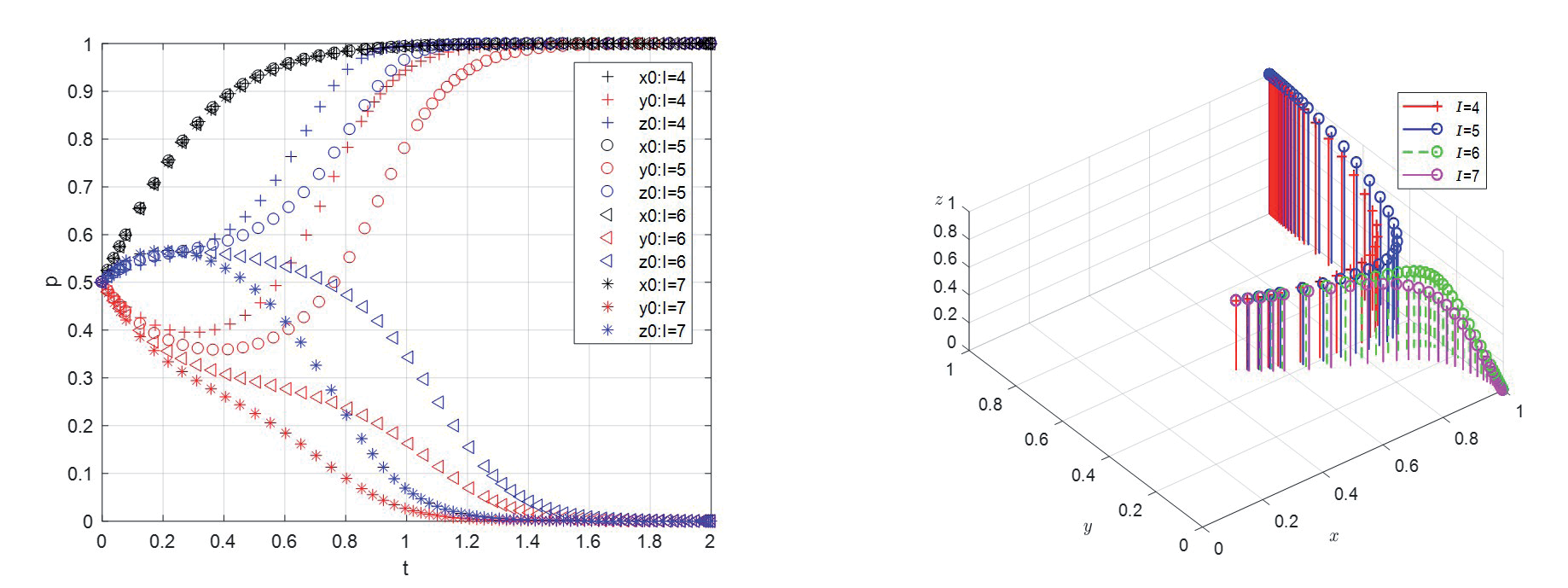
Financial institutions to enterprise funding efforts, affecting the financial institutions synergistic benefits, have a greater impact on the stability of synergy. This paper, in the case of other parameters remaining unchanged, so that I = 4, 5, 6, 7, to get the results as shown in Fig. 6, the enterprise subsidy I critical value is in the range of 5 to 6, when I is greater than 6, the equilibrium point will converge to E (1,0,0). That is, the financial institutions and enterprises are reluctant to cooperate, and financial institutions are reluctant to cooperate with greater willingness to, when I is less than 5, the equilibrium will converge to E (1,1,1), when the parties are willing to cooperate and the enterprise is more willing to cooperate with an increase in the subsidy.
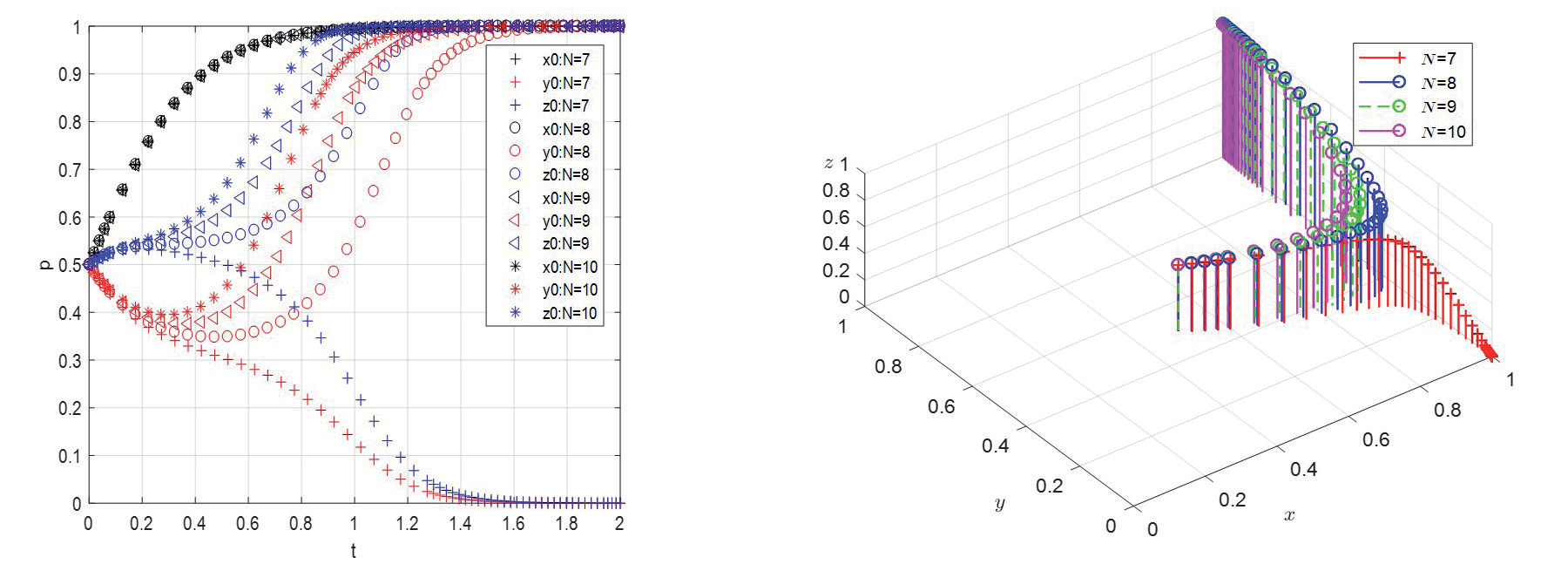
The size of the green finance technical benefits obtained by the financial institutions affects the synergy benefits of the financial institutions, and has a greater impact on the stability of the synergy, this paper in the case of other parameters remain unchanged, so that N = 7, 8, 9, 10, to get the results as shown in Fig. 7, the green finance technical benefits of the N critical value in the range between 7 to 8, when N is less than 7, the equilibrium point will converge to E (1,0,0), that is, the financial institutions and the enterprise then is not willing to cooperation, and the financial institutions is not willing to cooperate more willingness, when N is greater than 8, the equilibrium point will tend to E(1,1,1), at this time all parties are willing to cooperate. In addition, the simulation results show that there is a relationship between the subsidies of financial institutions and the green finance benefits obtained, and when financial institutions do not choose to cooperate, the benefits obtained under the non-cooperative bN are smaller than the subsidy cost I spent under the cooperative, and financial institutions are reluctant to collaborate in innovation. This is because financial institutions will choose a non-cooperative strategy when the subsidy costs they spend under cooperation are higher if the green finance benefits obtained are lower. The green finance benefits obtained bN, minus the cost I, are less than the green finance benefits obtained bN, without cooperation.
(3) The impact of the coefficient of distribution of benefits between financial institutions and enterprise on the evolution of collaborative innovation.
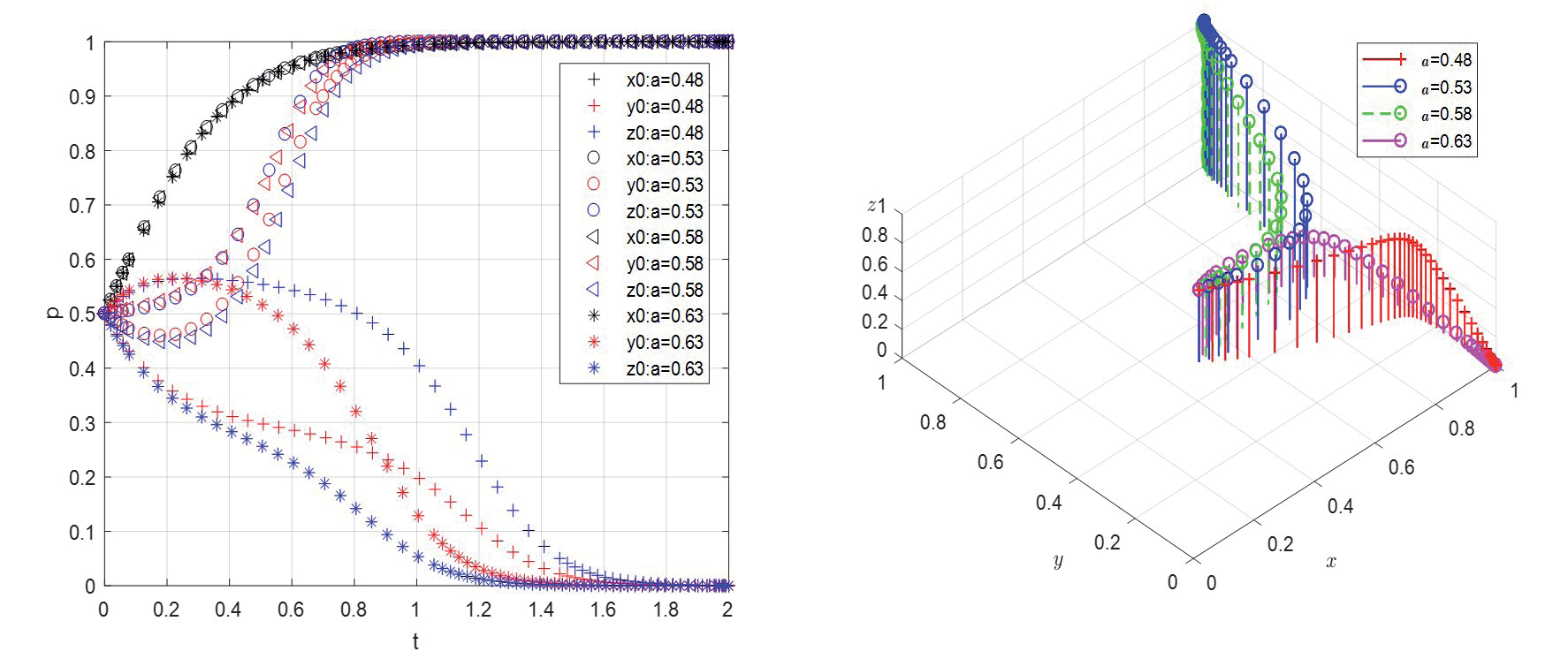
Fig. 8 shows the impact of changes in the technology benefit sharing coefficient a on financial institutions and enterprises’ collaborative innovation. As can be seen from Fig. 8, the critical value of the coefficient a of synergistic benefit distribution between financial institutions and enterprises is 0.48~0.58, and when the value of a is lower than 0.48 and when a is greater than 0.58, the enterprises and financial institutions will choose the strategy of non-collaboration. When a is between 0.53~0.58, both parties are more inclined to cooperate, and the enterprise is more inclined to cooperate. In addition, when a is less than 0.48, enterprises first tend to synergize, but as financial institutions choose the non-synergistic strategy, resulting in their inability to create high-end technological products, enterprises also choose the non-cooperative strategy along with it.
Conclusions and Recommendations
This paper systematically analyzes the evolution of the behavioral decision-making process of the government, financial institutions, and enterprises in maintaining the stability of collaborative innovation by constructing the government-financial institution-enterprise collaborative innovation evolution game model. The conclusions of the study are as follows.
(1) Financial institutions are more sensitive to the government’s supportive policies, technological benefits, and environmental benefits. Financial institutions have strong financing ability, and by giving enterprises upfront subsidies, they can encourage enterprises to participate in innovation, but the investment subsidy should not be too high, with both sides of the profits under equal share, as once enterprises receive a too-high subsidy, financial institutions are not willing to collaborate. Therefore, the subsidies given by financial institutions to enterprises to promote collaboration should be assessed based on the benefits of the technology, the degree of difficulty, and the ability of the enterprise. Subsidies are given to enterprises based on the general results of the assessment.
For the created technology positioning and enterprise ability to assess, if the enterprise ability is weak, technology positioning is low, the created products are low-end products, at this time the financial institutions to enterprise subsidies less subsidies; if the enterprise ability is strong, technology positioning is low, the created products are low-end products, but due to the enterprise ability is strong, in order to maintain the cooperation at this time the financial institutions to enterprise subsidies medium subsidies; if the enterprise ability is weak, technology positioning is high, then the created products are high-end products, but due to high technological positioning, in order to promote enterprises to increase scientific research capacity and maintain cooperation, at this time the financial institutions to enterprise subsidies medium subsidies; if the enterprise capacity is strong, high technological positioning, the products created are high-end products, but due to high technological positioning, at this time the financial institutions to enterprise subsidies more subsidies.
(2) The government's subsidy, financing benefits, innovation benefits, and technological spillover are affected by the high-end and greenness of the technology. The higher the level of sophistication of the technology, i.e. the degree of innovation and uniqueness, the greater the technological benefits to the government, and hence the need for larger subsidies. The level of government subsidies is proportional to the sophistication of the technology to ensure that innovators continue to be supported and that their innovative capacity is fully utilized. In addition, the higher the high-end nature of a technology and the more intelligent it is, the more inclined all parties are to protect the technology against loss and unauthorized use in order to achieve a quick monopoly of the market and more economic benefits. Therefore, the government must focus on the importance of protecting intellectual property rights in the practice of guiding and supporting high-end technological innovation and motivate innovators to actively apply for patents and other intellectual property rights to protect their innovations.
On the other hand, the greenness of technology also has an important impact on government policies and measures. With the increasing requirements for environmental protection, green technologies are receiving more and more attention. The government will pay more attention to the subsidies and financing benefits of green technologies in order to promote the development and application of environmentally friendly technologies and realize the dual benefits of economy and environment. This also further enhances the competitiveness of green technologies and promotes the innovative activities of all parties in the green field.
(3) Technology has a spillover nature. Given the importance of technological spillovers, especially in areas involving technologies with high market potential, long innovation cycles, and high levels of risk, governments should put in place appropriate laws and regulations to protect intellectual property rights. The purpose of doing so is to prevent misuse or unauthorized use of knowledge and innovation in the process of technological spillovers and to ensure that financial institutions and enterprises are able to reap more profits and higher returns. A sound system of laws and regulations can provide a stable and predictable environment for technological innovation. Such protection measures can discourage knowledge theft and unfair competition in the process of technological spillovers, thus encouraging enterprises and financial institutions to invest more resources and efforts in technological innovation. At the same time, intellectual property protection can also provide innovators with certain rights and protect their legitimate interests, thus enhancing their incentive to innovate.
In addition to establishing laws and regulations, the government should also strengthen the supervision and enforcement of intellectual property rights. By strengthening the protection of intellectual property rights, knowledge theft, and infringement in the process of technology spillover can be effectively prevented. This will create a fair and competitive environment for technological innovation and application, which will be conducive to attracting more investors and innovators to participate in technological research, development, and application.
For government-finance-enterprises, the technological gains obtained through co-innovation have a greater impact on their willingness to participate. If the technological gains from the cooperation are low, governments, financial institutions, and firms often choose to abandon the alliance and maintain the existing situation. When determining cooperation projects, the magnitude of technological gains depends on the high-end nature of the technology. High-end technologies tend to have higher technological returns, so enterprises and financial institutions need to select those major green research projects with potentially large economic and technological returns for innovation. Such a selection can help them maximize their economic and technological returns and thus increase their willingness to cooperate. The government plays an important guiding and supporting role in this process. The government can provide strong support for cooperation by providing funding, policy support, and regulatory guidance. In particular, in the area of green scientific research, the government can promote the research, development, and application of environmentally friendly technologies, providing more opportunities for enterprises and financial institutions to participate in green science and technology innovation and gain greater technological benefits.
This paper studies the green technology innovation system composed of government, enterprises, and financial institutions, but the main body of the green technology innovation system is not limited to the three, intermediary institutions, academic research organizations, and other organizations are also the main body of the green technology innovation system, with a strong driving force. In addition, the influencing factors affecting the synergistic innovation of the three main bodies include carbon sinks, carbon trading, and the maturity of green financial products. Therefore, it is necessary to conduct a more comprehensive and in-depth study on the influencing factors of the three main bodies.

