


Introduction
The world has come to a new era where the development of new technologies has been the main focus of the community. This development has put a high demand in energy generation where many vigorous research initiatives aimed at developing alternative renewable and potentially carbon-neutral solid, liquid, and gaseous biofuels as alternative resources have been made throughout the world [1]. Nowadays, almost 80% of global energy demand is produced from fossil fuels [2]. The utilization of fossil fuels has been amplified due to anthropogenic activities, including transportation, industrialization, and deforestation, which the rapid development of the human population has further exacerbated. The rise in the utilization of fossil fuels has led to an escalation of environmental alterations, including the release of carbon dioxide (CO2), nitrous oxide (N2O), sulfur dioxide (SO2), and methane (CH4). The depletion of energy resources and the swift alteration of the earth’s climate have compelled governments to seek alternative energy sources that possess renewability, sustainability, and environmental compatibility and concurrently lead to a reduction in greenhouse gas levels [1]. Historically, the first generation of biofuels derived from terrestrial crops such as sugarcane, sugar beet, maize, and rapeseed. This however places an enormous strain on world food markets, which leads to the destruction of the world’s forests as well as causing water shortages. The second-generation biofuels are derived from forest residue, lignocellulose agriculture, and non-crop feedstock. The challenge for this generation is over competing land use changes together with the above circumstances [3]. Today, the third generation of biofuels, which is specifically derived from microalgae, can make a breakthrough of the major drawbacks related to the first and second generations of biofuels. Microalgae are photosynthetic microorganisms with simple growth requirements that consist of light, nutrients, and carbon dioxide. It can produce lipids, carbohydrates, and proteins in large amounts over short periods, which can be further processed into biofuels and valuable co-products [1]. Microalgae biofuel is a promising candidate for leading the transition to green energy due to its advantageous characteristics. Algal biofuels are of particular interest due to the general algal characteristics of increased productivity and reduced land and water requirements relative to plant-based biofuels. Algal biofuels have garnered significant attention as potential sources of sustainable substitutes for transportation fuels generated from petroleum. Notably, it necessitates minimum, if any, modifications to diesel engines and requires very limited integration into the existing fuel supply network [4]. Microalgae have emerged as a promising option for the manufacture of biodiesel owing to their remarkable bio-productivity and the economic feasibility of extracting value products. The triglycerides present in microalgae can be removed and subjected to transesterification, creating biodiesel that can be utilized as a liquid fuel for transportation purposes. Algal growth systems possess the capacity to generate TAG in greater quantities compared to terrestrial plant systems. Unfortunately, farming, harvesting techniques, and expensive oil extraction result in high costs, such that microalgae has not yet been widely commercialized [5]. Thus, extensive research and developments have recently focused on the improvement of lipid productivity [6]. Two factors governed the increase lipid productivity, which are improvements in lipid content and biomass productivity. In photoautotrophic cultures, there are many culture conditions that can increase in lipid content, such as high light intensity, high iron concentration, and high carbon dioxide concentration [7]. However, the most effective culture condition is the limitation of the major nutrient nitrogen where the algae cells are put under unfavorable conditions, which normally causes carbon from carbohydrates and protein to be converted into lipids [8]. Nitrogen is a crucial ingredient for promoting biomass development and facilitating triacylglycerol (TAG) synthesis within algal cells. Incorporating a modest quantity of nitrogen and phytohormones into the growth substrate can significantly reduce the expenses associated with biomass production. Numerous studies have investigated the optimal nitrogen source and concentration to enhance algal biomass and oil production. Nitrogen plays a crucial role in influencing the growth of microalgae and the content of proteins and lipids. Nitrogen plays a crucial role in DNA, RNA, and chlorophyll production. Nitrogen is a crucial element in the synthesis of proteins and nucleic acids. Consequently, a reduction in nitrogen availability within a medium restricts the production of proteins and nucleic acids, leading to an elevation in lipid content. Several studies have documented that nitrogen stress is responsible for significant alterations in protein and lipid synthesis in microalgae [9, 10]. Sodium nitrate represents a readily accessible and cost-effective nitrogen source that can be effectively employed in the large-scale cultivation of commercially available algae strains with high lipid content [11]. Sodium nitrate plays a crucial role in microalgae cells’ physiological processes and proliferation. Furthermore, potassium is recognized as an enzyme activator that plays a pivotal role in metabolic processes, facilitating photosynthesis and enhancing nitrogen uptake in plants. Similarly, the potassium nitrate (KNO3) is a key compound that contains both potassium and nitrogen. It is a vital nutrient for microalgae growth and is crucial in regulating metabolism. The microalgae exhibit a widespread capacity to utilize nitrate (NO3-), nitrite (NO2-), or ammonium (NH4+) as a source of nutrients. Ammonium is typically the favored source of nitrogen. Various compounds can serve as sources of ammonium ions for microalgae cultures, and these compounds can impact the culture’s development. This impact might be attributed to their influence on the pH or provision of elements other than nitrogen. Chloride and sulfate are often utilized ammonium compounds, while ammonium nitrate offers two nitrogen forms, and carbonate provides a carbon source in addition to nitrogen [12]. Recent studies have focused on waste materials with high organic carbon and nitrogen content, which can significantly increase microalgae growth. In some instances, it may be advantageous to pre-treat waste streams to increase their organic carbon content; [14] for instance, acidogenic fermentation of swine and poultry manure and kelp waste extract were used for this purpose. In a previous study, the combination of kelp waste extract and urea substantially improved the lipid content and biochemical composition of the microalgae Chlorella sorokiniana. In the present study, three distinct nitrogen sources (NaNO3, KNO3, and NH4Cl) were combined with kelp refuse extract to determine the most cost-effective nitrogen source for enhancing the biomass growth and lipid composition of Chlorella sorokiniana.
Experimental
Microalgae Source and Experimental Design
Chlorella sorokiniana (FACHB-275) was collected from the Institute of Hydrobiology, Chinese Academy of Sciences culture collection. C. sorokiniana was introduced into Erlenmeyer flasks with a capacity of 500 mL, each holding 300 mL of growth media. The Erlenmeyer flasks were incubated within a controlled climate cabinet, maintaining a temperature of 23±1ºC, and the incubation period followed a light/ dark cycle of 16 hours of light and 8 hours of darkness. The light intensity during the incubation was set at 45 μmol photon m-2 s-1. The 10 mL stock cultures were obtained from media that had reached a specific density. These stock cultures were then cultivated in BBM medium, while working cultures were cultivated in media where the nitrogen source was substituted with various concentrations (15, 30, 45, 60, and 75 mg L-1) of NaNO3, KNO3, NH4Cl, and 8% KWE, which were mixed into all the mediums as a growth-promoting agent. The Kelp waste extracts (KWE) were prepared with enzymolysis as reported by [13]. The composition of BBM and KWE [13] was demonstrated in Table 1. Ammonium chloride was selected from a range of ammonium salts due to considerations related to cost optimization. Additionally, it is worth noting that ammonium chloride is among the substrates less extensively studied to cultivate algae species. The cultures were allowed to incubate for 15 days at a temperature of 23±1ºC, following a light/ dark cycle of 16 hours of light and 8 hours of darkness. The light intensity during this incubation period was measured at 55 μmol photon m-2 s-1. The Erlenmeyer flasks were agitated three times per day.
Measurement of Cell Density and Pigment Contents
The optical density (OD) measurements of the samples are done every 3rd day by using the SpectraMax M5 microplate reader (Molecular Devices, US). The OD measurement for each sample was done three times, and the average was taken to increase the accuracy of the result. The pigment content of every sample was determined as described by [14]. Ten mL of algal culture was inserted into a centrifuge tube and centrifuged at 8000 rpm for 10 min, and then 2 mL of methanol was added to the pellet and kept at 4ºC for 24 h in the dark. After 24 h the sample was transferred into a spectrophotometer glass cuvette, and the chlorophyll a, b, and beta-carotene contents were measured at 470, 653, and 666 nm, respectively. Finally, the relative amounts of pigments were calculated by the following equations and expressed in mg.L-1.
Table 1.
Composition of Bold’s Basal medium (BBM) and kelp waste extracts.
Chlorophyll a (Chl a) = 15.65A666 − 7.34A653
Chlorophyll b (Chl b) = 27.05A653 − 11.21A666
Beta-Carotene (Bc) = (1000A470
− 2.86Chl a − 129.2Chl b)/245.
Carbohydrate Measurement
The cellular carbohydrate contents were analyzed through the standard method [15]. Five mL of microalgae sample was transferred into a centrifuge tube and centrifuged at 8000 rpm for 10 min. After the centrifuge process, the transparent supernatant was stored at -20ºC for 12 h. After 12 h, the sample was at 37ºC in a water bath. Finally, the carbohydrate content results were recorded spectrometrically at 490 nm.
Neutral Lipid Extraction
The neutral lipid content of the microalgae was detected through the use of the Nile red staining method [16]. One mL of culture was mixed in 330 μL of 25% dimethyl sulfoxide and then sonicated for 1 min by ultrasonication (KQ5200B, China); then, 15 μL of Nile red (0.1 mg mL-1 acetone) was added into the mixture; the cells were stained at 40ºC for 10 min in a water bath. The fluorescence intensity was measured by a SpectraMax M5 Microplate Reader with the wavelengths of excitation and emission at 480 nm and 575 nm, respectively.
Calculation of the Dry Cell Weight and Total Lipid Contents
To determine the biomass production of the culture, the microalgae cells were collected at a stationary phase by centrifugation at 4ºC and 8000 rpm for 10 min and then desiccated by a lyophilizer for 48 h. After obtaining the constant dry weight, the weight of the empty centrifuge tube was subtracted from the weight before drying. The biomass weight was shown in g.L-1. The total lipid contents were quantified with chloroform-methanol based on a modified method [16]. The method was as reported by [13]. The lipid content was evaluated gravimetrically and expressed as the dry cell weight percentage (% DCW).
Statistical Analysis
All experiments were conducted in triplicate. Data were statistically analyzed by Graph Pad Prism, version 8.0. All values were expressed as mean±SEM. The statistical differences were assessed by a two-way ANOVA by considering Bonferroni post-tests to compare the means of the replicates, where P-values <0.05 were considered significant.
Results
Effect of Different Nitrogen Sources and KWE on Cell Growth of C. sorokiniana
The present study was designed to determine the effect of different nitrogen sources and KWE on the cellular growth of C. sorokiniana under laboratory conditions. The change in the cell population with supplemented different nitrogen sources and concentrations during 15 days of cultivation is shown in Fig. 1. We found that NaNO3 and KNO3 successfully enhanced cell growth, but unfortunately, ammonium chloride increased minimum cell growth. Cell concentration was increased rapidly from day 3 to day 12 and then decreased till the end of the experiment. It was observed that the microalgae cultured in sodium nitrate at 30 mg.L-1 recorded the highest cell density, 28.83 × 10⁷ cells mL-1, while the highest concentration of NaNO3.
Effect of Different Nitrogen Sources and KWE on the Pigment Content of C. sorokiniana
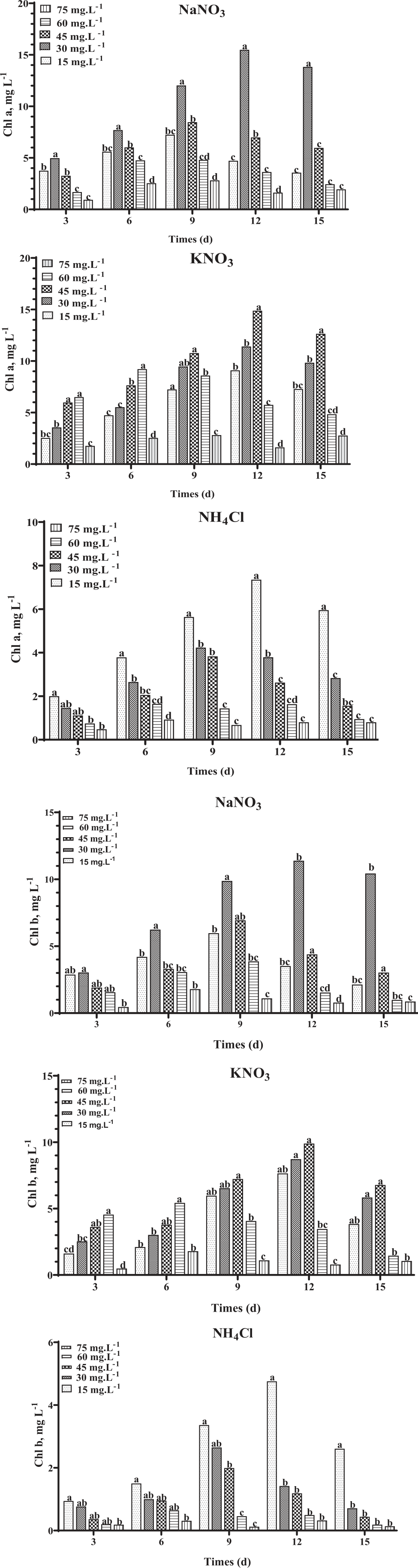
The effect of different nitrogen sources and concentrations on the chl a and b pigments was investigated. The content of chl a was recorded as mg L-1 (p<0.05), and the results are presented in Fig. 2a). A substantial enhancement in pigment content was noticed under the different concentrations of nitrogen sources. Results show that the chlorophyll contents remained constant at all nitrogen sources from day 1 to day 3 and then increased from day 3 to day 12 on all nitrogen concentrations and then decreased till the end of the experiment. It was observed that higher concentrations of nitrogen ranged from 60 to 75 mg L-1 led to a decrease in all photosynthetic pigments, and the color of the culture also changed from green to light brown during 15 days of cultivation. On the other hand, the moderate concentration of nitrogen sources sodium nitrate and potassium nitrate stimulated the production of chlorophyll a and b contents. Whereas the addition of potassium nitrate and ammonium chloride in the growth medium produced a one-fold lower value of chl a and a two-fold lower value of chl b as compared to sodium nitrate (Fig. 2b). Meanwhile, the highest values of chl a 17.2 mg L-1 and chl. b 10 mg L-1 was achieved in the presence of 30 mg L-1 of sodium nitrate.
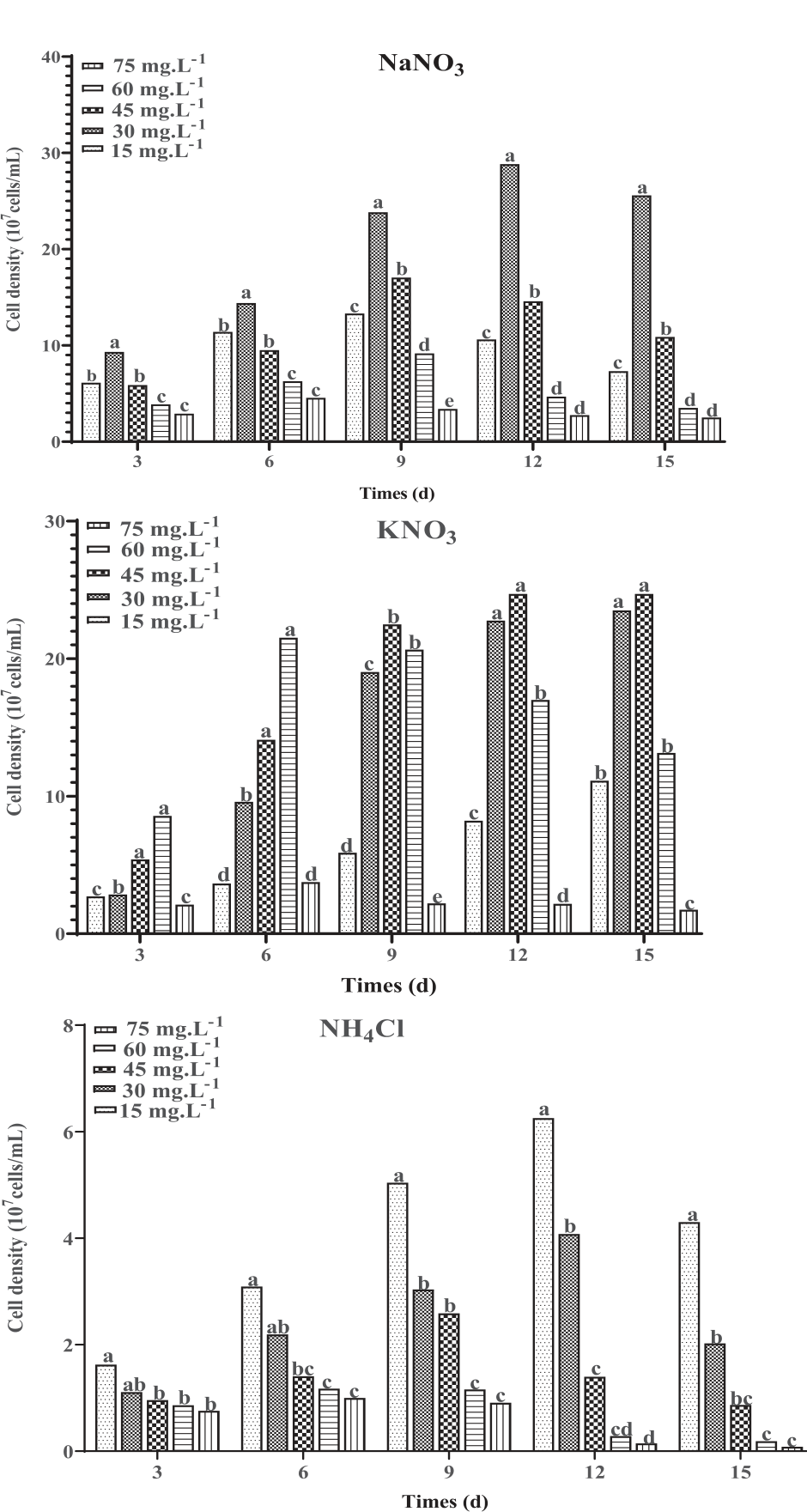
Fig. 2a.
Effect of different nitrogen sources and KWE on chl a contents of C. sorokiniana. Fig. 2b. Effect of different nitrogen sources and KWE on chl b contents of C. sorokiniana.
Effect of Different Nitrogen Sources and KWE on the Carbohydrate Content of C. sorokiniana
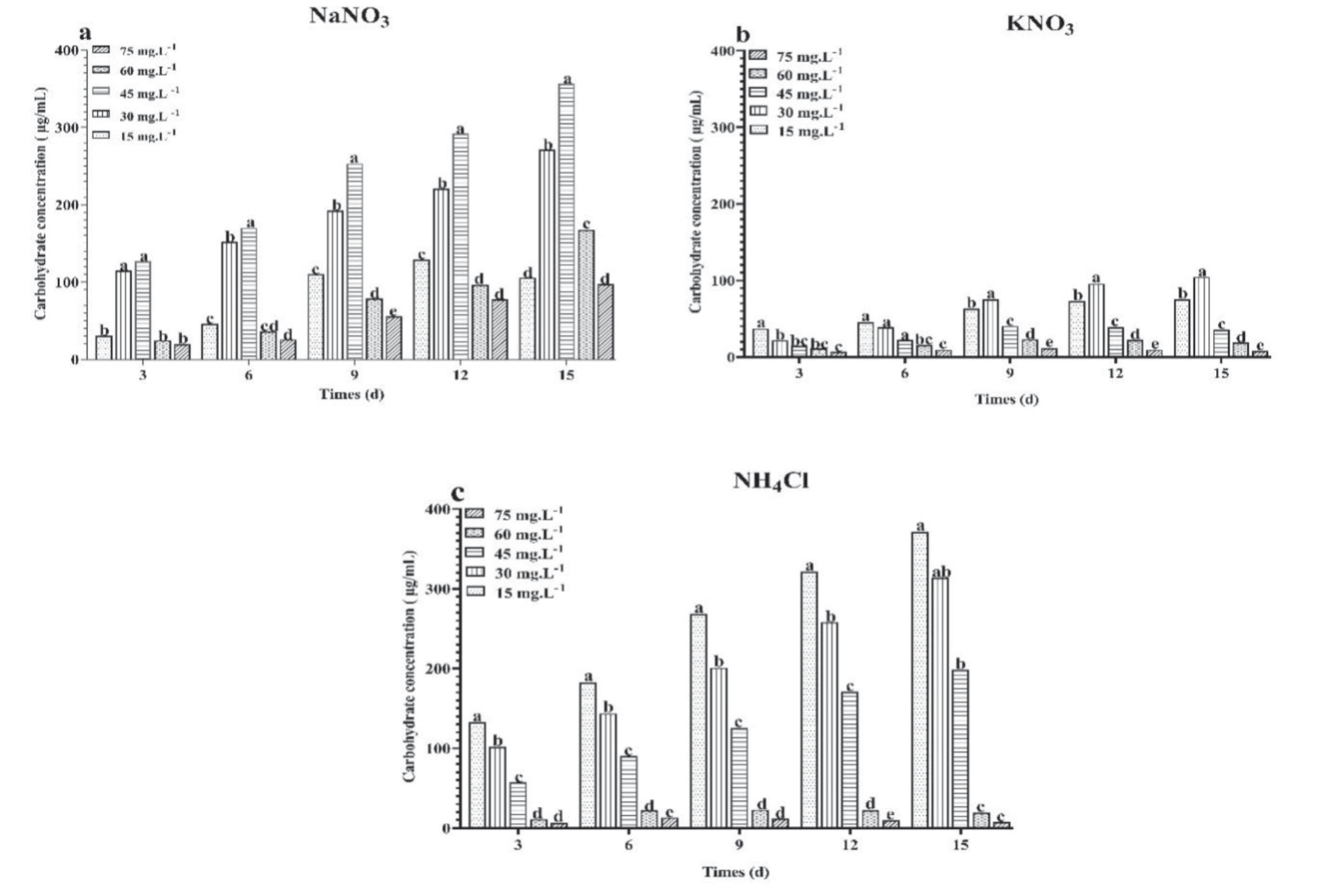
The present study tested the effect of different nitrogen sources (NaNO3, KNO3, and NH4Cl) on C. sorokiniana to determine the most suitable nitrogen source and concentration to stimulate carbohydrate production in microalgae cells. Fig. 3 demonstrates the effect of different nitrogen concentrations on the carbohydrate production of C. sorokiniana. It was observed that all higher nitrogen concentrations (60 and 74 mg L-1) failed to increase the carbohydrate content. In comparison, the lower and moderate 15-45 mg L-1 concentrations of nitrogen sources highly enhanced the carbohydrate content. The rich carbohydrate content of 45 mg L-1 was recorded under 45 mg L-1 of NaNO3, and the lowest amount of 104.6 μg mL-1 of carbohydrate was found under the treatment of 60 mg L-1 of KNO3. Compared to all nitrogen sources, the highest 390.1 μg mL-1 carbohydrate content was recorded in the presence of 15 mg L-1 of ammonium chloride. This progressive increment in carbohydrate content was observed due to an increase in the polysaccharide fractions; consequently, the highest carbohydrate content was recorded in the NH4Cl culture.
Effect of Different Nitrogen Sources and KWE on Biomass and Total Lipid Content of C. sorokiniana
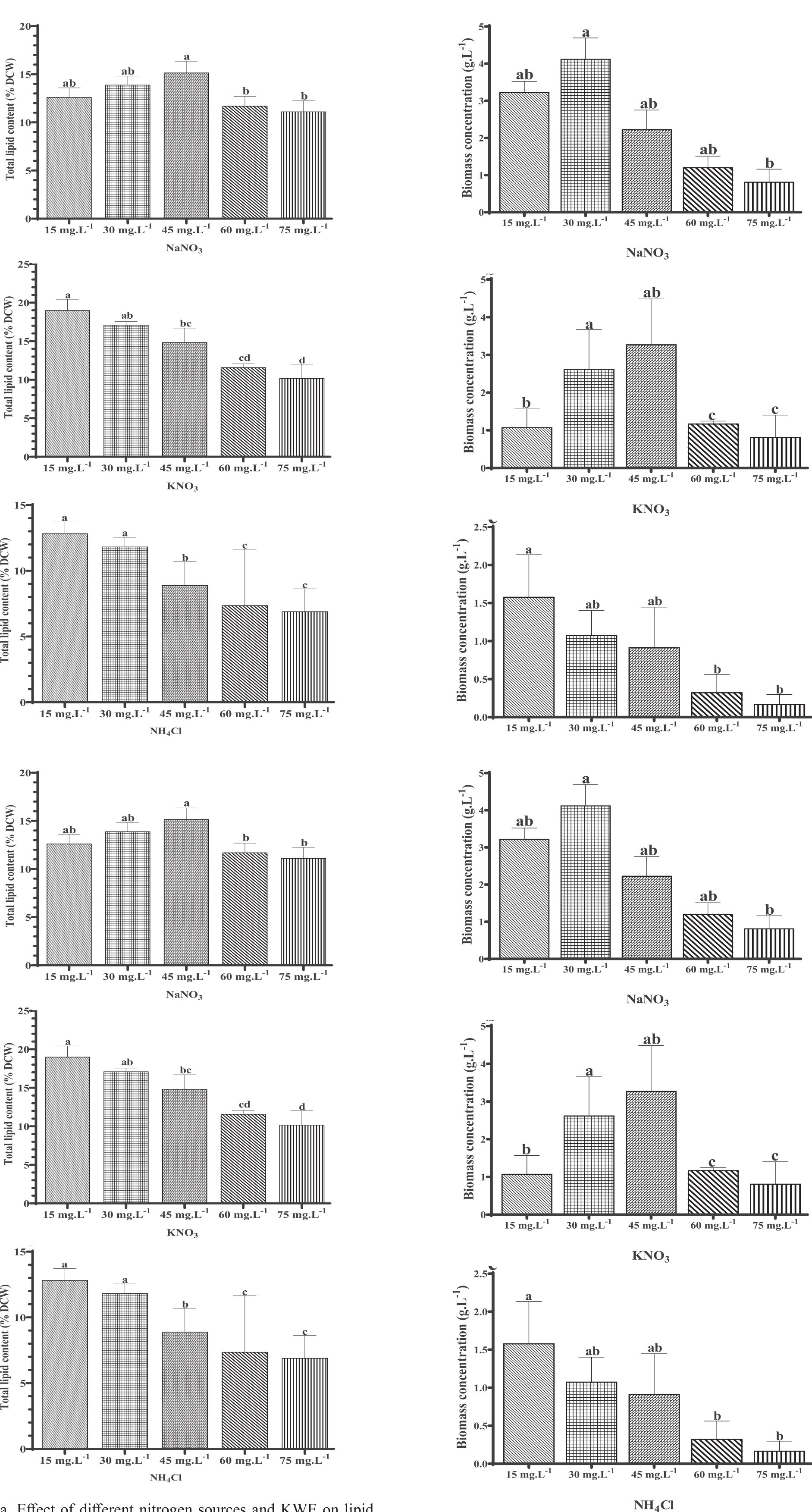
This experiment was conducted to study the effect of different nitrogen sources on the biomass growth of algae. The results of dry weight data are shown in Fig. 4b). The results for the 15 days of lower and higher doses of nitrogen treatment demonstrated that the higher dose showed a negative impact on biomass growth. Based on the data analysis of 13 days, the highest biomass concentration was achieved from the culture given by 45 mg L-1 of KNO3, and the lowest biomass content was recorded in the culture given by 30 mg L-1 of NH4Cl. Nitrogen is the most important element for lipid formation during microalgae growth. Fig. 4a) presents a comparison of the lipid production of C. sorokiniana in the presence of different nitrogen sources. In the present study, the lipid content of microalgae samples was estimated by the modified Bligh and Dyer method and was found to be highest (19% and 15% of dcw) in the presence of 15mg.L-1 of KNO3 and 45 mg.L-1 of NaNO3, respectively. In contrast, there was a significant decrease of 12% in lipid content recorded in the presence of NH4Cl.
Discussion
Nitrogen is one of the most essential nutrients for microorganisms to synthesize amino acids, proteins, and nucleic acids, and the type of nitrogen supplied can have a significant effect on the efficacy of cell growth and metabolite formation [17]. In the present
study, the limitation of nitrogen concentrations significantly influenced the cell density and lipid
productivity of microalgae. A low 30 mg.L-1 dose of NaNO3 was identified as the critical concentration
to achieve maximum cell density. Similarly, the cells that grew in low treatment of N sources accumulated higher biomass. Results showed that
30 mg.L-1 of NaNO3 is the best concentration for cell growth and biomass productivity, and further increases in N concentration from 45 to 75 mg L-1 will lead to a biomass decrease. On the other hand, the cultures supplemented with ammonium chloride showed growth inhibition when nitrogen concentration was increased from 15 mg L-1, resulting in lower cellular density due to turbidity and cessation of cell division. This mortality of cells at higher concentrations of NH4Cl culture was likely caused by an excess of the ammonium salt, which acidified the culture medium as a result of the salt hydrolysis yielding a strong acid and a weak base: NH4⁺+ Cl⁻ + HOH ↔ NH4OH + Cl⁻ + H⁺ [18]. This result shows a similar trend to the research conducted that nitrogen sources are suitable for growth, but some nitrogen sources directly affect the biochemical composition of cells and result in lower cellular density and biomass production [19]. It is reported that the nitrogen source is a fundamental material for the formation of chlorophyll in synthesis, and magnesium plays a major role in photosynthesis’ light absorption [20]. The formation of chlorophyll is also influenced by nitrogen concentration [21]. Our results indicate that the mixture of KWE, NaNO3, and KNO3 showed the best performance enhancement of pigment contents. In contrast, the addition of KWE and ammonium chloride in culture showed a negative effect on pigment contents. Compared with all nitrogen treatments, 30 mg L-1 of NaNO3 showed the best performance in the case of pigment accumulation. This enhancement in chlorophyll content proves that KWE contains all the macro and micronutrients that are present in commercial fertilizers to enhance plant and microalgae growth. Similar results have also been reported by [22], who observed that adding FBLU fertilizer in culture media increased (5.51 μg.g-1) chlorophyll a of Gracilaria sp. Moreover, the variations in the composition of the culture medium can cause changes in the biochemical composition of marine microalgae, especially in lipids and carbohydrates, and nitrogen starvation is a basic method to accelerate carbohydrate production in algal cells [23]. The carbohydrate content determined by this study was compared with experimental data, as shown in Fig. 3. It was observed that during the first 3 days, the carbohydrate content accumulated slowly on all nitrogen treatments. Compared with all nitrogen treatments, the highest carbohydrate content (428.1 μg mL-1) was recorded in the culture with the lowest nitrogen concentration (15 mg L-1 NH4Cl). This is due to the insufficient usage of the applied nitrogen source, which decreases the availability of nitrogen in cells and increases the production of carbohydrates but slows down algal growth. Furthermore, nitrogen transformation efficiency (NTE) is a crucial optimization parameter for mass culture because biomass production must be unrestricted by nutrient supply; residual unmetabolized nutrients increase the price of the product. A high NTE does not always indicate metabolic need. Several microalgae have been observed to consume excessive nitrogen for enhanced biomass growth [24]. To reveal the effects of different nitrogen sources on microalgae biomass and lipid production, three famous nitrogen sources (NaNO3, KNO3, and NH4Cl) were used to cultivate C.
Fig. 4a.
Effect of different nitrogen sources and KWE on lipid contents of C. sorokiniana. Fig. 4b. Effect of different nitrogen sources and KWE on biomass production C. sorokiniana.
sorokiniana. The results also demonstrated that different nitrogen treatments influenced biomass growth and lipid productivity. It was found that the
influence of sodium nitrate and potassium nitrate on the biomass of C. sorokiniana was much better than that of ammonium chloride. The moderate concentration of sodium nitrate and potassium nitrate ranged from 30-45 mg L-1, producing the highest biomass content compared to a higher concentration of 60-75 mg L-1. Therefore, our findings do not support most other studies in which the increasing nitrogen concentrations highly increase biomass growth because the biomass productivity of microalgae is highly dependent on the culture medium and the species of microalgae [25]. Moreover, the previous study has shown that nitrogen concentration in the nutrient medium is one of the most influential factors in lipid accumulation in microalgae, and nitrogen deficiency is widely regarded as the most effective stimulator for lipid accumulation in microalgae [26]. Similarly, in our study, all cultures except N deficient cultures showed an increasing trend in lipid content as the cultivation time elapsed, and the degree of increase in lipid content was very different, depending on the supplied N sources. The sodium nitrate and potassium nitrate cultures produced the highest lipid content compared to ammonium cultures. The lipid content obtained in NaNO3 and KNO3 flask cultures was comparable. The medium containing 45, 60, and 75 mg L-1 inhibits the lipid synthesis of C. sorokiniana. It can be seen in Fig. 4b that when the C. sorokiniana grew in the presence of a higher concentration of NaNO3, the cells were active, but the intracellular lipid content decreased. When NaNO3 and KNO3 in the medium are relatively low, the intracellular lipid content could be relatively high. From the result, the highest (19% dcw) lipid content was recorded in the presence of 15 mg L-1 of KNO3. Results of this study support the hypothesis of [27], that the result shows that the mixed culture of C. sorokiniana and Closterium sp. if KNO3 was added only by 50% and 25%, the resulting dry biomass decreased, whereas lipid production increased.
Conclusions
Nitrogen deprivation is the most widely accepted strategy for lipid content enhancement. In the present study, it was observed that sodium nitrate seemed to be the preferred nitrogen source for algal biomass growth. The maximum biomass concentration of 4.1 g L-1 was reached at 30 mg L-1 NaNO3. In the presence of 15 mg L-1 NH4Cl, the highest productivity of carbohydrates (428.1 g mL-1) was recorded. Sodium nitrate was the greatest nitrogen source for maximizing lipid content (19% dcw). The results indicate that microalgae can be considered a basic material for future biodiesel production applications.

