

Introduction
As a kind of “pre-capital”, infrastructure is a prerequisite for economic growth and social development. In the era of the digital economy, advancing digital infrastructure construction and unlocking digital dividends [1] have become effective means for achieving the “dual-carbon” goals [2]. China is currently the largest carbon-emitting country globally [3]. Its energy structure is predominantly coal-based. Despite the implementation of a series of policy measures in recent years aimed at limiting and reducing carbon emissions [4], China’s total daily carbon emissions are still at the highest level in the world, and green and low-carbon development has a long way to go. The global economic downturn underscores the prominence of digitization and decarbonization as the prevailing themes in global economic and social development, serving as new engines for sustainable economic growth [5, 6]. The industrial sector contributes the most to global carbon dioxide emissions, accounting for approximately 30% of the total emissions [7]. As the “world’s factory,” China’s industry not only serves its domestic needs but also caters to global demands. Therefore, the focus of carbon reduction in China is centered on enterprises, with the effectiveness of corporate carbon emission reductions directly influencing the nation’s overall carbon reduction goals [8]. Simultaneously, as a developing country, China faces the dual challenge of economic development and environmental protection [4]. A pressing research question is how digital infrastructure development can decouple economic growth from the increase in carbon emissions.
In September 2023, during an inspection in Heilongjiang, President Xi Jinping first introduced the concept of “new quality productivity,” emphasizing the integration of technological innovation resources and the leadership of strategic emerging industries to accelerate the formation of new quality productivity. New quality productivity is a new competitiveness and lasting driving force for China’s high-quality economic development, and it is characterized by digitalization, networking and green development. Vigorously promoting digital infrastructure construction, driven by digitization towards greening, facilitates the rapid formation of new quality productivity, enhancing China’s new competitive advantage and enduring force for high-quality economic development. Enterprises, as the most crucial microeconomic entities in a market economy, play a pivotal role in achieving the dual-carbon goals through carbon emission reduction. Thus, it becomes imperative to explore the extent, impacts, and mechanisms of digital infrastructure on carbon emissions in Chinese enterprises. This paper aims to unveil the impact mechanisms of digital infrastructure on corporate carbon reduction and quantify its effects, holding significant implications for expediting digital infrastructure construction and promoting low-carbon green development.
The concept of a “low-carbon economy” was first introduced in the UK’s Energy White Paper in 2003, garnering widespread attention from the international community and academia. A low-carbon economy means that the sustainable way to reduce carbon emissions is to reduce carbon energy consumption [9]. One of the crucial paths for low-carbon development is to improve carbon productivity by reducing CO2 emissions and enhancing total factor productivity [10]. Low-carbon transformation is fundamentally an environmental regulation and a primary means for enterprises to achieve carbon emission reduction goals [11]. The theory of digital infrastructure, originating from internet research and behavior network theory, has been diverse in perspectives among foreign scholars. It encompasses the application of information and communication technology and related infrastructure [12]. It forms a new infrastructure system based on information networks, combined with new generation information technology [1]. It serves as an external facilitating factor regulating the relationship between societal cognitive characteristics and entrepreneurial actions [13]. It involves providing digital capabilities such as storage and computing services through ICT systems [14].
With the rapid development of digital infrastructure and increasing constraints on resources and the environment, the low-carbon governance effects of digital infrastructure have become a focal point in academia. However, consensus on whether it effectively reduces carbon emissions remains elusive [15]. The data traffic of China’s 5G network infrastructure is a major contributor to increased carbon dioxide emissions, while technological progress significantly reduces emissions through lowered energy intensity [16]. On one hand, digital infrastructure may have adverse effects on future carbon emissions. Data centers operate at a huge cost in energy consumption [17]. The high energy consumption design of Bitcoin poses a major obstacle to energy development [18]. China’s carbon emissions related to digital infrastructure show exponential growth [19]. On the other hand, digital infrastructure has positive effects on carbon emissions. As a green technology tool, internet infrastructure is crucial for improving carbon emission efficiency [20]. The carbon reduction effect of China’s digital economy is evident, with energy structure mediating between digital economy and carbon reduction [21]. Digital economy directly reduces carbon emissions, promoting low-carbon development [22]. Digitization facilitates accurate measurement and accounting of carbon emissions [23].
Amid China’s determined pursuit of its dual carbon objectives, digital infrastructure stands as a pivotal foundation for the growth of the digital economy. The urgent need to explore how digital technology and digital infrastructure can be optimally utilized to facilitate China’s transition to carbon neutrality and foster the concurrent development of “digitalization” and “greening” is a matter of significant importance [24]. In this context, this article employs the “Broadband China” pilot as a quasi-natural experiment to investigate the impact of digital infrastructure on corporate carbon emission reduction and to understand the mechanisms behind this effect. The study aims to provide strategic guidance for enterprises under the aegis of digital infrastructure development, enabling them to actively engage in and complete their transformation towards a reduced-carbon, green model in this era. In comparison to previous research, this paper contributes in several aspects. Firstly, from a theoretical perspective, it constructs a theoretical framework for understanding how digital infrastructure affects low-carbon development, enriching and expanding the cross-disciplinary research on digitization and decarbonization. Secondly, in terms of mechanism analysis, it explores the intrinsic mechanisms of how digital infrastructure promotes corporate carbon reduction from the perspectives of “technological dividend” and “structural dividend” effects, offering new insights for addressing the dual constraints of economic and environmental goals and promoting green and low-carbon development. Thirdly, in heterogeneity testing, it examines the heterogeneous impacts of digital infrastructure on corporate carbon emissions based on factors such as corporate property rights, industry competition intensity, resource endowment, and industrial characteristics of the city, contributing to a deeper understanding of the relationship between digital infrastructure and corporate carbon emissions. This provides a scientific basis for the rational formulation and implementation of policies to empower enterprises for low-carbon development through digital infrastructure. The structure of the remainder of this paper is as follows: Section 2 presents the theoretical analysis and research hypotheses. Section 3 details the research design, including the model setup, variable selection, data sources, and explanations. Section 4 discusses the empirical results. Section 5 focuses on mechanism testing and heterogeneity analysis. Finally, Section 6 concludes with the main findings and policy recommendations.
Theoretical Analysis and Research Hypotheses
Digital Infrastructure and Corporate Carbon Emission Reduction
Digitization and decarbonization are dual engines propelling green development in human society and are intrinsic requirements for the high-quality advancement of the economy and society. When digitization intersects with decarbonization, is it a conflict or a mutual empowerment? According to the “SMARTer2030” report released by the Global Enabling Sustainability Initiative (GeSI), by 2030, the global ICT industry’s carbon emissions will only account for 1.97% of global emissions, but ICT technologies will enable a 20% reduction in global carbon emissions by empowering other industries. In other words, digitization will enable decarbonization with a tenfold leverage effect. As a new potential of the digital economy, digital infrastructure presents new opportunities for enterprises to achieve green and low-carbon economic development. Digital infrastructure supports enterprises in enhancing their ability to adapt to ecological changes through digital transformation, developing intelligent manufacturing based on digital technology, creating digital twin systems, utilizing technologies like big data and artificial intelligence for intelligent analysis and fine management of production processes, promoting energy efficiency, reducing carbon emissions, optimizing industrial structures across different sectors, and fostering intelligent development within industries [25]. This leads to a comprehensive deepening of digital applications for carbon reduction across various industries.
Building on the above analysis, this paper further proposes:
Hypothesis 1: Digital infrastructure has a negative impact on corporate carbon emissions, meaning that digital infrastructure contributes to the reduction of corporate carbon emissions.
“Technological Dividend” Effect and “Structural Dividend” Effect of Digital Infrastructure
Following the environmental effect framework proposed by Grossmanand Krueger [26] and Dong et al. [27], digital infrastructure, on the one hand, generates a technological dividend effect through green technological innovation and energy efficiency improvement. On the other hand, it produces a structural dividend effect through digital transformation.
Green Innovation
Green technological innovation integrates technological innovation with ecosystems, breaking the traditional development framework of “high investment, high consumption.” It is a core driving force for achieving green and low-carbon development and improving natural resource efficiency [28]. The new generation of information and communication technologies involved in digital infrastructure enhances the level of intelligent informationization in enterprises. Through the application and penetration of information technology, it efficiently facilitates information transmission, providing support for green technological innovation in enterprises. On one hand, the rapid development of information technology provides an efficient, convenient, and intelligent information platform for innovation activities in enterprises, enhancing information spill-over and knowledge spillover effects among related industries, thus promoting the joint development of enterprise informatization and technological innovation. On the other hand, the widespread application of information technology helps enterprises optimize production layouts. By applying intelligent and digital technologies in enterprise management, it triggers green technological innovation in key areas such as energy and transportation, effectively improving the efficiency of resource and energy utilization, and promoting energy-saving and carbon reduction.
Energy Efficiency
On the supply side of energy, digital technologies such as big data, cloud computing, and artificial intelligence support the widespread application of the platform economy in the energy digital industry. New energy development and utilization models, such as contract energy management, third-party environmental pollution control, and energy futures management, emerge continuously, further promoting improvements in energy utilization methods and the evolution of energy business models. This greatly enhances the fine management level of energy supply-side management and the overall efficiency of energy use, significantly reducing carbon emission intensity and total emissions. On the energy trading side, with the interconnection of digital infrastructure, platform companies experience explosive growth. Energy market entities can achieve precise transactions through multilateral platforms, effectively improving energy transaction efficiency and resource allocation efficiency [29]. This directly or indirectly reduces carbon emissions from energy activities.
Digital Transformation
Firstly, digital transformation helps improve enterprise environmental governance capabilities. As digitalization, networking, and intelligentization deepen, enterprises can introduce advanced technologies to not only bring in efficient production equipment, enhance production automation, and reduce energy consumption but also upgrade and transform end-of-pipe governance facilities. This accelerates technological innovation to enhance enterprise environmental governance capabilities, driving the transformation of production processes towards cleanliness. Secondly, digital transformation facilitates the shift towards service-oriented enterprises. The integration of cutting-edge technologies such as artificial intelligence and big data into enterprise production and operation reduces communication barriers between enterprises and customers. It helps enterprises understand customer needs, optimize product design, promote the transformation towards service-oriented enterprises, thereby increasing labor productivity and reducing corporate carbon emissions. Finally, digital transformation contributes to improving enterprise resource allocation efficiency. The widespread penetration and application of information technology can promote the rapid flow of various resource factors, facilitating the coordination of supply and demand for enterprises. Simultaneously, it enables the efficient transfer of production factors from less efficient to more efficient sectors, promoting the internal upgrading of industries [30]. This enhances total factor productivity and drives the transition to a low-carbon economy.
Building on the above analysis, this paper further proposes:
Hypothesis 2: Digital infrastructure can promote the reduction of corporate carbon emissions through the “technological dividend” effect and the “structural dividend” effect.
Material and Methods
Model Specification
In August 2013, the State Council of China issued the “Broadband China” strategic implementation plan. The Ministry of Industry and Information Technology and the National Development and Reform Commission approved three batches totaling 120 “Broadband China” demonstration cities in 2014, 2015, and 2016. The “Broadband China” pilot accelerated the construction of broadband and other network infrastructure, effectively promoting the upgrading of digital infrastructure. In this study, the “Broadband China” pilot is considered as an exogenous policy shock [31-33]. Through constructing a time-varying DID model, the study examines the impact of the improvement in the level of digital infrastructure brought about by the “Broadband China” pilot on corporate carbon emissions.
In Equation (1), Carbon is the dependent variable, representing the carbon emissions of firm i in year t; bb is the core independent variable, indicating whether the firm belongs to the “Broadband China” pilot list. Controls are the set of control variables, including both city-level and firm-level control variables. Firm and Year represent firm and year dummies, considering individual and time effects. ε is the random disturbance term.
Variable Selection
(1) Dependent Variable: The total carbon emissions (Carbon) of listed companies are chosen as the dependent variable. Chinese corporate carbon emission data primarily come from voluntary disclosures by enterprises. Following the approach of Wang et al. [34], data is collected from social responsibility reports, annual reports, sustainable development reports, and environmental reports of listed companies for the years 2006-2021.
(2) Core Independent Variable: The binary variable bb, indicating whether a city was part of the “Broadband China” pilot in a given year, serves as the core independent variable. It takes the value of 1 if the city was a pilot city in that year and 0 otherwise.
(3) Control Variables: City-level control variables include the natural growth rate (rate), total retail sales of social consumer goods (lnconsu), year-end financial institution deposits (lndeposit), and the number of regular higher education institutions (lnschool). Firm-level control variables encompass leverage ratio (Lev), shareholding ratio of the largest shareholder (Top1), firm age (FirmAge), return on assets (Roa), the proportion of fixed assets (Fixed), and revenue growth rate (Growth).
Data Source and Explanation
This study uses a sample of 2749 A-share listed companies on the Shanghai and Shenzhen Stock Exchanges from 2006 to 2021. Data on listed companies mainly come from annual reports, social responsibility reports, sustainable development reports, and environmental reports. Data on prefecture-level cities are mainly obtained from the annual “China City Statistical Yearbook” and the Wind database. The enterprise data is matched with city-level data to form a new dataset for empirical analysis.
Results and Discussion
Regression Results Analysis
Baseline Regression Analysis
Columns (1) and (2) in Table 1 present the results of the regression model based on the two-way fixed-effects model, while columns (3) and (4) show the OLS regression results. Columns (2) and (4) include additional city and firm-level control variables compared to columns (1) and (3). The estimated results in Table 1 indicate that the regression coefficients of digital infrastructure are significantly negative at the 1% level. This implies a significant negative correlation between digital infrastructure and corporate carbon emissions, confirming hypothesis H1. Feng et al. [35] believed that digital infrastructure construction was a key means to promote development transformation, energy conservation and emission reduction. Empirical results showed that the implementation of digital infrastructure had a significant impact on reducing carbon emissions. Ma et al. [36] concluded that digital infrastructure construction is significantly negatively correlated with total carbon emission and carbon emission intensity, which is conducive to the “double control” of corporate carbon emission.
Robustness Test
(1) Dynamic Effects and Placebo Tests
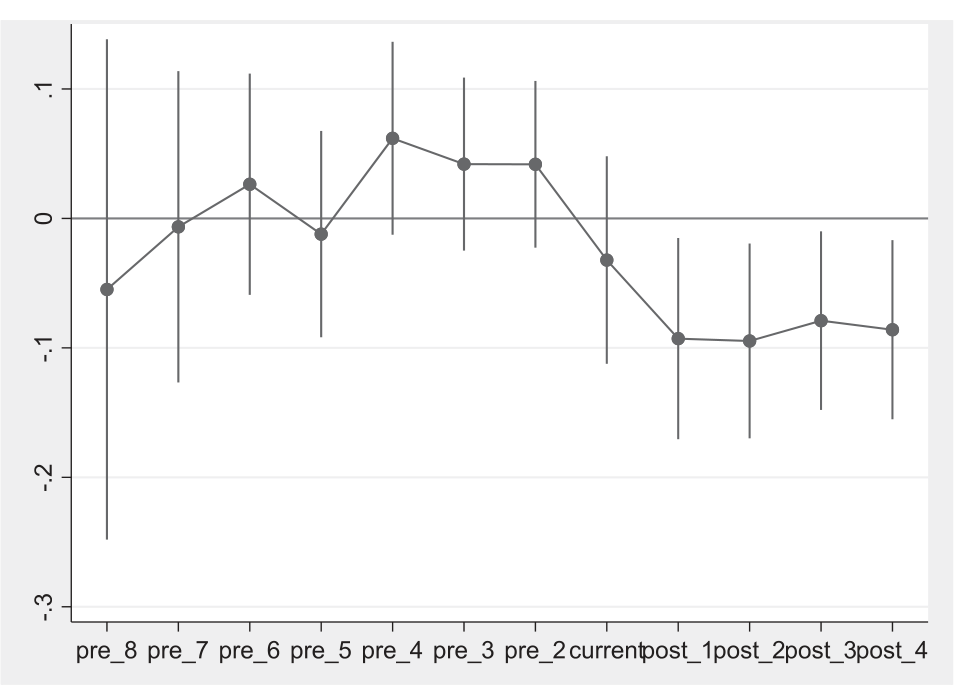
The key assumption for using the DID method is that the experimental and control groups exhibit parallel trends [37], meaning that, before the implementation of the “Broadband China” strategy, the carbon emissions of listed companies in both groups had a relatively stable trend. In this study, following the approach of Li et al. [38], we employ the Event Study Approach to investigate the dynamic effects of the “Broadband China” pilot. In this paper, the previous period of the implementation of “Broadband China” strategy, 2013 (recorded as “-1 period”), is selected as the base period [39]. As shown in Figure 1,the coefficients before the pilot are generally insignificant, before the pilot are generally insignificant, indicating that there is no systematic difference in carbon emissions between the experimental and control regions before the “Broadband China” pilot. However, the coefficients for the pilot year and the following four years are significantly positive at the 10% level, suggesting a significant negative impact of the “Broadband China” pilot on corporate carbon emissions.
Table 1.
Baseline regression results.
To eliminate the possibility of the carbon reduction effect of the “Broadband China” strategy being influenced by random factors, a placebo test is conducted by randomly assigning “Broadband China” pilot cities [40]. The expression for the coefficient estimation of the DID term bb is as follows:
Where Controls represent all observable control variables. To ensure an unbiased estimation of ∂1, it is essential that γ equals zero. However, it is challenging both to ascertain the exact value of γ as zero and to directly examine whether estimation results may be affected by random factors. This study adopts a computer simulation approach, guided by relevant economic theories, to ensure that bb does not influence the dependent variable. Based on this premise, if it is possible to estimate ∂1 as equal to zero, we can deduce that γ is indeed zero. To achieve this, we conducted 500 random samples. The results of the placebo test for coefficient estimation, as depicted in Fig. 2, show that the estimated coefficients are primarily concentrated around zero. This suggests that the baseline regression results in this study are highly unlikely to be driven by unobserved factors.
(2) Substituting Dependent and Core Independent Variables
The intensity of corporate carbon emissions is represented by the ratio of corporate CO2 emissions to the number of employees. The coefficient estimate for digital infrastructure in this alternative measure (see Table 3, column (1)) is consistent with the baseline estimation. Simultaneously, indicators such as telecommunications revenue [1], postal revenue, the number of mobile phone users, and international Internet users [41] are processed through Principal Component Analysis (PCA) to obtain the level of digital infrastructure development at the prefecture-level (di). When matched with firm-level data, the results in Table 3, column (2), demonstrate that the coefficient estimate remains significantly negative, supporting the baseline regression conclusion.
(3) PSM-DID
The DID method may suffer from “selection bias,” especially in large sample sizes. To ensure the robustness of the regression results, propensity score matching (PSM) is combined with DID. First, PSM is used to identify the treatment features with control variables; then, DID is applied to the matched results. Column (3) in Table 2 shows that digital infrastructure remains significantly favorable for reducing corporate carbon emissions, consistent with the previous analysis.
(4) Controlling for Other Policies and Industry-Year Interaction Fixed Effects
Considering that government-implemented environmental governance policies may introduce bias into the baseline estimation results, this study, through the collection and organization of documents, identifies the low-carbon city policy initiated in 2010 and the carbon emission trading policy initiated in 2013 as potentially influencing the estimation results during the sample period. Consequently, virtual variables for these policies and their interaction terms with the linear time trend are introduced into the baseline regression to control for the impact of these relevant policies on the estimation results. Specifically, ‘lowc’ and ‘right’ represent whether a city in a given year was part of the low-carbon city pilot or carbon emission trading pilot. A value of 1 indicates participation, while 0 indicates non-participation. The final results can be found in Table 3, columns (1) and (2).
Furthermore, to avoid overlooking industry-specific dynamic factors that may bias the estimation results, this study attempts to include industry-year interaction fixed effects to control for time heterogeneity trends associated with industry variations. The results of this adjustment can be seen in Table 4, column (3). It is evident that, even after controlling for other policies and industry-year interaction fixed effects, there is no substantial change in the significance and direction of the coefficient representing the impact of digital infrastructure on corporate carbon emissions. This further reinforces the robustness of the baseline results.
Mechanism Test and Heterogeneity Analysis
Mechanism Analysis
Based on the empirical results mentioned above, digital infrastructure significantly promotes corporate carbon reduction. So, what is the mechanism through which digital infrastructure empowers corporate carbon reduction? As indicated by the theoretical analysis in the preceding sections, digital infrastructure can impact corporate carbon reduction through the effects of technological dividends and structural dividends. In the following sections, we empirically examine these specific mechanisms.

Table 2.
Robustness test I - The impact of digital infrastructure on corporate carbon emissions.
Table 3.
Robustness test II - The impact of digital infrastructure on corporate carbon emissions.
(1) Green Technological Innovation
Green technology innovation can be primarily categorized into two types based on the goals and implementation methods: Disruptive green technology innovation and Progressive green technology innovation. The former refers to innovative activities that bring about transformative changes in existing green technologies, leading to the elimination of outdated products and exhibiting a high degree of disruption. The latter involves continuous innovation within existing technology clusters, often driven by experience accumulation or learning, focusing on enhancing product aesthetics and design, among other aspects. In this study, we employ the number of green patents filed in a given year and the number of green utility models as proxy variables for measuring disruptive and progressive green innovation, denoted as ‘inv’ and ‘uti,’ respectively. Table 4, columns (1) and (2), reveals that disruptive green innovation did not pass the significance test, whereas the coefficient for progressive green innovation is statistically significant and positive. This suggests that digital infrastructure can facilitate a reduction in corporate carbon emissions through progressive green innovation, implying a distinct ‘Porter Effect’ associated with digital infrastructure development. Research conducted by Bu et al. [42] corroborated this finding, indicating that digital technologies can contribute to carbon emissions reduction by elevating the level of green technology innovation. Furthermore, Zou and Pan [32] underscored the significance of green innovation as a vital mechanism for reducing environmental pollution in the context of network infrastructure development.
(2) Improvement in Energy Efficiency
The efficiency of energy utilization is characterized by the principle that less energy input yields greater energy efficiency at a given output level, while the same output achieved with higher energy input signifies lower energy efficiency. Therefore, the commonly adopted metric for measuring energy efficiency is the unit GDP energy consumption, representing the amount of energy consumption required to achieve economic growth. Following the approach of Shao et al. [43], energy efficiency is measured as the ratio of energy consumption to GDP, denoted as ‘energy.’ As indicated in Table 4, column (3), the construction of digital infrastructure significantly reduces the energy consumed per unit of output, thus enhancing energy efficiency. This improvement stems from the extensive application of digital technologies such as cloud computing, blockchain, and the Internet of Things throughout the energy production, consumption, trading, storage, and management chains. This integration of traditional energy industries with the digital sector optimizes energy production and consumption, leading to an overall increase in energy efficiency, and substantially reducing the carbon intensity and total emissions associated with energy activities. Some scholars have come to a similar conclusion that the digital economy can promote better energy efficiency [44, 45], improving energy efficiency can reduce carbon emissions. Wang et al. [46] conducted a natural experiment based on the pilot policy of “Broadband China” and concluded that digital transformation significantly reduced electricity consumption and intensity, providing empirical evidence for reducing energy consumption and carbon emissions through the application of digital technology.
(3) Digital Transformation
The infrastructure is the foundation of digital transformation, which helps companies achieve carbon reduction. On one hand, digital transformation facilitates the breaking of temporal and spatial barriers for various innovative resources, reduces information acquisition costs for businesses, strengthens efficient development of green technologies, and elevates a company’s carbon reduction technology capabilities. On the other hand, digital transformation optimizes business management processes, enhances decision-making capabilities, improves production efficiency, and guides companies towards a transition from traditional industrial structures to intelligent production methods, contributing to reduced resource consumption and carbon emissions. Referring to the practice of Wu et al. [47], this study employs Python to measure the digital transformation of enterprises (digital), using data extracted from the annual reports of publicly listed companies. This measurement encompasses 76 digital-related word frequencies across five dimensions: artificial intelligence technology, big data technology, cloud computing technology, blockchain technology, and the application of digital technology. According to Table 4, column (4), the impact of digital infrastructure on reducing corporate carbon emissions is significantly influenced by digital transformation. Jia et al. [48] argued that network infrastructure effectively promoted corporate digital transformation. The study conducted by Shang et al. [49] revealed that corporate digital transformation can significantly reduce carbon emission intensity by enhancing a company’s technological innovation capabilities, internal control capabilities, and environmental information disclosure capabilities.
In conclusion, digital infrastructure promotes corporate carbon reduction primarily through stimulating green technological innovation, enhancing energy efficiency, and facilitating digital transformation. Thus, H2 is basically validated.
Heterogeneity Analysis
(1) Heterogeneity in Ownership
In order to investigate the influence of digital infrastructure on corporate carbon emissions under different ownership attributes, this study, building upon a baseline regression model, further categorizes the sample into state-owned and non-state-owned enterprises based on their ownership attributes. We examine the differential impact of digital infrastructure development on corporate carbon emissions. Table 5 reports the regression results for the ownership nature samples in columns (1) and (2). In column (1), the regression coefficient of the DID term(bb) for state-owned enterprises is significantly negative. In column (2), the regression coefficient of the DID term(bb) for non-state-owned enterprises is negative but not statistically significant. This suggests that the reduction of corporate carbon emissions through digital infrastructure is more significant in state-owned enterprises. Possible reasons for this disparity include, on one hand, that under the “dual carbon” goals, state-owned enterprises, compared to non-state-owned enterprises, face not only market constraints on carbon reduction but also a greater political task of carbon reduction. State-owned enterprises have a stronger ecological and environmental protection responsibility, are more focused on green development, and consequently exhibit better environmental responsibility behavior by increasing investments in energy conservation and environmental protection to reduce carbon emissions [50].On the other hand, carbon reduction requires substantial financial resources, and state-owned enterprises have a natural connection with the government, making it easier for them to obtain bank credit support, government subsidies, and tax incentives [51]. This results in a higher enthusiasm for carbon reduction and better implementation of national pollution reduction and carbon reduction policies. Therefore, state-owned enterprises have inherent advantages in resources [52] and policies, making the effect of reducing carbon emissions through digital infrastructure more pronounced. The research findings of Zhang and Liu [53] indicated that non-state-owned enterprises typically did not actively participate in the “dual carbon” goals if the government did not take any action. Tang et al. [54] pointed out that the impact of local government regulatory pressure and societal pressure on corporate carbon information disclosure exhibits ownership heterogeneity, namely, local government regulatory pressure had a greater influence on carbon information disclosure in state-owned enterprises, while societal pressure had a greater impact on carbon information disclosure in non-state-owned enterprises.
Table 4.
Mechanism analysis.
(2) Heterogeneity in Industry Competition
The development of digital infrastructure and the reduction of corporate carbon emissions are related to the intensity of competition within industries. To examine the heterogeneity in the impact of digital infrastructure on corporate carbon emissions across different industry competition levels, the study employs the Herfindahl-Hirschman Index (HHI) to measure industry competition intensity [55]. The HHI gauges market share concentration, calculated as the sum of the squares of all companies’ market shares. A higher HHI indicates higher market concentration and potentially less competition, while a lower HHI suggests more intense competition. Following the approach of Liu et al. [56], the study calculates the HHI using the main business revenue of listed companies from 2000 to 2022.The sample is divided into high-competition and low-competition industries based on the median HHI. Regression results in Table 5, columns (3) and (4), reveal that the estimated coefficient for digital infrastructure in the high-competition industry group is -0.1047 and significant at the 1% level. In contrast, the estimated coefficient for the low-competition industry group is negative but not significant. This implies that the carbon reduction effect of digital infrastructure is more pronounced for companies in high-competition industries, while it is not significant for those in low-competition industries. The reason may be that companies in highly competitive environments place greater emphasis on performance and industry standing, exhibiting stronger innovation intentions. Thus, they are more motivated to gain core competitiveness through digital technology, resulting in a more noticeable carbon reduction effect from digital infrastructure. In contrast, companies in less competitive environments, with limited competition in relatively closed markets, may find it challenging to realize the carbon reduction effects of digital infrastructure.
Table 5.
Heterogeneity analysis - ownership and industry competition.
(3) Heterogeneity in Urban Resource Abundance
Resources, as both a support and constraint to urban development, have long been a subject of study in the context of economic growth. The concept of the “resource curse” concerning resource endowments and economic growth was first introduced by Auty and Warhurst [57]. Zhang et al. [58] believed that resource endowment had a “curse” effect on green economic growth. On November 12, 2013, the State Council issued the “National Sustainable Development Plan for Resource-Based Cities (2013-2020)” [59], which identified 262 resource-based cities, county-level cities, or urban districts, categorized into four types of resource-based cities – growing, mature, declining, and regenerative – based on the abundance of their resources [60]. Regression results based on the grouping of urban resource endowments are presented in columns (1) and (2) of Table 6. Comparing non-resource-based cities with resource-based cities, it is evident that the estimated coefficient for digital infrastructure is significantly negative for non-resource-based cities. These regression results indicate that digital infrastructure is more conducive to driving carbon reduction among enterprises in non-resource-based cities. This observation may be attributed to the fact that resource-based cities, reliant on their resource wealth, tend to have a more singular industrial structure [61]. In resource-based cities, resource-based industries occupy a larger share of the economy, and since many resource-based industries are pollution-intensive, characterized by high pollution emissions and low levels of resource utilization efficiency, they often cause severe ecological damage. It takes more time to improve the level of production and pollution control technology through digital infrastructure to reduce carbon emissions, so it is difficult for enterprises in resource-based cities to achieve carbon emission reduction through digital infrastructure. Wang and Zhong [62] argued that the development of the digital economy was conducive to reducing carbon emission intensity among local businesses and exhibited heterogeneity across different types of cities. For instance, the construction of smart cities in non-resource-based cities in China significantly decreased corporate carbon emission intensity. Du et al.’s research indicated that the construction of digital infrastructure served as a potent tool for enhancing carbon emission efficiency and breaking free from the resource curse [31].
(4) Heterogeneity in Urban Industrial Attributes
On March 18, 2013, the National Development and Reform Commission issued a notification titled “Notice on the Adjustment and Transformation Plan for Old Industrial Bases Nationwide (2013-2022)” [63], which revealed that there was a total of 120 old industrial cities in China, including 95 prefecture-level cities and 25 cities at the municipal, direct-controlled, and provincial capital levels. The term “old industrial base” in the plan refers to the industrial bases formed during the periods of the “First Five-Year Plan,” “Second Five-Year Plan,” and “Third Front Construction,” which were strategically established and developed by the country with heavy industry as the backbone. While these old industrial cities have made significant historical contributions to the formation and improvement of China’s independent and complete industrial system, they are currently facing unprecedented ecological pressures [64]. The overall energy intensity of these old industrial bases is 1.3 times higher than the national average, and over 60% of them have energy intensity levels exceeding the national average, indicating a challenging situation for energy conservation and emission reduction efforts. According to the results of the regression analysis categorized by urban industrial attributes, as shown in columns (3) and (4) of Table 6, the estimated coefficient for digital infrastructure is significantly negative at the 1% significance level for non-old industrial bases, whereas it is negative but not significant for old industrial bases. This suggests that digital infrastructure has a significant role in reducing corporate carbon emissions in non-old industrial bases. One possible explanation for this observation is that old industrial bases, due to their outdated infrastructure and extensive development approach, face increasingly severe environmental problems and greater pressure for sustainable development [65, 66]. Furthermore, their transition to cleaner and more advanced industries has been slower. In contrast, non-old industrial base cities generally have lower average energy consumption and pollution levels, as well as a higher adoption of clean production technologies. Therefore, compared to old industrial bases, digital infrastructure has a more pronounced impact on carbon emission reduction in non-old industrial bases. Wang et al. [39] utilized the e-commerce pilot policy as a quasi-natural experiment to investigate the impact of digital technology on carbon reduction. The e-commerce pilot policy was found to be conducive to reducing corporate carbon emissions, with particularly significant effects observed in non-old industrial cities and non-resource-based cities.
Table 6.
Heterogeneity analysis - urban resource abundance and industrial characteristics.
In summary, the impact of digital infrastructure development, represented by “Broadband China,” on corporate carbon emissions indeed exhibits heterogeneity concerning ownership attributes, industry competition intensity, urban resource abundance, and industrial attributes, confirming the validity of H3.
Conclusions
The construction of digital infrastructure is a crucial carrier for the development of the digital economy. Accelerating this construction not only serves as an effective means for China to achieve stable growth and expand domestic demand but also provides a “new foundational opportunity” for the green and low-carbon development of Chinese enterprises. In the context of achieving “Carbon peak and carbon neutrality”, whether the “Broadband China” pilot policy, aimed at promoting digital infrastructure and powering the digital economy, contributes to reducing corporate carbon emissions is a question of interest. This paper uses the “Broadband China” pilot policy as a quasi-natural experiment. Based on the theoretical analysis, and employing matched data from 2,749 listed companies in the Shanghai and Shenzhen stock markets and 282 prefecture-level cities from 2006 to 2021, we adopt a time-varying DID method to examine the impact and mechanisms of digital infrastructure construction on corporate carbon emissions. Our findings are as follows: During the sample period, the “Broadband China” strategy significantly promotes the reduction of carbon emissions in pilot cities’ enterprises. This conclusion holds true even after a placebo test, PSM-DID, and a series of robustness tests. The mechanism analysis reveals that the “Broadband China” strategy primarily facilitates corporate carbon emission reduction through technological and structural dividend effects. Specifically, green technological innovation, energy efficiency improvement, and digital transformation are important channels through which digital infrastructure reduces corporate carbon emission levels. Heterogeneity analysis indicates that compared to private enterprises, weaker competitive industries, resource-based cities, and enterprises in old industrial bases, the establishment of “Broadband China” pilot cities is more effective in promoting carbon emission reduction in state-owned enterprises, stronger competitive industries, non-resource-based cities, and enterprises in non-old industrial bases. In other words, the carbon emission reduction effect of digital infrastructure exhibits heterogeneity across cities, industries, and enterprises. This study deepens our understanding of the effects, mechanisms, and differences of digitalization in enabling low-carbon development, contributing to the advancement of China’s digital powerhouse goals and the realization of dual carbon goals.
The findings of this study offer several policy implications: Governments need to solidify the construction of digital infrastructure, thereby providing new impetus for carbon reduction initiatives in enterprises. China should accelerate the establishment of a pervasive, smart, and connected digital infrastructure, thereby advancing its goals of becoming a strong digital nation and a digital China. This includes expediting developments in areas such as 5G base stations, industrial Internet, big data centers, and artificial intelligence. Additionally, efforts should be made to explore green and low-carbon pathways, facilitating the integration of information technology with environmentally friendly technologies. By promoting low consumption, low emissions, recyclability, and sustainability in industrial structures and production methods, digital infrastructure can effectively support low-carbon development and cultivate the inherent capacity for digital transformation in enterprises, enabling green and low-carbon growth.
Governments and enterprises should prioritize green technological innovation, energy efficiency, and digital transformation as key drivers in their agendas. This focus is essential for enhancing the carbon reduction impact of digital infrastructure. Firstly, implementing incentive policies related to green technology innovation and further refining market-driven systems for green technology innovation will encourage market players to actively engage in green technology innovation across various dimensions. This will harness the leading and supportive role of green technology innovation in promoting low-carbon development in enterprises. Secondly, leveraging digital infrastructure to promote the transformation and upgrading of the energy industry sector, improve energy utilization efficiency, and accelerate the development and utilization of clean energy will drive energy efficiency reform. This will continuously reduce corporate carbon emissions, aiding in achieving peak carbon and carbon neutrality goals. Lastly, enterprises should align with the trend of “digitalization + decarbonization,” enhancing their awareness of digital transformation. They should formulate a tailored digital transformation strategic plan that aligns with their specific circumstances, accelerate digital technology research and development, and explore the potential of digital transformation in energy conservation and emission reduction. The government, on the other hand, should address the financial challenges associated with enterprise digital transformation. It should provide certain tax incentives and fiscal subsidies to enterprises that leverage digitalization to enable green and low-carbon development, expediting digital transformation in businesses.
Governments and enterprises must base their strategies on the distinct characteristics of industries, cities, and enterprises, and explore new pathways for low-carbon development in enterprises. Firstly, increased scientific and financial investment in resource-based cities will promote green technology innovation and the development of strategic emerging industries. This should be coupled with the vigorous development of non-resource industries and the active deployment of strategic emerging industries. Efforts should focus on diversifying and modernizing the industrial system, moving away from resource dependence and traditional development models. Secondly, the transformation and upgrading of old industrial bases with high pollution and high energy consumption should be advanced. This entails the development of low-energy consumption, low-pollution tertiary and high-tech industries, reducing unit economic output energy consumption, and ultimately establishing a market-oriented pathway for energy conservation and emission reduction, driven by energy structure transformation, energy efficiency improvement, and industrial structure optimization. Lastly, state-owned enterprises, benefiting from their resources and policy advantages, should actively respond to national policies related to the coordinated development of digitalization and greenization. They should serve as exemplary leaders in driving carbon reduction and enhancing energy efficiency. Simultaneously, successful experiences of digital empowerment for green development should be shared with non-state-owned enterprises, encouraging more enterprises to engage in green development and contributing to the achievement of dual carbon goals.

