

Introduction
According to the World Meteorological Organization, the extent of climate change will continue to intensify from the peaks of mountains to the depths of oceans, with 2015 to 2022 being the hottest eight years on record1. This increasing climate risk is due to humanity’s economic and social development and the lack of attention to 1 https://public.wmo.int/en/our-mandate/climate/wmo-state-
ment-state-of-global-climate environmental protection [1]. Therefore, advancing human production processes to achieve carbon emission reductions and address the risks posed by climate change is crucial and urgent. China has recently made significant economic progress as the largest growing nation. Nevertheless, this rapid expansion has also introduced substantial environmental challenges. The pursuit of low carbon is currently the focus of the Chinese government’s efforts, but carbon emissions reduction is a challenging target [2]. Although China, the largest developing nation, has recently experienced significant economic progress, it has also experienced severe environmental challenges.
As digital technology advances, the digital economy will infuse global economic growth with renewed vigor and emerge as a significant driver of worldwide economic advancement [3]. An organization’s digital transformation facilitates tracking its carbon footprint, helping it identify and implement measures to reduce its carbon emissions [4]. Digital transformation can have several negative impacts. Equipment needed for digital transformation, such as electronic devices, servers, and data centers, requires significant resources for manufacturing and maintenance. Waste from producing and disposing of such equipment can lead to the waste of resources and environmental impacts. Digital transformation will likely increase power demand in enterprises, especially in extensive facilities such as data centers. Carbon emissions might increase if these power sources are derived primarily from fossil fuels. Given the substantial contribution of digital transformation to carbon emissions in China, examining it within the industrial sector is pragmatic [5].
The contributions of this paper can be summarized as follows: (1) Given the worldwide endeavor to transition toward low-carbon economies, examining the largest growing nation on the planet has substantial benchmark importance for other nations across the globe. Furthermore, whereas previous research has focused on carbon emissions in municipalities and provinces, the present study calculates the quantity of carbon emissions emitted by the industrial sectors of publicly traded Chinese enterprises. (2) This study uses an empirical approach to examine the effect of organizational digital transformation on carbon emissions and the process behind the development of green technological innovations and industrial robots. Furthermore, this article investigates digital transformation’s heterogeneous impact on carbon emissions across businesses, providing China with a detailed reform roadmap to achieve carbon neutrality and carbon peaking objectives.
The paper is structured as follows: Section 2 provides a review of the literature and presents the research hypotheses. Section 3 presents the methodology and data. Section 4 analyzes the empirical regression results. Finally, the last section summarizes the paper’s main findings.
Literature Review
Digital technology and digital transformation have become ubiquitous in all facets of the firm, particularly in the age of Industry 4.0 [6]. Specifically, digital transformation has encompassed the organizational structure, production capacity, operations, and business models. The essence of digital transformation is both technological and strategic. These technological innovations have improved enterprises’ competitive advantage and market competitiveness [7]. Enterprises cannot rely only on traditional thinking. They need to adjust their development strategy according to the trend of digital development and constantly adapt to market changes. Future growth opportunities are reliant upon the digital transformation of organizations. In the case of green sustainable development, digital technology contributes positively to reducing carbon emissions and environmental degradation. Digital technologies positively facilitate enterprises’ reductions in energy consumption and promote sustainable development. Nonetheless, some scholarly work contends that expanding the digital economy may have adverse environmental consequences. Enterprises that pursue digital transformation excessively often burden their businesses and cause environmental pollution [8]. Accordingly, we conducted an in-depth literature review on the relationship between corporate digital transformation and carbon emissions. We first defined the core scientific question of our research: Does digitalization affect corporate carbon emissions? Through a systematic review, we found that while the potential of digital technology to improve energy efficiency and reduce carbon emissions has been primarily recognized, existing research is often limited to specific industries or technologies, thus lacking a comprehensive analysis of different scales, types of enterprises, and regional backgrounds. To overcome this limitation, we used quantitative analysis methods to assess the relationship between digitalization and carbon emissions and carried out a series of robustness tests to verify the reliability of our findings.
Given the above literature, this paper proposes the following hypotheses:
Hypothesis 1b: The digital transformation of enterprises
exacerbates the increase in corporate carbon emissions.
Industrial robots are increasing worldwide and have profoundly changed the growth model of the global economy. The enhancement of industrial robots’ intelligence, adaptability, and autonomy and the expansion of their potential applications have been facilitated by recent advancements in machine learning, the Internet of Things (IoT), and artificial intelligence [9]. Most scholars agree that using robots as emerging production technologies benefits society’s development. Greater levels of artificial intelligence have a more pronounced influence on technological innovation at the regional level, specifically on green technology. Manufacturing intelligence facilitates the generation of the “cost reduction effect” and the “technology upgrading effect,” thereby fostering green technological innovation. Automation may aid in mitigating climate change and reducing regional carbon emissions, both of which are aspects of sustainable development [10]. Additionally, industrial robots may increase production and bridge the human resources gap produced by an aging population.
As digitalization continues to sweep the globe, the relationship between industrial robots and digitalization becomes closer. Utilizing industrial robots is an unavoidable component of digital transformation; for example, in Industry 4.0, industrial robot implementation will act as a critical dependency route for the digital transformation of businesses [11]. Robots can perform repetitive, high-intensity work, improve productivity and product quality, and reduce production costs. Furthermore, the proliferation of digital technology is expanding the spectrum of industrial robot applications. Academics anticipate that industrial robots will assume an unparalleled role in collaborative and synchronized machines, identity systems, autonomous problem-solving, and knowledge acquisition through machines [12].
Hypothesis 2: The use of industrial robots promotes the curbing of carbon emissions through the digital
transformation of companies.
By developing and deploying innovative technologies, green technology reduces resource waste, encourages the use of sustainable power, and promotes sustainable development [13]. In addition to fostering economic expansion, green technology innovation may reduce greenhouse gas emissions, alleviate climate change, and enhance environmental quality. Green technology innovation encompasses many areas, including renewable energy, energy-saving technologies, green transportation, and the circular economy, and is an essential tool for addressing climate risk. In the case of carbon emissions, green technology innovation prevents the release of emissions generated in industrial processes through carbon capture and storage devices. This strategy is critical for reducing the carbon footprint of high-carbon-emitting industries. Additionally, green technology has played a role in the energy sector’s green transformation and modernization. The application of green technologies enables the widespread use of renewable energy, which reduces carbon emissions from energy consumption and mitigates climate change. Additionally, by using green technology, businesses may more efficiently monitor and control energy use, reducing carbon emissions.
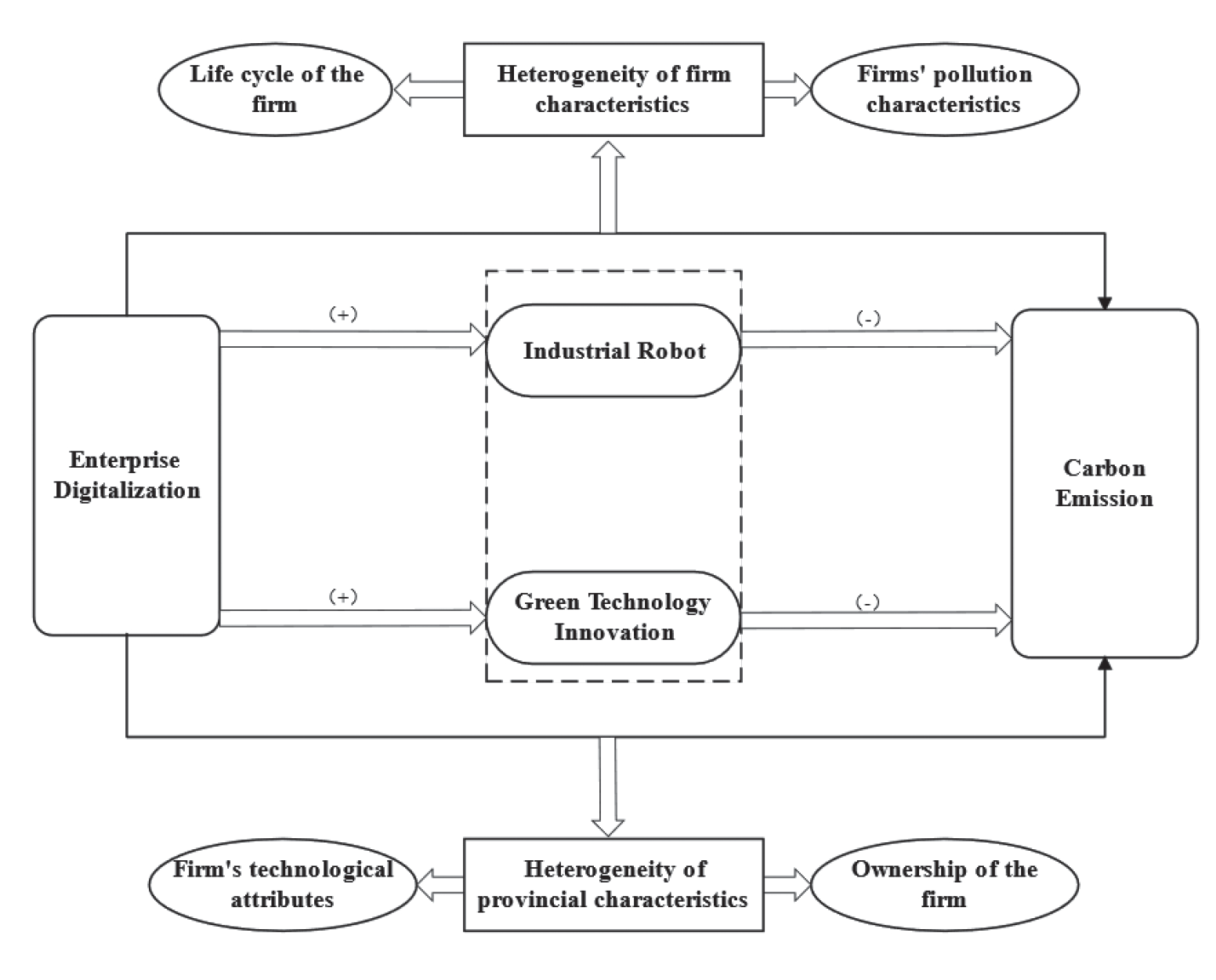
The growth of the digital economy and technological advances foster innovations in green technology. The digital economy revitalizes green technology innovation via data-driven innovations, enhancements in energy efficiency, environmental advances, and digital solutions [14]. The digitalization of green innovation requires technology such as big data analytics and the Internet of Things, which provide precise information on energy usage, resource management, and environmental conditions and thus assist in detecting and resolving environmental difficulties. According to the above literature, green technology innovation positively impacts reducing carbon emissions. Fig. 1 shows the research framework of this paper.
Methods
Data and Sample
These firms’ yearly reports and financial information were created using the WIND database. We also used various officially published data from the Office for National Statistics and other sources. This paper used IFR data on industrial robots. To enhance the reliability and consistency of our sample, we performed the following data processing steps: (1) retain companies within specific manufacturing companies; (2) exclude companies that consistently report losses and those classified as special treated (ST or *ST); and (3) exclude companies with incomplete essential data. A sample of 1897 manufacturing companies listed as A-share from 2011 to 2020 was obtained.
Empirical Model
This research used year and firm double fixed models for empirical analysis to examine the effects of corporate digital transformation on carbon emissions. We calculated robust standard errors clustered at the company level to address serial correlation and heteroskedasticity.
where Dig is the core explanatory variable and the remaining variables are control variables. μi is the individual fixed effect, γt is the year fixed effect, and εit is the random disturbance term.
To test Hypotheses 2 and 3, we further modeled the use of moderating effects as follows:
where X is the moderating variable, Dig is the core explanatory variable, and the remaining variables are control variables. μi is the individual fixed effect, γt is the year fixed effect, and εit is the random disturbance term.
Variables
Dependent Variable
In this research, we summarized and categorized keywords associated with digital transformation. We used Python software to analyze the language of these annual reports from publicly traded corporations to determine how frequently terms linked to digital transformation appear. A higher frequency of these terms in an organization’s annual report suggests a higher level of digital transformation in the organization, as an enterprise’s degree of digital transformation is strongly indicated by the frequency with which such terms appear in its annual report. We consulted the work of Shang et al. [10] to identify the terminology associated with enterprise digital transformation.
Independent Variable
Currently, carbon emission data on the corporate side is not directly available because the government does not mandate that listed companies disclose carbon emission data. We drew on the studies of Chapple et al. and Shang et al. [10, 15] to approximate corporate carbon emissions based on energy consumption by industry.
Control Variables
According to previous research, this study selected characteristics that might influence business carbon emissions. Degree of corporate gearing (Lev): We measure this variable using the ratio of total liabilities to total assets [4]. Margin of net profit on total assets (ROA): We measure this variable using the ratio of the firm’s total net profit to the firm’s average total assets [2]. Gross margin on sales (GrossProfit): We measure this variable using the gross profit ratio to sales revenue [16]. Liquidity ratio (Liquid): We measure this variable using the ratio of a firm’s assets to liabilities. Deposit-to-credit ratio (INV): We measure this variable using the ratio of total corporate loans to total deposits[13]. Intangible asset ratio (Intangible): We measure this variable using the ratio of intangible assets to paid-in capital [17]. Total asset growth rate (AssetGrowth): We measure this variable using the ratio of the firm’s increase in total assets at the end of the year to total assets at the beginning of the year [18].
Moderating Variables
Industrial Robot
Acemoglu and Restrepo [19] examined the impact of robot adoption on the labor market in the United States by utilizing a general equilibrium model. They measured U.S. robot penetration indicators at the regional level, similar to constructing the Bartik variable [20]. This paper employed their methodology to establish a firm-level robot penetration indicator for the Chinese manufacturing industry. The following measures were used:
Green Technology Innovation
This research examines two aspects of advances in green technology: the number (tech1) and quality (tech2) of green technology innovation owned by publicly traded firms. Patent output directly indicates innovation success and thus goes beyond R&D spending [21]. We use the number of green utility patents to measure the amount of green technology innovation and the number of green invention patents to measure the quality of green technology innovation because green invention patents must indicate more innovation [22].
Descriptive Statistics
Table 1 presents the descriptive statistics for the variables considered in this study. The mean value of the dependent variable lnCE is 11.33, and the SD value is 1.23, indicating a significant difference in the carbon emissions of different firms. This result suggests that addressing carbon emissions can alleviate the pollution problems different firms face, highlighting the significance of the present study.
Empirical Results
Benchmark Regression
In this study, we employ Model 1 to investigate the influence of enterprise digital transformation on carbon emissions. The regression outcomes are presented in Table 2. The coefficient of Dig is significantly negative regardless of the inclusion of control variables. This result suggests that an enterprise’s digital transformation can significantly slow the increase in carbon emissions. The empirical results verify that Hypothesis 1a is valid.
Robustness Check
Deletion of Samples from Anomalous Years
Enterprises, as microeconomic subjects, have suffered enormous impacts. The COVID-19 outbreak in 2019 has had a far-reaching economic impact on China and the world [23]. Therefore, this paper deletes data from this atypical year. In Table 3, the coefficients are still negatively significant after the 2019 data are deleted from the first column, proving that our benchmark regression is reliable.
IV Method
In this work, we used the postal and telecommunication communication data of the city where the business was situated in 1984 as an instrumental variable for the firm’s digital transformation, citing Shang et al. [10]. First, the exchange communication model adopted by the city in the past affects the local acceptance of information technology both technically and socially, which fulfills the condition of relevance. The second argument is that communication services for people’s daily needs are the primary goal of postal and telecommunications communication, and this aim is achieved by the fact that they have no direct impact on the enterprise’s carbon emissions. Finally, we cross-multiply the lagged period of the number of cell phone subscribers in the nation with the number of post offices per million inhabitants in the city where the firm is located and use this product as our final instrumental variable. This choice is because the postal and telecommunication communications data for each city in 1984 are cross-sectional, whereas our data are panel data.
The empirical findings show that the instrumental variable may be identified. The conclusion of this paper holds because the Cragg-Donald Wald F statistic indicates that the instrumental variable is valid, and even after addressing the endogeneity issue, the results in Column (2) of Table 3 demonstrate that the digital transformation of firms still significantly suppresses the increase in firms’ carbon emissions.
Lagged Variable
Considering the lagged nature of the variables, regressions were conducted on lnDig lagged by one period. Based on Table 3’s findings, businesses in the above scenarios may still considerably reduce their corporate carbon emissions via digital transformation, and this paper’s benchmark regression findings remain valid.
Table 1.
Descriptive statistics.
Table 2.
Results of the benchmark regression.
| VARIABLES | (1) lnCEit | (8) lnCEit |
|---|---|---|
| lnDigit | -0.309*** (0.0848) | -0.320*** (0.0773) |
| Control variables | No | Yes |
| Firm fixed effects | Yes | Yes |
| Year fixed effects | Yes | Yes |
| Observations | 13,084 | 13,084 |
| R-squared | 0.381 | 0.499 |
Table 3.
Robustness test.
[i] Notes: The first column presents the regression results after excluding atypical years, the second column shows the results of the instrumental variable regression, the third column shows the results of the regression using lagged variables, and the fourth column shows the results of trimmed observations.
Winsorization
We winorize all variables, including lnCE, by less than 1% and more than 99%. The results remain robust to our benchmark regression, as shown in Table 3.
Mechanism Analysis
Industrial Robot
Industrial robots are increasingly being used, but more research is needed to determine how they affect carbon emissions as businesses transform digitally. This study examines the function of industrial robots using Model (2), thus underscoring the inhibitory impact of industrial robots, which facilitate the digital transformation of enterprises, on carbon emissions. The results in the first column of Table 4 show that the moderating effect of industrial robots is significantly negative, suggesting that the application of industrial robots promotes the carbon reduction effect of digitization. Hypothesis 2 is thus substantiated.
Green Technology Innovation
Building on the prior literature, we explored the potential moderating influence of green technology innovation on the negative relationship between corporate digital transformation and carbon emissions. Columns (2) and (3) in Table 4 indicate that the moderating effects of the quantity and quality of green technology innovation are significantly adverse at the 1% level.
It is essential to emphasize that despite the substantial moderating roles of both the quantity and quality of green technological innovations, the strength of the moderating effect attributable to the quality surpasses that of the quantity. Thus, the empirical findings above provide robust support for Hypothesis 3.
Heterogeneity Analysis
Firm Ownership
In China, SOEs typically have more resources than non-SOEs due to their economic and political advantages. This situation prompts whether SOEs’ digital transformation is more effective in reducing carbon emissions. The analysis in Table 5 suggests that it is. The likely reason is that SOEs prioritize carbon emission efficiency when facing more government and societal pressure. Unlike non-SOEs, which are more profit-driven and less likely to adopt digital transformation primarily for emission reduction, SOEs can afford to sacrifice some economic efficiency for emission control.
Firm Technological Attributes
We divided the businesses in our sample into high-tech and non-high-tech categories based on the China National Bureau of Statistics (NBS) guidelines. The regression findings for high-tech enterprises are shown in Table 5 in Column (3), while the results for non-high-tech firms are displayed in Column (4). The findings suggest that high-tech companies’ digital transformation may more effectively reduce carbon emissions. The reason might be that high-tech companies have higher overall technology levels, and after digital transformation, their capabilities grow more quickly, resulting in a more considerable decrease in carbon emissions.
Table 4.
Regression results for moderating effects.
[i] Notes: Column (1) presents the results of the regression on the moderating effect of industrial robots, Column (2) shows the results of the regression on the quantity of green technology innovations, and Column (3) displays the results of the regression on the quality of green technology innovations.
Firm Pollution Characteristics
We categorized the companies in our sample into heavy and nonheavy polluters based on documents published by the China Securities Regulatory Commission (CSRC)2. The regression findings are shown in Table 5, with Column (5) showing the results for highly polluting enterprises and Column (6) showing the results for non-highly polluting firms. These regression results show that while the digital transformation of businesses contributes significantly to reducing carbon emissions in both highly and non-highly polluting industries, this contribution is higher in highly polluting industries. The reason might be that businesses that emit more pollutants also tend to emit more carbon dioxide. Thus, businesses that are undergoing digital transformation can reduce their carbon emissions more effectively.
Life Cycle of Firms
We adopted Dickinson’s method to categorize the enterprises in our sample into growth, maturity, and decline stages based on cash flow indicators, thus addressing the issue of indicator covariance [24]. The findings in Table 5 indicate that digital transformation significantly lowers carbon emissions during the maturity and decline phases but not during the growth phase. 2 http://www.csrc.gov.cn/csrc/c101864/c1024632/content.
shtml The growth phase might result in increased emissions due to expansion efforts that counteract the emission-reducing effects of digitalization. In contrast, during maturity and decline, the focus on efficiency and cost reduction aligns with the emission-cutting benefits of digital transformation. In the recession phase, the imperative to optimize and compete may intensify the drive for digital initiatives that curb emissions.
Results and Discussion
This paper demonstrates that businesses’ digital transformation slows the increase in carbon emissions. However, this research reveals that a company’s digital transformation may affect its carbon emissions depending on its characteristics and circumstances. Regarding the impact of firm ownership, state-owned businesses’ digitization reduces carbon emissions more effectively than non-state-owned businesses. Another critical factor influencing a firm’s digital transformation that will affect its carbon emissions is whether it is a high-tech company. The digital transformation of high-tech companies dramatically reduces their carbon emissions, but non-high-tech companies’ carbon emissions are not reduced by digital transformation. Additionally, we discover that digital transformation affects the carbon emissions of highly polluting companies more significantly than those of non-highly polluting companies. Furthermore, different stages in the life cycle of enterprises have different effects on the contribution of digital transformation to carbon emissions reduction. More precisely, throughout the growth stage, a company’s digital transformation does not prevent it from reducing its carbon emissions. Digital transformation may help reduce carbon emissions in both the maturity and decline stages, although its impact on reducing carbon emissions is most significant during the decline period. We also discovered that innovation in green technology and industrial robots are essential processes. The quantity of green technology innovation is not as impactful as the quality. Identifying these two processes further explains the contribution of businesses’ digital transformation to reducing their carbon emissions.
Table 5.
Results of the heterogeneous regression.
[i] Notes: Columns (1) and (2) present the regression results for state-owned and non-state-owned enterprises, respectively. Columns (3) and (4) present the regression results for high-tech and non-high-tech industries, respectively. Columns (5) and (6) present the regression results for high-pollution and non-high-pollution industries, respectively. Columns (7), (8), and (9) present the regression results for the growth, maturity, and decline stages, respectively.
Thus, by implementing the following policies, the Chinese government may promote carbon emissions reduction through corporate digital transformation: (1) Digital transformation strategy optimization. The digital transformation of businesses reduces carbon emissions in the industrial sector. For non-high-tech enterprises and enterprises in the growth period, digital transformation strategies should be optimized to improve their ability to reduce carbon emissions. (2) Life cycle management. This paper demonstrates that digital transformation may lower carbon emissions when businesses mature and decline. Therefore, enterprises should increase their digital transformation efforts in these two stages and incorporate sustainability into managing the whole life cycle. (3) Boost the standard of green technology innovation. The results of this study indicate that firms should prioritize improving the quality of green technology innovations more than increasing the number of such innovations because the former is more impactful than the latter in reducing carbon emissions. (4) Promote the upgrading of the robotics industry. Robotics must be tightly linked with biotechnology, new energy, new materials, next-generation information technology, and other technical advancements to support upgrading industrial robots. The government should endorse research projects that explore the potential for industrial robots to be implemented in diverse fields, ranging from health care to agriculture and construction. This endeavor can serve to expand the scope of the robotics market. Encouraging the development and adoption of eco-friendly industrial robots can help minimize the carbon footprint and environmental impact. This goal can be achieved by implementing environmental standards and offering incentives.

