

Introduction
As the climate warms, more and more urban planners and architects are being called upon to provide methods and solutions that can be applied to sustainable development to mitigate global urban warming [1]. At the same time, the sustainability of global ecosystems plays a major role in the economic development of human beings and the long-term and stable development of society and technology [2]. As the nucleus of the ecosystem, urban green spaces can absorb fine particles and exhaust gases in the air to protect ecological diversity, improve air quality, regulate atmospheric temperature, and improve human well-being [3-5]. Internationally, in July 2024, UN Deputy Secretary-General Amina Mohammed emphasized the dire situation of the SDGs and the importance of advancing green and digital transformation as the 2030 deadline approaches [6]. Therefore, how cities can be made green and low-carbon as well as sustainable is now an urgent and valuable issue in urban design. In the field of social sciences, the existing literature mainly focuses on economic and trade [7], urban planning [8], urban design [9], infrastructure and ecology [10, 11] have been researched and discussed in terms of urban green development. Most of these articles have used empirical research, case studies, field research, interviews, and questionnaires to study this. This means that most of the existing studies have neglected the fact that the relevant policies introduced by different countries in recent years have been a key point in driving development. In addition, with the current 5G era [12], digital art [13] and the emergence of smart cities [14]. The digital technology has provided a revolutionary scientific impetus for the advancement of urban design [15]. At the same time, the introduction of national policies and the demand for green and creative cities, as well as the active development of urban design strategies for sustainable development by scholars, are driving the rapid transformation of cities [16]. These factors are driving the rapid transformation of cities. Will this emerging force have a significant impact on the city's development? Will it make entire cities greener?
The Urban Design Pilot Program originated from the Ministry of Housing and Urban-Rural Development (MOHURD) of China as a national development strategy to promote urban design and urban renewal, shaping the new features of cities and improving the level of urban construction. The development of the urban design pilot program is very much related to the global strategy of smart city development. The smart city is a major trend in urban development in today's 5G era, which enables harmonious and vibrant urban development [17].
In recent years, there has been a gradual increase in discussions and analyses related to urban design and urban green development [18, 19]. However, there are no studies that analyze urban design and urban green development from the perspective of “urban design pilot policy” for the time being.
After collating relevant previous studies, we focus specifically on the literature on policies, typologies, perspectives, and urban management in the fields of urban design, digitalization, and green urban development. Specifically, from a policy and planning perspective, in recent years, the United Nations’ Sustainable Development Goal #11 (SDG11) has set out the goal of “inclusive, resilient and sustainable cities” [20]. This goal is closely related to the optimization of urban green spaces. Han [21] and others have studied urban green space, showing that optimizing the urban spatial structure and developing green cities are currently more important directions in Chinese cities. In addition, the construction of urban design is related to smart cities and sustainable cities and emphasizes the importance of digital technological innovation [22]. From the perspective of digital infrastructure in urban design, it has gradually emerged in cities in recent years. Previous studies have shown that digital infrastructure in cities is conducive to promoting green innovation in cities [23]. Interestingly, some studies look at the intersection of digital, artistic, and ecological aspects of urban green development from the perspective of urban design and digitalization. For example, One Beat, One Tree, a virtual forest projected on the Arc de Triomphe in Paris, France, combines the skin of urban buildings with technology and nature. Kim and Comunian et al. [24] have included a complexity perspective in the study of art and cities and have done detailed research and analysis. In addition, ecological studies of landscapes and complex populations in cities help to plan and manage urban green spaces [25]. Thus, urban design can help to enhance the image and vitality of cities and promote urban revitalization and sustainable development. These cross-cutting areas of digital, artistic, and ecological urban design can help to avoid a “one-size-fits-all” city. To promote urban design in these cross-cutting areas, the digital economy is indispensable [26], element configuration [27] and energy efficiency [28]. Among them, some scholars' research shows that the digital economy not only has a significant contribution to green space but also has a positive effect on science and technology innovation in Chinese cities [29].
Therefore, this paper is dedicated to exploring urban design for green urban development. To answer this question, we conducted a quasi-natural experiment based on China's urban design pilot policy. To standardize and promote the healthy development of urban design, the Ministry of Housing and Urban-Rural Development (MOHURD) launched a national urban design pilot policy in 2017, namely the Urban Design Management Measures. In the same year, the Ministry of Housing and Urban-Rural Development (MOHURD) listed 20 cities, including Beijing, as the first batch of urban design pilot cities. Based on the results of the review, in March and July 2017, there were two batches of cities as urban design pilots, respectively. The number of urban design pilots was 20 in the first batch, represented by Beijing, and 37 in the second batch, represented by Shanghai. After the establishment of the pilot cities, the policy clarifies the definition, purpose, and content of urban design as well as the responsibilities of the relevant management departments. The pilot urban design policy aims to improve the level of urban construction, shape urban landscape characteristics, and promote urban design through urban design.
In summary, this policy is the key to the transformation of urban design in China and a breakthrough to eliminate the “one-size-fits-all” appearance of cities. It has great research value. The research idea framework of this paper is shown in Fig. 1 below.
The reasons for choosing China for the study are as follows. China has a large number of cities, and the effect of urban design is significant during the period from 2017 to 2024. My study selects a panel of 286 cities in 31 provinces (municipalities) in China from 2012 to 2022. In addition, China's green space area is rapidly expanding. Compared to 2005, by 2020, China's green space area reached 96.00 square meters, an increase of 128.68%. The green development level of urban design pilot areas contributes to the increase of green space in China after the opening of the urban design pilot policy. In addition, through the literature review, we can find that in the urban design pilot policy, improving the efficiency of factor allocation, enhancing the efficiency of energy utilization, and promoting the development of a digital economy are important factors in promoting the green development of cities. As China has a vast territory, the green development of Chinese cities for the better is of great significance to the optimization of the global ecosystem. Therefore, China's rich experience in implementing urban pilot policies is worthwhile for other countries to learn from.
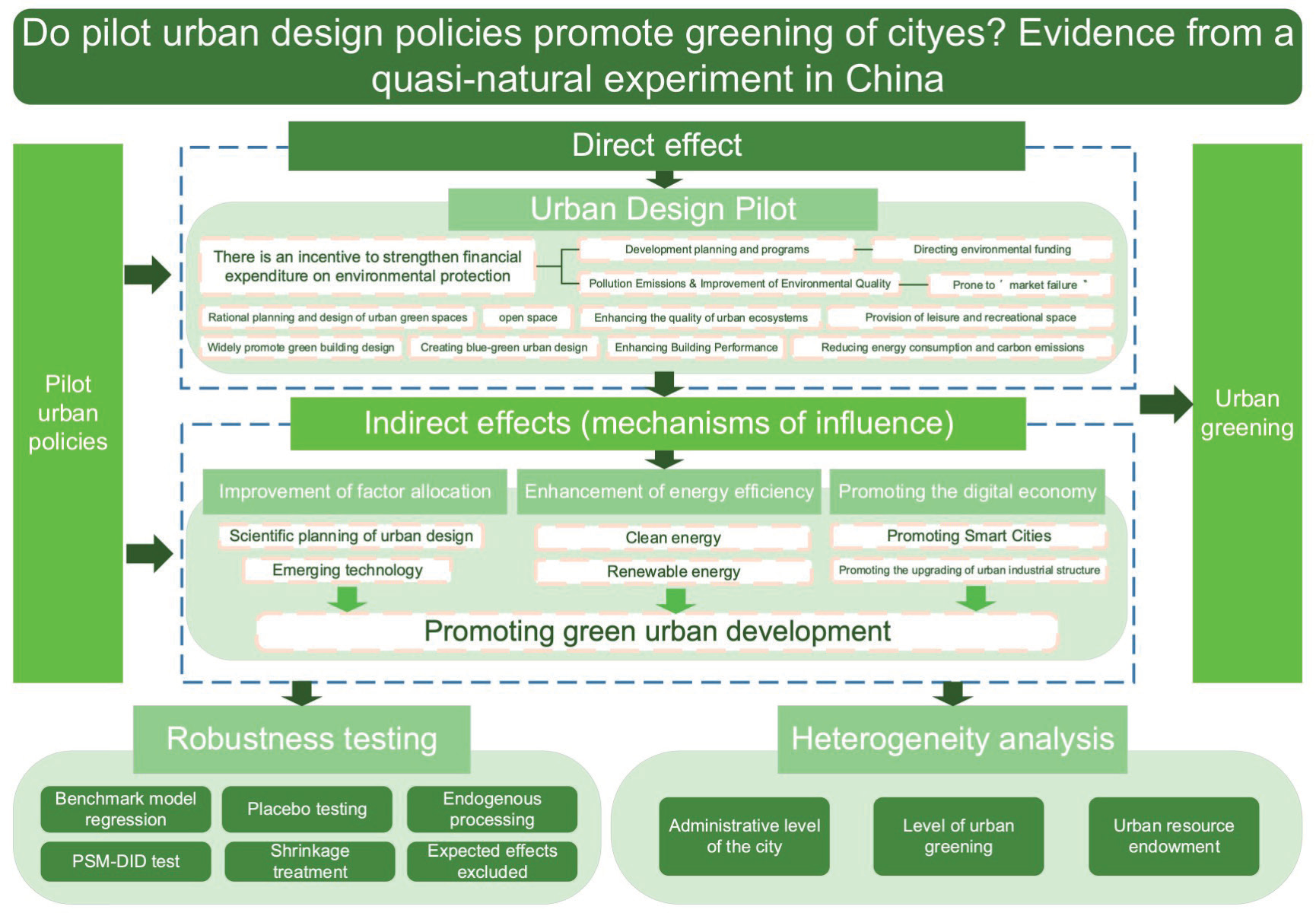
The rest of the paper is as follows. Section 2 conducts the relevant theoretical analysis and hypotheses. Section 3 presents the research design. Section 4 presents the results of the study. Section 5 provides a discussion, and Section 6 presents conclusions and policy recommendations.
Theoretical Analysis
Direct Effects of Pilot Urban Design Policies on the Greening of Cities
First, compared with non-urban design pilot cities, urban design pilot cities have an incentive to increase financial expenditures for environmental protection. On the one hand, the principles of “increasing policy support and investment” and “promoting green urban development” are emphasized in the development plans and programs of the design cities, which provide clear objectives and guidelines for increasing environmental protection funding. On the other hand, design cities have a prominent task in reducing pollution emissions and improving environmental quality, but environmental quality has strong positive externalities and is prone to “market failure” [30]. To solve the above problems, each city government will give effective financial subsidies related to environmental protection to the corresponding subjects. Environmental protection financial expenditures have the dual characteristics of financial expenditures and environmental regulation [31]. It can lead to social investment and guide environmental governance behaviors at both the macro and micro levels. Secondly, urban design refers to the process of planning and designing urban space, function, and form, aiming to create livable, sustainable, and efficient urban environments. Creating sustainable cities is conducive to minimizing damage to the natural environment and promoting the existing urban infrastructure systems [32]. Therefore, good urban design can not only enhance the artistry and functionality of the city but also significantly promote the green development of the city. On the one hand, rational planning and design of urban green space and open space can enhance the quality of the urban ecological environment and provide space for leisure and recreation. Through high-density development and mixed land use, urban sprawl and land wastage are reduced, and natural ecosystems are protected [33]. The use of urban design with blue-green infrastructure (BGI) [34, 35] in open space areas not only improves building energy efficiency but also reduces energy consumption and carbon emissions.
H1: Pilot urban design policies can promote the greening of cities.
Indirect Effects of Pilot Urban Design Policies on Green Urban Development
Factor Allocation Efficiency
Factor mismatch is the reality of policy distortion in the national pursuit of balanced development, and persistent factor mismatch hurts the sustainable development of the economy, resulting in production inefficiencies [36]. Efficient urban planning and policy advice can improve the quality of the urban environment, promote the effective use of resources, and enhance the overall efficiency of the city [37]. At the same time, the incorporation of new technologies, such as the Internet of Things (IoT), into urban planning can also help to reduce environmental pollution and improve the sustainability of cities [38]. Therefore, scientific urban design planning can enhance the city's innovation ability and production efficiency, thus attracting more human capital and financial capital and other factors of production for the city, helping to realize the reorganization and upgrading of factors and reallocation, prompting the transformation and upgrading of the traditional industries that are highly energy-consuming and highly polluting, and forming the scale effect of the green industry, which will ultimately realize the green development of the city's economy. On the one hand, urban design can rationally utilize urban space and realize the efficient use of land. Through scientific planning and design, it can determine the land use functions of the city, delineate the development positioning of different areas, and avoid the waste of land resources and repeated construction. On the other hand, with the continuous development of science and technology, various emerging technologies, such as the Internet of Things, big data analysis, and artificial intelligence, have been introduced into urban planning and design in order to optimize the efficiency of urban space utilization that It can help manage and utilize urban resources more effectively and improve the efficiency and effectiveness of urban operation, thus promoting green urban development.
H2: Urban design pilots promote green urban development by improving factor allocation efficiency.
Energy Efficiency
Enhancing urban energy efficiency plays an irreplaceable role in promoting the development of cities in a greener and more sustainable direction and is one of the most important ways to realize green urban development [39, 40]. On the one hand, in urban design planning, the Government has prioritized the use of clean energy [41]. For example, solar energy, wind energy, water energy, etc., in order to reduce the dependence on traditional energy sources, thus reducing energy waste and environmental pollution. Therefore, optimizing the layout of energy utilization facilities [42], reduce energy loss and waste, and promote green urban development. On the other hand, the urban design pilot makes the government increase the development and utilization of renewable energy, encourages enterprises and individuals to participate in the development and utilization of renewable energy, improves the conversion efficiency and utilization efficiency of renewable energy, and utilizes clean energy to replace traditional energy, which can reduce greenhouse gas emissions and reduce the damage to the environment, and at the same time reduce the energy loss in the process of energy extraction and transportation, further reducing the impact on the environment. Therefore, urban design pilots can promote green urban development by reducing the use of traditional energy and opening up new energy sources to improve energy utilization efficiency.
H3: Pilot urban design policies promote the greening of cities by improving energy efficiency.
Development of the Digital Economy
Through technology penetration and industrial integration, the digital economy plays a driving role in optimizing and upgrading the industrial structure of cities [43, 44]. The low-cost and large-scale availability of data elements, as well as their non-competitive and non-exclusive characteristics, make the digital economy an environmentally friendly industry, optimizing the structure of elemental ratios. This means less depletion of the urban ecological environment. Urban design plays an important role in promoting the development of the urban digital economy. By promoting the construction of smart cities [45, 46], urban design can significantly improve the level of smart cities and thus promote the development of the digital economy. First of all, it is possible to build an independent information technology system in urban design [47], provide digital applications and services [48, 49], explore cross-departmental, cross-business, and cross-system integration applications, and strengthen the application of data elements in the entire life cycle of urban planning, construction, management, and services. It has also strengthened the application of data elements in urban planning, construction, management, service, and operation of the whole life cycle and promoted the digital transformation of economy, governance, and life to mutually empower, integrate, and promote each other. Secondly, urban design promotes the upgrading of the city's industrial structure, vigorously develops the manufacturing digital economy, high-end equipment, and other key industrial enterprises, and further strengthens the “Digital Workshop” and “Smart Factory” construction, creating focused and systematic cultivation of several digital economy core industry growth and leading enterprises, to promote the development of the city's digital economy.
H4: Pilot urban design policies promote the greening of cities through the promotion of the digital economy.
Material and Methods
Data Sources
The sample used in this study is the panel data of a total of 286 prefecture-level cities in 31 provinces (municipalities) packages in China from 2012 to 2022. The raw data come from the China Urban Statistical Yearbook, China Labor Statistical Yearbook, China Urban Construction Statistical Yearbook, China Economic and Social Development Statistical Database, China National Intellectual Property Database Station, and the EPS database.
Variable Definition
Explained Variables
Green Total Factor Productivity (GTFP) was chosen to represent urban green development as an explanatory variable. The index is measured by the SBM-GML index method. Based on the construction of the non-radial and non-angle SBM model, this study further constructs the GML index to examine the dynamic change of efficiency, which can cope with multiple inputs and outputs, as well as the non-expected output problem, and it avoids the problem of unsolvable linear programming of the traditional ML index.
Each city as a production decision-making unit (DMU) a = (a1,··· ···am) (a inputs) b = (b1,··· ···bn) (b desired outputs), c = (c1,··· ···cj) (c non-expected outputs) are included in the decision cell, the SBM directional distance function can be defined, with constant returns to scale, as follows.
(1)
ρ denotes the efficiency value of the role unit; sa ∈ Rm , sc ∈ RS2 denotes the excess of inputs and undesired outputs; sb ∈ RS1 denotes the shortfall in the desired output; ms1s2 denotes the number of corresponding variables, respectively.
(2)
DGαβ,c = max{β|b+βb,c−βc ∈ PG(a)} denotes the full directional distance function that depends on the global set of production possibilities a); The GMLt,t+1 index characterizes the change in green total factor productivity (GTFP) of two adjacent role units during the study period. The GTFP decomposition yields an indicator of technical change. The GTFP decomposition yields two components, the technology change indicator (GTC) and the efficiency change indicator (GEC): GTC > 1 and GEC > 1 imply technological progress and efficiency improvement, respectively. Input indicators for GTFP measurement: labor, capital input, and energy. The number of employees in the city at the end of the year represents labor, and the capital stock data of each city is estimated as capital input using the “perpetual inventory method”. Energy is represented by the area of urban construction land, total water supply, and total electricity consumption, while output indicators measured by GTFP include desired output and undesired output. Gross regional product, per capita wages of urban residents, and green space in urban parks are used as desired outputs. Urban carbon dioxide, wastewater, industrial smoke and dust, and industrial sulfur dioxide emissions are used as non-desired outputs.
Core Explanatory Variables
The core explanatory variable is the design city pilot. If the city is selected as a Design City Pilot city, it is assigned a value of 1 for the current year and subsequent years; otherwise, it is 0.
Intermediary Variable
The mediating variables selected in this study are factor allocation efficiency, energy utilization efficiency, and digital economy development.
For the measurement of the energy utilization efficiency index, considering the accuracy of the downscaling model inversion, a linear model without intercept is adopted to decompose the provincial energy consumption data into each prefecture-level city according to the value of the lighting data and then divide it by the gross regional product to obtain this variable. The basic logic is that the higher the brightness of lights at night indicates more economic activities at night, which means the higher the level of economic development and the corresponding energy consumption.
Table 1.
Descriptive statistics of variables.
For the measurement of digital economy development indicators. The construction of the indicator system utilizes the entropy value method for measurement. The indicators are the number of Internet broadband access users among 100 people, the total amount of telecommunication services per capita, the number of cell phone subscribers among 100 people, the proportion of employees in the computer services and software industry to the proportion of employees in urban units, and the digital financial inclusion index.
The degree of regional resource mismatch is used to reflect the efficiency of factor allocation as follows:
Where, γKi and γLi are absolute factor price distortion coefficients, which can be replaced by relative price distortion coefficients in the actual measurement:
Among them,
Control Variable
As for control variables, they mainly include per capita gross domestic product (Pgdp), obtained by dividing the city's GDP by the city's total population at the end of the year, which represents the level of economic development. Population density level (Den), obtained by dividing the population of prefecture-level cities by the area of the administrative region, characterizing the differential impact of the scale of human activities in the city; industrial structure level (Str), measured by the proportion of added value of the secondary industry to the regional GDP, representing the overall industrial structure characteristics; financial development level (Fin), measured by the balance of loans of financial institutions as a proportion of the GDP; and the degree of government intervention (Gov), measured by urban per capita fiscal revenue. The degree of environmental regulation (Er) is expressed as the comprehensive utilization rate of urban general industrial solid waste. Descriptive statistics of the variables are shown in Table 1.
Table 2.
Benchmark model regression results.
Model Design
Based on the theoretical analysis and research hypotheses, the following two-way fixed effect model is established to test the impact of urban design pilot policies on urban green development:
Where GTFP is an explanatory variable indicating the level of green development of the city, and DID is an explanatory variable indicating whether city c was selected as an urban design pilot area in year t. Xct is a control variable. The coefficient β1indicates the policy effect of urban design pilots on the greening of cities. θ and ω denote individual fixed effects and time-fixed effects, respectively. εict is the perturbation term.
In addition, in order to test the mechanism by which the urban design pilot policy affects the green development of the city, a mediating effect model is constructed as shown below:
In this case, the Mediator is the mediating variable, which indicates urban factor allocation efficiency, energy utilization efficiency, and digital economy development, and the rest of the variables are consistent with equation (5).
Results and Discussion
Benchmark Model Regression Analysis
According to research hypothesis 1, in order to test that the urban design pilot policy can promote urban green development, the results of utilizing the two-way fixed effect model are shown in Table 2, column (1) does not consider the control variables and fixed effects, column (2) and column (3) control the urban fixed effects, time fixed effects and other control variables, respectively, and column (4) adds all the control variables, and the results show that, no matter what the scenario is, the impact effect of the urban design pilot policy on urban green development is significantly positive. The results show that, regardless of the circumstances, the impact effect of the pilot policy on urban green development is significantly positive, indicating that the urban design pilot policy can significantly promote urban green development. Compared with non-pilot areas, the green development level of urban design pilot areas is increased by 15.5%. From the perspective of control variables, the level of urban economic development, the level of population density, the level of industrial structure, and the level of environmental regulation can significantly enhance the level of urban green development.
Parallel Trend Test
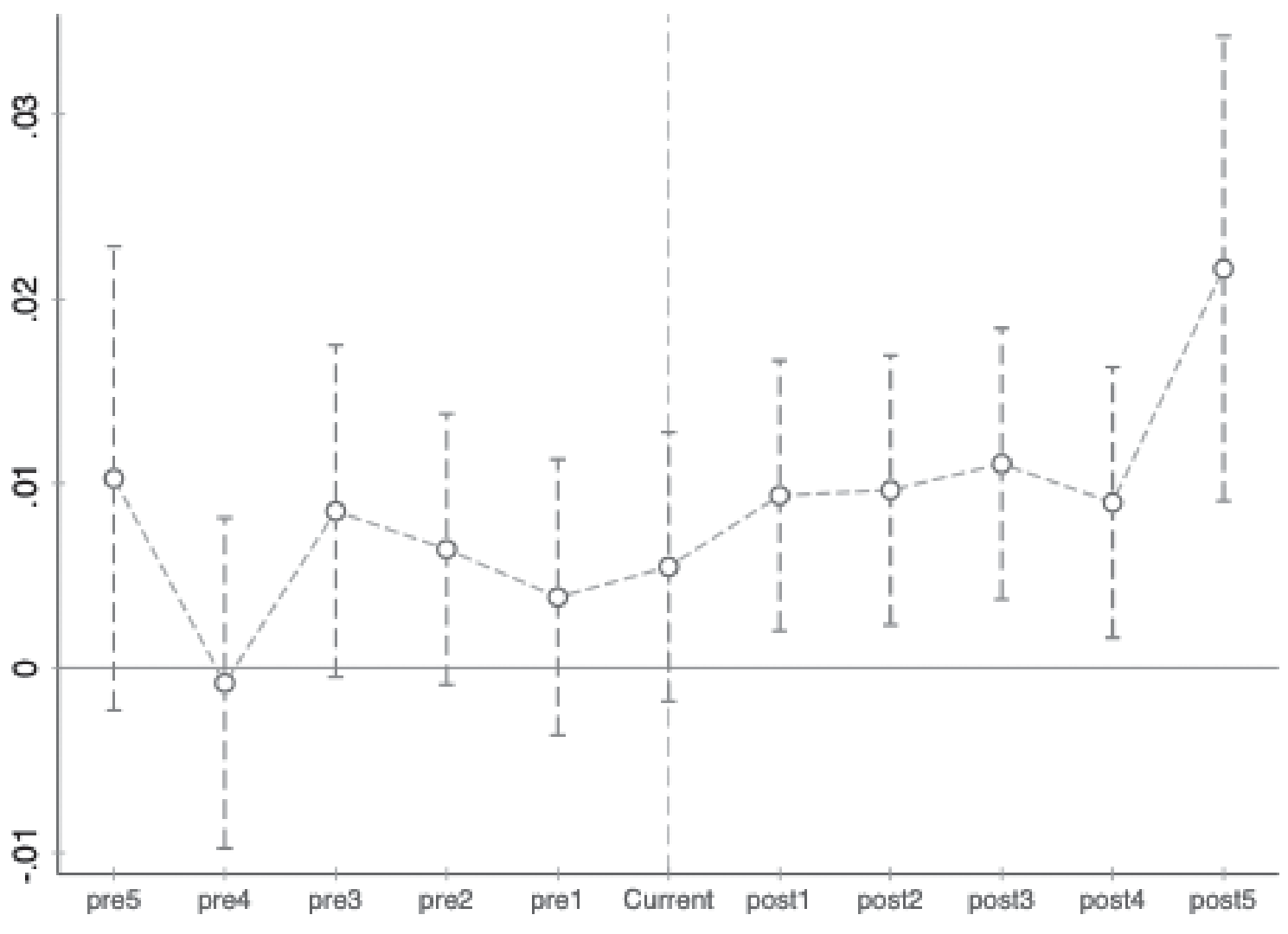
The premise of the policy assessment using the double-difference method is that the model must satisfy the assumption of “parallel trends”, i.e., the green development levels of the pilot cities and non-pilot cities before the implementation of the urban design pilot policy should have the same trend of change; otherwise, the resulting policy effects may be disturbed by the differences between the cities themselves. The results of the parallel trend test are shown in Fig. 2, in which the vertical coordinate represents the size of the regression coefficient of the effect of the urban design pilot policy, the horizontal coordinate represents the relative time of the implementation of the policy, and the short vertical line in the figure represents the confidence interval. Before the implementation of the urban design pilot policy, the estimated coefficients fail to pass significance, indicating that there is no significant difference in the level of urban green development before the policy. The regression coefficients from the 1st year after the implementation of the urban design pilot policy onwards are all significantly positive, and the effect of the policy on the green development level of the pilot cities is increasing year by year. Therefore, the double-difference method can be used to assess the impact of the urban design pilot policy on urban green development.
Placebo Test
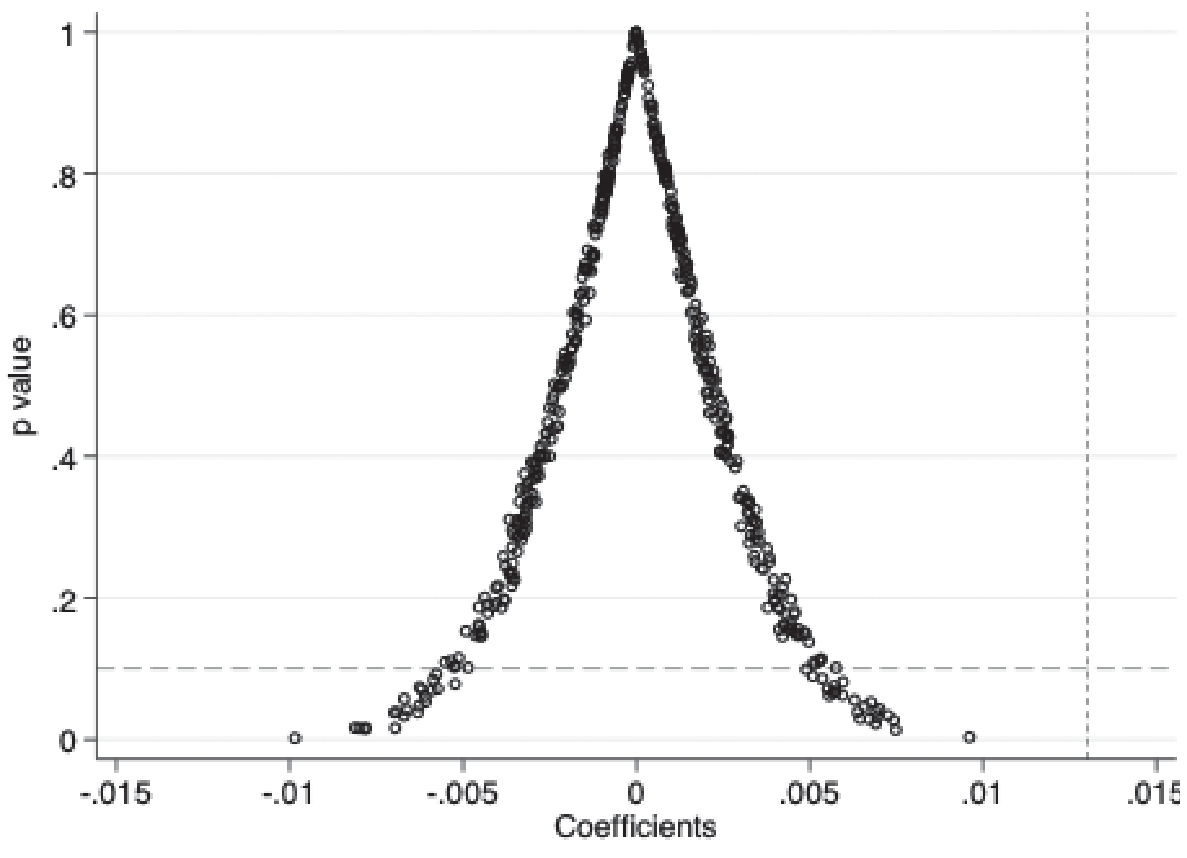
In order to exclude whether the changes in the level of urban green development are caused by other policies or random factors in the same period, this study adopts the randomly selected policies as the treatment group for replacement verification, i.e., the placebo test. The specific idea is: randomly select 57 districts among 286 districts as the virtual experimental group, the remaining districts as the control group, and repeat 500 times. If the coefficients obtained from the randomly selected virtual policies are significantly different from the regression results of this study, it means that the conclusion that the urban design pilot policy promotes the green development of the city is due to the urban design pilot policy, rather than other policies in the same period. Fig. 3 shows the results of the placebo test, the results of the randomly selected policies show a positive too distribution, the test is better, and the coefficients obtained in this study are significantly different from the results obtained from the other dummy policies, which indicates that the conclusion that the urban design pilot policy promotes the green development of the city is robust.
Other Robustness Tests
(1) Endogenous processing. In order to overcome the possible problems of reverse causality and omitted variables in the model of the impact of urban design pilot policies on urban green development, bias in the model estimation generates endogeneity. In this study, the urban greening area in 2001 is selected as an instrumental variable to deal with the endogeneity problem using the instrumental variable method for robustness testing. Theoretically, the urban greening area can provide a basis for being selected as an urban design pilot, and the more the government pays attention to the urban greening area, the more likely it is to be selected as an urban design pilot, which satisfies the correlation condition. On the other hand, historical data have no direct influence on current urban green development. In the test of instrumental variables, firstly, the result of the Hausman test shows P=0.000, which indicates that there is an endogeneity problem in the influence of urban design pilots on urban green development. Second, when conducting the weak instrumental variable test, the F-statistic of urban green development is greater than 10, indicating that there is no weak instrumental variable. After eliminating the endogeneity of the model, the results of the second-stage regression are shown in column (1) of Table 3, and the conclusion that the urban design pilot policy promotes urban green development is robust.
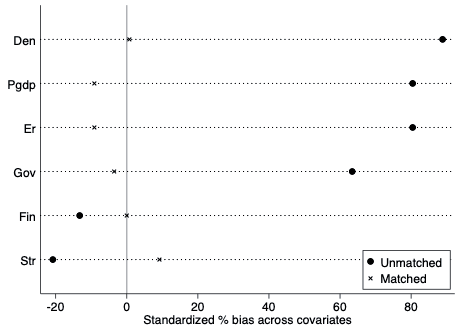
(2) PSM-DID test. The selection of urban design pilot cities may not be random but based on certain resource advantages of the cities, in other words, even without the impact of urban design pilot policy, the green development level of the pilot cities and non-pilot cities may be systematically different due to certain resource endowment differences. Therefore, to avoid sample selectivity bias, this paper adopts the propensity score matching (PSM) method to match the samples of “urban design pilot cities and non-pilot cities first, and then use the double-difference method for estimation to ensure that the different results caused by the policy shocks are comparable. Before using propensity score matching, the samples are tested for balance, i.e., whether the values of all control variables are significantly different between the pilot and non-pilot cities after matching. If the difference is not significant, then the matching is good, i.e., it is reliable to choose such a matched sample for the next step of double difference estimation. The Logit regression model is used to match the nearest neighbor within caliper between the urban design pilot cities and the non-pilot cities, and the results of the balance test in Fig. 4 show that there is no significant difference in the values of all the control variables between the two groups after matching, which indicates that the balance test is passed. Based on the matching results, PSM-DID regression estimation is carried out, and the results are shown in column (2) of Table 3 and the conclusion that the urban design pilot policy promotes urban green development is robust.
(3) Tailoring. Since the level of green and low-carbon development of urban economy varies greatly among different cities in China, and there is the phenomenon that the development level is high in the east and low in the central and western parts of the country, there may be some extreme values in the sample, which may bias the empirical results. Therefore, the main variables involved in the model are further reduced by 1% and 99% levels to eliminate extreme values. The regression results in column (3) of Table 3 show that the conclusion that urban design pilot policies promote green development in cities is robust after controlling for the relevant variables.
(4) Expectation effects are ruled out. The market micro subjects will have an anticipation effect on the government's policy tendency. That is, the market and industry in the pilot city react before the policy. It may interfere with the net effect of urban design pilot policies affecting urban green development. Therefore, the baseline regression model is augmented with an interaction term policyi*postpre for the pilot city dummy variable policyi and the year before policy implementation dummy variable postpre. To test the impact of the expected effects. The regression results are shown in column (4) of Table 3, the estimated coefficients of the expected effect term (policyi*postpre) are all positive but do not pass the significance test, while the core explanatory variables are significantly positive, suggesting that the exogenous nature of the urban design pilot policy is strong and that there is no policy expected effect. The conclusion that urban design pilot policies promote green urban development is robust.
Heterogeneity Analysis
Heterogeneity in the Administrative Hierarchy of Cities
Different administrative levels in a city can lead to differences in resource allocation, policy implementation, and governance capacity, thus affecting the effectiveness of pilot urban design policies. National or provincial administrative centers usually have more resources and funds for the construction and maintenance of urban infrastructure. Meanwhile, cities with high administrative levels usually have stronger policy formulation and implementation capabilities and are able to respond quickly to national policies, develop localized implementation rules, and promote effective implementation of policies. Therefore, this study further examines the impact of urban design pilots on urban green development from the perspective of heterogeneity of city administrative levels. Municipalities directly under the central government, sub-provincial cities, and provincial capitals are defined as high administrative level cities, and the rest are low administrative level cities. The regression results are shown in Table 4, which shows that the effect of the urban design pilot on the green development of cities with high administrative levels is greater than that of cities with low administrative levels. It indicates that there is heterogeneity in the effect of the urban design pilot on urban green development based on the administrative level of cities.
Table 3.
Robustness test.
Table 4.
Heterogeneity analysis.
Heterogeneity of Urban Greening Levels
Urban greening level plays a crucial role in urban design pilots and has a profound impact on the green development of the urban economy in terms of enhancing the image and quality of the city, improving the quality of life of residents, promoting the development of tourism and driving the prosperity of related industries. The regression results in Table 4 show that the effect of urban design pilots on the green development of cities with high greening levels is greater than that of cities with low greening levels, indicating that there is heterogeneity in the effect of urban design pilots on the green development of cities based on the greening level of cities.
Heterogeneity of Urban Resource Endowments
For resource-based cities, whether urban design pilots can reduce energy consumption and pollution emissions and solve the problems of a single industrial structure and resource dependence in resource-based cities becomes the key to the green and low-carbon transformation of resource-based cities. This study is divided into high-resource cities and low-resource cities based on the list of resource cities published by the State Council of China. The regression results in Table 4 show that compared with low-resource cities, urban design pilots have a greater impact on the green development of high-resource cities, indicating that there is heterogeneity in the impact of urban design pilots on the green development of cities based on the resource endowment of cities. It is a key factor for cities to break the “resource curse”.
Mechanism Analysis
According to the model design, the three mediating variables of factor allocation efficiency, energy use efficiency, and digital economy development are chosen to explore the mechanism of urban design pilot policy's influence on urban green development. First, the results of column (1) and column (2) show that the urban design pilot policy promotes urban capital allocation efficiency and labor allocation efficiency.
Secondly, in order to explore the mediating effect of urban energy use efficiency, the model results show that the impact coefficient of the urban design pilot policy on urban energy use efficiency is 0.025, the urban design pilot policy improves urban energy use efficiency, and the urban design pilot is able to provide the energy basis and guarantee for the development of emerging businesses such as 5G and big data, and to promote the transformation of the urban energy structure. In addition, the improvement of energy use efficiency can reduce the dependence on traditional energy and promote the green development of the urban economy. Therefore, the urban design pilot promotes the green development of the urban economy by improving energy utilization efficiency.
Finally, the impact coefficient of the urban design pilot policy on the development of the urban digital economy is 0.101, indicating that the urban design pilot policy can significantly promote the development of the urban digital economy. In addition, the improvement of the urban digital economy development level means that enterprises will continue to optimize the production process, improve the city's pollution control capacity, and then promote the green transformation of the urban economy. Therefore, the urban design pilot policy can promote the green development of cities by improving the level of urban digital economy development.
Discussion
Based on the above research, it can be seen that the urban design pilot policy improves the efficiency of urban energy use. At the same time, it promotes the transformation of urban energy structure and the green development of urban economy. Therefore, it is necessary to explore the strategic role of the "urban design pilot" policy. This policy can be regarded as the most important policy for urban design projects in China since the 21st century. The implementation of this policy will help to improve the transformation and quality of urban design and green space development. The quality of urban green space has an impact on the health of the population [50, 51]. China's Ministry of Housing and Urban-Rural Development (MOHURD) has issued a national development strategy, the "Pilot Urban Design" policy. Two batches of pilot cities were selected in 2017, and we regard this policy as a quasi-natural experiment. Our regression results indicate that the "urban design pilot" policy is conducive to green urban development. Among the results of our study, which matches the sample of urban design pilot cities with the sample of non-pilot cities, as shown in Column (2) of Table 3, the conclusion that the urban design pilot policy promotes urban green development is robust. In addition, in this section, we focus on whether the factor allocation efficiency, energy use efficiency, and digital economy development of the city play a mediating role in the Urban Design Pilot policy. The regression results of the mediation effect model are shown in Table 5. The urban design pilot policy promotes urban capital allocation efficiency and labor allocation efficiency. Among them, the improvement of urban factor allocation efficiency helps to realize factor restructuring, upgrading, and reallocation, prompting the transformation and upgrading of traditional industries with high energy consumption and pollution and ultimately realizing the green development of the urban economy. Therefore, the urban design pilot policy can promote the green development of the city by improving the factor allocation efficiency. In addition, in the city, the improvement of energy use efficiency can reduce the dependence on traditional energy sources and promote the green development of the urban economy at the same time. Therefore, the urban design pilot can promote the green development of the urban economy by improving the efficiency of energy utilization. It can also be seen from the coefficient of influence of urban design pilot policy on the development of urban digital economy that urban design pilot policy can significantly promote the development of urban digital economy. Finally, our study also finds that the impact effect of urban green development is higher when urban design pilots are carried out in cities with a high administrative level, a high level of greenness, and a high level of resource endowment.
In addition, the first difference from previous studies is that we have selected the pilot urban design policy implemented in China for our empirical study. The policy focuses on the holistic and systematic nature of urban planning and design, the shaping of urban features and styles. It also promotes the optimization of urban spatial structure and the improvement of urban functions and enhances the quality of the city and the quality of life of its residents. So far, no scholars have selected the pilot urban design policy for research. However, an international policy related to the implementation of this policy in China is the “Singapore 2050” plan implemented by Singapore. The Singaporean government is planning and making efforts to achieve zero greenhouse gas emissions in Singapore by 2050. The policy places more emphasis on the compound use of land, the revival of local culture, the development of underground space, and the protection of scientific mechanisms. However, it has something in common with China's pilot urban design policy. That is, they both focus on the promotion of green urban development, economic development, etc., and even global green development.
Conclusions
Our study examines the impact of urban design pilot policies on urban green development based on a panel of 286 Chinese cities from 2012 to 2022 and finds that: first, urban design pilot policies can promote urban green development, with the level of green development in urban design pilot areas increasing by 15.5 percent compared to non-pilot areas. Second, the urban design pilot promotes urban green development by improving factor allocation efficiency, enhancing energy efficiency, and promoting the development of the digital economy. Third, the impact of urban design pilots on urban green development is higher in cities with high administrative rank, green level, and resource endowment. This study has important theoretical significance and practical value for deepening the urban design pilot policy and further enhancing the green competitiveness of cities.
Based on the conclusions, the policy recommendations lie in the following three points: Firstly, local governments need to introduce urban design upscaling plans and guidelines as soon as possible. Second, improving the efficiency of factor allocation in urban spaces, efficiency, and promoting the digital economy in cities. Third, the results of the study show that the impact of urban green development is higher when urban design is piloted in cities with a high administrative level, a high level of greenness, and a high level of resource endowment. However, we still need to implement the policy in cities that show low performance on the three points above. In this way, we may break the imbalance between the development of urban areas and create a more balanced and livable new type of city in China and around the world.

