

Introduction
In 2023, a storm of healthcare reform is taking place across China. Healthcare, as one of the three mountains in China, imposes a heavy financial burden on residents [1]. Data shows that from 2010- 2022, the growth rate of China’s per capita healthcare expenditure is as high as 2.39%. Meanwhile, the growth rate of per capita disposable income is only 1.95%, with the growth rate of per capita health expenditure being greater than its income growth rate. According to the National Economic and Social Development Statistics Bulletin of the People’s Republic of China 2022, per capita healthcare expenditure is as high as RMB 2,120 per capita in the country’s per capita consumption expenditure, accounting for 8.6% and ranking fifth.
In addition, as the largest developing country, China’s unbalanced and uncoordinated ecological environment remains a prominent problem [2]. The China Ecological Environment Status Bulletin released by the Ministry of Ecology and Environment in 2022 shows that 126 of the country’s 338 cities above prefecture level still have air quality exceeding the standard. These pollutants can enter the human body through the respiratory tract, resulting in disorders in residents’ self-regulatory functions and a decline in immunity, bringing health risks, illness and even death to residents [3-6]. The 2010 Global Burden of Disease study showed that air pollution is the fourth largest health risk factor for Chinese people [7]. In China, between 350,000 and 500,000 premature deaths are caused by air pollution each year. It can be seen that China’s environmental pollution is still serious, and residents are at increased risk of disease [8-11].
Therefore, it is of great significance to investigate the mechanism of ecological environment quality on health expenditure in China. Based on this, this study adopts the China’s Ecological Environment Index (EI) from 2009 - 2019 and the SYS-GMM method to study it. Since the residents’ health expenditure is susceptible to the influence of the previous period’s health expenditure, there is a strong endogeneity problem, and the common panel estimation method is biased and non-consistent. Furthermore, differential GMM is susceptible to weak instrumental variables and small sample bias. For this reason, Blundell et al. (2000) proposed the systematic GMM method, but the consistency of the systematic GMM estimator depends on two conditions, one is the absence of autocorrelation of the perturbation terms, which is identified by the AR test, and the validity of the instrumental variables, which is judged by the Sargan test adopted by some literatures, but the Sargan statistic provided by the official order assumes that the perturbation terms are independently and identically distributed, which is an overly strict and unsupported assumption. However, the Sargan statistic provided by the official command assumes that the perturbation terms are independently and identically distributed, which is too strict and often does not correspond to the reality. Therefore, in this paper, we use the unofficial command xtabond2 to report the heteroskedasticity-robust Hansen statistic to judge the validity of the instrumental variables in the estimation of the systematic GMM [3].
In summary, the research focuses on the following three aspects: (1) To study in depth the health effect and driving effect of ecological environment quality on residents’ health expenditure, so as to reduce the burden of residents’ health expenditure. (2) To adopt the ecological environment index as a proxy variable for environmental quality, with a view to comprehensively evaluating the level of ecological environment quality in China. (3) Considering the great differences in resource allocation in China, heterogeneity analyses are conducted from both subjective and objective perspectives, so as to deeply explore the differences in the impact of ecological environment quality on residents’ health expenditures in different regions.
Materials and Methods
Literature Review and Research Hypotheses
Against the backdrop of the COVID-19 pandemic, the surge in health expenditures has emerged as a pivotal concern for many developing nations [12, 13]. According to the health expenditure theory, factors affecting health expenditure can generally be divided into two main categories: income factors and non-income factors. Among them, income factors mainly include economic growth [14, 15]. Non-income factors are mainly classified into six primary categories, namely:
(1) Demographic factors [16-18]; (2) Non-medical health determinants [19, 20]; (3) Societal characteristic factors [21, 22]; (4) Medical technological advancements [23, 24]; (5) Environmental pollution factors [25-27]; and (6) Other macroeconomic elements [28, 29]. Based on existing research, non-income factors play an important role in influencing health expenditures, with this study primarily focusing on ecological environmental quality factors. Many researchers have identified that environmental degradation often leads to increasing health expenditures [30-32].
Ecological Environmental Quality and Residents’ Health Expenditure
The theoretical research on the impact of ecological environmental pollution on health expenditure dates back to Grossman’s study [33]. The Grossman’s health demand model suggests that the present stock of an individual’s health capital is a function of their health capital investment and health capital depreciation. Environmental pollution accelerates the rate of residents’ health depreciation. As ecological environment quality deteriorates, health depreciation increases, and health stocks decrease. In line with the principle of diminishing marginal utility, when health capital stocks decrease significantly, the utility brought about by residents increasing one unit of health expenditure is higher than the utility brought by increasing the same unit of other normal consumer goods [34]. Therefore, based on the utility maximization theory, the decline in ecological environment quality will lead to frequent occurrences of various chronic diseases, and people will inevitably increase the additional health expenditure costs in order to overcome the diseases. At the same time, the increase in residents’ health expenditure will also bring about many adverse effects. Among them, most scholars believe that health expenditure may crowd out other economic capital investments, which is detrimental to economic and social development [35, 36]. Research estimates that health costs caused by the decline in environmental quality in China resulted in economic losses of $10.14 billion, accounting for 0.9% of the country’s total GDP in 2016 [37]. Overlooking the additional health expenditure burden caused by environmental pollution may underestimate the adverse impact of declining environmental quality on residents’ actual income. Thus, this study proposes Hypothesis 1.
Hypothesis 1: The decline in ecological environmental quality leads to an increase in residents’ health expenditure.
Health Effects and Driving Effects of Ecological Environmental Quality
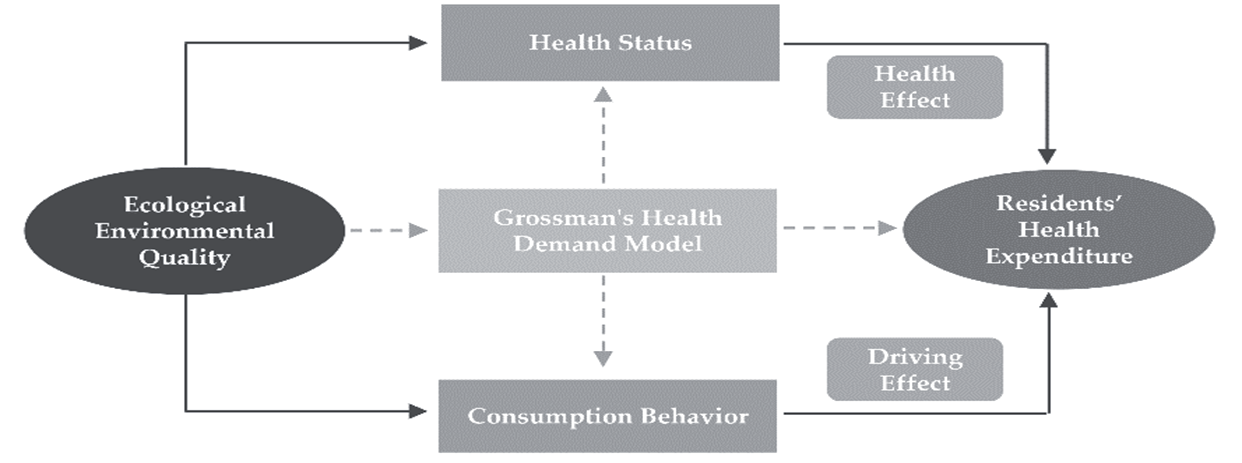
This paper delves extensively into the channels through which ecological environmental quality affects residents’ health expenditures. On one hand, ecological environmental quality has health effects [38-40]. Ceteris paribus, as ecological environmental quality worsens, heightened environmental pollution is set to introduce heightened health risks and perils to residents [41]. Research indicates that a decline in environmental quality can lead to an increase in a series of diseases, especially respiratory diseases, cardiovascular and cerebrovascular diseases [42], thereby increasing residents’ health costs. Generally speaking, the decline in environmental quality affects the health status of residents, and since residents’ health expenditure is closely related to their health status, which is the “health effect” of environmental quality. On the other hand, the decrease in environmental quality prompts residents to pay more attention to ecological pollution [43], further influencing consumers’ demand preferences. When the public environmental consciousness awakens, residents will actively participate in activities like healthcare and low-carbon consumption. During the consumption process, they consciously choose high-value eco-friendly or green products and services, consequently diminishing resource consumption and emissions of environmental pollutants. This, in turn, drives an increase in residents’ health expenditure, which is the “driving effect” of environmental quality (health effects and driving effects, refer to Figure 2). Based on the above analysis, this study proposes Hypotheses 2a and 2b.
Hypothesis 2a: Ecological environmental quality affects residents’ health expenditure through the health effects of ecological environment quality.
Hypothesis 2b: Ecological environmental quality affects residents’ health expenditure through the driving effects of ecological environment quality.
Heterogeneous Impact of Environmental Quality on Residents’ Health Expenditure
Economic development varies among regions in China, and their abilities to resist the deterioration of environmental quality also differ [44]. For economically developed regions, residents possess greater employment opportunities and relatively higher levels of actual income. When individuals endowed with the capability and greater disposable income, they are inclined to acquire more advanced and relatively costlier pollution abatement equipment, like air purifiers, to alleviate the influence of ecological environment pollution. Additionally, regions with elevated economic development inherently harbor higher health expenditure costs, and residents with higher income levels are less sensitive to health expenditures [45]. Therefore, this paper estimates that a decline in ecological environmental quality will not significantly affect the health expenditure in economically developed areas. However, for less economically developed regions, when the ecological environmental quality declines, residents, in order to maintain higher health human capital health, are more likely to increase their health costs. This aligns with the logic that economically underdeveloped areas are prone to the “environment-health-poverty trap” [44]. Additionally, regional disparities in the emphasis on ecological environmental quality can influence residents’ health expenditure levels [43]. Enhancing environmental stewardship is vital to achieving synergistic growth between the environment and economy, in line with the “Porter Hypothesis.” Compared to the central government, local governments are better acquainted with the environmental characteristics and pollution types within their jurisdictions, enabling them to formulate governance decisions that are better suited to practical needs. However, this also depends on how much emphasis the local government places on ecological environmental issues. The higher degree of emphasis local governments assign to environmental pollution control, the larger the allocation of resources for enhancing regional environmental resources. The greater the efforts in environmental governance, the better the improvement in environmental quality, resulting in a reduction in residents’ health expenditure. Building upon the aforementioned analysis, the study advances Hypotheses 3a and 3b.
Fig. 1.
Relationship between Ecological Environment Quality and Residents' Health Expenditure. The outer circle highlights the channel by which the environment affects health expenditure, while the inner circle provides the theoretical underpinnings that support these channels. Source: Organized by the author.
Hypothesis 3a: The decline in environmental quality does not have a significant impact on residents’ health expenditure in economically developed areas, but it significantly increase the health expenditure costs of residents in economically underdeveloped areas.
Hypothesis 3b: Compared to regions with a lower emphasis on environmental governance, areas with a higher emphasis on environmental governance can significantly reduce residents’ health expenditure costs.
Research Design
Sample Selection
This analysis employs dynamic panel data from 30 Chinese provinces spanning 2009 to 2019. Data on ecological environmental quality is sourced from the annual “Ecological Environmental Status Bulletin” published by China’s Ministry of Ecology and Environment, in conjunction with the ecological index meticulously assembled by the author. Due to data limitations in certain provinces, the author actively sought ecological index from provinces with missing data through email and by submitting the government’s public application documents (Tibet, Hong Kong, Macau were excluded due to significant data absence). It should be noted that, during the years 2009 to 2014, the provinces across China adhered to the evaluation indicators and calculation methods delineated in the “Ecological Environmental Status Evaluation Technical Specifications (Trial)” (HJ/T 192-2006). In the wake of national amendments to the technical specifications, since 2015, the revised “Ecological Environmental Status Evaluation Technical Specifications” (HJ 192- 2015) has been used as the standard. Although the calculation method of the ecological index of each province after 2015 is different from that of the previous years, the information remains indicative of the region’s ecological environment quality. It’s noteworthy that the “China Health Statistics Yearbook” began publishing health expenditure data in 2009. Considering the significant outbreak of COVID-19 in early 2020, which could distort the causal relationship between ecological environment quality and residents’ health expenditure [46], the chosen sample period for this study is confined to 2009-2019. Health-related data is sourced from the “China Health and Wellness Statistics Yearbook”, while additional data have been procured from the “China Statistical Yearbook” and respective provincial statistical yearbooks.
Model Design
In our effort to investigate the impact of ecological environmental quality on residents’ health expenditures, this study designates health expenditure as the dependent variable, with ecological environmental quality serving as the independent variable. However, because health expenditure is difficult to meet the strict exogenous requirements, the individual effect makes the dynamic panel model inherently endogenous [47]. Consequently, in order to tackle the endogenous problem, this study harnesses the SYS-GMM empirical approach [48], adding the health expenditure of the previous period to the control variable hexi,t-1. The foundational configuration of the model is articulated as follows:
In the above equation, i represents the province, while t delineates the specific year. The hexit represents the level of health expenditure in region i during period t. The ecoit represents the ecological environment quality in region i during period t. Xit represents a series of other control variables affecting residents’ health expenditure. εit represents the random error term. The primary focal point of this model resides in the estimation of the coefficient α2 parameter.
Aiming to illuminate the channels through which environmental quality affects residents’ health expenditures, this research establishes the following mediation model to dissect both the health effect and driving effect behind ecological environmental quality.
In Equation (2) and Equation (3), Zit represents two mediator variables that affect residents’ health expenditure by ecological environment quality, namely, the number of residents’ medical visits (mev) [49] and the Baidu Index of environmental concern (eindex) [50]. In this study, we use the number of medical visits as a proxy variable of health effect, while the Baidu index of environmental concern serves as the proxy variable of driving effect. Other variables have the same meanings as model (1). We focus on the estimated parameters of coefficients γ1 and δ2.
Variable Selection
(1) Dependent Variable. In this study, residents’ health expenditure is taken as the dependent variable (hex). Some scholars regard hospitalization cost as a proxy variable of health expenditure [51], while this paper uses per capita health expenditure data [52]. Since China only publishes health expenditure at the provincial level, this study calculates the per capita health expenditure using a weighted average of the health expenditures of urban and rural residents. The respective proportions of the urban and rural populations serve as the weights.
(2) Independent Variable. The core explanatory variable was ecological environmental quality (eco). In the current scholarly landscape, environmental pollution metrics predominantly pivot around singular indices – encompassing the likes of PM concentration, SO2emissions, or metrics rooted in industrial effluents and particulate emissions, while some scholars also use a multi-index system to assess ecological environment quality [53]. This analysis opts for the Ecological Index as the pivotal gauge in assessing the measurement indicator of ecological environmental health [54].
The Ecological Environment Index, denoted as EI, integrates multiple facets of a region’s ecological and environmental conditions. It incorporates five primary determinants: the Biological Abundance Index (BAI), Vegetative Coverage Index (VCI), Water Network Density Index (WNDI), Land Degradation Index (LDI), and Pollutant Burden Index (PBI). An auxiliary variable, the Environmental Constriction Index (ECI), further refines the insights of these metrics. These indices jointly elucidate regional biodiversity, vegetative cover distribution, water resource availability, land degradation severity, and pollution burden. Notably, the calculation of EI utilizes a weighted approach:
(3) Control Variables. Several determinants influence the health expenditure patterns of residents. Drawing from pertinent literature, this study incorporates the following salient control variables:
First, population aging process (agp). Aging Demographics (agp): The old-age dependency ratio serves as the chosen indicator. As the population skews older, prevalent ailments like lung diseases and hypertension become more commonplace. Addressing these health concerns amplifies labor costs, consequently elevating health expenditure [55]. Second, education attainment (edu). The study employs the mean educational years of residents per province as the metric. It’s calculated as: average years of education = (illiteracy count×1+primary education count×6+junior high count×9+high school or secondary count×12+college or higher count×16)/population aged over 6. A rise in educational standards not only augments residents’ income but those with elevated income levels also tend to allocate more towards healthcare. Furthermore, better education fosters heightened health-consciousness, prompting greater resource allocation towards health [56]. Third, economic growth (GDP). The logarithm of per capita GDP is harnessed as the evaluative metric. Economically prospering regions typically feature enhanced medical facilities, which indirectly influences residents’ health outcomes [31, 57]. Fourth, government intervention (gov). For empirical assessment, the proportion of the general public budgetary expenditure relative to GDP is utilized. The governmental prioritization towards public health notably affects the residents’ healthcare spending [47]. Fifth, external economic engagement (ope). This research leverages the GDP-relative proportion of the aggregate import-export volume for quantitative scrutiny. Amplified external economic assimilation translates to heightened economic production dynamics, which subsequently catalyzes a crescendo in residents’ health-related outlays [58]. Table 1 provides a descriptive breakdown of each variable.
Table 2.
The Impact of Environmental Quality on Residents' Health Expenditure.
Results and Discussion
Baseline Regression Results
Table 2 presents the basic regression results examining the impact of ecological environment quality on residents’ health expenditures. Alongside the SYS-GMM model’s estimations, we also include regression outcomes from the OLS and fixed effect (FE) models. Column (1) of Table 2, displaying OLS regression, indicates that an enhancement in ecological environment quality corresponds to a reduction in residents’ health expenditure. At the same time, in light of effect factors encompassing geography, politics, and historical nuances, Chinese provinces manifest pronounced individual heterogeneities, and these individual fixed effects might influence the ecological environment, so we use the two-way fixed effects model in column (2). After further controlling the individual fixed effect, the negative impact of ecological environment quality on residents’ health expenditure was further enhanced. However, since the ecological environment quality includes the impact of the residents’ health expenditure delayed by a period, there are some errors in the above estimates. Consequently, this investigation harnesses the SYS-GMM model as the benchmark model. And the regression outcomes are displayed in column (3) of Table 2. Since the Hansen statistic of the overidentification test is non-significant, thereby attesting to the validity of the selected instrumental variables. Following this, the AR (2) test accepts the null hypothesis, suggesting the absence of autocorrelation in the disturbance term. This underscores the reasonableness of our estimation methods.
The regression outcomes derived from the SYS-GMM model highlight the significant negative repercussions of ecological environment quality on residents’ health expenditures, which is also consistent with the relevant results of Narayan et al. [25, 59]. On the one hand, the degradation of environmental quality stands as a cardinal etiological factor for diverse ailments. The decline of ecological environment quality will greatly reduce labor productivity [60]. In a bid to sustain healthy human capital, individuals invariably escalate their health spending. On the other hand, environment pollution will increase infant mortality. Since infants are the main drivers of economic growth in the future, their untimely demises can accentuate the distortion of the demographic fabric, amplifying the challenges of an aging populace. As the elderly demographic swells in proportion within the population structure, it invariably propels an upsurge in residents’ health outlays. In conclusion, hypothesis 1 is confirmed.
Table 3.
Health Effects of Environmental Quality.
Channel Analysis of Environmental Quality Affecting Residents’ Health Expenditure
The Channel of Health Effect
Table 3 provides a detailed exposition on how ecological environmental quality, through the health effect, influences residents’ health expenditure. Within the scope of this study, we employ the number of medical visits as a proxy, capturing the dynamics of residents’ health status [49]. Delving into the regression outcomes, it emerges distinctly that the ecological environmental quality and medical visits share a pronounced negative association, and there’s a notable positive correlation between medical visits and residents’ health expenditure. Such findings intimate that deteriorations in the ecological environmental quality invariably precipitate a surge in the frequency of residents’ medical visits, which escalates the overarching health expenditure. This is because environmental pollution is the main cause of various chronic diseases (such as lung maladies), in the quest to mitigate the health adversities spawned by an attenuating environmental quality and to maintain their health capital or endowments, individuals must to amplify expenditures geared towards addressing pollution-affiliated maladies (as corroborated by extant literature). In light of these elucidations, the hypothesis 2a, stands robustly corroborated.
The Channel of Driving Effect
Table 4 illustrates how environmental quality influences residents’ health expenditure via the driving effect of public behavior. This research exploits the magnitude of public attention to environmental issues, as measured by the Baidu search index, is used as a proxy variable for the behavioral driving effect [61]. The justification for this choice is manifold: on the one hand, being the preeminent Chinese search engine, Baidu, given its expansive reach and robust data availability, can adeptly analyze regional disparities in China based on search frequency and geographic statistics. On the other hand, the term “green” can not only encapsulates residents’ proclivities and actionable intent regarding environmental amelioration, thereby shedding light on potential endeavors to enhance their ambient living conditions and holistic health. Consequently, the research posits the Baidu Search Index (eindex), which searches for “green” keywords on PC and mobile terminals, as the proxy variable driven by residents’ behavior. Regression outcomes robustly attest to a pronounced inverse correlation between ecological environment quality and the public’s environmental concern, while a pronounced positive correlation exists between environmental awareness and health expenditure. That is, the worse quality of the ecological environment, the residents’ environment attention will be significantly increased, and thus increases residents’ health expenditure. This may be due to an augmented public consciousness in environmental degradation, nudging consumers towards high-value green health commodities. This shift augments the appetite for green health-centric products, ultimately inflating the residents’ health costs [62]. Cumulatively, these insights affirm the veracity of hypothesis 2b.
Table 4.
Driving Effects of Environmental Quality.
Heterogeneity Analysis
Heterogeneity of Economic Development Level
To scrutinize the potential variances in the influence of ecological environmental quality on residents’ healthcare expenditure between economically developed regions and undeveloped regions, we classified provinces whose residents’ income surpasses the median as economically developed regions, and the remaining provinces are delineated as economically undeveloped regions [63].
Columns (1) and (2) in Table 5 show that, although the effect of ecological environmental quality on the health expenditures of residents in economically advanced regions is negligible, a significant negative correlation is observed with the health outlays of denizens in economically undeveloped areas. This may be because residents of economically developed areas have higher real incomes relative to their standard of living, so they tend to pursue higher levels of happiness and spend more on health care. At the same time, residents in economically developed areas are relatively insensitive to changes in health expenditure due to their small elasticity of health income [64]. Contrastingly, in economically undeveloped regions, any deterioration in environmental caliber markedly escalates the residents’ healthcare costs. On the one hand, the declination in environmental quality not only diminishes individual utility, but also compels individuals to redirect resources, originally intended for alternative tangible capital ventures, towards mitigating ailments induced by environmental contaminants. This reallocation consequently incurs heightened healthcare costs. On the other hand, residents in economically underdeveloped areas have relative lower income and higher elasticity of health income, rendering them acutely responsive to health expenditure perturbations, especially when addressing ailments borne out of environmental degradation [65]. In light of these elucidations, hypothesis 3a, stands robustly corroborated.
Table 5.
Heterogeneity Analysis.
Heterogeneity in the Emphasis on Environmental Governance
To discern the potential correlation between environmental quality’s impact on inhabitants’ health-related expenditures and the respective region’s focus on environmental administration, this research utilizes the 2016 elasticity coefficient of environmental pollution governance investment for different regions in China (elasticity coefficient of environmental pollution governance investment = environmental pollution governance investment growth rate /GDP growth rate). Consequently, regions in China have been bifurcated into two categories: those with high emphasis on environmental governance (coefficient values of 1 or above, denoting a growth rate in environmental investment either surpassing or matching the GDP progression) and those with low emphasis on environmental governance (coefficient values below 1, indicating a languid investment growth rate compared to GDP’s rise) [66].
As elucidated in the columns (3) and (4) of Table 5, regions with high emphasis on environmental governance witness a marked diminution in health expenditures as a result of superior ecological quality. In contrast, in regions with a more subdued environmental focus, this influence remains insubstantial. This insinuates that when local administrative bodies amplify their concern towards environmental degradation, there’s a commensurate escalation in the allocation of resources aimed at ameliorating the living environment for its residents. Such endeavors not only enhance the overall well-being of the populace but also curtail the susceptibility to illnesses emanating from environmental contaminants, thereby attenuating associated healthcare outlays [43, 67]. Summing up the findings, the research hypothesis 3b, stands robustly corroborated.
Table 6.
Robustness Test.
An Examination of Robustness and Potential Endogeneity
Probing into the Robustness
In a pursuit to ascertain the robust nature of the regression outcomes, our study diligently embraces a triad of methodologies: a meticulous replacement of the dependent variable, an acute consideration for potentially omitted variables, and a thorough exclusion of influences stemming from other policy paradigms.
(1) Alternate the dependent variable’s metric. Drawing inspiration from the plethora of extant scholarly contributions, our investigation pivots the environmental quality’s evaluative criterion towards the PM2.5 concentration [26]. By channeling the regression through the fixed effects model, the insights derived from column (1) of Table 6 elucidate a significant negative correlation between PM2.5 concentration and the financial outlays residents earmark for health. This intriguing revelation harmoniously aligns with the findings echoed by our baseline regression model.
(2) Delving into the Omitted Variables. Prevailing scholarly discourses illuminate that the nuanced spectrum of green technological innovation across diverse regions profoundly influences the residents’ health cost [59, 68]. In an endeavor to assiduously negate the potential distortions emanating from omitted variables, our study appropriates the volume of green invention patent applications across provinces as a surrogate for the green technological innovation, symbolized as (lnpatent), thereby exercising stringent controls over it. The revelations presented in column (2) of table 6 underscore that, even upon judiciously factoring in the green innovation cadence of individual provinces, the regression coefficient tethered to our independent variable retains significant.
Table 7.
Instrumental Variable Method.
(3) Setting aside the influence of other policies. In the course of assessing the repercussions of environmental quality on the health expenditure of residents, one cannot overlook the potential perturbations from concurrent policies, potentially skewing the evaluative outcomes. Existing research indicates that a unified medical insurance system for urban and rural residents can significantly enhance health demands [47]. While the urban-rural medical insurance policy originated from a pilot program in 2008, its broad-based expansion ensued post the State Council’s promulgation of the “Opinions on Integrating the Basic Medical Insurance System for Urban and Rural Residents” in 2016. Consequently, this paper incorporates a dummy variable pertaining to the fundamental medical insurance policy enveloping urban and rural inhabitants into the model, subsequently undertaking a regression analysis. As delineated in Table 6, column (3), controlling the unified urban-rural medical insurance policy, the regression coefficient associated with the independent variable retains its significance, underscoring the validity of our foundational assertions.
Probing Endogeneity Concerns
(1) Harnessing the SYS-GMM Approach. Grappling with the intrinsic endogeneity dilemmas that envelop our variable of interest, namely health expenditure, our discourse has meticulously sought validation through the SYS-GMM model. The empirical outcomes have been previously delineated and affirmed within the preceding sections of this study.
(2) Instrumental Variable Method. In a meticulous effort to disentangle and rectify biases in our empirical elucidations steered by potential endogeneity, a thermal inversion (characterized as ‘item’) to stand as an instrumental variable for the overarching ecological environmental quality, taking cues from both Fan Xia (2022) and Olivier Deschenes (2020) [26, 39]. A thermal inversion intriguingly encapsulates the scenario wherein atmospheric temperature exhibits an upward trajectory commensurate with elevating altitudes. This particular dynamic unerringly aligns with the twin cardinal tenets of instrumental variables: On the one hand, the existence of thermal inversions makes the cold air below cannot rise and mix with the cleaner warm air above, thus affecting the ecological environment quality and meeting the correlation requirements. On the other hand, a thermal inversion is not directly related to the health expenditure of residents, thus satisfying requirements unrelated to the residual term. Delving into the specific results obtained by the 2SLS method as delineated in Table 7, our primary regression illuminates a decidedly positive and significant coefficient for the instrumental metric, while the F-statistic audaciously surpasses the benchmark of 10, signifying a triumphant traversal through the weak correlation test. In addition, the secondary stage regression phase witnesses a metamorphosis in the absolute coefficient value, yet its directional sign remains in harmonious with the benchmark findings. Synthesizing the entirety of this study, even when weighed against the backdrop of conceivable endogeneity quandaries, our articulated outcomes manifest unwavering robustness.
Conclusions
Research Conclusions
In a review of the content of this study, it is possible to arrive at several vital conclusions. In contrast to prior focus on aspects such as the pricing of medical services and health insurance, this study makes an incisive entry through the lens of ecological environmental quality, deeply investigating its influence on residents’ health expenditure. Through a comprehensive analysis of provincial-level panel data spanning from 2009 to 2019 in China, the results compellingly reveal:
Firstly, a prominent negative correlation exists between the ecological environment quality and residents’ health spending. This outcome serves to accentuate the critical role that the ecological environment plays in shaping the spending patterns related to residents’ health.
Secondly, through a channel analysis, it is evident that the ecological environment’s quality affects residents’ health expenditure predominantly via two separate channels, namely, health effects and driving effects. This insightful finding broadens the theoretical paradigm concerning the interconnection between the environment and health, thereby furnishing additional references for the formulation of pertinent policies.
Thirdly, through an analysis of heterogeneity, the degradation in ecological environment quality seemingly doesn’t markedly influence the health expenditure in economically developed regions, yet it conspicuously elevates the level of health spending in economically undeveloped areas. Simultaneously, in areas prioritizing environmental emphasis, ecological environment quality notably reduces residents’ health expenses, whereas in locales where environmental concern is not as paramount, its influence is notably less significant. This difference elucidates the necessity for the government to tailor policies based on individual regional circumstances, giving due consideration to both the diverse stages of economic growth and the varying degrees of emphasis on the environment across different regions.

