

Introduction
Benefiting from the dividends of reform and opening up, China’s economy has experienced rapid growth. However, this swift progress has also given rise to environmental issues. In the 2022 World Environmental Performance Ranking, China holds the 160th position out of 180 countries and regions, signaling a grim state of environmental pollution in the country. Frequent environmental pollution incidents have not only resulted in substantial property losses but have also profoundly affected residents’ overall well-being [1]. According to a report on the state of the environment and the attainment of environmental protection goals for 2022, nearly one-third of the nation’s cities suffer from substandard air quality, leading to increased healthcare expenses and reduced work productivity. Furthermore, as per a study by the World Health Organization, approximately 2 million people in China die each year due to air pollution. To effectively mitigate the environmental pollution problem and promote a green economy and sustainable development, the 2022 report of the 20th Party Congress highlighted the need to vigorously advance environmental pollution prevention and treatment. This approach is recognized as a vital component of Chinese-style modernization, with a specific focus on environmental pollution control.
In light of the current challenges posed by inadequate kinetic energy for domestic economic operations and the conversion of both old and new kinetic energy sources, driven by environmental pollution, China has consistently championed the advancement of the digital economy. Notably, the National Development and Reform Commission implemented the “Broadband China” pilot policy in three phases across 120 cities (clusters) in 2014, 2015, and 2016. The objective is to stimulate explosive growth in the digital economy by enhancing the scale of broadband subscribers, the speed of network coverage, and other levels of infrastructure construction. Presently, China’s digital economy holds the second position globally [2]. Emerging technologies, such as the Internet and big data, have become deeply integrated with traditional industries. The value-added ratios of high-tech manufacturing and equipment manufacturing stand at 15.1% and 32.4%, respectively. These figures have increased by 5.7 and 4.2 percentage points compared to 2012, indicating that “Made in China” is gradually transitioning to “Made in China”. Given this context, several questions warrant exploration: Can the “Broadband China” pilot policy enhance the level of environmental pollution control? If this impact is confirmed, by what mechanism does the “Broadband China” pilot policy bring about its influence on environmental pollution management? Do these effects vary across different location choices, city sizes, and levels of urbanization? Providing answers to these questions holds significant theoretical and practical importance in promoting the “Broadband China” pilot policy and enhancing environmental pollution management in China.
The “Broadband China” pilot policy aims to enhance network facilities in pilot cities to effectively promote the development of the digital economy. The digital economy encompasses a range of economic activities in which digitized knowledge and information serve as key production factors, with modern information networks playing a pivotal role. The utilization of ICTs to improve efficiency is also a central aspect of the digital economy, an area regarded as a strategic cornerstone of the new economic paradigm [3]. While the role and accomplishments of the digital economy in China’s economic and social development have steadily grown, environmental pollution management has also emerged as a priority in guiding China’s high-quality economic development. Surprisingly, no study has empirically assessed the impact of the digital economy on the level of environmental pollution management thus far. Various scholars have investigated the influencing factors of environmental pollution from different perspectives. Notably, financial agglomeration [4], FDI [5], environmental regulation [6], and urbanization [7] emerge as significant factors influencing environmental pollution. On another front, scholars have explored the implications of the digital economy, with the majority of studies analyzing the economic welfare derived from its development. These analyses often focus on enhancing economic efficiency [8], alleviating market pressure [9], and promoting industrial upgrading [10]. Fewer studies have delved into the realm of environmental pollution control, which falls under the domain of social welfare. With this in mind, this study empirically evaluates the impact of the digital economy on the level of urban environmental pollution management and its underlying mechanisms. This assessment is based on panel data from 286 cities at the prefectural level and above in China, spanning from 2010 to 2020. We utilize the implementation of the “Broadband China” pilot policy as a quasi-natural experiment and employ the double-difference method to uncover these mechanisms.
The possible contributions of this study are mainly reflected in the following three aspects; First, it enriches and broadens research on the factors influencing the control of environmental pollution. The ascent of the digital economy not only positively impacts economic development but, more crucially, offers a novel opportunity to mitigate environmental pollution. By leveraging digital technology and innovative approaches, the environmental situation can be effectively ameliorated, presenting fresh ideas to achieve the goal of sustainable development [9]. Second, this study delves into the mechanics of the Broadband China pilot policy by theoretically and empirically exploring the relationship between the policy and the management of environmental pollution. Through heterogeneity analysis, it aims to dissect the internal logical relationship between the two, offering insights to better comprehend the impact of the digital economy on environmental governance. Third, this study introduces innovation level and industrial structure upgrading as mediating variables and validates the influence mechanism of the digital economy on the management of environmental pollution using the mediating effect model. By delving deeper into the intrinsic workings of the digital economy, it further illuminates its pathway to realizing environmental governance by fostering innovation and facilitating industrial structure upgrading [11], offering fresh perspectives and theoretical underpinning for related research fields.
The remaining sections are structured as follows: The second section analyzes the theoretical mechanisms of broadband Chinese pilot policies on the level of environmental pollution control; the third section presents the research design and data description; the fourth section presents the empirical results, including the benchmark regression, the parallel trend test, and the endogeneity and robustness tests; the fifth section presents the analysis of the mechanisms; the sixth section analyzes the heterogeneity; and the last section presents the conclusions of the study and the policy recommendations.
Policy Background and Research Hypotheses
Policy Background
Serving as a crucial pillar for the establishment of a national “information highway,” the development level of broadband networks has evolved into a pivotal gauge of a country’s Information and Communication Technology development. It stands as a key factor in enabling countries to actively participate in global economic, scientific, technological, and industrial competition. Over recent years, many industrialized nations have prioritized the development of broadband networks, considering it a strategic focus for deployment, leading to the active promotion of national broadband plans [12]. In 2013, the State Council issued the “Broadband China Strategy and Implementation Plan.” Subsequently, in 2014, the General Office of the Ministry of Industry and Information Technology and the General Office of the Development and Reform Commission released the “Guidelines on Creating a Broadband Network.” Further reinforcing this strategy at the city level, the General Office of the Ministry of Industry and Information Technology, along with the General Office of the Development and Reform Commission, issued the Circular on the Establishment of “Broadband China” Demonstration Cities (City Groups) in 2014. “Broadband China” is a strategic initiative devised by the Chinese government to propel the development of informatization and the digital economy. This plan is designed to enhance Internet speed and penetration by fortifying the construction of broadband networks to meet escalating digital demands. Up to 2019, the Chinese government has greenlit three batches, comprising 120 “Broadband China” demonstration clusters (city clusters) in 2014, 2015, and 2016. The Broadband China pilot policy plays a crucial role in supporting the digital economy by fostering the expansion of broadband network infrastructure.
Theoretical Analysis and Research Hypotheses
Impact of the Digital Economy on the Level of Environmental Pollution Management
The digital economy, which catalyzes social change and evolution, revolves around digital technology as a propellant for comprehensive economic and social transformation. It achieves this through innovation, the valuation of data, enhanced connectivity, and structural upgrading [13]. The high technology, high integration, and high potential characteristics of the digital economy make it play a central role in environmental pollution management. Specifically, after being selected as a pilot city of “Broadband China”, the impact of the digital economy on environmental pollution management is mainly reflected in the following aspects: the development of the digital economy realizes intelligent management and intelligent transportation through the Internet of Things technology, reduces the waste of resources and energy consumption, and then reduces the emission of environmental pollutants [14]. Relevant studies have shown that the application of ICT can improve production efficiency and reduce the intensity of energy consumption, thus promoting carbon emission reduction [15]. In addition, the development of Internet technology can significantly reduce environmental pollution in local and neighboring areas [16]. Secondly, the promotion of the digital economy has led to the digital transformation of various fields, which can effectively reduce the environmental burden by reducing the waste of energy and raw materials through data analytics and intelligent management. Enterprises can integrate information into the production process with the support of the digital economy to improve production efficiency and provide substantial support for environmental pollution management [17]. Third, the development of the digital economy also provides more convenient channels for social participation and supervision of environmental governance. Through channels such as social media and online platforms, the public can participate more directly in environmental protection affairs, monitor emissions from pollution sources, and push enterprises to produce and operate more responsibly [18]. Therefore, the development of the digital economy helps to improve environmental pollution management, which in turn promotes economic development to meet the needs of the times. Based on these findings, this study proposes the following hypotheses:
H1: The digital economy can improve environmental pollution management.
Mediating Mechanisms of the Digital Economy Affecting the Level of Environmental Pollution Management
Firstly, the digital economy can enhance the innovation capacity of pilot cities, consequently improving their ability to manage environmental pollution. As a new type of economic form originating from technological innovation, the digital economy regards digitized knowledge and information as key production factors. Technological innovation is not only an intrinsic driving force of the digital economy, but also a key enabler of its continuous evolution [19]. On the one hand, technological innovation in the digital economy stems from continuous breakthroughs in electronic devices and communication networks, which provide cities with more advanced environmental pollution monitoring, prediction, and management systems. Through intelligent monitoring, pollution sources can be accurately monitored and responded to promptly, thus reducing the harm of environmental pollution to the ecosystem. On the other hand, the digital economy has accelerated the speed and breadth of knowledge dissemination with the help of extensive information communication channels. This increase in the efficiency of knowledge dissemination helps to enrich the knowledge base of the entire economy at the macro level, thus actively promoting the vigorous development of technological innovation. So, can promoting the development of the digital economy and harnessing its latent innovation potential become another crucial factor in enhancing China’s management of environmental pollution? Undoubtedly, the answer is yes. First, with the rapid progress of information technology, the establishment of various types of intelligent monitoring, prediction, and management systems has become possible, realizing accurate monitoring and timely response to pollution sources, thus effectively reducing the harm of environmental pollution to the ecosystem [20]. Secondly, the digital economy provides a brand new way for the development and utilization of clean energy and reduces the dependence on traditional highly polluting energy sources, thus reducing pollution emissions in the environment, including the atmosphere and water bodies. The application of clean energy is promoted in the process of digital transformation [21], which provides a viable way to reduce the negative environmental impact of the overall energy industry. Based on this, this study proposes the following hypotheses:
H2: The digital economy can improve regional innovation capacity, affecting the level of environmental pollution management.
Secondly, the digital economy can facilitate the industrial structure upgrade in pilot cities, enhancing their environmental pollution management capacity. Industrial structure upgrading is an orderly evolutionary process, the core of which lies in promoting the transformation from low value-added to high value-added and continuously improving coordination and heightening [22]. This transformation is essentially a shift from administrative to market-based factor market guarantee mechanisms, aiming at the optimal allocation and effective utilization of inter-industry factors of production [23]. The rise of the digital economy provides a strong impetus for this upgrade. By strengthening the degree of association between factors, the digital economy provides a good institutional mechanism environment for the free flow of factors [24], which helps to optimize the structure of resource allocation, improve the level of inter-industry coordination and association, and promote the rationalization of the overall industrial structure. Secondly, the development of the digital economy can also accelerate the informatization and intelligence of productivity levels, break the boundaries of the traditional factor market, and accelerate the pace of factor marketization reform, thus driving the transformation and upgrading of industrial structure [13]. Emerging technologies, such as the industrial internet and big data, are regarded as important driving forces. The use of these technologies allows the traditional manual and empirical control mode to be transformed into standardized and precise control, which improves production efficiency and achieves the goals of improving quality and efficiency, energy savings, and pollution control [25]. The high-efficiency data transmission and processing capacity brought by the digital economy means faster response speeds and shorter control intervals, which provides strong support for the optimization and enhancement of industrial structures. The digital economy creates favorable conditions for upgrading the industrial structure of the pilot cities by strengthening the degree of interconnection of elements inside and outside the industry and promoting the upgrading of productivity levels. Based on this, the following hypotheses are proposed in this study:
H3: The digital economy can influence the level of environmental pollution management through industrial structure upgrading.
Research Design and Data Description
Multi-Period DID Model Construction
The “Broadband China” pilot policy, initiated in 2014, represents a policy shock that is external to environmental pollution governance. Given that the expansion of pilot cities under the “Broadband China” pilot policy is occurring incrementally, for a rigorous assessment of the policy’s impact on environmental pollution governance, we adopt a methodology inspired by [26]. Specifically, we employ the asymptotic double-difference method to isolate the causal effect and construct the following model:
Where i denotes city and t denotes year, Govit is an explanatory variable that represents the level of environmental pollution control at the city level. Didit is a treatment dummy variable that takes the value of 1 if city i is selected as a “Broadband China” pilot city in year t, and 0 if it is not. Xit is a set of control variables. νi is a city-fixed effect, μt is a year-fixed effect, and εit is a random error term. α1 is the core coefficient of interest in this study, which measures the average difference in the level of environmental pollution control before and after the Broadband China pilot policy shock.
Variable Settings and Data Sources
Data Sources
Based on the completeness and availability of data, this study ultimately examines 286 prefecture-level and higher cities spanning the period from 2010 to 2020. The data sources include the China Urban Statistical Yearbook, provincial statistical yearbooks, city statistical bulletins, and the EPS database.
Variable Settings
1. Dependent Variable: Environmental Pollution Governance Level (Gov). The index of environmental pollution governance level is calculated by the entropy value method, and an increase in this index indicates that the city has a higher level of environmental pollution governance. In this study, the level of local environmental pollution governance is divided into two subsystems, namely, ecological environmental pollution and ecological environmental governance. The specific indexes include (1) Ecological Environment Pollution: This category includes three indicators - industrial wastewater emissions, industrial sulfur dioxide emissions, and industrial soot emissions - chosen to assess pollutant emissions. (2) Ecological Environment Governance: This category encompasses four indicators - greening coverage rate of built-up areas, comprehensive utilization rate of industrial solid waste, domestic sewage treatment rate, and harmless treatment rate of domestic garbage - selected to reflect the positive societal response to ecological degradation and environmental pollution.
2. Core Explanatory Variable. The primary explanatory variable is a dummy variable representing the status of being a “Broadband China” pilot city. This variable takes the value of 1 if a city was designated as a “Broadband China” pilot city in a given year and beyond, and 0 if it was not selected. As of 2019, there have been three rounds of “Broadband China” demonstration cities. The list of these demonstration cities is sourced from China’s Ministry of Industry and Information Technology’s official website. It is important to note that in the sample used for this study, certain demonstration cities have been excluded due to either missing data or administrative-level inconsistencies. For instance, cities like Yanbian Korean Autonomous Prefecture, Alar City, Linzhi City, Yongcheng City, etc., have been omitted. Consequently, the final dataset consists of 108 demonstration city samples and 178 non-demonstration city samples.
3. Mediating variables. (1) Innovation Ability (Innov). In this study, the urban innovation level primarily refers to the city’s technological innovation prowess. Two main types of indicators are used to gauge the level of technological innovation: technological innovation input and technological innovation output. However, the process from innovation input to innovation output is intricate, with a high risk and failure rate, often resulting in a low innovation input-output ratio or even a non-positive output relationship. Consequently, measuring innovation input may overestimate the urban innovation level. Conversely, innovation output can provide a more direct and objective measurement of the urban innovation level. Patents, serving as the ultimate manifestation of knowledge production and innovation, are the most widely accepted indicator for evaluating urban innovation output [27]. Therefore, in this study, we employ the number of granted patent applications as a metric to assess the city’s innovation level. (2) Industrial Structure Upgrading (Isu). Industrial structure upgrading signifies changes in industry and improvements in efficiency. To precisely reflect the research objectives of this study and the essence of industrial structure upgrading, we draw from the work of [11] and construct an industrial structure upgrading index to measure the degree of industrial structure upgrading. The specific formula for measuring this index is as follows:
Where Ii indicates the ratio of the output value of industry i to the total output value. Generally speaking, this index mainly reflects the upgrading relationship among the three types of industries, and the larger the value of Isu, the higher the level of industrial structure development, which also means that the industrial structure of the region is more advanced.
4. Control Variables. In line with existing studies [28, 29], this study also controls for other variables that influence the level of urban environmental pollution control. (1) The level of economic development (Rgdp), expressed using the per capita gross economic product of each prefecture, was logarithmized. (2) Level of openness to the outside world (Open), which is expressed as the ratio of foreign direct investment to GDP..
(3) Educational attainment (Edu), which is measured by the ratio of undergraduate students per 10,000 people in the city. (4) Fiscal decentralization (Fin), which is measured by the ratio of budgeted revenues to budgeted expenditures. (5) Infrastructure (Infra), the development of infrastructure can reduce transportation time and costs, consequently affecting the emission of environmental pollutants. It is represented by the per capita urban road area. (6) Population density (Popu), using the number of permanent residents per unit area to express the indicator.
Results and Discussion
Parallel Trend Testing
The application of the double-difference method to assess the environmental pollution control level under the “Broadband China” pilot policy relies on the fulfillment of the parallel trend test. This test differs from the conventional approach of comparing the mean values between demonstration cities and non-demonstration cities within a single batch of pilot studies. In this study, the concept introduced by [30] is adapted, and the event analysis method is employed to conduct the parallel trend test. The test model is formulated as follows:
where Di,t0+k is a series of dummy variables measuring the years before and after the “Broadband China” pilot policy. The relative years of the parallel trend test in this study covers three years before and six years after the implementation of the demonstration program, and when k = 0, it means the year when the demonstration city was built. The results of the parallel trend test are shown in Fig. 1, before the implementation of the policy, there was no significant difference between the treatment group and the control group, which satisfies the parallel trend test. And after the implementation of the policy, βk began to rise significantly, and the rise increased over time. This indicates that the broadband China strategy significantly improves the level of environmental pollution control in the demonstration cities, and the effect of the policy gradually increases over time.
Benchmark Regression Results
In this study, a multi-period double-difference model is employed to evaluate the impact of the “Broadband China” pilot policy on the level of environmental pollution control, and the regression results are presented in Table 1. Model 1 provides the estimation results without the inclusion of control variables or fixed effects. Model 2 incorporates city-fixed effects and year-fixed effects. Model 3 introduces city-level control variables. Across all three regression models, the coefficients for the “Broadband China” pilot policy variable are consistently positive and statistically significant at the 10% level. This signifies that the implementation of the “Broadband China” policy has a substantial and statistically significant positive effect on a city’s capacity to manage environmental pollution and promote green, low-carbon development [31]. As previously mentioned, the adoption and promotion of this pilot policy not only provide crucial policy support to pilot cities but also facilitate the enhancement and expansion of broadband network infrastructure. This, in turn, unlocks the digital dividend, improves resource utilization efficiency, fosters energy conservation, and reduces energy consumption. Consequently, it contributes significantly to enhancing a city’s environmental pollution management capabilities.
Endogeneity and Robustness Tests
PSM-DID Test
To address potential sample bias issues arising from the selection of demonstration cities, this study employs the PSM-DID method to further mitigate the potential interference of self-selection in the estimation results. Specifically, the “Broadband China” demonstration cities are treated as the treatment group, while control variables from the baseline model serve as matching indicators. The first-order nearest-neighbor matching method is employed to conduct year-by-year matching within a specified caliper. The matching results demonstrate a reduction in and insignificance of the differences in the mean values of the covariates between the demonstration cities and the non-demonstration cities. As a result, the treatment group becomes balanced and comparable to the control group. The estimated results for the matched samples are presented in column (1) of Table 2. These results indicate that the regression outcomes remain significantly positive, affirming the robustness of the baseline model estimates.
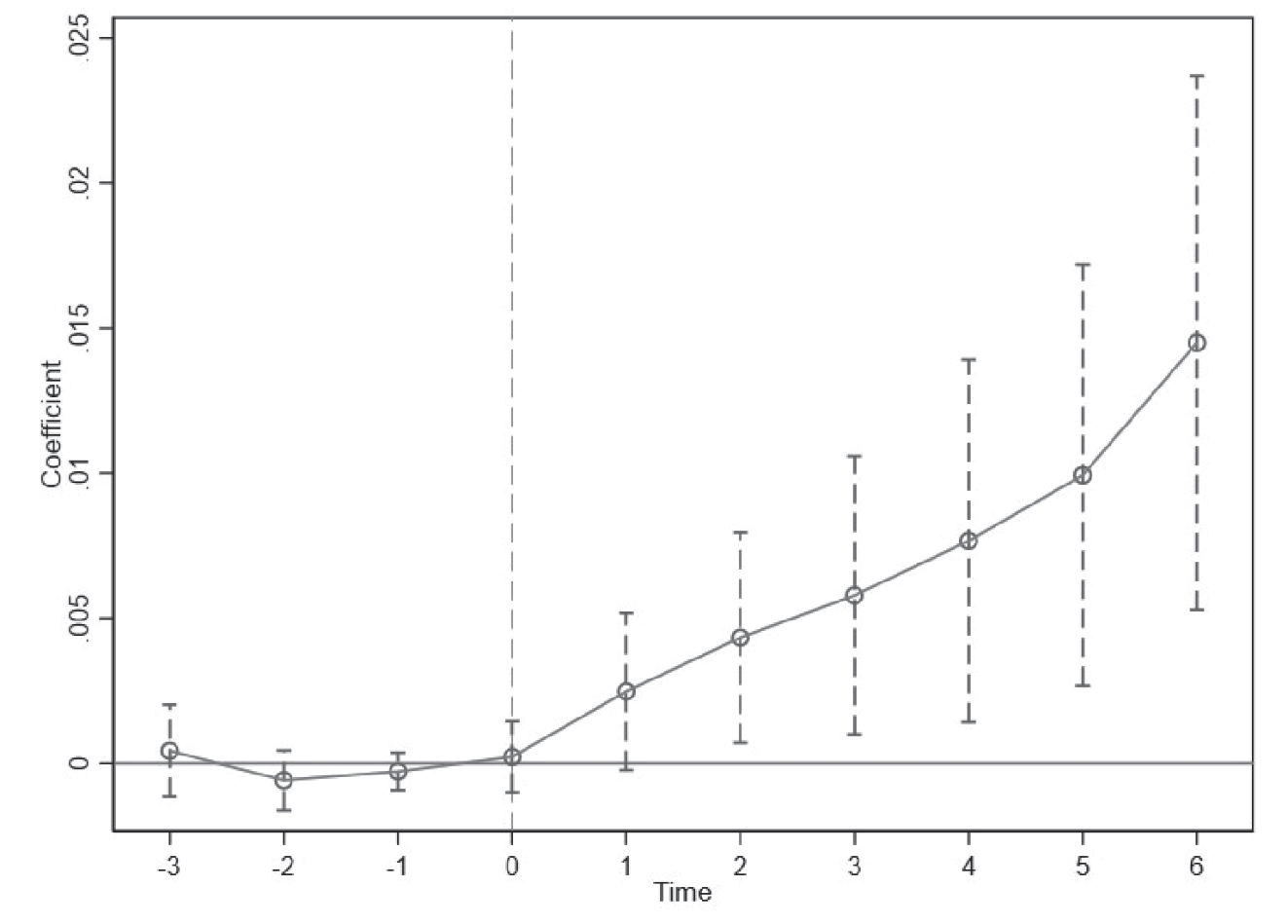
Table 1.
Benchmark regression results.
Table 2.
PSM-DID test and robustness test results.
Placebo Test
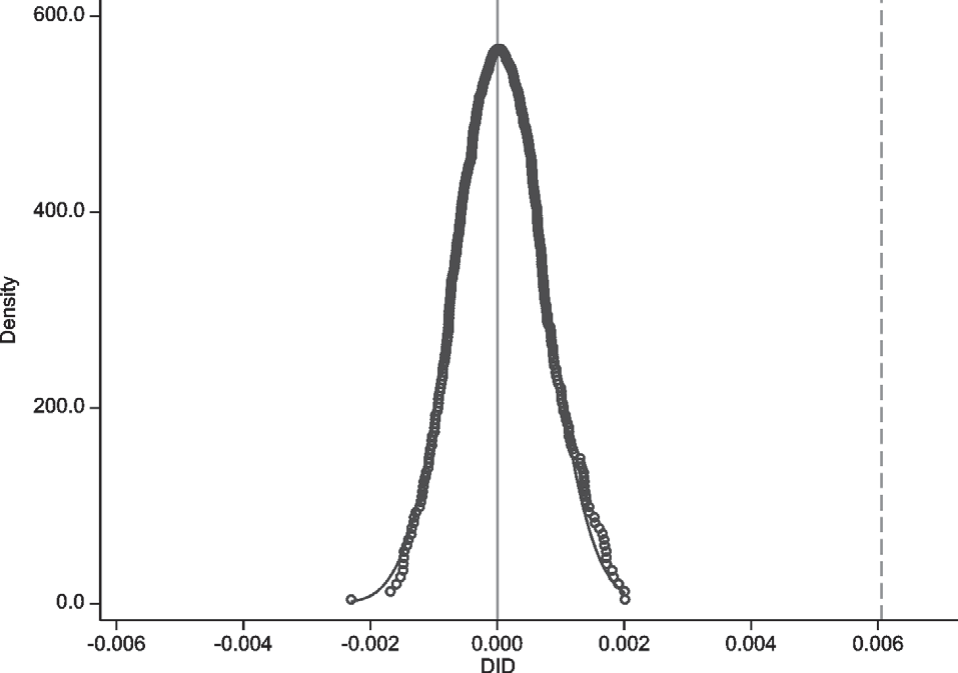
This study draws on existing research to conduct a placebo test, i.e., constructing policy dummy variables by randomly selecting treatment groups in the sample, testing their effects on the outcome variables [32], and repeating the process 1,000 times. Fig. 2 illustrates the distribution of the 1000 estimated coefficients, with the black solid line showing the true policy effect. From the figure, it can be seen that the estimated coefficients obtained from the randomly selected treatment group are all distributed around the zero value and obey the normal distribution, while the true estimated coefficients are located in the tails of this distribution, which is a small probability event. Accordingly, it can be ruled out that the baseline estimates in this study are due to unobservable factors.
Other Robustness Tests
(1) Replacement of Core Explanatory Variables: The study utilizes the Digital Economy Index from Tencent Research Institute as an alternative measure of urban digital economy development. (2) Outlier Elimination: Outliers in the environmental pollution control samples are removed, reducing the tail by 1%. (3) Exclusion of Municipalities: Given the unique administrative status and attributes of municipalities like Beijing, Tianjin, Shanghai, and Chongqing, they have been excluded from the analysis to mitigate their potential influence on the estimation results. (4) Control for Other Policy Interferences: Various policies related to the “Broadband China” strategy and environmental pollution control were implemented during the sample period. To account for this, the study includes dummy variables for representative policies such as the Innovative City Pilot and Smart City Pilot in the baseline model to control for their potential impact. These dummy variables take the value 1 if a city was selected as a pilot city for the respective policy and 0 otherwise. Columns (2)-(5) of Table 2 present the results of these tests, demonstrating that even after the replacement of proxy variables, sample optimization, and control for other policies, the impact of the “Broadband China” pilot policy on the level of environmental pollution governance remains statistically significant.
Mechanism Analysis and Heterogeneity Analysis
Mechanism Analysis
Based on the previous theoretical analysis, to test the mechanism by which the digital economy affects the level of environmental pollution control, this study constructs the following mediation effect model:
Where, mediatorit is the mediating variable. If the coefficients λ1 and η2 are significant at the same time, and η1 become smaller or the significance level decreases compared with β1, it means that the addition of the mediator variable reduces the impact of the pilot policy of “Broadband China”, and the mediator variable plays a partially intermediary role; if η1 is not significant, it means that the mediator variable plays a completely intermediary role in the process of determining the influence of the digital economy on the management of environmental pollution.
Innovation capacity test. As per the theoretical analysis in the previous section, the “Broadband China” pilot policy may impact the level of environmental pollution control by enhancing urban innovation capacity. To validate this mechanism, the number of authorized patent applications is employed as a representation of a city’s innovation level. This is used to investigate the influence of the “Broadband China” pilot policy on environmental pollution control by way of improving innovation levels. The regression results are presented in Table 3. Columns (1)-(2) display the regression outcomes when innovation capacity is considered a mediating variable. The results in column (1) indicate that the “Broadband China” pilot policy significantly stimulates the innovation level of cities. Meanwhile, the combined model in column (2) demonstrates that the augmentation of urban innovation capacity has a substantial positive impact on environmental pollution control. Notably, the coefficient representing the impact of the “Broadband China” pilot policy on environmental pollution control decreases after including the mediator variable. This suggests that innovation capacity plays a partially mediating role in the influence of the “Broadband China” pilot policy on environmental pollution control. Hence, it can be concluded that innovation capacity partially mediates the impact of the “Broadband China” pilot policy on environmental pollution governance.
Table 3.
Impact mechanism analysis.
Industrial structure upgrading test. This study also explores the transmission mechanism involving industrial structure upgrading and employs the industrial structure upgrading index to gauge the level of industrial structure transformation. The regression results are displayed in Table 3. Columns (3)-(4) provide the regression outcomes when industrial structure upgrading serves as a mediating variable. The findings indicate that the “Broadband China” pilot policy contributes to the transformation and upgrading of the industrial structure within cities. Moreover, industrial structure upgrading partially mediates the influence of the “Broadband China” pilot policy on the level of environmental pollution control. Thus, the results confirm that the “Broadband China” pilot policy fosters the transformation and upgrading of a city’s industrial structure, and industrial structure upgrading plays a partial intermediary role in the policy’s impact on the level of environmental pollution control.
Heterogeneity Analysis
Given China’s vast size and the resulting disparities in resource endowment, foreign trade, institutional constraints, and industrial structure, regional development differences emerge. Consequently, the impact of the “Broadband China” pilot policy on environmental pollution control exhibits heterogeneity. Building on prior research, the following section investigates whether the influence of the digital economy on environmental pollution governance differs based on location choice, city size, and urbanization level.
Location Choice Heterogeneity
China exhibits pronounced disparities in regional development, stemming from variations in geographical location, natural resource endowments, economic advancement, infrastructure, and population distribution. Consequently, these disparities in city location conditions may result in heterogeneous impacts of the “Broadband China” pilot policy on environmental pollution control. In this study, the sample is categorized into three groups based on the geographic location of the cities: the eastern, central, and western regions. The analysis explores the regional heterogeneity of the “Broadband China” pilot policy on environmental pollution control within these groups. The test results, as displayed in Table 4, reveal that the effects of the “Broadband China” pilot policy on environmental pollution control are statistically significant across all regions. Particularly, the impact is highly significant at the 1% level for eastern cities. This suggests that the establishment of demonstration cities has a more pronounced effect on environmental pollution control in eastern regions. One plausible explanation is that geographical and transportation constraints limit the spread of the digital economy in the central and western regions compared to the eastern region. Consequently, the driving force of the “Broadband China” pilot policy on environmental pollution control is relatively weaker in these areas.
City Size Heterogeneity
The agglomeration effect resulting from the expansion of the city scale can enhance economic efficiency, but it also gives rise to urban issues and environmental pollution challenges. The resource disparities stemming from variations in city scale may impact the implementation of the “Broadband China” pilot policy. To examine the differentiated effects of the policy on environmental pollution management due to variations in city scale, this study utilizes group regression based on city categories derived from the “2022 City Business Attractiveness Ranking”. In this study, first-tier cities, new first-tier cities, and second-tier cities are combined into one category, labeled as the first group of cities. Third-tier cities constitute the second category, and fourth- and fifth-tier cities are combined into the third category. The regression results, presented in Table 5, indicate that the coefficients for the “Broadband China” pilot policy are statistically significant and positive in the first and second groups of cities. However, they are not significant in the third group of cities. This suggests that the impact of the digital economy on environmental pollution management is more pronounced in the first and second groups of cities but less evident in the third group. One plausible explanation is that larger cities exhibit a higher degree of industrial specialization and possess a richer pool of innovation factors, thereby enhancing their ability to stimulate innovation and improve local environmental pollution governance capacity.
Heterogeneity in Urbanization Levels
Urbanization primarily manifests through the concentration of secondary and tertiary industries in cities, coupled with the continuous influx of rural populations into urban areas. This urbanization process may influence the implementation of the “Broadband China” pilot policy. To investigate whether differences in the level of urbanization result in heterogeneous impacts of the digital economy on environmental pollution management, the sample is divided into two groups based on the median urbanization rate of the population. The cities are categorized as either high or low in terms of urbanization level, and group regression is conducted, with the results displayed in Table 6. The regression outcomes reveal that the pilot policy has a significant and positive impact on both types of cities, but its effect is more pronounced in cities with higher urbanization levels. This suggests that a higher level of urbanization provides residents with greater access to network infrastructure and associated benefits, which can create more favorable conditions for the implementation of the “Broadband China” pilot policy. Hence, the impact of the digital economy on environmental pollution management exhibits a certain degree of heterogeneity depending on the level of urbanization.
Table 5.
Heterogeneity in city size.
Conclusions and Policy Recommendations
Building a robust digital economy and addressing environmental pollution are strategic imperatives for China’s high-quality economic development in the new era. This study employs a multi-period DID model based on panel data from 286 prefecture-level and higher cities in China from 2010 to 2020, focusing on the “Broadband China” pilot policy to assess the digital economy’s impact on environmental pollution control. The study further investigates heterogeneous impacts and mechanisms. The study reveals that the Broadband China pilot policy had a substantial and positive impact on the governance of environmental pollution in the examined pilot cities, a conclusion supported by a series of rigorous tests for robustness. Mechanism tests indicate that the pilot policy’s positive influence on the level of environmental pollution governance primarily operates through the levels of innovation and industrial structure upgrading. Both of these mediators play a partially mediating role in this process. Heterogeneity analysis demonstrates that variations in the effects of the Broadband China pilot policy on the level of environmental pollution governance are associated with geographic location, city size, and the level of urbanization. Specifically, in the eastern region, where cities are larger and urbanization rates are higher, the upgrading effect of the Broadband China pilot policy on the level of environmental pollution governance is more pronounced. Conversely, in the central and western regions, characterized by smaller city sizes and lower rates of urbanization, the impact of the Broadband China pilot policy on environmental pollution control is either smaller or statistically insignificant.
Based on the aforementioned findings, the policy implications derived from this study are as follows: First, in light of the ongoing technological and industrial revolution, it is recommended that the government increase its investment in the Internet sector, with a particular emphasis on 5G and big data business applications. Key investment directions include digital infrastructure construction and the expansion of digital application scenarios. This encompasses the network infrastructure, cybersecurity enhancements, and the development of Internet of Things (IoT) technology. Additionally, the government should prioritize the innovation of digital technology across various fields, such as education and healthcare, to enhance efficiency and productivity. The application of digital technology in urban management and environmental protection should be promoted to foster sustainable development. Second, the government should leverage the “technological effect” and “structural effect” of environmental governance. This involves placing a strong emphasis on pollution prevention at the source and moving away from the traditional concept of “pollute first, treat later.” The development of the digital economy can serve as an engine for promoting industrial upgrading and innovation. Through technological innovation, resources can be guided towards high-value-added, low-energy consumption, and high-efficiency enterprises, thereby facilitating the green transformation of businesses. Similarly, the optimization and upgrading of industrial structures are crucial steps. The development of environmentally friendly and sustainable industries can help reduce reliance on high-pollution and high-energy-consumption sectors, ultimately lowering the environmental burden. Third, to enhance the effectiveness of coordinated regional pollution management, the government should establish a robust mechanism for coordinated regional pollution prevention and control. This includes implementing a cross-regional joint prevention and control mechanism for environmental governance, breaking away from the traditional territorial management model. Regional governments should coordinate the development of consistent environmental regulations and policies to ensure the effective addressing of cross-regional environmental problems with clearly defined legal responsibilities and punishment mechanisms. Simultaneously, public participation in environmental governance decision-making should be encouraged to enhance a sense of social co-governance.
This study acknowledges certain limitations that could be addressed in future research. First, there is a need to broaden the scope of empirical sample data. The current focus on Chinese cities provides valuable insights, but future research could enhance its depth by expanding to the micro-level and delving into specific enterprises or industries. Additionally, at the macro level, the study could consider exploring areas such as county-level cities to augment the comprehensiveness and applicability of the research results. Second, the research on intrinsic mechanisms could benefit from further enrichment. While the study has delved into the influence pathways of the research theme from the perspectives of regional innovation and industrial structure upgrading, there may be other mechanism variables that remain undiscovered. Future research might consider exploring the impact of institutional variables, such as the humanistic environment and industrial agglomeration, on the research theme.
This exploration could contribute to enriching the theoretical framework by uncovering additional mechanisms of action.

